
Reports
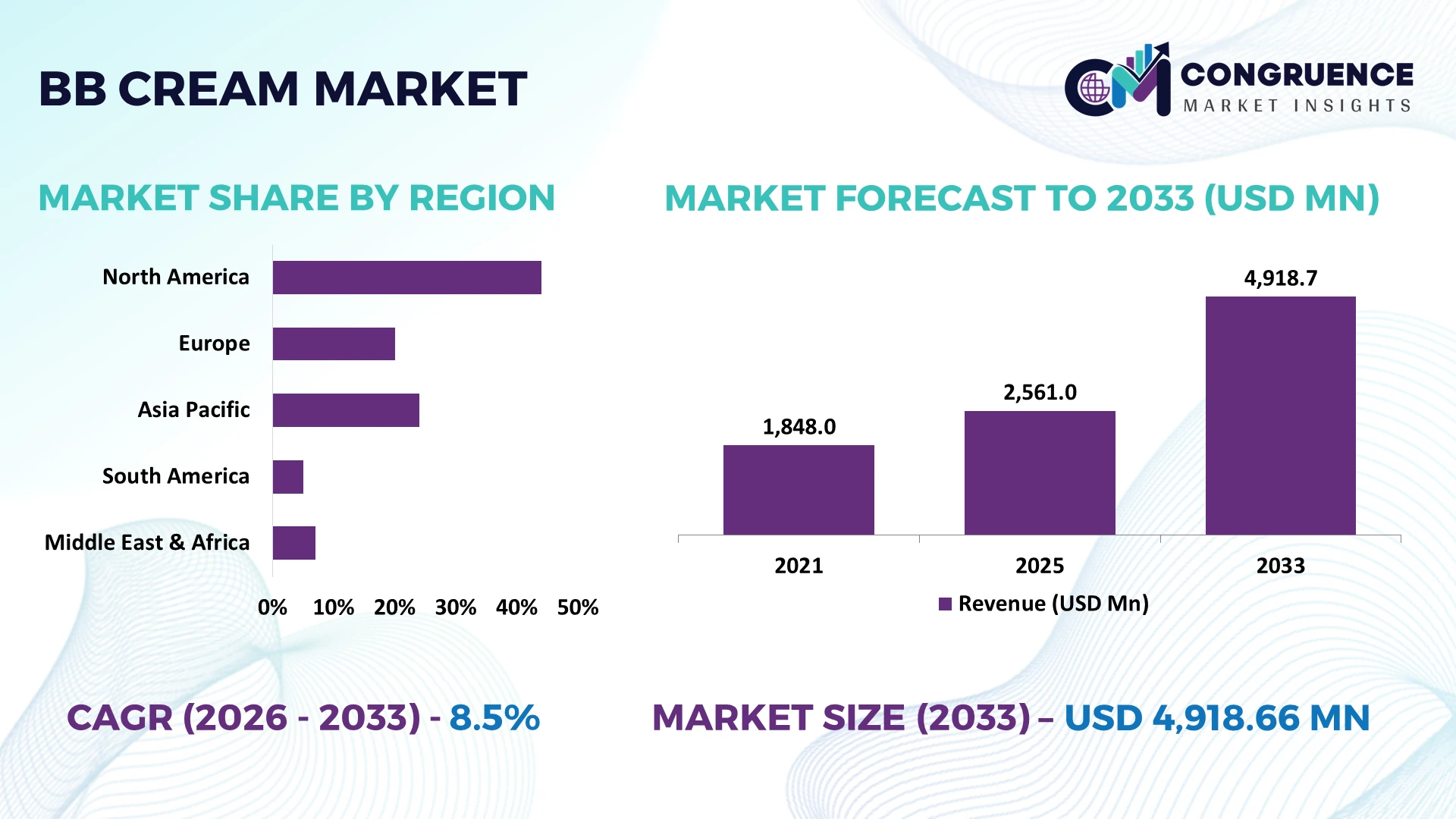
The Global BB Cream Market was valued at USD 2561 Million in 2025 and is anticipated to reach a value of USD 4918.66 Million by 2033 expanding at a CAGR of 8.5% between 2026 and 2033. Growth is being driven by skincare-makeup hybridization, SPF-integrated complexion products, lightweight multi-benefit formulations, and rapid K-beauty penetration through cross-border digital retail.
China represents an estimated 27% of global BB cream consumption, supported by its large color-cosmetics manufacturing base, advanced livestream-commerce ecosystem, and strong adoption of SPF, niacinamide, and barrier-support formulations. South Korea contributes roughly 15% but leads product innovation through cushion-BB formats and personalized shade technology. China’s consumption base is approximately 80% larger than South Korea’s, while ongoing K-beauty export diversification toward the U.S. and Europe is reshaping global sourcing and brand competition.
Brands prioritizing multifunctional formulations, Asian beauty innovation pipelines, and digitally optimized shade portfolios are positioned to capture the strongest global BB cream market opportunities.
Market Size & Growth: USD 2.56 billion in 2025 advances toward USD 4.92 billion by 2033 at 8.5%, driven by skincare-infused complexion products.
Top Growth Drivers: Multifunctional skincare contributes roughly 34% of momentum, SPF integration 27%, and lightweight natural-finish formulations 21%.
Short-Term Forecast: By 2028, advanced formulation and automated filling technologies are expected to reduce production losses approximately 12%.
Emerging Technologies: AI shade matching, microencapsulation, and adaptive pigments are improving personalization, coverage consistency, and skincare-active delivery.
Regional Leaders: Asia-Pacific approaches USD 2.70 billion by 2033, supported by high K-beauty and cushion-format adoption.
North American Position: North America approaches USD 950 million, with hybrid makeup-skincare products gaining traction across digital-first beauty channels.
European Position: Europe approaches USD 860 million, supported by SPF functionality, natural finishes, and sustainability-focused packaging adoption.
Consumer Trends: Approximately 60% of younger complexion-product users increasingly favor products combining hydration, coverage, SPF, and treatment benefits.
Pilot/Case Example: In 2025, AI-powered virtual makeup systems expanded personalized product discovery using facial analysis across millions of digital interactions.
Competitive Landscape: L’Oréal holds an estimated 10% global position, competing with Amorepacific, Estée Lauder, Shiseido, Missha, and LVMH beauty brands.
Innovation & ESG Outlook: Refillable formats, PCR packaging exceeding 50% in selected products, AI personalization, and skin-barrier actives define the next competitive cycle.
BB Cream demand is concentrating around multifunctional complexion care, lightweight coverage, sun protection, hydration, and skin-barrier support. AI-driven shade matching, adaptive pigments, cushion delivery systems, and skincare-active formulations are accelerating product differentiation. More than 50% of category momentum is concentrated in Asia-Pacific, while K-beauty’s expanding U.S. and European distribution is reshaping competitive positioning and setting the stage for strategic market expansion.
BB cream is becoming strategically important as color cosmetics converge with skincare, sun protection, and personalized beauty, forcing brands to compete on formulation performance rather than coverage alone. Roughly 60% of younger beauty consumers now favor multifunctional complexion products, strengthening investment in niacinamide, ceramides, peptides, and mineral/organic UV filters. Digital adoption is also restructuring distribution as virtual try-on, social commerce, and direct-to-consumer channels reduce dependence on physical shade testing.
AI-assisted shade matching provides a measurable advantage over conventional visual selection, reducing shade-selection mismatches by approximately 20–30% in digitally optimized environments while improving conversion efficiency. South Korea leads innovation in cushion-BB, lightweight textures, and skincare-active delivery, whereas China provides greater manufacturing and consumption scale. The U.S. increasingly favors skinification and inclusive shade ranges, creating different formulation and merchandising requirements from Asian markets.
Through 2026–2028, AI personalization, adaptive pigments, refillable packaging, and barrier-support formulas will move deeper into mainstream portfolios. Beauty retailers already deploy virtual facial analysis to recommend complexion shades before purchase, lowering sampling requirements and improving digital engagement. Companies are redirecting R&D toward multifunctionality, expanding cross-border K-beauty distribution, and partnering with technology platforms. Competitive advantage will increasingly depend on combining formulation science, shade intelligence, rapid product iteration, and localized consumer data.
The strongest BB cream market driver is the structural convergence of skincare and makeup, with approximately 60% of younger complexion users showing preference for products delivering multiple functions. SPF-enabled formulations represent roughly 25–30% of premium multifunctional complexion launches, while skincare actives increasingly appear across mass-market products. South Korea remains influential through cushion delivery, fermented ingredients, ceramides, and barrier-focused formulations that migrate rapidly into international portfolios. Rising K-beauty exports have accelerated this technology transfer into the U.S. and European retail channels. The cause-and-effect is clear: consumers reduce multi-step routines, increasing the commercial value of products combining coverage, hydration, UV protection, and treatment. L’Oréal, Amorepacific, Shiseido, and emerging Korean brands are consequently investing in active-infused formulations, localized shades, digital distribution, and faster product-development cycles.
BB creams face structural pressure from increasingly complex formulations combining pigments, UV filters, preservatives, skincare actives, and emulsifiers within one stable product. Reformulation can affect approximately 10–20% of ingredient systems when UV-filter, allergen, or chemical restrictions change, while premium pigments and specialty actives can represent more than 25% of formulation input costs. European cosmetics regulation creates particularly demanding compliance requirements, while differences between EU, U.S., Japanese, and Chinese sunscreen classifications complicate global SKU standardization. This fragmentation raises testing expenditure, extends launch schedules, and limits economies of scale for smaller brands. Companies are reducing exposure by developing market-specific formulations, qualifying multiple ingredient suppliers, simplifying ingredient architectures, and contracting regional manufacturers. The operational priority is formulation modularity: brands capable of changing regulated components without rebuilding entire products preserve launch speed and margin discipline.
Personalized complexion technology creates an underexploited opportunity because BB cream performance depends heavily on shade, undertone, skin condition, climate, and desired coverage. AI-assisted shade recommendation can reduce digital shade mismatches by approximately 20–30%, while virtual try-on can expose consumers to dozens of shades without physical testers. India is particularly attractive as expanding beauty e-commerce intersects with highly diverse undertones, humid-climate formulation requirements, and growing Korean beauty penetration. Between 2026 and 2028, adaptive pigments, AI skin diagnostics, microbiome-compatible ingredients, and climate-responsive textures will increasingly connect digital diagnostics with physical formulations. Brands are investing in proprietary shade datasets, virtual consultation tools, local R&D, and technology partnerships. A non-obvious advantage lies in inventory productivity: better personalization enables companies to identify local shade demand before allocating stock, reducing slow-moving variants while supporting broader inclusive portfolios.
The long-term challenge is translating personalization into scalable manufacturing without creating excessive shade inventories and operational complexity. Expanding a BB cream line from 6 shades to 20–30 shades can multiply forecasting, pigment procurement, batch scheduling, retailer allocation, and inventory requirements even when total category volume remains unchanged. Shade performance also varies with oxidation, SPF systems, undertone, and lighting, making digital-to-physical consistency difficult. This pressure is particularly significant in the U.S. and India, where heterogeneous skin tones make narrow shade architectures commercially restrictive. Companies must combine modular pigment systems, smaller production batches, AI demand forecasting, and regional shade data to maintain availability without increasing obsolete inventory. Successful competitors will treat shade architecture as a supply-chain capability, not merely a marketing feature; solving flexible manufacturing and color consistency becomes essential for sustainable international deployment.
Hybrid Formulas Gain More Actives: BB cream portfolios are shifting toward treatment-led complexion products, with advanced launches increasingly combining 3–5 functions such as tint, hydration, barrier support, priming, and UV protection. Active concentrations around 2–5% niacinamide and stronger ceramide systems are becoming common differentiators. Brands are shortening standalone makeup ranges and reallocating formulation budgets toward clinically positioned hybrids, improving basket consolidation and supporting premiumization without adding additional consumer routine steps.
Lightweight Textures Replace Heavy Coverage: Demand is moving from dense foundation-like BB formulas toward serum, gel, and breathable emulsions delivering approximately 15–25% lower perceived product weight and faster blendability. Korean and Japanese manufacturers are scaling water-rich bases and flexible film-formers, while U.S. brands are reducing occlusive texture profiles. This transition improves warm-climate usability and repeat application, prompting manufacturers to redesign rheology, pigment dispersion, and packaging compatibility.
Packaging Becomes Operationally Smarter: Airless pumps, compact cushions, controlled-dose applicators, and mono-material components are replacing conventional tubes in selected premium lines. Controlled dispensing can lower product overuse by roughly 10–15%, while refillable cushion systems can reduce primary packaging material by 20–40%. European packaging requirements and retailer sustainability targets are accelerating redesign programs, pushing suppliers toward standardized refill mechanisms and higher post-consumer recycled content.
Social Commerce Compresses Launch Cycles: TikTok, livestreaming, and creator-led demonstrations are shortening product discovery cycles, with digitally native launches testing 5–10 shade or finish variants before wider retail deployment. AI-supported content testing can reduce campaign iteration time by approximately 20%. Companies are integrating social listening with demand planning, allowing successful shades and textures to move into replenishment faster while weak variants are discontinued earlier.
Liquid BB Cream leads the type segmentation with an estimated 44% share, supported by scalable filling processes, broad shade adaptability, easy incorporation of humectants and UV filters, and compatibility with both mass and premium distribution. Its mature manufacturing infrastructure also keeps unit economics favorable compared with more specialized dispensing formats. Tinted BB Cream represents roughly 18% as brands simplify complexion routines for consumers seeking sheer coverage, while Matte BB Cream remains strategically important in humid markets such as India, Indonesia, and the Philippines where oil-control performance influences repeat purchase.
Cushion BB Cream is the fastest-growing type, accounting for approximately 20% of category demand as portability, controlled application, and K-beauty merchandising accelerate adoption. Cushion formats are gaining shelf space through refillable compacts and thinner emulsions, while BB Cream Stick remains a smaller but strategically useful segment for travel, targeted coverage, and solid-format convenience. Companies are prioritizing cushion engineering, refill systems, and portable applicators while retaining liquid formulations as the principal volume platform.
Daily Makeup remains the leading application with an estimated 39% share because BB cream directly replaces multiple routine steps through light coverage, moisturization, priming, and complexion correction. Skin Hydration represents approximately 22% as hyaluronic acid, glycerin, ceramides, and barrier-support ingredients become embedded within color formulations. Blemish Coverage remains an established use case, particularly among younger consumers seeking breathable alternatives to full-coverage foundation, while Anti-Aging Care occupies a smaller premium position through peptides, antioxidants, retinoid alternatives, and firming claims.
Sun Protection is the fastest-growing application, approaching an estimated 20% of use-driven demand as SPF-enabled complexion products move deeper into everyday routines. Korean, Japanese, Indian, and Australian consumers increasingly expect UV functionality alongside tint, encouraging brands to engineer photostable filters and lighter textures suitable for reapplication. Companies are expanding SPF-integrated ranges, increasing dermatological testing, and aligning shade development with sunscreen compatibility. Operationally, multifunctional products strengthen shelf productivity because one SKU can compete across makeup, skincare, and sun-care missions.
Individual Consumers dominate BB cream demand with an estimated 72% share, reflecting frequent at-home application, widespread e-commerce availability, and the category’s positioning as a simplified daily complexion solution. Cosmetic Retailers represent approximately 14% of end-user activity because omnichannel chains increasingly combine physical shade testing with digital recommendation and replenishment. Beauty Salons and Makeup Artists remain smaller professional buyers, using BB creams primarily for lightweight base preparation, natural-finish services, bridal looks, and rapid complexion correction rather than high-coverage artistry.
Cosmetic Retailers are the fastest-growing end-user group as AI recommendation, social commerce, virtual try-on, and integrated loyalty data improve shade discovery and conversion. Dermatology Clinics remain niche but strategically relevant for post-procedure, sensitive-skin, and barrier-support formulations where ingredient credibility influences purchasing. Brands are creating retailer-exclusive shades, professional sampling formats, dermatologist-tested variants, and digitally optimized assortments. Competitive investment is consequently shifting toward consumer-data integration and retailer partnerships, where improved recommendation accuracy can reduce shade mismatch and strengthen repeat purchasing without materially expanding physical merchandising space.
Asia-Pacific accounted for the largest market share at approximately 46% in 2025 however, Asia-Pacific is expected to register the fastest growth, expanding at a CAGR of approximately 9.6% between 2026 and 2033.
Skinification and Omnichannel Personalization Reshape Competition
North America accounts for approximately 23% of global BB cream demand, anchored by the United States and its sophisticated prestige, mass, specialty-beauty, and direct-to-consumer channels. Skinification is changing assortment strategy as retailers allocate more complexion space to products combining tint, hydration, barrier support, and sun protection. U.S. prestige makeup sales increased approximately 4% in 2025, reinforcing demand for differentiated complexion formats rather than conventional foundation alone. AI-powered shade recommendation and virtual try-on are increasingly integrated into digital merchandising, improving product discovery without expanding physical tester inventories. Brands are simultaneously widening undertone coverage and introducing lighter serum-like textures. Canadian demand remains more concentrated around hydration, sensitive-skin positioning, and multifunctionality. Operationally, retailers are using loyalty data, digital diagnostics, and localized inventories to improve shade availability and reduce slow-moving SKUs.
United States Market Outlook: The United States provides the region’s strongest commercialization platform through specialty retailers, department stores, marketplaces, brand-owned websites, and beauty technology ecosystems. Prestige makeup expanded approximately 4% in 2025, while AI-enabled consultation now operates at million-interaction scale. Brands are prioritizing inclusive shade architectures, skincare actives, creator-led launches, and retailer-exclusive formulations to strengthen conversion and replenishment efficiency.
Regulation Accelerates Formulation and Packaging Redesign
Europe represents approximately 19% of global BB cream consumption, with Germany, France, the United Kingdom, Italy, and Spain forming the principal commercial base. Competition increasingly revolves around ingredient transparency, UV-filter compliance, dermatological positioning, and packaging sustainability rather than simple coverage claims. EU packaging rules are accelerating movement toward recyclable structures, lower material intensity, and refill-oriented formats, while cosmetics regulation places greater operational emphasis on safety assessment and formulation documentation. Premium manufacturers are consequently rationalizing ingredients and designing packaging platforms that can support multiple complexion products. France retains particular importance through its cosmetics R&D, luxury beauty ecosystem, and international brand infrastructure. Germany provides strong pharmacy and dermocosmetic channels, while the United Kingdom has rapidly adopted digitally discovered skincare-makeup hybrids. This environment favors companies capable of integrating regulatory engineering directly into formulation and packaging development.
France Market Outlook: France combines advanced cosmetics formulation expertise with major luxury and dermocosmetic ecosystems, making it strategically important for premium BB cream development. French manufacturers are increasingly incorporating higher recycled-content packaging, skin-barrier ingredients, and clinically positioned claims. Strong export infrastructure also allows locally developed complexion technologies to move efficiently into European and international distribution networks.
K-Beauty Innovation Meets Chinese Scale
Asia-Pacific commands approximately 46% of global BB cream demand, reflecting the category’s Korean origins, China’s enormous beauty-consumption infrastructure, and established multifunctional cosmetics adoption in Japan. South Korean manufacturers lead cushion technology, lightweight emulsions, barrier-support ingredients, and rapid formulation cycles, while Chinese companies provide substantial contract-manufacturing scale and digitally accelerated commercialization. China represents approximately 27% of global consumption, compared with roughly 15% for South Korea, creating complementary scale and innovation centers. Korean cosmetics exports surpassed the USD 10 billion threshold in 2024, demonstrating the strength of cross-border beauty distribution. Japan contributes through technically sophisticated UV protection and natural-finish formulations, while India is becoming strategically relevant for affordable SPF-integrated and humidity-resistant products. Manufacturers are increasingly combining Korean formulation expertise with localized production, marketplace analytics, and country-specific shade architecture to shorten commercialization cycles.
China Market Outlook: China provides the largest country-level consumption base, representing approximately 27% of worldwide BB cream demand. Its advantage combines extensive cosmetics manufacturing capacity, sophisticated livestream commerce, rapid contract formulation, and dense digital marketplaces. Domestic brands increasingly compete through fast product iteration, localized undertones, active ingredients, and accessible pricing, forcing international companies to shorten development and replenishment cycles.
Digital Beauty Expands Multifunctional Demand
South America represents approximately 7% of global BB cream demand, with Brazil dominating through its extensive cosmetics consumption base, direct-selling networks, pharmacies, beauty specialists, and rapidly developing e-commerce infrastructure. Hot and humid conditions strengthen demand for lightweight, matte, sweat-resistant, and sun-protective formulations rather than heavier complexion products. Brazil accounts for an estimated 55–60% of regional BB cream consumption, while Argentina, Colombia, and Chile provide secondary demand centers. Social commerce and creator-led product discovery are lowering market-entry barriers for international and digitally native brands, although currency volatility, import duties, and distribution costs complicate imported SKU economics. Companies are responding with local manufacturing partnerships, smaller packaging configurations, targeted shade assortments, and localized pricing. Operational advantage increasingly comes from producing closer to demand while retaining international formulation technology and brand positioning.
Brazil Market Outlook: Brazil combines substantial domestic cosmetics manufacturing with one of the world’s most developed beauty-consumption cultures. It contributes an estimated 55–60% of South American BB cream demand. Local production enables brands to manage import exposure while tailoring matte finishes, SPF functionality, pigmentation, and undertones to Brazilian consumers, creating a strong localization advantage over standardized imported portfolios.
Premium Retail and Climate Adaptation Advance
Middle East & Africa accounts for approximately 5% of global BB cream demand, led commercially by the UAE, Saudi Arabia, South Africa, and increasingly digitally connected Gulf markets. Premium beauty retail infrastructure in Dubai, Abu Dhabi, and Riyadh supports international brand deployment, while high UV exposure strengthens the relevance of SPF-integrated complexion products. Saudi Arabia’s retail modernization and expanding beauty e-commerce ecosystem are widening premium product accessibility, whereas the UAE operates as a regional distribution and re-export hub. Formulation requirements are distinct: heat stability, lightweight textures, oil control, pigmentation breadth, and long-wear performance carry greater operational importance. African markets remain fragmented by distribution infrastructure and imported-product costs, encouraging selective rather than uniform expansion. Companies are concentrating inventories in major urban centers, partnering with omnichannel retailers, and adapting formulations and shade portfolios to climate and skin-tone diversity.
United Arab Emirates Market Outlook: The UAE provides the strongest premium commercialization and distribution infrastructure for BB cream across the Gulf. Dubai’s dense concentration of malls, specialty beauty retailers, international tourism, and cross-border logistics supports rapid brand testing. Companies increasingly use the country as a launch platform for SPF-rich, long-wear, premium Korean, Japanese, European, and American complexion products.
L’Oréal, Shiseido, Amorepacific, Estée Lauder, LVMH and regional K-beauty specialists compete across premium, masstige and digitally native BB cream positioning. The top five groups collectively control approximately 38% of category sales, leaving meaningful space for Korean and local challengers. Global leaders compete through distribution scale, dermatological research and brand portfolios, while Asian specialists emphasize cushion technology, rapid formulation and skincare integration. Premium formulations command roughly 20–30% pricing premiums, whereas digital-first launches can shorten commercialization cycles by approximately 20%. Players are expanding SPF-enabled ranges, partnering with beauty-tech platforms, localizing shade portfolios and vertically integrating formulation capabilities. Competition is shifting from basic coverage toward AI-assisted personalization, barrier-care actives and adaptive pigments. Regulatory differences in sunscreen classification, shade inventory complexity and retailer access create substantial entry pressure. Winning requires formulation speed, locally relevant shade architecture, defensible skincare performance and omnichannel distribution capable of converting digital discovery into repeat purchases efficiently across markets while controlling inventory complexity.
L’Oréal S.A.
Shiseido Company, Limited
Amorepacific Corporation
The Estée Lauder Companies Inc.
LVMH Moët Hennessy Louis Vuitton
Unilever PLC
Procter & Gamble Co.
Kao Corporation
Kosé Corporation
LG H&H Co., Ltd.
Clarins Group
Coty Inc.
Revlon, Inc.
Natura &Co Holding S.A.
Current BB cream technology centers on multifunctional emulsions combining pigments, humectants, film formers, niacinamide, hyaluronic acid, and high protection UV systems. Modern pigment dispersion improves coverage uniformity by 15–20% versus conventional mixing, while controlled dose packaging cuts product waste by 10–15%. Cushion and serum formats are increasingly deployed across Korean, Japanese, and Western portfolios, giving manufacturers faster texture differentiation and stronger portability without multiplying core formulation platforms.
Emerging systems include AI shade matching, encapsulated actives, adaptive pigments, and skin barrier delivery technologies. AI assisted matching reduces shade selection errors by roughly 20–30% compared with visual shade selection, improving digital conversion and lowering return exposure. Encapsulation improves active stability by approximately 15–25% in optimized formulations. Brands with proprietary complexion datasets, especially K beauty innovators, gain advantage through localized shade planning and faster consumer feedback integration.
Between 2026 and 2028, disruptive development will center on climate responsive textures, microbiome compatible ingredients, refillable cushions, and digitally guided personalization. Modular pigment systems can shorten shade extension cycles by approximately 20%, while refill architecture can reduce primary packaging material by 20–40%. Companies integrating formulation science, consumer data, and flexible manufacturing now can scale inclusive portfolios with lower inventory complexity and stronger premium positioning globally today.
May 2024 SILKYGIRL received Philippine FDA cosmetic notification for Magic BB Cream SPF 30 in Natural and Radiant variants, formalizing two market-ready shades. The regulatory clearance strengthened compliant distribution for a multifunctional complexion product combining coverage and daily sun protection. Source: fda.gov.ph
March 2025 Chifure renewed BB Cream N, raising UV protection from SPF27/PA++ to SPF30/PA++ while improving pore coverage and texture. The six-function product consolidates serum, emulsion, moisturizer, sunscreen, primer, and foundation, strengthening its time-saving multifunctional value proposition for consumers. Source: chifure-group.jp
August 2025 FAU introduced its third-generation Puff-Type BB after cumulative worldwide sales exceeded 5 million units. The integrated puff combines application and dispensing, improving portability and hygiene while extending a proven Korean BB franchise toward younger consumers and refill-led usage. Source: faucosmetic.com
April 2026 Maybelline India launched Fit Me Glow BB Cream with SPF 50, 24-hour hydration, 2% niacinamide, and nine shades tailored for Indian skin tones. The launch combines skincare, sun protection, and coverage, expanding mass-market access to multifunctional complexion technology. Source: maybelline.co.in
The report evaluates the BB Cream Market across Liquid BB Cream, Cushion BB Cream, BB Cream Stick, Matte BB Cream, and Tinted BB Cream, alongside Daily Makeup, Skin Hydration, Sun Protection, Blemish Coverage, and Anti-Aging Care applications. It assesses Individual Consumers, Beauty Salons, Makeup Artists, Dermatology Clinics, and Cosmetic Retailers, with Asia-Pacific holding approximately 46% of demand and liquid formats representing about 44% of type consumption.
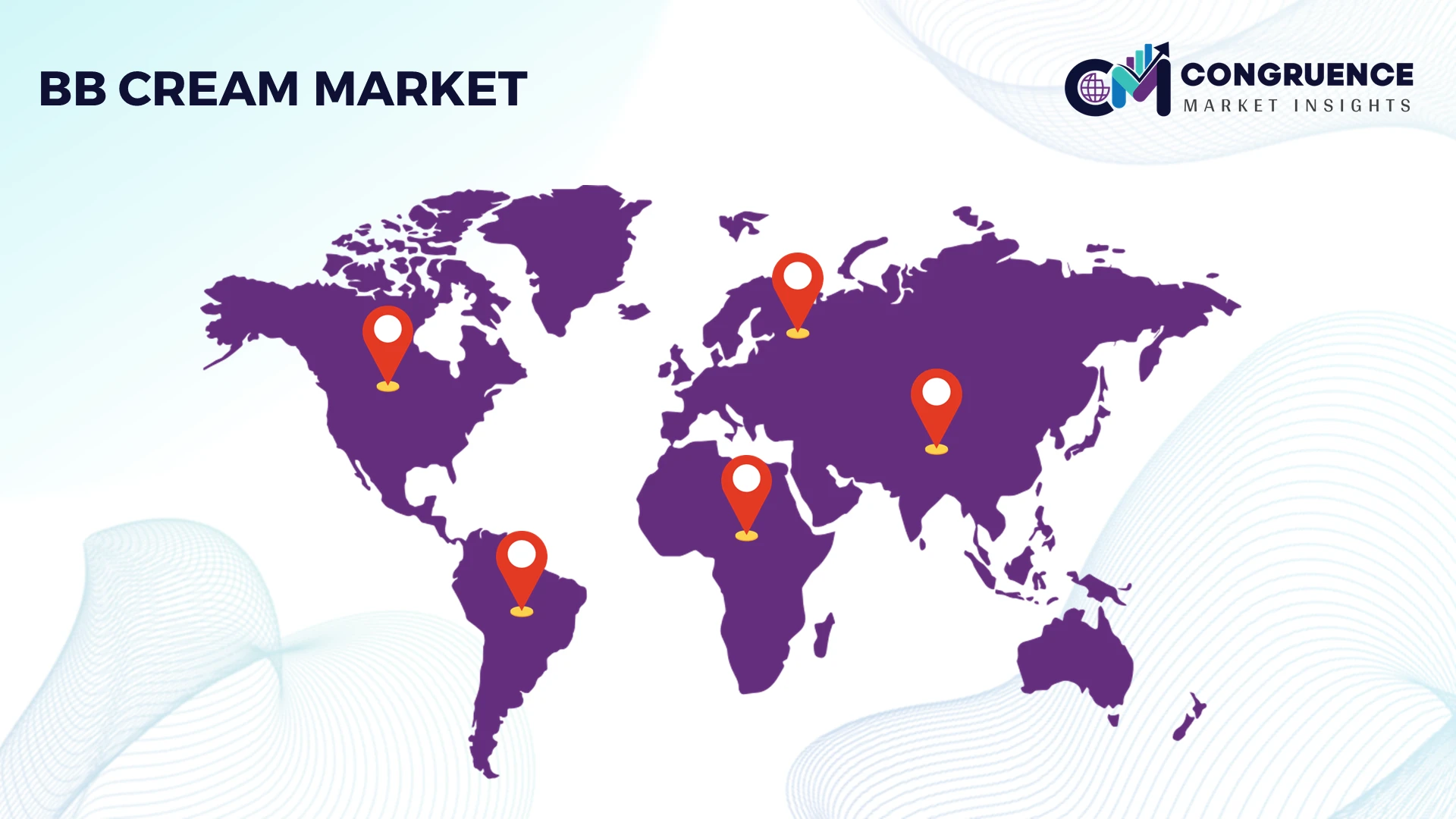
Geographic coverage spans North America, Europe, Asia-Pacific, South America, and Middle East & Africa, including country-level competitive and adoption patterns. Technology assessment covers AI shade matching, adaptive pigments, encapsulated actives, advanced UV systems, refillable cushions, and digital personalization. The report also evaluates formulation localization, regulatory exposure, omnichannel distribution, K-beauty expansion, shade architecture, and supply-chain execution, supporting investment planning, market entry, portfolio prioritization, partnership decisions, and competitive positioning through 2026–2033.
| Report Attribute/Metric | Report Details |
|---|---|
Market Revenue in 2025 | USD 2561 Million |
Market Revenue in 2033 | USD 4918.66 Million |
CAGR (2026 - 2033) | 8.5% |
Base Year | 2025 |
Forecast Period | 2026 - 2033 |
Historic Period | 2021 - 2025 |
Segments Covered | By Type
By Application
By End-User
|
Key Report Deliverable | Revenue Forecast, Growth Trends, Market Dynamics, Segmental Overview, Regional and Country-wise Analysis, Competition Landscape |
Region Covered | North America, Europe, Asia-Pacific, South America, Middle East, Africa |
Key Players Analyzed | L’Oréal S.A., Shiseido Company, Limited, Amorepacific Corporation, The Estée Lauder Companies Inc., LVMH Moët Hennessy Louis Vuitton, Unilever PLC, Procter & Gamble Co., Kao Corporation, Kosé Corporation, LG H&H Co., Ltd., Clarins Group, Coty Inc., Revlon, Inc., Natura &Co Holding S.A. |
Customization & Pricing | Available on Request (10% Customization is Free) |




