
Reports
The Global Bayonet Neill-Concelman Market was valued at USD 245.0 Million in 2025 and is anticipated to reach a value of USD 521.4 Million by 2033 expanding at a CAGR of 9.9% between 2026 and 2033. Growth is driven by rising deployment of high-frequency signal connectors in broadcast infrastructure, aerospace communication systems, industrial testing equipment, and defense electronics requiring reliable RF connectivity.
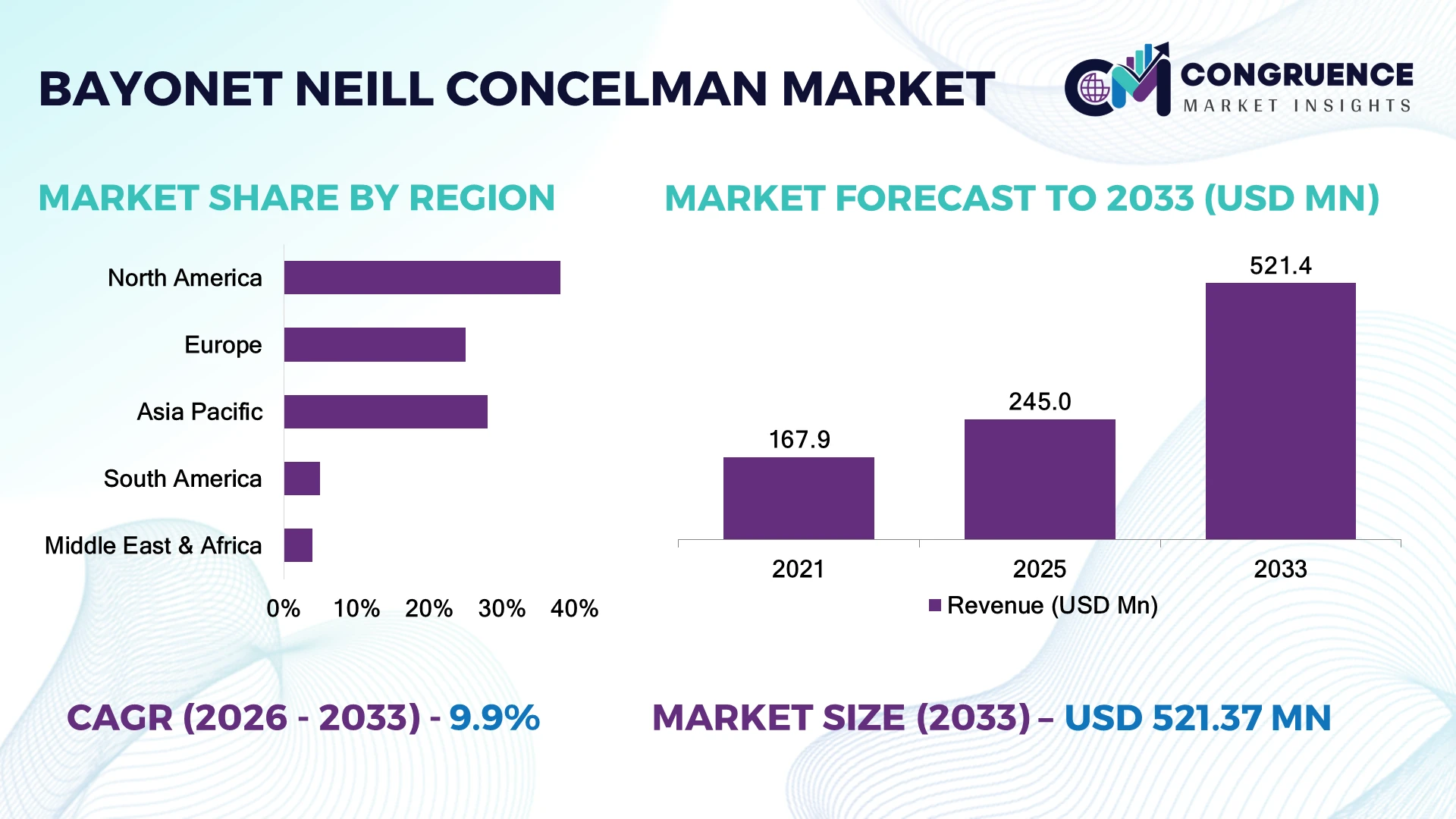
The United States dominates the market with approximately 38% share, supported by defense modernization programs, semiconductor testing facilities, and expansion of advanced communication networks. The country has allocated over USD 800 billion toward defense capabilities in recent years, strengthening demand for RF-grade components. China follows with nearly 22% share, driven by electronics manufacturing and 5G infrastructure investments, while Japan maintains strong adoption in precision instrumentation. The U.S. market shows nearly 70% higher defense-sector adoption intensity compared with several emerging economies, reinforcing supplier positioning.
Strategic implication manufacturers prioritizing aerospace, defense, and next-generation communication applications will gain stronger competitive advantage.
Market Size & Growth: Valued at USD 245.0 Million in 2025 and projected at USD 521.4 Million by 2033, expanding at 9.9% CAGR due to increasing RF connectivity requirements in defense and industrial electronics.
Top Growth Drivers: Defense electronics adoption (35%), broadcast infrastructure upgrades (28%), and industrial automation connectivity (22%) are the leading demand contributors.
Short-Term Forecast: By 2028, advanced connector manufacturing is expected to reduce installation time by 20% and improve signal reliability by 15% through precision designs.
Emerging Technologies: AI-enabled testing systems, automated connector assembly, and advanced shielding materials are improving RF performance and production accuracy.
Regional Leaders: North America is projected near USD 200 Million with defense modernization; Asia-Pacific near USD 180 Million with electronics manufacturing expansion; Europe near USD 100 Million with aerospace adoption.
Consumer/End-User Trends: More than 60% of professional RF equipment users prioritize durable connectors for high-frequency applications and harsh environments.
Pilot/Case Example: A 2024 aerospace communication upgrade project improved signal stability by 18% through advanced BNC-based RF integration.
Competitive Landscape: Leading suppliers hold approximately 45% combined share, with key players including Amphenol, TE Connectivity, Molex, Hirose Electric, and Cinch Connectivity Solutions.
Regulatory & ESG Impact: RoHS-compliant connector adoption exceeds 75% in developed markets, supporting reduced hazardous material usage and sustainable electronics production.
Investment & Funding: Over USD 1.5 billion has been directed toward broader RF and connectivity ecosystem expansion, driven by manufacturing localization and strategic partnerships.
Innovation & Future Outlook: Next-generation BNC solutions focus on miniaturization, higher-frequency performance, and integration with advanced communication platforms.
The Bayonet Neill-Concelman Market supports critical RF connectivity across telecommunications, defense, broadcasting, and laboratory applications. Demand is increasing as manufacturers introduce compact designs, improved shielding technologies, and higher durability connectors. Approximately 30% of new connector development projects emphasize enhanced signal integrity and automated testing capabilities. Supply-chain restructuring following global semiconductor disruptions is encouraging localized production strategies, especially across the United States, Germany, and Japan. These shifts are creating stronger opportunities for specialized connector suppliers and technology-focused manufacturers.
The Bayonet Neill-Concelman Market is becoming strategically important as industries prioritize dependable RF transmission systems for defense communication, satellite equipment, broadcasting, and advanced testing environments. Global supply-chain restructuring and increased localization of electronic component manufacturing are reshaping procurement strategies, with companies reducing dependency on concentrated manufacturing hubs.
Technology advancement is accelerating the transition from traditional RF connectors toward precision-engineered solutions with improved durability and performance. Modern automated connector testing systems reduce inspection time by nearly 30% compared with manual validation processes, enabling manufacturers to improve production consistency. The United States maintains leadership through defense and aerospace deployment, while China and South Korea demonstrate faster industrial-scale adoption through electronics manufacturing ecosystems.
Operational deployment in aerospace communication platforms and laboratory testing environments demonstrates the connector’s continued relevance in mission-critical applications. Companies are increasing investments in automated production lines, strategic supplier partnerships, and regional manufacturing facilities to strengthen resilience. Over the next 2–3 years, demand will increasingly favor suppliers offering customized RF solutions, faster delivery capabilities, and compatibility with evolving communication infrastructure. Competitive positioning will depend on engineering innovation, supply-chain flexibility, and application-specific expertise.
Increasing demand for secure and stable RF connectivity is the primary driver supporting Bayonet Neill-Concelman Market expansion. Defense electronics, aerospace communication, and industrial testing applications account for nearly 55% of premium connector demand. The growing adoption of advanced communication networks and electronic warfare systems in the United States and Europe is accelerating procurement of high-performance connectors. Aerospace manufacturers are integrating BNC solutions into testing and monitoring platforms where signal accuracy is critical. Companies are responding through product upgrades, expanded manufacturing capacity, and partnerships with defense technology providers. A key strategic shift is the movement toward ruggedized connectors designed for extreme operating environments, improving reliability across mission-critical applications.
Raw material volatility and dependency on specialized metals remain key constraints for BNC connector manufacturers. Copper and alloy price fluctuations have increased component production costs by approximately 12–18% during recent market cycles. Manufacturers relying heavily on overseas suppliers face additional logistics pressure due to geopolitical disruptions affecting electronic component availability. Smaller producers experience higher margin pressure because of limited purchasing power and certification costs. Companies are reducing exposure through supplier diversification, regional sourcing strategies, and long-term material contracts. A significant operational challenge is balancing cost control with maintaining strict RF performance standards required for aerospace, defense, and industrial applications.
The expansion of next-generation communication infrastructure creates new opportunities for Bayonet Neill-Concelman Market participants. Approximately 40% of new industrial communication projects emphasize improved signal integrity and faster testing capabilities. Growth in satellite communication, smart manufacturing, and automated testing environments is increasing demand for reliable RF connectors. Emerging economies including India and Vietnam are becoming attractive manufacturing hubs due to electronics production expansion and localization policies. Companies are investing in R&D for compact BNC designs, improved shielding materials, and hybrid connectivity solutions. A non-obvious opportunity lies in upgrading legacy communication systems, where BNC-compatible components provide cost-efficient modernization without complete infrastructure replacement.
Integration challenges remain a significant barrier as communication systems require higher frequencies, smaller components, and greater compatibility. Approximately 25% of industrial electronics manufacturers report connector redesign requirements when upgrading legacy platforms. Cybersecurity-sensitive applications and defense environments require stricter validation processes, increasing development timelines. Workforce shortages in precision electronics manufacturing also affect production scalability in advanced markets such as Japan and Germany. Companies must address these challenges through automated quality control, workforce development programs, and collaborative engineering partnerships. Long-term competitiveness will depend on delivering connectors that combine traditional reliability with compatibility across increasingly complex digital and RF ecosystems.
Miniaturized RF Connector Designs: Manufacturers are shifting toward compact BNC variants with improved signal performance, driven by 5G testing, aerospace electronics, and portable diagnostic equipment. Approximately 35% of new connector developments emphasize size reduction, while automated manufacturing improves assembly efficiency by nearly 20%. Companies are expanding precision engineering partnerships to meet demand for smaller, high-reliability RF components.
Localized Supply Chain Strategies: Global electronics disruptions and semiconductor shortages are accelerating regional sourcing initiatives, with nearly 45% of connector suppliers increasing domestic or regional production capabilities. Companies in the United States, Germany, and Japan are restructuring supplier networks, adopting dual-source procurement models, and investing in automated inventory systems to reduce delivery delays and production interruptions.
Advanced Testing Automation Adoption: RF manufacturers are deploying AI-assisted inspection and automated validation systems to improve workflow accuracy. Enterprise adoption of automated testing platforms has increased by around 30%, reducing quality-control cycles by 25%. Companies are integrating smart manufacturing tools to enhance consistency, lower labor dependency, and support higher-volume production requirements.
High-Frequency Application Expansion: Demand is shifting toward BNC usage in aerospace, defense, broadcasting, and laboratory environments requiring stable signal transmission. Nearly 40% of industrial users are upgrading legacy RF systems with enhanced connector solutions. Companies are responding through application-specific designs, strategic collaborations, and product certifications aligned with evolving communication infrastructure standards.
Standard BNC connectors remain the leading type segment, accounting for approximately 58% market share due to widespread compatibility, cost efficiency, and established integration across broadcasting, testing equipment, and industrial systems. Their mature ecosystem allows companies to maintain lower replacement costs and faster deployment cycles. However, high-performance BNC variants are emerging as the fastest-growing segment, supported by demand for improved shielding, durability, and signal integrity in aerospace and defense applications.
Advanced BNC designs currently represent nearly 25% of new industrial connector installations, reflecting a shift toward specialized RF performance requirements. Traditional connectors continue serving commercial applications, while enhanced versions gain traction in mission-critical environments. Companies are increasing investments in material innovation, precision manufacturing, and customized connector solutions to capture premium application demand.
Broadcasting and communication infrastructure represents the leading application segment with approximately 42% market share, supported by extensive use of BNC connectors in video transmission, signal monitoring, and professional equipment. The segment maintains strong demand due to installed infrastructure across television networks and communication facilities. Industrial testing applications are emerging as the fastest-growing area, driven by automation, electronics validation, and advanced manufacturing requirements.
Testing and measurement applications account for nearly 28% of new BNC deployments as manufacturers require accurate RF signal evaluation. Security systems, medical equipment, and laboratory applications collectively contribute around 30% of demand, reflecting diversified adoption patterns. Companies are expanding application-focused product portfolios and developing specialized connectors for higher-frequency environments.
Defense and aerospace organizations represent the dominant end-user segment, contributing approximately 36% market share due to extensive deployment in communication systems, radar testing, and electronic monitoring platforms. These users prioritize durability, environmental resistance, and long operational life, encouraging suppliers to develop ruggedized BNC solutions. Industrial manufacturers follow with nearly 32% adoption, driven by automation and equipment testing requirements.
Telecommunication providers and research institutions are becoming the fastest-growing end-user groups as digital infrastructure upgrades accelerate. Research facilities account for approximately 18% of emerging demand, particularly in advanced electronics development. Companies are responding through customized contracts, technical partnerships, and application-specific product engineering to strengthen relationships with high-value buyers.
North America accounted for the largest market share at 38% in 2025 however, Asia-Pacific is expected to register the fastest growth, expanding at a CAGR of 11.2% between 2026 and 2033.

North America holds the leading position in the Bayonet Neill-Concelman Market with approximately 38% share, supported by strong aerospace, defense, broadcasting, and electronic testing infrastructure. The United States contributes the majority of regional demand through military communication systems, semiconductor testing facilities, and advanced RF applications. More than 60% of regional BNC consumption is concentrated in professional and industrial environments rather than consumer electronics. Increasing investments in defense electronics and communication modernization programs are encouraging suppliers to expand domestic manufacturing and customized connector development. Companies are strengthening partnerships with aerospace contractors and technology integrators to improve supply reliability and application-specific performance.
United States Market Outlook: The United States remains the strategic hub due to its advanced defense ecosystem, aerospace manufacturing base, and high adoption of precision RF components. Over 50% of regional defense-related connector requirements originate from U.S. programs involving communication, surveillance, and testing systems. Domestic suppliers are increasing automation and localized production capabilities to support faster delivery and reduced supply-chain dependency.
Europe represents a significant market supported by aerospace engineering, industrial automation, automotive electronics, and advanced research infrastructure. The region accounts for nearly 25% of global demand, with Germany, France, and the United Kingdom leading deployment activities. European manufacturers are increasingly adopting reliable RF connectors for laboratory testing, communication equipment, and industrial monitoring systems. More than 40% of new industrial electronics projects emphasize improved connectivity and component reliability. Sustainability regulations and supply-chain localization initiatives are influencing procurement decisions, encouraging companies to adopt durable and compliant connector solutions. Manufacturers are expanding partnerships with industrial automation providers to strengthen regional production capabilities.
Germany Market Outlook: Germany leads European adoption through its strong industrial automation ecosystem, automotive electronics sector, and precision engineering capabilities. The country accounts for nearly 35% of European industrial connector consumption. Expansion of smart manufacturing facilities and testing laboratories is increasing demand for reliable RF connectivity solutions, while manufacturers focus on automation-driven production and engineering customization.
Asia-Pacific is the fastest-expanding market, driven by large-scale electronics manufacturing, telecommunications infrastructure development, and increasing industrial automation adoption. The region contributes approximately 28% of global BNC demand, with China, Japan, South Korea, and India representing major contributors. China’s electronics production ecosystem accounts for nearly 45% of regional connector manufacturing capacity. Growing investments in communication networks, semiconductor facilities, and testing infrastructure are accelerating deployment. Companies are increasing regional production, developing cost-efficient designs, and forming manufacturing partnerships to support rising demand. The shift toward localized electronics supply chains is creating additional opportunities for regional connector producers.
China Market Outlook: China maintains a strong position through its extensive electronics manufacturing base, communication infrastructure expansion, and industrial automation deployment. The country produces a significant share of global electronic components and supports large-scale connector integration across factories and testing facilities. Companies are investing in automated manufacturing systems to improve production efficiency and meet domestic and export demand.
South America represents an emerging market approximately of 5% supported by telecommunications expansion, broadcasting modernization, and industrial equipment upgrades. Brazil and Argentina account for a major portion of regional demand, with Brazil contributing nearly 45% of South American BNC consumption. Growing investments in communication infrastructure and industrial monitoring systems are improving adoption opportunities. However, limited local manufacturing capacity results in higher dependency on imported components, affecting deployment timelines. Companies are addressing these challenges through distribution partnerships, regional inventory expansion, and supplier diversification. Increasing modernization of broadcast networks and industrial facilities is creating steady demand for reliable RF connectors.
Brazil Market Outlook: Brazil leads the regional market due to its larger industrial base, telecommunications network expansion, and broadcasting sector presence. The country represents more than 40% of regional application demand, particularly across communication and industrial equipment sectors. Companies are strengthening distribution networks and improving availability of imported RF components to support expanding infrastructure requirements.
The Middle East & Africa market is developing through investments in communication infrastructure, defense modernization, broadcasting systems, and industrial technology upgrades. The region contributes approximately 4% of global demand, with Gulf countries representing the largest share of adoption. Countries such as Saudi Arabia and the UAE are increasing technology investments through digital infrastructure programs and industrial transformation initiatives. More than 30% of regional demand comes from communication, defense, and monitoring applications. Companies are expanding partnerships with local distributors and technology integrators to improve market access and support large-scale projects. Infrastructure modernization remains a key factor shaping long-term adoption.
Saudi Arabia Market Outlook: Saudi Arabia is emerging as a strategic market due to defense technology investments, communication infrastructure development, and industrial diversification programs. The country is increasing deployment of advanced electronic systems across multiple sectors, creating demand for reliable RF connectivity solutions. Companies are establishing regional partnerships to support project-based requirements and strengthen supply availability.
The Bayonet Neill-Concelman Market features global connector manufacturers such as Amphenol RF, TE Connectivity, Molex, Radiall, Rosenberger, and Cinch Connectors competing with specialized RF suppliers and regional manufacturers. Global leaders compete through advanced engineering, broad distribution, and aerospace-grade solutions, while regional players focus on cost efficiency and customization. The top five companies collectively account for approximately 45% market share. Competition is driven by RF performance, pricing, supply-chain reliability, customization, and production speed, with advanced suppliers improving manufacturing efficiency by nearly 20% through automation. Companies are expanding production capacity, forming industry partnerships, and developing application-specific connectors for defense, testing, and communication systems. The market is shifting toward localized sourcing, higher-frequency designs, and specialized RF solutions. Strict certification requirements and technical expertise remain major entry barriers. Success depends on combining innovation, reliable supply networks, customization capability, and faster response to evolving industrial requirements.
TE Connectivity
Molex LLC
Cinch Connectors
Radiall
Rosenberger Group
COAX Connectors
Hirose Electric Co., Ltd.
Neutrik AG
Samtec
Pasternack Enterprises
Telegärtner
Mueller Electric
Interface Connectors
The Bayonet Neill-Concelman Market is advancing through improved shielding materials, high-frequency connector designs, and precision manufacturing technologies. Modern BNC connectors with enhanced materials and optimized structures deliver approximately 20% better signal stability compared with traditional designs. Adoption of automated testing systems is increasing across professional connector manufacturers, with more than 60% of advanced production facilities integrating automated quality validation to improve consistency and reduce inspection delays.
AI-supported inspection, automated assembly, and digital manufacturing platforms are becoming important competitive differentiators. These technologies reduce production defects by nearly 25% and improve manufacturing efficiency compared with manual processes. Leading suppliers benefit through faster customization, improved reliability, and stronger positioning in aerospace, defense, and industrial applications.
Between 2026 and 2028, manufacturers will focus on compact RF solutions, higher-frequency performance, and application-specific connector engineering. Companies investing in smart manufacturing and advanced materials will gain advantages over cost-focused suppliers by delivering improved durability, faster production cycles, and stronger compatibility with evolving communication systems.
January 2025 Molex introduced its MMCX Power over Coax (PoC) solution featuring a full-locking mechanism to improve RF connection stability in compact systems. The solution supports aerospace, automotive, industrial automation, and telecommunications applications by reducing signal interruptions and simplifying upgrades through IEC 61169-52 compatibility. Source: www.molex.com
February 2025 Molex launched a ruggedized EMI-filtered interconnect and RF component portfolio for aerospace and defense applications. The expansion included more than 250 customizable configurations designed to improve electromagnetic compatibility and signal integrity in mission-critical systems such as radar, airborne communication, and navigation platforms. Source: www.molex.com
July 2025 Rosenberger introduced modular camera connection solutions for automotive applications, using high-frequency coaxial interfaces supporting frequencies up to 20 GHz. The development targets ADAS, driver monitoring, and autonomous vehicle systems by improving data transmission reliability and electromagnetic shielding performance. Source: www.rosenberger.com
September 2025 TE Connectivity launched an inside-device connectivity portfolio for next-generation vehicle electronic control units, covering board-to-board, wire-to-board, flex-to-board, and wire-to-wire solutions. The portfolio strengthens compact electronic architectures by improving reliability and supporting software-defined vehicle platforms. Source: www.te.com
The Bayonet Neill-Concelman Market Report covers market segmentation by connector type, application, end-user, regional performance, competitive landscape, and technology developments. The analysis evaluates standard and advanced BNC connectors across radio antennas, avionics, nuclear instrumentation, test equipment, broadcasting, telecommunications, defense, and industrial applications. Regional coverage includes North America, Europe, Asia-Pacific, South America, and Middle East & Africa, highlighting manufacturing centers, deployment trends, and investment priorities.
The report examines supplier strategies, product innovation, automation adoption, supply-chain developments, and emerging RF connectivity requirements. Coverage includes leading manufacturers, market positioning, operational trends, and strategic opportunities. The study supports investment planning, expansion strategies, competitive benchmarking, and technology decisions by identifying high-potential applications, evolving customer requirements, and future market direction through 2033.
| Report Attribute / Metric | Details |
|---|---|
| Market Revenue (2025) | USD 245.0 Million |
| Market Revenue (2033) | USD 521.4 Million |
| CAGR (2026–2033) | 9.9% |
| Base Year | 2025 |
| Forecast Period | 2026–2033 |
| Historic Period | 2021–2025 |
| Segments Covered |
By Type
By Application
By End-User
|
| Key Deliverables | Revenue Forecast; Market Trends; Growth Drivers & Restraints; Technology Insights; Segmentation Analysis; Regional Insights; Competitive Landscape; Regulatory & ESG Overview; Recent Developments |
| Regions Covered | North America; Europe; Asia-Pacific; South America; Middle East & Africa |
| Companies Profiled | Amphenol RF; TE Connectivity; Molex LLC; Cinch Connectors; Radiall; Rosenberger Group; COAX Connectors; Hirose Electric Co., Ltd.; Neutrik AG; Samtec; Pasternack Enterprises; Telegärtner; Mueller Electric; Interface Connectors |
| Customization & Pricing | Available on Request (10% Customization Free) |




