
Reports
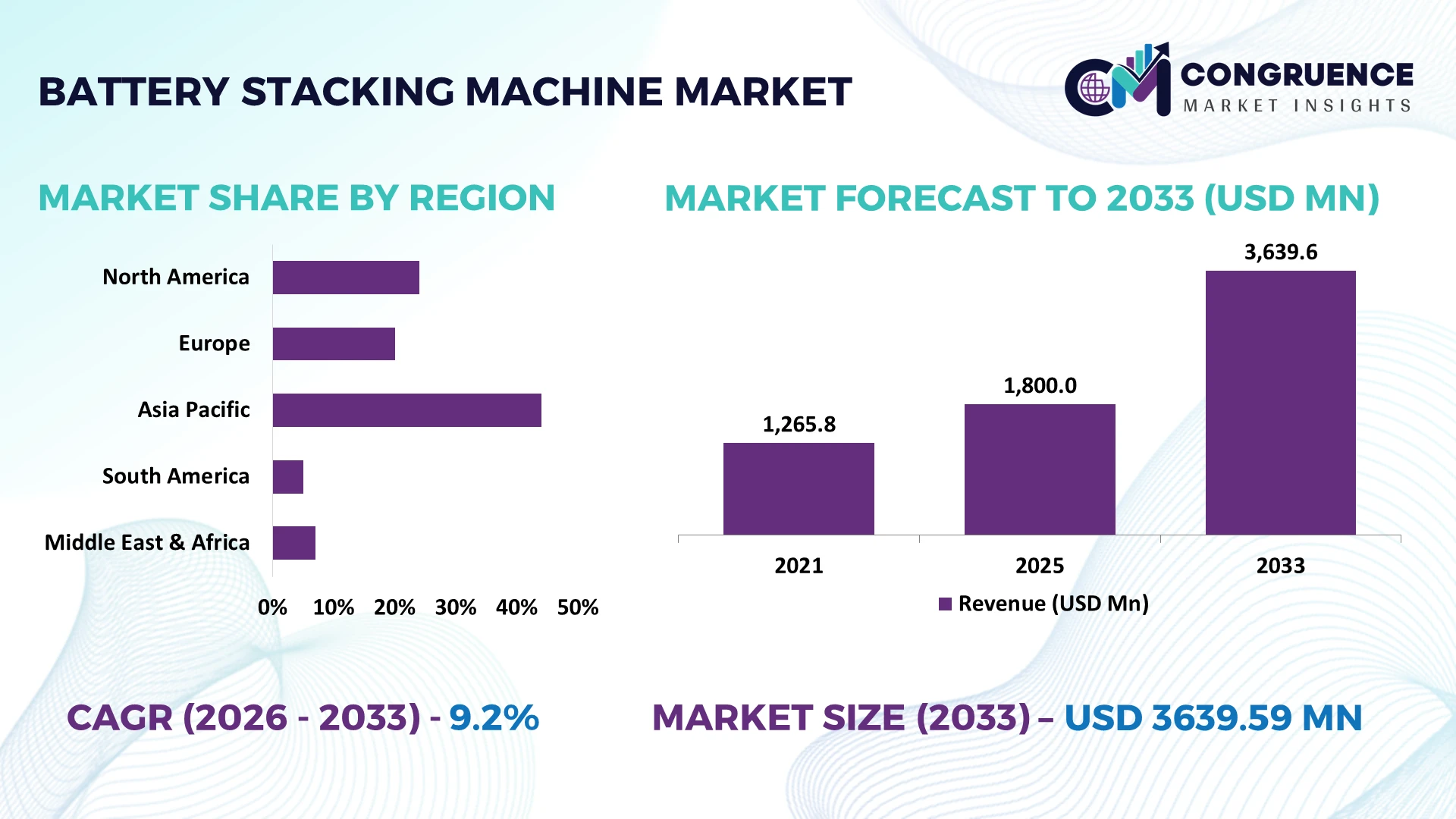
The Global Battery Stacking Machine Market was valued at USD 1800 Million in 2025 and is anticipated to reach a value of USD 3639.59 Million by 2033 expanding at a CAGR of 9.2% between 2026 and 2033. Growth is driven by rapid deployment of high-speed battery cell manufacturing lines, precision electrode stacking automation, and large-scale investments in next-generation lithium-ion and solid-state battery production.
China remains the dominant country, accounting for approximately 58% of global lithium-ion cell manufacturing capacity while accelerating investments in advanced battery production equipment through integrated EV and energy storage supply chains. Compared with South Korea, China operates significantly larger battery manufacturing clusters, whereas South Korea leads in premium cell technology and process precision. Ongoing global supply-chain diversification following evolving trade policies has encouraged additional equipment localization, strengthening production resilience and supporting faster industrial deployment across multiple regions.
This competitive landscape favors manufacturers investing in high-throughput automation, precision quality control, and localized equipment ecosystems.
Market Size & Growth: USD 1800 Million in 2025 reaching USD 3639.59 Million by 2033 at 9.2% CAGR, supported by expanding automated battery gigafactory production.
Top Growth Drivers: Automation adoption exceeds 35%, EV battery demand grows above 20%, and manufacturing digitalization improves production consistency by 25%.
Short-Term Forecast: By 2028, advanced stacking systems reduce production defects by 18% while improving equipment throughput by 22%.
Emerging Technologies: AI inspection, robotic stacking, and machine vision increase production accuracy by over 30% across advanced battery manufacturing facilities.
Regional Leaders: Asia-Pacific surpasses USD 2100 Million, Europe exceeds USD 760 Million, and North America approaches USD 540 Million through regional manufacturing expansion.
Consumer/End-User Trends: More than 70% of new battery production projects prioritize fully automated stacking equipment for higher consistency and lower waste.
Pilot/Case Example: In 2026, a smart battery manufacturing project improved stacking precision by 28% while reducing material scrap by 16%.
Competitive Landscape: Top manufacturers collectively hold approximately 45% market share, led by Wuxi Lead, Manz, PNT, Yinghe Technology, and CKD Corporation.
Regulatory & ESG Impact: Automated production reduces material waste by nearly 15% while supporting stricter industrial sustainability and localization initiatives.
Investment & Funding: More than USD 8 Billion in global battery manufacturing investments strengthens equipment localization amid continuing regional supply-chain expansion.
Innovation & Future Outlook: High-speed intelligent stacking, digital twins, and solid-state battery production platforms accelerate the industry's transition toward fully connected manufacturing.
Battery stacking machines are becoming essential across electric vehicle batteries, energy storage systems, and premium consumer electronics where precision assembly directly influences cell performance and manufacturing efficiency. AI-enabled inspection, high-speed robotic stacking, and inline quality analytics are improving production consistency by nearly 25%, while regional equipment localization and resilient supply-chain strategies continue reshaping procurement decisions, setting the foundation for the strategic discussion ahead.
Battery stacking machines have become a strategic manufacturing asset as battery producers compete on production precision, throughput, and cell consistency rather than capacity expansion alone. Supply-chain restructuring following global trade realignments has accelerated equipment localization, encouraging manufacturers to establish regional production bases and reduce dependence on single-country sourcing. Automated stacking systems now support defect rates below 1% while enabling faster product changeovers, strengthening competitiveness across electric mobility and energy storage manufacturing.
Compared with conventional semi-automatic stacking equipment, advanced AI-enabled systems improve stacking accuracy by approximately 30% and reduce production cycle time by nearly 20%, lowering operational waste and improving overall equipment utilization. China leads in deployment scale through large integrated battery manufacturing clusters, while Germany emphasizes high-precision engineering and digital manufacturing integration for premium battery production. Over the next two to three years, more than 40% of newly commissioned battery production lines are expected to incorporate intelligent inspection, predictive maintenance, and closed-loop quality monitoring.
A practical example is the deployment of fully automated stacking lines within large battery gigafactories, where manufacturers integrate robotics, machine vision, and digital quality management to improve production stability and reduce manual intervention. Companies are expanding partnerships with automation specialists, increasing localized equipment manufacturing, and investing in modular production platforms that shorten commissioning cycles. Organizations that combine intelligent automation with resilient supply networks will secure stronger operational flexibility, higher manufacturing consistency, and durable competitive positioning.
Electric vehicle and energy storage manufacturers are rapidly upgrading production lines to achieve tighter quality control and higher throughput, making automated battery stacking a core manufacturing investment. More than 70% of new battery production projects prioritize advanced automation, while intelligent inspection systems improve stacking precision by nearly 30% and reduce material waste by around 15%. China's continuing expansion of battery manufacturing capacity has encouraged equipment suppliers to establish localized engineering and service capabilities. In response, leading companies are investing in modular stacking platforms, strategic technology partnerships, and AI-enabled process optimization, enabling faster production ramp-up, improved product consistency, and stronger competitive differentiation across high-volume battery manufacturing.
High capital expenditure and reliance on precision motion-control components continue to limit broader deployment, particularly among mid-sized manufacturers. Imported servo systems, machine vision hardware, and precision linear modules account for nearly 35% of equipment costs, while component lead times have increased by approximately 20% during periods of supply-chain disruption. Japan remains an important supplier of high-precision automation components, creating procurement challenges for manufacturers seeking rapid expansion. Companies are responding through supplier diversification, localized component sourcing, and long-term procurement agreements that improve production continuity, stabilize operating costs, and reduce exposure to external supply fluctuations.
The transition toward solid-state batteries creates new opportunities for highly accurate stacking technologies capable of handling thinner electrodes and advanced separator materials. AI-driven production analytics improve process efficiency by approximately 25%, while digital twin platforms reduce equipment commissioning time by nearly 18%. South Korea is accelerating investment in next-generation battery manufacturing technologies through collaboration between equipment suppliers and cell manufacturers. Companies are expanding research partnerships, developing flexible stacking architectures, and integrating cloud-based manufacturing intelligence, positioning themselves to serve emerging battery chemistries while improving operational adaptability and long-term production efficiency.
Expanding intelligent battery manufacturing across multiple production sites introduces integration complexity involving robotics, manufacturing execution systems, cybersecurity, and workforce capability. More than 45% of advanced battery facilities require extensive software integration, while predictive maintenance platforms reduce unplanned downtime by roughly 20% only after successful system standardization. Germany's highly automated manufacturing environment demonstrates the importance of interoperable industrial communication standards across production assets. Companies must strengthen digital infrastructure, invest in workforce training, and establish technology partnerships that simplify cross-platform integration, ensuring consistent production quality, scalable operations, and sustainable long-term manufacturing competitiveness.
AI-Enabled Manufacturing Shift: Battery manufacturers are integrating AI-based vision inspection, automated alignment, and intelligent control systems, improving stacking accuracy by nearly 30% and reducing inspection cycles by 25%. Increasing battery quality requirements and skilled labor shortages are accelerating smart factory adoption, encouraging equipment suppliers to expand automation software, predictive maintenance, and real-time production analytics.
Supply Chain Localization Growth: Battery producers are increasing local equipment sourcing by approximately 20% as global supply-chain restructuring encourages domestic manufacturing ecosystems. China, India, and European battery hubs are expanding production infrastructure, while stacking machine suppliers are developing regional assembly, service networks, and component partnerships to reduce equipment delivery delays and improve manufacturing continuity.
Modular Automation Adoption: Manufacturers are shifting toward flexible stacking platforms capable of supporting multiple battery formats, reducing production changeover time by around 35% and improving equipment utilization by nearly 22%. Companies are investing in scalable automation architectures that support lithium-ion and solid-state battery production, allowing faster upgrades without replacing complete manufacturing systems.
Digital Quality Management Expansion: Advanced battery factories are adopting connected monitoring platforms that track more than 95% of critical stacking parameters throughout production. Stricter battery safety standards and customer qualification requirements are accelerating digital traceability adoption. Equipment manufacturers are embedding machine learning diagnostics, automated reporting, and cloud-based monitoring tools to reduce defects and improve operational transparency.
Fully Automatic battery stacking machines lead the market with approximately 61% share due to their high-speed production capability, precise alignment control, and integration with automated manufacturing environments. These systems reduce manual intervention by nearly 70% and improve stacking consistency by around 28%, making them the preferred choice for large-scale battery production facilities. Manufacturers are prioritizing fully automated solutions to improve throughput, minimize process variation, and address workforce limitations in advanced manufacturing hubs.
Semi-Automatic machines maintain demand among medium-scale producers because they provide operational flexibility with moderate investment requirements, while Manual systems remain relevant for research laboratories and pilot-scale battery development. Fully Automatic systems represent the fastest-growing category as companies increase investments in robotics, AI-based inspection, and digital production platforms. Equipment suppliers are responding through modular machine designs, automation upgrades, and strategic technology partnerships to support evolving battery manufacturing requirements.
EV Batteries represent the leading application segment with nearly 49% market share, driven by expanding electric vehicle manufacturing and increasing investment in battery gigafactories. Advanced stacking machines improve electrode positioning accuracy by approximately 25% and reduce material waste by nearly 15%, helping manufacturers achieve higher production efficiency. Lithium-Ion Batteries remain the dominant technology due to widespread adoption across electric vehicles, consumer electronics, and energy storage applications.
Solid-State Batteries are emerging as the fastest-growing application as manufacturers prepare production lines requiring advanced precision and specialized stacking capabilities. Energy Storage Batteries are gaining importance due to grid-scale storage expansion, while Consumer Batteries continue supporting demand for compact and high-performance electronic devices. Companies are developing flexible stacking platforms, expanding automation capabilities, and forming technology partnerships to support multiple battery chemistries and improve production adaptability.
Battery Manufacturers dominate end-user demand with approximately 57% share because of their large-scale production volumes, continuous automation investments, and requirement for consistent cell quality. Advanced stacking systems reduce manual handling by nearly 65% and improve manufacturing stability by around 27%, enabling producers to increase output while maintaining strict quality standards. Companies are integrating automated stacking machines with digital factory platforms to improve operational control and production efficiency.
Automotive Companies represent the fastest-growing end-user group as vehicle manufacturers expand battery capabilities through vertical integration, joint ventures, and strategic supply agreements. Electronics Manufacturers continue adopting specialized stacking systems for compact battery formats, while Energy Storage Companies are increasing equipment investments for large-scale storage projects. Machine suppliers are responding with customized solutions, localized support, and collaborative development models to strengthen customer relationships and accelerate deployment.
China accounted for the largest market share at 58% in 2025 however, India is expected to register the fastest growth, expanding at a CAGR of 11.4% between 2026 and 2033.
Localized Battery Manufacturing Accelerates Automation Adoption
North America is strengthening its position in the battery stacking machine market through expanding EV manufacturing capacity, domestic battery projects, and supply-chain localization strategies. The region contributes approximately 18% of global demand, supported by increasing investments in battery production facilities across the United States. Advanced stacking equipment adoption is rising as manufacturers prioritize automation, precision, and reduced production dependency on overseas suppliers. More than 20 new battery manufacturing projects announced across North America are encouraging equipment suppliers to establish local service networks and technology partnerships. Companies are focusing on AI-enabled inspection, robotic integration, and flexible production systems to improve operational efficiency and meet growing battery manufacturing requirements.
United States Market Outlook:
The United States remains the key market due to strong EV manufacturing expansion and battery infrastructure investments. The country hosts several large-scale battery production facilities, with automated manufacturing systems increasingly integrated into new plants. More than 70% of upcoming battery production projects emphasize advanced automation capabilities to improve quality control, reduce labor dependency, and strengthen domestic supply-chain resilience.
Sustainable Battery Production Drives Equipment Modernization
Europe is emerging as a strategic market for battery stacking machines due to regulatory focus on local battery manufacturing, carbon reduction targets, and advanced industrial automation. The region accounts for nearly 15% of market demand, supported by battery projects in Germany, Hungary, and France. Manufacturers are adopting precision stacking systems to meet stricter quality standards and improve production efficiency. European battery facilities are increasingly integrating digital manufacturing platforms, with automation investments improving production consistency by approximately 25%. Companies are developing partnerships with equipment providers to strengthen regional manufacturing capabilities and reduce reliance on imported battery technologies.
Germany Market Outlook:
Germany leads European adoption through its strong automotive manufacturing base, engineering expertise, and advanced industrial infrastructure. The country continues expanding battery production capabilities, with several automotive manufacturers investing in localized battery ecosystems. More than 60% of new production facilities incorporate automated equipment solutions to improve manufacturing precision and operational flexibility.
Gigafactory Expansion Strengthens Manufacturing Leadership
Asia-Pacific dominates the battery stacking machine market due to its concentrated battery production ecosystem, large-scale EV manufacturing, and established equipment supply chains. The region represents approximately 60% of global demand, driven by China, Japan, South Korea, and India. China’s extensive battery manufacturing infrastructure enables large-volume deployment of automated stacking systems, while South Korea focuses on high-precision production technologies. More than 50% of global battery cell production capacity is concentrated in this region, creating strong demand for advanced manufacturing equipment. Companies are expanding automation capabilities, forming technology partnerships, and developing localized production solutions to support increasing battery output.
China Market Outlook:
China remains the dominant country due to its extensive battery manufacturing network, established equipment ecosystem, and large EV supply chain. The country operates more than half of global battery cell production capacity and continues investing in intelligent manufacturing systems. Battery manufacturers are increasingly adopting automated stacking solutions to improve efficiency, reduce defects, and support high-volume production.
Emerging Battery Ecosystems Create New Deployment Opportunities
South America represents an emerging market for battery stacking machines as countries develop mineral-to-manufacturing strategies and strengthen energy storage infrastructure. The region currently contributes a smaller share of global demand but is gaining attention due to lithium resource availability and renewable energy expansion. Brazil and Chile are exploring battery value-chain development, encouraging future equipment investments. Battery manufacturing projects remain limited compared with Asia-Pacific, but industrial modernization efforts are increasing demand for automated production technologies. Companies are evaluating partnerships, localized assembly opportunities, and scalable equipment models to overcome infrastructure limitations and support future battery manufacturing growth.
Brazil Market Outlook:
Brazil is positioned as the leading South American market due to its automotive industry, renewable energy sector, and growing interest in battery manufacturing. The country’s expanding electric mobility initiatives and energy storage requirements are encouraging investment in advanced production technologies. Battery-related industrial projects are increasingly evaluating automation solutions to improve manufacturing efficiency and reduce operational costs.
Energy Transition Investments Support Industrial Development
The Middle East & Africa market is developing through renewable energy expansion, industrial diversification, and emerging battery storage projects. The region currently represents a smaller portion of global demand but is gaining strategic importance as governments invest in clean energy infrastructure and localized manufacturing capabilities. Countries including Saudi Arabia and the United Arab Emirates are promoting advanced industrial ecosystems, creating opportunities for battery production equipment suppliers. Energy storage deployment is increasing, with several large-scale projects targeting renewable integration and grid stability. Companies are exploring partnerships, infrastructure investments, and customized automation solutions to support future battery manufacturing requirements.
Saudi Arabia Market Outlook:
Saudi Arabia is becoming a strategic market through industrial diversification programs, renewable energy investments, and emerging battery supply-chain initiatives. The country is developing advanced manufacturing infrastructure and attracting technology partnerships to support energy transition goals. Large-scale renewable energy projects and planned industrial zones are creating opportunities for automated battery production technologies and energy storage equipment deployment.
The Battery Stacking Machine Market features competition between global automation leaders, specialized battery equipment manufacturers, and regional technology suppliers. Key players such as Wuxi Lead, Manz AG, PNT, Yinghe Technology, and CKD Corporation compete through automation expertise, precision engineering, and production scalability. The top five companies collectively control approximately 45% of market activity, creating a moderately consolidated structure. Competition centers on machine accuracy, customization, delivery speed, and integration capabilities, with advanced suppliers improving efficiency by 20–30% through AI inspection and robotic automation. Leading manufacturers expand through strategic partnerships, localized service networks, and vertical integration of software and hardware solutions. Regional suppliers compete through cost advantages and faster customization cycles, while global leaders focus on technology differentiation. The competitive landscape is shifting toward intelligent manufacturing platforms, creating higher entry barriers around engineering expertise, automation ecosystems, and customer qualification. Winning requires combining precision technology, reliable supply chains, customization capability, and long-term manufacturing partnerships.
Wuxi Lead Intelligent Equipment Co., Ltd.
Manz AG
PNT Co., Ltd.
Yinghe Technology Co., Ltd.
CKD Corporation
Hirano Tecseed Co., Ltd.
Shenzhen Geesun Intelligent Technology Co., Ltd.
Shenzhen Haoneng Technology Co., Ltd.
Guangzhou Tinci Materials Technology Co., Ltd.
Hitachi High-Tech Corporation
Toray Engineering Co., Ltd.
Fuji Corporation
Battery stacking machine technology is shifting from conventional mechanical alignment systems toward intelligent automation platforms integrating AI vision, robotics, and real-time process monitoring. AI-based inspection improves defect detection accuracy by nearly 30%, while automated alignment systems increase production consistency by approximately 25%. More than 60% of newly developed battery manufacturing lines now prioritize intelligent automation features, helping companies reduce manual intervention and improve operational control.
Compared with traditional semi-automatic stacking systems, advanced fully automatic platforms deliver around 35% faster production cycles and reduce process variation by nearly 20%. Machine learning algorithms, digital twins, and predictive maintenance tools are becoming critical technologies as manufacturers seek higher equipment utilization and lower downtime. Large battery producers benefit most from these innovations because they operate high-volume production environments requiring continuous quality optimization.
Between 2026 and 2028, integration of robotics, cloud-based manufacturing analytics, and flexible stacking architectures will reshape competitive positioning. Companies investing early in modular automation and software-driven equipment capabilities gain advantages through faster production scaling, improved customization, and reduced operating complexity. Technology suppliers that combine hardware precision with intelligent manufacturing ecosystems will capture stronger opportunities as battery production becomes increasingly digital and automated.
June 2024 Manz AG, with Dürr and GROB, presented a European battery concept factory integrating complete production processes from electrode manufacturing to cell assembly. The partnership targeted end-to-end automation across six workstreams, improving equipment integration and strengthening Europe’s localized battery manufacturing ecosystem.
June 2024 Manz AG showcased its modular stacking machine technology for lithium-ion production, featuring redundant material feeding systems and support for multiple cell geometries. The innovation improved production flexibility and availability, helping battery manufacturers optimize scalable manufacturing lines while adapting to changing cell formats. Source: MANZ AG
2025 Wuxi Lead Intelligent Equipment expanded its intelligent battery manufacturing capabilities by advancing AI-based production technologies, including cell capacity prediction systems achieving above 95% prediction accuracy. The development reduced grading machine requirements by 50% and lowered energy consumption by 60%, improving factory efficiency. Source: leadintelligent.com
June 2024 Dürr, GROB, and Manz strengthened their strategic battery equipment collaboration by demonstrating a complete European production solution at Battery Show Europe. The initiative combined multiple manufacturing technologies into one platform, supporting faster deployment of localized battery plants and reducing integration complexity for manufacturers. Source: electrive.com
The Battery Stacking Machine Market Report covers detailed analysis across Manual, Semi-Automatic, and Fully Automatic systems, along with applications including Lithium-Ion Batteries, Solid-State Batteries, EV Batteries, Energy Storage Batteries, and Consumer Batteries. The report evaluates demand patterns among Battery Manufacturers, Automotive Companies, Electronics Manufacturers, and Energy Storage Companies across major markets including North America, Europe, Asia-Pacific, South America, and Middle East & Africa.
The study examines automation adoption, AI-enabled manufacturing, robotics integration, digital quality monitoring, and next-generation battery production technologies shaping industry transformation between 2026 and 2033. With analysis of leading companies, competitive positioning, deployment trends, and emerging manufacturing models, the report supports investment planning, expansion strategies, technology decisions, and long-term market positioning for stakeholders across the battery production ecosystem.
| Report Attribute/Metric | Report Details |
|---|---|
Market Revenue in 2025 | USD 1800 Million |
Market Revenue in 2033 | USD 3639.59 Million |
CAGR (2026 - 2033) | 9.2% |
Base Year | 2025 |
Forecast Period | 2026 - 2033 |
Historic Period | 2021 - 2025 |
Segments Covered | By Type
By Application
By End-User
|
Key Report Deliverable | Revenue Forecast, Growth Trends, Market Dynamics, Segmental Overview, Regional and Country-wise Analysis, Competition Landscape |
Region Covered | North America, Europe, Asia-Pacific, South America, Middle East, Africa |
Key Players Analyzed | Wuxi Lead Intelligent Equipment Co., Ltd., Manz AG, PNT Co., Ltd., Yinghe Technology Co., Ltd., CKD Corporation, Hirano Tecseed Co., Ltd., Shenzhen Geesun Intelligent Technology Co., Ltd., Shenzhen Haoneng Technology Co., Ltd., Guangzhou Tinci Materials Technology Co., Ltd., Hitachi High-Tech Corporation, Toray Engineering Co., Ltd., Fuji Corporation |
Customization & Pricing | Available on Request (10% Customization is Free) |




