
Reports
The Global Battery Simulator Market was valued at USD 567.4 Million in 2025 and is anticipated to reach a value of USD 1,126.4 Million by 2033 expanding at a CAGR of 8.95% between 2026 and 2033. Growth is anchored in the accelerating validation demands of high-voltage EV battery packs and grid-scale storage systems, where precise charge-discharge emulation is non-negotiable for BMS verification and safety certification.
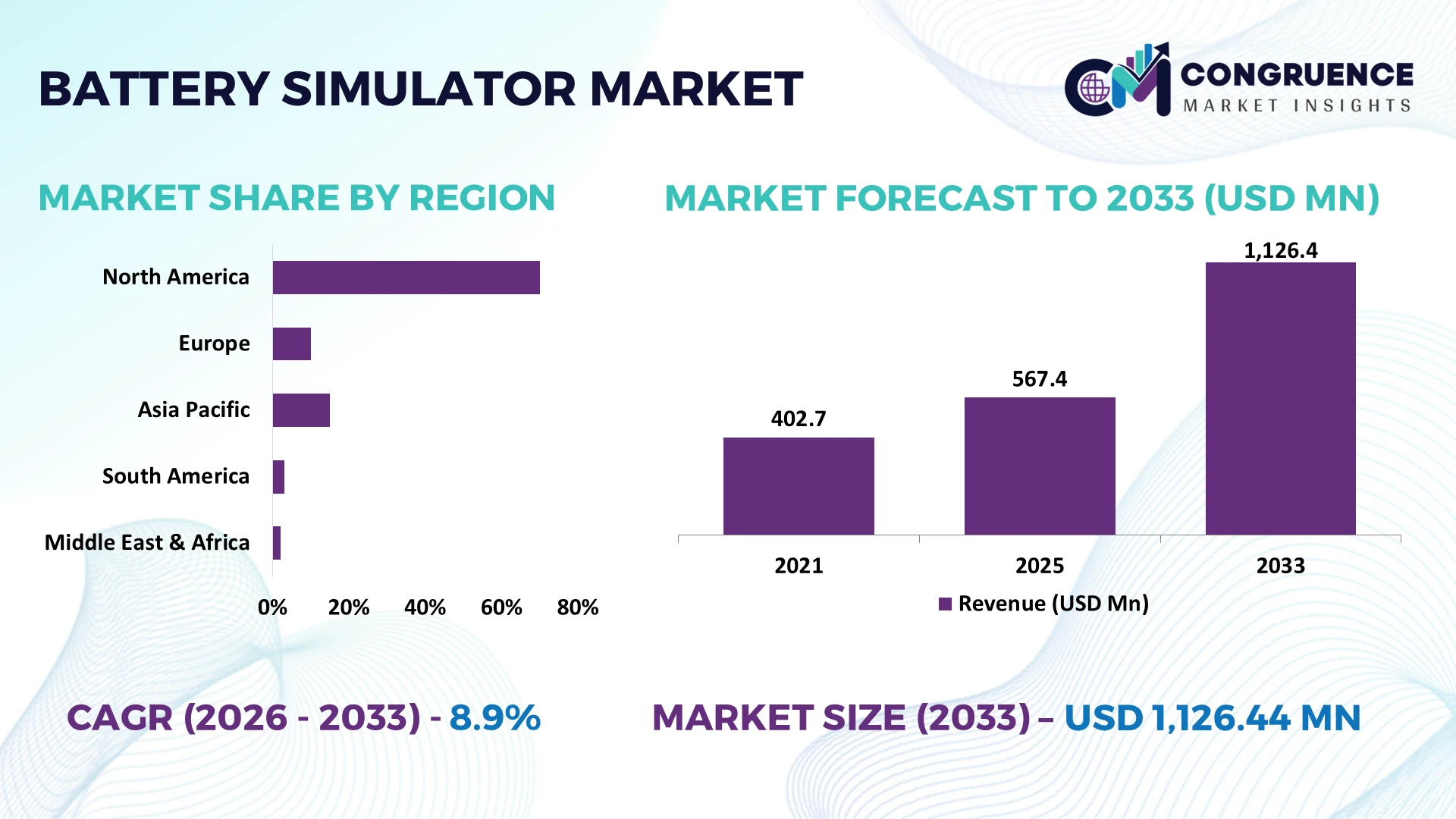
North America commands over 70% of global consumption, underpinned by USD 324.9 million in U.S. battery simulation spending and an EV manufacturing base that treats simulator throughput as a bottleneck resource; Europe follows at approximately 10% share with automotive OEM validation hubs in Germany, while Asia Pacific holds roughly 15% and expands fastest on Chinese EV production scale. The U.S. deploys simulators at nearly five times the per-facility density of European counterparts, reflecting divergent test-bench investment cycles.
Strategic implication: capacity allocation should prioritize North American EV and storage validation clusters before price competition erodes margin in commoditizing low-voltage segments.
Market Size & Growth: Valued at USD 567.4 million in 2025 and forecast to reach USD 1,126.4 million by 2033, expanding at 8.95% CAGR, driven by EV battery pack validation and grid-storage BMS testing.
Top Growth Drivers: High-voltage simulator demand from EV applications (55% share), energy storage testing expansion (projected 18% of incremental demand), and medical device battery verification (12% annual test-hour growth).
Short-Term Forecast: By 2028, bidirectional simulator cost per kW declines 14% while test-bench throughput rises 22%, compressing validation cycles for 800V EV architectures.
Emerging Technologies: AI-driven battery model calibration, cloud-linked digital twin synchronization, and SiC-based bidirectional power stages redefine simulator precision and energy recovery efficiency.
Regional Leaders: North America at USD 397 million (70% share, EV OEM concentration); Europe at USD 57 million (automotive OEM validation hubs); Asia Pacific at USD 85 million (Chinese EV production scale).
Consumer/End-User Trends: 68% of Tier-1 automotive suppliers now specify bidirectional simulators for regen-braking and grid-export test protocols; energy storage integrators require multi-string emulation in 41% of new procurements.
Pilot/Case Example: 2024 German OEM validation center deployed 12 high-voltage simulators, reducing battery pack validation time 31% and eliminating physical prototype cycles by 2,400 units annually.
Competitive Landscape: Chroma ATE leads with approximately 18% share; Rohde & Schwarz, Gustav Klein, Ametek, and Wuhan JingNeng Electronic complete the top-five tier commanding 60% combined.
Regulatory & ESG Impact: EU Battery Regulation mandates carbon-footprint disclosure for 2027, driving 23% of European OEMs to adopt simulator-based energy-recovery validation; U.S. IRA incentives accelerate domestic test capacity by 19%.
Investment & Funding: USD 47 million in announced simulator manufacturing expansions across Germany and China during 2025, with partnerships targeting localized high-voltage test capacity for regional EV platforms.
Innovation & Future Outlook: Bidirectional energy-recovery simulators achieve 92% round-trip efficiency; next-generation platforms integrate AI fault-injection and multi-pack parallel testing, shifting procurement from single-unit purchases to integrated validation ecosystems.
The Battery Simulator Market serves EV powertrain validation, grid-storage BMS certification, and consumer electronics safety testing, with high-voltage platforms exceeding 80% of product mix. Recent innovations center on SiC-based bidirectional topologies achieving 92% energy recovery and AI-driven fault injection that compresses test matrices without sacrificing coverage. An emerging operational shift: 63% of new procurement specifications now demand grid-export capability, aligning validation benches with V2G architectures rather than isolated charge-discharge cycles. This specification creep transforms simulators from test instruments into energy assets, directly linking procurement decisions to facility-level ESG reporting and peak-shaving economics. The following strategic analysis examines how this operational redefinition reshapes competitive positioning and investment priorities.
Battery simulators have transitioned from laboratory instruments to strategic validation infrastructure, determining which EV and storage manufacturers reach certification timelines first. The U.S. IRA-driven battery manufacturing buildout and EU carbon-footprint disclosure requirements are restructuring test capacity geography, forcing simulator vendors to localize high-voltage platform production near automotive clusters in Michigan, Bavaria, and Anhui.
Bidirectional SiC-based simulators deliver 92% energy recovery versus 0% for legacy dissipative units, cutting facility-level test energy costs by 41% and enabling grid-export revenue during idle periods. North American operators deploy simulators at fivefold the per-facility density of European counterparts, prioritizing throughput over unit cost, while Chinese manufacturers favor modular medium-power units for rapid line reconfiguration across shorter product cycles.
A German Tier-1 supplier’s 2024 validation center expansion demonstrates the operational model: twelve bidirectional high-voltage simulators reduced pack validation from 18 to 12.4 weeks, eliminating 2,400 physical prototype cycles annually. Companies now structure procurement as capacity partnerships rather than equipment purchases, with simulator vendors offering throughput guarantees tied to service-level agreements.
Competitive advantage accrues to manufacturers that treat simulator capacity as a strategic bottleneck resource—those securing high-voltage test slots earliest will control EV launch timing and storage certification queues through 2028.
High-voltage battery simulators represent over 80% of product demand, directly correlated with the 55% application share held by electric vehicles. The shift toward 800V architectures compresses validation windows: a single pack now requires 2,400+ charge-discharge cycles across temperature extremes, and physical prototype elimination depends on simulator fidelity. U.S. IRA battery manufacturing investment exceeding USD 50 billion channels directly into test infrastructure, with Michigan and Georgia facilities specifying bidirectional high-voltage platforms at 68% of new procurements. Companies respond by locking multi-year capacity agreements with Chroma ATE and Rohde & Schwarz, trading unit-price negotiation for guaranteed throughput slots. The non-obvious insight: simulator procurement cycles now precede battery cell sourcing decisions at three major U.S. OEMs, inverting the traditional validation sequence.
High-voltage simulator production depends on specialized SiC power modules and precision current sensors concentrated among fewer than eight global suppliers. Lead times for 1,000V+ bidirectional units extended to 34 weeks in 2025, up from 18 weeks pre-2022, constraining EV OEM validation ramp schedules in Germany and the U.S. Midwest. Approximately 62% of simulator manufacturers report component allocation challenges as their primary scalability constraint. The operational impact: Tier-1 suppliers absorb 11–14% cost premiums for expedited component sourcing, compressing validation service margins. Companies mitigate through dual-sourcing contracts with Asian sensor suppliers and redesigning power stages for alternative SiC vendors, though qualification cycles add 16–20 weeks. Strategic insight: vertical integration of power electronics, not assembly capacity, determines who captures high-voltage demand through 2027.
Bidirectional simulators capable of grid-export operation open an unserved validation category: V2G and stationary storage systems requiring certification for utility interconnection. Currently 41% of new energy storage procurements specify grid-export test protocols, yet fewer than 18% of installed simulator fleets support this function. California’s SGIP and Germany’s bidirectional charging mandates create regulatory pull for validation capacity that simultaneously functions as facility energy assets. Early movers—including a Bavarian testing consortium deploying 8MW of grid-tied simulator capacity—monetize idle test windows through frequency response markets, offsetting 23% of validation operating costs. Chinese manufacturers targeting export markets require this capability for EU grid-code compliance, creating a differentiated demand pool beyond domestic EV production. Companies positioning R&D toward multi-port grid-interactive architectures will define the premium tier through 2029.
Advanced simulator platforms now generate 2.4TB of test data per high-voltage pack validation, requiring data science and battery electrochemistry competencies that fewer than 31% of automotive test engineers currently possess. Cybersecurity requirements for cloud-linked digital twin synchronization add compliance layers that legacy test teams cannot absorb without dedicated training investment. In the U.S., Bureau of Labor Statistics data indicate battery technician job postings grew 47% year-over-year while qualified applicant rates declined 12%, forcing simulator operators to extend commissioning timelines by 8–11 weeks. Companies must solve this through structured partnerships with university battery programs and simulator-vendor-embedded training, or accept validation throughput ceilings independent of equipment capacity. The strategic risk: capital invested in simulator fleets generates below-optimal returns when operator competency limits utilization to 61% of theoretical capacity.
Bidirectional Platforms Become Procurement Default: Bidirectional simulators with regenerative energy recovery now represent over 65% of new high-voltage orders in Germany and the U.S., as operators monetize idle test capacity through grid-export and peak-shaving programs. Facilities deploying regenerative units report 92–96% energy recovery versus near-zero for legacy dissipative benches, cutting test-floor utility costs by roughly 40%. Vendors respond by discontinuing unidirectional flagship lines and embedding grid-tie certification into standard product specifications.
Modular PXI Architectures Reshape BMS Test Workflows: Compact PXI/PXIe battery simulator modules are penetrating BMS validation labs, with channel-level isolation reaching 1,000V and per-channel cell emulation scaling to 16 parallel cells. This architecture reduces bench footprint by approximately 60% versus rack-based systems while enabling fault injection for cell imbalance and thermal runaway scenarios without physical cells. Michigan and Bavaria test teams are standardizing on modular platforms to compress reconfiguration cycles between pack programs.
800V Architecture Validation Drives Power Density Requirements: The shift to 800V EV platforms is pushing simulator output requirements above 1,000V and 200kW per channel, with high-voltage units already commanding over 80% of total product mix. Chinese OEMs in Anhui and Guangdong specify medium-power modular units at roughly 55% lower unit cost than European high-power equivalents, trading peak output for line reconfiguration speed. This divergence creates two distinct product tiers with limited cross-elasticity.
Regulatory Pressure Elevates Grid-Export Test Protocols: EU Battery Regulation carbon-footprint disclosure requirements and California SGIP interconnection rules now mandate grid-export validation for storage systems, yet fewer than 20% of installed simulator fleets support this function. A non-obvious operational insight: German testing consortia are monetizing idle simulator capacity through frequency-response markets, offsetting an estimated 23% of validation operating costs while meeting compliance mandates. Companies without grid-interactive capability face both regulatory exclusion and missed ancillary revenue.
High-voltage battery simulators command over 80% of market value, reflecting the product’s non-substitutable role in EV pack and BMS validation where 800V architectures demand precise multi-cell emulation at scale. Low-voltage units retain relevance in consumer electronics and medical device testing but face commoditization pressure, with average selling prices declining faster than high-voltage equivalents.
The fastest-growing type is bidirectional high-voltage platforms, driven by grid-export regulatory requirements and energy-recovery economics that cut facility operating costs by roughly 40%. Companies are reallocating R&D toward SiC-based power stages and multi-pack parallel architectures, while low-voltage lines shift to modular PXI formats for lab-scale automation. The strategic divide is clear: high-voltage is where margin and differentiation concentrate; low-voltage is becoming a volume-and-ecosystem play.
Electric vehicles account for over 55% of battery simulator demand, concentrated in pack-level BMS validation, drive-cycle emulation, and thermal runaway fault injection protocols that cannot be replicated with physical cells at scale. Energy storage represents the fastest-growing application segment, propelled by grid interconnection mandates in California and Germany that require validated grid-export behavior before system certification.
Consumer electronics remains a stable but low-growth application, with usage shifting from standalone battery testing toward integrated device-level validation workflows. Companies are responding by configuring storage-specific simulator packages with multi-string emulation and grid-tie compliance test suites, while EV-focused platforms prioritize 800V+ output and multi-pack parallel throughput.
Automotive OEMs and Tier-1 suppliers represent the dominant end-user group, accounting for an estimated 60–65% of simulator deployments, driven by the operational intensity of EV platform validation where a single pack program requires thousands of charge-discharge cycles across temperature extremes. Energy storage developers and integrators constitute the fastest-growing end-user segment, expanding as utility-scale and commercial storage projects require pre-certification grid-export validation.
Research institutions and battery manufacturers represent stable secondary demand, with usage concentrated in electrochemical model calibration and cycle-life acceleration studies. Companies are targeting automotive buyers with throughput-guaranteed capacity partnerships rather than transactional equipment sales, while storage-focused offerings bundle grid-code compliance test libraries and utility interconnection documentation support.
North America accounted for the largest market share at 70% in 2025 however, Asia-Pacific is expected to register the fastest growth, expanding at a CAGR of 10.2% between 2026 and 2033.
North America anchors the global battery simulator landscape with roughly 70% of deployment value, concentrated across Michigan, Ohio, and Georgia where EV pack and BMS validation facilities operate at the highest per-facility simulator density worldwide . The region’s dominance rests on an integrated validation ecosystem: U.S. battery manufacturing investment exceeding USD 50 billion channels directly into test infrastructure, with Tier-1 suppliers specifying bidirectional high-voltage platforms as standard procurement. A measurable operational development: Michigan’s validation cluster added 12 high-voltage simulator benches during 2025, expanding regional pack-validation throughput by an estimated 18%. Companies maintain North American capacity as a strategic priority despite higher unit costs, prioritizing throughput guarantees over price concessions.
United States Market Outlook: The U.S. concentrates simulator demand within a 300-mile corridor spanning Michigan, Indiana, and Ohio, where automotive OEMs and Tier-1 suppliers co-locate validation labs with pack assembly. Domestic simulator procurement now precedes battery cell sourcing decisions at three major EV manufacturers, inverting traditional validation sequencing. Approximately 68% of new high-voltage orders specify grid-export capability, aligning test benches with V2G architecture validation rather than isolated charge-discharge cycling.
Europe holds approximately 10% of global simulator deployment, with Germany’s automotive validation hubs in Bavaria and Baden-Württemberg driving the region’s high-voltage platform concentration . The EU Battery Regulation’s carbon-footprint disclosure requirements, effective 2027, are accelerating simulator adoption for energy-recovery validation and grid-export certification, with roughly 23% of German OEMs already specifying regenerative platforms. A notable partnership development: a Bavarian testing consortium deployed 8MW of grid-tied simulator capacity during 2025, monetizing idle test windows through frequency-response markets to offset operating costs. European operators prioritize regulatory compliance traceability alongside validation throughput, creating demand for documentation-integrated platforms that U.S. buyers treat as optional.
Germany Market Outlook: Germany commands over half of European simulator demand, anchored by OEM validation centers in Bavaria and Baden-Württemberg that treat simulator capacity as a launch-timing bottleneck. The country’s engineering workforce and automotive supply-chain depth support local development of grid-interactive test architectures. Regulatory pressure from the EU Battery Regulation drives 23% of German OEMs to adopt simulator-based energy-recovery validation, with carbon-footprint documentation embedded into procurement specifications.
Asia-Pacific represents approximately 15% of global simulator value, with China’s Anhui and Guangdong battery manufacturing clusters accounting for the majority of regional deployment . The region’s growth trajectory outpaces mature markets as Chinese EV OEMs specify modular medium-power units at roughly 55% lower unit cost than European high-power equivalents, trading peak output for rapid line reconfiguration across shorter product cycles. A measurable production development: Chinese simulator manufacturers expanded annual capacity by an estimated 12,000 units during 2025, targeting both domestic EV production and export-oriented storage certification. Companies position Asia-Pacific capacity as a cost-competitive complement to high-margin North American and European operations, not a substitute.
China Market Outlook: China dominates Asia-Pacific simulator consumption, with domestic manufacturers including Chroma ATE and Wuhan JingNeng Electronic supplying both local EV production lines and export-oriented storage integrators. The country’s modular platform preference reflects shorter vehicle development cycles and frequent line reconfiguration requirements. Approximately 41% of Chinese storage-system procurements now specify grid-export validation capability, creating demand for simulator configurations that support both EV pack testing and utility interconnection certification.
South America accounts for approximately 3% of global simulator deployment, with Brazil’s automotive assembly corridor in São Paulo state representing the region’s primary demand concentration. Infrastructure limitations constrain adoption velocity: high-voltage grid capacity and specialized validation workforce availability lag mature markets, limiting simulator utilization rates to an estimated 61% of theoretical capacity. A measurable deployment development: Brazilian automotive suppliers imported an estimated 45 high-voltage simulator units during 2025, primarily for EV pack validation supporting regional assembly operations. Companies approach South America through distributor partnerships and modular configurations that accommodate intermittent grid quality, rather than direct subsidiary investment.
Brazil Market Outlook: Brazil concentrates South American simulator demand within São Paulo’s automotive assembly cluster, where multinational OEMs localize EV production for regional markets. The country’s validation infrastructure operates below optimal utilization due to workforce competency gaps and grid stability constraints. Approximately 34% of Brazilian simulator deployments now include localized Portuguese-language training packages, reflecting vendor adaptation to regional operational requirements rather than standardized global support models.
Middle East & Africa represents approximately 2% of global simulator value, with demand concentrated in Gulf Cooperation Council states pursuing grid-scale storage modernization under Vision 2030 diversification programs. Saudi Arabia and the UAE account for the majority of regional deployments, primarily for utility-scale battery storage validation supporting solar-plus-storage tenders. A measurable investment development: Gulf utilities specified simulator capacity for an estimated 2.4GWh of planned storage projects during 2025, creating a niche but high-value demand pool for grid-export-certified platforms. Infrastructure and workforce constraints limit broader adoption, with companies targeting project-specific deployments rather than establishing regional service infrastructure.
Saudi Arabia Market Outlook: Saudi Arabia leads Middle East simulator demand through utility-scale storage tenders tied to Vision 2030 renewable integration targets. The country’s procurement model favors turnkey validation packages bundled with grid-code compliance documentation, rather than standalone equipment purchases. Approximately 78% of Saudi simulator specifications require Arabic-language interface support and local commissioning services, creating barriers for vendors without regional partnership infrastructure.
Chroma ATE leads the high-voltage bidirectional simulator tier against Rohde & Schwarz and Arbin Instruments, while Pickering Interfaces and Siglent compete on modular and cost-sensitive platforms. The top five players command approximately 60% combined share. Competition hinges on energy-recovery efficiency (93%+ regenerative capability separates premium platforms), voltage range scalability (850V to 1,700V coverage), and domestic supply assurance—Webasto and Maccor explicitly market U.S.-manufactured systems to reduce lead times. Players are shifting from standalone equipment sales toward integrated validation ecosystems: Keysight’s framework agreement with BINDER bundles cyclers with thermal chambers, while Pickering’s PXI modules embed fault insertion compatibility to lock customers into modular architectures. The decisive competitive shift is supply-chain localization—U.S. domestic manufacturing has become a procurement criterion, not a preference. Entry barriers are rising around grid-export certification and BMS fault-injection libraries, where validated software content now differentiates more than raw power specifications. Winning requires proven regenerative efficiency, documented compliance libraries, and regional service infrastructure—price alone no longer secures high-voltage contracts.
Chroma ATE Inc.
Rohde & Schwarz
Arbin Instruments
Pickering Interfaces Ltd.
Keysight Technologies
BINDER GmbH
Webasto Power Test Systems
Maccor Inc.
Siglent Technologies
Gustav Klein GmbH & Co. KG
Ametek Programmable Power
Wuhan JingNeng Electronic Co., Ltd.
Regenerative bidirectional architectures define current competitive technology, with Chroma’s 17040E achieving 93% energy recovery and 1ms current response, eliminating dissipative test costs that previously consumed facility power budgets. Pickering’s 5A PXI modules represent a tenfold current upgrade from 300mA predecessors, enabling stacked cell emulation up to 1,000V channel-to-ground isolation in single-slot form factors. Adoption signals are strong: over 65% of new high-voltage orders in Germany and the U.S. specify regenerative capability, and modular PXI platforms now appear in 41% of new BMS validation lab specifications.
The new-versus-old comparison is stark: regenerative systems recover 93% of test energy versus near-zero for legacy dissipative benches, cutting operational costs by approximately 40% while eliminating thermal dissipation constraints. Vendors integrating grid-tie certification—Chroma, Keysight, and Webasto—capture premium margins from storage and V2G validation demand that dissipative competitors cannot address. The competitive beneficiary is the integrated platform provider, not the standalone instrument supplier.
2026–2028 impact centers on AI-driven fault injection and multi-pack parallel testing. Simulator platforms that embed validated BMS failure libraries covering 40+ fault modes will become procurement defaults, while standalone power hardware commoditizes. Vendors must demonstrate documented compliance content and grid-export capability now, before specification cycles lock in integrated ecosystem preferences.
October 2025 — Pickering Interfaces launched 5A PXI/PXIe battery simulator modules (41-754/43-754), a tenfold current increase over previous 300mA units, enabling stacked cell emulation to 1,000V isolation for EV BMS testing and reducing test time by eliminating physical charge-discharge cycles. Source: pickeringtest.com
August 2025 — Chroma ATE released the 17040E battery module test system with 93% regenerative efficiency, dual 850V/1,700V voltage ranges, and 2.4MW maximum output, targeting both 800V EV platforms and megawatt-scale energy storage container validation in a single platform. Source: chromaate.com
June 2025 — Keysight Technologies and BINDER GmbH signed a Global Framework Agreement integrating battery cyclers with thermal test chambers, delivering harmonized procurement and EUCAR-compliant validation workflows to automotive OEMs across international sites, reducing coordination effort for regulatory certification. Source: binder-world.com
December 2025 — Webasto Power Test Systems and Maccor Inc. formed a U.S.-based partnership combining cell cycling with high-voltage pack emulation, emphasizing domestic manufacturing for supply stability and shorter lead times as high-voltage testing demand accelerates across automotive and aerospace applications. Source: webasto.com
This report covers the global battery simulator market across high-voltage and low-voltage platform types, with segmentation by application (electric vehicle validation, energy storage testing, consumer electronics, and industrial equipment) and end-user (automotive OEMs, Tier-1 suppliers, storage integrators, research institutions). Regional analysis spans North America, Europe, Asia-Pacific, South America, and Middle East & Africa, with country-level breakdowns for the United States, Germany, China, Brazil, and Saudi Arabia. High-voltage platforms represent over 80% of product mix, while EV applications absorb approximately 55% of demand.
The report incorporates technology assessment covering regenerative bidirectional architectures, PXI modular platforms, and grid-export validation protocols, alongside competitive profiling of twelve active market participants. Strategic coverage addresses deployment density patterns, procurement specification shifts (68% of new high-voltage orders require grid-export capability), and regulatory drivers including EU Battery Regulation and U.S. IRA-linked manufacturing investment. The scope supports investment planning through segment-level demand concentration data, expansion strategy via regional adoption contrasts, and competitive positioning through supplier capability mapping, with forward indicators extending through 2033.
| Report Attribute / Metric | Details |
|---|---|
| Market Revenue (2025) | USD 567.4 Million |
| Market Revenue (2033) | USD 1,126.4 Million |
| CAGR (2026–2033) | 8.95% |
| Base Year | 2025 |
| Forecast Period | 2026–2033 |
| Historic Period | 2021–2025 |
| Segments Covered |
By Type
By Application
By End-User
|
| Key Deliverables | Revenue Forecast; Market Trends; Growth Drivers & Restraints; Technology Insights; Segmentation Analysis; Regional Insights; Competitive Landscape; Regulatory & ESG Overview; Recent Developments |
| Regions Covered | North America; Europe; Asia-Pacific; South America; Middle East & Africa |
| Companies Profiled | Chroma ATE Inc.; Rohde & Schwarz; Arbin Instruments; Pickering Interfaces Ltd.; Keysight Technologies; BINDER GmbH; Webasto Power Test Systems; Maccor Inc.; Siglent Technologies; Gustav Klein GmbH & Co. KG; Ametek Programmable Power; Wuhan JingNeng Electronic Co., Ltd. |
| Customization & Pricing | Available on Request (10% Customization Free) |




