
Reports
The Global Battery Separators Market was valued at USD 4385.88 Million in 2025 and is anticipated to reach a value of USD 10552.8 Million by 2033 expanding at a CAGR of 11.6% between 2026 and 2033. Growth is driven by lithium-ion battery gigafactory expansion, rising lithium iron phosphate adoption, ceramic-coated separator integration, and high-throughput wet-process membrane manufacturing.
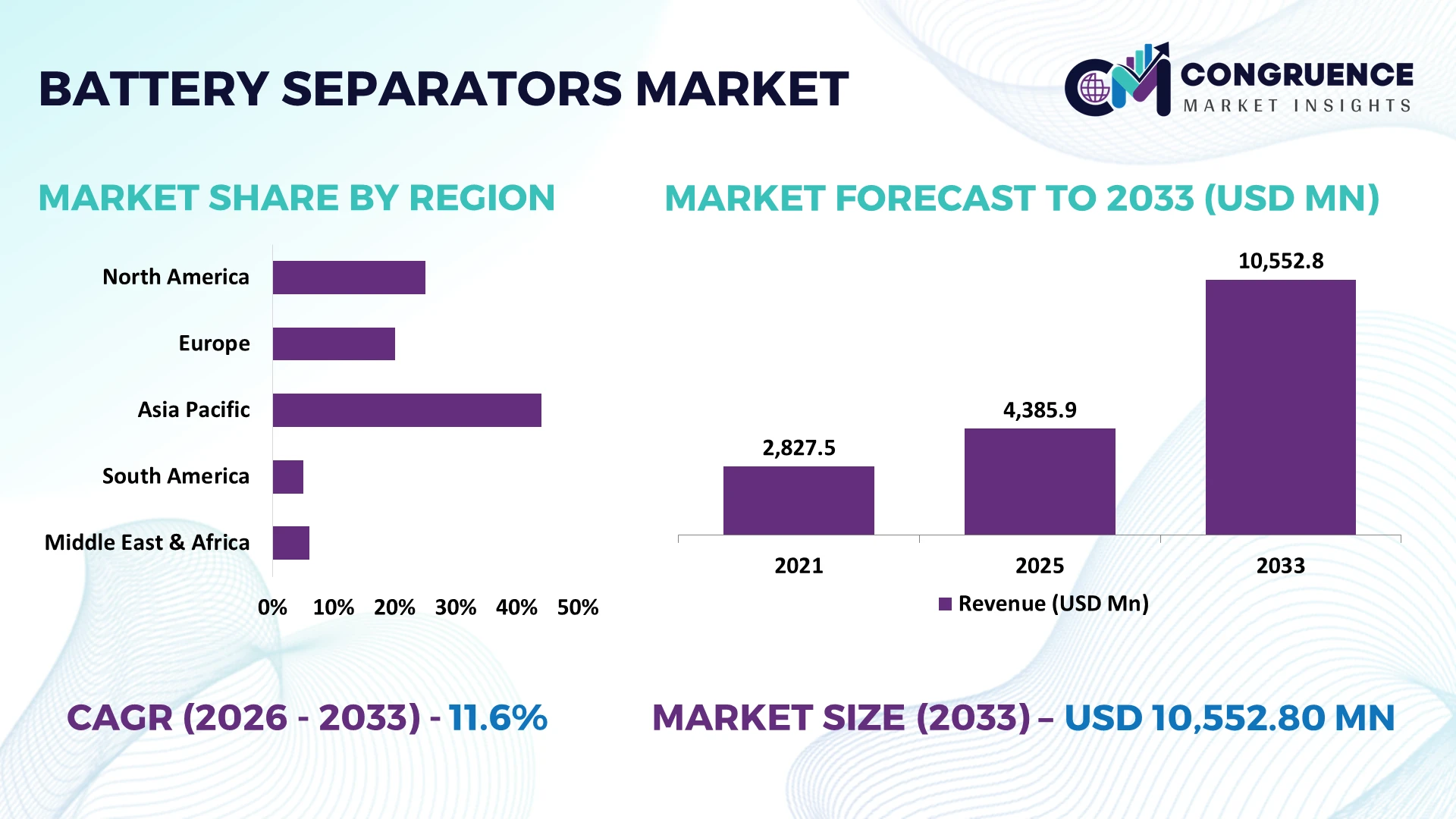
China dominates global battery separator production through its integrated lithium-ion battery supply chain, extensive manufacturing capacity, and large-scale electric vehicle industry. Chinese manufacturers account for an estimated 80% of global battery separator output, supported by companies including SEMCORP, Senior Technology Material, and Sinoma Science & Technology. China's battery cell manufacturing capacity exceeds 1 TWh annually, while lithium iron phosphate batteries represent more than 70% of domestic electric vehicle battery installations. Compared with the United States, China's established separator coating and polymer film manufacturing infrastructure provides substantial production-scale advantages.
Strategically, manufacturers prioritizing ceramic-coated membranes, localized production partnerships, and high-yield separator manufacturing will strengthen competitiveness as battery supply chains diversify.
Market Size & Growth: Valued at USD 4385.88 Million in 2025, projected to USD 10552.8 Million by 2033 at 11.6% CAGR, driven by ceramic-coated separator adoption for EV thermal safety .
Top Growth Drivers: EV separator consumption growth (24.9% year-over-year through July 2026), ceramic-coated segment expansion (22.05% CAGR), and energy storage system demand acceleration .
Short-Term Forecast: By 2027, China’s GB 38031-2025 mandates thermal propagation safeguards effective July 2026, driving composite-coated separator qualification across domestic and export cell platforms .
Emerging Technologies: Ceramic-coated separators stable above 200°C, aramid nanofiber membranes with 300°C dimensional stability, and solid-state electrolyte membrane development by Chinese separator leaders .
Regional Leaders: Asia-Pacific at USD 4.5 billion and 49.75% share, North America expanding from USD 1 billion to USD 2.7 billion by 2035, Europe growing on gigafactory localization .
Consumer/End-User Trends: Electric vehicles consume 55–60% of separator volume; energy storage systems represent 15–18% and grow fastest as China deploys over 100 GWh annually .
Pilot/Case Example: SEMCORP shipped 8.825 billion square meters in 2024, returned to profitability in 2025 with CNY 13.6 billion revenue, and agreed in May 2026 to acquire SK IE Technology’s Changzhou plant .
Competitive Landscape: Asahi Kasei (Celgard) leads with 13.7% share; SEMCORP, SK IE Technology, Toray, and W-SCOPE hold 50.7% combined market share .
Regulatory & ESG Impact: EU Battery Regulation mandates carbon footprint and recycled content disclosure; China’s GB 38031-2025 elevates thermal safety specifications effective July 2026 .
Investment & Funding: I Squared Capital acquired majority stake in ENTEK (September 2025); Asahi Kasei’s CAD 1.56 billion Ontario complex exemplifies domestic-content incentive-driven investment .
Innovation & Future Outlook: Composite-coated separators and solid-state electrolyte membranes represent next-generation frontiers; below-9µm thickness segment grows fastest for energy density gains .
The Battery Separators Market encompasses microporous polymer films and advanced composite membranes that electrically isolate battery electrodes while permitting ionic transport. Electric vehicle battery packs, stationary energy storage systems, and portable electronics generate demand for polyethylene, polypropylene, and ceramic-coated separator technologies. High-porosity wet-process films, multilayer shutdown membranes, and heat-resistant coatings are improving safety and manufacturing consistency. Global electric car sales surpassed 20 million units in 2025, reinforcing demand for reliable lithium-ion battery components. Trade restrictions and battery localization policies are encouraging manufacturers to diversify separator production beyond established Asian supply chains, making material qualification and manufacturing efficiency increasingly important competitive factors.
Battery separators are becoming strategically important as electric vehicle manufacturers prioritize thermal safety, energy density, and localized component sourcing. Separator performance directly influences battery reliability, fast-charging capability, and manufacturing consistency, making membrane engineering a competitive differentiator. The European Union's battery regulatory framework is accelerating supply-chain traceability, while North American manufacturers are establishing domestic separator production to reduce import dependence. Asahi Kasei's Canadian manufacturing investment demonstrates how battery material suppliers are aligning production capacity with automotive electrification strategies.
Advanced ceramic-coated separators offer improved thermal stability compared with conventional polyolefin membranes, particularly under elevated operating temperatures. Standard polyethylene separators exhibit thermal shutdown behavior around 130–135°C, while polypropylene layers retain structural stability at temperatures approaching 160°C. Ceramic coatings further improve dimensional stability and reduce thermal shrinkage under specified testing conditions. China maintains manufacturing scale advantages, whereas Japan specializes in high-performance membrane technologies and Canada is developing localized production infrastructure.
Between 2026 and 2028, separator procurement will increasingly emphasize coating uniformity, thinner membranes, and qualification across multiple battery chemistries. Automated optical inspection and controlled stretching processes will support production consistency. Manufacturers investing in precision coating, polymer formulation, and automotive qualification partnerships will strengthen supply agreements and improve long-term competitive positioning.
Electric vehicle battery manufacturing expansion is increasing demand for high-performance separators capable of supporting energy density, thermal stability, and consistent ionic transport. Global electric car sales increased by more than 25% in 2024, while electric vehicles represented over 20% of worldwide car sales. China's electric vehicle market accounted for more than 40% of domestic automobile sales, strengthening demand for lithium-ion battery components. Battery manufacturers are increasingly integrating ceramic-coated polyethylene membranes to improve thermal resistance and reduce internal short-circuit risks. SEMCORP, Senior Technology Material, and Asahi Kasei are expanding advanced separator manufacturing and coating capabilities. Suppliers combining high-volume production with stringent defect control gain stronger automotive qualification prospects and long-term procurement opportunities.
Battery separator manufacturing remains exposed to concentrated polymer supply chains, energy-intensive processing, and complex production equipment requirements. China accounts for an estimated 80% of global separator manufacturing capacity, creating substantial geographic concentration. Wet-process manufacturing requires solvent extraction, precision stretching, and drying operations, increasing operational complexity compared with conventional film production. Polyethylene and polypropylene feedstocks also expose manufacturers to petrochemical price fluctuations. The United States' Section 301 tariff measures, including a 25% tariff on selected battery components, reinforce supply-chain localization pressures. Companies are responding through regional sourcing agreements, production automation, and alternative coating formulations. Manufacturers with integrated polymer procurement and high production yields are better positioned to manage unit costs and maintain supply reliability.
Advanced separator materials create opportunities in high-voltage batteries, rapid-charging systems, and emerging solid-state-compatible cell designs. Conventional polyethylene membranes generally begin thermal shutdown near 135°C, while polypropylene-based structures withstand temperatures approaching 160°C before melting. Ceramic coatings improve dimensional stability under elevated-temperature conditions, supporting safer operation in demanding applications. Nanofiber and aramid-based membranes offer additional opportunities for improving electrolyte wettability and mechanical strength. Japan's established specialty polymer industry provides a strong foundation for advanced membrane development. Companies including Asahi Kasei and Toray Industries are investing in coating technologies, multilayer structures, and battery manufacturer partnerships. Suppliers delivering improved thermal performance without sacrificing ionic conductivity gain access to premium automotive and industrial energy storage applications.
Scaling ultra-thin separator manufacturing presents technical challenges involving pore uniformity, puncture resistance, coating adhesion, and defect detection. Advanced lithium-ion battery separators commonly operate within thickness ranges of approximately 7–16 micrometres, requiring precise control during stretching and coating. Reducing membrane thickness from 12 to 9 micrometres represents a 25% reduction, increasing sensitivity to mechanical damage and manufacturing defects. High-speed production lines must maintain consistent porosity and dimensional stability across wide film rolls. South Korean and Japanese manufacturers face demanding automotive qualification requirements involving thermal shrinkage, tensile strength, and electrolyte compatibility. Companies are investing in machine-vision inspection, automated process control, and inline defect classification. Reliable manufacturing yields increasingly determine supplier competitiveness and customer qualification success.
Polyethylene Separators hold a leading position in conventional lithium-ion battery separator production, supported by controlled microporosity, electrolyte wettability, and compatibility with high-volume wet-process manufacturing. Polyethylene membranes typically exhibit thermal shutdown behavior near 130–135°C, providing an important safety mechanism during abnormal cell heating. Polypropylene Separators offer higher melting temperatures and mechanical rigidity, making them suitable for dry-process manufacturing and selected industrial battery designs. PE/PP Composite Separators combine complementary polymer properties, supporting improved dimensional stability and multilayer safety functionality.
Ceramic-Coated Separators represent the fastest-advancing commercial technology category as manufacturers incorporate alumina and other inorganic coatings to improve thermal resistance and mechanical integrity. Nonwoven Separators support specialized applications requiring enhanced electrolyte absorption and flexible material structures. Solid-State Separators remain at an earlier commercialization stage, with development focused on ceramic electrolytes and ion-conductive polymer composites. SEMCORP is strengthening advanced coating capabilities, while Asahi Kasei and Toray Industries emphasize membrane engineering and material differentiation. Competitive investment increasingly favors coating precision, controlled pore architecture, and scalable specialty polymer processing.
Electric Vehicles represent the largest application category, driven by substantial battery capacity per vehicle and stringent requirements for fast charging, thermal safety, and consistent cell performance. A typical electric passenger vehicle contains approximately 40–100 kWh of battery capacity, creating substantially greater separator material requirements per unit than portable electronics. Consumer Electronics applications prioritize compact construction, thin membranes, and dimensional consistency, whereas Electric Two-Wheelers emphasize cost efficiency and durability under frequent charging cycles. Separator manufacturers are adjusting film thickness, pore distribution, and mechanical properties to match these operating conditions.
Grid Storage represents an important emerging application as utility-scale battery installations require extended operating lifetimes and predictable performance under repeated cycling. Energy Storage Systems serving commercial and residential installations prioritize safety, electrolyte retention, and dependable operation across variable temperatures. Industrial Batteries support material handling equipment and specialized machinery exposed to vibration and demanding duty cycles. Manufacturers are developing application-specific separator portfolios rather than relying on standardized membrane configurations. This differentiation creates opportunities for premium products in demanding applications while preserving cost-competitive offerings for high-volume battery installations.
Battery Manufacturers represent the dominant direct purchasing category because separator materials are procured during cell manufacturing and integrated into established production processes. Companies including CATL, BYD, LG Energy Solution, and Panasonic Energy influence supplier selection through technical qualification, production capacity requirements, and procurement agreements. Automotive OEMs increasingly participate in component specification decisions, particularly for battery safety, warranty performance, and supply-chain localization. Consumer Electronics companies emphasize supplier consistency and compact battery design, while Industrial Equipment Manufacturers prioritize dependable performance and replacement-cycle economics.
Energy Storage Providers are becoming more influential in separator purchasing decisions as large battery projects require standardized safety performance and predictable maintenance costs. Telecommunications companies maintain specialized demand for backup power systems, where reliability and operational continuity take precedence over maximum energy density. Separator manufacturers are responding through joint development agreements, localized supply contracts, and customized product qualification programs. Suppliers capable of meeting multiple customer procurement standards gain stronger negotiating positions and reduce dependence on individual battery manufacturers.
Asia-Pacific accounted for the largest market share at an estimated 75% in 2025 however, North America is expected to register the fastest growth, expanding at an estimated CAGR of 14.2% between 2026 and 2033.
North America's battery separators industry is undergoing structural transformation as automotive manufacturers establish regional component supply chains. The United States Inflation Reduction Act has strengthened incentives for domestic battery production, encouraging investment in separator manufacturing, coating facilities, and specialized polymer processing. Asahi Kasei's Canadian separator facility represents a major industrial development, with planned annual capacity of approximately 700 million square metres. ENTEK is also developing domestic separator manufacturing capabilities to support battery supply chain localization. Canadian automotive investments and United States battery manufacturing projects are increasing demand for qualified membrane suppliers. Regional production remains less developed than established Asian manufacturing networks, creating opportunities for technology licensing and industrial partnerships. Manufacturers integrating coating, inspection, and battery qualification capabilities locally gain advantages in delivery coordination and supply continuity.
United States Market Outlook: The United States is strengthening its battery separator manufacturing ecosystem through federal industrial incentives and private-sector expansion. ENTEK's Indiana separator project is designed to support domestic lithium-ion battery production, with planned manufacturing capacity sufficient for approximately 1.4 million electric vehicles annually. Domestic polymer processing expertise and automotive manufacturing infrastructure support investment in separator production equipment, specialized coatings, and quality assurance technologies.
Europe's battery separator market is increasingly influenced by environmental compliance, automotive electrification, and the development of localized battery manufacturing networks. Regulation (EU) 2023/1542 introduces lifecycle documentation, carbon footprint requirements, and supply chain due diligence obligations that affect battery material procurement. Germany, France, Sweden, and Hungary host important battery manufacturing and automotive production activities, creating opportunities for separator supply integration. European manufacturers are emphasizing energy-efficient processing, traceable material inputs, and consistent membrane performance. The European Battery Alliance continues supporting industrial coordination across battery materials and manufacturing infrastructure. However, project financing constraints and battery factory restructuring have increased pressure on suppliers to align capacity expansion with confirmed customer demand. Companies offering flexible production volumes and strong regulatory documentation gain procurement advantages.
Germany Market Outlook: Germany remains a strategic battery separator demand center through its automotive engineering capabilities and established industrial materials sector. Volkswagen's PowerCo battery operations in Salzgitter support the development of domestic cell manufacturing infrastructure. Germany's automotive manufacturers prioritize battery component reliability, process qualification, and regulatory compliance, creating opportunities for separator suppliers specializing in high-performance coatings and industrial-scale quality control.
Asia-Pacific dominates battery separator manufacturing through established polymer film production, extensive battery cell manufacturing capacity, and integrated materials supply chains. China, Japan, and South Korea maintain complementary industrial advantages across manufacturing scale, precision membrane engineering, and advanced coating technologies. Chinese producers benefit from vertically integrated battery material ecosystems, while Japanese companies specialize in separator consistency and sophisticated polymer processing. South Korean manufacturers emphasize high-performance membranes for premium automotive battery applications. Companies including SEMCORP, SK IE Technology, and Asahi Kasei maintain substantial manufacturing and development activities across the region. Southeast Asian industrial expansion is also creating opportunities for battery component manufacturing diversification. Suppliers combining manufacturing automation, coating expertise, and established cell manufacturer relationships retain significant advantages in production efficiency and customer qualification.
China Market Outlook: China maintains the strongest industrial position through its concentration of battery manufacturing capacity and domestic separator suppliers. SEMCORP and Senior Technology Material operate within established lithium-ion battery supply networks serving major cell manufacturers. China's electric vehicle battery industry supports high-volume separator production, while domestic equipment manufacturers contribute to stretching, coating, and film inspection technology development. Integrated industrial clusters enable rapid manufacturing adjustments and coordinated battery material procurement.
South America's battery separator market is developing through electric mobility adoption, industrial battery requirements, and investment in battery-related mineral processing. Brazil, Chile, and Argentina represent important countries within the regional battery value chain, although large-scale separator manufacturing remains limited. Brazil's automotive industry supports demand for battery components used in electric vehicles and commercial mobility applications. Chile and Argentina contribute through lithium resource development, creating opportunities for downstream battery material processing. Industrial batteries used in mining equipment, telecommunications infrastructure, and renewable energy installations provide additional application diversity. Regional manufacturers face challenges involving specialized processing equipment, technical workforce availability, and dependence on imported separator films. Partnerships with established international battery material suppliers offer a practical pathway toward localized coating, conversion, and component distribution operations.
Brazil Market Outlook: Brazil represents the region's most strategically significant battery separator demand market because of its established automotive manufacturing base and expanding electric mobility ecosystem. BYD's industrial investment in Bahia supports the development of domestic electric vehicle production capabilities. Battery component suppliers can benefit from Brazil's manufacturing infrastructure, established industrial distribution networks, and growing demand for battery systems used in transportation and stationary applications.
The Middle East & Africa battery separators market is shaped by renewable energy infrastructure investment, industrial electrification, and emerging battery manufacturing initiatives. Saudi Arabia and the United Arab Emirates are expanding energy storage infrastructure alongside renewable electricity development, creating demand for lithium-ion battery components. Morocco is developing battery-related industrial investments supported by automotive manufacturing infrastructure and access to European supply chains. South Africa maintains demand for battery systems used in backup electricity, telecommunications, and commercial energy storage. Regional separator manufacturing remains at an early stage, with dependence on imported membrane materials and specialized equipment. Industrial development strategies increasingly emphasize battery assembly, material processing, and technical partnerships. Companies entering these markets benefit from aligning separator specifications with stationary storage requirements and developing local technical support capabilities.
Morocco Market Outlook: Morocco is emerging as a strategic battery materials manufacturing location through automotive supply chain investment and industrial development initiatives. Gotion High-Tech's announced battery manufacturing investment supports the country's ambition to establish integrated battery production capabilities. Morocco's proximity to European automotive markets, established industrial zones, and trade relationships creates opportunities for separator coating, material conversion, and specialized battery component manufacturing.
Asahi Kasei (Celgard), SEMCORP, SK IE Technology, Toray Industries, and W-SCOPE anchor the battery separators market, with the top five players commanding approximately 50.7% of global market share . Competition bifurcates between Chinese volume leaders—SEMCORP, Senior Technology, Sinoma—controlling 91.5% of EV separator shipments with 30–40% cost advantages, and Japanese/Korean technology specialists competing on high-margin ceramic-coated and wet-process capabilities . The basis of competition is shifting from capacity scale toward thermal safety compliance: China's GB 38031-2025 mandate effective July 2026 elevates coated separator specifications, while ex-China consumption grew 43.2% year-over-year, forcing Western OEMs to qualify non-Chinese supply . Consolidation is accelerating as SEMCORP agreed in May 2026 to acquire SK IE Technology's Changzhou plant, while I Squared Capital acquired ENTEK to scale North American production. Entry barriers center on multi-plant consistency validation and OEM qualification cycles exceeding 18 months.
Asahi Kasei (Celgard)
SEMCORP
SK IE Technology
Toray Industries
W-SCOPE
Senior Technology Material
Sinoma Science & Technology
Sumitomo Chemical
UBE Corporation
Mitsubishi Paper Mills
ENTEK
Freudenberg Performance Materials
Bernard Dumas
Daramic
Current battery separator technologies combine microporous polyethylene films, multilayer polymer structures, and ceramic surface treatments to balance ionic conductivity, mechanical strength, and thermal protection. Wet-process biaxial stretching enables precise pore control, while automated thickness measurement improves manufacturing consistency. Compared with a conventional 12-micrometre membrane, a 9-micrometre separator delivers a 25% thickness reduction, creating additional space for active electrode materials. Manufacturers integrating precision extrusion and inline optical inspection benefit from tighter dimensional tolerances and improved production yield across automotive battery programs.
Emerging technologies emphasize aramid coatings, electrospun nanofibers, and inorganic composite membranes. Ceramic particle coatings reduce thermal shrinkage under elevated temperatures, while functionalized polymer surfaces improve electrolyte wettability. Lithium iron phosphate batteries represented nearly half of global electric vehicle battery demand in 2024, reinforcing the importance of chemistry-specific separator engineering. Companies developing tailored pore structures and coating formulations can improve electrolyte compatibility while differentiating products through safety performance, processing stability, and cell qualification.
Between 2026 and 2028, solid electrolyte membranes, AI-assisted defect classification, and solvent-efficient coating processes will reshape development priorities. Ceramic-polymer hybrid separators are progressing through prototype validation, while digital process controls connect membrane inspection with manufacturing adjustments. Suppliers achieving reliable scale-up gain stronger positioning in next-generation battery platforms.
September 2026: SEMCORP signed a tripartite strategic cooperation with LUSTER LightTech and Welion New Energy, deploying AI quality inspection systems across nine domestic and two overseas production bases. The collaboration targets solid-state battery material technology, with SEMCORP integrating AI visual inspection to transition from passive defect detection to proactive process control. Source: semcorp.com
August 2026: Asahi Kasei completed its Hipore wet-process separator coating line in Charlotte, North Carolina, co-located with its Celgard dry-process facility. The line begins commercial production in second-half fiscal 2026, establishing North America's first integrated wet-process separator supply capability. Source: asahi-kasei.eu
August 2026: SK Innovation announced absorption of SK IE Technology through a 1:0.1174540 share swap, targeting 60 billion won in annual cost savings. SKIET's utilization rate fell to approximately 20% in Q1 2026, with the Polish plant remaining the sole production base after Chinese and Korean facility closures. Source: en.yna.co.kr
October 2025: Toray Industries withdrew from its Hungarian separator joint venture by selling its 50% stake to LG Chem for $206 million, narrowing focus to high-safety applications in Japan and South Korea. Sumitomo Chemical ceased domestic separator production at Ohe Works by March 2026, consolidating manufacturing at its South Korean subsidiary. Source: cen.acs.org
The Battery Separators Market Report examines material technologies, application demand, purchasing structures, and manufacturing competitiveness between 2026 and 2033. Type coverage includes Polyethylene Separators, Polypropylene Separators, PE/PP Composite Separators, Ceramic-Coated Separators, Nonwoven Separators, and Solid-State Separators. Application analysis evaluates Electric Vehicles, Consumer Electronics, Energy Storage Systems, Industrial Batteries, Electric Two-Wheelers, and Grid Storage. End-user coverage spans Battery Manufacturers, Automotive OEMs, Consumer Electronics, Energy Storage Providers, Industrial Equipment Manufacturers, and Telecommunications.
Regional assessment covers North America, Europe, Asia-Pacific, South America, and Middle East & Africa, examining production localization, industrial investment, and battery infrastructure. Technology analysis evaluates microporous membrane processing, ceramic coatings, precision inspection, and emerging solid electrolyte architectures. The report supports manufacturing investment decisions, supplier benchmarking, geographic expansion, material qualification strategies, and competitive positioning across established and emerging battery applications.
| Report Attribute/Metric | Report Details |
|---|---|
Market Revenue in 2025 | USD 4385.88 Million |
Market Revenue in 2033 | USD 10552.8 Million |
CAGR (2026 - 2033) | 11.6% |
Base Year | 2025 |
Forecast Period | 2026 - 2033 |
Historic Period | 2021 - 2025 |
Segments Covered | By Type
By Application
By End-User
|
Key Report Deliverable | Revenue Forecast, Growth Trends, Market Dynamics, Segmental Overview, Regional and Country-wise Analysis, Competition Landscape |
Region Covered | North America, Europe, Asia-Pacific, South America, Middle East, Africa |
Key Players Analyzed | Asahi Kasei (Celgard), SEMCORP, SK IE Technology, Toray Industries, W-SCOPE, Senior Technology Material, Sinoma Science & Technology, Sumitomo Chemical, UBE Corporation, Mitsubishi Paper Mills, ENTEK, Freudenberg Performance Materials, Bernard Dumas, Daramic |
Customization & Pricing | Available on Request (10% Customization is Free) |




