
Reports
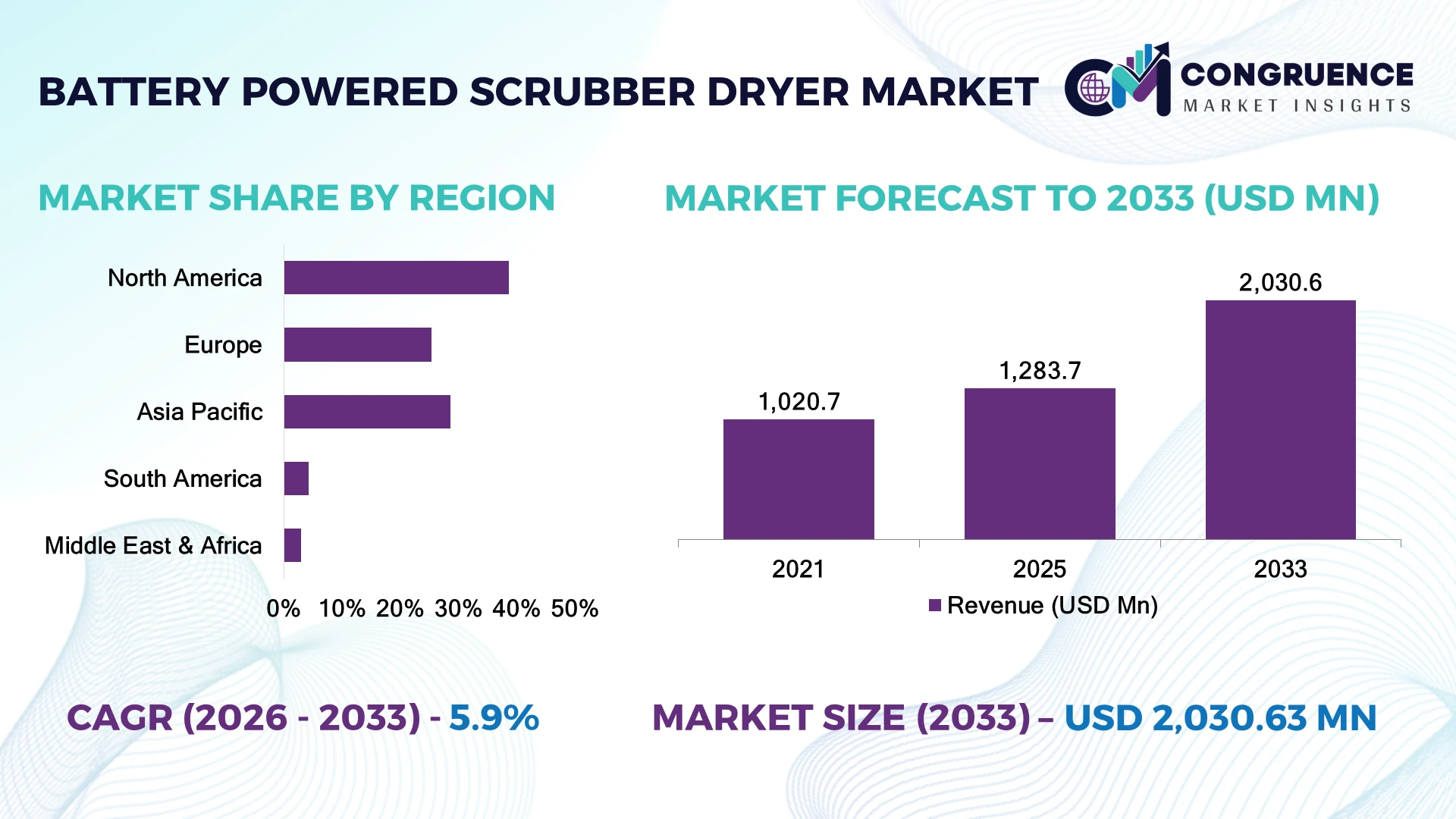
The Global Battery-Powered Scrubber Dryer Market was valued at USD 1,283.7 Million in 2025 and is anticipated to reach a value of USD 2,030.6 Million by 2033 expanding at a CAGR of 5.9% between 2026 and 2033. Growth is being driven by the replacement of corded and combustion-based cleaning equipment with lithium-ion autonomous machines that improve floor-cleaning productivity while reducing charging downtime and indoor emissions.
The United States remains the dominant country, supported by large-scale deployment across warehouses, airports, hospitals, retail facilities, and contract-cleaning operations, with commercial users increasingly shifting toward lithium-ion platforms that can deliver roughly 15–25% higher usable operating productivity than older lead-acid configurations. China combines manufacturing scale with competitive battery and motor supply, while Germany emphasizes energy-efficient industrial cleaning. In 2026, tighter sustainability procurement requirements across large facilities are accelerating equipment replacement decisions.
Strategically, suppliers that combine battery efficiency, fleet connectivity, rapid charging, and service coverage are better positioned to capture enterprise replacement cycles.
Market Size & Growth: USD 1,283.7 million in 2025 to USD 2,030.6 million by 2033 at 5.9% CAGR, supported by lithium-ion fleet modernization.
Top Growth Drivers: Lithium-ion adoption 28%, labor-productivity pressure 24%, automated cleaning 18%.
Short-Term Forecast: By 2028, advanced machines target 15–20% lower operating costs and 10–15% higher cleaning productivity.
Emerging Technologies: Lithium-ion batteries, IoT fleet monitoring, autonomous navigation, and AI-assisted route optimization are reshaping commercial cleaning.
Regional Leaders: North America, Europe, and Asia-Pacific lead deployment, with institutional users increasingly adopting cordless equipment for large indoor facilities.
Consumer/End-User Trends: Contract cleaners and warehouse operators are driving battery-platform adoption, with fleet replacement activity rising approximately 12%.
Pilot/Case Example: 2025 autonomous-cleaning deployments demonstrated approximately 20% reductions in manual cleaning hours across high-traffic commercial environments.
Competitive Landscape: Major suppliers including Tennant, Nilfisk, Kärcher, Hako, and Diversey compete through battery runtime, maneuverability, service networks, and automation.
Regulatory & ESG Impact: Sustainability-focused procurement is increasing preference for zero-tailpipe-emission indoor equipment by approximately 10–15% among large facility operators.
Investment & Funding: Equipment manufacturers are increasing investment in lithium-ion platforms, connected fleets, robotics, and aftermarket service infrastructure.
Innovation & Future Outlook: 2026–2030 competition is shifting toward autonomous navigation, predictive maintenance, modular batteries, and software-enabled fleet optimization.
Battery-powered scrubber dryers are becoming operationally important across warehouses, supermarkets, healthcare facilities, airports, manufacturing plants, and commercial buildings. Lithium-ion systems now enable longer duty cycles, faster charging, and lower maintenance requirements, while connected machines increasingly provide utilization data and maintenance alerts. Adoption is particularly strong where labor availability and uninterrupted floor access directly affect operating costs. The 2026 emphasis on energy efficiency and electrification is pushing facility managers toward measurable total-cost-of-ownership decisions rather than simple equipment-price comparisons.
Battery-powered scrubber dryers are becoming strategic assets in commercial facility operations because cleaning productivity, labor utilization, and equipment uptime increasingly influence total operating costs. Large warehouses, logistics centers, hospitals, airports, and retail networks are replacing manually intensive cleaning workflows with ride-on and walk-behind electric systems. Lithium-ion platforms typically deliver 15–25% more usable runtime and substantially faster recharge cycles than conventional lead-acid configurations, improving shift continuity and reducing maintenance intervention.
The competitive landscape differs by market. North American operators emphasize fleet productivity and service coverage, European buyers place greater weight on energy efficiency and sustainability metrics, while Chinese manufacturers increasingly compete through battery integration, electronics, and equipment cost. Over the next 2–3 years, connected fleet adoption is positioned to rise as operators seek 10–15% improvements in machine utilization through route tracking, battery monitoring, and preventive maintenance.
A practical shift is emerging in distribution centers, where autonomous-capable scrubber dryers can perform repetitive cleaning during low-traffic periods without disrupting material handling. Manufacturers are therefore prioritizing robotics partnerships, modular battery systems, software integration, and regional service networks. Competitive advantage increasingly depends on delivering measurable cleaning productivity and lifecycle economics rather than machine specifications alone.
Lithium-ion battery adoption is reshaping commercial floor-cleaning fleets because faster charging, longer usable runtime, and lower maintenance requirements improve equipment utilization. Advanced battery-powered scrubber dryers can deliver approximately 15–25% higher usable productivity than comparable lead-acid configurations, while charging time can fall by 30–50%. In the United States, large warehouses, airports, hospitals, and retail facilities are increasingly prioritizing cordless equipment to eliminate cable-management constraints and reduce indoor emissions. European procurement programs are reinforcing this shift through energy-efficiency criteria. Manufacturers are responding with modular battery platforms, rapid-charging systems, and connected fleet monitoring. The strategic advantage is shifting from equipment price toward total cost of ownership, battery uptime, and serviceability.
High initial equipment costs and battery replacement economics remain material constraints for smaller cleaning contractors. Lithium-ion configurations can carry approximately 20–40% higher upfront costs than conventional lead-acid machines, while battery systems can represent 25–35% of equipment value. Charging infrastructure also becomes restrictive in facilities operating multiple shifts without dedicated electrical capacity. In India and parts of Southeast Asia, fragmented service networks can increase downtime when battery-management electronics require specialized technicians. Supply-chain volatility affecting battery cells, power electronics, and replacement components adds further cost pressure. Manufacturers are reducing exposure through localized assembly, multi-supplier battery sourcing, standardized components, extended service contracts, and leasing models that spread capital expenditure across operating periods.
Autonomous navigation and connected fleet management are opening higher-value applications in warehouses, airports, hospitals, and large retail facilities. AI-assisted route optimization can reduce unnecessary machine travel by approximately 15–20%, while telemetry-based maintenance programs can improve equipment availability by 10–15%. In Germany and the United States, labor shortages are strengthening the business case for machines capable of scheduled operation during low-traffic periods. Manufacturers are integrating LiDAR, machine vision, geofencing, battery analytics, and cloud dashboards into premium platforms. The non-obvious opportunity lies in converting scrubber dryers from standalone cleaning equipment into managed productivity assets. Companies combining hardware, software, financing, and aftermarket services can capture recurring revenue while improving customer retention.
Scaling intelligent scrubber dryers requires reliable integration between navigation systems, facility layouts, safety controls, and human-operated cleaning workflows. Deployment complexity can increase by 20–30% when machines require site mapping, restricted-zone programming, and interoperability with facility-management systems. Cybersecurity also becomes relevant as connected equipment transmits operational and maintenance data across enterprise networks. In the United States and Europe, large facilities increasingly require documented safety performance before autonomous equipment enters shared workspaces. Manufacturers therefore need stronger software validation, technician training, remote diagnostics, and integration partnerships. The critical long-term challenge is not machine autonomy alone but achieving consistent cleaning performance across changing floor layouts, traffic conditions, and multi-vendor facility environments.
Lithium-Ion Runtime Gains Lithium-ion platforms are replacing lead-acid systems as operators prioritize longer duty cycles and faster turnaround. Newer battery architectures can provide approximately 15–25% higher usable productivity, while recharge periods fall by 30–50%. Manufacturers are expanding modular battery ranges and rapid-charging options, particularly for multi-shift warehouses and healthcare facilities.
Connected Fleet Monitoring Commercial fleets are moving toward telemetry-enabled machines, with connected equipment penetration approaching 20–30% in technology-forward enterprise deployments. Battery health, utilization, location, and maintenance alerts reduce avoidable downtime by roughly 10–15%. Suppliers are integrating cloud dashboards and remote diagnostics, turning service contracts into data-driven fleet-management programs.
Autonomous Cleaning Deployment Autonomous-capable scrubber dryers are moving beyond pilots into controlled warehouse, airport, and retail environments. Route optimization can reduce unnecessary machine movement by 15–20%, while scheduled overnight operation improves floor-access efficiency. Companies are partnering around LiDAR, machine vision, and safety software to address labor shortages without disrupting daytime facility operations.
Service Models Reshape Purchasing Equipment procurement is increasingly shifting toward leasing, managed cleaning, and uptime-based contracts as enterprises seek predictable operating costs. Service-based models can reduce upfront capital exposure by approximately 20–30%, particularly for large fleets. Manufacturers are responding with battery warranties, preventive-maintenance packages, financing partnerships, and regional service hubs, making lifecycle support a stronger competitive differentiator.
Walk-behind scrubber dryers lead the market with an estimated 60–65% share, supported by lower acquisition costs, compact dimensions, and strong suitability for supermarkets, hospitals, schools, and medium-sized commercial facilities. Their maneuverability remains a decisive advantage where cleaning routes include narrow aisles, furniture, or continuously occupied spaces. Ride-on scrubber dryers account for roughly 35–40% but represent the faster-growing type as warehouses, logistics centers, airports, and manufacturing sites prioritize higher area coverage and reduced labor intensity. Industry market analysis also identifies walk-behind models as the largest product segment, with approximately 65% share in 2024, while ride-on machines recorded the stronger growth trajectory.
The mature walk-behind segment is shifting toward lithium-ion batteries, ergonomic controls, connected diagnostics, and autonomous-assist features, while ride-on investment is concentrating on larger tanks, extended runtime, and high-throughput cleaning. Manufacturers are increasingly developing modular platforms that serve both configurations, allowing fleet operators to standardize batteries and service components. The strategic priority is therefore moving toward ride-on automation without weakening the established walk-behind replacement market.
Industry-backed insight: A 2025 field study observed 498 pedestrians around autonomous cleaning robots, showing that machine movement patterns materially influence human lateral movement and reinforcing the importance of safe human-machine interaction in commercial environments.
Commercial cleaning represents the leading application, accounting for approximately 43–45% of market demand, supported by supermarkets, retail complexes, hotels, offices, airports, and other facilities requiring frequent floor maintenance. Industrial cleaning follows at approximately 35–38%, with demand concentrated in warehouses, manufacturing plants, logistics hubs, and distribution centers where larger floor areas favor higher-capacity equipment. Healthcare and institutional environments remain strategically important because cleaning frequency, low operating noise, and controlled water use directly influence equipment selection.
Industrial cleaning is the faster-expanding application as warehouse automation, larger distribution footprints, and multi-shift operations increase the value of mechanized floor maintenance. Operators increasingly prioritize ride-on configurations, lithium-ion runtime, rapid charging, and autonomous navigation, while commercial facilities continue favoring compact machines with high maneuverability. Manufacturers are responding with application-specific brush systems, variable-pressure controls, larger recovery tanks, and connected fleet management. This shift is strategically important because industrial contracts typically support larger fleet deployments, whereas commercial customers create broader replacement volumes and recurring aftermarket demand.
Industry-backed insight: A 2025 field observation involving 498 pedestrians around autonomous cleaning robots demonstrated measurable changes in pedestrian movement according to robot size and movement pattern, highlighting the operational importance of predictable navigation in occupied facilities.
Healthcare facilities represent a leading end-user segment, accounting for an estimated 28–30% of demand, driven by hospitals and medical facilities requiring repeatable floor cleaning, low-noise operation, controlled water recovery, and equipment capable of working around patients and staff. Retail follows at approximately 24–26%, supported by supermarkets, shopping centers, and large-format stores with high pedestrian traffic. Hospitality remains important, particularly where compact equipment and quiet operation are essential across hotels and public areas.
Warehousing and logistics represent the fastest-growing end-user group as distribution centers expand floor coverage and operate increasingly automated, multi-shift workflows. These buyers place greater emphasis on productivity, battery runtime, autonomous navigation, and machine utilization than healthcare operators. Approximately 60% of large industrial deployments increasingly favor higher-throughput configurations, encouraging manufacturers to develop ride-on platforms, larger battery systems, fleet analytics, and preventive-maintenance packages. Healthcare buyers continue prioritizing maneuverability and hygiene-focused controls, while retail emphasizes speed and operational flexibility. Competitive positioning is therefore shifting toward customized equipment packages rather than standardized machines across all end-user categories.
Industry-backed insight: A 2025 autonomous-cleaning-robot field study involving 498 observed pedestrians found that robot dimensions and movement patterns affected lateral pedestrian adaptations, underscoring the need for safe deployment protocols in occupied healthcare, retail, and institutional environments.
North America accounted for the largest market share at 34.2% in 2025 however, Asia-Pacific is expected to register the fastest growth, expanding at a CAGR of 7.1% between 2026 and 2033.
Fleet Electrification and High-Productivity Cleaning Drive Adoption
North America holds the leading position with approximately 34.2% of global battery-powered scrubber dryer demand, supported by extensive warehouse, retail, healthcare, airport, and institutional cleaning operations. The United States represents the primary demand center, with large facility operators increasingly replacing lead-acid equipment with lithium-ion platforms offering faster charging and approximately 15–25% higher usable productivity. Distribution centers and large-format retailers are particularly important deployment hubs because extended floor areas favor ride-on and autonomous-capable machines. Battery-powered equipment also aligns with indoor air-quality and sustainability requirements where combustion-powered alternatives are unsuitable. Manufacturers are strengthening regional service networks, financing programs, and connected fleet offerings to accelerate replacement cycles. The strategic opportunity is concentrated in enterprise fleets where uptime, labor productivity, and lifecycle maintenance costs justify premium equipment.
United States Market Outlook: The United States provides the strongest commercial base through its extensive logistics, healthcare, retail, aviation, and industrial infrastructure. Large distribution facilities increasingly favor ride-on machines with lithium-ion batteries, telemetry, and autonomous navigation because cleaning must occur without interrupting material-handling workflows. Contract cleaning companies are also adopting fleet leasing and service agreements to reduce upfront capital requirements. Approximately 20–30% of technology-oriented enterprise fleets are incorporating connected equipment capabilities, strengthening demand for remote diagnostics and utilization analytics. The country's mature aftermarket infrastructure gives manufacturers an additional advantage through replacement batteries, brushes, service contracts, and software-enabled maintenance.
Sustainability Procurement Accelerates Low-Emission Fleet Replacement
Europe represents approximately 29% of global demand, with Germany, France, the United Kingdom, Italy, and the Nordic markets supporting substantial deployment across industrial facilities, retail, logistics, hospitality, and healthcare. Sustainability-oriented procurement is shifting purchasing criteria toward lithium-ion efficiency, water conservation, low-noise operation, and measurable lifecycle performance. Germany remains particularly important because its industrial and logistics base supports higher adoption of ride-on and automated cleaning equipment. Manufacturers are responding with energy-efficient motors, battery-management systems, recyclable components, and autonomous-assist functions. European buyers increasingly evaluate total operating cost alongside purchase price, strengthening premium positioning for machines capable of reducing labor requirements and extending operating cycles.
Germany Market Outlook: Germany is the region's most strategically significant market because of its dense manufacturing, logistics, retail, and commercial infrastructure. Large industrial facilities increasingly require cleaning equipment capable of operating around automated material-handling systems without interrupting production workflows. Battery-powered scrubber dryers with lithium-ion packs and autonomous navigation are gaining relevance for these environments, while low-noise operation supports deployment in occupied commercial facilities. Approximately 15–20% productivity improvement is achievable when high-capacity ride-on equipment replaces smaller manual cleaning workflows across suitable large-floor applications. Manufacturers are therefore prioritizing German partnerships, technical service coverage, fleet-management systems, and application-specific configurations.
Manufacturing Scale and Warehouse Automation Reshape Demand
Asia-Pacific is the fastest-expanding market, supported by manufacturing expansion, modern retail development, logistics infrastructure, airports, hospitals, and large commercial facilities. China provides substantial production capacity for motors, batteries, electronics, and cleaning equipment, strengthening local supply economics, while Japan and South Korea emphasize automation, reliability, and advanced battery technologies. India is emerging as an important deployment market as organized retail, warehousing, healthcare, and industrial facilities expand. Large logistics and manufacturing sites increasingly favor ride-on machines because higher floor coverage can reduce cleaning labor intensity by approximately 15–25%. Manufacturers are responding through localized production, lithium-ion integration, competitive pricing, and partnerships with facility-management companies.
China Market Outlook: China combines manufacturing depth with a rapidly expanding base of warehouses, industrial facilities, shopping complexes, airports, and institutional buildings. Domestic availability of battery cells, electric motors, controllers, and power electronics supports competitive equipment costs and faster product localization. Manufacturers are increasingly integrating lithium-ion systems, intelligent water dosing, battery-management software, and autonomous navigation into commercial cleaning platforms. China's large logistics facilities provide particularly strong opportunities for ride-on scrubber dryers, where higher cleaning coverage directly supports labor productivity. Approximately 20% lower equipment acquisition costs can be targeted through localized component sourcing compared with comparable imported configurations, strengthening the country's role as both a production and deployment hub.
Retail Modernization and Industrial Cleaning Support Expansion
South America represents a smaller but increasingly commercialized market, with Brazil accounting for the largest share of regional demand through supermarkets, shopping centers, airports, food-processing facilities, warehouses, and manufacturing sites. Battery-powered machines are particularly attractive where operators require low-noise cleaning and flexible operation around customers or production personnel. Brazil's expanding logistics and organized-retail infrastructure is increasing demand for ride-on equipment, while Argentina, Chile, and Colombia provide additional institutional and commercial opportunities. Deployment remains more sensitive to equipment financing, imported component costs, and after-sales availability than in mature markets. Suppliers are therefore emphasizing localized distribution, leasing, service contracts, and standardized replacement components. Approximately 10–15% productivity gains from mechanized cleaning create the strongest business case in large-format facilities.
Brazil Market Outlook: Brazil is the region's principal market because of its large retail footprint, industrial base, food-processing activity, logistics facilities, and commercial real-estate inventory. Supermarkets and distribution centers are important buyers because extensive floor areas justify battery-powered ride-on equipment over labor-intensive manual cleaning. Local distributors increasingly support equipment sales with maintenance contracts, financing, and replacement consumables, reducing downtime associated with imported components. Lithium-ion models are gaining traction where facilities operate extended cleaning schedules and require faster turnaround between shifts. Brazil's expanding warehouse and organized-retail infrastructure creates a strong pathway for larger machines, connected fleets, and autonomous-ready cleaning systems.
Large-Scale Facility Development Creates Premium Equipment Demand
The Middle East & Africa market is being shaped by airports, shopping malls, hotels, hospitals, logistics facilities, and large commercial developments requiring high-capacity floor-cleaning equipment. The United Arab Emirates and Saudi Arabia represent key demand centers because large hospitality, aviation, retail, and infrastructure projects create concentrated requirements for professional cleaning fleets. Battery-powered systems are particularly suitable for enclosed premium facilities where low noise and zero tailpipe emissions are operational priorities. Large projects increasingly specify mechanized cleaning equipment alongside facility-management contracts, supporting fleet-scale procurement. Suppliers are expanding distributor networks, service coverage, and financing arrangements to address after-sales requirements. Premium ride-on and autonomous-capable machines can improve cleaning productivity by approximately 20–30% in large facilities, strengthening their investment case.
United Arab Emirates Market Outlook: The United Arab Emirates provides the strongest regional opportunity through its concentration of airports, hotels, shopping malls, healthcare facilities, exhibition venues, and large commercial properties. Facility operators require compact but high-productivity machines capable of working around continuous pedestrian traffic, making battery-powered systems particularly suitable. Dubai and Abu Dhabi also support technologically advanced deployments where connected fleet monitoring and autonomous navigation can improve equipment utilization. Large hospitality and retail facilities increasingly favor lithium-ion platforms because rapid charging and low-noise operation support daytime cleaning without disrupting customers. Approximately 20% higher productivity from ride-on configurations can materially improve cleaning economics across large floor areas, encouraging suppliers to combine equipment, service, and fleet-management contracts.
The Battery-Powered Scrubber Dryer market pits global equipment leaders such as Tennant, Nilfisk, Kärcher, Hako, and Comac against regional manufacturers competing primarily on price, service reach, and customization. The top five players are estimated to command about 45% of market value, leaving substantial room for specialized suppliers. Competition centers on battery runtime, cleaning productivity, automation, water efficiency, and lifecycle support; premium platforms target 15–25% productivity gains, while cost-focused models compete through 10–20% lower acquisition costs. Companies are expanding regional manufacturing, partnering with robotics and software providers, and vertically integrating batteries, controls, and fleet-management systems. The competitive shift is moving from mechanical cleaning performance toward autonomous navigation, connected diagnostics, and recurring service models. Entry barriers include established dealer networks, service infrastructure, battery engineering, and safety validation. Winning requires differentiated total-cost economics, dependable uptime, rapid service, and scalable automation rather than equipment pricing alone across large enterprise and contract-cleaning fleets globally today.
Tennant Company
Nilfisk Group
Kärcher
Hako GmbH
Comac S.p.A.
Fimap S.p.A.
Diversey Holdings
Numatic International
RPS Corporation
Adiatek S.r.l.
AMANO Corporation
NSS Enterprises
Lithium-ion power systems are becoming the baseline technology for battery-powered scrubber dryers, replacing lead-acid configurations in demanding fleets. Modern lithium-ion platforms deliver roughly 15–25% higher usable productivity through faster charging, stable voltage, and reduced maintenance. Battery-management systems add thermal monitoring and charge optimization, while connected telemetry tracks runtime, battery health, utilization, and service intervals. Adoption is strongest in enterprise fleets where uptime directly affects labor economics.
Autonomous navigation is the most disruptive technology shift. LiDAR, cameras, mapping software, and AI-based obstacle detection enable machines to operate with limited supervision in warehouses, airports, and retail facilities. Autonomous platforms can reduce repetitive operator involvement by approximately 20–30% in suitable workflows, while automated docking supports longer operating windows. Compared with conventional operator-controlled machines, route optimization can improve productive coverage by around 10–20%. Tennant, Kärcher, Nilfisk, and other technology-focused suppliers benefit most as software, robotics, and hardware become integrated purchasing criteria.
From 2026 to 2028, fleet-management platforms, predictive maintenance, autonomous docking, and energy-aware cleaning controls will increasingly converge. Connected equipment can improve machine utilization by 10–15% by identifying idle time and maintenance needs. Companies acting now can secure software ecosystems, service contracts, and enterprise fleet relationships before autonomous cleaning becomes a standardized procurement requirement.
April 2025 Tennant Company launched the X6 ROVR autonomous scrubber, covering up to 75,000 square feet per tank with optional autonomous charging. The launch expands robotic cleaning into larger commercial facilities, addressing labor constraints while increasing machine utilization. Source: tennantco.com
February 2025 Tennant Company began manufacturing T16AMR autonomous scrubbers in the Netherlands, establishing localized European production. The move shortens lead times, reduces transportation complexity, and strengthens regional service responsiveness as autonomous cleaning adoption expands across industrial facilities and commercial sites. Source: roboticsandautomationnews.com
October 2025 Kärcher launched the KIRA B 200 autonomous scrubber dryer with a 200-liter water tank, improved connectivity, and speed-dependent water dosing. The platform targets warehouses and distribution centers, increasing capacity while reducing manual intervention and enabling management. Source: issa.com
January 2025 Truvox International launched the Multiwash PRO Battery scrubber dryer with up to 60 minutes of runtime. The battery configuration extends mechanized cleaning into locations without accessible power, supporting deployment across hard floors, carpets, and entrance matting. Source: nature.com (Nature)
The Battery-Powered Scrubber Dryer Market Report evaluates product demand across walk-behind, ride-on, stand-on, and autonomous-capable configurations, with application coverage spanning commercial, industrial, institutional, healthcare, hospitality, retail, logistics, and other large-floor environments. The analysis assesses lithium-ion adoption, battery architecture, connected fleet management, automated dosing, autonomous navigation, charging systems, and emerging service-based equipment models.
Regional coverage includes North America, Europe, Asia-Pacific, South America, and the Middle East & Africa, with country-level assessment of manufacturing capacity, enterprise deployment, distribution infrastructure, and replacement activity. The report examines leading companies, competitive positioning, pricing dynamics, aftermarket strategies, and technology differentiation, including the shift toward automation and fleet intelligence. Quantitative segmentation indicators and adoption patterns support investment planning, market-entry decisions, regional expansion, product portfolio prioritization, partnership strategy, and competitive positioning through 2026–2033.
| Report Attribute/Metric | Report Details |
|---|---|
|
Market Revenue in 2025 |
USD 1,283.7 Million |
|
Market Revenue in 2033 |
USD 2,030.6 Million |
|
CAGR (2026 - 2033) |
5.9% |
|
Base Year |
2025 |
|
Forecast Period |
2026 - 2033 |
|
Historic Period |
2021 - 2025 |
|
Segments Covered |
By Type
By Application
By End-User
|
|
Key Report Deliverable |
Revenue Forecast, Growth Trends, Market Dynamics, Segmental Overview, Regional and Country-wise Analysis, Competition Landscape |
|
Region Covered |
North America, Europe, Asia-Pacific, South America, Middle East, Africa |
|
Key Players Analyzed |
Tennant Company, Nilfisk Group, Kärcher, Hako GmbH, Comac S.p.A., Fimap S.p.A., Diversey Holdings, Numatic International, RPS Corporation, Adiatek S.r.l., AMANO Corporation, NSS Enterprises |
|
Customization & Pricing |
Available on Request (10% Customization is Free) |




