
Reports
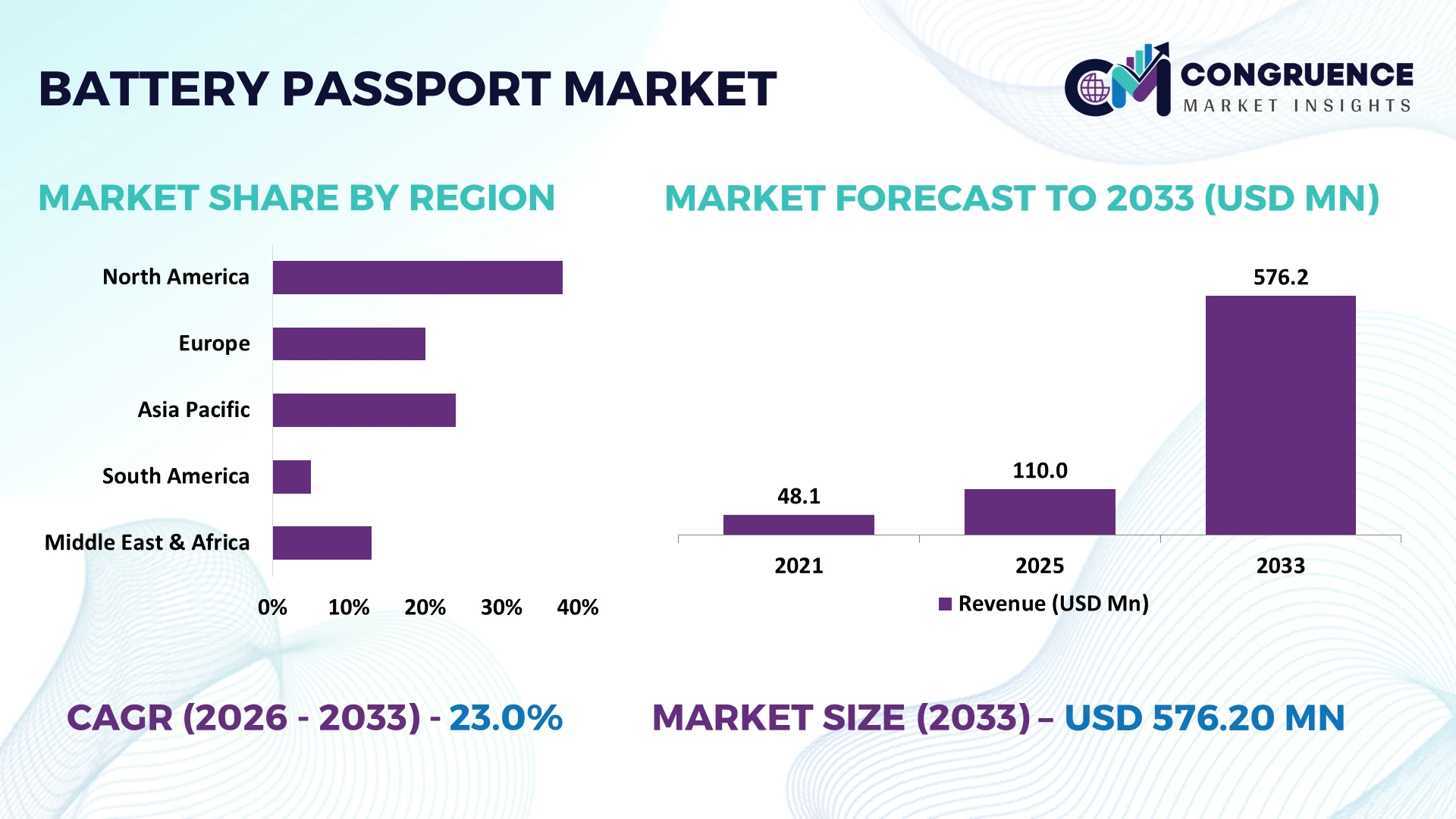
The Global Battery Passport Market was valued at USD 110 Million in 2025 and is anticipated to reach a value of USD 576.2 Million by 2033 expanding at a CAGR of 23% between 2026 and 2033. Growth is being accelerated by mandatory battery traceability requirements, expanding electric vehicle production, digital product identity platforms, and cross-border supply chain transparency initiatives across advanced battery ecosystems.
China remains the dominant country, accounting for approximately 58% of global lithium-ion battery manufacturing capacity while supporting over 45% of large-scale battery traceability deployments through integrated EV and energy storage supply chains. Compared with the European Union, which is accelerating digital battery compliance through regulatory implementation and industrial investments, China maintains stronger manufacturing scale, whereas Europe leads in standardized battery data governance. Rising strategic investments linked to critical mineral security and post-2025 industrial policies continue strengthening technology adoption across automotive, battery manufacturing, and recycling sectors.
Organizations investing in interoperable battery passport platforms, secure data exchange, and lifecycle compliance capabilities will strengthen global market positioning and supply chain resilience.
Market Size & Growth: USD 110 Million in 2025, reaching USD 576.2 Million by 2033 at a CAGR of 23%, driven by digital battery traceability and lifecycle compliance across global EV supply chains.
Top Growth Drivers: Battery traceability adoption exceeds 40%, EV battery production expands by over 25%, and recycling data integration improves operational visibility by nearly 30%.
Short-Term Forecast: By 2028, automated battery compliance processes reduce documentation costs by approximately 28% while improving data verification efficiency by 35%.
Emerging Technologies: AI-driven analytics, blockchain-based digital identity, and IoT-enabled battery monitoring increase traceability accuracy by nearly 32% across advanced manufacturing networks.
Regional Leaders: Asia-Pacific approaches USD 245 Million, Europe exceeds USD 170 Million, and North America nears USD 105 Million, supported by expanding regulatory adoption and localized battery supply chains.
Consumer/End-User Trends: More than 60% of automotive manufacturers prioritize battery lifecycle transparency to strengthen sustainability reporting and supplier qualification.
Pilot/Case Example: During 2026, industrial battery passport pilots improved material traceability by approximately 40% while reducing manual compliance processing by nearly 30%.
Competitive Landscape: The top supplier group controls roughly 42% of advanced battery passport deployments, with competition centered on software integration, cybersecurity, digital identity, and lifecycle analytics capabilities.
Regulatory & ESG Impact: Compliance-focused battery passport implementation improves verified carbon reporting by over 35% while supporting stricter international battery trade requirements amid supply chain realignment.
Investment & Funding: More than USD 2.1 Billion in ecosystem investments supports digital battery infrastructure, strategic partnerships, and scalable compliance platforms across major manufacturing regions.
Innovation & Future Outlook: Digital twins, interoperable battery data standards, and cloud-native lifecycle platforms accelerate next-generation battery intelligence, strengthening circular economy execution and cross-border operational transparency.
Battery Passport Market demand is expanding across electric vehicles, stationary energy storage, battery recycling, and critical mineral traceability, where digital lifecycle management has become a competitive requirement. AI-enabled verification, blockchain-backed data integrity, and cloud-based compliance platforms are reducing reporting complexity, with digital process automation improving operational efficiency by approximately 30%. Regulatory alignment and resilient supply-chain coordination are reshaping procurement priorities, creating a strong foundation for the strategic market assessment that follows.
Battery passport platforms are becoming a strategic differentiator as manufacturers compete on traceability, regulatory compliance, and critical mineral transparency rather than production volume alone. Digital product identity is reshaping battery supply-chain governance, particularly following stricter lifecycle reporting requirements and localized battery manufacturing initiatives. More than 55% of large battery producers are integrating digital traceability into quality and compliance workflows, strengthening procurement decisions while reducing verification delays across automotive and energy storage value chains.
Cloud-based battery passport platforms combined with AI-driven analytics process lifecycle records around 35% faster than legacy document-centric compliance systems while lowering manual verification effort by nearly 30%. Germany is advancing standardized industrial deployment through automotive innovation, whereas China continues scaling implementation through vertically integrated battery manufacturing ecosystems with broader production coverage. Over the next two to three years, enterprise deployment across large battery manufacturing facilities is expected to exceed 65%, supported by interoperability standards and automated data-sharing frameworks.
A practical example is battery manufacturers connecting mining, cell production, logistics, and recycling records into a unified digital passport, reducing audit preparation time and improving supplier validation. Companies are increasing investments in secure data infrastructure, software partnerships, and digital compliance platforms to strengthen cross-border operations. Organizations that establish interoperable battery passport ecosystems early will secure stronger competitive positioning, improve operational resilience, and build long-term supply-chain credibility.
Mandatory battery traceability requirements and expanding electric mobility ecosystems are accelerating enterprise adoption of battery passport solutions. Around 60% of global automotive battery suppliers are strengthening lifecycle data management, while automated digital compliance reduces documentation processing time by nearly 30% and improves traceability accuracy by approximately 35%. The European battery regulatory framework has encouraged manufacturers to redesign supply-chain data architecture, creating stronger demand for interoperable digital platforms. In response, companies are expanding software capabilities, forming technology partnerships, and integrating blockchain, AI, and IoT into battery management systems. A notable strategic shift is the growing alignment between battery producers and recycling firms, enabling closed-loop material verification that strengthens procurement confidence and long-term operational efficiency.
Fragmented digital ecosystems remain a major structural limitation for battery passport deployment. Nearly 45% of suppliers continue operating with incompatible enterprise systems, while cross-platform data integration can increase implementation costs by approximately 20%. Critical mineral sourcing across multiple countries creates inconsistent reporting formats and verification procedures, slowing seamless information exchange throughout the battery lifecycle. These limitations affect deployment speed, compliance consistency, and operational scalability for multinational manufacturers. Companies are reducing exposure by localizing digital infrastructure, adopting standardized APIs, strengthening long-term technology agreements, and diversifying software providers. Organizations capable of simplifying interoperability across suppliers gain a measurable operational advantage through faster compliance execution and improved supply-chain coordination.
Battery passport platforms are evolving beyond compliance into operational intelligence systems that support predictive lifecycle management and circular economy optimization. AI-enabled analytics improve battery health forecasting by nearly 25%, while automated material recovery tracking increases recycling process visibility by around 30%. Japan and South Korea are accelerating investment in smart battery ecosystems integrating digital twins, cloud analytics, and advanced manufacturing intelligence. Companies are expanding R&D, collaborating with battery recyclers, and developing interoperable digital platforms that support secondary battery markets and remanufacturing services. A less obvious opportunity lies in battery financing and insurance, where verified lifecycle records improve asset valuation, reduce transactional uncertainty, and enable more efficient risk assessment across commercial fleets.
Long-term execution depends on securely managing massive volumes of battery lifecycle information across globally distributed supply chains. More than 50% of manufacturers identify cybersecurity and secure data exchange as critical deployment priorities, while complex supplier onboarding can extend implementation timelines by approximately 25%. Industrial hubs in China and Germany must coordinate thousands of suppliers using consistent digital identity frameworks without compromising confidential manufacturing information. These execution challenges influence deployment consistency, operational trust, and international competitiveness. Companies must strengthen encrypted data infrastructure, invest in cybersecurity expertise, expand cloud security partnerships, and establish common governance frameworks. Sustainable competitive leadership will depend on secure, scalable, and interoperable battery passport ecosystems rather than standalone compliance capabilities alone.
AI-Driven Compliance Automation Battery manufacturers are replacing manual compliance workflows with AI-enabled verification engines that improve document validation accuracy by approximately 34% and reduce processing time by nearly 30%. Regulatory enforcement and expanding battery production are accelerating deployment across Germany and South Korea. Companies are integrating AI with enterprise resource planning systems, enabling faster supplier qualification, lower administrative costs, and more consistent lifecycle reporting across complex manufacturing networks.
Cross-Enterprise Data Interoperability Standardized digital information exchange is becoming a priority as over 55% of large battery supply chains adopt interoperable data architectures to simplify cross-company collaboration. Unified digital identity frameworks reduce duplicate reporting by around 25% while improving audit readiness by nearly 32%. Manufacturers are responding through software alliances, common data standards, and cloud-native platforms that streamline supplier onboarding and strengthen operational visibility across international battery ecosystems.
Recycling Integration Expands Battery passport deployment is extending beyond manufacturing into end-of-life material recovery as recycled material verification improves traceability efficiency by approximately 35%. Circular economy regulations and critical mineral security concerns are driving battery recyclers to establish direct digital connectivity with manufacturers. Companies are expanding partnerships with recycling specialists, enabling automated material authentication and supporting more efficient resource recovery without disrupting production continuity.
Secure Digital Identity Networks Enterprise investment is shifting toward encrypted battery identity platforms capable of protecting sensitive manufacturing data while supporting high-volume transactions. Around 48% of advanced deployments now incorporate secure digital identity technologies, reducing unauthorized data access risks by nearly 27%. China and Japan are strengthening secure battery information infrastructure through industrial digitalization programs, while technology providers continue scaling cybersecurity capabilities to reinforce operational trust and international supply-chain coordination.
Cloud-Based solutions dominate the Battery Passport Market with an estimated 46% share, supported by rapid scalability, lower infrastructure costs, and seamless integration with enterprise resource planning and manufacturing execution systems. Large automotive and battery manufacturers increasingly prefer cloud deployment because it accelerates supplier connectivity and enables centralized lifecycle data management across international operations. On-Premises platforms remain important for organizations managing highly sensitive manufacturing information and strict internal cybersecurity requirements, particularly in industrial facilities requiring complete data control.
Blockchain-Based platforms represent the fastest-growing segment as demand for tamper-resistant lifecycle records and transparent critical mineral verification accelerates. Adoption has increased by approximately 33% across advanced battery ecosystems, while Hybrid deployments are expanding as enterprises balance cloud flexibility with secure local infrastructure. Companies are investing in interoperable architectures, strategic software partnerships, and modular deployment models that simplify implementation while supporting evolving regulatory frameworks. Investment priorities continue shifting toward platforms capable of combining secure data exchange with operational scalability across increasingly complex battery supply chains.
Battery Traceability accounts for approximately 43% of market deployment as manufacturers prioritize verified material origin, production transparency, and supplier accountability. Digital traceability has become operationally essential for automotive and industrial battery producers seeking streamlined compliance and improved procurement confidence. Compliance Management remains a mature application supporting automated documentation workflows, while Supply Chain Monitoring continues strengthening logistics visibility and supplier coordination across increasingly distributed manufacturing networks.
Lifecycle Management is the fastest-growing application as enterprises integrate battery health, maintenance, reuse, and recycling information into unified digital ecosystems. Deployment has expanded by nearly 31%, while automated lifecycle analytics improve operational planning efficiency by approximately 26%. Companies are scaling integrated software platforms, expanding digital monitoring capabilities, and connecting production with downstream recycling partners. Investment is increasingly directed toward applications that convert compliance data into operational intelligence, strengthening asset utilization and long-term battery value throughout the product lifecycle.
Automotive manufacturers represent the largest end-user segment with an estimated 49% share due to high battery deployment volumes, stringent lifecycle reporting requirements, and expanding electric vehicle production. Large vehicle manufacturers continue integrating battery passport capabilities directly into procurement and manufacturing operations to improve supplier validation and regulatory readiness. Battery Manufacturers form the second-largest customer group, strengthening digital quality management and production traceability across gigafactory operations through increasingly automated compliance systems.
Energy & Utilities is the fastest-growing end-user category as grid-scale battery storage deployment expands and lifecycle monitoring becomes operationally critical. Adoption has increased by approximately 30%, while digital battery asset management improves maintenance planning efficiency by nearly 24%. Electronics manufacturers continue adopting battery passports for premium portable devices requiring verified material sourcing and sustainability reporting. Companies are responding through sector-specific software customization, strategic technology partnerships, and ecosystem-based service offerings that address diverse operational requirements while strengthening long-term customer retention.
Asia-Pacific accounted for the largest market share at 44% in 2025 however, Europe is expected to register the fastest growth, expanding at a 25% CAGR between 2026 and 2033.
Digital Compliance Integration Across EV Supply Chains
North America represents a mature Battery Passport Market supported by advanced electric vehicle manufacturing, battery recycling investments, and enterprise software integration. The region contributes approximately 24% of global deployment activity, with battery passport implementation increasingly integrated into automotive production, energy storage systems, and critical mineral tracking. More than 55% of large battery manufacturers are digitizing lifecycle data management to strengthen supplier verification and regulatory readiness. Strategic partnerships between software providers, battery producers, and recycling operators continue expanding interoperable data ecosystems. Companies are prioritizing cybersecurity, cloud deployment, and automated compliance platforms to improve audit efficiency while supporting resilient domestic battery manufacturing strategies.
United States Market Outlook: The United States leads regional adoption through expanding battery manufacturing capacity, advanced software ecosystems, and large-scale electric vehicle production. More than 60% of new battery manufacturing projects incorporate digital lifecycle management planning during deployment. Technology providers continue investing in AI-enabled compliance platforms and enterprise integration capabilities, allowing manufacturers to improve supplier transparency, accelerate operational reporting, and strengthen end-to-end battery value chain management.
Regulatory Leadership Accelerates Standardized Deployment
Europe remains the global benchmark for standardized battery passport implementation through comprehensive lifecycle governance and industrial sustainability initiatives. The region accounts for approximately 31% of global deployment activity, supported by coordinated regulatory implementation and strong automotive manufacturing capabilities. More than 65% of major battery manufacturers are aligning digital reporting systems with standardized lifecycle documentation, improving cross-border operational consistency. Investments in battery recycling infrastructure and digital product identity platforms continue strengthening industrial collaboration while supporting transparent material sourcing. Companies increasingly deploy interoperable software architectures to simplify compliance across multinational manufacturing operations.
Germany Market Outlook: Germany serves as Europe's operational center through its automotive manufacturing strength, industrial automation expertise, and advanced battery research ecosystem. Around 40% of regional enterprise battery passport deployments involve German manufacturing networks. Automotive companies continue expanding partnerships with digital platform providers, enabling integrated battery lifecycle monitoring, supplier verification, and automated compliance processes across domestic and international production facilities.
Manufacturing Scale Drives Digital Traceability
Asia-Pacific leads the Battery Passport Market through unmatched battery production capacity, integrated supply chains, and expanding electric mobility infrastructure. The region contributes approximately 44% of global market activity, supported by vertically integrated battery manufacturing ecosystems and accelerating digital transformation. Nearly 58% of global lithium-ion battery production capacity remains concentrated within Asia-Pacific, encouraging rapid deployment of lifecycle traceability platforms. Manufacturers increasingly integrate battery passport solutions into production, logistics, and recycling operations to strengthen operational visibility and export readiness. Enterprise software providers continue expanding localized digital platforms supporting high-volume industrial deployment.
China Market Outlook: China dominates the regional market through large-scale battery manufacturing, advanced supply-chain integration, and extensive electric vehicle production infrastructure. More than 45% of industrial battery passport deployments are associated with Chinese battery manufacturing ecosystems. Domestic companies continue investing in intelligent manufacturing, blockchain-enabled traceability, and automated production data management to strengthen export competitiveness and operational transparency across global battery supply chains.
Critical Mineral Traceability Gains Momentum
South America is strengthening its strategic position through critical mineral production, expanding battery material processing, and increasing interest in digital supply-chain transparency. The region represents approximately 6% of global market deployment while attracting new investment linked to lithium extraction and responsible sourcing initiatives. Around 35% of new mining modernization programs now include digital traceability planning to improve downstream material verification. Infrastructure limitations continue affecting deployment speed, yet partnerships between mining companies and technology providers are improving operational visibility. Enterprises increasingly prioritize traceability solutions that support international battery manufacturers seeking verified raw material sourcing.
Chile Market Outlook: Chile remains the region's most influential market because of its global lithium industry and expanding digital mining initiatives. A growing share of lithium producers are integrating digital tracking systems into extraction and export operations to strengthen supply-chain transparency. Mining companies continue collaborating with technology firms to improve material authentication, enhance operational reporting, and align production with international battery manufacturing requirements.
Industrial Diversification Supports Digital Transformation
The Middle East & Africa market is expanding through industrial diversification, mining modernization, and strategic investment in advanced manufacturing ecosystems. The region contributes approximately 5% of global deployment activity while strengthening digital infrastructure supporting battery material traceability. More than 30% of newly announced battery mineral processing initiatives incorporate digital monitoring and lifecycle data capabilities. Governments and industrial investors continue prioritizing technology partnerships that improve transparency, operational efficiency, and international market access. Companies are integrating digital compliance platforms into mining and processing operations to strengthen competitiveness within global battery supply chains.
Saudi Arabia Market Outlook: Saudi Arabia is emerging as the region's leading market through industrial diversification strategies, digital infrastructure investments, and advanced manufacturing development. Multiple battery material processing initiatives now integrate digital lifecycle management during project planning. Enterprise partnerships supporting smart industrial platforms are strengthening operational readiness, improving supply-chain transparency, and positioning the country as a future participant within global battery manufacturing and traceability ecosystems.
Competition centers on global digital traceability providers such as Circulor, Minespider, Circularise, EVRYTHNG, and Battery Pass consortium participants competing against enterprise software integrators and specialized blockchain developers. The top five solution providers collectively account for approximately 48% of commercial deployments. Technology leadership, interoperability, cybersecurity, and implementation speed outweigh price competition, with AI-enabled workflow automation improving operational efficiency by nearly 30% and standardized data integration reducing onboarding time by about 25%. Companies compete through strategic partnerships with automotive manufacturers, battery producers, recycling firms, and mining enterprises while expanding cloud-native platforms and vertically integrated lifecycle management capabilities. The competitive shift favors interoperable ecosystems capable of connecting production, logistics, compliance, and recycling within a unified digital environment. Entry barriers include complex regulatory alignment, enterprise integration expertise, and trusted data governance. Sustained market leadership depends on scalable digital infrastructure, secure cross-enterprise collaboration, and seamless interoperability across global battery value chains.
Circulor
Minespider
Circularise
Everledger
OPTEL Group
Siemens
SAP
IBM
Accenture
Atos
AVEVA
Tata Consultancy Services
Infosys
Wipro
Cloud-native battery passport platforms, AI-powered data validation, and API-driven enterprise integration define the current technology landscape. Around 62% of new deployments use cloud architectures to connect mining, manufacturing, logistics, and recycling data through a unified lifecycle record. AI-assisted compliance engines improve document verification accuracy by approximately 34%, while automated workflows reduce manual processing time by nearly 30%. Companies increasingly integrate battery passport platforms with ERP, MES, and product lifecycle management systems, creating continuous digital traceability across complex supply chains and improving operational responsiveness.
Emerging technologies include blockchain-backed digital identity, digital twins, and IoT-enabled battery monitoring. Blockchain verification reduces data tampering risks by nearly 40%, while IoT-enabled lifecycle monitoring improves asset visibility by approximately 28%. Compared with legacy spreadsheet-based compliance systems, integrated digital platforms complete supplier verification about 45% faster while lowering administrative effort by roughly 32%. Nearly 48% of large battery manufacturers have initiated interoperable data-sharing frameworks, strengthening collaboration among battery producers, automotive OEMs, and recycling partners through standardized digital records.
Disruptive innovation between 2026 and 2028 will center on interoperable digital product passports, automated ESG reporting, and AI-driven predictive lifecycle analytics. Organizations deploying secure multi-enterprise platforms gain faster regulatory readiness, improved supplier transparency, and stronger procurement intelligence. Technology providers offering scalable cybersecurity, standardized interoperability, and intelligent analytics will outperform standalone software vendors as enterprise buyers increasingly prioritize integrated lifecycle ecosystems over isolated compliance applications.
June 2024 Global Battery Alliance launched the second wave of Battery Passport pilots involving 11 pilot consortia representing over 80% of global EV battery market share, significantly expanding real-world interoperability testing and standardized ESG reporting.
June 2024 Volvo Cars introduced the world's first production EV battery passport for the EX90, developed with Circulor, providing battery origin, recycled content, and carbon footprint data through a QR code, ahead of the 2027 EU requirement.
June 2025 Circulor announced a strategic cooperation with TÜV Rheinland to strengthen digital sustainable compliance services and battery passport verification, enhancing trusted certification capabilities for enterprise battery supply chains. Source: Circulor
November 2024 Global Battery Alliance confirmed completion of harmonized Battery Passport pilots by ten consortia representing over 80% of global EV battery production, validating standardized sustainability reporting across seven critical battery materials. Source: Global Battery Alliance
The report delivers comprehensive analysis across Cloud-Based, On-Premises, Blockchain-Based, and Hybrid deployment models while evaluating Battery Traceability, Compliance Management, Lifecycle Management, and Supply Chain Monitoring applications. It assesses demand across Automotive, Battery Manufacturers, Electronics, and Energy & Utilities, covering major markets in North America, Europe, Asia-Pacific, South America, and the Middle East & Africa. More than 60% of enterprise deployments emphasize digital traceability and interoperable lifecycle management, reflecting the market's transition toward standardized battery data ecosystems.
The study examines technology adoption trends including AI, blockchain, IoT, cloud platforms, and digital twins alongside competitive positioning, deployment patterns, and enterprise collaboration strategies. It provides actionable intelligence supporting investment planning, product expansion, partnership evaluation, regulatory preparedness, and operational optimization between 2026 and 2033. Strategic assessment also highlights emerging battery recycling ecosystems, critical mineral traceability initiatives, and evolving digital compliance frameworks, enabling stakeholders to identify high-priority growth segments and strengthen long-term competitive positioning through technology-driven business transformation.
| Report Attribute/Metric | Report Details |
|---|---|
Market Revenue in 2025 | USD 110 Million |
Market Revenue in 2033 | USD 576.2 Million |
CAGR (2026 - 2033) | 23% |
Base Year | 2025 |
Forecast Period | 2026 - 2033 |
Historic Period | 2021 - 2025 |
Segments Covered | By Type
By Application
By End-User
|
Key Report Deliverable | Revenue Forecast, Growth Trends, Market Dynamics, Segmental Overview, Regional and Country-wise Analysis, Competition Landscape |
Region Covered | North America, Europe, Asia-Pacific, South America, Middle East, Africa |
Key Players Analyzed | Circulor, Minespider, Circularise, Everledger, OPTEL Group, Siemens, SAP, IBM, Accenture, Atos, AVEVA, Tata Consultancy Services, Infosys, Wipro |
Customization & Pricing | Available on Request (10% Customization is Free) |




