
Reports
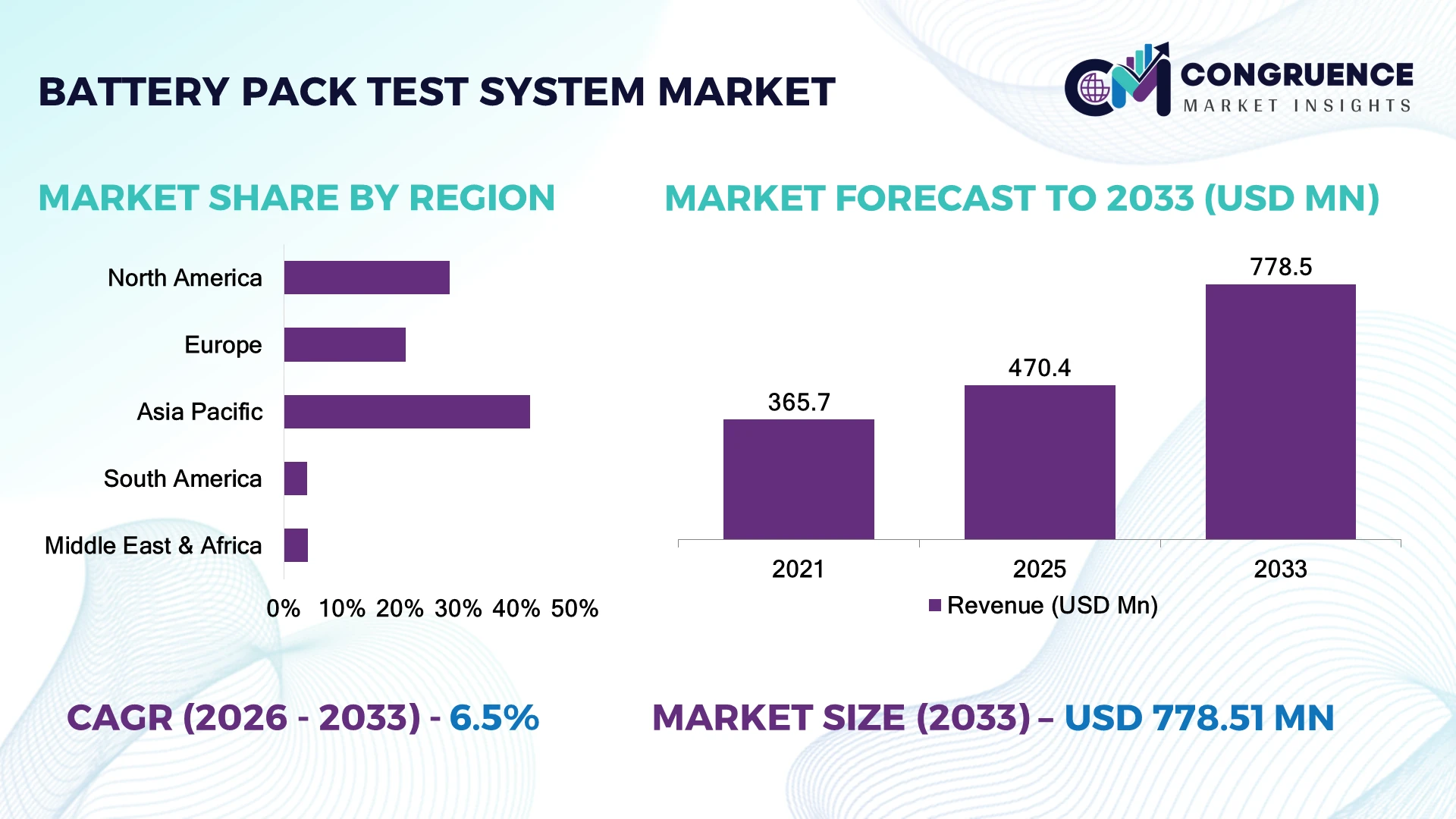
The Global Battery Pack Test System Market was valued at USD 470.4 Million in 2025 and is anticipated to reach a value of USD 778.5 Million by 2033 expanding at a CAGR of 6.5% between 2026 and 2033. Growth is being driven by gigafactory automation, stricter battery safety validation, higher pack complexity, and rising demand for automated end-of-line testing across EV and energy-storage production.
China dominates battery manufacturing, accounting for more than 80% of global lithium-ion manufacturing capacity, while the United States and European Union each represent roughly 6–7%. China’s manufacturing capacity exceeded 3 TWh in 2025, creating a substantially larger installed base for battery pack test systems than either Western market. In 2026, U.S.-China trade restrictions and supply-chain localization are accelerating regional testing investment and non-China equipment sourcing.
Test-system suppliers that combine high-throughput automation, traceability, and chemistry-flexible validation are best positioned to capture localization-driven factory investments.
Market Size & Growth: USD 470.4 million in 2025 is projected to reach USD 778.5 million by 2033 at 6.5% CAGR, driven by automated battery validation.
Top Growth Drivers: EV production expansion 30%, factory automation 25%, and battery-storage deployment 20% are major demand catalysts.
Short-Term Forecast: By 2028, automated test workflows are expected to reduce manual validation requirements by 15–20% at high-volume facilities.
Emerging Technologies: AI diagnostics, regenerative power cycling, digital twins, and high-voltage automated inspection are reshaping pack-level validation.
Regional Leaders: Asia-Pacific approaches USD 470 million by 2033, North America about USD 170 million, and Europe approximately USD 120 million, reflecting expanding localized testing.
Consumer/End-User Trends: Automotive manufacturers remain dominant, while stationary-storage producers are increasing automated testing deployment as pack architectures diversify.
Pilot/Case Example: 2026 automated battery facilities are targeting approximately 95% production automation, increasing demand for integrated end-of-line testing.
Competitive Landscape: Leading suppliers include NI, Keysight, Chroma, Hioki, and Arbin, competing through precision, regenerative capability, automation, and software integration.
Regulatory & ESG Impact: EU battery-passport requirements cover 71 defined data points, increasing demand for digitally traceable test and performance records.
Investment & Funding: Global battery manufacturing capacity exceeded 4 TWh by end-2025, directing billions of dollars of factory investment toward automated inspection and validation.
Innovation & Future Outlook: Multi-chemistry testing, AI-based fault diagnosis, digital twins, and closed-loop manufacturing will shift competition toward software-integrated test platforms.
Battery pack test system demand is concentrating around EV gigafactories, energy-storage plants, and high-voltage commercial-vehicle programs requiring automated end-of-line validation. More than 80% of global battery manufacturing capacity remains concentrated in China, intensifying localization efforts elsewhere. AI-assisted diagnostics, regenerative test equipment, and digital traceability are gaining traction as pack architectures become more complex, setting the foundation for the market’s strategic transformation.
Battery pack test systems are becoming a strategic manufacturing asset rather than a final inspection tool because pack architectures now integrate higher voltages, sophisticated battery-management systems, thermal controls, and digitally traceable performance data. Global lithium-ion manufacturing capacity exceeded 4 TWh by the end of 2025, while China represented more than 80% of capacity. This concentration is pushing the United States, Europe, India, and Southeast Asia toward localized production and locally accessible validation infrastructure.
The technology shift is equally important. Conventional test benches rely heavily on fixed instrumentation and manual intervention, whereas regenerative automated platforms can return a large share of test energy to the electrical grid, reducing energy consumption associated with cycling by roughly 20–30% in suitable high-throughput configurations. AI-based diagnostics further reduce dependence on manual waveform interpretation and accelerate fault classification.
Between 2026 and 2028, battery manufacturers will increasingly connect pack testers with MES, BMS data, traceability platforms, and automated production lines. The EU battery passport requirement beginning in February 2027 reinforces this transition by requiring structured battery information. Suppliers that integrate testing, analytics, traceability, and production automation will gain stronger positions than standalone instrumentation vendors.
Battery manufacturing automation is increasing demand for integrated pack testing as production lines move toward higher throughput and tighter quality tolerances. China accounts for more than 80% of global lithium-ion manufacturing capacity, while automated production environments increasingly target above 90% equipment automation. High-voltage packs also require electrical, thermal, insulation, BMS, and functional validation within compressed takt times. The EU battery-passport framework is adding digital traceability requirements to production data. Test-system suppliers are responding with regenerative cyclers, automated fixture handling, synchronized BMS communication, and MES connectivity. The non-obvious shift is that testing is becoming a production-control layer rather than an isolated quality checkpoint, allowing manufacturers to identify process drift earlier and reduce costly downstream rework.
Battery pack test deployment remains constrained by high-voltage infrastructure, power-management requirements, thermal management, and equipment integration costs. Large-format packs can require hundreds of kilowatts during simultaneous charging and discharging, while regenerative systems can recover approximately 70–90% of cycling energy but still require substantial electrical infrastructure. Test stations operating above 800 V also demand specialized safety architecture, isolation monitoring, and trained personnel. In China, mature battery clusters support better utilization, whereas emerging manufacturing hubs face higher commissioning complexity. Suppliers are reducing deployment risk through modular architectures, bidirectional power electronics, standardized interfaces, and localized service teams. The strategic pressure is shifting from instrument price toward total installed cost, facility compatibility, energy recovery, and commissioning speed.
Software-defined battery testing creates an opportunity to convert standalone instrumentation into integrated manufacturing intelligence. AI-assisted waveform analysis can reduce manual diagnostic workload by roughly 20–30%, while automated test sequencing can improve station utilization by approximately 10–15% in high-volume environments. India, the United States, and Southeast Asia are expanding localized battery production, creating demand for scalable systems that support multiple chemistries and pack architectures. Digital twins can further connect simulated and physical validation before expensive production testing. Suppliers are positioning through cloud-connected analytics, API-based BMS integration, and partnerships with automation providers. The strongest opportunity lies in software recurring value: test-data analytics, predictive maintenance, traceability, and process optimization can generate higher customer lifetime value than hardware sales alone.
Battery manufacturers increasingly operate mixed production lines covering cylindrical, prismatic, and pouch cells, creating integration complexity for test-system suppliers. Pack voltage can range from roughly 400 V to more than 1,000 V, while communication architectures vary across BMS platforms and vehicle programs. A test platform designed around one configuration can require substantial engineering changes for another, increasing commissioning workload by approximately 10–20% in highly customized deployments. Cybersecurity also becomes more important as testers connect directly with MES, cloud analytics, and factory networks. Companies must develop configurable hardware, standardized communication protocols, cybersecurity controls, and modular software libraries. The long-term competitive advantage will come from reducing engineering effort per new pack rather than simply increasing electrical test capacity.
800-Volt Testing Raises Complexity: EV platforms are moving toward 800 V and higher architectures, increasing requirements for insulation testing, high-voltage switching, BMS communication, and thermal validation. Regenerative equipment can recover roughly 70–90% of cycling energy, reducing facility electricity demand. Suppliers are redesigning fixtures and safety systems around higher voltage while improving automated interlocks and diagnostic coverage.
Digital Traceability Enters Production: Battery-passport requirements are pushing manufacturers to connect test results with serial numbers, production records, and material information. Automated data capture can reduce manual documentation workload by approximately 20–30% and improve batch traceability. European manufacturers are accelerating MES integration, while equipment suppliers are adding APIs, standardized data structures, and cybersecurity controls to existing testers.
Mixed Chemistry Needs Flexible Platforms: Production facilities increasingly handle lithium-ion variants with different voltage windows, charging profiles, and BMS protocols. Software-configurable systems can reduce changeover engineering by approximately 10–15% compared with dedicated test architectures. Manufacturers are therefore favoring modular cyclers, programmable loads, interchangeable fixtures, and reusable test libraries, creating competitive pressure on suppliers with rigid hardware platforms.
Predictive Diagnostics Gains Traction: AI-assisted analysis is shifting battery testing from pass/fail inspection toward early anomaly detection. Automated waveform interpretation can reduce manual diagnostic workload by approximately 20–30%, particularly across high-volume end-of-line stations. Manufacturers are integrating test data with manufacturing execution systems to identify recurring defects, while suppliers increasingly compete on analytics, model accuracy, and actionable failure classification rather than instrumentation alone.
Automated end-of-line battery pack test systems represent the leading type, accounting for approximately 46% of market demand in 2025, as EV and energy-storage factories prioritize high-throughput validation integrated directly into production lines. Automated systems reduce manual intervention, improve repeatability, and synchronize electrical, insulation, BMS, and functional testing. Regenerative platforms are the fastest-growing type, gaining adoption as manufacturers seek lower electricity consumption and higher test-station utilization. Their ability to recover roughly 70–90% of cycling energy creates a measurable operating advantage over conventional dissipative systems.
Manual and semi-automated systems remain relevant for laboratories, low-volume production, prototyping, and specialized pack programs, but their share is gradually declining. Companies are therefore prioritizing modular automated platforms, programmable power electronics, and reusable test libraries. Investment is shifting toward systems capable of handling 400–1,000+ V architectures and multiple battery chemistries, making flexibility increasingly important alongside throughput.
Global battery manufacturing capacity exceeded 4 TWh in 2025, reinforcing the commercial requirement for automated, high-throughput validation infrastructure across expanding production facilities.
Electric vehicle battery testing represents the leading application, accounting for approximately 61% of battery pack test system demand in 2025. EV manufacturers require extensive end-of-line validation covering voltage, insulation resistance, BMS communication, thermal behavior, charging performance, and functional safety. Energy-storage system testing is the fastest-growing application as grid-scale and commercial storage deployments increase and pack architectures diversify. Stationary systems typically emphasize long-duration cycling, thermal management, and reliability validation rather than vehicle-specific performance parameters.
Consumer electronics and industrial battery applications remain smaller but strategically relevant because they require compact test configurations and faster product-change cycles. Companies supplying EV programs are increasingly integrating testers with MES platforms and robotic handling, with automation capable of reducing manual test intervention by approximately 20–30%. Energy-storage manufacturers are favoring configurable cyclers and extended-duration testing, creating demand for systems that combine high power with continuous data logging. Application-specific software is therefore becoming an important differentiator.
Electric vehicles accounted for more than 20% of global new-car sales in 2025, strengthening the requirement for automated battery validation across high-volume automotive production programs.
Automotive OEMs represent the leading end-user group, accounting for approximately 54% of battery pack test system demand in 2025 because vehicle manufacturers require validated packs before assembly-line release and increasingly control critical battery quality processes internally. Battery-cell and pack manufacturers form the second major group and represent the fastest-growing buyer segment as dedicated gigafactories expand globally. Their requirements emphasize throughput, automated material handling, process traceability, and integration with manufacturing execution systems.
Energy-storage manufacturers, testing laboratories, and research institutions serve specialized requirements, typically prioritizing flexible test configurations over continuous high-volume production. OEM purchasing is increasingly shifting toward integrated turnkey systems, while independent battery manufacturers favor modular architectures that can scale with production capacity. Automotive customers are also demanding tighter data integration, with automated test records reducing manual documentation workloads by approximately 20–30%. Suppliers are responding through strategic partnerships with automation companies, localized service networks, and software platforms connecting testers with BMS and factory-control systems.
Automotive manufacturers and battery producers collectively represent the principal installed base for high-voltage pack testing, with modern production programs increasingly targeting automated validation across more than 90% of end-of-line operations.
Asia-Pacific accounted for the largest market share at 42.3% in 2025 however, North America is expected to register the fastest growth, expanding at a CAGR of 7.1% between 2026 and 2033.
Localized gigafactories are accelerating high-voltage test infrastructure
North America is becoming a critical market for battery pack test systems as automakers and battery manufacturers localize production and integrate automated validation into new plants. The United States represents the dominant regional demand center, supported by expanding cell and module manufacturing across Michigan, Georgia, Tennessee, Nevada, and North Carolina. U.S. battery manufacturing projects tracked in 2025 represented more than 200 GWh of operating cell capacity, creating substantial demand for pack-level electrical, thermal, insulation, and BMS testing. Toyota’s North Carolina battery facility, designed for up to 30 GWh annually, further demonstrates the scale of localized production. Test suppliers are responding with high-voltage platforms, regenerative cycling, robotic fixtures, and MES integration. The strategic shift is toward factory-integrated validation rather than standalone laboratory testing, increasing the value of suppliers capable of commissioning complete automated test cells.
United States Market Outlook: The United States remains the principal North American market because of its expanding domestic battery ecosystem and large automotive manufacturing base. Toyota’s North Carolina facility represents a $13.9 billion investment and is designed around 14 production lines. New battery plants increasingly require automated pack validation capable of handling high-voltage architectures, thermal testing, BMS communication, and traceable end-of-line inspection.
Battery localization is increasing demand for compliance-ready validation systems
Europe is strengthening its battery testing infrastructure as local cell and pack manufacturing expands and manufacturers face tighter traceability and safety requirements. Germany remains the leading industrial center, supported by automotive OEMs, battery plants, engineering laboratories, and a dense supplier ecosystem. European manufacturers are increasingly integrating electrical testing with manufacturing execution systems, automated data capture, and battery-passport workflows. More than 6% of global lithium-ion manufacturing capacity was located in the European Union in 2025, providing a growing installed base for specialized testing equipment. Suppliers are emphasizing high-voltage safety, regenerative power systems, environmental testing, and software interoperability. The commercial emphasis is shifting toward complete validation architectures that can support both current lithium-ion platforms and emerging chemistries without major equipment replacement.
Germany Market Outlook: Germany represents Europe's strongest industrial opportunity because automotive production, battery manufacturing, engineering expertise, and laboratory infrastructure are concentrated within a mature manufacturing ecosystem. The country's battery operations increasingly require automated traceability and high-voltage validation. Suppliers with strong integration capabilities can serve OEM plants, cell producers, and independent testing facilities through modular systems supporting multiple pack architectures.
Manufacturing scale keeps Asia-Pacific at the center of test-system demand
Asia-Pacific remains the largest market because China, South Korea, and Japan contain the world's most concentrated battery manufacturing clusters. China alone accounts for more than 80% of global lithium-ion manufacturing capacity, while Chinese producers represented almost 75% of global electric-car battery deployment in 2025. This production concentration generates extensive demand for automated pack testing, charging-discharge systems, insulation validation, BMS communication testing, and end-of-line inspection. South Korea and Japan contribute advanced automotive and battery engineering programs, while India is building a smaller but rapidly developing manufacturing base. Test-equipment suppliers are expanding localized engineering, service, and integration capabilities. China's large production volumes favor high-throughput systems, whereas India increasingly favors flexible platforms capable of supporting multiple emerging battery formats.
China Market Outlook: China is the most strategically significant country because it combines the world's largest battery manufacturing base with extensive EV production and energy-storage deployment. Chinese battery manufacturers increasingly operate highly automated facilities where test systems are integrated directly into production-control infrastructure. Suppliers benefit from strong local electronics and power-conversion ecosystems, enabling rapid customization, high-volume deployment, and shorter service-response cycles.
Brazil is building localized battery and energy-storage capabilities
South America remains a smaller battery testing market, but Brazil is establishing the strongest foundation through electric-mobility programs, energy-storage projects, and automotive manufacturing. Demand is concentrated around battery assembly, electric buses, industrial storage, and research facilities rather than large-scale cell manufacturing. Brazil's established automotive ecosystem provides an important deployment base for pack validation, while imported test equipment remains prevalent because specialized local production is limited. Testing requirements increasingly cover battery management, insulation resistance, charging performance, thermal behavior, and durability. Local integrators are gaining importance by adapting imported equipment to regional production requirements and providing commissioning support. The strategic opportunity is therefore concentrated in flexible, service-intensive systems rather than massive standardized gigafactory installations.
Brazil Market Outlook: Brazil offers the region's strongest commercial base because of its established vehicle manufacturing sector and expanding electrification ecosystem. Battery testing demand is increasingly linked to electric buses, hybrid vehicles, stationary storage, and local pack assembly. Suppliers offering modular equipment, Portuguese-language software support, and regional maintenance capabilities can reduce deployment complexity and improve utilization for smaller production programs.
Energy-storage deployment is creating a specialized testing opportunity
Middle East & Africa is developing primarily around stationary energy storage, renewable-power integration, telecommunications backup, and emerging electric-mobility programs rather than large-scale cell manufacturing. Saudi Arabia and the United Arab Emirates are the principal technology and infrastructure centers, supported by major renewable-energy projects and grid modernization programs. Battery testing demand is consequently concentrated on pack safety, capacity verification, thermal management, lifecycle performance, and commissioning validation. Large energy-storage projects increasingly require documented acceptance testing before commercial operation, strengthening demand for portable and container-scale test platforms. Regional suppliers are partnering with international equipment manufacturers to provide installation, calibration, and after-sales support. The commercial model is shifting toward localized service and turnkey deployment rather than direct equipment-only sales.
Saudi Arabia Market Outlook: Saudi Arabia is the region's strongest emerging market because of its large-scale renewable-energy and grid-storage development agenda. Battery systems deployed for solar integration and backup applications require commissioning and performance verification before operational acceptance. Suppliers combining high-power testing, environmental monitoring, remote diagnostics, and local service capabilities are positioned to capture demand as domestic energy-storage infrastructure expands.
Chroma, Keysight, NI, AVL, and Neware compete across precision testing, automation, regenerative power, and software integration. Chroma and Neware emphasize scalable high-throughput equipment, while Keysight, NI, and AVL compete through instrumentation, analytics, automation, and engineering. The top five suppliers are estimated to hold about 45% of the global market, leaving regional integrators and specialists meaningful access.
Competition is defined by energy efficiency, voltage range, interoperability, and deployment speed. Regenerative systems can recover 85–90% of discharge energy, while high-end platforms now extend testing toward 1,700–2,000 V. Modular software can reduce reconfiguration effort by roughly 10–20% versus rigid dedicated setups. Suppliers are expanding engineering teams, partnering with battery manufacturers, and integrating MES, BMS, thermal chambers, and automated handling.
The shift is from standalone cyclers toward software-connected, factory-integrated platforms. Entry barriers include high-voltage safety expertise, calibration, cybersecurity, and reliable global service coverage. Winning requires scalable hardware, open software, fast commissioning, and lifecycle support.
Chroma ATE Inc.
Keysight Technologies, Inc.
National Instruments Corporation
AVL List GmbH
Neware Technology Limited
Arbin Instruments
Bitrode Corporation
Digatron Power Electronics GmbH
Hioki E.E. Corporation
NH Research
Maccor, Inc.
PEC
Comemso GmbH
Unico, Inc.
Battery pack testing is moving toward regenerative, high-voltage, software-connected platforms. Current systems support 800–1,000 V packs, while advanced platforms reach 1,700–2,000 V. Regenerative architectures can recover about 85–90% of discharge energy, reducing facility electricity losses by roughly 1–2% at utilization levels. Automated end-of-line testing is gaining adoption in EV plants, replacing manual inspection with synchronized electrical, insulation, BMS, and functional checks.
Emerging technology centers on modular power electronics, digital twins, hardware-in-the-loop simulation, and AI-assisted diagnostics. Model-based testing can reduce prototype cycles by approximately 10–20%, while automated anomaly classification can reduce manual diagnostic workload by 1–2% in deployments. Compared with fixed test benches, modular systems improve reconfiguration efficiency by roughly 10–15% when battery architectures change. Open software interfaces are becoming strategically important because manufacturers increasingly connect testers with MES, BMS databases, robotics, and lab-management platforms.
From 2026–2028, competitive advantage will shift toward integrated test ecosystems rather than standalone instruments. Chroma and Keysight benefit from high-power platforms, while NI and AVL gain through software, automation, and data integration. Suppliers supporting multiple chemistries, 800 V-plus architectures, cybersecurity, and automated traceability will shorten commissioning and improve asset utilization. The next phase combines regenerative hardware, AI analytics, digital twins, and factory connectivity into continuous battery-quality intelligence.
January 2026 Chroma partnered with National Taiwan University of Science and Technology to deploy high-power battery and powertrain testing at its Smart EV Research Center in Taiwan. The facility includes systems supporting 300 kW, strengthening industry-academia validation capability and development. Source: chroma.com
February 2026 Keysight released PathWave Advanced Battery Test and Emulation software version 2026, improving usability, stability, and performance through software updates. The release strengthens model-based battery testing workflows and supports faster validation across programmable two-quadrant power platforms globally and deployment. Source: keysight.com
April 2026 NI released PAtools Battery Software Suite 2026 Q2 for EV battery test stations. The release supports Windows 11 and 64-bit environments, extending software-based control for cell, module, and pack testing while improving compatibility across production laboratories and manufacturing. Source: ni.com
September 2025 Neware won a €33,000 University of Limerick contract for battery test equipment. The procurement demonstrates continued European adoption of Chinese testing platforms and strengthens Neware’s institutional footprint for battery research and validation applications across Europe programs and universities. Source: etenders.gov.ie
The Battery Pack Test System Market Report covers automated and semi-automated systems, regenerative platforms, laboratory configurations, and end-of-line test systems across EV batteries, energy-storage systems, consumer electronics, and industrial battery applications. End-user analysis includes automotive OEMs, battery manufacturers, energy-storage companies, laboratories, and research institutions across North America, Europe, Asia-Pacific, South America, and Middle East & Africa.
The report evaluates high-voltage testing, BMS validation, insulation and safety testing, thermal validation, regenerative cycling, hardware-in-the-loop simulation, AI diagnostics, digital twins, and MES connectivity. Quantitative analysis considers segment shares, voltage ranges, deployment intensity, automation levels, channel configurations, and supplier participation. The findings support equipment investment, factory localization, supplier selection, technology roadmaps, partnerships, and competitive positioning through 2026–2033, with particular attention to 800 V-plus platforms, gigafactory deployment, energy-storage testing, and software-defined validation.
| Report Attribute/Metric | Report Details |
|---|---|
|
Market Revenue in 2025 |
USD 470.4 Million |
|
Market Revenue in 2033 |
USD 778.5 Million |
|
CAGR (2026 - 2033) |
6.5% |
|
Base Year |
2025 |
|
Forecast Period |
2026 - 2033 |
|
Historic Period |
2021 - 2025 |
|
Segments Covered |
By Type
By Application
By End-User
|
|
Key Report Deliverable |
Revenue Forecast, Growth Trends, Market Dynamics, Segmental Overview, Regional and Country-wise Analysis, Competition Landscape |
|
Region Covered |
North America, Europe, Asia-Pacific, South America, Middle East, Africa |
|
Key Players Analyzed |
Chroma ATE Inc., Keysight Technologies, Inc., National Instruments Corporation, AVL List GmbH, Neware Technology Limited, Arbin Instruments, Bitrode Corporation, Digatron Power Electronics GmbH, Hioki E.E. Corporation, NH Research, Maccor, Inc., PEC, Comemso GmbH, Unico, Inc. |
|
Customization & Pricing |
Available on Request (10% Customization is Free) |




