
Reports
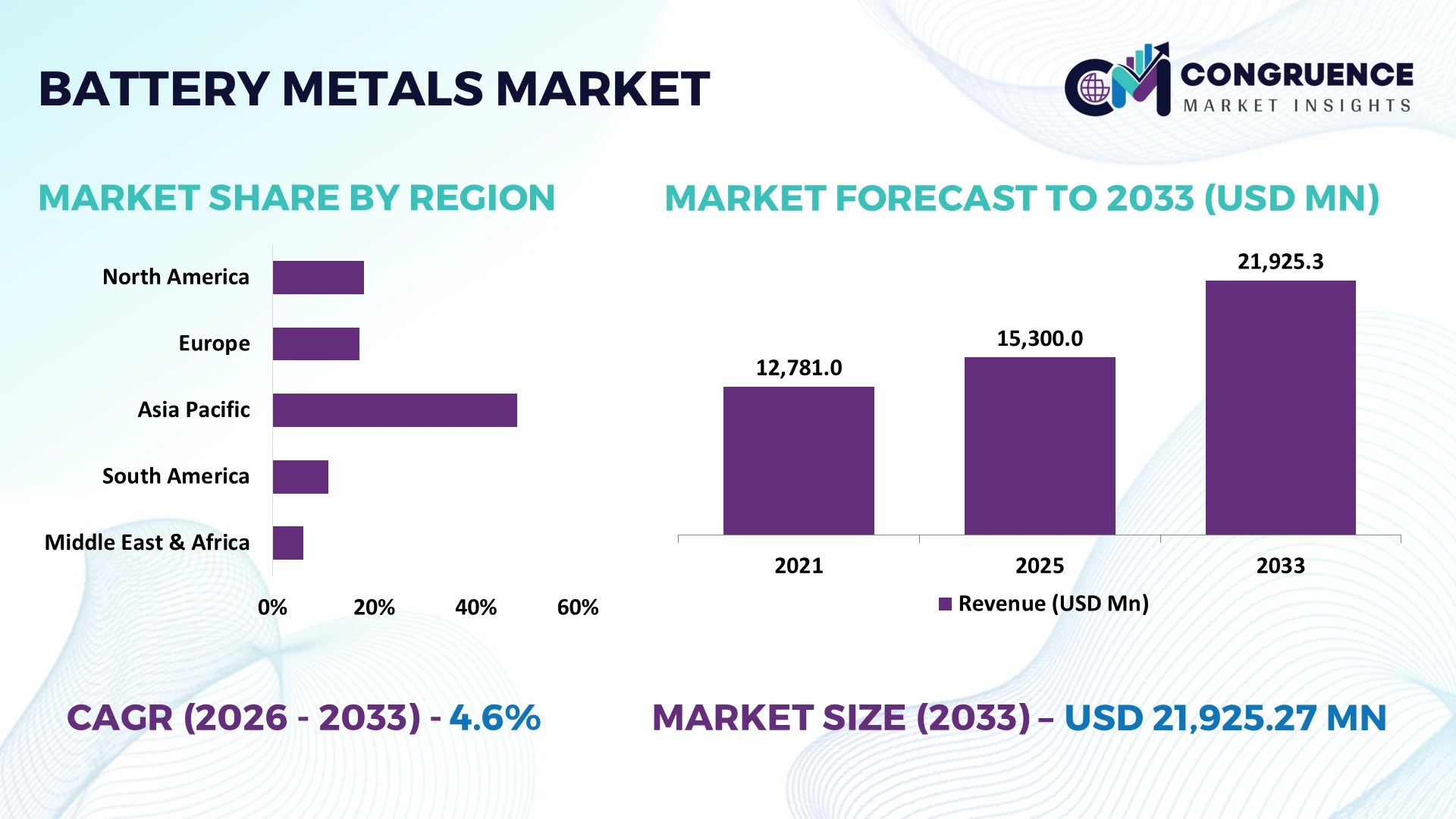
The Global Battery Metals Market was valued at USD 15,300.0 Million in 2025 and is anticipated to reach a value of USD 21,925.3 Million by 2033 expanding at a CAGR of 4.6% between 2026 and 2033. Growth is propelled by grid-scale battery storage deployment, which absorbed over 15% of total lithium-ion battery demand in 2025, creating a demand pillar independent of passenger EV cycles.
China dominates midstream processing with 74% of global lithium refining and 76% of cobalt refining capacity, while Chinese firms committed roughly USD 120 billion to foreign mining operations between 2023 and 2025. This refining concentration exceeds China's 62,000 metric tons of annual lithium production by a factor that underscores processing—not extraction—as the true chokepoint.
Strategic implication, supply security now hinges on refining partnerships and offtake agreements rather than mere resource access, forcing automakers and cell producers to prioritize midstream investments over upstream equity.
Market Size & Growth: Valued at USD 15,300.0 Million in 2025 and forecast to reach USD 21,925.3 Million by 2033, with grid storage adoption driving demand diversification beyond EVs.
Top Growth Drivers: Stationary storage deployments growing over 20-fold in five years (15% of battery demand); EV sales representing 70% of lithium-ion deployment; LFP chemistry capturing 50% of automotive battery market share.
Short-Term Forecast: By 2027, battery pack prices in China already sit 30% below U.S. levels, with LFP cost advantages exceeding 40% versus NMC, accelerating chemistry substitution.
Emerging Technologies: Sodium-ion batteries entering Chinese automotive markets; direct lithium extraction (DLE) scaling; AI-driven grid storage optimization improving dispatch efficiency.
Regional Leaders: China (74% lithium refining share), Indonesia (nickel quota-controlled supply), North America (Electra's Ontario cobalt refinery targeting 5,120 tpa by 2027).
Consumer/End-User Trends: Battery storage now absorbs 15% of total demand; portable electronics fell below 5% from nearly half a decade ago.
Pilot/Case Example: Electra Battery Materials' Ontario refinery secured LG Energy Solution commitment for 60% of cobalt sulfate output through 2029, with US$73 million construction budget approved in 2026.
Competitive Landscape: Top three producers (SQM, Ganfeng, Albemarle) hold approximately 30% combined share; Chinese refiners control dominant midstream positions.
Regulatory & ESG Impact: DRC cobalt export restrictions since February 2025 doubled prices within a year, forcing buyers toward Indonesian and recycled alternatives.
Investment & Funding: EcoPro committed US$40 million to Pursuit's Argentina lithium project, including US$20 million equity for 20% stake and 100% offtake of initial 5,000 tpa LCE production.
Innovation & Future Outlook: LFP dominance in storage (>90% share) and automotive (>50%) is reshaping metal demand profiles, favoring lithium over cobalt and nickel.
The Battery Metals Market is pivoting toward chemistry-specific demand: lithium-iron-phosphate's rise to over 50% of EV batteries and 90% of storage systems has decoupled lithium demand from cobalt and nickel trajectories. Indonesia's nickel quota tightening and DRC's cobalt export restrictions have injected policy-driven volatility, with cobalt prices doubling within a year of the DRC's February 2025 intervention. A subtle shift: Chinese firms now own roughly 75% of Indonesia's nickel refining capacity, meaning geographic diversification of mining does not translate to supply chain independence. This chemistry and ownership fragmentation directly frames the strategic calculus for investors and OEMs navigating the sector.
Battery metals have transitioned from commodity inputs to strategic leverage points, as refining concentration and chemistry shifts determine which supply chains remain viable. China's 74% lithium and 76% cobalt refining shares mean that even non-Chinese mining projects often feed Chinese-controlled processing infrastructure, creating a structural dependency that resource nationalism alone cannot resolve.
Technology comparison illustrates the stakes: LFP batteries now cost over 40% less than NMC alternatives, driving their share above 50% in EVs and 90% in storage. This chemistry preference directly reduces cobalt and nickel intensity per kilowatt-hour while concentrating demand on lithium and iron phosphate. Regionally, China's battery pack prices sit 30% below U.S. and 35% below European levels, reflecting integrated refining-to-cell manufacturing advantages that Western projects must overcome.
Electra's Ontario cobalt refinery offers a deployment template: by securing LG Energy Solution's commitment for 60% of output through 2029 before completing construction, the project locks in demand-side certainty while building domestic refining capacity. Over the next 2–3 years, operational indicators will center on refinery commissioning rates, offtake coverage ratios, and LFP versus NMC adoption splits rather than headline capacity announcements. Competitive positioning now demands midstream ownership or binding offtake—not merely mining exposure—to secure relevance in an increasingly chemistry-differentiated market.
China's control of 74% of lithium refining and 76% of cobalt refining creates a structural margin pool that upstream miners and downstream cell makers cannot access without midstream investment. Grid storage's 15% share of battery demand and LFP's 50% automotive penetration are redirecting capital toward refining capacity configured for lithium-intensive chemistries. South Korea's EcoPro committed US$40 million to Argentina's Rio Grande Sur project, securing 100% offtake of initial 5,000 tpa LCE output—a direct response to refining-security concerns. Companies that secure refining capacity ahead of demand curves capture structural margins unavailable to pure miners or cell assemblers.
The DRC's cobalt export restrictions since February 2025 doubled prices within a year, while Indonesia's nickel quota signals create recurring supply uncertainty. China's suspension of the Jianxiawo lithium mine added further price instability, with lithium carbonate testing buyers' absorption capacity after a near-threefold cost increase. These policy interventions directly compress cell maker margins and delay storage project final investment decisions. Companies are responding through regional diversification—EcoPro's Argentina investment and Electra's Ontario refinery both explicitly target supply chain resilience outside single-jurisdiction exposure.
LFP's dominance in storage (>90%) and automotive (>50%) creates a concentrated opportunity in lithium refining and iron phosphate processing, while cobalt and nickel demand faces structural headwinds from chemistry substitution. Sodium-ion batteries entering Chinese automotive markets offer a non-lithium pathway for entry-level vehicles, with potential to capture 10–15% of the compact EV segment. Companies positioning refining capacity around lithium chemicals rather than cobalt/nickel intermediates align with the dominant demand trajectory. South Korea's EcoPro and Chile's SQM are already pivoting investment toward lithium-intensive processing assets.
Electra's Ontario refinery requires US$73 million to reach commercial production by Q4 2027, but North America currently operates only one active lithium mine producing 1,000 metric tons annually—insufficient to feed domestic refining ambitions. The operational gap between refining capacity announcements and feedstock availability creates stranded asset risk. Companies must solve this through offtake-backed project finance and international feedstock agreements, as EcoPro has done by pairing its Argentina investment with Korean downstream demand. Refineries without secured feed or locked offtake face commissioning delays and utilization shortfalls that erode projected returns.
LFP Chemistry Consolidates Dominance Lithium iron phosphate now powers over 90% of global battery energy storage systems and more than half of EV batteries, with prices falling over 15% in 2025 versus under 5% for NMC . Chinese LFP pack prices sit 30% below U.S. levels, driving adoption across Southeast Asia and Brazil where LFP shares exceed 50% . Cell makers including LG Energy Solution and Samsung SDI are pivoting production lines toward LFP to defend market position in Europe and North America.
Midstream Refining Localization Accelerates Western governments and manufacturers are funding non-Chinese refining capacity at unprecedented scale, with Electra's Ontario cobalt refinery and EcoPro's Argentina lithium offtake securing downstream commitments before commissioning. North America's refining gap remains stark—the continent operates only one active lithium mine producing 1,000 metric tons annually against announced refinery capacity exceeding 50,000 tpa. Automakers are responding through binding offtake agreements that de-risk project finance.
Grid Storage Becomes Demand Anchor Stationary storage absorbed 19% of global lithium-ion demand in 2025, up from 10% in 2023, with deployments reaching 318 GWh . China accounted for 58% of BESS deployments while the U.S. contributed 18%, and Saudi Arabia and Chile entered the top ten markets. This demand pillar is less cyclical than passenger EVs, giving refiners a predictable baseline for capacity planning.
Policy-Driven Supply Volatility Reshapes Sourcing DRC cobalt export restrictions since February 2025 doubled prices within a year, while Indonesia's nickel quota controls created recurring uncertainty. Battery-grade cobalt buyers are diversifying toward Indonesian and recycled feedstocks, with recycling capacity announcements rising sharply across South Korea and Japan. Companies that locked multi-year offtake before the DRC intervention secured cost advantages unavailable on spot markets.
Lithium represents approximately 64% of the battery metals market by type, underpinned by its irreplaceable role across LFP, NMC, and emerging sodium-lithium hybrid chemistries . Lithium demand is structurally insulated from cobalt and nickel substitution trends because LFP—now over 50% of EV batteries and over 90% of storage systems—eliminates cobalt and nickel entirely while remaining lithium-intensive.
Nickel follows at roughly 14% of primary consumption tied to battery applications, though its growth trajectory is increasingly contested by LFP's cost advantages exceeding 40% versus NMC. Cobalt faces the most constrained outlook, with EV batteries representing 41% of demand but chemistry substitution eroding that base. Chinese refiners dominate lithium processing at 74% share, and companies including Ganfeng and SQM are expanding lithium chemical conversion capacity rather than nickel or cobalt intermediates.
Electric mobility accounts for approximately 65% of battery metals demand by application, with global EV battery installations reaching 1,187 GWh in 2025 and China alone representing 64.8% of that volume. This concentration reflects passenger car electrification's scale, though the segment's growth rate is moderating as major markets approach higher penetration levels. Energy storage systems represent the fastest-growing application, capturing 19% of lithium-ion demand in 2025 versus 10% in 2023, with deployments tripling to 318 GWh.
Consumer electronics has contracted to below 5% of demand, down from nearly half a decade ago, rendering it a residual rather than strategic segment . Companies are reallocating product focus accordingly: CATL's storage system integration business delivered over 70 projects with shipment volumes growing over 160% year-on-year, while its EV battery growth tracked the broader market.
Automotive OEMs remain the dominant end-user group, absorbing over 70% of lithium-ion battery deployment through direct procurement and cell supply partnerships. Their purchasing behavior is shifting toward LFP-dominant portfolios for mass-market models while reserving NMC for premium and long-range segments, creating a bifurcated demand structure that refiners must serve simultaneously. Battery energy storage system operators represent the fastest-growing end-user category, with global BESS installations growing more than 20-fold over five years and grid-scale projects dominating at 89% of deployments.
Utilities and independent power producers in China and the U.S. are contracting multi-year storage capacity, providing refiners with demand visibility that automotive spot purchases do not. Companies are responding through tailored offtake structures: lithium producers are increasingly splitting contract portfolios between automotive-qualified long-term agreements and storage-grade spot-indexed volumes, while storage-focused cell makers like Hithium and EVE Energy are securing dedicated lithium supply outside automotive channels.
Asia-Pacific accounted for the largest market share at 48% in 2025 however, North America is expected to register the fastest growth, expanding at a CAGR of 7.2% between 2026 and 2033.
North America holds approximately 18% of global battery metals market share, with the United States driving the bulk of announced refining and cell manufacturing capacity. The region's strategic focus centers on reducing midstream dependency, yet operational reality lags ambition: the continent operates only one active lithium mine producing 1,000 metric tons annually against announced refinery capacity exceeding 50,000 tpa. Canada's nickel output reached 140,000 metric tons in 2025, with the Sudbury Basin remaining the second-largest nickel ore supplier globally. Electra Battery Materials' Ontario cobalt refinery, backed by a US$73 million construction budget and LG Energy Solution's commitment for 60% of output through 2029, represents the region's most advanced midstream deployment.
United States Market Outlook: The U.S. accounts for over 80% of North America's battery metals demand, driven by Inflation Reduction Act-driven cell plant announcements exceeding 1,000 GWh in planned capacity. Domestic lithium production remains nascent, with the Thacker Pass project targeting first production in 2027, forcing automakers to rely on Canadian and Chilean feedstock while domestic refining scales.
Europe represents approximately 17% of global battery metals market share, with Germany, Poland, and Hungary anchoring cell manufacturing clusters. The region's regulatory framework—particularly the Critical Raw Materials Act and battery passport requirements—demands supply chain transparency that current refining infrastructure cannot deliver. European nickel premiums face downward pressure amid global oversupply, with LME warehouse stocks totaling 282,504 metric tons in October 2026. Northvolt's restructuring and the slow ramp of European gigafactories underscore the gap between policy ambition and operational execution.
Germany Market Outlook: Germany leads Europe's battery metals demand through its automotive OEM concentration, with Volkswagen, BMW, and Mercedes-Benz driving LFP and NMC procurement. The country's cell manufacturing capacity pipeline exceeds 300 GWh, yet domestic refining capacity remains negligible, creating a structural import dependency that German automakers are addressing through offtake agreements with Chinese and Korean refiners.
Asia-Pacific commands approximately 48% of global battery metals market share, with China alone accounting for 74% of lithium refining and 76% of cobalt refining capacity. Indonesia's nickel output reached 2.6 million metric tons in 2025, representing 67% of global production, while the country's 2026 quota reduction to 260-270 million wet tons signals policy-driven supply management. China's lithium production rose nearly 50% in 2025 to 62,000 metric tons, displacing Chile from the second-ranking global position.
China Market Outlook: China's dominance extends beyond refining to cathode active material production, with LFP cathode output exceeding 90% of global supply. The country's battery cell manufacturers—CATL, BYD, and EVE Energy—are increasingly localizing production in Europe and Southeast Asia to circumvent trade barriers, exporting manufacturing capability rather than finished cells to maintain margin control.
South America holds approximately 11% of global battery metals market share, anchored by Chile's 19.3% share of global lithium production and Argentina's rapidly expanding brine operations. Chile remains the world's largest exporter of lithium carbonate and hydroxide, with a 46% combined share of processed lithium product exports. However, the region's inability to capture downstream value—Chile's lithium export value fell 13.6% in 2025 despite production growth—exposes the structural gap between extraction and processing.
Chile Market Outlook: Chile's lithium production reached 56,000 metric tons of lithium content in 2025, up 14.5% year-on-year, yet its global share declined from 26% in 2020 to 19.4% as Australian and Chinese output expanded faster. SQM and Albemarle's Salar de Atacama operations produced 311,300 metric tons LCE in 2025, with the government's National Lithium Strategy seeking to add value through downstream partnerships.
The Middle East & Africa region represents approximately 6% of global battery metals market share, dominated by the Democratic Republic of Congo's 72% share of global cobalt output. The DRC's export restrictions since February 2025 doubled cobalt hydroxide prices within a year, demonstrating the region's pricing leverage over battery chemistry decisions. Saudi Arabia and the UAE are emerging as battery storage deployment markets, with Saudi Arabia entering the top ten global BESS markets in 2025.
DRC Market Outlook: The DRC produced approximately 330,000 metric tons of cobalt in 2025, with the quota system introduced in October 2025 capping exports and driving standard-grade cobalt prices to US$41,879 per metric ton by mid-2026. The government's decision not to roll over unused quotas from June 2026 underscores its intent to maintain price leverage, forcing Chinese refiners and Western automakers to accelerate Indonesian and recycled feedstock diversification.
The battery metals market is shaped by a three-way contest: diversified mining majors (SQM, Albemarle, Ganfeng Lithium) competing against vertically integrated Chinese refiners and emerging Western midstream entrants such as Electra and EcoPro. The top five players hold approximately 30% combined share, leaving the market structurally fragmented yet concentrated at the refining stage where China controls 74% of lithium and 76% of cobalt processing. Competition pivots on supply-chain control rather than price alone, with LFP chemistry capturing over 50% of automotive demand and reshaping which metals matter. Ganfeng and SQM are locking in offtake-backed expansion in Argentina and Chile, while Korean players like EcoPro secure downstream commitments before commissioning. The decisive competitive shift is vertical integration: miners moving downstream into chemicals and cell makers moving upstream into refining. Entry barriers are feedstock security and refining permits, not capital. Winning requires owned or contracted midstream capacity aligned to LFP-dominant demand.
SQM
Albemarle
Ganfeng Lithium
Tianqi Lithium
Tianyi Lithium
Chengxin Lithium
Huayou Cobalt
Yahua Group
Shengtun Mining
Ruifu Lithium
Lygend Resources
Allkem
GEM Co.
CNGR Advanced Material
Livent Corporation
LFP chemistry is the current dominant technology, capturing over 50% of automotive batteries and 90% of energy storage systems. Its cost advantage exceeds 40% versus NMC, driving adoption that eliminates cobalt and nickel demand per kilowatt-hour while concentrating value on lithium and phosphate processing. Chinese producers control over 98% of LFP cathode and cell manufacturing, creating a technology monopoly that Western entrants cannot easily replicate.
Emerging technologies are bifurcating. Sodium-ion batteries offer upstream diversification but remain China-dominated downstream, with potential to capture 10–15% of compact EV demand. Direct lithium extraction (DLE) promises faster permitting and lower water intensity, with Chile's National Lithium Strategy mandating state participation through Codelco-SQM joint ventures, where majors now hold 53% of exploration budgets.
Disruptive pressure comes from electrodeposited lithium-metal anodes, which eliminate graphite and enable higher energy density, with pilot facilities targeting commercial scale by 2028. For 2026–2028, competitive advantage accrues to refiners configured for lithium chemicals rather than cobalt or nickel intermediates. Companies delaying chemistry-aligned refining investment face stranded midstream assets as LFP locks in its cost-driven dominance.
February 2025 — The Democratic Republic of Congo implemented export limits that doubled cobalt hydroxide prices within a year, forcing Chinese refiners and Western automakers to accelerate Indonesian and recycled feedstock diversification, reshaping global cobalt supply economics and offtake strategies.
2025 — Albemarle reported lithium consumption for energy storage increased 90% year-over-year to 380,000 metric tons, with U.S. storage growth up 145%, validating storage as a demand pillar independent of EV cycles and driving producer expansion priorities. Source: spglobal.com
2025 — TMC The Metals Co. increased its nickel-related exploration budget fourfold to $13 million in the Clarion-Clipperton Zone, targeting polymetallic nodules that could reduce U.S. dependence on imported nickel, cobalt, and manganese. Source: spglobal.com
August 2026 — Indonesia reduced 2026 ore quota to 260–270 million tonnes from 379 million in 2025, creating a projected 32,000-tonne nickel deficit and forcing Weda Bay Nickel to halt production, demonstrating policy-driven supply control reshaping nickel availability. Source: ftmercati.com
The report covers the full battery metals value chain across lithium, nickel, cobalt, and manganese, segmented by type, application, and end-user. Type coverage spans lithium compounds, nickel intermediates, cobalt chemicals, and emerging chemistries, with LFP's 50% automotive share and 90% storage dominance framing demand analysis. Application segmentation addresses electric mobility, grid storage, and consumer electronics, where storage's 15% demand share and 20-fold growth trajectory are quantified. End-user analysis covers automotive OEMs, BESS operators, and electronics manufacturers, with utility-scale storage representing 89% of deployments.
Regional analysis spans Asia-Pacific's 74% lithium refining concentration, North America's refining buildout against 1,000 tpa domestic mine supply, Europe's regulatory-driven transparency mandates, South America's extraction-processing gap, and Middle East & Africa's cobalt leverage. Technology coverage includes LFP dominance, sodium-ion emergence, DLE commercialization, and electrodeposition pathways through 2028. The report supports investment planning through refining-capacity benchmarking, expansion prioritization via chemistry-aligned demand forecasting, and competitive positioning against Chinese midstream incumbency, with strategic direction for 2026–2033.
| Report Attribute / Metric | Details |
|---|---|
| Market Revenue (2025) | USD 15,300.0 Million |
| Market Revenue (2033) | USD 21,925.3 Million |
| CAGR (2026–2033) | 4.6% |
| Base Year | 2025 |
| Forecast Period | 2026–2033 |
| Historic Period | 2021–2025 |
| Segments Covered |
By Type
By Application
By End-User
|
| Key Report Deliverables | Revenue Forecast; Market Trends; Growth Drivers & Restraints; Technology Insights; Segmentation Analysis; Regional Insights; Competitive Landscape; Regulatory & ESG Overview; Recent Developments |
| Regions Covered | North America; Europe; Asia-Pacific; South America; Middle East & Africa |
| Key Players Analyzed | SQM; Albemarle; Ganfeng Lithium; Tianqi Lithium; Tianyi Lithium; Chengxin Lithium; Huayou Cobalt; Yahua Group; Shengtun Mining; Ruifu Lithium; Lygend Resources; Allkem; GEM Co.; CNGR Advanced Material; Livent Corporation |
| Customization & Pricing | Available on Request (10% Customization Free) |




