
Reports
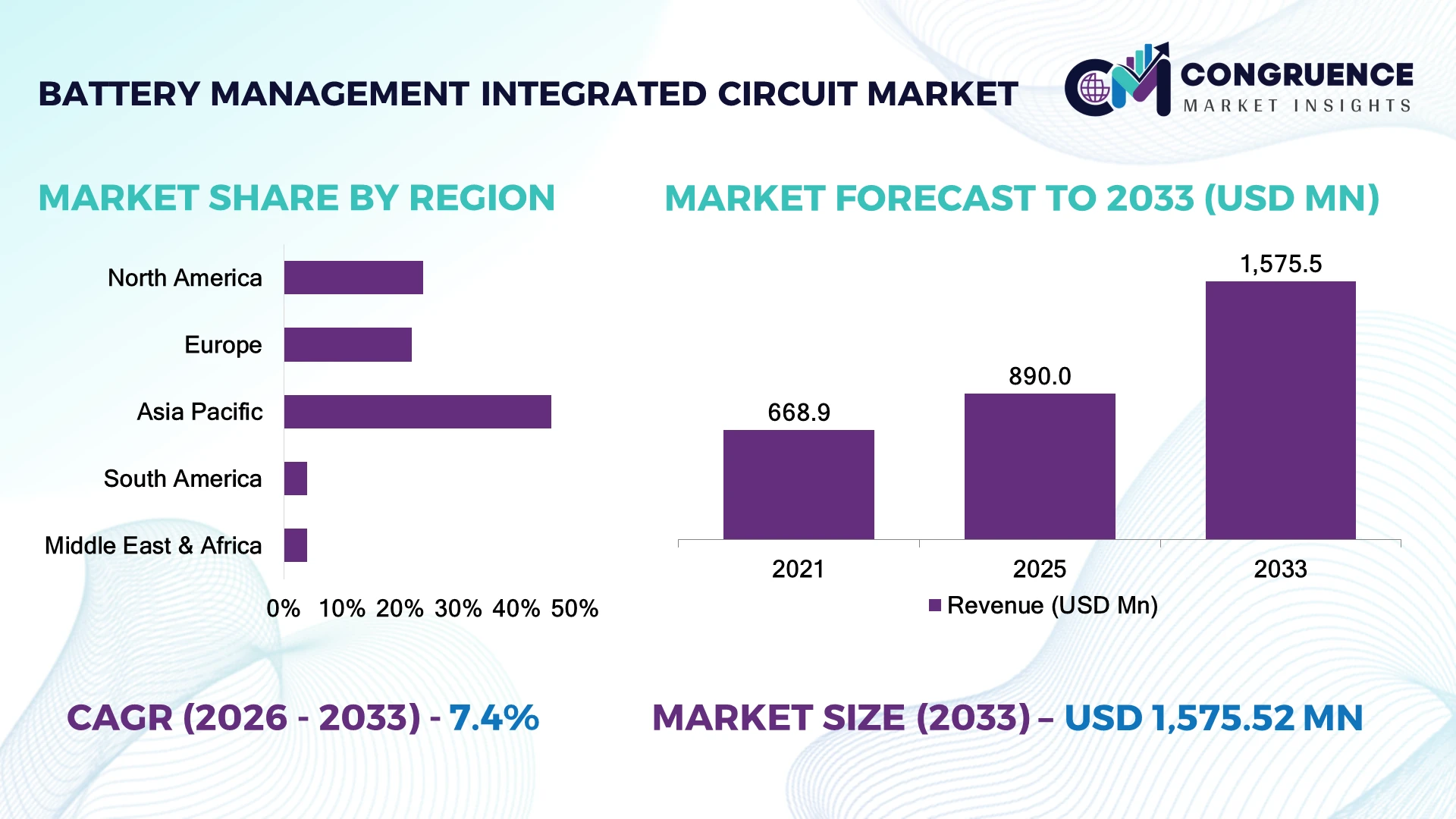
The Global Battery Management Integrated Circuit Market was valued at USD 890.0 Million in 2025 and is anticipated to reach a value of USD 1,575.5 Million by 2033 expanding at a CAGR of 7.4% between 2026 and 2033. Growth is being accelerated by rapid electrification of transportation, higher battery energy-density requirements, and increasing deployment of advanced battery monitoring architectures across automotive and industrial systems.
China dominates the global Battery Management Integrated Circuit market with an estimated 38% share of battery electronics manufacturing capacity, supported by more than USD 130 billion in EV and battery supply-chain investments. The country accounts for over 60% of global lithium-ion battery production, while the United States leads in advanced semiconductor design and battery software integration. Supported by strategic industrial policies and energy-transition initiatives, China deploys battery management solutions at significantly higher volumes than Germany, strengthening its manufacturing advantage.
This dominance reinforces the importance of supply-chain localization, semiconductor partnerships, and advanced battery analytics capabilities for long-term competitive positioning.
Market Size & Growth: USD 890.0 Million in 2025, reaching USD 1,575.5 Million by 2033, supported by EV platform expansion and intelligent battery architectures.
Top Growth Drivers: EV adoption (+24%), battery energy-density improvements (+18%), and industrial energy storage deployments (+21%).
Short-Term Forecast: By 2028, battery monitoring accuracy improves by 15% while power-management losses decline by 12%.
Emerging Technologies: AI-driven battery diagnostics, wireless BMS architectures, and advanced mixed-signal IC integration reshape performance standards.
Regional Leaders: Asia Pacific (~USD 620 Million), North America (~USD 180 Million), and Europe (~USD 145 Million), driven by localized battery ecosystems.
Consumer/End-User Trends: Over 65% of new EV battery packs utilize advanced multi-cell monitoring ICs for enhanced safety.
Pilot/Case Example: In 2024, next-generation wireless BMS deployments reduced wiring complexity by nearly 30% in selected EV programs.
Competitive Landscape: Texas Instruments holds an estimated 16% share alongside Analog Devices, NXP Semiconductors, Renesas Electronics, and Infineon Technologies.
Regulatory & ESG Impact: Battery safety regulations improved compliance testing rates by approximately 20% across automotive supply chains.
Investment & Funding: More than USD 25 billion in battery ecosystem investments support semiconductor localization and strategic partnerships.
Innovation & Future Outlook: High-voltage battery platforms, predictive diagnostics, and software-defined battery systems are becoming core differentiators.
Battery Management Integrated Circuit solutions are increasingly deployed across electric vehicles, stationary energy storage systems, industrial robotics, and consumer electronics where battery safety and operational efficiency remain critical. Recent innovations include wireless battery monitoring, AI-enabled state-of-health estimation, and high-precision cell-balancing technologies. More than 40% of next-generation EV platforms are integrating advanced battery analytics capabilities, while supply-chain diversification initiatives are encouraging regional semiconductor manufacturing expansion, setting the stage for deeper strategic transformation across the industry.
Battery Management Integrated Circuits are becoming strategically important as battery-powered systems move from consumer applications into mission-critical transportation, industrial automation, and energy infrastructure. The market sits at the intersection of semiconductor innovation and electrification, making it a key competitive battleground for chipmakers, automotive OEMs, and battery manufacturers. Supply-chain restructuring following global semiconductor shortages has accelerated investment in localized production and resilient sourcing networks.
Technological advancement is creating measurable operational advantages. Advanced battery management ICs can improve cell-balancing efficiency by more than 20% compared with legacy monitoring systems while reducing thermal management risks through real-time diagnostics. China leads large-scale deployment due to its integrated battery manufacturing ecosystem, whereas the United States maintains strength in semiconductor design, battery software intelligence, and high-performance power-management architectures. Over the next two to three years, adoption of wireless battery monitoring systems is expected to expand significantly across premium EV and industrial storage applications.
A practical example is the integration of wireless BMS platforms in electric vehicle battery packs, reducing wiring requirements and simplifying assembly operations. Companies are expanding strategic partnerships with battery manufacturers, increasing R&D spending on AI-enabled battery analytics, and prioritizing high-voltage architectures. Organizations that secure semiconductor expertise, battery ecosystem partnerships, and advanced monitoring capabilities will establish stronger competitive positioning and long-term operational advantages.
The accelerating shift toward electrified mobility and intelligent energy storage systems is the primary driver supporting Battery Management Integrated Circuit adoption. Global EV production expanded by more than 25% over recent years, while battery pack capacities increased by nearly 20%, creating demand for higher-performance monitoring and protection ICs. Stricter battery safety regulations in China and the United States are pushing manufacturers toward advanced multi-cell monitoring solutions. This transition improves battery lifespan, thermal stability, and operational reliability. Semiconductor companies are responding through dedicated automotive-grade product portfolios, expanded production capacity, and strategic collaborations with battery manufacturers. A notable strategic insight is that battery-management functionality is increasingly becoming a differentiating feature rather than a supporting component, allowing suppliers to capture greater value within the battery ecosystem.
The market continues to face structural limitations from semiconductor supply dependency and battery-material cost volatility. Lead times for certain automotive-grade semiconductor components have periodically exceeded 20 weeks, while fluctuations in lithium and critical mineral pricing have influenced battery production planning. More than 55% of global battery manufacturing remains concentrated within a limited number of supply-chain hubs, creating exposure to geopolitical and trade-related disruptions. These constraints directly affect production scheduling, inventory management, and long-term procurement strategies. Companies are mitigating risks through localized sourcing, long-term supplier agreements, and expanded manufacturing footprints outside traditional production centers. An important operational insight is that supply-chain resilience is increasingly becoming a procurement priority equal to product performance.
The emergence of software-defined batteries and intelligent energy management platforms is creating substantial opportunities for Battery Management Integrated Circuits. Advanced predictive diagnostics can improve battery health assessment accuracy by over 30%, while wireless battery management architectures reduce wiring complexity by approximately 25–30%. Government-backed electrification initiatives and grid modernization programs are further expanding deployment opportunities. Japan and South Korea are investing heavily in next-generation battery technologies, creating demand for highly integrated monitoring solutions. Semiconductor vendors are increasing R&D investments, forming ecosystem partnerships, and developing AI-enabled battery analytics capabilities. A non-obvious strategic opportunity lies in industrial energy storage systems, where predictive battery intelligence can reduce maintenance costs while improving operational uptime across critical infrastructure assets.
A major challenge involves integrating Battery Management Integrated Circuits across increasingly complex battery architectures while maintaining safety, cybersecurity, and interoperability standards. Modern EV battery systems can contain thousands of individual cells requiring continuous monitoring and data management. Software-related battery management functions now account for nearly 35% of overall system complexity, increasing validation and certification requirements. As connected battery platforms expand, cybersecurity concerns are becoming more prominent, particularly for cloud-connected fleet and energy-storage applications. Companies must invest in advanced validation tools, cybersecurity frameworks, and standardized communication protocols to maintain deployment consistency. A key strategic insight is that future competitiveness will depend not only on semiconductor performance but also on the ability to integrate hardware, software, and battery intelligence into scalable operational ecosystems.
Wireless BMS Architecture Expansion Wireless battery management platforms are moving into mainstream deployment, reducing wiring requirements by 25–30% and lowering assembly complexity by nearly 20%. Automotive manufacturers are integrating distributed monitoring networks to improve battery-pack flexibility and diagnostic visibility. As high-voltage EV platforms become standard, semiconductor suppliers are scaling wireless communication modules and forming strategic battery ecosystem partnerships to accelerate deployment speed and manufacturing efficiency.
AI-Driven Battery Intelligence Adoption Advanced battery analytics engines are improving state-of-health prediction accuracy by over 30% while reducing unexpected battery failures by approximately 15%. Companies are embedding machine-learning algorithms directly into battery management workflows to optimize charging behavior and extend operational lifespan. Growing pressure to improve fleet reliability and energy-storage performance is encouraging semiconductor vendors to invest in intelligent sensing technologies and software-integrated power-management architectures.
Localized Semiconductor Supply Networks Supply-chain diversification efforts have increased regional semiconductor sourcing initiatives by more than 20%, while localized battery electronics production programs continue expanding across the United States, India, and Southeast Asia. Geopolitical trade pressures and resilience planning are driving procurement restructuring. Manufacturers are establishing dual-sourcing strategies, expanding packaging facilities, and strengthening long-term supplier agreements to reduce disruption risks and improve production continuity.
High-Voltage Platform Optimization Battery systems operating above 800V have increased by nearly 35% across next-generation vehicle programs, improving charging performance and power-delivery efficiency. This transition requires higher-precision monitoring ICs and enhanced thermal-management functionality. Semiconductor companies are accelerating product development cycles, expanding automotive-grade portfolios, and collaborating with battery manufacturers to support faster charging architectures while improving overall system reliability and operational performance.
Multi-cell Battery Management ICs account for approximately 48% of total market demand and remain the dominant type due to their scalability, safety performance, and suitability for electric vehicle and energy-storage applications. These solutions enable real-time monitoring across large battery packs while improving cell balancing and thermal protection. Their widespread adoption in China, the United States, and Germany is supported by growing deployment of high-capacity battery systems. More than 60% of newly launched EV battery platforms now integrate advanced multi-cell monitoring architectures, reinforcing their leadership position.
Single-cell Battery Management ICs represent a mature segment with strong usage across consumer electronics and portable devices where cost optimization and compact integration remain priorities. Meanwhile, wireless battery management ICs are emerging as the fastest-growing category, with adoption rates increasing by over 25% as manufacturers seek lighter battery packs and simplified assembly processes. Companies are expanding R&D investments, developing higher-precision sensing capabilities, and strengthening partnerships with battery manufacturers. Investment priorities are increasingly shifting toward intelligent monitoring, predictive diagnostics, and wireless communication technologies that enhance battery efficiency and operational visibility.
Electric Vehicles represent the largest application segment, accounting for approximately 55% of Battery Management Integrated Circuit demand. The concentration stems from increasing battery-pack complexity, stricter safety requirements, and growing adoption of high-voltage architectures. Modern EV platforms require continuous monitoring, thermal management, and cell-balancing functionality, making advanced battery management ICs operationally critical. More than 65% of newly introduced EV battery systems utilize enhanced monitoring capabilities designed to improve performance consistency and battery longevity. Energy Storage Systems are the fastest-growing application segment as utilities and commercial operators expand battery-based grid stabilization projects. Adoption within stationary storage deployments has increased by more than 20%, driven by renewable energy integration and infrastructure modernization programs. Consumer electronics remain a significant mature application, while industrial equipment and robotics continue expanding usage through electrification initiatives. Semiconductor manufacturers are increasing production capacity, integrating AI-enabled diagnostics, and introducing higher-precision monitoring solutions. Demand is increasingly shifting toward applications where battery reliability, operational uptime, and predictive maintenance capabilities directly influence business performance and asset utilization.
Automotive OEMs account for approximately 52% of total Battery Management Integrated Circuit procurement, making them the dominant end-user segment. Demand concentration is driven by large-scale EV production, advanced battery architectures, and increasing vehicle electrification targets. Automotive battery systems require sophisticated monitoring, protection, and communication functions, creating sustained purchasing volume. Nearly 70% of advanced EV programs now prioritize enhanced battery intelligence capabilities as part of their platform development strategies. Energy and utility operators represent the fastest-growing end-user group as battery energy storage deployments expand across grid-support and renewable integration projects. Adoption rates in this segment have increased by more than 22% as operators seek improved battery reliability and asset management capabilities. Consumer electronics manufacturers continue generating stable demand through portable devices, while industrial equipment providers are accelerating deployment across automated systems and electric machinery. Companies are targeting these end users through customized product portfolios, strategic partnerships, and application-specific solutions. Competitive positioning increasingly depends on delivering integrated monitoring, analytics, and safety functions tailored to each end-user environment.
Asia-Pacific accounted for the largest market share at 46% in 2025 however, North America is expected to register the fastest growth, expanding at a CAGR of 8.2% between 2026 and 2033.
North America represents approximately 24% of global Battery Management Integrated Circuit demand, supported by accelerating EV production, battery manufacturing expansion, and advanced semiconductor innovation. The region has become a major center for battery analytics, wireless battery management systems, and high-voltage battery architectures. Automotive OEMs and energy storage developers are increasing adoption of advanced monitoring ICs to improve battery safety and operational efficiency. More than 60% of newly announced battery manufacturing projects in the region incorporate localized electronics supply strategies. Strategic partnerships between semiconductor suppliers and battery manufacturers continue to strengthen deployment capabilities, while large-scale energy storage projects are increasing demand for sophisticated battery monitoring solutions. Operational focus remains centered on supply-chain resilience, performance optimization, and integrated battery intelligence platforms.
United States Market Outlook: The United States leads regional market activity through strong semiconductor design capabilities, expanding battery manufacturing investments, and growing EV deployment. More than 70% of regional battery management IC demand originates from automotive and energy storage applications. Federal support for domestic semiconductor manufacturing and battery supply-chain development has accelerated facility expansion and technology commercialization. Companies are prioritizing advanced battery diagnostics, wireless communication technologies, and AI-enabled battery monitoring solutions to strengthen operational competitiveness and reduce dependence on overseas supply networks.
Europe accounts for approximately 22% of the global market and remains a critical hub for battery innovation, electrified transportation, and sustainable manufacturing initiatives. Strict battery safety standards and vehicle electrification targets continue to accelerate deployment of advanced battery management ICs across automotive and industrial applications. The region benefits from a rapidly expanding battery manufacturing ecosystem supported by strategic industrial investments and cross-border technology collaboration. Battery monitoring solutions are increasingly integrated into high-performance electric vehicles and stationary storage systems to support operational reliability and compliance requirements. Manufacturers are investing in localized production capabilities while enhancing digital battery management functions to improve lifecycle performance. Enterprise demand is increasingly focused on high-precision monitoring, predictive maintenance, and system-level optimization.
Germany Market Outlook: Germany remains the most influential market due to its automotive manufacturing strength, engineering expertise, and battery technology investments. The country hosts a significant concentration of EV production facilities and battery development programs. More than half of Germany’s advanced battery electronics demand is linked to vehicle electrification initiatives. Automotive manufacturers are collaborating closely with semiconductor suppliers to integrate intelligent battery monitoring systems that improve safety, efficiency, and battery utilization across next-generation vehicle platforms.
Asia-Pacific holds the leading market position with approximately 46% of global demand, driven by its unmatched battery manufacturing capacity, semiconductor production ecosystem, and large-scale EV deployment. The region accounts for the majority of global lithium-ion battery output and remains the primary production hub for battery management electronics. Strong industrial integration enables faster deployment of advanced battery monitoring technologies across transportation, consumer electronics, and energy storage applications. Battery production facilities continue to expand capacity while semiconductor manufacturers invest in higher-performance power management and sensing technologies. Regional enterprises are increasingly adopting intelligent battery architectures to improve product differentiation, operational efficiency, and battery reliability. Manufacturing scale remains the region’s strongest competitive advantage.
China Market Outlook: China serves as the largest individual market due to its extensive battery manufacturing infrastructure, semiconductor ecosystem, and EV production leadership. The country contributes more than 60% of global lithium-ion battery manufacturing capacity and maintains a highly integrated battery supply chain. Domestic manufacturers continue investing in advanced battery monitoring technologies, wireless battery management systems, and intelligent energy management platforms. Strong industrial policy support and large-scale deployment activity provide a substantial operational advantage for local and international market participants.
South America represents a developing but increasingly important market, accounting for approximately 4% of global demand. Growth is supported by expanding renewable energy projects, increasing adoption of battery storage systems, and gradual electrification of transportation fleets. Utility operators are deploying battery technologies to improve grid reliability and support renewable integration initiatives. Several industrial sectors are adopting battery-powered equipment to improve operational efficiency and reduce fuel dependency. Infrastructure limitations and supply-chain constraints remain challenges, but growing investment activity continues to strengthen deployment opportunities. Companies are focusing on strategic partnerships, localized distribution networks, and application-specific solutions to expand market presence and improve accessibility across key industries.
Brazil Market Outlook: Brazil is the region’s most significant market due to its industrial scale, energy infrastructure, and renewable energy leadership. Utility modernization initiatives and expanding solar deployment are increasing demand for battery management technologies. More than 40% of regional battery storage activity is concentrated in Brazil, creating opportunities for advanced monitoring and battery optimization systems. Industrial operators are increasingly adopting battery-backed power solutions to improve energy reliability and operational continuity across critical facilities.
The Middle East & Africa market accounts for approximately 4% of global demand and is increasingly influenced by large-scale infrastructure modernization, renewable energy deployment, and industrial diversification programs. Battery management technologies are gaining relevance in utility-scale storage projects, smart infrastructure developments, and emerging electric mobility initiatives. Governments and private enterprises are investing in energy transition programs that require reliable battery monitoring and management capabilities. Deployment activity is expanding within grid-support applications, industrial facilities, and commercial energy systems. Strategic investment programs and technology partnerships are improving market accessibility while creating opportunities for advanced battery electronics suppliers. Operational priorities remain focused on reliability, energy efficiency, and infrastructure resilience.
Saudi Arabia Market Outlook: Saudi Arabia leads regional market activity through major infrastructure investments, energy diversification programs, and expanding renewable energy deployment. Large-scale energy storage initiatives are increasing the need for advanced battery monitoring and control technologies. The country continues to develop smart infrastructure projects that require high-performance battery systems capable of supporting operational reliability. Strategic investments in industrial modernization and energy transition initiatives are strengthening demand for intelligent battery management solutions across utility, transportation, and commercial sectors.
The Battery Management Integrated Circuit market is led by global semiconductor leaders including Texas Instruments, Analog Devices, Renesas Electronics, NXP Semiconductors, and Infineon Technologies, competing directly against specialized battery-management innovators and emerging Asian power-management suppliers. The top five players collectively control approximately 58% of market activity, creating a moderately consolidated structure where technology leadership outweighs pure pricing strategies. Competition centers on monitoring accuracy, power efficiency, automotive qualification, and system integration capabilities. Advanced battery-monitoring platforms deliver up to 20% higher diagnostic precision, while wireless architectures reduce wiring complexity by nearly 30%, creating clear differentiation. Global leaders compete through product innovation and ecosystem partnerships, whereas regional suppliers focus on cost optimization and localized supply advantages. Companies are expanding automotive-grade portfolios, investing in AI-enabled battery analytics, and pursuing vertical integration with battery manufacturers. The competitive landscape is shifting toward intelligent battery platforms and software-integrated solutions. High qualification requirements, safety certifications, and long design cycles remain significant entry barriers. Winning requires superior battery intelligence, reliable supply chains, and deep application-specific integration expertise.
Analog Devices, Inc.
NXP Semiconductors N.V.
Renesas Electronics Corporation
Infineon Technologies AG
STMicroelectronics N.V.
onsemi
ROHM Co., Ltd.
Microchip Technology Incorporated
MaxLinear, Inc.
Monolithic Power Systems, Inc.
Toshiba Electronic Devices & Storage Corporation
ABLIC Inc.
Silicon Laboratories Inc.
Battery Management Integrated Circuit technology is evolving from basic voltage monitoring toward intelligent battery analytics and predictive control. Advanced multi-cell monitoring ICs now achieve up to 20% greater measurement accuracy than legacy architectures while improving thermal-event detection rates. More than 65% of newly developed electric vehicle battery platforms incorporate enhanced sensing and diagnostics capabilities. This transition enables longer battery life, improved operational reliability, and stronger compliance with increasingly demanding safety requirements. Automotive manufacturers and energy storage operators benefit most from these performance gains because battery efficiency directly affects system utilization and operating costs.
Emerging technologies include wireless battery management systems, AI-enabled state-of-health estimation, and integrated functional safety architectures. Wireless systems reduce harness complexity by nearly 30% while lowering assembly effort and improving battery-pack design flexibility. AI-based battery diagnostics can improve predictive maintenance accuracy by more than 25%, helping operators identify performance degradation before operational disruption occurs. Adoption is accelerating across premium EVs, industrial equipment, and grid-scale storage applications.
Between 2026 and 2028, software-defined battery platforms, edge analytics, and intelligent power-management ICs are expected to become primary competitive differentiators. Companies that integrate hardware, software, and battery intelligence into unified platforms will gain stronger operational visibility, faster deployment cycles, and improved lifecycle performance. Early adopters are positioned to secure significant competitive advantages as battery ecosystems become increasingly data-driven.
June 2026 – Texas Instruments introduced the BQ79826Z-Q1, described as the industry's highest-cell-count battery monitor with integrated electrochemical impedance spectroscopy (EIS). The device supports 44% more channels than previous solutions, enabling predictive battery diagnostics and reduced system complexity for EVs and energy storage systems. This strengthens TI’s position in advanced battery intelligence and next-generation battery safety. Source: www.ti.com
February 2025 – Infineon Technologies and Eatron expanded their partnership beyond automotive applications to develop AI-powered battery management solutions for industrial and consumer markets. The collaboration integrates battery optimization software with Infineon’s semiconductor portfolio, enabling advanced diagnostics, state-of-health prediction, and battery lifecycle management. The move broadens Infineon’s addressable market while accelerating intelligent battery management adoption. Source: www.infineon.com
March 2025 – Renesas Electronics unveiled a complete lithium-ion battery management platform featuring pre-validated firmware for battery-powered products including e-bikes, robotics, drones, and industrial devices. The integrated platform streamlines development and accelerates deployment across multiple applications, helping manufacturers reduce engineering complexity and shorten product qualification cycles. Source: www.renesas.com
December 2024 – Infineon Technologies signed a strategic collaboration agreement with EVE Energy to develop next-generation automotive battery management systems. The partnership combines Infineon’s battery monitoring ICs, microcontrollers, and power semiconductors with EVE Energy’s battery technologies to create safer and more cost-efficient EV battery systems. The initiative strengthens supply-chain integration and enhances battery performance optimization capabilities.
The Battery Management Integrated Circuit Market Report provides comprehensive analysis across major technology categories, application environments, end-user industries, and geographic markets. The study evaluates battery monitoring architectures, wireless battery management technologies, safety-focused integrated circuits, and intelligent battery analytics solutions. Coverage includes automotive, energy storage, consumer electronics, industrial systems, and emerging electrification applications. Regional assessment spans North America, Europe, Asia-Pacific, South America, and the Middle East & Africa, capturing deployment concentration, manufacturing activity, technology adoption patterns, and competitive positioning.
The report examines evolving demand structures, investment priorities, and operational trends influencing purchasing decisions between 2026 and 2033. More than half of market demand remains concentrated within transportation and battery-storage ecosystems, while intelligent battery management adoption continues expanding across industrial applications. Strategic insights support market entry planning, product development, partnership evaluation, supply-chain optimization, and competitive benchmarking. The analysis also highlights emerging battery intelligence platforms, software-integrated architectures, and next-generation monitoring technologies shaping future industry direction and long-term competitive advantage.
| Report Attribute / Metric | Details |
|---|---|
| Market Revenue (2025) | USD 890.0 Million |
| Market Revenue (2033) | USD 1,575.5 Million |
| CAGR (2026–2033) | 7.4% |
| Base Year | 2025 |
| Forecast Period | 2026–2033 |
| Historic Period | 2021–2025 |
| Segments Covered |
By Type
By Application
By End-User
|
| Key Deliverables | Revenue Forecast; Market Trends; Growth Drivers & Restraints; Technology Insights; Segmentation Analysis; Regional Insights; Competitive Landscape; Regulatory & ESG Overview; Recent Developments |
| Regions Covered | North America; Europe; Asia-Pacific; South America; Middle East & Africa |
| Companies Profiled | Texas Instruments Incorporated; Analog Devices, Inc.; NXP Semiconductors N.V.; Renesas Electronics Corporation; Infineon Technologies AG; STMicroelectronics N.V.; onsemi; ROHM Co., Ltd.; Microchip Technology Incorporated; MaxLinear, Inc.; Monolithic Power Systems, Inc.; Toshiba Electronic Devices & Storage Corporation; ABLIC Inc.; Silicon Laboratories Inc. |
| Customization & Pricing | Available on Request (10% Customization Free) |




