
Reports
The Global Battery Logistics Market was valued at USD 3890 Million in 2025 and is anticipated to reach a value of USD 8399.39 Million by 2033 expanding at a CAGR of 10.1% between 2026 and 2033. Growth is being accelerated by rising lithium-ion battery transportation volumes from electric vehicle production, stricter hazardous goods compliance requirements, and expanding battery recycling networks across global supply chains.
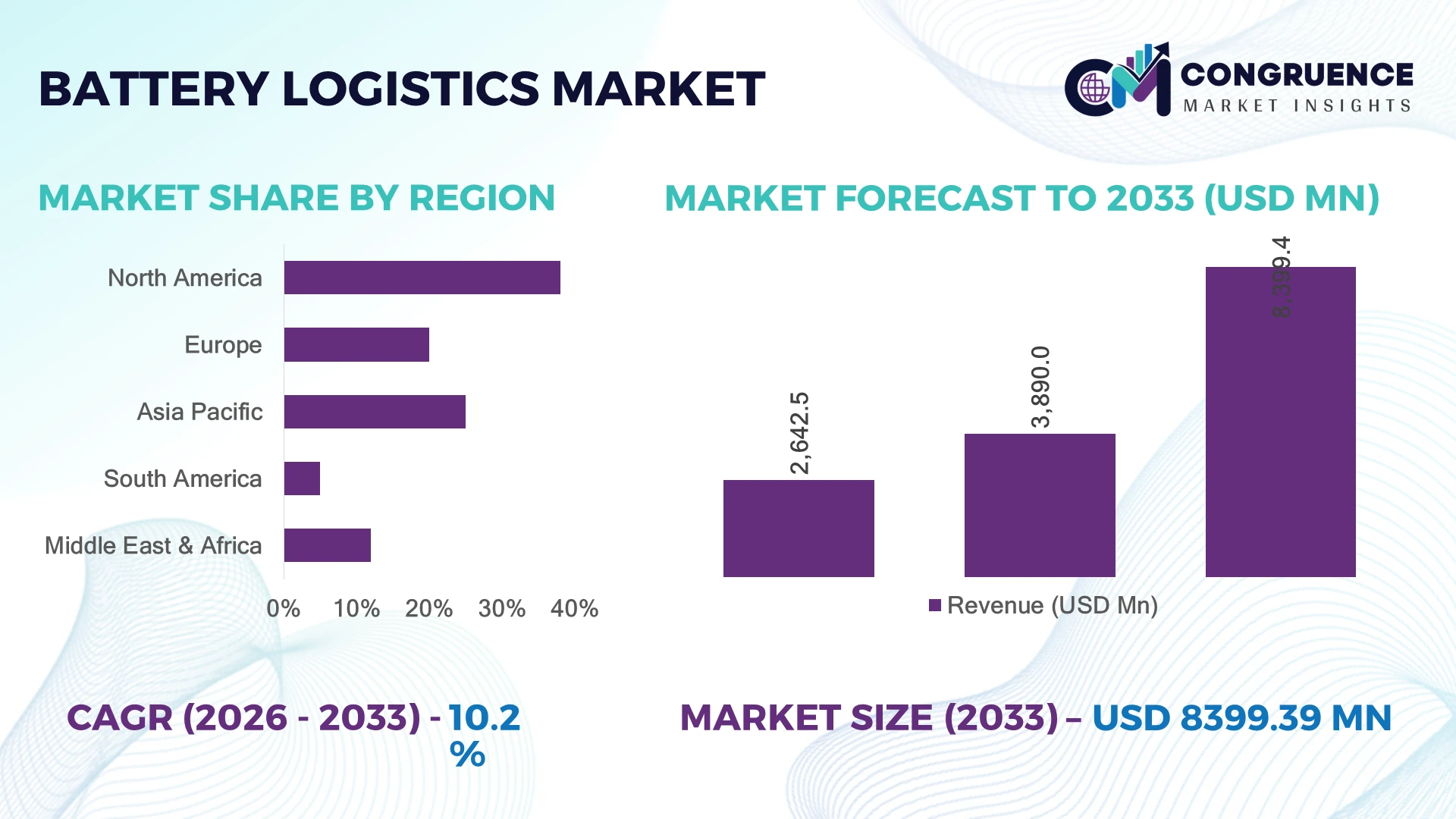
China remains the dominant battery logistics hub, accounting for approximately 42% of global lithium-ion battery manufacturing capacity in 2026, supported by investments exceeding USD 20 billion across battery supply-chain infrastructure and export logistics corridors. In comparison, the United States holds nearly 14% of global capacity while accelerating domestic battery transport networks under industrial reshoring initiatives. Advanced battery tracking systems now support over 65% of large-scale battery shipments, improving visibility, compliance, and transit efficiency amid evolving trade and geopolitical dynamics.
Strategic implication: logistics providers with specialized hazardous-material handling, digital shipment monitoring, and cross-border compliance capabilities are positioned to capture the highest-value contracts across the battery ecosystem.
Market Size & Growth: USD 3890 Million in 2025 rising to USD 8399.39 Million by 2033 at 10.1% growth, supported by expanding EV battery production and recycling logistics demand.
Top Growth Drivers: EV battery shipments up 28%, battery recycling volumes up 24%, and compliance-driven specialized transport demand up 18%.
Short-Term Forecast: By 2028, advanced tracking and route optimization reduce transit delays by 15% and improve logistics efficiency by 12%.
Emerging Technologies: AI-driven route planning, IoT-enabled battery monitoring, and automated warehouse systems improve shipment visibility by over 30%.
Regional Leaders: Asia-Pacific exceeds USD 3.8 billion, North America approaches USD 2.1 billion, and Europe surpasses USD 1.7 billion, driven by localized battery supply-chain expansion.
Consumer/End-User Trends: More than 70% of large battery manufacturers prioritize real-time shipment monitoring and compliance-focused logistics partners.
Pilot/Case Example: In 2026, automated battery warehousing projects achieved 20% faster handling times and reduced inventory errors by 18%.
Competitive Landscape: Leading providers collectively control approximately 35% market share, with competition centered on specialized hazardous-goods logistics capabilities.
Regulatory & ESG Impact: Enhanced battery transport regulations improve compliance rates by nearly 22% while supporting circular-economy objectives.
Investment & Funding: Global investments surpass USD 8 billion across logistics hubs, recycling networks, and battery transport infrastructure modernization.
Innovation & Future Outlook: Digital battery passports, predictive logistics analytics, and autonomous handling systems support a high-growth shift toward end-to-end supply-chain visibility.
Battery logistics operations are increasingly concentrated around electric vehicle manufacturing clusters, stationary energy storage projects, and battery recycling facilities. Advanced IoT sensors, digital tracking platforms, and automated compliance management systems are improving shipment visibility by more than 25% while reducing handling risks. A notable trend is the rapid expansion of closed-loop battery supply chains, where transportation networks support both distribution and end-of-life recovery, aligning with evolving regulatory requirements and strengthening operational resilience across global markets, setting the stage for deeper strategic evaluation.
Battery logistics has become a strategic enabler of industrial competitiveness as electric vehicle production, grid-scale energy storage deployment, and battery recycling networks expand across global supply chains. The market is increasingly influenced by supply-chain restructuring, with manufacturers reducing dependency on single-country sourcing and developing localized transport corridors. As battery shipments classified as hazardous goods continue to rise, logistics performance is becoming a critical factor affecting production continuity, regulatory compliance, and inventory efficiency.
Digital logistics platforms are reshaping operations. AI-enabled route optimization and real-time battery monitoring systems reduce transit disruptions by nearly 20% compared with legacy manual tracking methods while lowering compliance-related administrative costs by approximately 15%. China continues to lead in shipment scale through integrated battery manufacturing clusters, while Germany and the United States are advancing specialized logistics infrastructure focused on traceability and recycling flows. More than 60% of large battery producers now integrate digital shipment visibility tools into transportation planning.
A practical example is the deployment of dedicated battery logistics hubs near EV manufacturing centers, enabling faster inventory turnover and safer handling processes. Over the next two to three years, automated compliance management adoption is expected to exceed 70% among major operators. Companies are expanding partnerships with recycling firms, transport specialists, and technology providers to secure end-to-end logistics capabilities. Organizations that build resilient, data-driven battery logistics ecosystems will strengthen operational control, customer retention, and long-term competitive positioning.
The rapid expansion of electric vehicle manufacturing and battery production ecosystems remains the primary growth catalyst for battery logistics services. Global battery shipment volumes have increased by more than 25% over the past two years, while battery recycling flows have expanded by approximately 18%, creating additional transportation demand. China’s integrated battery manufacturing hubs and the United States' domestic battery supply-chain investments are reshaping freight patterns and requiring specialized hazardous-material handling capabilities. This increase in shipment complexity directly drives demand for real-time monitoring, temperature-controlled transport, and compliance-focused logistics solutions. In response, logistics providers are investing in dedicated battery handling facilities, digital tracking systems, and strategic partnerships with battery manufacturers. A notable operational insight is that logistics reliability is increasingly influencing supplier selection decisions, making transportation capability a competitive differentiator rather than a supporting function.
Stringent transport regulations and uneven infrastructure readiness continue to limit operational scalability. Compliance-related handling costs account for nearly 12%–15% of battery transportation expenditures, while documentation requirements can extend cross-border shipment processing times by over 20%. In countries with developing logistics networks, limited availability of certified battery storage and hazardous-goods facilities creates bottlenecks that reduce network efficiency. Frequent regulatory updates regarding lithium-ion battery transport further increase administrative burdens for operators managing international routes. To mitigate these constraints, companies are diversifying transport networks, localizing warehousing capacity, and securing long-term contracts with certified logistics partners. A key strategic insight is that regulatory readiness increasingly determines market access, particularly for providers targeting multinational battery manufacturers and large-scale recycling operations.
The emergence of circular battery supply chains presents a significant opportunity beyond conventional transportation services. More than 30% of battery manufacturers are actively integrating reverse logistics programs, while automated shipment visibility solutions improve operational efficiency by approximately 22%. In the United States and Germany, growing investments in battery recycling infrastructure are creating demand for specialized collection, transportation, and traceability services. Digital battery passports and IoT-enabled tracking technologies are improving lifecycle transparency and enabling more efficient material recovery processes. Companies are responding through technology partnerships, dedicated recycling logistics networks, and ecosystem development initiatives linking manufacturers, recyclers, and transport providers. A distinctive strategic opportunity lies in monetizing battery lifecycle data, transforming logistics operators from transport service providers into critical supply-chain intelligence partners.
As battery volumes increase, maintaining consistent operational performance across complex international networks becomes increasingly difficult. More than 40% of logistics operators report challenges related to specialized workforce availability, while advanced battery handling requirements can increase training needs by approximately 25%. The growing adoption of connected monitoring systems also expands cybersecurity exposure across transportation networks. In Japan and South Korea, rising battery density levels are placing additional pressure on safety protocols, packaging standards, and emergency response capabilities. These execution challenges directly affect service reliability, deployment consistency, and long-term competitiveness. Companies must invest in workforce development, cybersecurity frameworks, automation technologies, and specialized infrastructure to support future shipment requirements. The strongest operators will be those capable of scaling compliance, safety, and digital integration simultaneously without compromising operational efficiency.
Digital Shipment Visibility Expansion: Battery manufacturers and logistics providers are rapidly deploying IoT-enabled monitoring systems, with real-time tracking adoption exceeding 65% among large operators and shipment exception detection improving by nearly 30%. Stricter lithium-ion transport compliance requirements and rising cross-border battery flows are accelerating implementation. Companies are integrating predictive analytics into transport management platforms, reducing documentation delays by approximately 18% while improving operational responsiveness across high-value battery supply chains.
Dedicated Battery Logistics Hubs: Specialized battery handling facilities are becoming a preferred operational model, particularly in China, Germany, and the United States. Dedicated battery warehousing capacity expanded by over 20% during the past two years, while automated material handling systems improved throughput efficiency by roughly 15%. Instead of expanding generic logistics infrastructure, companies are concentrating investments near battery manufacturing clusters, creating shorter transport routes and reducing handling complexity across production networks.
Reverse Logistics Network Integration: Reverse logistics is evolving from a compliance function into a strategic operating segment. Battery collection and recovery volumes have increased by approximately 25%, while traceability requirements now influence more than 50% of large recycling contracts. Logistics providers are forming partnerships with recyclers and battery producers to establish closed-loop transportation networks. A less obvious shift is the growing value of lifecycle tracking data, which supports inventory planning and material recovery optimization.
Automation-Led Compliance Management: Automated compliance platforms are replacing manual documentation workflows as hazardous goods regulations become more complex. Digital compliance processing reduces administrative workloads by nearly 35% and lowers shipment approval times by about 20%. Labor shortages in specialized logistics functions are further driving adoption. Companies are restructuring operations around centralized compliance centers, combining automation, digital documentation, and risk monitoring to improve shipment consistency and reduce operational disruptions.
Transportation remains the leading segment within the Battery Logistics Market, accounting for the largest share of operational activity due to its direct role in moving lithium-ion batteries across manufacturing, assembly, and distribution networks. More than 55% of battery logistics expenditure is linked to transportation services, reflecting the complexity of hazardous-material movement and cross-border compliance requirements. Companies continue investing in dedicated transport fleets, advanced tracking technologies, and specialized carrier partnerships to improve shipment reliability and reduce transit risks. Warehousing remains strategically important as battery inventory volumes increase, while Packaging & Handling services continue evolving through enhanced safety standards and automated handling systems.
Reverse Logistics is emerging as the fastest-growing segment as battery recycling and second-life battery programs expand globally. Collection and recovery-related logistics volumes have increased by approximately 25%, creating new service opportunities beyond traditional transportation. Cold Chain Logistics is also gaining relevance for temperature-sensitive battery chemistries, particularly in long-distance transport. Logistics providers are expanding specialized facilities and integrating digital traceability systems to capture these evolving demand streams. Investment priorities increasingly favor lifecycle logistics capabilities rather than standalone transportation services.
Electric Vehicles represent the dominant application segment, supported by large-scale battery production, global EV manufacturing expansion, and increasingly complex transportation requirements. Nearly 60% of battery logistics activity is associated with EV battery movement, including raw material transport, battery pack distribution, and recycling flows. Companies are scaling dedicated logistics networks around EV manufacturing hubs to improve inventory turnover and reduce delivery lead times. Consumer Electronics remains a mature segment with stable shipment volumes, supported by continuous demand for smartphones, laptops, and portable devices requiring specialized battery transportation.
Energy Storage Systems are emerging as the fastest-growing application due to accelerating grid modernization projects and renewable energy integration initiatives. Logistics demand related to stationary storage deployments has increased by approximately 22%, creating requirements for larger-scale battery handling and project-based transportation services. Industrial Batteries continue generating demand through material handling equipment and backup power systems, while Medical Devices require highly controlled battery logistics processes. Providers are investing in automation, compliance management, and project logistics expertise to serve increasingly diverse battery deployment environments.
Electric Vehicles constitute the largest end-user group, driven by extensive battery procurement volumes, production scheduling requirements, and integrated supply-chain operations. More than 50% of specialized battery logistics contracts are linked to EV manufacturers and associated battery suppliers. These buyers prioritize real-time shipment monitoring, compliance assurance, and network reliability, encouraging logistics providers to develop customized service offerings and dedicated infrastructure. Consumer Electronics manufacturers remain important purchasers due to consistent shipment frequency and global distribution requirements, although demand growth is comparatively moderate.
Energy Storage Systems represent the fastest-growing end-user segment as utilities, energy developers, and infrastructure operators deploy larger battery installations. Logistics demand from this group has expanded by nearly 20%, driven by increasing project scale and deployment complexity. Industrial Batteries continue generating procurement activity across manufacturing and warehousing operations, while Medical Devices require highly specialized transport protocols and traceability standards. Logistics providers are strengthening partnerships, offering customized handling solutions, and expanding service portfolios to secure long-term contracts within these evolving customer segments. Competitive positioning is increasingly determined by sector-specific expertise rather than generalized transportation capabilities.
Asia-Pacific accounted for the largest market share at 46% in 2025 however, Middle East & Africa is expected to register the fastest growth, expanding at a CAGR of 11.8% between 2026 and 2033.
Supply Chain Localization Drives Logistics Modernization
North America represents a significant share of the Battery Logistics Market, supported by expanding domestic battery manufacturing, electric vehicle production, and battery recycling infrastructure. The region accounts for approximately 24% of global battery logistics activity, with the United States and Canada investing heavily in localized battery supply chains. Logistics providers are developing dedicated hazardous-material transportation networks and advanced warehousing capabilities to support battery movement. Automated compliance systems and digital shipment visibility platforms are now used across more than 60% of large battery logistics operations. A notable development is the expansion of battery-focused logistics corridors connecting manufacturing clusters with recycling facilities, improving operational efficiency and reducing transportation complexity.
United States Market Outlook: The United States remains the primary battery logistics hub within North America due to strong electric vehicle manufacturing activity, battery plant construction, and recycling network development. More than 70% of regional battery transportation demand originates from U.S.-based operations. Investments in dedicated battery warehousing, digital compliance management, and specialized transportation fleets continue to strengthen market leadership. Growing collaboration between battery producers, logistics providers, and recycling companies is creating integrated logistics ecosystems that improve shipment visibility, regulatory compliance, and inventory management efficiency.
Regulatory Compliance and Circular Logistics Expansion
Europe maintains a strong position in battery logistics through advanced regulatory frameworks, battery recycling initiatives, and expanding gigafactory infrastructure. The region contributes approximately 22% of global battery logistics demand and emphasizes traceability, safety compliance, and sustainable transportation practices. Increasing implementation of battery lifecycle tracking systems is reshaping logistics workflows across manufacturing and recycling networks. Dedicated battery handling facilities have expanded by nearly 18% over recent years, improving operational readiness for growing shipment volumes. Logistics providers are increasingly integrating reverse logistics capabilities to support circular economy objectives and evolving battery recovery requirements.
Germany Market Outlook: Germany serves as the strategic center of Europe's battery logistics ecosystem due to its automotive manufacturing strength and expanding battery production capacity. The country hosts a growing network of battery logistics hubs connected to vehicle manufacturing facilities and recycling infrastructure. More than 30% of Europe's battery manufacturing-related logistics activity is linked to Germany. Investments in automated warehousing, digital traceability platforms, and battery recycling logistics continue to enhance operational efficiency while supporting compliance with increasingly stringent transportation and sustainability regulations.
Manufacturing Scale Creates Logistics Dominance
Asia-Pacific leads the Battery Logistics Market through unmatched battery manufacturing concentration, integrated supply chains, and export-driven transportation activity. The region accounts for approximately 46% of global battery logistics demand, supported by large-scale production facilities across China, South Korea, and Japan. Battery export volumes continue to rise, increasing demand for specialized transportation, packaging, and compliance services. More than 65% of battery-related international shipments originate from Asia-Pacific manufacturing networks. Logistics providers are expanding dedicated infrastructure, digital monitoring systems, and multimodal transportation capabilities to support growing operational complexity and shipment volumes.
China Market Outlook: China remains the most influential battery logistics market globally due to its dominant battery manufacturing capacity and extensive export network. The country accounts for more than 40% of global battery production output, generating substantial logistics demand across transportation, warehousing, and reverse logistics services. Continuous investments in smart logistics parks, automated distribution centers, and battery recycling infrastructure strengthen operational efficiency. Chinese logistics operators are increasingly deploying AI-enabled shipment management tools to improve visibility, reduce transit delays, and support expanding international battery trade flows.
Resource Development Supports Logistics Demand
South America is emerging as an important battery logistics market due to growing lithium supply-chain activity, expanding energy storage deployments, and increasing electric mobility investments. The region contributes approximately 5% of global battery logistics demand but is gaining importance as battery raw material exports expand. Infrastructure modernization efforts and logistics corridor improvements are supporting battery-related transportation requirements. However, uneven transportation infrastructure and regulatory fragmentation continue to influence operational efficiency. Logistics providers are responding through strategic partnerships, localized warehousing investments, and enhanced cross-border transportation capabilities.
Brazil Market Outlook: Brazil represents the largest battery logistics market in South America due to its industrial scale, expanding electric mobility sector, and improving transportation infrastructure. The country accounts for nearly 40% of regional battery-related logistics activity. Investments in energy storage projects and domestic battery assembly operations are increasing demand for specialized transportation and warehousing solutions. Logistics providers are focusing on network optimization, compliance capabilities, and multimodal transportation strategies to improve service reliability and support future battery ecosystem expansion.
Infrastructure Investment Accelerates Market Development
Middle East & Africa is becoming a high-priority market as governments invest in industrial diversification, renewable energy infrastructure, and advanced logistics networks. The region contributes a relatively modest share of global battery logistics demand but demonstrates strong momentum through energy storage deployment and logistics modernization initiatives. Dedicated industrial zones and port infrastructure projects are enhancing battery transportation efficiency. Battery-related logistics infrastructure investment has increased by approximately 20% in key markets, improving operational capabilities. Companies are strengthening regional partnerships and developing specialized logistics services to support evolving battery supply chains.
United Arab Emirates Market Outlook: The United Arab Emirates serves as the leading battery logistics hub in the Middle East & Africa due to its advanced logistics infrastructure, strategic trade location, and industrial diversification initiatives. The country functions as a major distribution gateway connecting Asian, European, and African battery supply chains. Significant investment in smart warehousing, digital trade platforms, and multimodal transportation facilities continues to improve operational efficiency. Growing deployment of energy storage projects is creating additional demand for specialized battery transportation and handling services across the national logistics network.
The Battery Logistics Market is characterized by competition between global logistics leaders such as DHL Supply Chain, Kuehne+Nagel, DB Schenker, DSV, and CEVA Logistics, regional hazardous-material specialists, and battery-focused supply-chain providers. The top five players collectively control approximately 32% of market activity, while regional operators compete through regulatory expertise and localized infrastructure. Competition is centered on shipment visibility, compliance management, transportation reliability, and specialized battery handling capabilities. Advanced tracking platforms improve operational efficiency by nearly 20%, while automated compliance systems reduce processing time by about 15%. Companies are strengthening positions through battery logistics hubs, recycling partnerships, dedicated transport fleets, and digital monitoring investments. A notable competitive shift is the move toward integrated lifecycle logistics that combines transportation, warehousing, reverse logistics, and traceability services. The primary entry barrier is regulatory certification combined with specialized infrastructure requirements. Success increasingly depends on delivering end-to-end battery logistics ecosystems with proven compliance, visibility, scalability, and operational resilience.
DHL Supply Chain
Kuehne+Nagel
DB Schenker
DSV
CEVA Logistics
UPS Supply Chain Solutions
FedEx Logistics
Expeditors International
Nippon Express
GEODIS
Bolloré Logistics
Yusen Logistics
Hellmann Worldwide Logistics
Kerry Logistics Network Limited
Battery logistics operations are increasingly built around IoT-enabled tracking, cloud-based transport management systems, and automated compliance platforms. More than 65% of large battery shipments now utilize real-time monitoring technologies, improving shipment visibility by approximately 30% and reducing compliance-related delays by 18%. Integrated sensor networks continuously monitor temperature, shock exposure, and battery condition during transit, helping operators reduce handling risks while improving delivery reliability. Companies managing high-volume electric vehicle battery flows benefit most through stronger inventory control and faster exception management.
Emerging technologies include AI-driven route optimization, digital battery passports, and predictive logistics analytics. AI-enabled planning systems improve route efficiency by nearly 15% while lowering transport costs by approximately 10% compared with conventional planning methods. Adoption of digital battery identification systems has exceeded 35% among advanced battery supply chains, supporting traceability and lifecycle management requirements. Integration between logistics platforms, battery manufacturers, and recycling networks is becoming a critical operational differentiator as regulatory scrutiny and circular economy requirements increase.
Between 2026 and 2028, autonomous warehouse systems, robotics-assisted battery handling, and digital twin technologies are expected to reshape logistics execution. Automated battery handling operations deliver roughly 25% higher throughput than traditional manual workflows while reducing handling errors by nearly 20%. Logistics leaders investing in automation, AI orchestration, and end-to-end visibility platforms are strengthening competitive positioning through faster processing, improved compliance performance, and scalable battery lifecycle logistics capabilities.
May 2026 – DHL Supply Chain broke ground on a European Battery Logistics Hub in the Netherlands featuring 17,000 square meters of specialized high-voltage battery storage and service capacity. The project strengthens EV and energy-storage supply chain support while expanding compliant battery lifecycle logistics operations across Europe. Source: group.dhl.com
June 2026 – CEVA Logistics and BYD signed a three-year global logistics memorandum of understanding covering operations across 100+ countries and six continents. The partnership expands end-to-end battery, automotive, and energy-storage logistics capabilities while improving supply-chain resilience and localized operational execution. Source: cevalogistics.com
March 2026 – CEVA Logistics launched a dedicated maritime transport solution for used lithium-ion batteries, deploying five specialized containers with 30-tonne capacity each. The initiative strengthens reverse logistics capabilities and supports growing battery recycling flows across European transportation networks. Source: cevalogistics.com
February 2026 – DHL Supply Chain opened its first Electric Vehicle Center of Excellence in Central Europe, adding a 26,000-square-meter facility and expanding its network to 20 EV Centers of Excellence globally. The expansion enhances battery logistics expertise, specialized storage, and e-mobility supply-chain support. Source: dhl.com
This report provides comprehensive analysis of the Battery Logistics Market across Transportation, Warehousing, Reverse Logistics, Cold Chain Logistics, and Packaging & Handling segments. It evaluates demand patterns across Electric Vehicles, Consumer Electronics, Energy Storage Systems, Industrial Batteries, and Medical Devices while assessing purchasing behavior across major end-user categories. The study covers North America, Europe, Asia-Pacific, South America, and Middle East & Africa, representing more than 95% of global battery transportation and logistics activity. Operational trends, deployment patterns, regulatory developments, and technology adoption levels are analyzed to identify evolving market priorities.
The report further examines digital tracking systems, AI-enabled logistics management, automated warehousing, battery traceability platforms, and reverse logistics infrastructure shaping industry transformation between 2026 and 2033. Coverage includes competitive positioning, supply-chain modernization strategies, investment priorities, partnership activity, and emerging battery recycling ecosystems. Strategic insights support expansion planning, infrastructure development, service portfolio optimization, operational efficiency improvement, and long-term decision-making across battery manufacturing, transportation, storage, and lifecycle management networks.
| Report Attribute/Metric | Report Details |
|---|---|
Market Revenue in 2025 | USD 3890 Million |
Market Revenue in 2033 | USD 8399.39 Million |
CAGR (2026 - 2033) | 10.1% |
Base Year | 2025 |
Forecast Period | 2026 - 2033 |
Historic Period | 2021 - 2025 |
Segments Covered | By Type
By Application
By End-User
|
Key Report Deliverable | Revenue Forecast, Growth Trends, Market Dynamics, Segmental Overview, Regional and Country-wise Analysis, Competition Landscape |
Region Covered | North America, Europe, Asia-Pacific, South America, Middle East, Africa |
Key Players Analyzed | DHL Supply Chain, Kuehne+Nagel, DB Schenker, DSV, CEVA Logistics, UPS Supply Chain Solutions, FedEx Logistics, Expeditors International, Nippon Express, GEODIS, Bolloré Logistics, Yusen Logistics, Hellmann Worldwide Logistics, Kerry Logistics Network Limited |
Customization & Pricing | Available on Request (10% Customization is Free) |




