
Reports
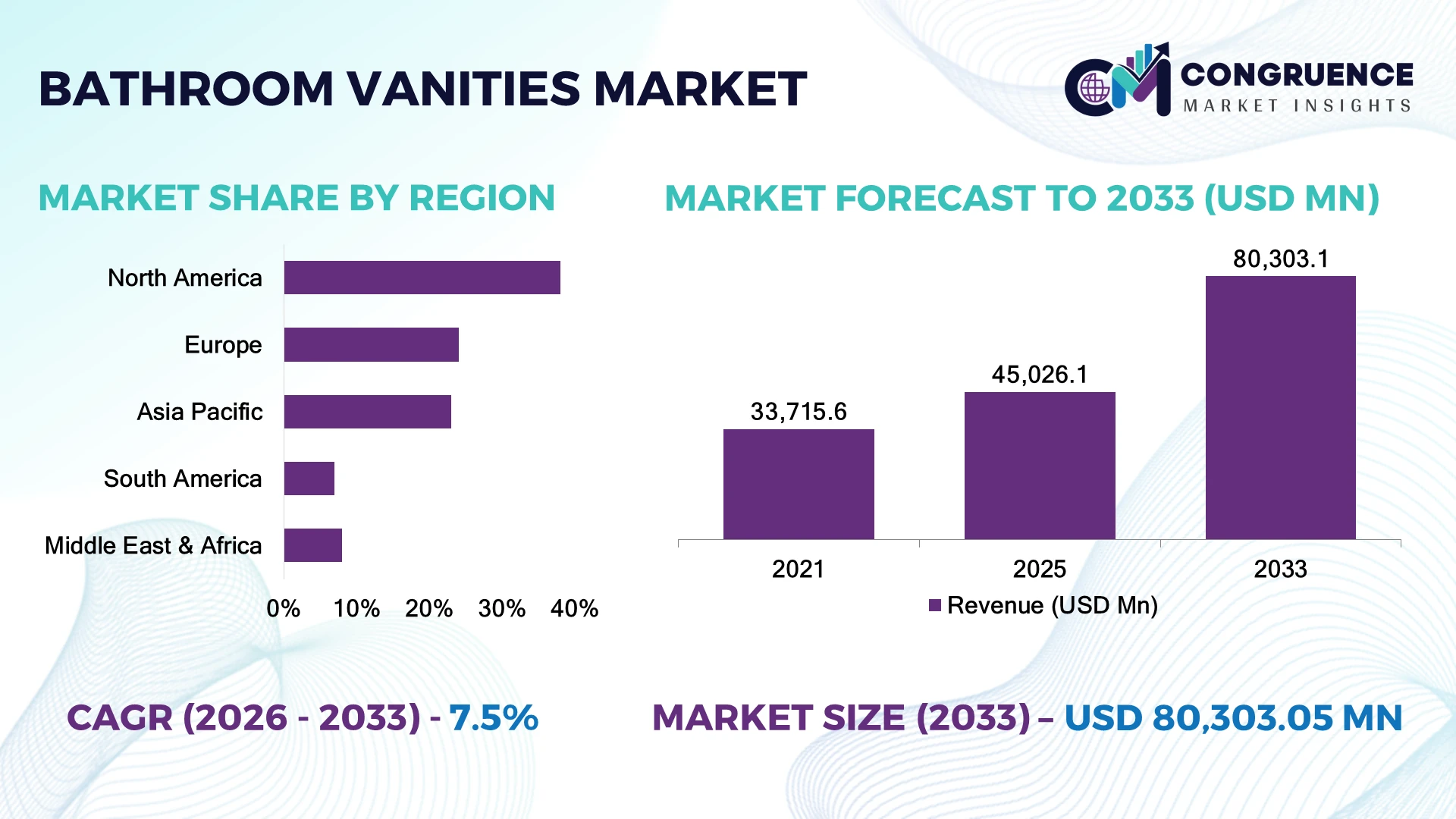
The Global Bathroom Vanities Market was valued at USD 45,026.1 Million in 2025 and is anticipated to reach a value of USD 80,303.1 Million by 2033 expanding at a CAGR of 7.5% between 2026 and 2033. Growth is driven by premium bathroom remodeling, compact-space furniture adoption, engineered-stone surfaces, modular storage systems, and rising replacement demand from residential renovation and hospitality projects.
The United States remains the dominant country market, accounting for approximately 34% of global bathroom vanity demand, supported by residential remodeling, multifamily construction, and premium fixture replacement. China follows with roughly 18%, benefiting from large-scale housing development and furniture manufacturing capacity. U.S. demand for integrated storage and countertop configurations is approximately 20% higher than conventional pedestal formats, while smart and modular designs are gaining adoption.
Strategic advantage is shifting toward manufacturers combining modular production, digital customization, durable materials, and shorter fulfillment cycles.
Market Size & Growth: USD 45.0 Billion in 2025 to USD 80.3 Billion by 2033 at 7.5% CAGR, driven by remodeling and modular bathroom furniture adoption.
Top Growth Drivers: Residential renovation 34%, premium bathroom upgrades 27%, multifamily construction 18%.
Short-Term Forecast: By 2028, modular vanity configurations are positioned to reduce installation time by 15–20% versus heavily customized site-built cabinetry.
Emerging Technologies: CNC manufacturing, digital configurators, moisture-resistant engineered materials, and integrated LED/smart-storage systems are reshaping product development.
Regional Leaders: North America is projected near USD 28 Billion by 2033, Europe around USD 20 Billion, and Asia Pacific approximately USD 19 Billion, with customization adoption strongest in North America.
Consumer/End-User Trends: Wall-mounted and floating vanities account for approximately 25% of premium urban installations, reflecting demand for visual spaciousness and easier floor maintenance.
Pilot/Case Example: By 2027, automated CNC cutting and pre-assembled cabinet systems are targeting 15–20% reductions in installation labor for standardized vanity configurations.
Competitive Landscape: U.S. and European premium manufacturers compete with Chinese and Southeast Asian volume producers; leading brands collectively represent approximately 20–25% of organized-market sales.
Regulatory & ESG Impact: Water-resistant engineered wood, recycled-content surfaces, and low-emission finishes are expanding, with sustainable-material specifications appearing in approximately 15% of premium commercial projects.
Investment & Funding: More than USD 1 Billion in manufacturing, retail-format expansion, product development, and distribution investment is supporting bathroom-furniture capacity and omnichannel sales infrastructure.
Innovation & Future Outlook: The market is shifting toward modular customization, integrated lighting, antimicrobial surfaces, smart storage, sustainable materials, and digitally configured products that shorten design-to-installation cycles.
The Bathroom Vanities Market is being reshaped by residential remodeling, premium hospitality interiors, multifamily housing, and compact urban bathrooms. Floating configurations, engineered-stone countertops, soft-close storage, integrated lighting, and moisture-resistant cabinetry are gaining traction, with premium modular formats capturing roughly 25% of urban upgrade projects. North American retailers are also expanding ready-to-assemble and digitally configurable inventory to manage shipping and installation constraints.
Bathroom vanities are becoming a strategic category within residential renovation and interior-furnishing supply chains because buyers increasingly expect storage, aesthetics, countertop integration, and installation convenience from one product system. The shift from site-built cabinetry toward modular and semi-custom furniture is reducing installation complexity while allowing manufacturers to standardize high-volume components. North America remains renovation-led, while China and India benefit more strongly from manufacturing scale and new residential construction.
Digital configuration and CNC production provide a measurable advantage over conventional manual fabrication. Automated cutting and drilling can reduce component-production time by approximately 15–20%, while pre-assembled modules can shorten onsite installation by 20–30%. This favors manufacturers with integrated design-to-production workflows rather than retailers dependent on fragmented cabinetry suppliers.
During 2026–2028, companies are prioritizing moisture-resistant materials, modular SKUs, localized inventory, and direct-to-consumer configuration tools. A multifamily developer, for example, can standardize several vanity sizes across hundreds of apartments while customizing finishes without redesigning cabinet structures. Manufacturers combining standardized cores with configurable fronts, countertops, lighting, and hardware will gain stronger margin control and faster fulfillment. Competitive positioning will increasingly depend on customization without manufacturing complexity.
Residential bathroom remodeling is strengthening demand for modular vanities, with renovation projects contributing approximately 34% of category demand and premium configurations growing 10–12% faster than basic cabinetry. In the United States, floating and integrated-countertop designs are gaining adoption as homeowners prioritize storage efficiency and simplified installation. CNC cutting, pre-drilled assemblies, and factory-finished components can reduce installation labor by 15–20%, improving contractor productivity. Manufacturers are responding by expanding modular SKU ranges, investing in automated production, and partnering with home-improvement retailers. A key structural shift is the move from vanity cabinets as standalone furniture toward coordinated systems combining storage, countertops, lighting, mirrors, and hardware, increasing average order complexity and attachment opportunities.
Bathroom vanity manufacturers remain exposed to fluctuations in engineered wood, plywood, quartz, hardware, and international freight, with material inputs typically representing 45–55% of finished product cost. Imported components can increase landed costs by 8–15% during freight or currency disruptions, while bulky vanity units create disproportionately high storage and transportation expenses. China-based manufacturers serving North American buyers face additional exposure to shipping-cycle volatility and inventory financing. Companies are mitigating pressure through localized component sourcing, regional warehousing, standardized cabinet dimensions, and multi-supplier contracts. The non-obvious constraint is dimensional inefficiency: poorly optimized packaging can consume 10–15% more container space, making packaging engineering a direct margin lever rather than a logistics afterthought.
Digital configuration platforms are creating a higher-value pathway between mass-produced and fully bespoke vanities. Online configurators can reduce design-to-quotation time by approximately 30–40%, while standardized cabinet platforms combined with selectable fronts, countertops, colors, and hardware can support 20–30% more configuration options without equivalent SKU proliferation. India, Vietnam, and Mexico offer attractive manufacturing locations for companies seeking lower-cost production closer to North American and European customers. Smart mirrors, integrated LED lighting, antimicrobial surfaces, and sensor-enabled storage are creating additional premium modules. Manufacturers are investing in configurable product architectures, retailer integrations, and regional assembly partnerships. The strategic opportunity is to industrialize customization rather than treat every customized order as a separate manufacturing project.
Expanding customization creates execution pressure because vanity manufacturers must coordinate cabinet dimensions, countertop tolerances, plumbing clearances, hardware, finishes, and installation specifications across thousands of possible configurations. High-mix production can increase planning and changeover requirements by 15–25%, while dimensional errors can generate 5–10% rework in complex installations. Labor availability is another constraint for installers and skilled cabinet technicians, particularly in high-renovation U.S. markets. Companies are addressing these risks through modular product architectures, parametric CAD systems, automated CNC machining, barcode-based production tracking, and installer certification. The critical challenge is maintaining mass-production efficiency while delivering personalization; manufacturers that fail to standardize the underlying cabinet platform risk margin erosion as customization expands.
Floating Designs Gain Ground: Floating vanities now represent approximately 25% of premium urban installations, while demand for wall-mounted configurations is increasing 10–12% annually in renovation-heavy markets. The shift responds to compact bathrooms, easier floor cleaning, and contemporary aesthetics. Manufacturers are strengthening wall-mount hardware, reinforcing cabinet structures, and offering standardized installation systems to reduce contractor time.
Factory Assembly Gains Importance: Pre-assembled vanity units are reducing onsite installation requirements by approximately 20–30%, particularly across multifamily and hospitality projects. Standardized modules also reduce installation-related errors by roughly 10–15%. U.S. developers and contractors are increasingly specifying factory-assembled configurations, prompting manufacturers to redesign packaging, palletization, and distribution workflows around faster project deployment.
Moisture Resistance Becomes Differentiator: Manufacturers are increasing use of moisture-resistant MDF, plywood cores, sealed edges, and engineered surfaces, with premium projects allocating approximately 8–12% more material value toward durability features. Rising humidity exposure and longer replacement cycles are reinforcing this transition. Suppliers are integrating sealed construction and water-resistant finishes earlier in production rather than treating protection as a final coating step.
Packaging Optimization Cuts Logistics Costs: Flat-pack and knock-down designs are gaining traction for e-commerce and cross-border distribution, with optimized packaging capable of reducing dimensional freight volume by 15–20%. This is particularly valuable for bulky vanity shipments where container utilization directly affects delivered cost. Manufacturers are investing in structural packaging, corner protection, and standardized carton sizes to reduce damage while improving warehouse density.
Floor-mounted bathroom vanities represent the leading type, accounting for approximately 54% of global demand, supported by broad compatibility with existing plumbing, higher storage capacity, and straightforward replacement in conventional residential bathrooms. Their established contractor familiarity keeps installation and specification costs relatively predictable. Wall-mounted or floating vanities are the fastest-growing type, with adoption increasing approximately 11–13% annually in premium urban renovation projects as homeowners prioritize visual space, easier floor maintenance, and contemporary design. Freestanding and other specialized configurations retain relevance in hospitality, compact apartments, and bespoke interiors, but remain more niche. Companies are expanding floating collections, reinforcing mounting systems, and standardizing modular cabinet dimensions. The strategic shift is not replacing floor-mounted products outright; it is moving premium investment toward flexible wall-mounted platforms while manufacturers preserve floor-mounted volume through broader finishes and integrated countertop options.
Residential bathroom applications account for approximately 67% of global bathroom vanity demand, reflecting replacement cycles, bathroom renovations, new housing, and homeowner-led upgrades. Remodeling is particularly influential in the United States, where homeowners increasingly combine cabinetry replacement with countertops, mirrors, lighting, and storage improvements. Hospitality and commercial applications represent roughly 21% and prioritize standardized dimensions, durability, procurement consistency, and rapid installation. The fastest-growing use case is multifamily housing, where standardized modular vanities can reduce installation time by approximately 20–30% across repeated floor plans. Companies are responding with configurable cabinet platforms, bulk-order programs, pre-assembled units, and project-specific finish packages. Healthcare, institutional, and other specialized applications remain smaller but increasingly emphasize antimicrobial surfaces, moisture resistance, and easy-clean construction, creating opportunities for specification-driven suppliers rather than purely design-led manufacturers.
Residential end-users represent approximately 69% of global bathroom vanity demand, supported by homeowners, renovation contractors, and individual property investors purchasing products for replacement and remodeling projects. Their purchasing behavior is shifting toward integrated storage, floating configurations, engineered countertops, and coordinated mirrors, with premium configurations capturing roughly 25% of urban renovation projects. Hospitality and commercial developers account for about 20% and prioritize lifecycle durability, standardized procurement, and rapid project installation over highly individualized designs. Multifamily developers are the fastest-growing buyer group, with standardized vanity specifications helping reduce installation requirements by approximately 20–30% across repeated apartment layouts. Manufacturers are responding with contractor programs, developer pricing, regional distribution, and configurable product platforms. The competitive distinction is increasingly between retail-led suppliers optimized for one-off customization and project-oriented manufacturers capable of delivering consistent multi-unit specifications at scale.
North America accounted for the largest market share at 38% in 2025 however, Asia-Pacific is expected to register the fastest growth, expanding at a CAGR of 8.5% between 2026 and 2033.

Remodeling intensity and premium modularization strengthen market leadership
North America represents approximately 38% of the global Bathroom Vanities Market, with the United States generating more than 85% of regional demand. Residential remodeling, multifamily turnover, and premium bathroom upgrades remain the principal demand engines. Floating vanities, integrated countertops, soft-close storage, and coordinated mirror systems are gaining traction in metropolitan renovation projects, with premium modular configurations accounting for approximately 25% of urban installations. Large home-improvement retailers and specialist distributors are expanding ready-to-install assortments to address contractor labor constraints and shorter project schedules. Manufacturers are investing in regional distribution centers, CNC-enabled production, and digital configuration platforms, reducing fulfillment and installation complexity. The strategic advantage increasingly lies in combining mass-production efficiency with localized customization.
United States Market Outlook: The United States is the region's dominant market because of its large remodeling ecosystem, extensive contractor network, and strong premium-fixture replacement activity. Bathroom renovation projects increasingly incorporate coordinated vanities, countertops, mirrors, and lighting rather than standalone cabinetry. Multifamily developers are also standardizing vanity dimensions across projects, allowing manufacturers to achieve 15–20% installation-time savings through pre-assembled configurations.
Sustainability and compact-space design reshape product specifications
Europe accounts for approximately 24% of global bathroom vanity demand, with Germany, the United Kingdom, France, and Italy forming the principal markets. Replacement activity is supported by mature housing stock, while compact apartment layouts favor wall-mounted and space-efficient configurations. European buyers increasingly emphasize moisture resistance, low-emission finishes, recycled materials, and repairable components. Premium sustainable specifications command approximately 8–12% higher material allocation in selected projects. Manufacturers are responding with engineered wood, water-resistant coatings, modular cabinet platforms, and localized assembly. Digital product configurators are also improving specification accuracy for contractors and designers, helping reduce customization-related rework by approximately 10%.
Germany Market Outlook: Germany remains Europe's most strategically significant market, supported by its large housing stock, established furniture manufacturing base, and sophisticated bathroom-fixture distribution network. Manufacturers increasingly combine standardized cabinet platforms with configurable surfaces and hardware, enabling customization without excessive production complexity. Sustainability-focused procurement is also strengthening demand for durable materials and longer-life bathroom furniture.
Manufacturing scale accelerates modular and export-oriented production
Asia-Pacific represents approximately 23% of global Bathroom Vanities demand and contains the industry's most important manufacturing ecosystems. China accounts for more than 45% of regional consumption and remains a major export base for cabinetry, engineered surfaces, hardware, and bathroom furniture. India and Southeast Asian markets are expanding through residential construction, hospitality development, and urban apartment projects. Manufacturers are increasing CNC automation and flat-pack production, with automated cutting and drilling reducing component-processing time by approximately 15–20%. Export-oriented producers are also establishing regional distribution partnerships to shorten delivery cycles. The competitive advantage is shifting toward manufacturers capable of combining China's supply-chain depth with localized customization and faster fulfillment.
China Market Outlook: China is the region's most strategically important country because it combines large domestic housing demand with extensive bathroom-furniture manufacturing capacity. Established clusters provide access to engineered boards, hardware, ceramics, countertops, and finishing suppliers within concentrated industrial ecosystems. Export manufacturers are increasingly using automated CNC production and standardized cabinet platforms, allowing broader product customization without proportionally increasing manufacturing complexity.
Urban remodeling and locally adapted products broaden demand
South America accounts for approximately 7% of global Bathroom Vanities demand, with Brazil contributing more than 55% of regional consumption. Residential renovation, apartment development, hospitality projects, and replacement of aging bathroom furniture support the market, while imported hardware and components create cost sensitivity. Brazilian manufacturers increasingly use locally sourced engineered wood and domestic finishing capacity to reduce exposure to currency and freight volatility. Modular vanity adoption is rising by approximately 8–10% in urban renovation projects, particularly where contractors require faster installation. Suppliers are expanding distributor networks and offering standardized cabinet platforms with locally preferred finishes. The key opportunity is balancing international design trends with regional material availability and price expectations.
Brazil Market Outlook: Brazil dominates South American demand through its large residential base, established furniture industry, and extensive construction ecosystem. Local manufacturers benefit from proximity to engineered-board and finishing suppliers, helping reduce lead times compared with fully imported products. Urban developers are increasingly specifying standardized vanity dimensions across apartment projects, creating opportunities for manufacturers offering volume pricing and pre-assembled delivery.
Hospitality investment drives premium bathroom-furniture specifications
Middle East & Africa represents approximately 8% of global Bathroom Vanities demand, with Saudi Arabia and the United Arab Emirates accounting for a substantial share of premium project activity. Luxury hotels, residential towers, mixed-use developments, and high-end villas are increasing demand for customized vanities featuring engineered stone, integrated lighting, premium hardware, and moisture-resistant cabinetry. Hospitality projects can require 15–25% higher specification levels than standard residential installations. Saudi Arabia's large-scale urban and tourism developments are strengthening project-based procurement, while UAE distributors provide access to premium imported brands. Manufacturers are responding through project partnerships, regional warehousing, customized finishes, and dedicated specification teams.
Saudi Arabia Market Outlook: Saudi Arabia is the region's most strategically significant market, supported by major hospitality, residential, and mixed-use development programs. Large projects favor standardized procurement combined with premium customization, creating demand for manufacturers capable of delivering hundreds of coordinated vanity units with consistent dimensions and finishes. Suppliers with regional inventory and project-management capabilities gain an advantage by reducing import lead times and installation delays.
Global leaders such as Kohler, LIXIL, Roca Group, Geberit, and Duravit compete with regional manufacturers and specialist vanity brands on design breadth, customization, manufacturing scale, and distribution. The top five players collectively account for roughly 22% of global sales, leaving substantial room for regional suppliers. Competition increasingly favors customization and supply responsiveness: digital configuration can shorten specification cycles 20–30%, while modular production can reduce installation effort 15–20%. Kohler and Roca are broadening premium portfolios; Roca is also using acquisitions to deepen luxury positioning. IKEA competes through standardized, affordable modular products and omnichannel reach, while specialist brands differentiate through bespoke finishes and project support. The market is shifting from standalone cabinetry toward integrated vanity systems combining storage, basins, lighting, and coordinated accessories. Entry barriers center on dealer networks, manufacturing consistency, plumbing compatibility, and certification requirements. Winning requires scalable modular production, reliable supply, strong design differentiation, and channel access without sacrificing customization.
Current CNC machining and automated panel processing are replacing labor-intensive cutting, drilling, and edge finishing, with automated workflows improving production efficiency by roughly 8–12% and reducing dimensional errors by 3–5%. Digital configuration platforms are becoming increasingly important, allowing customers and contractors to specify cabinet dimensions, finishes, countertops, and hardware before production; adoption is strongest among organized manufacturers and large retailers. Across factories, connected CNC cells are linked with automated material handling and digital work orders, reducing setup changes and improving repeatability across standardized vanity sizes.
Integrated LED lighting, sensor-enabled mirrors, soft-close hardware, and modular storage are emerging as higher-value differentiators, improving installation productivity by about 2–4% when supplied as coordinated systems. New automated production lines can deliver approximately 15–20% faster component processing than conventional workshop methods, benefiting high-volume manufacturers with standardized product architectures. Cloud-based order integration and barcode tracking further reduce fulfillment errors by around 2–3%.
From 2026–2028, competitive advantage will shift toward manufacturers combining CNC automation with mass customization, digital specification, and integrated bathroom systems. Players with established retail and contractor ecosystems will capture adoption fastest because they can deploy these technologies across larger project volumes, shorten lead times, and support broader product configurations without proportionally increasing production complexity.
February 2025 Kohler expanded its bathroom portfolio at KBIS, introducing multiple vanity collections alongside mirrors and medicine cabinets. The launches broadened coordinated bathroom solutions and premium design choice, strengthening its showroom and specification positioning across residential projects. Source: kohler.com
March 2025 IKEA began North India online deliveries, covering Delhi-NCR and nine satellite cities with more than 7,000 products. The expansion increased omnichannel access to bathroom furniture and vanities, supporting wider residential reach and digital purchasing convenience. Source: ikea.com
July 2025 Roca Group agreed to acquire a majority stake in Antonio Lupi Design, whose products reach more than 80 countries. The transaction strengthened Roca’s luxury bathroom-furniture portfolio and expanded international distribution capabilities for premium projects globally. Source: rocagroup.com
2025 Duravit advanced its Matane, Canada facility, designed to produce up to 450,000 ceramic pieces annually using 99.6% renewable electricity. The project strengthens low-carbon manufacturing capacity and supports North American supply resilience while advancing sustainable production standards. Source: duravit.com DURAVIT
The Bathroom Vanities Market Report covers floor-mounted, wall-mounted, floating, freestanding, and vanity configurations across residential remodeling, new housing, hospitality, commercial, multifamily, and institutional applications. End-user analysis distinguishes homeowners, contractors, property developers, hospitality operators, and commercial buyers, with assessment of premium, standardized, modular, and customized purchasing patterns. Regional coverage spans North America, Europe, Asia-Pacific, South America, and Middle East & Africa, with country-level emphasis on the United States, Germany, China, Brazil, Saudi Arabia, and other high-activity markets.
The report evaluates CNC machining, automated cutting and drilling, digital configuration, integrated lighting, smart mirrors, moisture-resistant materials, modular assembly, and sustainable manufacturing. It benchmarks leading companies, competitive positioning, distribution strategies, product innovation, and expansion priorities, while tracking segment shares, adoption levels, installation efficiencies, and project deployment patterns. The analysis supports investment planning, market-entry decisions, capacity expansion, portfolio prioritization, partnerships, and competitive positioning through 2033.
| Report Attribute/Metric | Report Details |
|---|---|
|
Market Revenue in 2025 |
USD 45,026.1 Million |
|
Market Revenue in 2033 |
USD 80,303.1 Million |
|
CAGR (2026 - 2033) |
7.5% |
|
Base Year |
2025 |
|
Forecast Period |
2026 - 2033 |
|
Historic Period |
2021 - 2025 |
|
Segments Covered |
By Type
By Application
By End-User
|
|
Key Report Deliverable |
Revenue Forecast, Growth Trends, Market Dynamics, Segmental Overview, Regional and Country-wise Analysis, Competition Landscape |
|
Region Covered |
North America, Europe, Asia-Pacific, South America, Middle East, Africa |
|
Key Players Analyzed |
Kohler Co., LIXIL Group Corporation, Roca Sanitario S.A.U., Geberit AG, Duravit AG, IKEA Group, American Woodmark Corporation, Villeroy & Boch AG, TOTO Ltd., Caesarstone Ltd., MasterBrand Cabinets LLC, James Martin Furniture, Virtu USA, Avanity Corporation |
|
Customization & Pricing |
Available on Request (10% Customization is Free) |




