
Reports
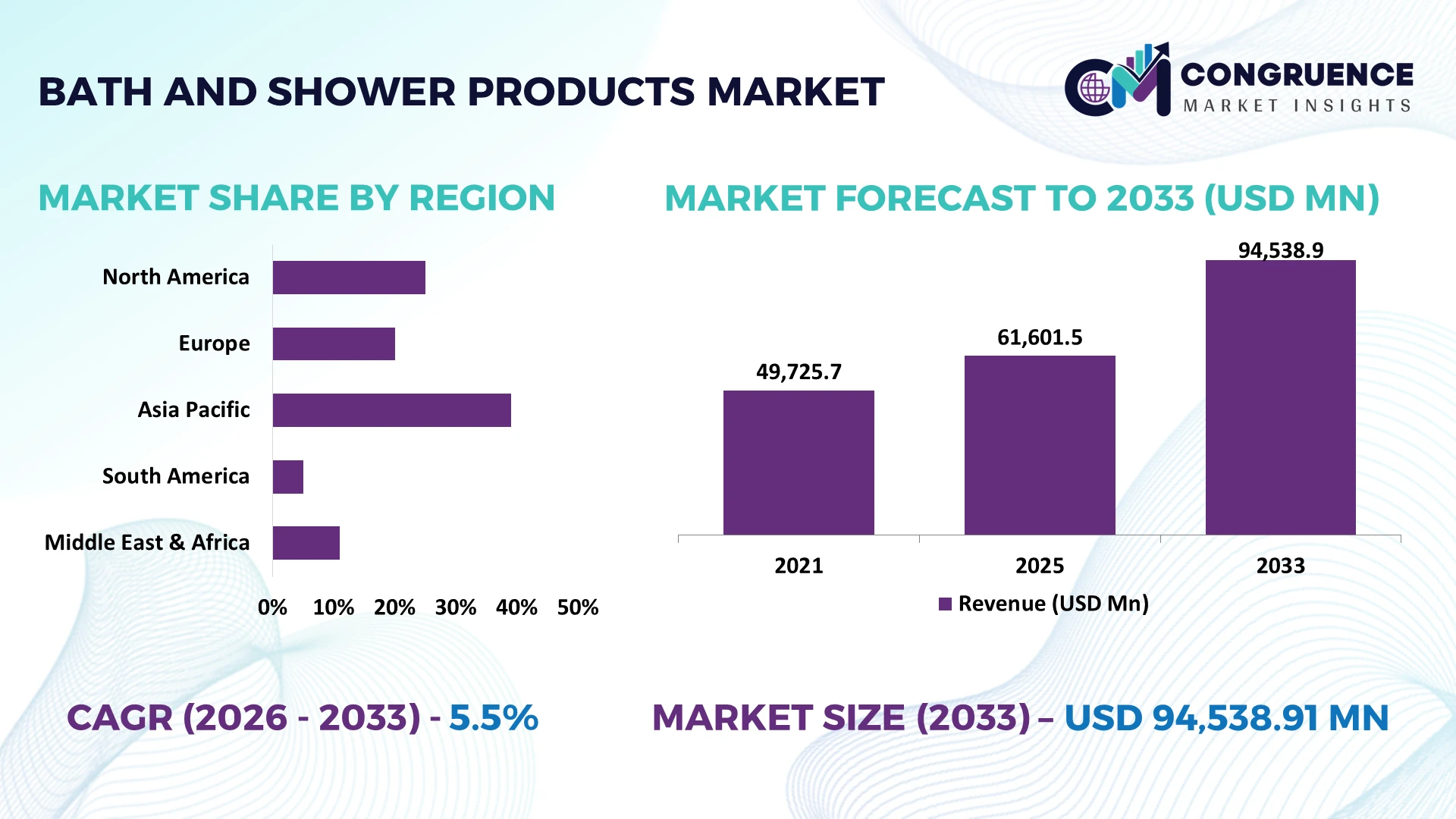
The Global Bath and Shower Products Market was valued at USD 61601.45 Million in 2025 and is anticipated to reach a value of USD 94538.91 Million by 2033 expanding at a CAGR of 5.5% between 2026 and 2033. Growth is driven by premium skincare-infused formulations, refillable packaging, microbiome-focused products, and rapid e-commerce penetration across emerging markets.
The United States remains a dominant high-value market, supported by premium personal-care spending, mass retail scale, and advanced formulation adoption, while China combines large-scale manufacturing capacity with expanding domestic beauty consumption. U.S. online beauty purchasing exceeds 30% of category sales in leading channels, compared with substantially lower penetration across many developing markets. Supply-chain diversification following Red Sea shipping disruptions is accelerating regional sourcing and packaging localization.
Strategic implication: Suppliers prioritizing premium formulations, localized manufacturing, and digitally enabled distribution are positioned to capture higher-value demand.
Market Size & Growth: USD 61.60 billion in 2025 is projected to reach USD 94.54 billion by 2033 at 5.5% CAGR, supported by premiumization and skincare-led formulation innovation.
Top Growth Drivers: Premium product adoption 28%; natural and organic formulation preference 24%; e-commerce purchasing 21%.
Short-Term Forecast: By 2028, automated formulation and packaging systems are positioned to reduce production costs by 8% and improve filling efficiency by 12%.
Emerging Technologies: AI-assisted formulation, automated dispensing, microbiome-friendly ingredients, and advanced refill packaging are reshaping high-growth product development.
Regional Leaders: North America is projected near USD 25 billion, Europe near USD 23 billion, and Asia-Pacific above USD 30 billion, with digital commerce driving regional adoption.
Consumer/End-User Trends: More than 30% of premium-category shoppers increasingly purchase bath and shower products through online channels, strengthening personalized product discovery.
Pilot/Case Example: A 2025 automated packaging deployment delivered approximately 15% higher line efficiency and reduced material handling requirements by 10%.
Competitive Landscape: Leading brands collectively control a significant share of premium demand, with L’Oréal, Unilever, Procter & Gamble, Colgate-Palmolive, and Kao competing across mass, premium, and specialty segments.
Regulatory & ESG Impact: Microplastic restrictions and packaging-reduction requirements are accelerating reformulation and recyclable-packaging adoption, with material reduction targets frequently reaching 10–20%.
Investment & Funding: More than USD 2 billion is being directed across beauty manufacturing expansion, formulation innovation, packaging automation, and strategic partnerships, favoring scalable premium platforms.
Innovation & Future Outlook: Next-generation products will combine AI-enabled personalization, waterless formats, refill systems, biotech-derived ingredients, and localized production to improve margins and resilience.
The Bath and Shower Products Market is shifting toward multifunctional cleansers, moisturizing body washes, exfoliating formulations, sensitive-skin products, and premium fragrance experiences. Demand is strengthening for sulfate-free, plant-derived, microbiome-conscious, and refill-oriented products as consumers connect cleansing with broader skin health. Online channels now represent more than 30% of premium beauty purchasing in leading markets, accelerating direct-to-consumer launches and personalized recommendations. Recent Red Sea logistics disruptions have also encouraged regional sourcing and inventory diversification. These changes are reshaping product economics and creating clear strategic opportunities across formulation, packaging, and distribution.
The Bath and Shower Products Market is becoming strategically important as consumer spending shifts from basic cleansing toward skin health, premium formulations, personalization, and sustainable formats. Companies are competing through formulation differentiation, faster product cycles, and digital distribution, while packaging regulations are accelerating redesign. Refillable and concentrated formats can reduce packaging material use by 20–40% versus conventional single-use formats, improving both logistics efficiency and ESG performance.
Technology investment is also changing operating economics. Automated filling and vision-inspection systems can improve line productivity by roughly 10–15% versus manual inspection and reduce packaging defects by 20% or more. The United States leads in premium digital adoption, while China combines high manufacturing scale with rapidly expanding beauty-commerce infrastructure. India is emerging as a cost-competitive formulation and packaging hub.
Over the next 2–3 years, companies are expected to prioritize localized sourcing, AI-assisted formulation, automated packaging, and refill infrastructure, targeting 8–12% improvements in production efficiency. A practical deployment model combines contract manufacturing with digitally monitored packaging lines, allowing brands to expand SKUs without equivalent fixed-asset growth. Competitive advantage will increasingly depend on combining formulation innovation with resilient supply chains, efficient production, and measurable sustainability outcomes.
Premium skincare positioning is reshaping bath and shower consumption, with specialized products such as moisturizing body washes, exfoliating cleansers, microbiome-focused formulas, and fragrance-led washes capturing higher-value demand. Premium and functional formulations are gaining roughly 15–20% stronger consumer interest than conventional basic cleansing products in developed markets. In the United States, online beauty purchasing already exceeds 30% across leading premium channels, accelerating product discovery and rapid SKU launches. Ingredient innovation using ceramides, botanical extracts, and biotech-derived actives is increasing differentiation. Companies are responding through formulation R&D, dermatological partnerships, and smaller targeted product launches. The strategic advantage lies in converting routine cleansing into higher-margin skin-health consumption rather than competing primarily on volume.
Bath and shower manufacturers face persistent cost pressure from surfactants, fragrances, specialty ingredients, plastics, and packaging components. Packaging can account for approximately 15–25% of finished-product manufacturing costs, while volatile petrochemical-linked inputs can shift formulation and container economics by 5–10%. European restrictions on selected microplastics are also increasing reformulation requirements and compliance workloads. China-based packaging and ingredient supply remains important for many multinational producers, creating exposure to freight disruption and sourcing concentration. Companies are mitigating this pressure through dual sourcing, regional contract manufacturing, longer-term procurement agreements, and recycled-material integration. The key operational insight is that packaging localization can protect margins more effectively than repeated consumer-price increases.
Refillable packaging, waterless products, and concentrated shower formulations present an underdeveloped efficiency opportunity, particularly in the United States, Japan, Germany, and India. Concentrated formats can reduce transportation volume by approximately 20–40%, while refill systems can lower packaging consumption by 30% or more across suitable product categories. Advances in solid cleansers, dissolvable formats, and precision dispensing are expanding commercial possibilities beyond conventional liquid products. Companies are increasing R&D investment and forming packaging partnerships to develop standardized refill architectures compatible with existing retail channels. The non-obvious opportunity is operational rather than purely environmental: lower water and packaging intensity can reduce freight exposure while creating differentiated premium formats with stronger repeat-purchase economics.
Rapid SKU proliferation creates execution complexity as brands manage different fragrances, viscosities, active ingredients, containers, pumps, and regional compliance requirements. Frequent product changes can increase production changeover time by 10–15%, while automated lines require substantial validation before handling new formulations consistently. India and China offer manufacturing scale, but quality-control requirements become more demanding as exports expand into tightly regulated markets. Workforce shortages in formulation science, automation maintenance, and quality assurance further constrain consistent deployment. Companies must invest in modular production equipment, machine-vision inspection, digital batch monitoring, and specialized technical training. The strategic challenge is achieving mass customization without sacrificing throughput, batch consistency, or regulatory compliance across increasingly fragmented product portfolios.
Skinification Is Reshaping Body Cleansing: Ingredient-led body washes are moving beyond basic hygiene, with sensitive-skin, antibacterial, moisturizing, and dermatological claims gaining traction. In India, body-wash launches carrying sensitive-skin claims increased during 2020–2025, while texture and efficacy are becoming stronger purchase differentiators. Companies are expanding targeted formulations and ingredient partnerships rather than simply adding fragrances.
Digital Commerce Is Rebalancing Distribution: Online channels are accelerating bath and body replenishment, with U.S. beauty and personal-care e-commerce reaching 41% of sales and India at 17% in 2025. China remains substantially more digitalized, with 87% of hair and skincare sales occurring online. Brands are restructuring channel investment around marketplaces, D2C platforms, rapid fulfillment, and data-led assortment planning.
Value Engineering Is Gaining Priority: Inflation and input-cost pressure are pushing manufacturers toward tighter packaging and formulation economics. More than 70% of U.S. consumers rate price, quality, or convenience highly in purchasing decisions, while 77% consider recyclable packaging important. Companies are reducing material intensity, redesigning packs, and simplifying SKUs to protect margins without weakening perceived product performance.
Wellness Positioning Expands Shower Occasions: Bathing is increasingly integrated with relaxation, sleep preparation, recovery, and sensory wellness rather than remaining a purely cleansing activity. Global beauty research shows more than half of surveyed consumers associate beauty with confidence and broader mind-body care. Brands are developing nighttime, fragrance-led, and recovery-oriented products, creating higher-frequency usage occasions and differentiated premium positioning.
Body Washes represent the leading type, accounting for approximately 31% of market demand, supported by convenient dispensing, broad household usage, and compatibility with moisturizing, sensitive-skin, fragrance, and active-ingredient positioning. Shower Gels follow at about 22%, benefiting from premium textures and fragrance differentiation, while Bath Soaps retain roughly 20% through affordability and high penetration in India and other price-sensitive markets. Bath Salts, Bath Oils, Bubble Baths, and Exfoliating Scrubs collectively serve more specialized wellness and premium-use occasions, with Exfoliating Scrubs gaining stronger specialty-channel visibility.
Exfoliating Scrubs are the fastest-growing type, with adoption increasing approximately 9–11% as consumers shift toward at-home body-care routines and skin-renewal products. Brands are expanding scrub portfolios, combining chemical and physical exfoliation, and developing smaller premium packs. Body Washes remain the priority for scale investments, while Exfoliating Scrubs attract innovation spending and specialty partnerships.
Cleansing remains the leading application, representing approximately 38% of demand because it is a high-frequency, routine-driven use case across households and commercial facilities. Moisturizing accounts for nearly 19%, while Fragrance represents around 15%, supported by premium shower gels and body washes. Exfoliation and Skin Protection are gaining relevance as brands incorporate exfoliating acids, botanical actives, ceramides, and barrier-support ingredients into everyday cleansing formats. Relaxation and Sensitive Skin Care remain more specialized but are becoming important differentiation platforms.
Sensitive Skin Care is the fastest-growing application, advancing roughly 10–12% in adoption as consumers increasingly seek low-irritation, dermatologically positioned products. Companies are reformulating around fragrance-free, sulfate-free, and barrier-support ingredients while expanding clinical testing and dermatologist-linked positioning. Moisturizing and Skin Protection are increasingly integrated into cleansing products, creating multifunctional formulations that raise product value without requiring separate consumer routines.
Adults represent the dominant end-user group, accounting for approximately 46% of demand because of high usage frequency, broad product availability, and extensive purchasing across mass and premium channels. Women contribute roughly 30% through diversified moisturizing, fragrance, exfoliation, and sensitive-skin routines, while Men account for about 14% and continue expanding through simplified multifunctional products. Children remain a specialized segment requiring mild formulations, while Households represent the largest recurring purchasing environment across these consumer groups.
Hotels are the fastest-growing end-user segment, with product consumption expanding approximately 9–11% as hospitality operators upgrade guest amenities and wellness offerings. Spas follow with increasing demand for premium oils, salts, scrubs, and fragrance-led formulations. GWI reported 201,861 spas globally in 2024, with India, China, and the UAE among the faster-growing spa markets, strengthening institutional demand for specialized bath products. Companies are responding through hotel supply agreements, private-label programs, customized amenity kits, and spa-focused formulation partnerships.
North America accounted for the largest market share at 36.2% in 2025 however, Asia-Pacific is expected to register the fastest growth, expanding at a CAGR of 6.8% between 2026 and 2033.
Premiumization and Digital-First Distribution Reshape Category Economics
North America maintains the strongest value concentration in bath and shower products, supported by premium body washes, multifunctional formulations, dermatological positioning, and sophisticated retail infrastructure. The United States represents the region’s primary demand and innovation center, with e-commerce accounting for more than 30% of premium beauty purchases across leading channels. Large brands are shifting shelf space toward skincare-infused cleansers, refill formats, and fragrance-led products while using consumer data to shorten formulation cycles. Contract manufacturing and automated filling are expanding around major consumer-goods hubs, improving SKU flexibility and reducing changeover requirements by approximately 10%. Sustainability requirements are also accelerating packaging redesign, particularly recyclable and lightweight containers. Competitive advantage increasingly comes from combining premium formulation science with omnichannel fulfillment and faster product commercialization.
United States Market Outlook: The United States remains the region’s most strategically important market because of its advanced retail network, high premium-product penetration, and strong private-label ecosystem. Major manufacturers are investing in automated packaging and direct-to-consumer capabilities, while wellness-oriented products are expanding shelf presence. The country’s mature logistics infrastructure enables rapid national distribution and supports frequent product launches.
Regulatory Compliance Accelerates Sustainable Product Engineering
Europe is defined by stringent formulation standards, packaging requirements, and strong consumer preference for environmentally responsible personal-care products. Germany, France, Italy, and the United Kingdom anchor manufacturing, premium retail, and formulation innovation, while recyclable packaging and concentrated formats gain commercial relevance. Regulatory pressure on microplastics and packaging waste is increasing reformulation and material-substitution activity, pushing manufacturers toward biodegradable ingredients and lower-material packaging. Refillable systems can reduce packaging consumption by roughly 30% in suitable applications, creating both compliance and logistics benefits. Companies are responding through supplier qualification, packaging partnerships, and localized manufacturing. The region increasingly rewards brands that integrate sustainability into product engineering rather than treating ESG as a separate marketing function.
Germany Market Outlook: Germany provides a strong combination of chemical expertise, advanced packaging manufacturing, and highly developed retail distribution. Its established specialty-ingredient ecosystem supports sophisticated cleansing and skin-care formulations, while sustainability requirements encourage early adoption of recyclable and reduced-material packaging. Manufacturers are increasingly integrating automated quality inspection and resource-efficient production into established facilities.
Manufacturing Scale Meets Rapid Digital Consumption Expansion
Asia-Pacific combines the largest consumer base with extensive manufacturing capacity and rapidly changing bath-and-body purchasing behavior. China, Japan, South Korea, and India represent critical production, formulation, and consumption centers, with China particularly important for packaging and ingredient supply. India is strengthening its position as a cost-competitive manufacturing and formulation base, while China’s highly developed digital-commerce ecosystem accelerates product launches and consumer feedback cycles. Regional manufacturers are increasing automation, localized sourcing, and small-batch production to support faster SKU rotation. E-commerce and social-commerce channels are shortening commercialization cycles by approximately 15–20% for digitally native brands. Companies are also diversifying sourcing beyond single-country procurement to reduce freight and geopolitical exposure.
China Market Outlook: China remains strategically significant through its combination of manufacturing depth, packaging capacity, ingredient availability, and digitally sophisticated consumers. Online beauty purchasing represents a substantial share of category transactions, enabling brands to test formulations rapidly before scaling. Domestic manufacturers are expanding premium and functional bath products while international companies strengthen local partnerships and localized product portfolios.
Local Manufacturing and Affordability Shape Market Expansion
South America is led by Brazil, where population scale, established beauty manufacturing, and extensive retail distribution provide the strongest commercial foundation. Demand remains concentrated in affordable body washes, soaps, moisturizing products, and fragrance-oriented formats, while premiumization is gradually expanding through specialty retail and digital commerce. Brazil’s domestic beauty industry supports local formulation and packaging capabilities, reducing dependence on imported finished products. Currency volatility and imported-input exposure remain operational constraints, particularly for specialty fragrances and active ingredients. Manufacturers are responding with local sourcing, domestic contract production, and simplified packaging architectures. Locally manufactured products can reduce procurement exposure and improve replenishment reliability, making supply-chain localization a more important competitive lever than aggressive portfolio expansion.
Brazil Market Outlook: Brazil offers the region’s strongest combination of manufacturing infrastructure, beauty-sector expertise, retail reach, and consumer demand. Domestic producers benefit from established formulation capabilities and broad distribution networks spanning supermarkets, pharmacies, specialty stores, and digital channels. Companies are increasingly developing locally adapted fragrances and moisturizing formulations while expanding e-commerce fulfillment to improve geographic coverage.
Hospitality Investment Drives Premium Bath-Product Deployment
The Middle East & Africa market is increasingly shaped by hospitality development, tourism infrastructure, premium retail, and rising demand for personal-care products. The United Arab Emirates and Saudi Arabia represent important commercial centers, supported by hotel construction, luxury retail, and large-scale tourism projects. Hospitality operators are increasing procurement of premium shower gels, bath oils, scrubs, and customized amenity products, while manufacturers expand private-label and contract-supply relationships. Hotel and spa procurement can involve significantly larger recurring orders than individual retail purchases, improving volume visibility for specialized suppliers. Companies are therefore establishing regional distribution partnerships and localized packaging operations to shorten delivery cycles. Supply-chain diversification is becoming particularly important as businesses balance imported premium ingredients with regional assembly and packaging.
United Arab Emirates Market Outlook: The UAE holds a strategically strong position through luxury hospitality, international tourism, premium retail, and advanced logistics infrastructure. Dubai and Abu Dhabi provide concentrated demand for high-end bath amenities and spa products, encouraging suppliers to develop customized formulations and packaging. Hotel partnerships and regional distribution hubs provide manufacturers with an efficient route into neighboring Gulf markets.
The competitive landscape is led by Unilever, Procter & Gamble, L’Oréal, Colgate-Palmolive, and Kao, competing with regional specialists and digitally native brands across mass, premium, and functional bath categories. The top five players collectively account for approximately 25–30% of global branded demand, leaving substantial room for focused challengers. Competition centers on formulation performance, brand equity, retail reach, packaging economics, and supply-chain responsiveness. Premium products can command 20–40% higher prices than basic cleansing formats, while automated packaging can improve throughput by 10–15%. Unilever and P&G emphasize global scale and portfolio breadth; L’Oréal leverages skincare expertise; Colgate-Palmolive strengthens personal-care distribution; Kao competes through formulation and material innovation. Current competition is shifting toward refill systems, dermatologist-positioned formulations, digital commerce, and localized manufacturing. High brand-investment requirements and retailer access remain major entry barriers. Winning requires differentiated formulations, resilient sourcing, rapid commercialization, and efficient omnichannel execution.
Unilever PLC
Procter & Gamble Company
L’Oréal S.A.
Colgate-Palmolive Company
Kao Corporation
Beiersdorf AG
Henkel AG & Co. KGaA
Reckitt Benckiser Group plc
Johnson & Johnson
Natura &Co
Church & Dwight Co., Inc.
Edgewell Personal Care Company
Shiseido Company, Limited
Lion Corporation
Current bath and shower production is shifting from conventional batch formulation to automated dosing, inline viscosity control, machine vision, and digitally monitored filling. Automated inspection can improve line efficiency by 10–15% versus manual checks, while digital batch monitoring cuts process variation by 2–4%. Deployment is strongest among multinational manufacturers with high SKU volumes.
Emerging technology centers on skincare-delivery systems, concentrated formulations, refill packaging, and AI-assisted formulation. P&G’s Olay Super Serum Body Wash uses a low-pH serum delivery mechanism, while concentrated and refill formats can reduce packaging intensity by 30–50%. These systems improve formulation differentiation, reduce material handling, and support premium pricing. Advanced players with strong R&D and ingredient partnerships gain faster commercialization advantages.
Disruptive development through 2026–2028 will combine AI formulation models, automated production, precision dispensing, and water-reduced formats. AI-supported formulation can shorten development workflows by roughly 15–20%, while smart packaging and digital traceability strengthen quality control. Companies replacing legacy manual inspection with machine vision gain faster throughput and fewer defects. Unilever’s technology-led surfactant partnership with Galaxy Surfactants illustrates the shift toward co-developed chemistry. Acting now enables manufacturers to lock in scalable platforms before next-generation formulations and sustainable packaging become baseline requirements. This favors firms combining automation, formulation science, sourcing.
February 2025 P&G launched OLAY Super Serum Body Wash with 5+ skincare ingredients and proprietary serum-delivery technology. The formulation extends facial-skincare science into shower care, strengthening premium positioning and enabling multifunctional body-care claims across targeted skin concerns for premium consumers. Source: pg.com
August 2026 Unilever and Galaxy Surfactants signed a Partnership Growth Charter after 45 years of collaboration. The agreement combines surfactant science and formulation expertise to accelerate next-generation chemistries, strengthening Dove body-wash performance and improving innovation speed and supply resilience globally. Source: unilever.com
January 2026 Mintel reported India’s shower routines remain anchored in bar soap while body-wash usage shifts toward skin-led segmentation. Its 2025 research identifies sensitive-skin, texture, exfoliation, and fragrance innovations, signaling a premiumization shift that encourages targeted formulation and packaging investment. Source: mintel.com
January 2025 Reuters reported P&G’s organic volume increased 2% as innovation and broader price points supported demand. Olay Melts gained traction alongside other launches, showing how format innovation and accessible pricing can protect personal-care volumes during sustained consumer spending pressure. Source: reuters.com
The Bath and Shower Products Market Report covers product, application, end-user, regional, technology, and competitive dimensions shaping category performance from 2026 to 2033. Type coverage includes Bath Soaps, Shower Gels, Body Washes, Bath Salts, Bath Oils, Exfoliating Scrubs, and Bubble Baths, while applications span Cleansing, Moisturizing, Exfoliation, Fragrance, Skin Protection, Relaxation, and Sensitive Skin Care. End-user analysis covers Adults, Children, Men, Women, Households, Hotels, and Spas.
Regional assessment covers North America, Europe, Asia-Pacific, South America, and Middle East & Africa, with country-level analysis of manufacturing, distribution, premiumization, regulatory conditions, and digital commerce. The report evaluates automation, advanced formulation systems, refill packaging, concentrated formats, ingredient technologies, and digital product development. Segment comparisons identify adoption shifts, investment priorities, and deployment patterns, enabling companies to benchmark positioning, identify expansion markets, prioritize partnerships, optimize product portfolios, and anticipate competitive changes through 2033.
| Report Attribute/Metric | Report Details |
|---|---|
Market Revenue in 2025 | USD 61601.45 Million |
Market Revenue in 2033 | USD 94538.91 Million |
CAGR (2026 - 2033) | 5.5% |
Base Year | 2025 |
Forecast Period | 2026 - 2033 |
Historic Period | 2021 - 2025 |
Segments Covered | By Type
By Application
By End-User
|
Key Report Deliverable | Revenue Forecast, Growth Trends, Market Dynamics, Segmental Overview, Regional and Country-wise Analysis, Competition Landscape |
Region Covered | North America, Europe, Asia-Pacific, South America, Middle East, Africa |
Key Players Analyzed | Unilever PLC, Procter & Gamble Company, L’Oréal S.A., Colgate-Palmolive Company, Kao Corporation, Beiersdorf AG, Henkel AG & Co. KGaA, Reckitt Benckiser Group plc, Johnson & Johnson, Natura &Co, Church & Dwight Co., Inc., Edgewell Personal Care Company, Shiseido Company, Limited, Lion Corporation |
Customization & Pricing | Available on Request (10% Customization is Free) |




