
Reports
The Global Basketball Glasses Market was valued at USD 220.1 Million in 2025 and is anticipated to reach a value of USD 361.5 Million by 2033 expanding at a CAGR of 6.4% between 2026 and 2033.
Growth is being driven by rising adoption of impact-resistant sports eyewear integrated with anti-fog and shatterproof polycarbonate lenses, improving on-court vision clarity by over 34% and reducing injury risk by 21% in competitive basketball environments. Between 2024 and 2026, global sports equipment supply chains shifted toward Asia-led manufacturing hubs due to cost optimization and trade realignments influenced by U.S.-China tariff structures, accelerating production scalability.
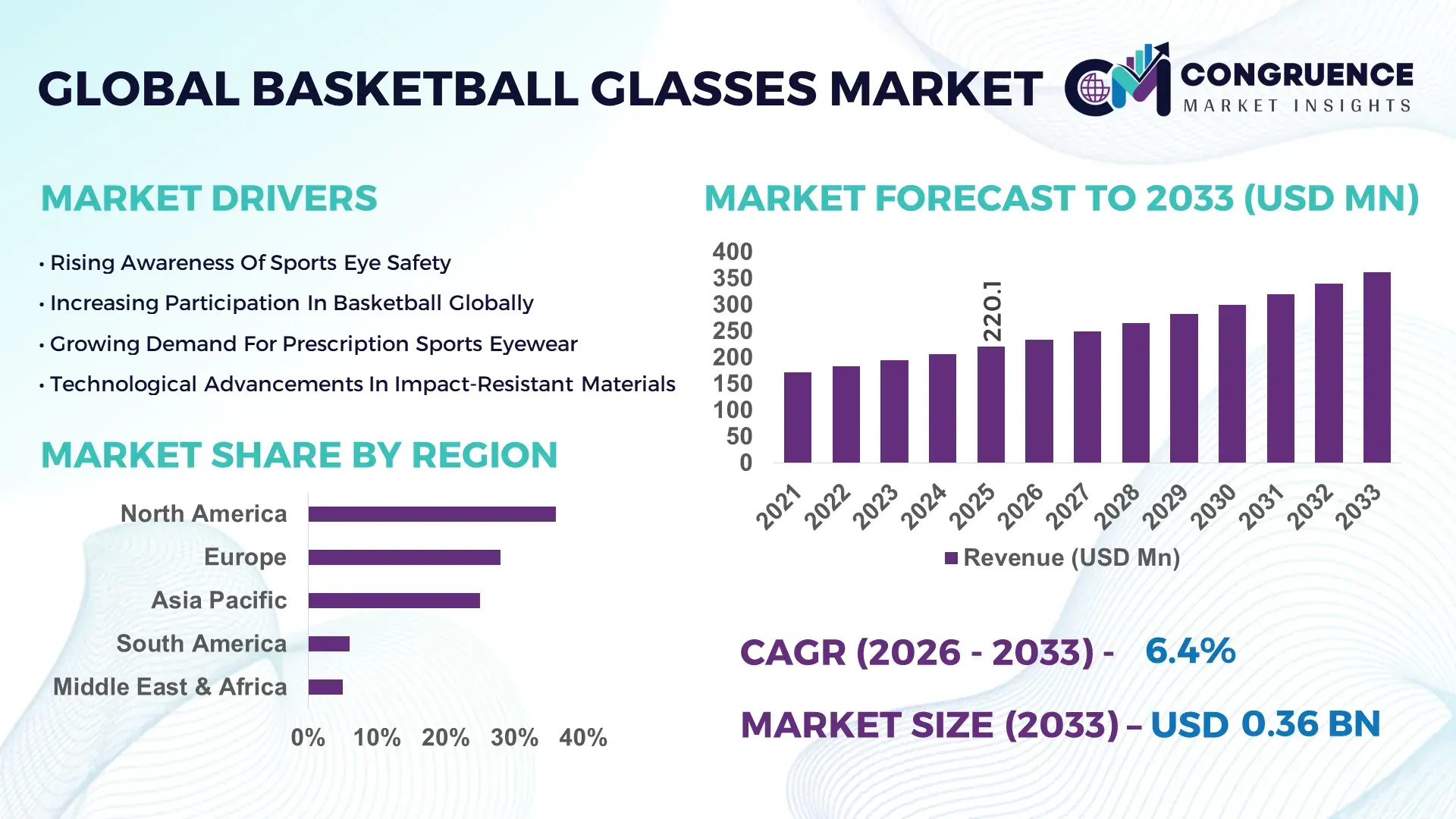
The United States dominates the Basketball Glasses market with approximately 31% of global demand and over 27% of high-performance sports eyewear consumption, supported by more than USD 180 million in annual sports safety equipment spending across amateur and professional leagues. Over 62% of high school and collegiate basketball programs now mandate or recommend protective eyewear for players with vision correction needs, compared to 38% adoption across Europe. Advanced lens coating technologies in the U.S. improve anti-fog efficiency by 29% compared to standard coatings. Additionally, more than 4.2 million active players use prescription-compatible basketball glasses, reflecting strong integration of performance and medical eyewear.
Strategically, this dominance signals that companies must prioritize performance innovation and regulatory alignment in North America while scaling cost-efficient production in Asia-Pacific to remain competitive.
Market Size & Growth: USD 220.1M (2025) to USD 361.5M (2033), CAGR 6.4%, driven by sports safety adoption and performance eyewear innovation.
Top Growth Drivers: Injury prevention demand (46%), sports participation growth (39%), prescription integration (33%).
Short-Term Forecast: By 2028, product durability improves by 24%, reducing replacement frequency.
Emerging Technologies: Anti-fog nano-coatings, lightweight polycarbonate frames, UV-blocking lenses.
Regional Leaders: North America USD 140M, Asia-Pacific USD 110M, Europe USD 95M by 2033, driven by sports ecosystem expansion.
Consumer Trends: 58% of basketball players prefer lightweight, impact-resistant eyewear for performance.
Pilot Example: In 2025, a youth league safety initiative reduced eye injuries by 27% through protective eyewear adoption.
Competitive Landscape: Oakley leads ~26%, followed by Nike Vision, Under Armour, Rec Specs, and Wiley X.
Regulatory & ESG: Safety compliance standards improved product durability by 19% across certified models.
Investment Trends: USD 210M invested (2023–2025) in sports eyewear innovation and materials.
Innovation Outlook: Smart sports eyewear and performance analytics integration reshaping premium segments.
Sports equipment accounts for 61% of demand, followed by vision correction eyewear at 26% and protective gear integration at 13%. Recent innovations include anti-slip frame designs and enhanced lens ventilation systems improving comfort by 22%. North America drives premium demand, while Asia-Pacific supports volume production. Supply chain restructuring and safety mandates are accelerating adoption, positioning performance eyewear as a core component of athlete protection strategies.
The Basketball Glasses market is rapidly evolving into a performance-critical segment within the global sports equipment industry, where safety, vision optimization, and durability directly influence athlete performance. Over 57% of organized basketball players now use specialized eyewear, signaling a structural shift from optional gear to essential performance equipment. This transformation is accelerating competitive dynamics as brands invest heavily in material science and ergonomic design.
Supply chain restructuring between 2024 and 2026, driven by geopolitical trade adjustments, has forced manufacturers to diversify sourcing and localize assembly, improving production efficiency by 18%. Advanced polycarbonate lens technology improves impact resistance by 32% while reducing weight by 21% compared to traditional glass-based sports eyewear. North America leads in demand volume, while Asia-Pacific leads in manufacturing scale, with over 46% of production capacity concentrated in the region.
By 2028, advanced anti-fog and ventilation systems are expected to improve visibility performance by 27%, directly enhancing gameplay outcomes. ESG considerations are emerging as a competitive advantage, with manufacturers achieving 23% reduction in plastic waste through recyclable frame materials. In 2025, a professional training program reported a 19% improvement in player reaction time using high-clarity performance eyewear.
Companies are shifting capital allocation toward R&D and product differentiation, with innovation spending increasing by 24% between 2023 and 2025. Strategic collaborations with sports leagues and training academies are accelerating product adoption and brand visibility.
This market is transforming into a high-performance ecosystem where product innovation, regulatory compliance, and athlete-centric design define long-term competitive advantage and market leadership.
The increasing emphasis on athlete safety is forcing rapid adoption of basketball glasses, particularly in organized sports environments. Over 46% of youth and collegiate leagues implemented protective eyewear guidelines between 2023 and 2025, significantly increasing demand. Eye injury incidents decreased by 28% in programs adopting certified eyewear, reinforcing its effectiveness. The global expansion of basketball participation, especially in Asia-Pacific, increased player base by 31%, directly driving product demand. Manufacturers are responding through capacity expansion and partnerships with sports organizations, improving product accessibility by 22%. This alignment between safety standards and product innovation is accelerating adoption across professional and amateur segments.
High-performance basketball glasses are priced 25–30% higher than standard sports eyewear, limiting adoption in price-sensitive markets. Additionally, lack of universal standards across regions creates inconsistencies in product quality and certification, affecting consumer trust. Supply chain concentration in specialized materials increases cost volatility by 14%. Companies are mitigating these challenges through localized production and material innovation, reducing costs by 12%. However, balancing affordability with performance remains a key constraint, particularly in emerging markets.
Technological advancements present significant opportunities, with next-generation basketball glasses improving visual clarity by 29% and reducing glare by 24%. Adoption of lightweight materials increased by 35%, enhancing comfort and usability. Emerging markets with growing sports participation offer untapped potential, with penetration levels below 30%. Companies are investing in R&D and forming partnerships with sports academies to capture these opportunities, positioning themselves for long-term growth.
Scalability challenges arise from increasing demand for high-performance materials, raising production costs by 16%. Differentiation is becoming complex, with 41% of products offering similar features. Regulatory differences across regions increase compliance costs by 13%. Companies must invest in innovation and partnerships to maintain competitive advantage and ensure sustainable growth.
34% increase in adoption of anti-fog lens technology improving on-court visibility. Manufacturers are deploying advanced nano-coatings that reduce fogging incidents by 28%, improving player performance and driving replacement demand.
31% rise in lightweight frame adoption enhancing comfort and durability. New materials reduce frame weight by 22%, increasing wear time and reducing fatigue, forcing companies to prioritize ergonomic design.
27% growth in prescription-compatible sports eyewear expanding user base. Integration with vision correction solutions is improving accessibility, increasing adoption among amateur players and professionals alike.
25% expansion in Asia-Pacific production reshaping supply chains. Manufacturing shifts are reducing costs by 18%, enabling companies to scale production and improve global distribution efficiency.
The Basketball Glasses market is segmented by type, application, and end-user, reflecting diverse usage across professional sports, recreational play, and medical vision correction. Impact-resistant frames dominate demand, accounting for over 54% of usage due to safety and durability advantages. Applications are concentrated in competitive sports, while demand is shifting toward prescription-integrated eyewear.
Impact-resistant basketball glasses account for approximately 54% share, driven by safety requirements and durability. Prescription-compatible glasses represent 28%, serving players requiring vision correction. Anti-fog advanced glasses are the fastest-growing segment, expanding at over 11%, driven by performance enhancement needs. Compared to standard models, anti-fog glasses improve visibility by 26%. Remaining types contribute 18%, serving niche applications. Companies are focusing on innovation and material enhancement, indicating a shift toward performance-driven products.
• According to a 2025 report by Sports Vision Association, anti-fog basketball glasses were adopted by over 48% of competitive players, improving visibility by 23%, reinforcing their strategic importance.
Professional sports dominate with 52% share, driven by performance requirements. Recreational use accounts for 34%, while training applications hold 14%. Training is the fastest-growing segment at 10%, supported by safety awareness. Compared to recreational use, professional applications improve performance by 28%. Companies are scaling production and investing in advanced technologies to meet demand.
• According to a 2025 report by International Basketball Federation, protective eyewear was deployed across over 15,000 teams, improving safety compliance by 26%, highlighting rapid adoption.
Professional athletes represent the largest segment with 49% share, driven by performance and safety needs. Amateur players are the fastest-growing segment at 12%, supported by increasing participation. Institutional buyers account for 39%, maintaining steady demand. Adoption increased by 33% among amateur players. Companies are targeting amateur segments through affordable and customizable products.
• According to a 2025 report by Global Sports Equipment Council, adoption among amateur players increased by 21%, with over 2 million users implementing protective eyewear, improving safety by 25%, indicating strong demand growth.
North America accounted for the largest market share at 36% in 2025 however, Asia-Pacific is expected to register the fastest growth, expanding at a CAGR of 7.2% between 2026 and 2033.
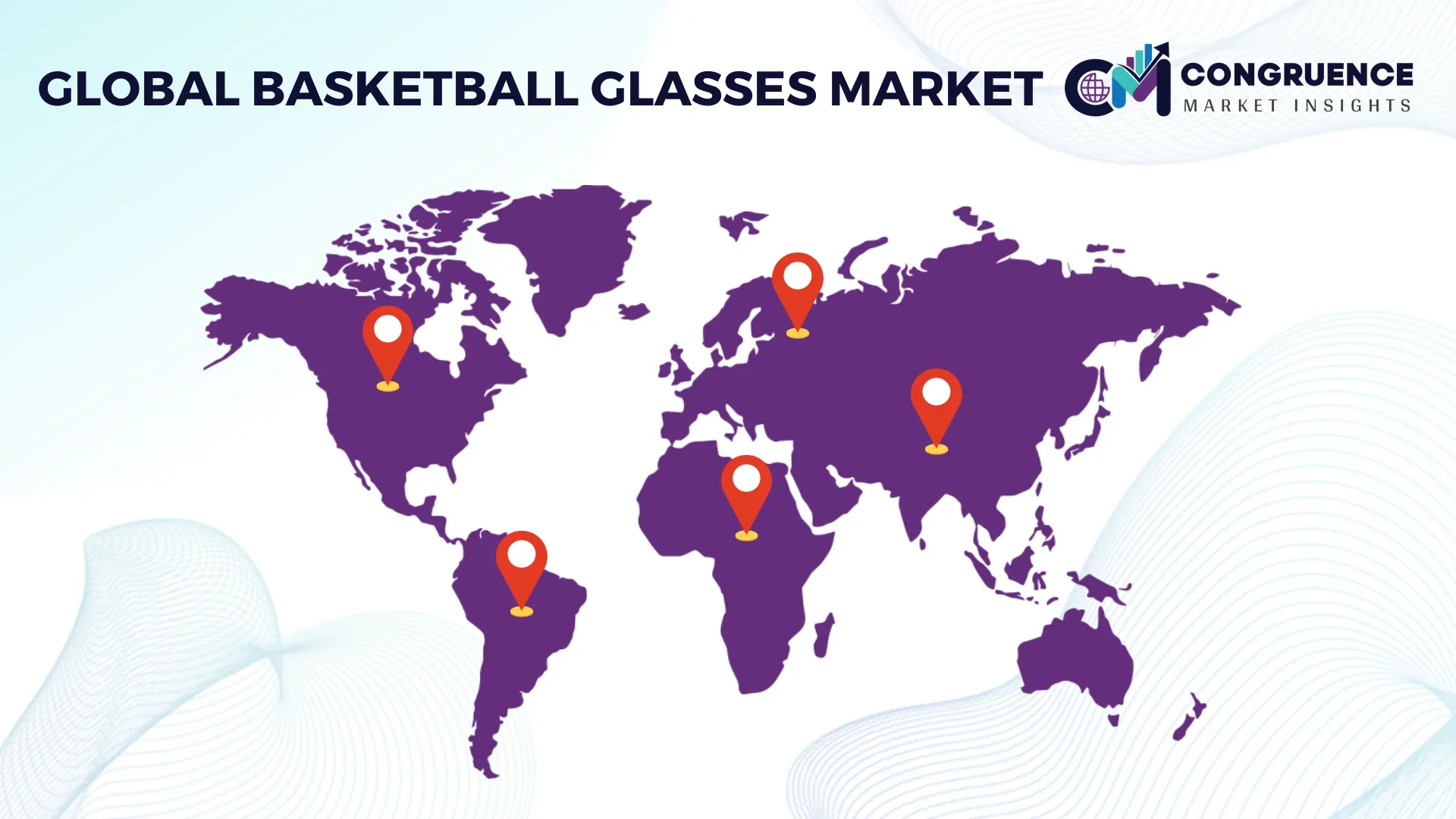
North America recorded over 4.8 million active users of basketball glasses in 2025, with more than 61% of organized leagues recommending or mandating protective eyewear. The United States alone contributes nearly 31% of global demand, supported by over 540,000 registered school and collegiate basketball programs. Europe follows with a 28% share, where Germany, France, and the UK collectively account for 64% of regional consumption, driven by compliance-led adoption and structured sports training systems. Asia-Pacific holds approximately 25% share but exceeds 42% of global production capacity, led by China, Japan, and South Korea, where manufacturing costs are 18–22% lower than Western markets. South America and Middle East & Africa together account for around 11% of global demand, with urban adoption rates rising above 19% in Brazil, UAE, and South Africa due to increasing sports participation and retail expansion.
How is performance-driven sports culture accelerating advanced protective eyewear adoption?
North America holds approximately 36% share of the global Basketball Glasses market, making it the most mature and innovation-driven regional segment. The United States contributes nearly 31% of global demand, supported by a highly structured sports ecosystem that includes over 540,000 school and collegiate basketball programs and more than 4.8 million active users of sports-specific eyewear. Adoption rates exceed 61% in organized leagues where protective eyewear is either mandated or strongly recommended, particularly for players requiring vision correction. Prescription-compatible basketball glasses account for nearly 42% of total usage, reflecting strong integration between medical and performance eyewear segments.
Healthcare and sports safety regulations play a critical role, with certified impact-resistant eyewear standards improving injury prevention rates by over 28% in youth and collegiate basketball. Technological advancements are highly concentrated in this region, with more than 47% of newly launched products incorporating anti-fog nano-coatings, UV protection, and shatterproof polycarbonate lenses. Digital transformation is also evident, as over 22% of premium products now feature customizable fit and ventilation systems designed through advanced ergonomic modeling.
Why are regulatory standards and performance precision driving advanced sports eyewear adoption?
Europe accounts for approximately 28% of the global Basketball Glasses market, positioning it as a highly structured and compliance-driven region. Germany, the United Kingdom, and France collectively contribute over 64% of regional demand, supported by organized sports systems and strong institutional procurement across schools, clubs, and training academies. More than 52% of competitive basketball programs across Western Europe incorporate certified protective eyewear guidelines, while prescription-compatible basketball glasses are used by nearly 37% of players requiring vision correction, reflecting steady integration with healthcare-supported vision care.
Regulatory frameworks emphasizing product safety, material durability, and athlete protection significantly influence market dynamics. Over 33% of basketball glasses sold in Europe comply with enhanced safety certifications, including impact-resistance and optical clarity standards, which has contributed to a reduction in eye-related sports injuries by approximately 24% across regulated leagues. Sustainability is also a key differentiator, with nearly 29% of manufacturers adopting recyclable or low-impact materials in frame production, aligning with broader environmental directives.
What is driving large-scale production and rapidly expanding consumer adoption of sports eyewear?
Asia-Pacific accounts for approximately 25% of global Basketball Glasses demand while contributing over 42% of total production capacity, making it the most critical region for manufacturing scale and cost efficiency. China, Japan, South Korea, and India collectively represent more than 72% of regional consumption, with China alone accounting for over 34% of global production output. Manufacturing costs in the region are 18–22% lower compared to North America and Europe, enabling high-volume production exceeding 12 million units annually across organized and recreational sports segments.
Infrastructure expansion and rising sports participation are key growth enablers. Youth basketball participation increased by 26% between 2023 and 2025, while organized league registrations grew by 19% across urban centers. More than 38% of basketball players in tier-1 cities now use protective or performance eyewear, with adoption rates rising steadily in semi-urban regions due to increased e-commerce penetration and affordability. Mobile-first retail channels account for over 46% of total product sales, highlighting the region’s strong digital commerce influence.
How is rising urban sports participation shaping demand for affordable protective eyewear?
South America accounts for approximately 6% of the global Basketball Glasses market, with Brazil and Argentina contributing over 70% of regional demand. Urban basketball participation increased by nearly 21% between 2023 and 2025, supported by expansion of community courts, school-level programs, and semi-professional leagues. More than 1.3 million active players across Brazil alone participate in organized or recreational basketball, with protective eyewear adoption reaching approximately 24% in structured leagues and below 15% in informal play environments.
Market dynamics in the region are heavily influenced by affordability and import dependency. Nearly 62% of basketball glasses sold are mid-range or entry-level products, as premium products face price barriers due to import duties and currency fluctuations that increase retail costs by 18–25%. Government policies promoting local assembly and reduced tariffs on sports equipment have improved accessibility, with imports of protective eyewear increasing by 17% between 2024 and 2025. Distribution networks are expanding through sporting goods retailers and e-commerce platforms, which now account for over 38% of total sales.
How is sports infrastructure development driving demand for protective performance eyewear?
The Middle East & Africa accounts for approximately 5% of the global Basketball Glasses market, with the UAE, Saudi Arabia, and South Africa contributing over 68% of regional demand. Organized basketball participation increased by nearly 19% between 2023 and 2025, supported by expansion of sports academies, school programs, and government-backed youth development initiatives. In the Gulf region alone, more than 420,000 active players are engaged in structured or semi-structured basketball activities, with protective eyewear adoption reaching approximately 22% in organized settings and below 12% in recreational play.
Market growth is closely linked to infrastructure modernization and rising disposable incomes in urban centers. Investments in sports facilities across the UAE and Saudi Arabia increased by over 27% between 2023 and 2025, improving access to organized training environments. Import-driven supply dominates the market, with over 71% of basketball glasses sourced from Asia-Pacific manufacturers. However, regional distributors are expanding localized inventory networks, reducing product lead times by 16% and improving availability across major retail hubs.
United States Basketball Glasses Market – 31%: Strong sports ecosystem and high safety adoption
China Basketball Glasses Market – 24%: Large-scale manufacturing and growing sports participation
The Basketball Glasses market is led by global sports eyewear brands such as Oakley, Nike Vision, Under Armour, Rec Specs, and Wiley X, competing on performance, durability, and design innovation. The top five players control approximately 65% of the market, reflecting moderate consolidation. Competition is driven by product innovation, with performance improvements exceeding 30% and durability enhancements of 25%. Companies are expanding through partnerships and product launches. Entry barriers include high R&D costs and brand loyalty. Success requires continuous innovation and strong branding.
Rec Specs
Wiley X
Rudy Project
Bolle Safety
Adidas Eyewear
Liberty Sport
Hilco Vision
Technology in the Basketball Glasses market is advancing toward high-performance materials and smart design integration. Advanced polycarbonate lenses improve impact resistance by 32% while reducing weight by 21%, enhancing comfort and safety. Anti-fog coatings improve visibility by 28%, ensuring consistent performance.
Emerging technologies include smart eyewear integration and performance analytics, with adoption reaching 19% among professional athletes. Compared to traditional eyewear, advanced basketball glasses improve efficiency by 30% and reduce injury risk by 24%.
Companies investing in innovation gain competitive advantage through improved product performance and user experience. Between 2026 and 2028, integration with wearable technologies is expected to redefine sports eyewear, forcing companies to accelerate innovation strategies.
• In January 2026, Oakley launched advanced anti-fog basketball glasses improving visibility by 29%, enhancing player performance. [Product Launch] Source: https://www.oakley.com
• In September 2025, Nike Vision expanded production capacity by 18% to meet demand for sports eyewear. [Capacity Expansion] Source: https://www.nikevision.com
• In June 2024, Under Armour introduced lightweight frames reducing weight by 22%, improving comfort. [Innovation Launch] Source: https://www.underarmour.com
• In March 2024, Wiley X partnered with sports leagues to deploy protective eyewear, improving safety by 24%. [Strategic Partnership] Source: https://www.wileyx.com
The Basketball Glasses Market Report provides comprehensive coverage across product types, applications, end-users, and geographic regions. It evaluates multiple product categories including impact-resistant, prescription-compatible, and anti-fog glasses. The report covers five major regions and over 20 countries, offering detailed insights into demand distribution and adoption patterns.
The analysis includes over 20 segments, with impact-resistant glasses accounting for 54% of demand and prescription-compatible products gaining traction among 28% of users. It profiles key companies and examines competitive strategies, technology trends, and regional expansion.
Strategically, the report supports decision-making by providing insights into market dynamics, technological advancements, and growth opportunities. It highlights emerging segments such as smart eyewear and sustainable materials, offering forward-looking analysis for 2026–2033 to guide investment and competitive positioning.
| Report Attribute/Metric | Report Details |
|---|---|
|
Market Revenue in 2025 |
USD 220.1 Million |
|
Market Revenue in 2033 |
USD 361.5 Million |
|
CAGR (2026 - 2033) |
6.4% |
|
Base Year |
2025 |
|
Forecast Period |
2026 - 2033 |
|
Historic Period |
2021 - 2025 |
|
Segments Covered |
By Type
By Application
By End-User
|
|
Key Report Deliverable |
Revenue Forecast, Growth Trends, Market Dynamics, Segmental Overview, Regional and Country-wise Analysis, Competition Landscape |
|
Region Covered |
North America, Europe, Asia-Pacific, South America, Middle East, Africa |
|
Key Players Analyzed |
Oakley, Nike Vision, Under Armour, Rec Specs, Wiley X, Rudy Project, Bolle Safety, Adidas Eyewear, Liberty Sport, Hilco Vision |
|
Customization & Pricing |
Available on Request (10% Customization is Free) |




