
Reports
The Global Bar Soap Market was valued at USD 3,244.0 Million in 2025 and is anticipated to reach a value of USD 4,631.0 Million by 2033 expanding at a CAGR of 4.55% between 2026 and 2033. Growth is driven by rising hospitality-sector procurement, multifunctional formulations, premium natural bars, and manufacturers shifting toward low-plastic packaging and localized production.
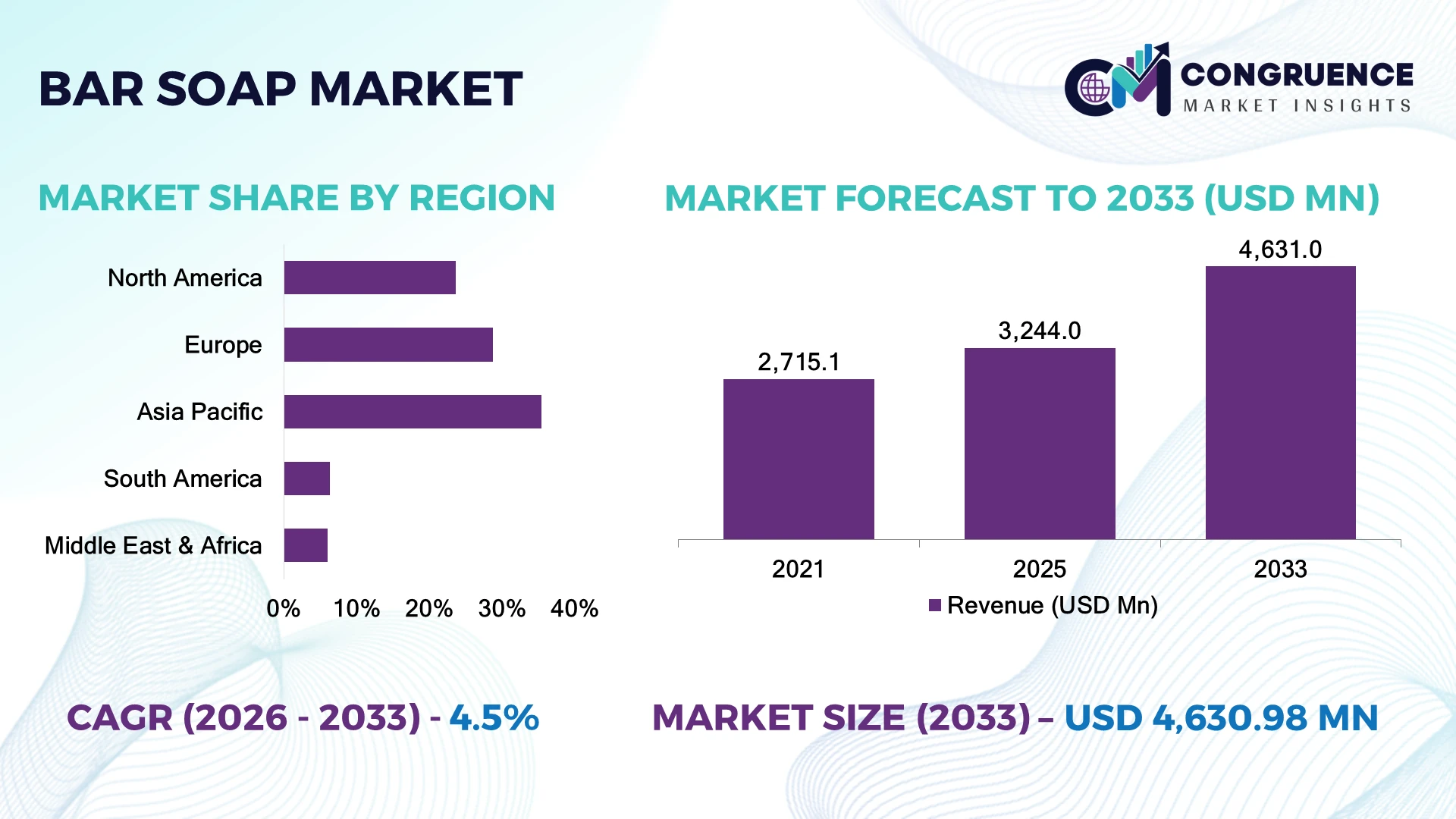
Asia Pacific held the dominant position with a 35.42% share in 2025, equivalent to about USD 11.49 billion under broader market estimates, supported by large-scale FMCG manufacturing in India, China, Japan, and Southeast Asia. India alone represented roughly USD 2.66 billion in 2025, while its soap industry benefits from extensive rural distribution and rapidly expanding premium, herbal, and personal-care formats. India therefore outpaces many mature markets in volume-led adoption and manufacturing localization.
The strategic priority is to combine high-volume emerging-market distribution with differentiated formulations and lower-impact packaging.
Market Size & Growth: The market is valued at USD 3,244.0 million in 2025 and is forecast to reach USD 4,631.0 million by 2033 at a 4.55% CAGR, supported by premiumization and multifunctional soap formats.
Top Growth Drivers: Hospitality procurement, natural formulations, and multifunctional products rank among the strongest drivers, with organic and natural positioning capturing approximately 39% of consumer preference in selected premium categories.
Short-Term Forecast: By 2028, manufacturers are targeting approximately 5–8% lower packaging-material usage and 3–6% higher production efficiency through lightweight wrapping, automated cutting, and localized sourcing.
Emerging Technologies: AI-assisted formulation, automated soap stamping, and advanced plant-derived surfactants are reshaping production, quality control, and product differentiation across high-volume FMCG facilities.
Regional Leaders: Asia Pacific, Europe, and North America represented approximately 35.42%, 28.71%, and 23.64% respectively in 2025; applying these shares to the 2033 market projection indicates approximately USD 1.64 billion, USD 1.33 billion, and USD 1.09 billion respectively, with digital retail and premium personal-care adoption accelerating.
Consumer/End-User Trends: Natural, antibacterial, moisturizing, and fragrance-led bars are gaining traction, while approximately 60% of surveyed consumers in selected markets increasingly associate ingredient transparency with product quality.
Pilot/Case Example: In 2023, Indian soap manufacturers demonstrated bamboo, banana-fiber, recycled-paper, and reduced-packaging formats, with packaging material reductions reaching approximately 50–80% in selected product configurations.
Competitive Landscape: Unilever remains a leading global participant, while Unilever, Procter & Gamble, Reckitt, Colgate-Palmolive, and Henkel form the principal multinational competitive group; the five largest companies held approximately 61.7% collectively in 2024.
Regulatory & ESG Impact: Plastic-waste policies and circular-economy initiatives are accelerating packaging redesign, with selected naked or paper-wrapped formats reducing conventional plastic packaging by more than 90%.
Investment & Funding: Global FMCG companies are directing billions of dollars across beauty, personal-care, manufacturing, and supply-chain transformation, with Unilever's USD 65 billion 2026 food-business transaction reinforcing its strategic concentration on higher-value consumer categories.
Innovation & Future Outlook: Next-generation growth centers on dermatological bars, botanical actives, concentrated formulations, AI-enabled quality control, and plastic-light packaging, shifting competition from basic cleansing toward formulation performance, brand differentiation, and operational efficiency.
The Bar Soap Market is increasingly concentrated around personal-care innovation, hospitality supply, and emerging-market consumption. Natural and multifunctional products are gaining momentum, while packaging redesign is becoming a practical differentiator as manufacturers respond to tightening plastic-waste expectations and supply-chain localization. Approximately 35.42% of global market share was concentrated in Asia Pacific in 2025, reinforcing the importance of regional manufacturing and distribution strategies.
Bar soap is strategically important because it combines high-volume FMCG turnover with relatively simple logistics, extended shelf stability, and growing opportunities for premium formulation. Manufacturers are repositioning beyond conventional cleansing through botanical ingredients, dermatological claims, antibacterial formats, and hospitality-specific products, creating differentiated margins without abandoning mass-market distribution.
Supply-chain restructuring is becoming increasingly important as geopolitical disruptions, freight volatility, and packaging regulations encourage localized production. Automated stamping, cutting, wrapping, and quality-inspection systems can deliver approximately 3–6% higher manufacturing efficiency compared with less automated legacy lines. India illustrates the scale advantage, with its bar soap market estimated at USD 2.66 billion in 2025 and national manufacturers increasingly combining mass distribution with herbal and premium product lines.
Over the next 2–3 years, manufacturers are expected to prioritize 5–8% reductions in packaging-material intensity, greater digital retail penetration, and localized raw-material procurement. Practical deployment includes paper-, bamboo-, and fiber-based packaging replacing conventional plastic formats. Companies are therefore increasing formulation R&D, expanding regional production, and forming supplier partnerships. Competitive advantage will increasingly depend on cost discipline, formulation differentiation, packaging efficiency, and resilient last-mile distribution.
Hospitality procurement and multifunctional formulations are strengthening the bar-soap value chain, with premium natural and specialty formats capturing increasing shelf space across hotels, spas, and personal-care retailers. Natural and organic positioning represents a significant premiumization opportunity, while India alone accounts for approximately USD 2.66 billion in bar-soap market activity. The post-pandemic hospitality recovery has also increased demand for individually packaged and branded cleansing products. Manufacturers are responding with dermatological, moisturizing, antibacterial, and botanical formulations while expanding contract manufacturing and hotel-supply partnerships. Supply-chain localization is reducing exposure to imported oils, fragrances, and packaging materials. The non-obvious advantage is that solid formats require less complex transportation and storage infrastructure than liquid alternatives, enabling manufacturers to improve distribution economics in high-volume emerging markets.
Cost volatility across vegetable oils, tallow, fragrances, surfactants, paper, and polyethylene continues to pressure bar-soap margins. Packaging can represent a meaningful component of unit cost, while conventional polyethylene wrapping creates additional exposure to tightening plastic-waste requirements. Manufacturing economics are particularly sensitive to commodity movements because mass-market bars operate within narrow price bands. Indian producers and other emerging-market manufacturers are responding through supplier diversification, longer procurement contracts, recycled-paper adoption, and greater domestic sourcing. Life-cycle assessments also demonstrate that water consumption during the use phase can materially influence environmental performance, creating additional pressure on product positioning. The strategic constraint is therefore not simply raw-material availability; it is the ability to maintain consistent formulation quality while absorbing commodity and packaging-cost fluctuations without weakening price competitiveness.
Low-plastic packaging, botanical formulations, and multifunctional cleansing bars provide a strong avenue for differentiation. Selected alternative packaging approaches can reduce conventional plastic use by approximately 50–90%, while premium natural products command stronger consumer engagement than undifferentiated commodity bars. India, Indonesia, and other densely populated emerging markets offer particularly attractive opportunities because established general-trade networks can rapidly distribute differentiated formats. Manufacturers are investing in R&D for plant-derived surfactants, sensitive-skin formulations, exfoliating bars, and solid personal-care products. Partnerships with packaging innovators are also enabling bamboo, banana-fiber, recycled-paper, and minimal-wrap solutions. The less obvious opportunity lies in institutional procurement: hotels, spas, hospitals, and travel operators can adopt standardized sustainable bars at scale, allowing producers to secure recurring B2B volumes while reducing packaging complexity.
Scaling sustainable bar-soap formats without compromising durability, fragrance retention, microbial stability, and consumer experience remains a significant execution challenge. Alternative packaging can require different machinery, while natural formulations introduce greater variability in oils, botanical extracts, colorants, and fragrances. Production lines therefore need tighter quality-control tolerances and automated inspection. Manufacturers face additional pressure to maintain consistent output while reducing packaging intensity by 5–8% and controlling production losses. Workforce capability is another constraint as plants transition toward automated stamping, wrapping, and vision-based inspection. Companies must invest in equipment modernization, formulation analytics, supplier qualification, and technical partnerships. The strategic challenge is achieving sustainability at industrial scale rather than through isolated premium launches; brands that fail to integrate environmental improvements into high-volume manufacturing will face weaker cost positions and inconsistent market execution.
Plastic-Light Packaging Transition: Manufacturers are reducing conventional plastic usage by 50–90% through paper wraps, molded fiber, and naked-bar formats. European packaging rules and rising packaging costs are accelerating redesign, while automated wrapping lines are being recalibrated for lighter materials. Companies are prioritizing supplier partnerships and packaging standardization to lower material intensity without slowing high-volume production.
Skin-Function Formulation Shift: Facial and dermatological bars are moving beyond basic cleansing, with specialized formulations gaining traction as skincare routines expand. Facial-care adoption is advancing at roughly 9% annually in leading market estimates, while body-care remains around 55% of application demand. Producers are expanding glycerin, botanical, exfoliating, and sensitive-skin formulations to capture higher-value usage occasions.
Digital Production Optimization: Soap plants are increasingly deploying automated stamping, cutting, weighing, and vision inspection, producing approximately 3–6% efficiency improvements and reducing process variation by 2–4%. Labor shortages and tighter quality requirements are accelerating automation in India and Southeast Asia. Manufacturers are concentrating capital on modular production lines that support faster SKU changes and smaller premium batches.
Localized Supply Networks: Geopolitical freight disruptions and volatility in vegetable oils, fragrances, and packaging inputs are pushing manufacturers toward dual sourcing and regional procurement. Localization programs are targeting 5–8% reductions in logistics exposure while improving replenishment speed. Companies are expanding supplier qualification in India, Indonesia, and China, revealing a non-obvious shift toward shorter ingredient-to-factory cycles rather than simply increasing production capacity.
Synthetic bar soaps remain the leading type, accounting for more than 90% of global market share in 2025. Their dominance reflects established manufacturing infrastructure, consistent formulation performance, broad price coverage, and compatibility with high-volume automated production. Conventional synthetic formats remain particularly strong in India, China, and other price-sensitive markets, where manufacturers prioritize stable quality and extensive distribution. Companies continue optimizing synthetic formulations through fragrance systems, moisturizing agents, antibacterial functionality, and improved skin compatibility rather than competing only on unit price.
Natural and organic bar soaps represent the fastest-shifting type, supported by ingredient transparency, botanical positioning, and sustainability-led purchasing. Their share remains substantially below conventional bars, but premium formulations are gaining shelf space and direct-to-consumer visibility. Natural formats are also attracting investment in cold-process production, plant-derived ingredients, and plastic-light packaging. Companies are increasingly maintaining conventional bars for volume while using natural and organic variants to expand premium portfolios. The strategic implication is a two-speed portfolio: synthetic products protect scale and distribution, while natural products improve differentiation and margin potential.
Skin/body care is the leading application, representing approximately 55% of global bar-soap demand in 2025. Its dominance comes from daily bathing routines, broad household penetration, and extensive product availability across supermarkets, general trade, pharmacies, and digital channels. Body-care bars also support multiple formulation positions, including moisturizing, antibacterial, herbal, deodorizing, and fragrance-based products. Companies are therefore expanding SKU depth while retaining high-volume core bars to protect distribution productivity and manufacturing utilization.
Facial care is the fastest-growing application, with adoption expanding at roughly 9% annually in current market estimates as consumers increasingly seek targeted cleansing for sensitivity, acne, dryness, and aging concerns. Hair care and specialized applications remain smaller but strategically relevant, particularly for dermatological and multifunctional products. Manufacturers are responding through dermatology partnerships, ingredient-focused R&D, and smaller premium packs. The key business shift is that bar soap is increasingly entering specialized skincare routines rather than remaining confined to general bathing, allowing companies to capture higher-value usage occasions without abandoning established body-care volumes.
Household/residential users remain the dominant end-user group, contributing more than 85% of global bar-soap demand. The segment benefits from recurring daily bathing and handwashing requirements, broad retail accessibility, and strong affordability advantages over many liquid alternatives. India illustrates the scale effect, with approximately 7.8 billion bars consumed in 2025. Manufacturers are responding with economy, mass-market, multipack, herbal, moisturizing, and dermatological variants designed around household purchasing frequency and regional price sensitivity.
Commercial and institutional users represent a smaller but faster-shifting demand pool, while industrial users retain specialized requirements. Hotels, healthcare facilities, workplaces, and public institutions increasingly specify standardized bars based on hygiene, packaging, fragrance, and procurement requirements. Institutional purchasing is particularly attractive because larger contracts improve production planning and reduce per-unit distribution costs. Companies are developing hospitality-sized formats, customized packaging, bulk procurement agreements, and distributor partnerships to capture this segment. The competitive priority is shifting from household volume alone toward a balanced portfolio combining recurring residential consumption with predictable institutional contracts and higher-value specialized products.
Asia Pacific accounted for the largest market share at 35.4% in 2025 however, Middle East & Africa is expected to register the fastest growth, expanding at a CAGR of 5.4% between 2026 and 2033.
North America accounted for 23.6% of the global bar soap market in 2025, supported by mature retail infrastructure, established personal-care brands, and strong hotel and spa procurement. The U.S. represented the region's largest market, with its market value projected at approximately USD 6.48 billion in 2026. Manufacturers are increasingly emphasizing specialty formulations, dermatological positioning, and product variety rather than competing solely through mass-volume formats. E-commerce and private-label channels are also improving SKU accessibility and replenishment efficiency. Companies are investing in automated stamping, wrapping, and quality-control systems while expanding partnerships with hospitality and beauty businesses. The region's mature supply chain gives producers an operational advantage in rapidly introducing premium and specialized products, although liquid cleansers continue to pressure conventional bar formats.
U.S. Market Outlook: The U.S. remains North America's primary manufacturing and consumption hub, supported by extensive mass-retail coverage, sophisticated contract manufacturing, and strong hotel and spa procurement. The market is projected to reach approximately USD 6.48 billion in 2026, reinforcing the country's importance for premium, dermatological, and specialty bar-soap launches.
Europe represented approximately 28.7% of the global market in 2025, making it the second-largest regional market. Mature retail networks, established personal-care manufacturers, and extensive premium-product availability support stable consumption across Germany, the U.K., France, and Italy. Sustainability requirements are increasingly influencing packaging specifications, ingredient selection, and product claims, encouraging manufacturers to reduce conventional plastic use and expand paper-based and minimal-packaging formats. Beauty-brand collaborations are also increasing product differentiation, particularly for botanical and dermatological bars. Germany and the U.K. remain important commercial centers, with their respective markets projected at approximately USD 1.84 billion and USD 1.62 billion in 2026. Companies are responding through formulation R&D, sustainable packaging partnerships, and shorter European supply chains. The strategic shift is toward higher-value products with measurable environmental attributes rather than volume-led category expansion.
Germany Market Outlook: Germany is Europe's largest country market, supported by strong retail infrastructure, established consumer-goods manufacturing, and stringent product-quality expectations. Its market is projected to reach approximately USD 1.84 billion in 2026. Manufacturers are increasingly using Germany as a launch and distribution base for premium, dermatological, natural, and environmentally positioned soap products.
Asia Pacific held the largest global position with a 35.4% share in 2025, supported by extensive household penetration, dense traditional-trade networks, modern retail expansion, and large-scale manufacturing. India, China, Japan, and Southeast Asian economies collectively provide a broad production and consumption base spanning economy, mass, and premium formats. India is particularly important because manufacturers can combine high-volume domestic distribution with herbal, botanical, and premium product innovation. Localized sourcing also reduces exposure to international freight disruption and improves replenishment speed. Companies are expanding production capabilities, strengthening e-commerce distribution, and developing country-specific formulations. The region's scale advantage is reinforced by long shelf life and comparatively simple logistics, allowing manufacturers to serve remote and urban markets through the same production architecture while selectively upgrading premium portfolios.
India Market Outlook: India is the region's most strategically significant growth market, combining extensive household usage, domestic manufacturing capacity, and broad rural-to-urban distribution. The country's bar-soap market was estimated at approximately USD 2.66 billion in 2025, while manufacturers increasingly integrate herbal ingredients, dermatological positioning, multipacks, and localized packaging to serve diverse price tiers.
South America represents a smaller 6.3% market share but strategically important bar-soap market, with Brazil accounting for the largest share of regional demand. The region's market is supported by high household consumption, established FMCG manufacturing, supermarkets, convenience stores, and expanding digital commerce. Brazil's manufacturing ecosystem enables multinational and domestic producers to serve mass-market demand while developing moisturizing, fragrance-led, herbal, and premium formats. Retail modernization is improving product availability outside major urban centers, although inflation sensitivity and uneven distribution infrastructure continue to influence purchasing decisions. Companies are strengthening local procurement, regional distributor relationships, and value-oriented multipack strategies. Brazil's large consumer base also creates an attractive testing environment for new formulations before wider Latin American expansion. The strategic opportunity lies in balancing affordability with differentiated formulations as modern retail and e-commerce gradually reshape purchasing behavior.
Brazil Market Outlook: Brazil is the region's principal industrial and consumption hub, supported by large-scale FMCG production, extensive supermarket networks, and established domestic and multinational soap manufacturers. Its position enables companies to localize formulations, packaging, and pricing while using Brazil as a distribution platform for neighboring Latin American markets.
Middle East & Africa is positioned as a high-momentum market, with the regional bar-soap segment expected to expand at approximately 6.0% annually through 2033. Cost efficiency, widespread availability, population growth, and strong hygiene requirements support bar-soap adoption across both household and institutional channels. Saudi Arabia, the UAE, and South Africa are important commercial hubs, while hospitality development is creating additional procurement demand for standardized and individually packaged formats. Regional producers are expanding local manufacturing and adapting fragrances, formulations, and packaging to cultural preferences. Supply-chain localization is becoming increasingly relevant as manufacturers seek shorter procurement cycles and lower import exposure. Companies are combining domestic production with distributor partnerships and modern retail expansion. The non-obvious advantage is that bar soap's long shelf life and comparatively simple storage requirements support distribution into markets where complex cold-chain or specialized logistics infrastructure is unnecessary.
Saudi Arabia Market Outlook: Saudi Arabia represents a strategically important Middle Eastern market because of its expanding hospitality infrastructure, modern retail penetration, and domestic manufacturing ambitions. Hotels, spas, and institutional buyers are increasing demand for standardized personal-care products, encouraging manufacturers to develop customized formats and strengthen local distributor and procurement partnerships.
The market pits Unilever, Procter & Gamble, Reckitt, Colgate-Palmolive, and Henkel against regional soap specialists and premium natural brands. The top five players held approximately 61.7% collectively, indicating concentrated leadership alongside fragmented regional competition. Price remains decisive in mass segments, while formulation innovation and supply-chain reach increasingly differentiate premium portfolios. Natural and specialty formats command roughly 10–15% higher price positioning, while automated production can improve manufacturing efficiency by 3–6%. Unilever is simplifying portfolios and expanding premium innovations; Reckitt is extending Dettol into dermatological and specialized formats; Colgate-Palmolive is relaunching Protex across Latin America and South Africa; Henkel is strengthening Dial's sustainability and innovation platform. Competitive intensity is shifting toward ingredient differentiation, packaging efficiency, localization, and faster product development. Entry barriers remain high because established players control distribution, brand equity, procurement scale, and formulation capabilities. Winning requires combining cost leadership with differentiated formulations, resilient sourcing, rapid innovation, and targeted regional execution.
Unilever PLC
Procter & Gamble Company
Reckitt Benckiser Group PLC
Colgate-Palmolive Company
Henkel AG & Co. KGaA
Kao Corporation
Godrej Consumer Products Limited
Wipro Consumer Care & Lighting
ITC Limited
Beiersdorf AG
Church & Dwight Co., Inc.
Dr. Bronner’s
COW Brand Soap Kyoshinsha Co., Ltd.
Shanghai Jahwa United Co., Ltd.
Bar-soap manufacturing is shifting from conventional batch-controlled production toward automated stamping, precision cutting, machine vision, and digitally monitored process parameters. Automated lines can deliver approximately 3–6% higher production efficiency and 2–4% lower process variation than less automated operations. Adoption is strongest among high-volume FMCG plants where consistent weight, shape, moisture, and packaging quality directly influence yield and retail compliance.
Formulation technology is also becoming more sophisticated. AI-assisted formulation screening and digital simulation reduce physical trial requirements, while botanical actives, dermatological ingredients, and lower-palm-oil formulations support premium differentiation. Unilever reports AI-powered simulations that eliminate multiple physical trials, while its digital content and automation tools are already deployed across four markets. Companies with integrated R&D and manufacturing platforms gain faster commercialization and better SKU economics.
Between 2026 and 2028, competitive advantage will increasingly come from connected production, traceable ingredients, automated inspection, and low-material packaging. Compared with conventional development workflows, digital simulation can shorten formulation cycles by roughly 10–20% in suitable projects. Global leaders benefit first because they can spread technology investment across larger production volumes, while regional manufacturers increasingly adopt modular automation to close the efficiency gap.
December 2024 Unilever reformulated Lifebuoy bar soap in India, reducing palm-oil content through starches, natural fatty acids, and vitamins while improving sensory performance. The redesign supports commodity resilience and expands the platform for broader international rollout. Source: unilever.com
September 2025 Reckitt expanded Dettol bar-soap formats in India and China, adding cooling and dermatological propositions. Dettol’s China portfolio reached 13 subcategories, demonstrating successful brand extension beyond traditional hygiene and strengthening premiumization and category penetration. Source: reckitt.com
April 2025 Henkel highlighted Dial’s sustainability and innovation program, including its partnership with Solidaridad and expanded responsible sourcing initiatives. Dial continues combining antibacterial positioning with product innovation, strengthening differentiation and supply-chain traceability across personal cleansing categories. Source: henkel.com
2025 Colgate-Palmolive relaunched Protex bar soap across key markets with enhanced packaging and 24-hour anti-germ protection. The 175-gram format and efficacy-focused campaign target penetration gains, strengthening Protex positioning through measurable protection and refreshed shelf visibility. Source: colgatepalmolive.com
The Bar Soap Market Report covers the industry across type, application, and end-user dimensions, including synthetic, natural, and organic formats; skin/body care, facial care, hair care, and specialized applications; and household/residential, commercial, institutional, and industrial users. Regional coverage spans North America, Europe, Asia Pacific, South America, and Middle East & Africa, with country-level analysis focused on major manufacturing and consumption hubs.
The report evaluates formulation innovation, automated production, digital quality control, sustainable packaging, ingredient traceability, and localized supply chains. It assesses competitive positioning across global leaders, regional manufacturers, premium brands, and emerging specialists. Coverage supports investment planning, manufacturing expansion, portfolio prioritization, sourcing decisions, partnership development, and competitive benchmarking through 2026–2033, while identifying high-potential niches, operational shifts, and changing consumer-use patterns.
| Report Attribute / Metric Details | Details |
|---|---|
| Market Revenue (2025) | USD 3,244.0 Million |
| Market Revenue (2033) | USD 4,631.0 Million |
| CAGR (2026–2033) | 4.55% |
| Base Year | 2025 |
| Forecast Period | 2026–2033 |
| Historic Period | 2021–2025 |
| Segments Covered |
By Type
By Application
By End-User
|
| Key Deliverables | Revenue Forecast; Market Trends; Growth Drivers & Restraints; Technology Insights; Segmentation Analysis; Regional Insights; Competitive Landscape; Regulatory & ESG Overview; Recent Developments |
| Regions Covered | North America; Europe; Asia-Pacific; South America; Middle East & Africa |
| Companies Profiled | Unilever PLC; Procter & Gamble Company; Reckitt Benckiser Group PLC; Colgate-Palmolive Company; Henkel AG & Co. KGaA; Kao Corporation; Godrej Consumer Products Limited; Wipro Consumer Care & Lighting; ITC Limited; Beiersdorf AG; Church & Dwight Co., Inc.; Dr. Bronner’s; COW Brand Soap Kyoshinsha Co., Ltd.; Shanghai Jahwa United Co., Ltd. |
| Customization & Pricing | Available on Request (10% Customization Free) |




