
Reports
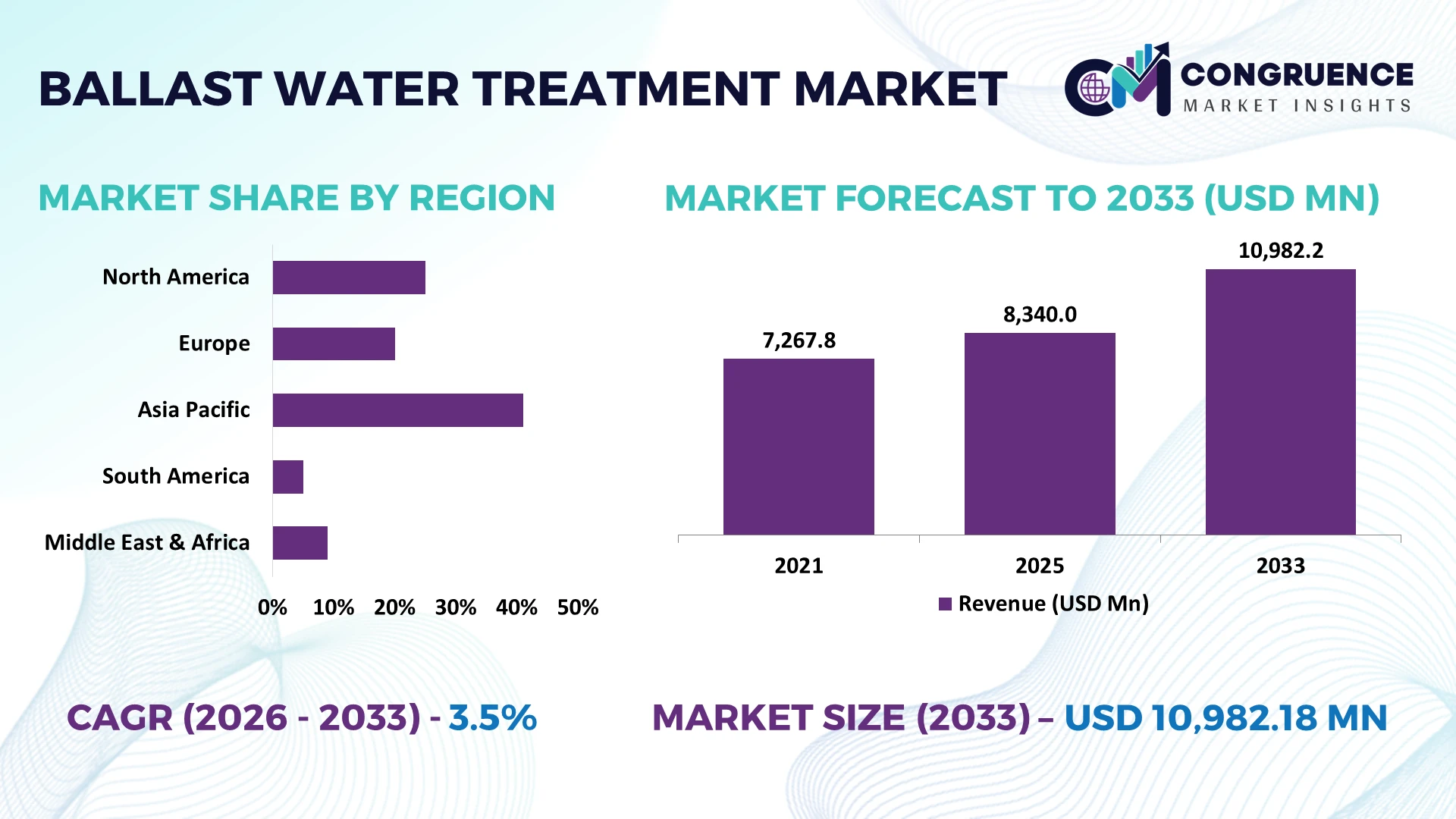
The Global Ballast Water Treatment Market was valued at USD 8340 Million in 2025 and is anticipated to reach a value of USD 10982.18 Million by 2033 expanding at a CAGR of 3.5% between 2026 and 2033. Growth is driven by mandatory IMO D-2 discharge compliance, newbuild vessel installations, UV filtration modernization, and increasing demand for ballast water treatment system maintenance and performance verification.
China dominates the global shipbuilding infrastructure supporting ballast water treatment equipment deployment, accounting for 56.1% of worldwide vessel completions in 2025, compared with South Korea's approximately 23.6%. Chinese shipyards delivered 53.69 million deadweight tonnes, an 11.4% annual increase, while securing 69% of global new shipbuilding orders. Shipbuilding investments and equipment procurement across Jiangsu and Shanghai support UV-based and electrochlorination treatment installations. Following the September 2024 IMO D-2 compliance deadline, shipowners increasingly prioritize certified equipment, reliable commissioning, and lifecycle servicing.
For equipment manufacturers, securing Chinese shipyard partnerships, strengthening technical support networks, and developing energy-efficient treatment systems are critical to sustained competitive positioning.
Market Size & Growth: Valued at USD 8340 Million in 2025, projected to USD 10982.18 Million by 2033 at 3.5% CAGR, driven by IMO D-2 compliance enforcement and retrofit demand.
Top Growth Drivers: Regulatory enforcement with daily fines up to USD 35,000 for non-compliance, approximately 30,000 vessels still awaiting retrofits, and port state control failure rates of 30% driving corrective installations.
Short-Term Forecast: By 2027, aftermarket service demand accelerates as first-generation systems installed during initial compliance wave require filter replacement, UV lamp changes, and software upgrades.
Emerging Technologies: UV-LED reactors paired with fine-mesh filters for LNG carriers, chemical-free treatment systems for cruise applications, and predictive maintenance platforms enabling remote monitoring.
Regional Leaders: Asia-Pacific at 34% to 38% share with China leading production, North America at 26% to 29% share with U.S. Coast Guard type-approval driving compliance, and Europe at 24% to 27% share with Norway and Germany leading.
Consumer/End-User Trends: LNG carriers command 26.05% of market value with over 50% specifying UV-LED and fine-mesh filter configurations; oil tankers accelerate at 26.23% CAGR as older VLCCs queue for yard slots.
Pilot/Case Example: Norwegian Greentech secured 10 BWTS contracts in February 2026 for shuttle tankers, live fish carriers, and offshore vessels, with energy-efficient UV and filter-based systems assembled in Fosnavåg, Norway.
Competitive Landscape: Alfa Laval, Qingdao Headway, and Qingdao Shuangrui lead with 29% combined share; BIO-UV, Optimarin, ERMA FIRST, and Wärtsilä compete across UV and electrochlorination platforms.
Regulatory & ESG Impact: IMO D-2 standard fully enforced since September 2024; new Ballast Water Record Book format effective February 2025; Electronic record books must be approved against MEPC.372(80) from October 2025.
Investment & Funding: Retrofit costs range from USD 0.5 million to USD 3 million per vessel; dry-dock wait times stretch 12 to 18 months in major Asian yards, creating scheduling bottlenecks.
Innovation & Future Outlook: Service model shifting from equipment sales to multiyear service agreements; upgrade kits and digital monitoring extend first-generation system life without full refit.
The global Ballast Water Treatment Market is transitioning from compliance-driven retrofit installations toward newbuild equipment integration, lifecycle maintenance, and digital performance verification. Advanced UV-based treatment systems, electrochlorination technologies, and automated filtration solutions address biological discharge requirements while improving vessel operating efficiency. Alfa Laval's PureBallast 3 Ultra technology reduces power requirements by up to 19% compared with earlier configurations. China's expanding shipbuilding orderbook and heightened international port-state inspections are reinforcing demand for reliable treatment performance. Consequently, equipment manufacturers are prioritizing certified system innovation, shipyard partnerships, remote monitoring, and comprehensive maintenance services, establishing the foundation for future strategic development.
The global Ballast Water Treatment Market has become strategically important as maritime compliance shifts from equipment installation toward verified treatment performance, lifecycle servicing, and operational reliability. The IMO D-2 standard became mandatory for applicable existing vessels by September 2024, accelerating investment in certified treatment technologies. China's shipbuilding industry accounted for 56.1% of global vessel completions in 2025, concentrating new equipment procurement among major Asian shipyards. Manufacturers are restructuring service networks and strengthening shipbuilding partnerships to secure long-term equipment contracts.
Technology differentiation increasingly influences procurement decisions. Alfa Laval PureBallast 3 Ultra reduces power consumption by up to 19% compared with previous configurations, while operating at approximately 50% of available power under favorable conditions. China's manufacturing scale supports volume installations, whereas European suppliers emphasize UV reactor efficiency, compact engineering, and digital monitoring. Shipowners increasingly favor equipment offering reliable biological disinfection without disrupting cargo operations.
Between 2026 and 2028, suppliers will prioritize predictive diagnostics, automated filter cleaning, and remote performance verification. Alfa Laval's support arrangements covering more than 3,000 installations demonstrate the commercial importance of maintenance services. Competitive positioning will depend on certified treatment reliability, lower operating costs, and integrated global technical support.
Mandatory biological discharge standards are sustaining equipment procurement across international shipping fleets. The IMO D-2 framework replaced reliance on the D-1 standard requiring 95% volumetric ballast water exchange with defined organism discharge limits. China's shipbuilding output increased 11.4% in 2025, accounting for 56.1% of worldwide vessel completions, while new orders represented 69% of global demand. This manufacturing concentration strengthens ballast water treatment installation opportunities at Chinese shipyards. Alfa Laval, ERMA FIRST, and other suppliers are expanding shipyard relationships, engineering support, and commissioning capabilities. Equipment selection increasingly occurs during vessel design, making early integration with ballast pumps, electrical infrastructure, and automation systems essential for securing contracts and reducing installation delays.
High installation expenditure and existing vessel infrastructure limitations constrain ballast water treatment system procurement. Conventional D-1 procedures required 95% ballast water exchange, while D-2 compliance necessitates biological treatment capable of meeting strict organism discharge limits. Shipowners must accommodate additional electrical loads, pipeline modifications, and equipment space requirements within existing vessel arrangements. Advanced PureBallast configurations reduce power demand by up to 19% compared with earlier models, demonstrating the importance of energy efficiency in lifecycle expenditure. In Greece, aging commercial vessels face particularly demanding retrofit economics and limited drydock availability. Suppliers are reducing procurement barriers through compact skid-mounted systems, standardized installation packages, and service agreements. Installation simplicity increasingly determines project profitability for shipowners operating vessels with shorter remaining service lives.
Digital performance verification and intelligent treatment optimization create opportunities beyond initial equipment installations. Alfa Laval's PureBallast 3 Ultra supports ballast flows between 32 and 3,000 cubic metres per hour, enabling applications across different vessel classes. Its optimized reactor configurations deliver power savings reaching 19%, while treatment systems operate at approximately 50% of available power under favorable water conditions. These capabilities support automated energy management and condition-based maintenance. Norway's marine technology industry offers opportunities for integrating remote diagnostics, electronic ballast water records, and predictive filter monitoring. Manufacturers are developing connected service platforms and collaborating with fleet operators to improve maintenance scheduling. Subscription-based technical support and performance analytics strengthen recurring customer relationships while improving vessel operational availability.
Maintaining compliant treatment performance across variable seawater conditions remains a critical operational challenge. IMO D-2 requirements limit organisms measuring at least 50 micrometres to fewer than 10 viable organisms per cubic metre, while organisms between 10 and 50 micrometres must remain below 10 per millilitre. These stringent thresholds require consistent disinfection despite changes in sediment concentration, salinity, and UV transmittance. Industry assessments during 2025 identified recurring sensor failures, filtration interruptions, and treatment shutdowns under challenging water conditions. In Singapore's high-traffic port environment, reliable ballast operations are essential for minimizing cargo-handling disruptions. Manufacturers must improve automated backflushing, sensor calibration, fault diagnostics, and crew training. Long-term competitiveness depends on reliable discharge compliance under actual operating conditions rather than laboratory performance alone.
Electronic Ballast Records Replace Paper: IMO amendments permitting electronic ballast water record books took effect in October 2025, reshaping compliance documentation across international fleets. Global port-state inspections reached 90,381 in 2024, increasing 1.9% annually. Ship operators are integrating digital logbooks, automated event recording, and centralized compliance dashboards. Equipment suppliers are adapting control interfaces to simplify inspection preparation and reduce administrative workload.
Challenging Water Conditions Reshape Operations: BIMCO's 2025 industry survey identified recurring filtration problems, UV transmittance limitations, and sensor faults during ballast operations. Some equipment defects required more than 2 months to resolve. Manufacturers are improving alarm logic, filter maintenance procedures, and authorized service coverage. Fleet managers increasingly assess real-world water-quality performance alongside certified treatment capacity when selecting replacement equipment.
Container Fleet Expansion Changes Specifications: Global container vessel capacity expanded 9.7% in 2024, reaching approximately 363.8 million deadweight tonnes by January 2025. The container fleet subsequently reached 6,033 vessels in April 2025. Korean and Chinese shipbuilders are coordinating ballast system layouts with vessel automation packages, encouraging suppliers to standardize compact equipment configurations and commissioning procedures.
Inspection Readiness Drives Crew Training: International port-state detention rates declined from 3.16% in 2023 to 3.00% in 2024, although ballast equipment deficiencies remain operationally significant. Shipping companies are incorporating treatment alarms, sampling procedures, and contingency reporting into vessel training. Marine service providers are expanding remote troubleshooting and onboard instruction, improving fault resolution and reducing disruption during cargo operations.
Filtration Systems represent the leading individual technology category, accounting for approximately 31.5% of the global ballast water treatment systems market in 2025. Their position reflects widespread integration as a primary treatment stage, removing suspended sediments and larger organisms before subsequent disinfection. Ultraviolet (UV) Systems represent another major category, particularly for vessels seeking chemical-free treatment and straightforward automation. Advanced UV configurations deliver power reductions reaching 19% compared with preceding equipment generations, strengthening operating efficiency. Filtration and UV are frequently deployed together, making integration quality an important purchasing consideration.
Electrochlorination Systems are gaining momentum in large-capacity vessel installations requiring high ballast water throughput and adaptable disinfection performance. Chemical Treatment Systems provide alternative biological control through approved active substances, while Ozonation Systems serve specialized oxidation-based applications. Deoxygenation Systems remain relevant for selected vessel configurations where oxygen removal supports biological control. Alfa Laval, ERMA FIRST, and Optimarin are investing in reactor efficiency, compact system engineering, and automated treatment management. Competitive investment increasingly favors equipment capable of handling variable water conditions, minimizing maintenance interventions, and supporting demanding vessel operating schedules.
Ballast Water Disinfection represents the principal application within the global Ballast Water Treatment Market, supported by mandatory biological treatment requirements across international shipping fleets. The IMO D-2 standard limits organisms measuring at least 50 micrometres to fewer than 10 viable organisms per cubic metre of discharged ballast water. This requirement establishes disinfection as a core shipboard operating function rather than an optional environmental procedure. Invasive Species Control remains closely associated with biological treatment effectiveness, while Pathogen Removal addresses specified microbial discharge limits. These applications influence equipment selection through treatment performance, biological verification, and certified operating parameters.
Port-State Compliance is emerging as an increasingly important application as maritime authorities strengthen inspections and documentation requirements. International inspections increased from 88,658 in 2023 to 90,381 in 2024, intensifying attention toward operational readiness. Ballast Water Management encompasses system monitoring, treatment scheduling, and crew procedures throughout ballast operations. Manufacturers are integrating electronic records, diagnostic alarms, and automated control interfaces to improve inspection preparation. Investment priorities increasingly emphasize traceable treatment performance, operational continuity, and reduced vessel detention exposure.
Bulk Carriers represent the leading individual vessel category, accounting for approximately 36.3% of ballast water treatment system demand in 2025. Their dominance reflects extensive global fleet capacity, frequent ballast exchanges, and operational requirements associated with bulk commodity transportation. Bulk carriers represented 42.5% of worldwide shipping carrying capacity in 2025, compared with 27.5% for Oil and Chemical Tankers' oil-tanker component. Commercial Shipping remains the broader purchasing category encompassing merchant fleet operators, while Shipbuilding and Repair Yards influence equipment selection through newbuild integration, retrofits, and commissioning contracts.
Container Ships are strengthening their position through fleet modernization and expanding vessel capacity. Global container shipping capacity increased 9.7% during 2024, encouraging procurement of compact, automated treatment installations. Cruise Ships prioritize passenger-service continuity, low-noise operation, and reliable port access. Naval Fleets require specialized equipment integration and mission-compatible operating arrangements. Manufacturers including Alfa Laval, Wärtsilä, and ERMA FIRST are developing vessel-specific configurations and shipyard partnerships. Competitive advantage increasingly depends on ballast flow compatibility, onboard installation requirements, and responsive international maintenance support.
Asia-Pacific accounted for the largest market share at 40.9% in 2025 however, Asia-Pacific is expected to register the fastest growth, expanding at a CAGR of 9.1% between 2026 and 2033.
USCG Certification and Vessel Compliance Modernization
North America represents a strategically important ballast water treatment market, supported by stringent discharge regulations, established maritime infrastructure, and advanced equipment certification requirements. The region accounted for approximately 24% of global ballast water treatment systems demand in 2025. The United States maintains a distinct regulatory framework requiring Coast Guard-approved treatment systems for applicable vessels discharging ballast water into American waters. This creates demand for independently certified equipment, replacement components, and documented operational performance. Canadian ports reinforce regional requirements through international ballast management obligations and environmental protection measures. Equipment suppliers are strengthening technical service networks around major maritime hubs, including Houston, Vancouver, and Los Angeles. Competition increasingly centers on equipment certification, reliable biological treatment, and maintenance accessibility. For shipowners, choosing systems compatible with American regulatory requirements reduces equipment acceptance risks and supports uninterrupted international vessel operations.
United States Market Outlook: The United States maintains strong demand through commercial shipping, tanker operations, and extensive coastal port infrastructure. Los Angeles and Long Beach collectively handled approximately 31% of American containerized international waterborne trade in 2025. USCG type-approval requirements strengthen demand for certified UV, filtration, and electrochlorination technologies. Domestic repair facilities and marine service providers benefit from recurring equipment calibration, biological performance testing, and treatment system maintenance contracts.
Environmental Enforcement and Advanced Marine Treatment Engineering
Europe maintains a substantial position in the ballast water treatment industry, supported by established maritime equipment manufacturers, international shipping operators, and extensive port-state inspection systems. The region accounted for approximately 26% of global ballast water treatment systems demand in 2025. Norway, Sweden, Germany, and the Netherlands contribute specialized marine engineering expertise, with regional suppliers emphasizing UV reactor performance, automated filtration, and energy-efficient disinfection. The Paris Memorandum of Understanding recorded 16,474 vessel inspections in 2025, with detention rates increasing from 4.03% to 4.18%. This heightened inspection environment reinforces attention toward operational documentation and equipment reliability across European shipping routes. Companies including Alfa Laval and Optimarin are strengthening service capabilities, onboard technical assistance, and performance monitoring. Regional procurement increasingly favors certified systems supported by established maintenance networks and responsive replacement component availability.
Netherlands Market Outlook: The Netherlands represents a strategic European maritime market through Rotterdam's extensive container, liquid bulk, and industrial port operations. Rotterdam handled approximately 428.4 million tonnes of cargo during 2025, while container throughput increased 3.1% to 14.2 million TEU. Frequent international vessel arrivals create substantial requirements for ballast water compliance verification, equipment servicing, and operational documentation. Dutch maritime engineering companies benefit from proximity to ship operators, port inspection activities, and specialized marine maintenance infrastructure.
Shipbuilding Concentration and Integrated Treatment System Procurement
Asia-Pacific dominates the global ballast water treatment industry through concentrated shipbuilding capacity, extensive maritime trade, and established marine equipment manufacturing networks. China, South Korea, and Japan form the region's principal shipbuilding centers, creating substantial opportunities for treatment system integration during vessel construction. China's shipbuilding industry completed 53.69 million deadweight tonnes in 2025, representing 56.1% of worldwide completions. South Korean shipyards specialize in high-value vessels, while Japanese manufacturers emphasize efficient equipment engineering and operational reliability. Regional suppliers are expanding shipyard partnerships, localized production capabilities, and installation support services. Singapore's position as a major international shipping hub strengthens aftermarket servicing and regulatory compliance activities. Procurement increasingly favors standardized treatment packages compatible with ship automation systems, reducing commissioning complexity and supporting consistent equipment deployment across large newbuild programs.
China Market Outlook: China maintains the strongest regional manufacturing advantage, securing 69% of global new shipbuilding orders during 2025. Its outstanding orderbook reached 274.42 million deadweight tonnes, increasing 31.5% annually. Major shipbuilding clusters in Jiangsu, Shanghai, and Liaoning support integrated procurement of marine equipment. Domestic ballast water treatment manufacturers are strengthening UV disinfection, electrochlorination, and filtration capabilities, while international suppliers pursue shipyard agreements and localized technical support to secure installation contracts.
Bulk Commodity Shipping and Port Compliance Infrastructure
South America's ballast water treatment market is supported by extensive bulk commodity exports, tanker movements, and expanding maritime infrastructure. Brazil, Chile, Peru, and Argentina maintain significant shipping activities associated with mineral exports, agricultural commodities, and energy transportation. Brazilian ports handled approximately 1.403 billion tonnes of cargo in 2025, representing a 6.1% annual increase. Higher vessel activity strengthens requirements for compliant ballast water discharge and dependable shipboard treatment equipment. Brazil's iron ore terminals and Chile's mineral export facilities present important operational environments where large ballast volumes require reliable treatment capacity. Regional suppliers increasingly emphasize equipment servicing, replacement components, and technical partnerships with port-related engineering companies. However, limited specialized manufacturing facilities and dependence on imported treatment technologies increase procurement complexity. Competitive opportunities center on localized maintenance, operator training, and equipment configurations suited to bulk shipping operations.
Brazil Market Outlook: Brazil leads regional demand potential through established maritime infrastructure and major export terminals serving international bulk carriers. Iron ore cargo reached approximately 425.8 million tonnes in 2025, with 406.2 million tonnes transported through long-distance international shipping. Santos, Paranaguá, and northern mineral export terminals support substantial commercial vessel traffic. Marine equipment suppliers are targeting shipowners and service providers requiring treatment reliability, regulatory documentation, and access to qualified maintenance personnel during port calls.
Energy Shipping Infrastructure and Maritime Service Expansion
The Middle East & Africa ballast water treatment market is shaped by large-scale petroleum transportation, expanding port infrastructure, and specialized maritime service requirements. The United Arab Emirates, Saudi Arabia, and South Africa maintain important commercial shipping networks supporting tanker movements, container operations, and bulk commodity exports. South African ports handled approximately 219.5 million tonnes of cargo and 4.47 million TEU during 2025, highlighting substantial commercial shipping activity. Gulf maritime hubs support treatment system servicing for international tankers and commercial fleets operating across interconnected shipping routes. Equipment manufacturers are expanding regional distribution arrangements, technical service partnerships, and component availability. Demand concentrates on systems capable of handling high ballast flow rates and challenging seawater conditions. Infrastructure modernization strengthens equipment servicing opportunities, while qualified engineering capacity and treatment system maintenance remain important operational considerations.
United Arab Emirates Market Outlook: The United Arab Emirates maintains a strategically important position through Jebel Ali, Khalifa Port, and established marine service facilities in Dubai and Abu Dhabi. Jebel Ali offers a container handling capacity exceeding 19 million TEU annually, supporting extensive international vessel operations. Regional maritime engineering companies provide opportunities for treatment equipment commissioning, automation integration, and maintenance support. Suppliers are strengthening local partnerships to deliver certified components, technical troubleshooting, and ballast water compliance services for tanker and container shipping operators.
Alfa Laval, Qingdao Headway, Qingdao Shuangrui, BIO-UV Group, and ERMA FIRST anchor the ballast water treatment market, with the top five players commanding approximately 45–50% of global installed base through type-approval breadth and shipyard integration depth. Competition bifurcates between established marine equipment leaders competing on global service networks and multi-technology portfolios, and regional specialists including Optimarin, Norwegian Greentech, and Techcross competing on UV-LED innovation and localized service responsiveness. The basis of competition has shifted from initial equipment price toward lifecycle service capability: port state control records show 29–44% of operational systems failing D-2 compliance due to maintenance gaps, making uptime and service agreements decisive procurement criteria. Players compete through multiyear service contracts, dry-dock scheduling partnerships, and retrofit upgrade kits extending first-generation system life. The competitive shift is toward chemical-free UV-LED platforms for cruise and LNG applications where operational simplicity commands premium pricing. Entry barriers center on USCG type-approval timelines and global service infrastructure.
Alfa Laval
Qingdao Headway Technology
Qingdao Shuangrui
BIO-UV Group
ERMA FIRST
Optimarin
Wärtsilä
Norwegian Greentech
Techcross
Mitsubishi Kakoki Kaisha
Veolia Water Technologies
Kurita Water Industries
Desmi Ocean Guard
Headway Technology Group
Current ballast water treatment technologies combine backflushing filters with ultraviolet irradiation or electrochlorination to meet biological discharge limits. Alfa Laval's PureBallast 3 Ultra treats flows from 42 to 3,000 cubic metres hourly; its revised UV design cuts power requirements by almost 20% at selected flows compared with earlier equipment. More than 10,000 PureBallast systems have been ordered worldwide, signalling commercial deployment. UV suppliers benefit where owners prioritize chemical-free treatment, while electrochlorination remains relevant to large-volume pumping arrangements.
Emerging systems integrate UV reactors, cleaning-in-place modules, pressure sensors and connectivity-ready controllers into compact assemblies. Prefabricated skid designs simplify shipyard interfaces and reduce piping work. Optimarin's Guardian extends UV treatment down to 60 cubic metres hourly, bringing automated disinfection to smaller vessels. Electronic records and condition monitoring improve fault tracing, but operators must calibrate sensors and validate discharge performance rather than equating reduced electricity use with superior biological results.
Through 2026–2028, connected servicing, adaptive UV dosing and standardized installations will define equipment upgrades. Suppliers pairing treatment hardware with remote diagnostics can shorten troubleshooting cycles and protect vessel availability. Shipyards in China and South Korea benefit from factory-assembled modules, while fleet operators gain predictable maintenance. Procurement should compare treatment limits, power use, spare-part access and actual port-water performance before selecting systems.
September 2026 – Alfa Laval introduced its PureBallast 3 Ultra Skid, extending a portfolio exceeding 10,000 system orders. The prefabricated, connectivity-ready configuration simplifies shipyard installation, supporting faster vessel integration and improved lifecycle servicing. Source: alfalaval.com.
June 2025 – Optimarin launched Guardian, a ballast water treatment platform including a compact 60 m³/h configuration. Following its acquisition of Hyde Marine technology, the company expanded vessel coverage and service flexibility, strengthening access to smaller commercial operators. Source: marinelink.com.
June 2025 – Norwegian Greentech secured contracts worth nearly NOK 20 million, including five ballast water treatment systems for Norwegian shipyards. The agreements expanded its marine equipment orderbook, strengthening domestic supplier relationships and production utilization. Source: kyst.no.
April 2024 – BIO-UV Group supplied a BIO-SEA L ballast water treatment system for the 52-metre wind-powered cargo vessel Grain de Sail II. Its 30 m³/h treatment capacity supports compliant ballast operations aboard specialized low-emission shipping vessels. Source: bio-uv.com.
The Ballast Water Treatment Market Report evaluates marine treatment equipment, regulatory compliance, technology adoption, and competitive positioning from 2026 to 2033. Technology segmentation covers Filtration, Ultraviolet, Electrochlorination, Chemical Treatment, Ozonation, and Deoxygenation Systems. Application analysis examines ballast water disinfection, invasive species control, pathogen removal, ballast water management, and port-state compliance. End-user coverage includes commercial shipping, container ships, tankers, bulk carriers, cruise ships, naval fleets, and shipbuilding and repair yards. Technical assessment addresses treatment capacities reaching 3,000 m³/h and advanced UV energy optimization.
Regional analysis encompasses North America, Europe, Asia-Pacific, South America, and the Middle East & Africa, examining shipbuilding concentration, fleet modernization, and servicing infrastructure. Competitive evaluation addresses certified technologies, supplier integration, digital monitoring, and aftermarket maintenance. Findings support equipment investment, shipyard partnerships, geographic expansion, and long-term compliance strategies.
| Report Attribute/Metric | Report Details |
|---|---|
Market Revenue in 2025 | USD 8340 Million |
Market Revenue in 2033 | USD 10982.18 Million |
CAGR (2026 - 2033) | 3.5% |
Base Year | 2025 |
Forecast Period | 2026 - 2033 |
Historic Period | 2021 - 2025 |
Segments Covered | By Type
By Application
By End-User
|
Key Report Deliverable | Revenue Forecast, Growth Trends, Market Dynamics, Segmental Overview, Regional and Country-wise Analysis, Competition Landscape |
Region Covered | North America, Europe, Asia-Pacific, South America, Middle East, Africa |
Key Players Analyzed | Alfa Laval, Qingdao Headway Technology, Qingdao Shuangrui, BIO-UV Group, ERMA FIRST, Optimarin, Wärtsilä, Norwegian Greentech, Techcross, Mitsubishi Kakoki Kaisha, Veolia Water Technologies, Kurita Water Industries, Desmi Ocean Guard, Headway Technology Group |
Customization & Pricing | Available on Request (10% Customization is Free) |




