
Reports
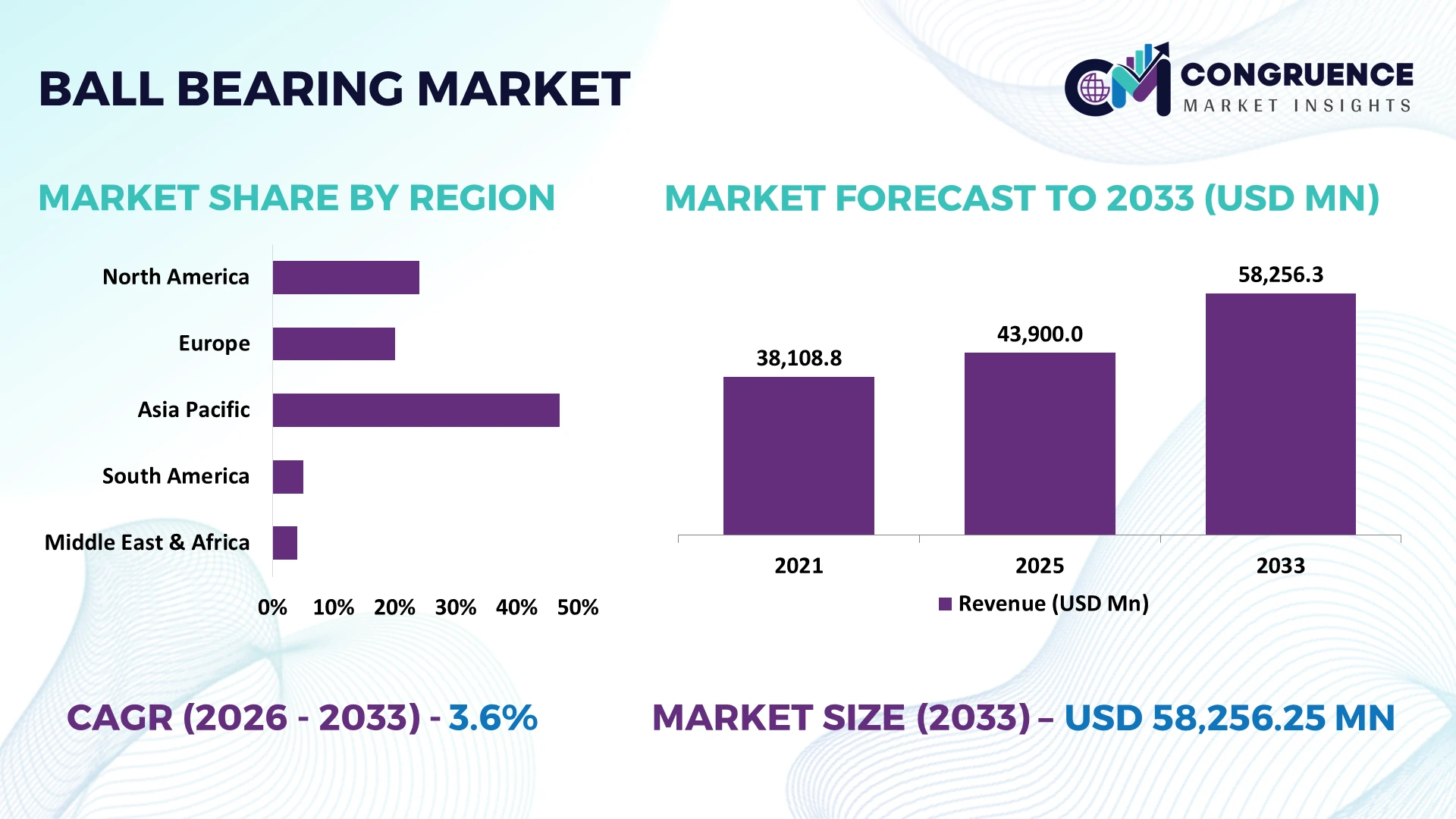
The Global Ball Bearing Market was valued at USD 43900 Million in 2025 and is anticipated to reach a value of USD 58256.25 Million by 2033 expanding at a CAGR of 3.6% between 2026 and 2033. Growth is being accelerated by precision manufacturing upgrades, electric vehicle drivetrain expansion, industrial automation deployment, and higher reliability requirements across aerospace, rail, and heavy machinery production.
China remains the dominant manufacturing hub, accounting for approximately 41% of global bearing production capacity, supported by continued investment in advanced manufacturing, automotive, robotics, and industrial equipment. Japan follows with nearly 16% of high-precision bearing output, while manufacturers across Europe continue expanding premium engineering capabilities. Ongoing supply-chain diversification after Red Sea shipping disruptions has increased regional sourcing by around 12%, strengthening production resilience and technology adoption across strategic industries.
For manufacturers and investors, expanding localized production with advanced precision engineering capabilities remains the strongest competitive strategy in the evolving global ball bearing market.
Market Size & Growth: USD 43,900 million in 2025 is projected to reach USD 58,256.25 million by 2033 at a 3.6% CAGR, driven by automation, EV production, and precision manufacturing expansion.
Top Growth Drivers: EV drivetrain demand contributes nearly 18% of incremental consumption, industrial automation expands bearing usage by 14%, and robotics integration improves equipment utilization by 11%.
Short-Term Forecast: By 2028, predictive maintenance and smart manufacturing reduce maintenance costs by approximately 16% while improving equipment uptime by 13%.
Emerging Technologies: AI-enabled condition monitoring, ceramic hybrid bearings, and advanced surface coatings improve operational efficiency by up to 18% and extend service life by around 22%.
Regional Leaders: Asia-Pacific exceeds USD 29 billion with expanding manufacturing capacity, Europe approaches USD 13 billion through premium engineering adoption, and North America surpasses USD 9 billion with industrial automation investments.
Consumer/End-User Trends: More than 48% of industrial buyers prioritize energy-efficient, maintenance-free bearing solutions for automated production environments.
Pilot/Case Example: A 2026 smart manufacturing implementation integrated sensor-enabled bearings, increasing predictive maintenance accuracy by 24% while reducing unplanned downtime by 19%.
Competitive Landscape: The leading supplier holds approximately 14% global market share, with competition driven by SKF, Schaeffler, NSK, NTN, and Timken through product innovation and regional expansion.
Regulatory & ESG Impact: Energy-efficiency initiatives lower lubrication consumption by nearly 15% while manufacturers increase recycled steel usage by approximately 20% to strengthen sustainability performance.
Investment & Funding: More than USD 2.8 billion supports manufacturing expansion, digital production lines, and strategic partnerships as companies diversify supply chains across Asia and North America.
Innovation & Future Outlook: High-speed precision bearings, digital quality inspection, and lightweight material engineering strengthen next-generation manufacturing while regional production expansion enhances long-term supply resilience.
Ball Bearing Market demand continues to strengthen across electric vehicles, industrial robotics, wind turbines, railway systems, and precision machinery where reliability and longer operating life remain critical purchasing priorities. Manufacturers are introducing sensor-integrated bearings, ceramic hybrid designs, and advanced low-friction coatings that improve operational efficiency by nearly 18%. Ongoing regional manufacturing expansion and localized sourcing strategies further reinforce supply resilience, setting the foundation for the strategic market assessment.
The Ball Bearing Market has become strategically important as manufacturers compete to improve equipment reliability, production efficiency, and localized supply resilience across automotive, aerospace, renewable energy, and industrial automation. Supply-chain restructuring following global logistics disruptions has accelerated investment in regional manufacturing and dual-sourcing strategies, reducing procurement risk while strengthening delivery performance. Enterprises increasingly prioritize precision-engineered bearings that support higher rotational speeds, lower friction, and predictive maintenance capabilities in digitally connected production environments.
Advanced sensor-enabled and ceramic hybrid bearings deliver approximately 20% longer operational life and reduce maintenance requirements by nearly 15% compared with conventional steel bearing systems, improving lifecycle economics for industrial users. China continues to lead high-volume production through manufacturing scale, while Japan and Germany remain focused on premium precision engineering and high-performance applications. Over the next two to three years, smart bearing deployment within automated production facilities is expected to exceed 35% across newly commissioned manufacturing lines, driven by digital maintenance strategies and factory modernization.
A practical example is the integration of condition-monitoring bearings in automated assembly plants, where predictive diagnostics have reduced unexpected downtime by roughly 18%. Manufacturers are expanding localized production, strengthening technology partnerships, and increasing investment in advanced materials and digital manufacturing. Companies that combine precision engineering with resilient supply networks and intelligent product capabilities will secure stronger competitive positioning and sustainable operational advantages.
Industrial automation and high-precision manufacturing remain the strongest structural drivers for the Ball Bearing Market as production facilities require components capable of operating continuously with minimal maintenance. Automated equipment installations have increased by nearly 14% in major manufacturing economies, while electric vehicle production has expanded bearing demand by approximately 17% across drivetrain and motor applications. China's continued investment in intelligent manufacturing and factory modernization has accelerated procurement of high-performance bearing solutions. This shift improves equipment uptime, lowers maintenance frequency, and increases production consistency. In response, manufacturers are expanding precision machining capacity, investing in advanced metallurgy, and forming technology partnerships to deliver customized bearing solutions with higher durability and improved energy efficiency, strengthening long-term industrial competitiveness.
Volatility in alloy steel prices and dependence on specialized bearing-grade materials continue to pressure manufacturing costs and production planning. Premium steel inputs account for nearly 55% of production costs for precision bearings, while logistics disruptions have extended procurement lead times by around 12% in several industrial supply chains. Japan's dependence on premium material imports for selected applications illustrates how supply concentration can influence manufacturing continuity. These constraints reduce pricing flexibility, delay customer deliveries, and complicate inventory optimization. Companies are responding through supplier diversification, localized sourcing agreements, long-term procurement contracts, and expanded domestic machining capabilities to improve operational resilience. Strategic inventory management is increasingly becoming a competitive differentiator rather than only a cost-control measure.
The strongest opportunity lies in intelligent bearing technologies that combine embedded sensors, advanced coatings, and digital monitoring for predictive maintenance. Smart bearing deployments are expected to increase by more than 30% across advanced manufacturing facilities, while ceramic hybrid designs improve rotational efficiency by approximately 18% and extend service intervals by nearly 20%. Germany's industrial digitalization initiatives continue encouraging adoption of connected production assets that require intelligent mechanical components. Companies are increasing research investment, collaborating with automation providers, and expanding application-specific product portfolios for robotics, offshore wind, and medical equipment. A key strategic advantage is the ability to deliver performance analytics alongside mechanical products, creating higher-value service ecosystems and stronger long-term customer relationships.
The transition toward digitally connected bearing systems introduces execution challenges beyond traditional manufacturing. Integrating sensor-enabled bearings with factory monitoring platforms increases implementation complexity, while nearly 28% of manufacturers report shortages of specialized maintenance and industrial analytics expertise. Compatibility with legacy production equipment remains a significant operational issue, particularly across older manufacturing facilities in the United States and other mature industrial economies. These factors slow deployment consistency and reduce the effectiveness of predictive maintenance programs despite strong technology availability. Companies must invest in workforce development, standardized digital interfaces, cybersecurity for connected industrial assets, and collaborative engineering partnerships. Organizations that successfully integrate mechanical precision with digital infrastructure will establish stronger operational resilience and long-term competitive differentiation.
Smart Bearings Enter Mainstream Operations Intelligent ball bearings with embedded sensors are moving from pilot deployments into production environments, with adoption increasing by approximately 28% across automated manufacturing facilities. Predictive monitoring reduces unexpected equipment failures by nearly 20% while improving maintenance scheduling accuracy by around 18%. Japanese manufacturers are integrating digital diagnostics into premium bearing portfolios as factories accelerate Industry 4.0 implementation. Companies are expanding software partnerships and connected maintenance platforms to convert traditional mechanical components into value-added operational assets.
Regional Manufacturing Footprint Expansion Supply-chain restructuring continues to reshape production networks as manufacturers increase localized sourcing by roughly 15% and reduce cross-border logistics dependence by nearly 12%. Red Sea shipping disruptions and industrial resilience strategies have accelerated investment in India, Mexico, and Eastern Europe for machining and assembly operations. Companies are balancing cost efficiency with supply continuity through regional manufacturing hubs, multi-country procurement strategies, and expanded inventory planning, strengthening delivery reliability for OEM customers.
Advanced Materials Improve Performance Ceramic hybrid bearings, optimized heat-treatment processes, and low-friction coatings are becoming standard for demanding industrial applications. Premium bearing solutions extend service life by approximately 22% while lowering energy losses by nearly 10% in high-speed equipment. German engineering firms are scaling advanced material technologies for robotics, aerospace, and precision machinery. Manufacturers continue expanding specialized product portfolios and investing in metallurgical innovation to improve lifecycle performance and reduce ownership costs.
Automation Reshapes Production Efficiency Digital inspection systems and robotic assembly lines now support more than 35% of newly upgraded bearing manufacturing facilities, improving dimensional consistency by approximately 17% while reducing production defects by nearly 14%. Rising labor shortages in advanced manufacturing economies are accelerating automation investments beyond cost reduction objectives. Companies are restructuring production workflows, deploying AI-assisted quality control, and expanding smart factory capabilities to strengthen manufacturing flexibility, shorten delivery cycles, and improve global competitiveness.
Deep Groove ball bearings remain the dominant product category, representing approximately 46% of overall demand due to their versatility, cost efficiency, and compatibility with electric motors, automotive assemblies, and industrial machinery. Their standardized design supports high-volume manufacturing while reducing maintenance requirements, making them the preferred solution across diverse operating environments. Manufacturers continue improving sealing technologies and lubrication performance to increase durability and operational efficiency. Self-Aligning and Thrust bearings retain strategic importance in applications exposed to shaft misalignment and axial loads, particularly within heavy industrial equipment and specialized machinery.
Angular Contact ball bearings represent the fastest-growing segment as demand rises for high-speed, precision applications in robotics, machine tools, and aerospace systems. Adoption has increased by roughly 16% as manufacturers prioritize higher rotational accuracy and load-handling capability. Product differentiation is shifting toward advanced materials, optimized cage designs, and application-specific engineering. Companies are expanding precision manufacturing capacity, strengthening OEM collaborations, and accelerating customized product development to capture premium industrial opportunities while balancing mature, high-volume demand with specialized high-performance applications.
Automotive applications account for approximately 39% of total ball bearing demand as passenger vehicles, commercial transportation, and electric mobility require high-volume, precision-engineered bearing systems. Continuous production of transmissions, wheel hubs, steering assemblies, and electric drive units sustains purchasing activity across global manufacturing networks. Industrial Machinery remains another mature application supported by factory modernization and equipment replacement cycles. Manufacturers increasingly develop application-specific bearing solutions that improve durability, reduce friction, and support longer maintenance intervals across demanding industrial environments.
Electric Motors represent the fastest-growing application, with deployment increasing by nearly 19% as automation systems, industrial equipment, and electric mobility expand worldwide. Improved motor efficiency requirements and higher operating speeds are accelerating demand for premium low-friction bearing technologies. Aerospace applications continue emphasizing lightweight materials, precision engineering, and certification compliance for mission-critical systems. Companies are responding by scaling automated production, strengthening engineering partnerships with OEMs, and expanding customized product portfolios to address evolving performance requirements across both established and emerging application segments.
Manufacturing represents the largest end-user segment, accounting for approximately 36% of total ball bearing consumption due to extensive deployment across production equipment, conveyor systems, robotics, packaging machinery, and automated assembly operations. Continuous investment in smart factories and industrial modernization increases replacement demand while supporting purchases of higher-performance bearing solutions. Automotive remains another major buyer through vehicle production expansion and component standardization, whereas Mining and Energy maintain stable demand for heavy-duty, high-load bearing applications requiring extended operational life under challenging conditions.
Aerospace & Defense is the fastest-growing end-user segment, with demand increasing by nearly 15% as aircraft production, defense modernization, and precision engineering programs expand. Higher reliability standards and lightweight system integration are driving adoption of advanced bearing technologies with enhanced performance characteristics. Companies are responding through customized engineering, long-term supply agreements, strategic partnerships with OEMs, and expanded technical support services. Competitive positioning increasingly depends on delivering application-specific solutions that improve operational reliability while supporting increasingly stringent industrial performance requirements.
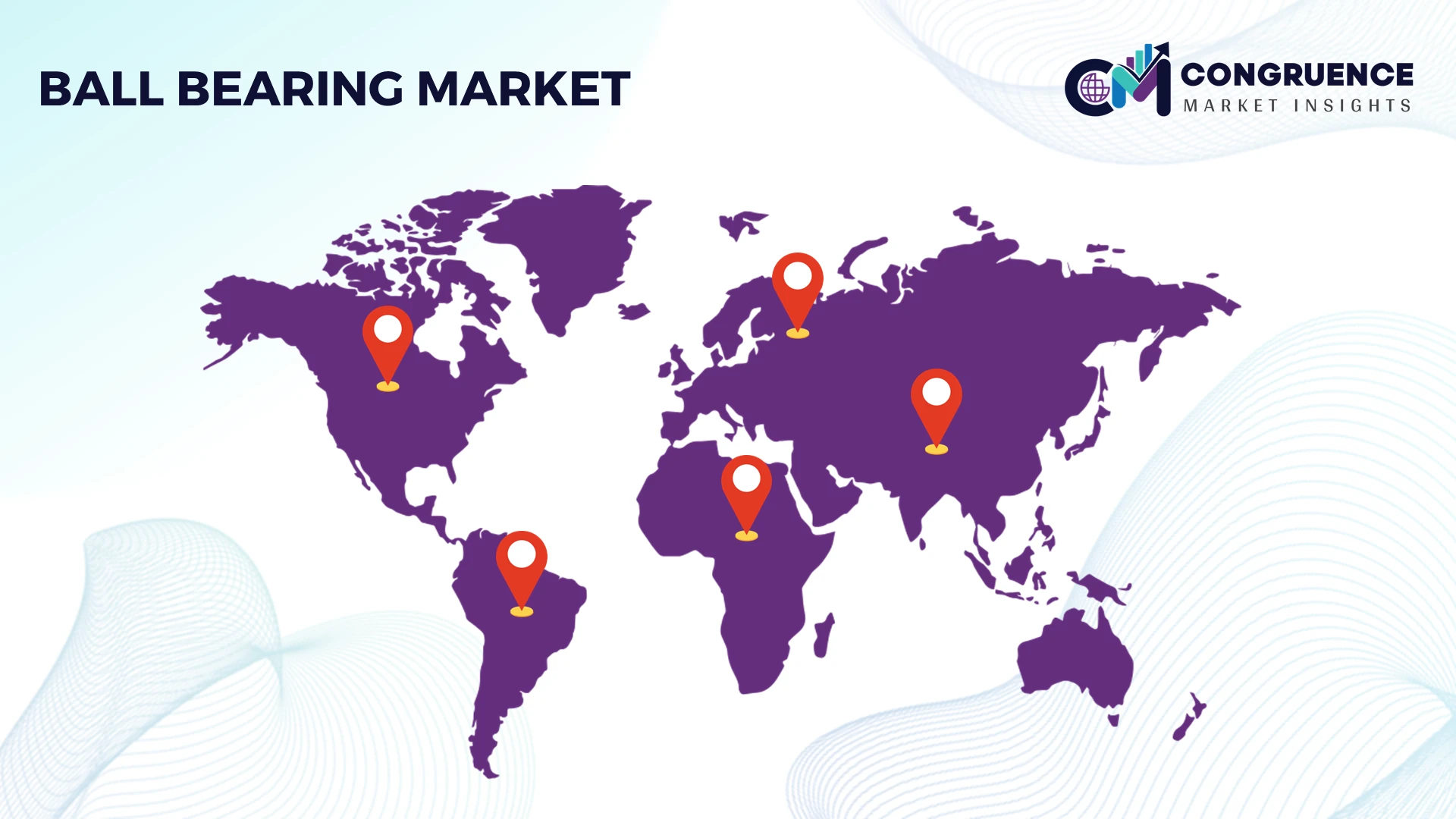
Asia-Pacific accounted for the largest market share at 52.8% in 2025 however, Middle East & Africa is expected to register the fastest growth, expanding at a 5.1% between 2026 and 2033.
Precision Manufacturing and Automation Strengthen Industrial Demand
North America represents approximately 21% of global ball bearing demand, supported by advanced manufacturing, aerospace production, industrial automation, and electric vehicle investments. The United States and Mexico continue strengthening regional supply chains through localized component manufacturing, reducing dependence on long-distance imports. More than 34% of newly upgraded manufacturing facilities now incorporate predictive maintenance systems that require premium bearing solutions. Automotive electrification, warehouse automation, and aerospace modernization continue increasing demand for high-performance bearings with extended operating life. Companies are expanding engineering centers, increasing automation within production facilities, and strengthening OEM partnerships to improve delivery reliability while supporting industrial resilience across critical manufacturing sectors.
United States Market Outlook: The United States leads regional demand through its extensive aerospace, automotive, defense, and industrial machinery sectors. Domestic manufacturers continue investing in advanced production technologies and digital quality control, while automated manufacturing deployment has increased by approximately 18% across large industrial facilities. Growing adoption of predictive maintenance and smart manufacturing supports higher demand for premium precision bearings designed for long operating cycles and lower maintenance requirements.
Engineering Excellence Drives Premium Product Positioning
Europe accounts for nearly 24% of global market demand, supported by advanced engineering, automotive manufacturing, renewable energy projects, and precision industrial equipment. Germany, Italy, and Sweden continue investing in highly automated manufacturing facilities emphasizing efficiency, sustainability, and product reliability. Nearly 32% of premium industrial machinery installations now specify advanced bearing technologies with improved lubrication systems and lower friction characteristics. Companies continue expanding localized engineering capabilities while strengthening collaborative product development with industrial equipment manufacturers to maintain competitiveness across demanding precision applications.
Germany Market Outlook: Germany remains Europe's strategic manufacturing center due to its leadership in automotive engineering, machine tools, and industrial automation. High-precision bearing deployment has increased by approximately 16% across robotics and advanced production equipment as manufacturers prioritize energy-efficient operations. Continuous investment in smart factories and engineering innovation strengthens demand for customized bearing solutions supporting premium industrial applications and export-oriented manufacturing.
Manufacturing Scale Creates Global Leadership
Asia-Pacific remains the world's largest production and consumption hub, contributing approximately 53% of global demand through extensive automotive, electronics, industrial machinery, railway, and renewable energy manufacturing. Large-scale production networks, integrated supplier ecosystems, and competitive manufacturing costs continue reinforcing regional leadership. More than 45% of newly installed industrial automation equipment within major manufacturing economies utilizes advanced bearing technologies designed for higher operational efficiency. Companies continue expanding precision machining capacity, automation investments, and export-oriented manufacturing facilities to strengthen production flexibility and supply-chain resilience.
China Market Outlook: China dominates regional manufacturing through its integrated industrial ecosystem and large-scale production capabilities. The country contributes approximately 41% of global bearing manufacturing capacity while continuously expanding investment in robotics, electric vehicles, and intelligent manufacturing. Higher adoption of automated production lines and digital quality inspection enables manufacturers to improve productivity while supplying both domestic industries and international OEM customers.
Industrial Modernization Supports Equipment Replacement
South America contributes approximately 6% of global demand, with industrial machinery, mining, agriculture, and automotive manufacturing remaining the principal consumption sectors. Infrastructure modernization and equipment replacement programs continue supporting steady procurement of durable bearing solutions despite periodic investment fluctuations. Brazil and Argentina are strengthening localized industrial production while mining operators increasingly prioritize longer-life bearing systems that reduce maintenance frequency. Companies continue expanding distributor networks, improving aftermarket services, and strengthening regional inventories to improve supply reliability and reduce operational interruptions for industrial customers.
Brazil Market Outlook: Brazil remains the region's largest market through its diversified manufacturing base, mining sector, agricultural equipment production, and automotive assembly operations. Industrial equipment modernization has increased demand for premium bearing solutions by approximately 14% across heavy machinery applications. Manufacturers continue strengthening local partnerships and expanding technical support capabilities to improve product availability and reduce maintenance costs for industrial operators.
Infrastructure Investment Expands Industrial Deployment
The Middle East & Africa market is increasingly shaped by infrastructure expansion, energy diversification, mining development, and industrial manufacturing investments. Large-scale logistics, railway, and industrial zone developments continue increasing deployment of rotating machinery requiring reliable bearing solutions. Approximately 22% of new industrial projects within major Gulf economies incorporate digitally monitored equipment designed for predictive maintenance. Companies are expanding regional distribution centers, strengthening service partnerships, and increasing localized inventories to improve supply responsiveness while supporting long-term industrial development initiatives.
Saudi Arabia Market Outlook: Saudi Arabia leads regional demand through large-scale industrial diversification, mining expansion, logistics infrastructure, and manufacturing investment programs. Industrial localization initiatives have accelerated deployment of advanced rotating equipment, increasing demand for precision bearings across heavy industries. Modern industrial projects continue emphasizing operational efficiency and equipment reliability, encouraging suppliers to expand regional technical support, inventory capacity, and engineering collaboration with domestic manufacturers.
Global leaders including SKF, Schaeffler, NSK, NTN, and Timken compete directly in premium engineering, while regional manufacturers challenge primarily through cost efficiency and localized supply. The top five players collectively control approximately 43% of the global market, maintaining leadership through precision manufacturing, extensive distribution networks, and long-term OEM relationships. Competition increasingly centers on product reliability, digital condition monitoring, customization, and delivery speed, with premium bearings extending service life by around 20% and optimized production reducing lead times by nearly 15%. Manufacturers strengthen market positions through regional capacity expansion, technology partnerships, vertical integration, and advanced materials development as supply-chain resilience becomes a purchasing priority. Competitive pressure continues shifting toward intelligent bearing solutions and application-specific engineering rather than price alone. High certification requirements, precision manufacturing expertise, and established customer qualification processes remain significant entry barriers. Sustainable competitive advantage depends on combining engineering excellence, resilient supply capability, rapid customization, and digital product innovation.
SKF
Schaeffler AG
NSK Ltd.
NTN Corporation
The Timken Company
JTEKT Corporation
MinebeaMitsumi Inc.
Nachi-Fujikoshi Corp.
RBC Bearings Incorporated
C&U Group
Luoyang LYC Bearing Co., Ltd.
ZWZ Bearing Co., Ltd.
Harbin Bearing Manufacturing Co., Ltd.
CW Bearing Corporation
Advanced steel metallurgy, precision grinding, and automated quality inspection remain the foundation of modern ball bearing manufacturing, while AI-enabled condition monitoring is rapidly becoming standard across high-value industrial equipment. Nearly 42% of newly installed automated production systems now incorporate predictive bearing monitoring, reducing unplanned downtime by approximately 18%. Automated optical inspection improves dimensional accuracy by around 15%, strengthening product consistency and lowering manufacturing defects. Companies integrating digital manufacturing with precision machining achieve faster production cycles and improved OEM qualification, creating measurable operational advantages in automotive, industrial machinery, and aerospace applications.
Emerging technologies are shifting competition toward intelligent, high-performance bearings. Ceramic hybrid designs improve rotational efficiency by approximately 16% while extending operational life by nearly 22% compared with conventional steel bearings. Sensor-integrated bearings enable continuous vibration and temperature monitoring, with deployment exceeding 28% across newly automated manufacturing facilities. Advanced low-friction coatings further reduce energy losses by approximately 10%. These technologies are increasingly integrated with industrial IoT platforms, enabling predictive maintenance and reducing lifecycle operating costs for equipment operators while differentiating premium manufacturers from low-cost competitors.
Between 2026 and 2028, digital twin validation, AI-assisted process optimization, and sustainable bearing refurbishment are expected to reshape manufacturing priorities. Compared with legacy bearing systems, intelligent bearing solutions improve maintenance efficiency by roughly 20% through real-time diagnostics and optimized replacement scheduling. Premium engineering companies benefit most by combining connected products, advanced materials, and lifecycle services, while cost-focused suppliers continue competing primarily on manufacturing scale. Organizations investing now in intelligent bearing ecosystems, automated production, and circular maintenance capabilities will strengthen long-term competitiveness through higher equipment reliability, improved customer retention, and resilient industrial supply networks.
March 2025 NSK developed a compact, lightweight deep groove ball bearing for electric vehicle drive units, achieving approximately 51% weight reduction and 25% lower torque than conventional designs, improving EV efficiency and high-speed performance. Source: https://www.nsk.com
May 2025 NTN introduced its HA-C Bearing featuring proprietary heat-treatment technology, delivering twice the static load capacity and more than eight times rolling fatigue life under heavy-load conditions, strengthening competitiveness in electrified automotive applications.
March 2026 SKF announced a new operating structure separating Bearing Solutions, Specialized Industrial Solutions, and Automotive businesses, strengthening strategic focus and operational transparency ahead of automotive business separation, improving execution across industrial product portfolios. Source: https://www.skf.com
May 2026 NTN strengthened global supply capability for electrical pitting-resistant bearings supporting next-generation electrified mobility, while its newly developed BEV hub bearings improved vehicle energy efficiency by 0.76%, reinforcing advanced electrification product leadership. Source: https://www.ntnglobal.com
The report delivers comprehensive analysis across Deep Groove, Angular Contact, Self-Aligning, and Thrust ball bearings, covering applications in Automotive, Industrial Machinery, Electric Motors, and Aerospace alongside end-user demand from Manufacturing, Automotive, Aerospace & Defense, Energy, and Mining. Regional evaluation spans North America, Europe, Asia-Pacific, South America, and the Middle East & Africa, highlighting production concentration, technology deployment, localization strategies, and evolving procurement patterns. More than 40% of the assessment emphasizes operational technology adoption, manufacturing modernization, and application-specific product positioning.
The study evaluates competitive positioning, innovation trends, intelligent bearing technologies, advanced materials, predictive maintenance integration, and regional supply-chain transformation between 2026 and 2033. It provides actionable intelligence supporting capacity expansion, investment prioritization, partnership development, product differentiation, and market-entry planning. Strategic insights also examine deployment trends, customer purchasing behavior, industrial automation adoption, and emerging niche opportunities, enabling manufacturers, OEMs, suppliers, and investors to make informed decisions in an increasingly technology-driven and operationally resilient global ball bearing market.
| Report Attribute/Metric | Report Details |
|---|---|
Market Revenue in 2025 | USD 43900 Million |
Market Revenue in 2033 | USD 58256.25 Million |
CAGR (2026 - 2033) | 3.6% |
Base Year | 2025 |
Forecast Period | 2026 - 2033 |
Historic Period | 2021 - 2025 |
Segments Covered | By Type
By Application
By End-User
|
Key Report Deliverable | Revenue Forecast, Growth Trends, Market Dynamics, Segmental Overview, Regional and Country-wise Analysis, Competition Landscape |
Region Covered | North America, Europe, Asia-Pacific, South America, Middle East, Africa |
Key Players Analyzed | SKF, Schaeffler AG, NSK Ltd., NTN Corporation, The Timken Company, JTEKT Corporation, MinebeaMitsumi Inc., Nachi-Fujikoshi Corp., RBC Bearings Incorporated, C&U Group, Luoyang LYC Bearing Co., Ltd., ZWZ Bearing Co., Ltd., Harbin Bearing Manufacturing Co., Ltd., CW Bearing Corporation |
Customization & Pricing | Available on Request (10% Customization is Free) |




