
Reports
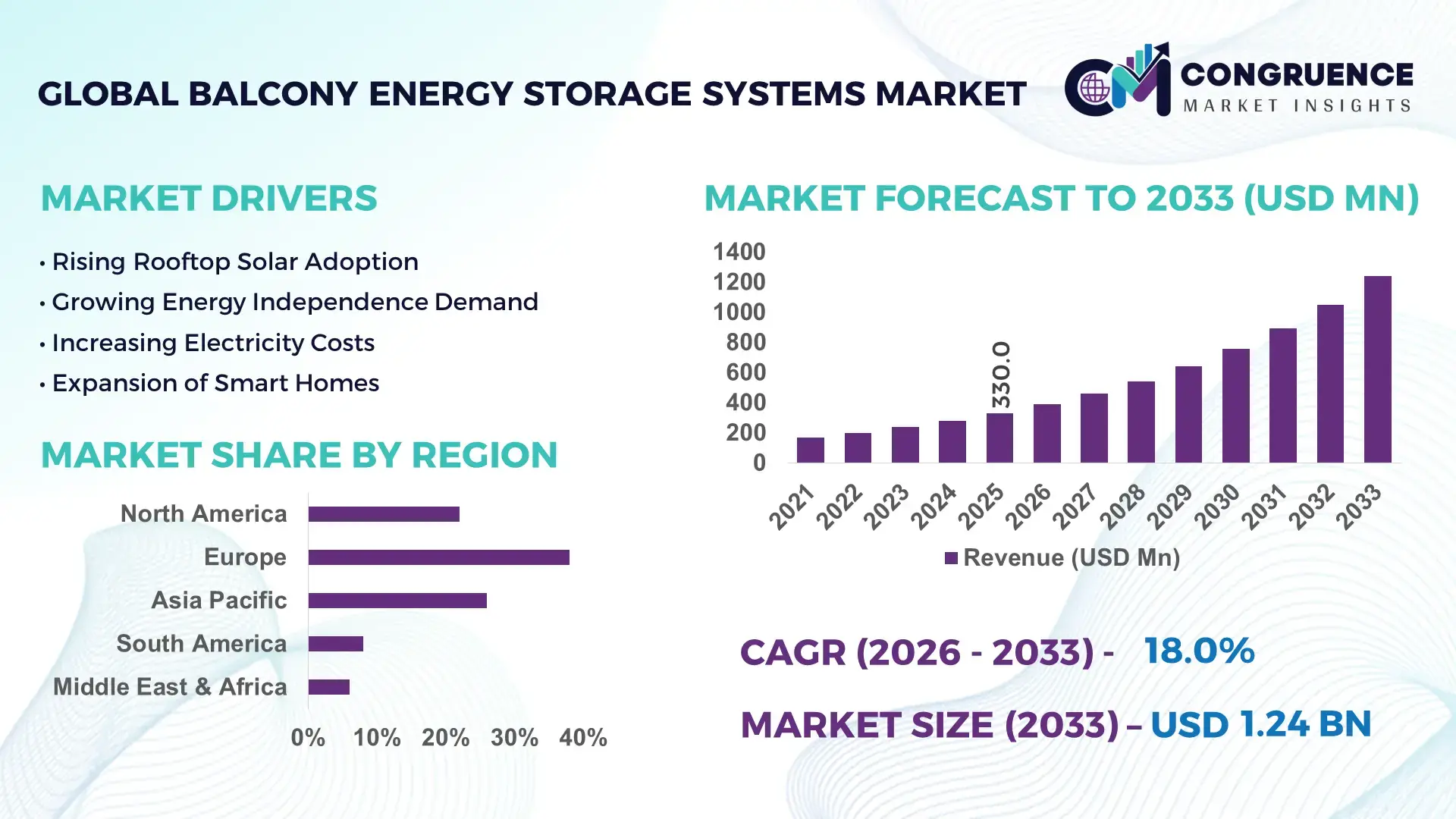
The Global Balcony Energy Storage Systems Market was valued at USD 330.0 Million in 2025 and is anticipated to reach a value of USD 1,240.4 Million by 2033 expanding at a CAGR of 18% between 2026 and 2033, according to an analysis by Congruence Market Insights. The growth is primarily driven by rising urban energy decentralization and increasing demand for plug-and-play residential energy solutions.
Germany leads the global Balcony Energy Storage Systems Market with strong production capacity and technological integration. Over 2.6 million balcony solar systems were installed in Germany by 2025, with more than 35% of new residential solar adopters opting for integrated storage units. Annual investments in small-scale distributed energy exceeded USD 1.5 billion, supporting advanced lithium-ion and hybrid battery manufacturing. Smart energy management systems are deployed in over 42% of installations, enabling real-time optimization. Additionally, over 28% of urban households in multi-apartment buildings are adopting micro-energy storage solutions for self-consumption optimization.
Market Size & Growth: USD 330.0 Million (2025) to USD 1,240.4 Million (2033) at 18% CAGR, driven by increasing residential solar adoption and decentralized energy systems.
Top Growth Drivers: Residential solar adoption (48%), energy cost savings (35%), government incentives (27%).
Short-Term Forecast: By 2028, system costs expected to decline by 22% due to battery efficiency improvements.
Emerging Technologies: AI-enabled energy optimization, lithium iron phosphate batteries, plug-and-play smart inverters.
Regional Leaders: Europe (USD 520M by 2033, strong regulatory push), Asia-Pacific (USD 410M, rapid urbanization), North America (USD 310M, smart home integration).
Consumer/End-User Trends: Over 40% of urban households prefer compact, modular energy storage for balconies and small spaces.
Pilot or Case Example: In 2024, a Germany pilot achieved 18% energy cost reduction using AI-integrated balcony storage systems.
Competitive Landscape: Market leader holds ~22% share, followed by major players such as EcoFlow, Zendure, Anker, Bluetti, and Hoymiles.
Regulatory & ESG Impact: Over 30 countries introduced rooftop and micro-storage incentives, targeting 25% residential carbon reduction by 2030.
Investment & Funding Patterns: More than USD 2.2 billion invested globally in decentralized residential energy solutions since 2023.
Innovation & Future Outlook: Hybrid solar-storage kits and grid-interactive micro-energy systems are expected to dominate future installations.
Residential sector contributes over 65% of demand, followed by small commercial units at 20% and others at 15%. Lithium-based storage systems account for over 70% of installations due to efficiency gains. Regulatory incentives across Europe and Asia are accelerating adoption, while rising electricity tariffs (up to 25% increase in urban regions) are boosting consumer interest. Future growth is supported by smart grid integration and AI-driven energy optimization technologies.
The Balcony Energy Storage Systems Market is strategically positioned at the intersection of decentralized energy generation, urban sustainability, and smart home ecosystems. With increasing pressure on centralized grids and rising electricity prices, distributed energy solutions are becoming essential for energy resilience. Advanced lithium iron phosphate (LFP) battery systems deliver up to 35% longer lifecycle performance compared to traditional lead-acid batteries, making them a preferred choice for balcony-based applications.
Europe dominates in volume due to high penetration of residential solar systems, while Asia-Pacific leads in adoption with over 38% of new urban households integrating micro-energy solutions into smart homes. By 2028, AI-driven energy optimization systems are expected to reduce household energy wastage by nearly 20%, significantly improving energy efficiency and cost savings.
From a compliance and ESG perspective, firms are committing to reducing residential carbon emissions by 30% by 2030 through micro-energy storage integration. Governments across regions are mandating grid-friendly systems that enable bidirectional energy flow and peak load reduction. In 2024, Germany achieved a 17% improvement in household energy efficiency through the deployment of smart balcony storage systems integrated with digital monitoring platforms.
Innovations such as plug-and-play solar kits, IoT-enabled battery management systems, and modular expansion units are redefining market scalability. These systems allow users to expand capacity by up to 50% without major infrastructure changes. As regulatory frameworks evolve and consumer awareness increases, the Balcony Energy Storage Systems Market is emerging as a critical pillar of energy transition strategies, supporting resilience, compliance, and long-term sustainable growth.
The Balcony Energy Storage Systems Market is evolving rapidly due to increasing urbanization, rising electricity costs, and the transition toward decentralized energy systems. The demand for compact, modular energy storage solutions is expanding significantly in high-density residential environments where rooftop installations are limited. Technological advancements in battery efficiency, particularly lithium-ion and LFP chemistries, have improved storage capacity by over 30% in the past five years. Additionally, integration with smart home ecosystems and IoT-enabled monitoring systems is enhancing energy management efficiency. Regulatory frameworks across Europe and Asia are promoting micro-generation and storage systems through subsidies and simplified installation norms. Consumer awareness regarding energy independence and sustainability is also rising, with over 45% of urban households actively exploring alternative energy solutions. The market is further influenced by grid instability concerns and peak load management requirements, positioning balcony energy storage systems as a practical solution for modern urban energy challenges.
The increasing demand for decentralized energy systems is a primary driver of the Balcony Energy Storage Systems Market. Urban households are seeking energy independence due to rising electricity tariffs, which have increased by up to 20–25% in several metropolitan regions. Balcony systems offer a cost-effective and space-efficient solution, particularly in apartments where rooftop solar installations are not feasible. More than 50% of new residential solar adopters in Europe are now considering integrated storage solutions to maximize self-consumption. Additionally, advancements in plug-and-play systems have reduced installation time by nearly 40%, making them accessible to a broader consumer base. Government incentives, including subsidies covering up to 30% of system costs, are further accelerating adoption. The ability of these systems to reduce grid dependency by 15–20% enhances their attractiveness among environmentally conscious consumers and urban dwellers.
Despite strong growth potential, high upfront costs remain a significant restraint in the Balcony Energy Storage Systems Market. Initial investment for a complete system, including solar panels, inverter, and battery storage, can be 30–40% higher than conventional energy solutions, limiting adoption among price-sensitive consumers. Additionally, the limited storage capacity of compact systems, typically ranging between 1 kWh to 5 kWh, restricts their ability to fully support household energy needs. Space constraints in urban balconies further limit system scalability. Consumer awareness is also uneven across regions, with less than 35% of potential users in emerging markets fully understanding the benefits of micro-energy storage systems. Technical challenges such as compatibility with existing electrical infrastructure and regulatory approval processes in certain countries can delay deployment timelines, impacting overall market penetration.
The integration of smart energy technologies presents significant opportunities for the Balcony Energy Storage Systems Market. The adoption of IoT-enabled energy management systems is increasing, with over 45% of new installations incorporating real-time monitoring and control features. These technologies allow users to optimize energy consumption, reduce wastage, and improve efficiency by up to 25%. The rise of smart homes and connected devices is creating a strong ecosystem for integrating balcony storage systems with home automation platforms. Additionally, the development of modular battery systems enables users to expand capacity incrementally, increasing flexibility and affordability. Emerging markets in Asia-Pacific and Latin America are witnessing growing interest due to rapid urbanization and increasing energy demand. Government initiatives promoting renewable energy adoption and carbon neutrality goals are further opening new avenues for market expansion.
Regulatory complexity and grid integration issues present key challenges for the Balcony Energy Storage Systems Market. Different countries have varying standards for small-scale energy generation and storage, creating inconsistencies in product certification and installation requirements. In some regions, approval processes can extend installation timelines by 20–30%, discouraging potential adopters. Grid compatibility is another concern, as not all systems are designed to support bidirectional energy flow or comply with local grid codes. Approximately 25% of installations face technical issues related to voltage regulation and inverter compatibility. Additionally, safety concerns regarding battery storage, particularly in densely populated residential areas, require stringent compliance with fire safety standards. These challenges necessitate continuous innovation and regulatory alignment to ensure seamless market growth.
Rapid Adoption of Plug-and-Play Systems: Over 60% of new installations in 2025 are plug-and-play systems, reducing installation time by 45% and enabling faster consumer adoption across urban apartments. These systems are gaining traction in Europe and Asia due to simplified regulatory approvals and ease of use.
Expansion of Smart Energy Management Integration: Approximately 48% of newly installed systems now include AI-based energy optimization, improving household energy efficiency by up to 22% and reducing electricity wastage significantly.
Growth in Lithium Iron Phosphate (LFP) Battery Usage: LFP batteries account for over 68% of installations due to higher safety and longer lifecycle, offering up to 30% improved durability compared to traditional lithium-ion batteries.
Increasing Urban Consumer Adoption: More than 42% of urban households in developed regions are adopting balcony energy systems, driven by rising electricity prices and the need for energy independence, with adoption rates growing fastest in multi-family housing units.
The Balcony Energy Storage Systems Market is segmented based on type, application, and end-user, each reflecting distinct adoption patterns and technological preferences. Lithium-based battery systems dominate due to higher efficiency and longer lifecycle, while hybrid systems are gaining traction for enhanced energy optimization. In terms of application, residential usage leads due to space constraints in urban environments, while small commercial applications are emerging steadily. End-user insights indicate strong adoption among urban households and smart home users, supported by increasing awareness and favorable regulatory policies. The segmentation reflects a clear trend toward compact, modular, and scalable energy solutions tailored for decentralized energy consumption.
Lithium-ion battery systems dominate the Balcony Energy Storage Systems Market, accounting for approximately 62% of total installations due to their high energy density, compact design, and longer lifecycle. Lithium iron phosphate (LFP) variants are gaining traction within this segment, offering enhanced safety and up to 30% longer operational life compared to conventional lithium-ion batteries. Lead-acid batteries, while still present, account for nearly 18% of the market, primarily due to lower initial costs but reduced efficiency and lifespan. Hybrid energy storage systems, integrating multiple battery technologies, represent around 20% and are increasingly adopted for improved energy optimization. Among these, hybrid systems are the fastest-growing segment, expanding at an estimated CAGR of 21%, driven by their ability to balance performance, cost, and scalability. These systems enable users to combine solar input with grid backup, improving energy reliability in urban environments.
• In 2025, a European energy agency reported that hybrid battery systems improved residential energy utilization efficiency by over 28% in pilot projects across multi-apartment buildings.
Residential applications lead the Balcony Energy Storage Systems Market, accounting for nearly 70% of total adoption, driven by increasing demand for self-consumption and energy cost savings in urban households. Small commercial applications, including retail shops and offices, contribute approximately 20%, leveraging these systems for backup power and operational continuity. Other niche applications, such as temporary installations and mobile energy solutions, make up the remaining 10%. Residential use continues to dominate due to rising electricity prices and limited rooftop access, while small commercial adoption is growing at a CAGR of around 19% due to increasing awareness of energy resilience. Consumer adoption trends indicate that over 45% of urban households are actively considering balcony energy storage systems, while nearly 38% of small businesses have piloted micro-energy solutions for operational efficiency.
• In 2024, a European smart energy initiative deployed balcony storage systems across 5,000 residential units, improving energy self-consumption by 26%.
Urban households represent the leading end-user segment, accounting for approximately 65% of total market demand due to increasing adoption of decentralized energy systems. Smart home users and tech-enabled households contribute around 20%, driven by integration with IoT-based energy management systems. Small commercial establishments account for nearly 15%, utilizing these systems for backup power and energy cost optimization. Smart home users are the fastest-growing segment, expanding at an estimated CAGR of 22%, supported by rising adoption of connected devices and AI-based energy monitoring solutions. Over 40% of smart home owners have integrated energy storage systems as part of their automation ecosystem. Additionally, more than 35% of consumers prefer modular systems that allow capacity expansion, reflecting a shift toward flexible energy solutions.
• In 2025, a global smart home association reported that integrating energy storage with home automation systems improved energy efficiency by 24% across connected households.
Europe accounted for the largest market share at 38% in 2025 however, Asia-Pacific is expected to register the fastest growth, expanding at a CAGR of 19% between 2026 and 2033.
Europe’s dominance is supported by over 3.5 million installed balcony solar-storage units, with Germany alone contributing more than 2.6 million units. Asia-Pacific is rapidly scaling, with China, Japan, and India collectively accounting for over 45% of new installations in 2025. North America holds approximately 22% share, driven by smart home adoption and rising electricity tariffs. South America contributes nearly 8%, supported by distributed energy needs in Brazil and Argentina, while the Middle East & Africa account for around 6%, with increasing urban electrification initiatives. Across all regions, over 52% of installations are concentrated in urban multi-apartment buildings, and more than 48% of systems are integrated with smart energy management platforms, reflecting a global shift toward decentralized, digitalized energy ecosystems.
North America holds approximately 22% of the global Balcony Energy Storage Systems Market, driven by strong adoption in residential and small commercial sectors. Key industries include smart homes, residential solar, and energy management services. The U.S. leads the region, with over 1.2 million small-scale solar installations incorporating storage solutions. Regulatory support such as tax credits covering up to 30% of renewable installations and net metering policies are accelerating adoption. Technological advancements include AI-enabled battery management systems and IoT-integrated smart grids, with over 46% of installations featuring remote monitoring capabilities. A notable example includes EcoFlow expanding its modular balcony storage systems across urban U.S. markets, improving system scalability by 40%. Consumer behavior reflects a strong preference for automation, with over 50% of users integrating storage systems into broader smart home ecosystems, particularly in energy-intensive households.
Europe dominates the Balcony Energy Storage Systems Market with a 38% share, led by Germany, the UK, and France. Germany alone accounts for over 60% of regional installations, supported by strong government incentives and simplified plug-and-play regulations. The European Union’s renewable energy directives and carbon neutrality targets are key drivers, with over 30 countries offering subsidies for residential solar-storage systems. Emerging technologies such as lithium iron phosphate batteries and AI-based energy optimization are widely adopted, with over 55% of installations incorporating advanced monitoring systems. Companies like Zendure are actively deploying modular balcony storage solutions across European cities, enhancing energy efficiency by up to 25%. Consumer behavior in Europe is heavily influenced by regulatory frameworks, with over 48% of households prioritizing energy self-consumption and sustainability compliance in purchasing decisions.
Asia-Pacific ranks as the fastest-growing region in the Balcony Energy Storage Systems Market, accounting for nearly 26% of global volume in 2025. China, Japan, and India are the top consuming countries, collectively contributing over 70% of regional demand. Rapid urbanization has led to increased adoption of compact energy solutions in high-density housing, with over 40% of new residential buildings integrating solar-ready infrastructure. Manufacturing capacity is expanding significantly, with China producing more than 65% of global lithium-ion batteries used in balcony systems. Innovation hubs in Japan and South Korea are advancing smart energy technologies, including AI-based load optimization and hybrid storage systems. Bluetti has introduced portable modular systems tailored for urban consumers, improving flexibility and adoption rates. Consumer behavior in the region is driven by affordability and mobile-first energy solutions, with over 45% of users prioritizing cost-efficient systems.
South America accounts for approximately 8% of the global Balcony Energy Storage Systems Market, with Brazil and Argentina as key contributors. Brazil leads with over 65% of regional installations, driven by increasing energy demand and grid reliability issues. The region is witnessing infrastructure expansion in distributed energy, with over 30% growth in residential solar adoption. Government incentives, including tax exemptions and net metering policies, are encouraging small-scale storage deployment. Technological adoption includes hybrid solar-storage systems, with nearly 35% of installations incorporating backup power features. Local companies are focusing on affordable solutions, enabling wider market penetration. Consumer behavior reflects a strong reliance on energy backup systems, with over 50% of users prioritizing reliability due to frequent power outages and grid instability.
The Middle East & Africa region accounts for around 6% of the Balcony Energy Storage Systems Market, with key growth in the UAE and South Africa. Demand is driven by energy diversification strategies, particularly in oil-dependent economies transitioning toward renewable energy. Over 25% of new residential developments in the UAE now include solar-ready infrastructure. Technological modernization includes smart grid integration and IoT-enabled energy monitoring, with adoption rates exceeding 30% in urban areas. Trade partnerships and government initiatives are promoting renewable energy investments, with several countries targeting over 20% renewable energy contribution by 2030. A regional example includes distributed solar-storage pilot programs in South Africa improving household energy reliability by 18%. Consumer behavior is influenced by energy security concerns, with increasing adoption of backup and hybrid systems in urban and semi-urban areas.
Germany – 28% Market share: The leadership driven by high residential solar adoption and over 2.6 million installed balcony systems.
China – 18% Market share: The growth is supported by strong battery manufacturing capacity and expanding urban energy demand.
The Balcony Energy Storage Systems Market is moderately fragmented, with over 45 active global and regional players competing across hardware manufacturing, software integration, and energy management services. The top five companies collectively account for approximately 48% of the market, indicating a competitive yet evolving landscape. Leading players such as EcoFlow, Zendure, Anker, Bluetti, and Hoymiles are focusing on modular product innovation, AI-enabled energy optimization, and plug-and-play system designs to strengthen their market positions.
Strategic initiatives include partnerships with solar panel manufacturers and smart home platform providers, with over 35% of companies engaging in cross-industry collaborations. Product launches have increased by nearly 28% between 2024 and 2025, reflecting rapid technological advancements. Companies are also investing in battery efficiency improvements, achieving up to 30% longer lifecycle performance.
Mergers and acquisitions are emerging as key strategies, particularly in Europe and Asia-Pacific, where firms aim to expand distribution networks and technological capabilities. Additionally, over 40% of competitors are integrating IoT and AI technologies into their offerings, enhancing real-time energy monitoring and system optimization. The competitive environment is further shaped by pricing strategies and regional expansion efforts, as companies seek to capture growing demand in urban residential markets.
Zendure
Anker Innovations
Bluetti
Hoymiles
Jackery
Goal Zero
Enphase Energy
Tesla Energy
Sonnen GmbH
BYD Energy Storage
Growatt
Sungrow Power Supply
Huawei Digital Power
The Balcony Energy Storage Systems Market is witnessing rapid technological evolution, driven by advancements in battery chemistry, digital energy management, and system integration. Lithium iron phosphate (LFP) batteries dominate the market, accounting for over 68% of installations due to their enhanced safety, thermal stability, and lifecycle exceeding 4,000 charge cycles. Compared to traditional lithium-ion batteries, LFP variants offer up to 30% longer operational lifespan and reduced degradation rates.
Smart energy management systems are increasingly integrated, with over 48% of installations featuring IoT-enabled monitoring and AI-based optimization. These systems can improve energy utilization efficiency by up to 25% by dynamically adjusting energy consumption patterns. Hybrid storage technologies, combining solar input with grid connectivity, are also gaining traction, representing nearly 35% of new installations.
Plug-and-play architectures are transforming the market by reducing installation time by up to 45%, enabling faster adoption in urban environments. Modular battery systems allow capacity expansion of up to 50%, providing flexibility for users with evolving energy needs. Additionally, advancements in inverter technology, including bidirectional and microinverters, are enhancing grid compatibility and energy flow efficiency.
Emerging innovations include vehicle-to-home (V2H) integration, enabling electric vehicles to act as supplementary energy storage units, and blockchain-based energy trading platforms that facilitate peer-to-peer energy exchange. These technological developments are positioning balcony energy storage systems as a critical component of future decentralized energy ecosystems.
• In April 2025, EcoFlow officially launched its STREAM Series plug-and-play balcony solar systems, introducing an AI-powered solar network capable of coordinating multiple batteries and delivering up to 2,300W AC output, enabling households to power up to 99% of appliances while reducing grid dependence. Source: www.prnewswire.com
• In April 2025, EcoFlow unveiled its second-generation STREAM balcony solar platform, integrating hybrid inverter-battery architecture and third-party compatibility, enabling distributed battery networking across homes and significantly improving system flexibility and energy optimization.
• In August 2025, EcoFlow introduced the STREAM Ultra X system with a 3.84 kWh LFP battery, doubling storage capacity compared to earlier models and supporting expansion up to 23 kWh, along with 2,300W output and multi-MPPT optimization for improved residential solar efficiency.
• In May 2025, EcoFlow expanded its STREAM plug-and-play balcony solar systems into the U.S. market, targeting apartments and multi-family homes, with over 120,000 units already deployed in Europe and new rollout supported by simplified installation and reduced permitting requirements.
The Balcony Energy Storage Systems Market Report provides a comprehensive analysis of the industry across multiple dimensions, including product types, applications, end-user segments, and geographic regions. The report covers key battery technologies such as lithium-ion, lithium iron phosphate, hybrid systems, and emerging storage solutions, highlighting their adoption patterns and performance characteristics. It evaluates applications across residential, small commercial, and niche use cases, with residential segments accounting for over 65% of total demand.
Geographically, the report analyzes five major regions—North America, Europe, Asia-Pacific, South America, and the Middle East & Africa—covering more than 25 countries. Europe leads with approximately 38% market share, followed by Asia-Pacific with 26% and North America with 22%, providing a detailed regional comparison of adoption trends, infrastructure development, and regulatory frameworks.
The report also examines technological advancements, including AI-based energy management systems, IoT integration, modular battery architectures, and smart grid compatibility. It highlights that over 48% of systems now include digital monitoring features, reflecting the growing importance of smart energy solutions. Additionally, the scope includes analysis of consumer behavior, investment trends exceeding USD 2.2 billion in recent years, and the competitive landscape with over 45 active players.
Furthermore, the report explores emerging trends such as decentralized energy ecosystems, plug-and-play installations, and hybrid solar-storage integration. It provides actionable insights into industry challenges, regulatory impacts, and innovation pathways, enabling stakeholders to make informed strategic decisions in a rapidly evolving market environment.
| Report Attribute / Metric | Details |
|---|---|
| Market Revenue (2025) | USD 330.0 Million |
| Market Revenue (2033) | USD 1,240.4 Million |
| CAGR (2026–2033) | 18% |
| Base Year | 2025 |
| Forecast Period | 2026–2033 |
| Historic Period | 2021–2025 |
| Segments Covered |
By Type
By Application
By End-User Insights
|
| Key Report Deliverables | Revenue Forecast; Market Trends; Growth Drivers & Restraints; Technology Insights; Segmentation Analysis; Regional Insights; Competitive Landscape; Regulatory & ESG Overview; Recent Developments |
| Regions Covered | North America; Europe; Asia-Pacific; South America; Middle East & Africa |
| Key Players Analyzed | EcoFlow; Zendure; Anker Innovations; Bluetti; Hoymiles; Jackery; Goal Zero; Enphase Energy; Tesla Energy; Sonnen GmbH; BYD Energy Storage; Growatt; Sungrow Power Supply; Huawei Digital Power |
| Customization & Pricing | Available on Request (10% Customization Free) |




