
Reports
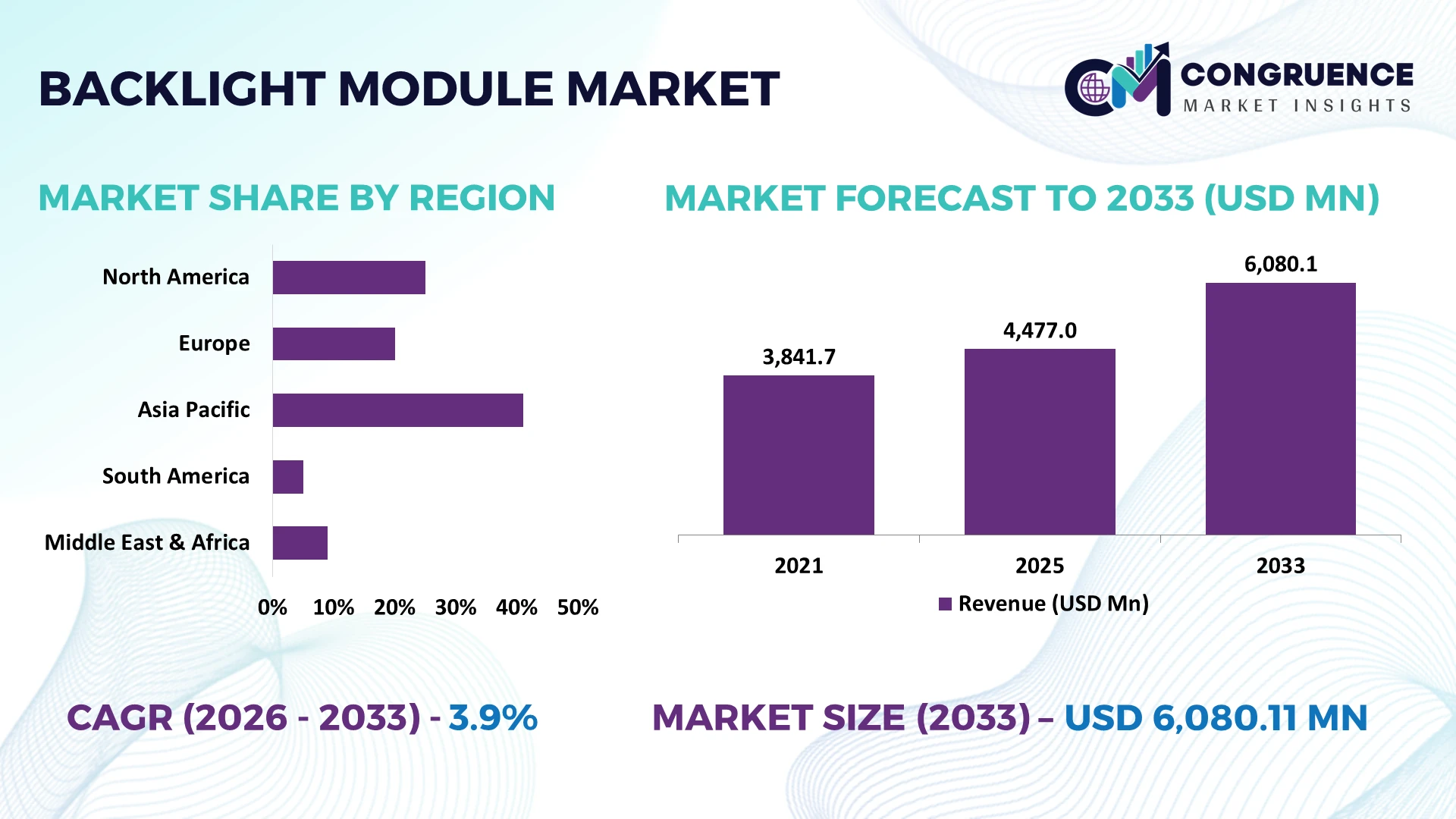
The Global Backlight Module Market was valued at USD 4477 Million in 2025 and is anticipated to reach a value of USD 6080.11 Million by 2033 expanding at a CAGR of 3.9% between 2026 and 2033. Growth is driven by Mini-LED penetration in premium displays, automotive cockpit digitization, larger LCD television panels, high-brightness industrial screens, and thinner edge-lit architectures.
China dominates backlight-module manufacturing through its integrated LCD panel, LED, optical-film, light-guide-plate, and electronics assembly ecosystem, accounting for an estimated 55–60% of global production capacity. BOE alone shipped more than 100 million large-area LCD panels in 2024, reinforcing domestic component pull from televisions, monitors, notebooks, and automotive displays. Compared with Japan, China offers substantially greater mass-production scale, while Taiwan retains leadership in specialized optical components. U.S.–China technology restrictions are accelerating localization of display-material and semiconductor supply chains.
Strategically, suppliers should prioritize China-linked display ecosystems, Mini-LED integration, automotive-qualified modules, and localized optical-component sourcing to protect margins and customer access.
Market Size & Growth: USD 4,477 million in 2025 reaches USD 6,080.11 million by 2033 at 3.9%, supported by Mini-LED and automotive displays.
Top Growth Drivers: Mini-LED adoption contributes approximately 35%, automotive display expansion 25%, and larger premium LCD panels 20% to incremental opportunity.
Short-Term Forecast: By 2028, advanced optical integration can reduce backlight thickness by approximately 15–20% while maintaining higher display brightness.
Emerging Technologies: Mini-LED arrays exceeding 1,000 dimming zones, quantum-dot films, and adaptive local-dimming algorithms are reshaping premium LCD architecture.
Regional Leaders: Indicative 2033 allocation places Asia-Pacific near USD 4.1 billion, North America USD 850 million, and Europe USD 700 million, led by premium-display adoption.
Consumer/End-User Trends: Large-screen televisions above 65 inches are gaining share, increasing LED count, optical-film area, and thermal-management requirements per display.
Pilot/Case Example: In 2025, premium Mini-LED televisions exceeded 2,000 local-dimming zones in selected models, materially improving contrast control versus conventional edge-lit LCDs.
Competitive Landscape: China controls roughly 55–60% of production capacity, with Radiant Opto-Electronics, Coretronic, MinebeaMitsumi, Forhouse, and Taesan competing across module platforms.
Regulatory & ESG Impact: LED backlighting delivers approximately 30–50% lower power consumption than legacy CCFL systems, supporting tighter display-energy efficiency requirements.
Investment & Funding: BOE’s Gen-8.6 AMOLED project represents approximately USD 8.8 billion of display investment, intensifying supply-chain modernization and component localization.
Innovation & Future Outlook: Mini-LED systems with 10,000+ LEDs in premium implementations are shifting competition toward precision mounting, thermal control, optical films, and intelligent dimming.
The Backlight Module Market is increasingly concentrated around premium LCD televisions, automotive displays, gaming monitors, notebooks, industrial panels, and high-brightness commercial screens. Mini-LED architectures are replacing conventional edge-lit configurations in performance-sensitive products, with advanced televisions now using thousands of independently controlled LEDs to improve contrast and luminance. Automotive cockpit digitization adds another high-value channel as larger instrument and infotainment displays require automotive-grade thermal stability. Meanwhile, U.S.–China technology restrictions are reinforcing localized Asian component sourcing, making optical integration, Mini-LED assembly yield, and supply-chain positioning central to the market’s strategic direction.
Backlight modules remain strategically important because LCD technology still anchors televisions, monitors, notebooks, automotive cockpits, industrial displays, and commercial signage despite OLED expansion. Competition is shifting from conventional LED illumination toward Mini-LED local dimming, thinner optical stacks, and integrated thermal management. China’s control of an estimated 55–60% of backlight manufacturing capacity reinforces localization as U.S.–China technology restrictions reshape display-component sourcing and capital allocation.
Mini-LED architectures deliver substantially finer luminance control than conventional edge-lit LED systems: premium products now exceed 2,000 local-dimming zones, while legacy edge-lit displays typically provide limited zonal control. LED systems also consume approximately 30–50% less power than legacy CCFL backlights. China leads manufacturing scale, Taiwan specializes in optical films and light-guide technologies, while Japan remains strong in high-reliability automotive and industrial components. Through 2026–2028, Mini-LED penetration will deepen across premium monitors, televisions, and vehicle displays.
Premium televisions already deploy thousands of Mini-LEDs behind individual LCD panels, requiring precision placement and advanced thermal design. Suppliers are investing in automated assembly, optical-film integration, local component ecosystems, and automotive qualification. Competitive advantage will increasingly depend on Mini-LED yield, optical efficiency, thermal control, and scalable customer-specific module engineering.
Mini-LED adoption is increasing component intensity and manufacturing value per backlight module as television, gaming-monitor, notebook, and automotive brands pursue higher contrast without abandoning LCD infrastructure. Premium systems increasingly incorporate 1,000–2,000+ local-dimming zones, while advanced designs use thousands of individual LEDs; optimized LED backlights also consume approximately 30–50% less power than legacy CCFL technology. China’s display-panel manufacturing ecosystem, representing an estimated 55–60% of global backlight capacity, provides the production base for this transition. Panel manufacturers are shifting investment toward automated Mini-LED placement, optical-film integration, driver electronics, and thermal management. The non-obvious advantage is economic: Mini-LED allows LCD manufacturers to defend premium product categories using established panel fabs while increasing backlight-module complexity and supplier content per display.
Backlight suppliers operate between powerful panel manufacturers and volatile LED, optical-film, resin, and electronics supply chains, creating persistent margin pressure. China controls approximately 55–60% of manufacturing capacity, while large panel producers can represent substantial customer concentration for individual module suppliers. LCD panel prices have historically moved by more than 20% during sharp inventory corrections, forcing component suppliers to absorb rapid procurement and utilization changes. U.S.–China technology controls further encourage duplicated sourcing and qualification, increasing inventory requirements for internationally exposed manufacturers. Suppliers are responding through localized optical-component procurement, long-term LED agreements, automated assembly, and diversification into automotive and industrial displays. Strategically, commodity television modules face the greatest pressure; suppliers with proprietary optical designs and automotive qualification retain stronger pricing protection than standardized assemblers.
Vehicle cockpit digitization creates an attractive diversification path because automotive displays require higher brightness, longer operating life, thermal stability, and qualification standards than mainstream consumer panels. Modern premium vehicles increasingly integrate three or more displays, while some cockpit screens exceed 15 inches and Mini-LED implementations can incorporate hundreds to thousands of independently controlled zones. China, the world’s largest automotive manufacturing base, is accelerating multi-screen adoption through electric and software-defined vehicles. Suppliers are developing curved backlights, ultra-thin optical stacks, high-temperature LEDs, local-dimming controllers, and integrated module assemblies while forming partnerships with Tier-1 cockpit suppliers. A non-obvious opportunity lies in lifetime value: automotive qualification creates longer production programs and higher switching costs than television cycles, allowing qualified suppliers to offset consumer-electronics price compression with more stable platform contracts.
Mini-LED commercialization creates an execution challenge because thousands of emitters must maintain uniform brightness, color, alignment, and thermal behavior across increasingly large panels. Premium backlights can contain more than 10,000 LEDs, meaning even a 0.1% placement or component defect rate can create multiple potential defects before inspection and repair. Local-dimming architectures exceeding 2,000 zones also increase driver-IC density, thermal load, calibration requirements, and software complexity. Chinese manufacturers are scaling high-speed transfer and automated optical inspection, but tighter pitch specifications increase equipment and process-control requirements. Suppliers must invest in precision placement, machine-vision inspection, binning, thermal simulation, repair automation, and driver-panel co-design. The decisive operational issue is yield: companies achieving stable mass-production uniformity can convert Mini-LED complexity into margin advantage, while weaker process control turns additional LED content directly into scrap and rework.
Mini-LED Zone Counts Intensify: Premium LCD systems are moving beyond 1,000 local-dimming zones, with flagship televisions exceeding 2,000 zones and selected implementations using more than 10,000 LEDs. Manufacturers are deploying automated placement, optical inspection, and algorithmic dimming to control uniformity. Higher component density increases module value while making assembly yield, thermal dissipation, and driver integration decisive production metrics.
Optical Stacks Become Thinner: Notebook, monitor, and automotive suppliers are reducing backlight thickness through optimized light-guide plates, diffuser films, reflective materials, and higher-efficiency LEDs. Advanced designs target approximately 10–20% thickness reduction while maintaining luminance. Suppliers are integrating previously separate optical functions into fewer layers, reducing assembly steps and material consumption while enabling slimmer bezels and lower-profile cockpit displays.
Automotive Qualification Tightens Operations: Larger digital cockpits are shifting backlight production toward high-temperature LEDs, enhanced thermal management, and longer-life optical materials. Premium vehicles increasingly incorporate three or more displays, with individual screens exceeding 15 inches. Chinese display suppliers are expanding automotive-qualified production and strengthening Tier-1 partnerships because vehicle programs offer longer design cycles and greater supplier continuity than rapidly refreshed consumer electronics.
Supply Chains Localize Critical Components: China accounts for roughly 55–60% of backlight-module capacity, intensifying exposure to geopolitical technology controls and concentrated component sourcing. Manufacturers are qualifying secondary LED, driver-IC, optical-film, and substrate suppliers across China, Taiwan, Japan, and South Korea. Dual sourcing raises initial qualification work but reduces production interruption risk; localization is consequently becoming a procurement capability rather than simply a cost-reduction strategy.
LED Backlight Modules lead with an estimated 55–60% share because they combine established manufacturing infrastructure, scalable brightness, long operating life, and compatibility across televisions, monitors, notebooks, automotive displays, and industrial screens. Edge-Lit Modules remain important for thin consumer devices, typically reducing module depth compared with conventional Direct-Lit Modules. Direct-Lit Modules retain relevance where brightness uniformity, larger screen sizes, and cost-efficient construction outweigh ultra-thin form-factor requirements.
Mini-LED Modules are the fastest-growing provided type as premium LCD manufacturers migrate toward hundreds or thousands of independently controlled dimming zones. Flagship implementations now exceed 2,000 zones and can incorporate more than 10,000 LEDs, materially increasing semiconductor, driver, substrate, and thermal-management content. OLED Backlight Modules occupy a structurally different position because OLED pixels are self-emissive and therefore do not require a conventional backlight; within the provided segmentation, their relevance reflects substitution pressure on backlit architectures. Suppliers are shifting investment toward Mini-LED transfer equipment, optical films, local-dimming electronics, and automated inspection while maintaining conventional LED capacity for volume products.
LCD Displays account for an estimated 45–50% of application demand because backlighting remains essential across televisions, monitors, notebooks, industrial equipment, and numerous embedded displays. Television Screens represent particularly high component consumption per unit because increasing panel dimensions require larger optical films, more LEDs, and stronger thermal control. Smartphone Displays contribute less backlight demand as premium handsets increasingly use self-emissive OLED technology, concentrating LCD backlights in value-oriented devices.
Automotive Displays are the fastest-growing provided application, driven by digital instrument clusters, central infotainment screens, passenger displays, and increasingly integrated cockpit architectures. Premium vehicles frequently incorporate three or more displays, while individual screens now exceed 15 inches in advanced platforms. Industrial Monitors remain smaller but attractive because long operating cycles, high brightness, and reliability requirements support specialized module designs. Manufacturers are expanding automotive-qualified LEDs, curved optical assemblies, high-temperature materials, and Mini-LED local dimming while automating high-volume LCD module production to defend cost competitiveness.
Consumer Electronics leads with approximately 55–60% of backlight-module demand because televisions, monitors, notebooks, tablets, and value-tier mobile devices generate the highest unit volumes. Display Manufacturers form the critical integration layer, purchasing LEDs, optical films, light-guide plates, drivers, and assemblies before supplying completed panels to electronics brands. Large LCD televisions increasingly require advanced Direct-Lit or Mini-LED configurations, while notebook manufacturers prioritize thinner Edge-Lit architectures and improved power efficiency.
Automotive Manufacturers are the fastest-growing provided end-user group as cockpit digitization raises display quantity, area, brightness, and qualification requirements per vehicle. Modern premium vehicles commonly integrate three or more screens, creating higher module content than traditional instrument-panel configurations. Industrial Equipment users prioritize sunlight readability and extended operating life, while Medical Device Manufacturers require brightness uniformity, stable color reproduction, and long-term component availability. Suppliers are responding with automotive-qualified production lines, customized optical stacks, longer supply commitments, and co-development agreements, shifting portfolio investment from commodity consumer modules toward applications with higher qualification barriers and longer platform lifetimes.
Asia-Pacific accounted for the largest market share at 66% in 2025 however, Asia-Pacific is expected to register the fastest growth, expanding at a CAGR of 4.5% between 2026 and 2033.
Premium Displays Shift Toward Mini-LED
North America accounts for approximately 14% of global backlight module demand, driven predominantly by televisions, gaming monitors, notebooks, automotive cockpits, medical displays, and commercial screens rather than large-scale domestic module manufacturing. The U.S. concentrates premium-device consumption and product engineering, creating stronger demand for high-brightness Mini-LED and precision local-dimming systems. Premium televisions now integrate more than 2,000 dimming zones, while advanced gaming displays increasingly exceed 1,000 zones, raising LED, driver-IC, optical-film, and thermal-management content per unit. U.S.–China technology restrictions have also increased procurement scrutiny around semiconductor and display-component origin. Electronics brands are responding with supplier diversification across Taiwan, Japan, South Korea, and Southeast Asia while retaining Asian module assembly. The business opportunity therefore concentrates in high-specification engineering, semiconductor control, and premium display integration rather than commodity module production.
United States Market Outlook: The U.S. provides the region’s strongest demand base through premium consumer electronics, automotive electronics, healthcare equipment, and enterprise displays. Vehicle cockpit screens increasingly exceed 12 inches, while high-end televisions exceed 2,000 local-dimming zones. Suppliers that combine Mini-LED control electronics, automotive qualification, optical efficiency, and diversified Asian sourcing are best positioned for U.S. design wins.
Automotive Displays Reshape Component Requirements
Europe represents approximately 12% of global backlight module demand, with Germany, France, the UK, Italy, and Central European manufacturing hubs supporting automotive, industrial, television, medical, and professional-display applications. Automotive digitization is the defining structural shift: premium vehicles increasingly incorporate three or more displays, requiring higher-brightness modules, wide-temperature operation, uniform illumination, and extended component availability. EU energy-efficiency requirements for electronic displays also pressure suppliers to improve LED efficiency, local dimming, optical transmission, and standby performance. Germany’s automotive manufacturing ecosystem concentrates demand for qualified display assemblies used in digital clusters, infotainment, head-up systems, and passenger screens. Module suppliers are therefore prioritizing automotive-grade LEDs, thinner optical stacks, thermal simulation, and long-duration qualification programs. Unlike Asia’s volume-oriented manufacturing base, European demand favors customized, higher-reliability architectures where engineering capability and certification carry greater purchasing weight.
Germany Market Outlook: Germany’s automotive sector produced more than 4 million passenger vehicles in 2024, providing a substantial installed production base for cockpit-display integration. Premium OEMs increasingly use multi-screen interiors and larger infotainment interfaces, giving qualified backlight suppliers opportunities in high-luminance modules, curved assemblies, thermal management, and long-life optical materials rather than commodity consumer configurations.
Integrated Display Supply Chains Control Scale
Asia-Pacific commands approximately 66% of global backlight module demand and an even larger proportion of production, supported by China, Taiwan, South Korea, Japan, and Vietnam. China alone represents an estimated 55–60% of global module capacity through integrated LCD panel, LED, light-guide plate, optical-film, PCB, and electronics assembly clusters. BOE ships more than 100 million large-area LCD panels annually, creating concentrated component demand across televisions, monitors, notebooks, and automotive displays. Taiwan retains strong optical-module and component expertise, while Japan specializes in precision and automotive applications. South Korea remains influential in premium display technology despite manufacturing restructuring toward higher-value formats. Mini-LED adoption is increasing automated placement and inspection requirements, while geopolitical supply-chain controls are accelerating domestic Chinese sourcing. Manufacturers are investing in component localization, high-speed transfer, optical integration, and production automation to protect yield and delivery continuity.
China Market Outlook: China combines the world’s largest LCD manufacturing ecosystem with extensive LED packaging, optical-film, electronics, and final-device assembly capacity. Domestic panel manufacturers now command more than half of global large-area LCD shipments. Localization of driver electronics and display materials is accelerating, strengthening suppliers able to integrate Mini-LED assembly, automated inspection, thermal engineering, and high-volume customer qualification.
Electronics Assembly Anchors Regional Demand
South America represents approximately 4% of global backlight module demand, with Brazil providing the principal electronics manufacturing and consumption base. Demand centers on televisions, monitors, industrial displays, automotive electronics, and value-oriented consumer devices, while sophisticated backlight components remain heavily dependent on Asian imports. Brazil’s Manaus Free Trade Zone provides a strategically important assembly cluster where televisions and other electronics are produced under localized manufacturing incentives. The country manufactures millions of television sets annually, creating recurring requirements for LED modules, optical films, driver boards, and replacement components. Currency volatility and imported-component exposure constrain procurement predictability, pushing assemblers toward inventory optimization and supplier diversification. Mini-LED remains concentrated in premium products, while conventional LED architectures dominate volume manufacturing. Suppliers are strengthening distribution, local assembly support, inventory buffers, and Asian sourcing partnerships rather than establishing capital-intensive upstream optical-component production.
Brazil Market Outlook: Brazil combines a population exceeding 200 million with the region’s most developed television and electronics assembly infrastructure. The Manaus manufacturing ecosystem provides localized final assembly while relying substantially on imported display components. Suppliers offering dependable inventories, localized technical support, cost-optimized LED modules, and rapid replacement capability hold an advantage when exchange-rate movements disrupt Asian component procurement.
Digital Infrastructure Expands Display Deployment
Middle East & Africa accounts for approximately 4% of global backlight module demand, concentrated in the UAE, Saudi Arabia, Israel, South Africa, and major commercial centers. The Gulf’s expanding digital-signage, hospitality, transportation, retail, control-room, and smart-city infrastructure creates demand for large-format and high-brightness LCD systems. Saudi Arabia’s Vision 2030 projects and the UAE’s smart-building ecosystem are increasing deployment of commercial displays requiring reliable LED backlighting under high ambient-light and temperature conditions. Regional manufacturing remains limited, making Asian component and finished-display supply chains operationally important. South Africa contributes established retail and industrial-monitor demand but remains more price sensitive. Suppliers are emphasizing high-luminance modules, thermal resilience, remote display management, and distributor inventories. The regional opportunity therefore favors specialized commercial and infrastructure displays rather than high-volume upstream backlight manufacturing.
Saudi Arabia Market Outlook: Saudi Arabia’s infrastructure transformation is creating concentrated display demand across airports, entertainment venues, retail developments, hotels, transport systems, and smart-city projects. Vision 2030 includes multiple large-scale developments requiring digital information infrastructure. Backlight suppliers benefit where high brightness, thermal durability, extended operating hours, and large-format performance outweigh the procurement advantages of standard consumer-grade modules.
Radiant Opto-Electronics, Coretronic, MinebeaMitsumi, Taesan, and Forhouse compete across integrated backlight modules, optical components, and customer-specific display assemblies, while Chinese suppliers challenge established Taiwanese and Japanese producers on scale and price. The top five suppliers hold approximately 45% of organized module demand. Competition centers on Mini-LED yield, optical efficiency, customization, and procurement cost; advanced LED architectures deliver 30–50% lower power use than legacy CCFL systems, while premium modules increasingly exceed 2,000 local-dimming zones. Taiwanese suppliers defend positions through optical integration and customer relationships; Japanese players emphasize automotive reliability, while Chinese manufacturers exploit localized panel ecosystems and automated mass production. Companies are expanding Mini-LED placement capacity, vertically integrating optical films, and partnering with panel manufacturers. The competitive shift favors high-density LED architectures over commodity edge-lit assembly. Capital-intensive precision equipment, yield control, customer qualification, and component sourcing remain entry barriers. Winning requires scalable Mini-LED manufacturing, optical expertise, reliable supply, application customization, and consistently high production yields.
Radiant Opto-Electronics Corporation
Coretronic Corporation
MinebeaMitsumi Inc.
Taesan LCD Co., Ltd.
Forhouse Corporation
Darwin Precisions Corporation
Kenmos Technology Co., Ltd.
Shenzhen Baoming Technology Co., Ltd.
Shenzhen Refond Optoelectronics Co., Ltd.
E-Litecom Co., Ltd.
Suzhou Dongshan Precision Manufacturing Co., Ltd.
Stanley Electric Co., Ltd.
Nichia Corporation
Seoul Semiconductor Co., Ltd.
Current backlight technology centers on high-efficiency LED modules, precision light-guide plates, optical films, local dimming, and integrated driver electronics. Coretronic reports advanced light-guide designs delivering 50–70% higher efficiency than conventional backlight units, while newer monitor solutions improve efficiency 15–25%. Mini-LED mass production across gaming laptops and monitors confirms commercial deployment beyond flagship televisions.
Emerging architectures combine Mini-LED arrays, active-matrix chip-on-glass driving, AI dimming, quantum-dot conversion, and thinner optical stacks. BOE’s Mini-LED systems can reduce display power consumption approximately 30%, while automotive implementations reach 2,850 dimming zones and 7,000-nit peak brightness. Compared with conventional globally dimmed LED backlights, thousands of independently controlled zones deliver dramatically stronger contrast and energy targeting, benefiting premium LCD manufacturers competing against OLED.
Disruptive RGB Mini-LED replaces blue-LED-plus-conversion architectures with independently controlled red, green, and blue emitters, improving color purity and reducing conversion losses. In 2026, major television brands introduced RGB Mini-LED platforms, signaling transition from demonstration to commercialization. Through 2026–2028, active-matrix driving, integrated optics, automated calibration, and RGB architectures will spread across televisions, automotive displays, monitors, and specialized screens. Suppliers mastering LED placement yield, thermal control, optical integration, and driver co-design gain pricing power and design flexibility; conventional module assemblers face accelerating commoditization.
May 2024 BOE showcased a 44.8-inch automotive oxide display using glass-based Mini-LED backlighting, delivering 2,000-nit brightness and million-level contrast. The launch expanded high-performance backlight deployment into smart cockpits, strengthening BOE’s positioning in automotive integration and vehicle visualization. Source: boe-us.com
February 2025 Coretronic raised its 2025 capital-expenditure target to approximately NT$1.5 billion. The backlight-module manufacturer invested as it advanced energy-saving products and diversified operations, strengthening production capabilities while addressing weaker conventional display demand and accelerating higher-value technology deployment. Source: digitimes.com
March 2025 BOE reported 140,000 MLED shipments during 2024 while advancing Mini-LED backlights that reduce power consumption by approximately 30%. The scale-up demonstrated traction beyond prototypes and reinforced BOE’s integrated ecosystem across monitors, notebooks, televisions, VR and automotive displays. Source: ledinside.com
January 2026 Hisense unveiled the 116UXS RGB MiniLED evo television with a four-primary backlight adding cyan to red, green and blue emitters. The 116-inch platform broadened multi-primary backlight architecture, advancing color precision and intensifying premium LCD competition against OLED technologies. Source: hisense-canada.com
The Backlight Module Market Report evaluates Edge-Lit Modules, Direct-Lit Modules, LED Backlight Modules, OLED Backlight Modules, and Mini-LED Modules across LCD Displays, Automotive Displays, Television Screens, Smartphone Displays, and Industrial Monitors. End-user coverage includes Consumer Electronics, Automotive Manufacturers, Display Manufacturers, Industrial Equipment, and Medical Device Manufacturers. LED Backlight Modules represent approximately 55–60% of current demand, while Mini-LED architectures increasingly capture premium applications requiring local dimming and higher luminance.
Regional coverage includes North America, Europe, Asia-Pacific, South America, and Middle East & Africa, with Asia-Pacific representing approximately 66% of market activity. Technology assessment covers Mini-LED, RGB Mini-LED, active-matrix driving, optical films, light-guide plates, AI dimming, and automated assembly. The report supports 2026–2033 investment planning, capacity allocation, technology partnerships, application diversification, supply-chain positioning, and competitive benchmarking.
| Report Attribute/Metric | Report Details |
|---|---|
Market Revenue in 2025 | USD 4477 Million |
Market Revenue in 2033 | USD 6080.11 Million |
CAGR (2026 - 2033) | 3.9% |
Base Year | 2025 |
Forecast Period | 2026 - 2033 |
Historic Period | 2021 - 2025 |
Segments Covered | By Type
By Application
By End-User
|
Key Report Deliverable | Revenue Forecast, Growth Trends, Market Dynamics, Segmental Overview, Regional and Country-wise Analysis, Competition Landscape |
Region Covered | North America, Europe, Asia-Pacific, South America, Middle East, Africa |
Key Players Analyzed | Radiant Opto-Electronics Corporation, Coretronic Corporation, MinebeaMitsumi Inc., Taesan LCD Co., Ltd., Forhouse Corporation, Darwin Precisions Corporation, Kenmos Technology Co., Ltd., Shenzhen Baoming Technology Co., Ltd., Shenzhen Refond Optoelectronics Co., Ltd., E-Litecom Co., Ltd., Suzhou Dongshan Precision Manufacturing Co., Ltd., Stanley Electric Co., Ltd., Nichia Corporation, Seoul Semiconductor Co., Ltd. |
Customization & Pricing | Available on Request (10% Customization is Free) |




