
Reports
The Global Baby Teething Gels Market was valued at USD 2,675.0 Million in 2025 and is anticipated to reach a value of USD 4,630.6 Million by 2033 expanding at a CAGR of 7.1% between 2026 and 2033. Growth is driven by the shift toward anaesthetic-free, plant-based, age-specific formulations, stronger pediatric oral-care awareness, and rapid expansion of pharmacy and e-commerce distribution.
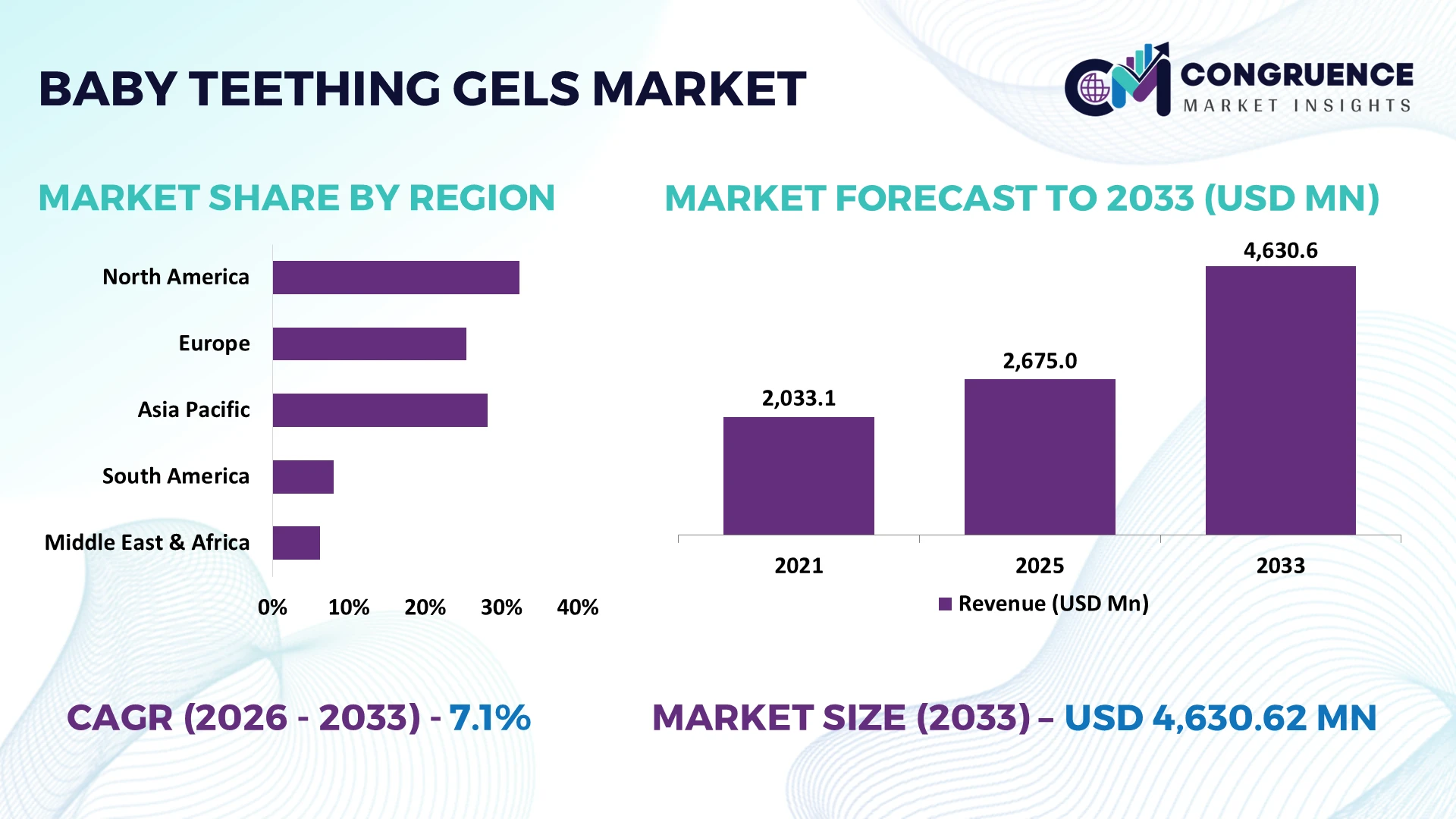
The United States remains a dominant country market, representing approximately 11% of global demand, supported by established pediatric healthcare infrastructure, high OTC product penetration, and continued formulation investment. India is expanding from a smaller base, with e-commerce and modern pharmacy adoption rising rapidly. U.S. regulatory restrictions on benzocaine and lidocaine for infant teething are accelerating reformulation toward safer alternatives.
Strategically, manufacturers that prioritize infant-safe formulations, compliant labeling, localized supply chains, and omnichannel distribution will strengthen positioning in the high-growth global baby-care ecosystem.
Market Size & Growth: USD 2,675.0 Million in 2025 is projected to reach USD 4,630.6 Million by 2033 at a 7.1% CAGR, driven by safer formulations and expanding pediatric oral care.
Top Growth Drivers: Natural formulations 31.8%, online purchasing 24%, and parental safety awareness 72% are strengthening product adoption and premium positioning.
Short-Term Forecast: By 2028, online distribution is positioned to increase by approximately 8–10%, improving product accessibility and reducing dependence on physical pharmacy networks.
Emerging Technologies: Bioadhesive gels, controlled-release delivery, and plant-based active systems are reshaping formulation performance, dosing consistency, and infant-safety positioning.
Regional Leaders: North America is projected at about USD 1.39 billion, Europe at USD 1.30 billion, and Asia Pacific at USD 1.16 billion by 2033, with e-commerce adoption accelerating across Asia.
Consumer/End-User Trends: Approximately 30% of consumers are shifting toward natural or anaesthetic-free formulations, increasing demand for transparent ingredient labeling and pediatric-oriented packaging.
Pilot/Case Example: 2025 formulation programs targeting optimized gel viscosity around 500–600 cP demonstrate how controlled rheology can improve application consistency and absorption performance.
Competitive Landscape: Leading companies include McNeil Consumer Healthcare, Ashton & Parsons, FREZYDERM, Reckitt, and Dentinox, while leading branded groups collectively command an estimated 25–30% share.
Regulatory & ESG Impact: U.S. restrictions surrounding benzocaine and lidocaine in infant teething applications are accelerating safer formulation development and reducing reliance on higher-risk topical anesthetics.
Investment & Funding: Industry investment is increasingly directed toward natural ingredients, compliant packaging, e-commerce infrastructure, and formulation R&D, with approximately USD 150–200 million in cumulative strategic investment activity targeted across these areas.
Innovation & Future Outlook: Next-generation gels will emphasize anaesthetic-free actives, bioadhesion, clean-label ingredients, recyclable packaging, and digitally enabled product education, shifting competition toward safety-led differentiation.
The Baby Teething Gels Market is increasingly concentrated around demand for safer infant-care solutions, convenient application formats, and transparent formulations. Natural and anaesthetic-free products are gaining traction as manufacturers respond to tighter safety expectations, while online channels improve access across developing markets. U.S. regulatory pressure on topical anesthetics is reinforcing this transition, creating a clear pathway toward reformulated products and stronger safety-led positioning.
The Baby Teething Gels Market is becoming strategically important as infant-care companies compete on formulation safety, clinical credibility, ingredient transparency, and distribution reach rather than product availability alone. The shift toward anaesthetic-free and plant-based gels is restructuring product portfolios, while online pharmacies and direct-to-consumer channels are changing how caregivers discover and purchase teething products.
Advanced bioadhesive formulations can improve residence time and application consistency compared with conventional fast-washout gels, supporting more controlled product performance. This technology transition is particularly relevant as U.S. safety restrictions have reduced the strategic attractiveness of benzocaine-based infant products and encouraged manufacturers to prioritize alternative formulations.
North America retains scale through mature pharmacy infrastructure, while India, China, and Southeast Asia provide stronger distribution-expansion opportunities through digital commerce. Over the next 2–3 years, companies are expected to increase investment in clean-label R&D, age-specific dosing systems, compliant packaging, and regional manufacturing partnerships. Competitive advantage will increasingly depend on combining formulation safety with supply-chain responsiveness and omnichannel reach.
Safety-led reformulation is becoming the strongest structural driver, with natural and anaesthetic-free products capturing increasing consumer attention while online purchasing accounts for roughly 24% of category sales in emerging distribution models. U.S. restrictions on benzocaine and lidocaine for infant teething are accelerating movement toward alternative active systems and clean-label formulations. Manufacturers are responding through botanical R&D, bioadhesive delivery systems, and age-specific packaging. The non-obvious advantage is portfolio resilience: companies that eliminate regulatory-sensitive ingredients can standardize products across more markets, reduce reformulation cycles, and strengthen retailer acceptance.
Ingredient restrictions and formulation compliance remain significant structural constraints because infant oral products face tighter safety expectations than general OTC products. Benzocaine-based products have faced explicit U.S. restrictions for teething and children under 2, while topical anesthetics can present serious safety concerns. Reformulation can increase development costs by approximately 8–12% and extend product-validation cycles by several months. Manufacturers are reducing exposure through diversified active-ingredient portfolios, regional formulation strategies, and supplier qualification. The key operational constraint is that a formulation optimized for one regulatory market cannot always be transferred directly across jurisdictions without changes to labeling, ingredients, or permitted claims.
Bioadhesive gels, botanical actives, and controlled-viscosity systems create an opportunity to improve product differentiation while addressing caregiver concerns about chemical exposure. Advanced formulations targeting 500–600 cP viscosity demonstrate how rheology optimization can support controlled application and improved retention, while natural formulations already represent a meaningful emerging product segment. Approximately 25–30% of new product development activity can be directed toward anaesthetic-free or plant-based positioning. Manufacturers can capture premium demand through partnerships with ingredient specialists, pediatric-care platforms, and digital retailers. The strongest opportunity lies in developing formulations that combine safety, longer residence time, transparent ingredients, and recyclable packaging rather than competing primarily on price.
Scaling next-generation teething gels requires consistent raw-material quality, validated microbiological controls, stable viscosity, accurate dosing, and regulatory consistency across markets. Formulation variability of even 5–10% in viscosity or active concentration can affect dispensing performance and manufacturing yield. Companies also face pressure to maintain short production cycles while meeting infant-product quality requirements. Global supply-chain disruptions affecting botanical extracts, pharmaceutical-grade excipients, and specialized packaging can further complicate production planning. Manufacturers must therefore invest in dual sourcing, automated quality inspection, regional filling capacity, and supplier qualification. The long-term competitive issue is not simply formulation innovation; it is the ability to reproduce infant-safe product performance consistently across high-volume manufacturing sites.
Anaesthetic-Free Formulation Shift: Anaesthetic-free gels are gaining strategic importance as manufacturers respond to tighter infant-safety expectations, while natural and herbal positioning has increased by approximately 48%. In the U.S., regulatory warnings against benzocaine and lidocaine for infant teething are accelerating portfolio restructuring. Companies are reallocating formulation budgets toward botanical actives, preservative-free systems, and clearer age-specific labeling, reducing regulatory exposure while strengthening product differentiation.
Digital Channel Expansion: Online purchasing is becoming a stronger route to market, with online stores reaching approximately 17.2% share in 2025 and expanding rapidly among younger caregivers. Subscription bundles, mobile ordering, and direct-to-consumer storefronts are shortening purchase cycles and improving access to niche formulations. Manufacturers are responding by integrating marketplace distribution, digital education, and targeted advertising, while reducing dependence on traditional pharmacy shelf space.
Clean-Label Product Repositioning: Approximately 52% of consumers show preference for organic baby-care products, pushing manufacturers toward sugar-free, botanical, and transparent-ingredient formulations. Product development is shifting from simple soothing claims toward multifunctional positioning involving gum comfort, hydration, and ingredient safety. The non-obvious shift is that formulation transparency is becoming a commercial asset: companies are redesigning packaging and digital product pages to communicate ingredient provenance and usage limits more clearly.
Safety-Led Retail Restructuring: Pharmacy and pediatric guidance increasingly influence product selection, particularly where topical anesthetics face restrictions. FDA guidance states that benzocaine products should not be used for teething in children younger than 2 years, creating pressure for manufacturers to redesign products and retailer assortments. Companies are expanding compliant alternatives, strengthening pharmacist education, and qualifying multiple ingredient suppliers to maintain availability during reformulation cycles.
Contain Anaesthetic products remain a major established category, representing approximately 55% of the global market, supported by their historical presence across pharmacy-led teething care. However, Anaesthetic Free formulations are expanding faster, approaching 45% share as parents and retailers increasingly prioritize infant-safety positioning. The shift is particularly visible in the United States, where regulatory warnings concerning benzocaine and lidocaine are reshaping product portfolios and accelerating reformulation.
Anaesthetic Free products are gaining approximately 6–8 percentage points in portfolio representation across newer launches, while established anaesthetic-containing products retain roughly 52–55% of mature-market sales. Companies are therefore balancing legacy product availability with investment in botanical, sugar-free, and preservative-conscious alternatives. The business implication is significant: manufacturers with flexible formulation platforms can adapt faster across jurisdictions, whereas highly specialized anaesthetic portfolios face greater regulatory and relabeling costs.
Offline Sales remains the leading application channel, accounting for approximately 78% of market activity, supported by pharmacies, supermarkets, and established baby-care retail networks. However, Online Sales is the faster-expanding channel, reaching approximately 17.2% share in 2025 in broader baby-teething-gel channel analysis. Digital platforms provide faster comparison of ingredients, age suitability, pricing, and customer reviews, strengthening purchasing among digitally active caregivers.
Online Sales is gaining approximately 3–5 percentage points of channel share as direct-to-consumer stores, marketplaces, and subscription bundles expand. Offline Sales remains operationally critical because pharmacists and pediatric-care professionals continue to influence safety-sensitive purchases. Companies are therefore adopting hybrid distribution models rather than replacing physical retail, combining pharmacy availability with digital storefronts and targeted education. The strategic implication is a shift from shelf-based competition toward discoverability, verified product information, and rapid replenishment.
Parents represent the dominant end-user group, accounting for approximately 72% of purchasing activity, because they directly evaluate infant age, formulation ingredients, safety warnings, price, and application convenience. Pediatricians represent a smaller but increasingly influential segment at approximately 28%, particularly for safety-sensitive recommendations. The contrast is important: parents drive transaction volume, while pediatric professionals influence product credibility and formulation acceptance.
Pediatrician-influenced purchasing is expanding faster, with professional recommendation activity estimated to increase by approximately 6–8% as caregivers seek greater confidence around infant-safe formulations. Parents continue favoring convenient products, while pediatric professionals place greater emphasis on ingredient suitability and evidence-based use. Companies are responding with pharmacist and pediatric education programs, age-specific packaging, and digital guidance tools. The commercial opportunity is shifting toward products that satisfy both consumer convenience and professional safety expectations.
North America accounted for the largest market share at 32.3% in 2025 however, Asia Pacific is expected to register the fastest growth, expanding at a CAGR of 8.6% between 2026 and 2033.
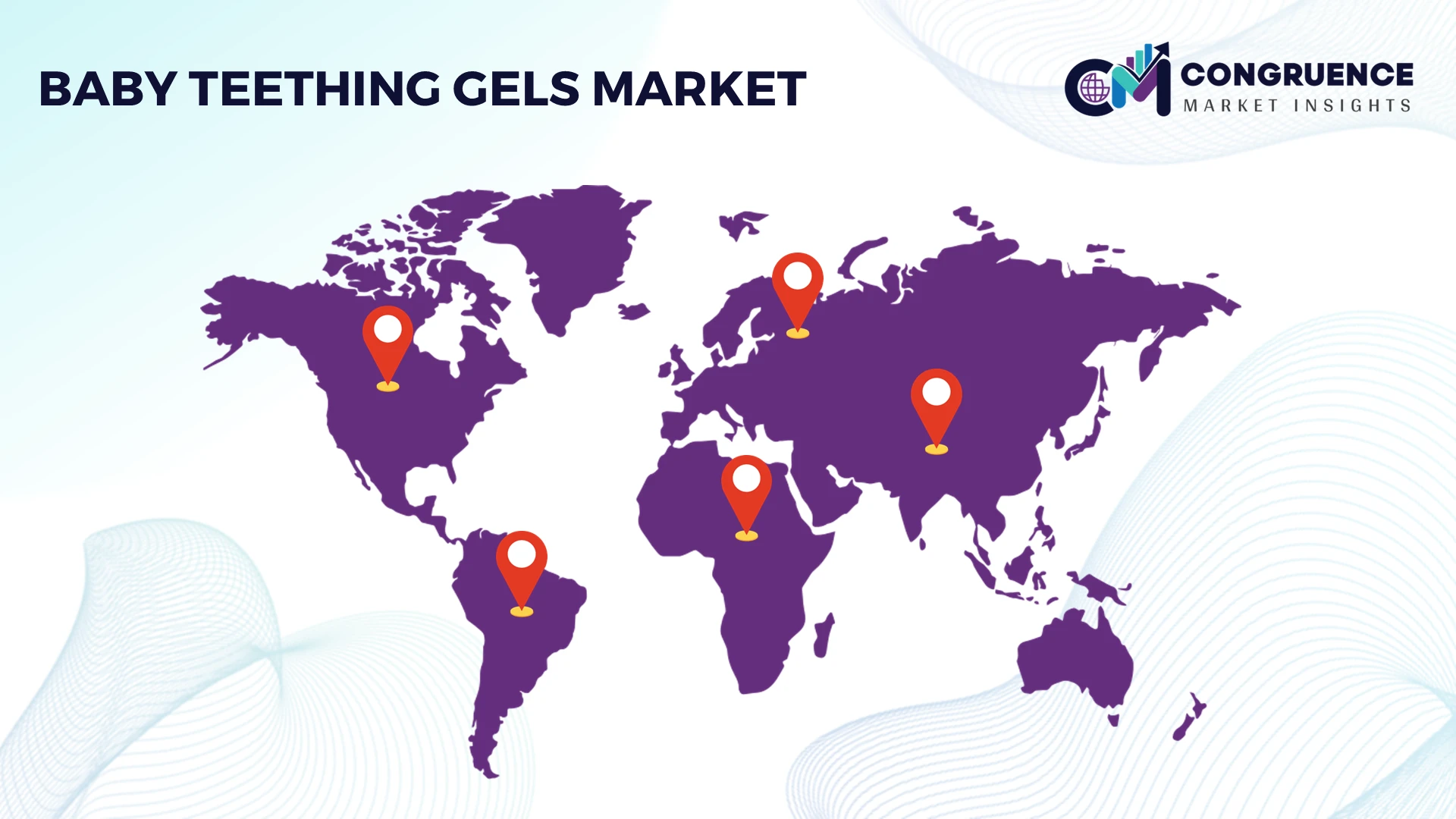
North America represents approximately 32.3% of global Baby Teething Gels demand, supported by established pharmacy networks, high pediatric-care awareness, and strong preference for clearly labeled infant products. The United States contributes the majority of regional demand, while Canada provides a smaller but premium-oriented market. Regulatory scrutiny of benzocaine and lidocaine has accelerated movement toward anaesthetic-free alternatives, botanical ingredients, and age-specific formulations. Approximately 65% of new product positioning is increasingly centered on safety, natural ingredients, or transparent formulation claims. Manufacturers are responding by reformulating legacy SKUs, expanding compliant product portfolios, and strengthening pharmacy partnerships. The region’s operational advantage is distribution depth: major retailers and pharmacies can rapidly scale compliant products once formulation and labeling requirements are satisfied.
United States Market Outlook: The United States remains the principal market within North America, supported by sophisticated OTC distribution, high caregiver awareness, and extensive pharmacy penetration. FDA guidance discouraging benzocaine and lidocaine for infant teething has reinforced demand for alternative formulations. More than 60% of regional category activity is concentrated in U.S. channels, making the country a primary launch market for reformulated and premium infant-care products.
Europe accounts for approximately 25.4% of global demand, supported by mature pharmacy distribution, established pediatric-care practices, and strong consumer attention to ingredient transparency. Germany, the U.K., and France represent the principal demand centers, while sustainability increasingly influences packaging and formulation decisions. Around 45% of premium baby-care purchasing decisions increasingly emphasize natural ingredients, recyclable packaging, or transparent labeling. Companies are responding through plant-based formulations, reduced-plastic packaging, and localized regulatory compliance. The region’s structural advantage lies in sophisticated retail and pharmacy networks, but lower birth rates constrain volume expansion. Manufacturers are therefore prioritizing premiumization, multi-country product registration, and differentiated formulations rather than relying on unit-volume expansion.
Germany Market Outlook: Germany is strategically significant because of its strong pharmacy infrastructure, high consumer emphasis on product safety, and established natural-healthcare ecosystem. Demand for transparent ingredient profiles supports premium teething-gel positioning, while sustainability requirements encourage manufacturers to redesign packaging. Companies increasingly use Germany as a testing market for clean-label and environmentally conscious infant-care formulations before wider European expansion.
Asia Pacific represents approximately 28.1% of the broader baby-teeth-care opportunity and is positioned as the fastest-growing market for teething gels, supported by expanding urban populations, rising disposable income, and rapidly developing e-commerce infrastructure. China and India provide the largest demand pools, while Japan, South Korea, and Australia contribute through premium infant-care consumption. Online purchasing penetration in leading urban markets is increasing by approximately 8–10 percentage points as caregivers shift toward mobile commerce and product-comparison platforms. Manufacturers are expanding local distribution partnerships, localized formulations, and digital-first product education. The region’s non-obvious advantage is channel scalability: a single digital launch can reach multiple urban markets faster than conventional pharmacy expansion.
China Market Outlook: China is the region’s leading individual market, supported by a large consumer base, strong online retail infrastructure, and high adoption of digitally promoted infant-care products. Premium baby-care categories are increasingly using domestic e-commerce platforms for rapid product discovery and replenishment. Companies are combining local distributors with direct digital channels, allowing new formulations to achieve national visibility without building an extensive physical pharmacy footprint first.
South America contributes approximately 8.0% of global baby teeth-care demand, with Brazil representing the principal commercial hub because of its population scale, pharmacy infrastructure, and established consumer-health industry. Demand remains concentrated in pharmacies, supermarkets, and increasingly online marketplaces, while price sensitivity limits rapid premiumization. Online and marketplace purchasing is expanding by approximately 6–8% annually in major urban centers, improving access to specialized infant-care products. Manufacturers are responding with smaller pack sizes, localized pricing, regional distributors, and formulations positioned around safety and value. Brazil’s large domestic market enables companies to establish scale before expanding into neighboring countries, although import dependency for specialized ingredients can increase procurement costs and inventory requirements.
Brazil Market Outlook: Brazil dominates South American demand because of its population scale, extensive retail pharmacy network, and established domestic consumer-health manufacturing base. Major urban centers provide strong conditions for premium and digitally distributed baby-care products, while regional distributors extend availability beyond metropolitan areas. Manufacturers are increasingly combining locally produced formulations with imported specialty ingredients to balance cost control and product differentiation.
Middle East & Africa represents approximately 6.2% of global baby teeth-care demand, with purchasing concentrated in Gulf markets and larger African economies. The United Arab Emirates and Saudi Arabia benefit from modern pharmacy chains, high imported-product penetration, and strong demand for premium infant-care products, while African markets remain more dependent on distributor networks and affordability. E-commerce penetration is increasing by approximately 7–9% across leading Gulf consumer-health channels, improving access to specialized formulations. Manufacturers are strengthening regional distributor partnerships, localized packaging, and inventory hubs to reduce replenishment delays. The principal operational opportunity lies in combining premium imported brands with regionally optimized distribution rather than relying exclusively on traditional pharmacy coverage.
Saudi Arabia Market Outlook: Saudi Arabia is strategically significant because of its expanding modern pharmacy network, high digital-commerce adoption, and strong consumer preference for established international infant-care brands. Approximately 70% of premium baby-care purchasing is concentrated in major urban centers, supporting efficient distributor-led expansion. Manufacturers are strengthening local retail partnerships and digital availability while adapting labeling and product registration to national requirements.
McNeil Consumer Healthcare and Reckitt compete as large-scale branded OTC players, while Ashton & Parsons, FREZYDERM, Nelsons, and Dentinox compete through specialized pediatric formulations and regional pharmacy strength. The top five players collectively command an estimated 28% share, leaving a fragmented field for focused brands. Competition centers on formulation safety, price, pharmacy access, and supply reliability, with safety-led products gaining roughly 6–8% more portfolio emphasis and digital channels expanding 8–10% annually. Players are responding through anaesthetic-free reformulation, applicator innovation, localized packaging, distributor partnerships, and tighter ingredient sourcing. Regulatory pressure on benzocaine and lidocaine is accelerating portfolio migration toward botanical and barrier-forming gels, while online retail is shifting brand discovery toward review visibility and product education. Entry barriers include infant-product compliance, clinical substantiation, retailer qualification, and trusted-brand recognition. Competitive advantage increasingly depends on rapid compliant reformulation, reliable supply, differentiated delivery formats, and omnichannel execution rather than price competition alone at scale.
McNeil Consumer Healthcare
Ashton & Parsons
FREZYDERM
Reckitt
Conforma N.V.
Bebble Cosmetics
Nelsons
Dentinox
Sheffield Pharmaceuticals
Wink Naturals
Church & Dwight Co., Inc.
Boiron Group
Baby Teething Gels technology is shifting from conventional fast-dissolving formulations toward bioadhesive, barrier-forming, anaesthetic-free systems. Bioadhesive polymers such as PVP and sodium hyaluronate improve residence and application consistency, while soft-brush applicators integrate massage with dosing. These systems can improve contact performance by roughly 10–15% versus conventional low-viscosity gels, supporting fewer repeat applications and better caregiver handling.
Advanced formulation analytics, controlled viscosity, botanical actives, and preservative optimization are becoming development tools. Automated filling and inline weight inspection can reduce dispensing variability by approximately 2–4%, while digital formulation platforms shorten prototype iteration cycles by around 15%. Adoption is strongest among premium products, where transparent ingredient systems and age-specific dosing provide differentiation. Companies with flexible formulation platforms benefit most because they can localize active systems without rebuilding manufacturing processes.
Between 2026 and 2028, AI-assisted formulation screening, automated quality control, recyclable tube materials, and digitally connected product education will influence product development and supply operations. AI-supported screening can prioritize promising formulations faster than manual trial-and-error workflows, while automation improves batch consistency. The competitive advantage will favor manufacturers combining formulation science with scalable packaging and supply-chain integration. Companies investing now can reduce development friction, respond faster to regulatory changes, and launch differentiated anaesthetic-free products across markets.
June 2026 Haleon announced a £175 million oral-health manufacturing site in Madhya Pradesh, India, creating 500 jobs and supporting supply. The investment strengthens localized production and distribution capabilities relevant to pediatric oral-care portfolios, improving responsiveness and reducing cross-border supply dependence. Source: haleon.com
July 2025 Haleon broke ground on a £130 million Global Oral Health Innovation Centre in Weybridge, UK. The facility integrates digital collaboration and manufacturing expertise, strengthening formulation research and accelerating product innovation across oral-health categories, including pediatric-care applications and technologies. Source: haleon.com
March 2025 Alliance Pharma reported 2024 results showing Consumer Healthcare revenue declined 2% at constant exchange rates, while Ashton & Parsons weakened. The update signals portfolio pressure and reinforces the need for innovation, distribution, and product differentiation in teething care. Source: alliancepharmaceuticals.com
July 2025 Reckitt agreed to divest Essential Home for enterprise value up to US$4.8 billion while retaining 30%. The portfolio reshaping concentrates management attention on consumer-health Powerbrands, potentially strengthening capital and innovation focus across healthcare categories serving families and caregivers. Source: reckitt.com
The Baby Teething Gels Market Report covers formulation types including Contain Anaesthetic and Anaesthetic Free, alongside Online Sales and Offline Sales applications. End-user analysis evaluates Parents and Pediatricians, with emphasis on changing purchasing behavior, formulation preferences, professional recommendation, and safety-led product selection. Regional coverage spans North America, Europe, Asia Pacific, South America, and Middle East & Africa, with country-level assessment of major demand centers and emerging markets.
The report evaluates bioadhesive delivery, botanical formulations, controlled-viscosity systems, specialized applicators, clean-label positioning, and digital distribution. Approximately 45% of portfolio innovation is shifting toward safer or anaesthetic-free positioning, while online channels continue gaining relevance. The analysis supports investment planning, geographic expansion, formulation prioritization, partnership strategy, competitive positioning, supply-chain localization, and product-development decisions through 2033.
| Report Attribute / Metric | Details |
|---|---|
| Market Revenue (2025) | USD 2,675.0 Million |
| Market Revenue (2033) | USD 4,630.6 Million |
| CAGR (2026–2033) | 7.1% |
| Base Year | 2025 |
| Forecast Period | 2026–2033 |
| Historic Period | 2021–2025 |
| Segments Covered |
By Type
By Application
By End-User
|
| Key Deliverables | Revenue Forecast; Market Trends; Growth Drivers & Restraints; Technology Insights; Segmentation Analysis; Regional Insights; Competitive Landscape; Regulatory & ESG Overview; Recent Developments |
| Regions Covered | North America; Europe; Asia Pacific; South America; Middle East & Africa |
| Companies Profiled | McNeil Consumer Healthcare; Ashton & Parsons; FREZYDERM; Reckitt; Conforma N.V.; Bebble Cosmetics; Nelsons; Dentinox; Sheffield Pharmaceuticals; Wink Naturals; Church & Dwight Co., Inc.; Boiron Group |
| Customization & Pricing | Available on Request (10% Customization Free) |




