
Reports
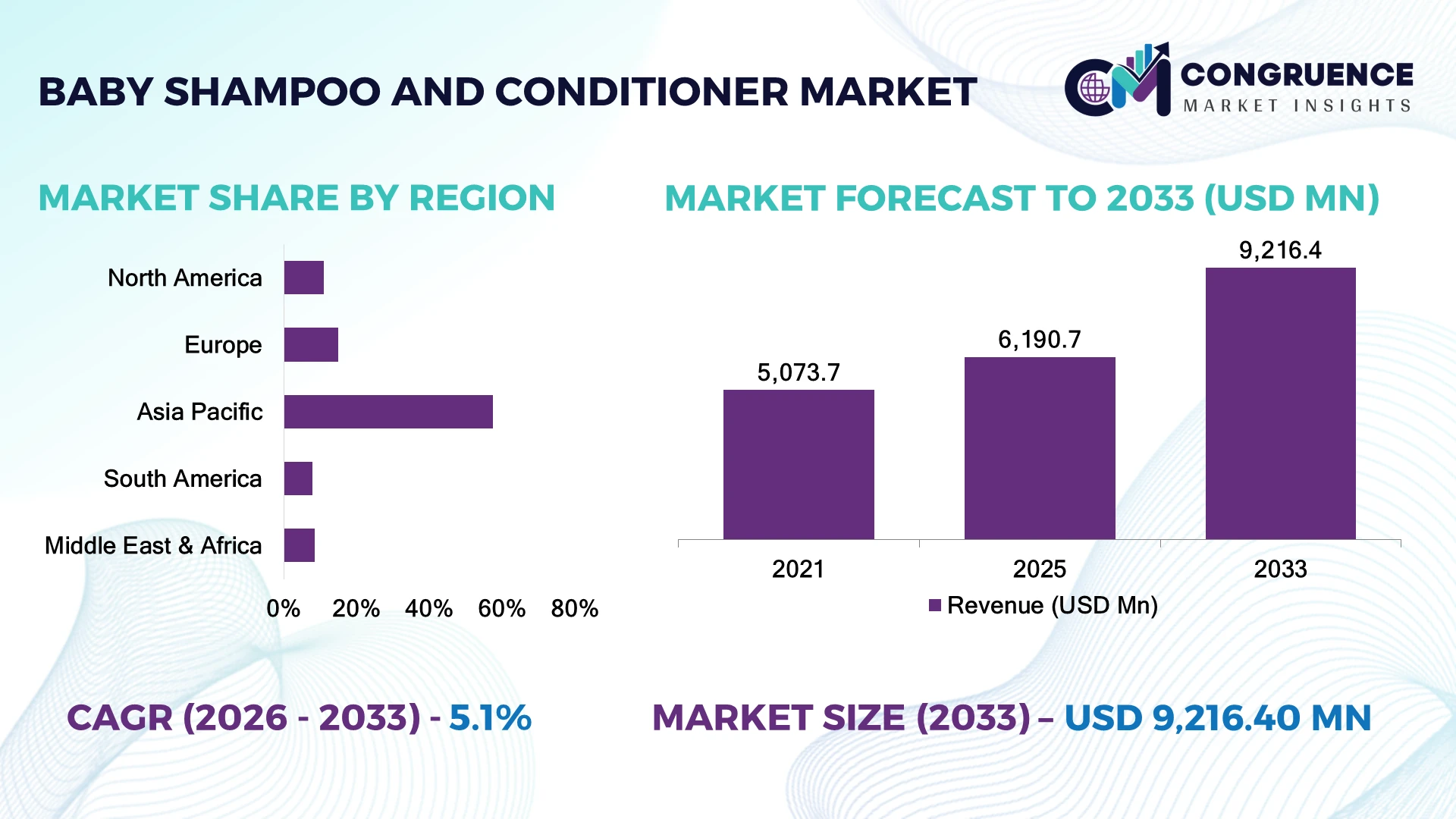
The Global Baby Shampoo and Conditioner Market was valued at USD 6,190.7 Million in 2025 and is anticipated to reach a value of USD 9,216.4 Million by 2033 expanding at a CAGR of 5.1% between 2026 and 2033. Growth is driven by demand for tear-free cleansing formulations, fragrance-free products for sensitive skin, pediatrician-tested personal care, and combined shampoo-conditioner products that simplify infant grooming.
The United States remains a key premium-market benchmark, supported by established baby-care brands, specialty retail, and e-commerce, while China offers significant scale through domestic manufacturing, urban retail networks, and digital commerce. India presents a contrasting opportunity, with a large young-consumer base and increasing access to organized baby-care products. For manufacturers, product safety, transparent ingredient disclosure, and channel-specific pricing remain central to market positioning.
Prioritize clinically supported formulations, resilient ingredient sourcing, and localized product portfolios to strengthen differentiation across mature and high-growth markets.
The Baby Shampoo and Conditioner Market is increasingly shaped by specialized cleansing products, premium sensitive-skin formulations, and convenient multi-benefit products. In China, online personal care sales grew 22.8% year over year in the 12 months through April 2025, underscoring the commercial importance of digital distribution, although this figure covers the broader category. Ingredient traceability and regulatory documentation are also becoming important operational priorities.
The Baby Shampoo and Conditioner Market is becoming strategically important as competition shifts from basic cleansing products toward differentiated formulations, trusted safety credentials, and higher-value product portfolios. Manufacturers must balance caregiver expectations for gentle ingredients with pricing discipline, regulatory compliance, and consistent product performance. Brand credibility and repeat purchasing increasingly depend on demonstrable product quality rather than broad claims alone.
Technology and supply-chain decisions will shape near-term competitiveness. Automated filling, in-line inspection, and digital batch traceability improve process control compared with manual inspection and fragmented records, although actual efficiency gains depend on plant configuration and production volumes. In the United States, the Modernization of Cosmetics Regulation Act framework strengthens facility-registration, product-listing, and safety-substantiation responsibilities. China presents a different competitive environment, where digital commerce and domestic brands accelerate product discovery and price competition.
Over the next 2–3 years, manufacturers should prioritize shorter product-development cycles, stable sourcing of surfactants and specialty ingredients, and packaging designs that reduce material use without compromising product protection. Practical deployment includes introducing fragrance-free baby shampoo through an established distribution network while validating formulation stability, packaging compatibility, and manufacturing consistency before expansion. Partnerships with ingredient suppliers, testing laboratories, and contract manufacturers can reduce execution risk.
Strategically, companies that combine validated formulations, reliable operations, and region-specific commercialization will be better positioned to defend margins and build durable consumer trust.
Demand for tear-free, fragrance-free, and dermatologically tested formulations is shifting competition toward specialized infant hair care. In the United States, approximately 1 in 10 children has atopic dermatitis, reinforcing the relevance of gentle cleansing products, although this condition does not directly measure shampoo demand. China's expanding digital retail ecosystem also improves product discovery and access to premium baby-care brands. As caregivers scrutinize ingredient lists, manufacturers are investing in mild surfactant systems, transparent labeling, and pediatric safety testing. The strategic advantage lies in converting formulation credibility into repeat purchasing rather than relying exclusively on brand awareness. Companies that substantiate sensitive-skin claims can strengthen premium positioning and reduce direct price comparisons.
Manufacturers face cost pressure from specialty surfactants, preservatives, fragrance-free formulation requirements, packaging materials, and product-safety validation. Even a 5–10% increase in key input costs can materially compress margins in mass-market products when retailers resist equivalent price adjustments; this is an illustrative sensitivity range, not a measured industry average. In the United States, the Modernization of Cosmetics Regulation Act adds facility-registration, product-listing, and safety-substantiation responsibilities for applicable businesses. Smaller producers often have less purchasing leverage and fewer in-house regulatory resources than multinational competitors. Companies are responding through dual sourcing, longer-term supplier agreements, standardized formulations, and consolidated procurement. A key operational insight is that ingredient substitution requires stability and mildness testing, so the lowest-cost input does not automatically produce the lowest total manufacturing cost.
India offers an opportunity to develop affordable, mild baby shampoos and conditioners for households entering organized infant personal care, while China's digital marketplaces provide established routes for differentiated product launches. India's internet user base exceeded 950 million in 2024, expanding the potential reach of online product education and direct-to-consumer campaigns; this figure represents the overall internet population, not baby-care shoppers. Manufacturers can use digital feedback, search behavior, and product reviews to identify demand for tear-free, low-fragrance, and combination cleansing products. Investment in localized pack sizes, vernacular ingredient communication, and contract manufacturing can improve market access without requiring immediate large-scale plant expansion. The less obvious opportunity is using online conversion and repeat-purchase data to optimize physical retail distribution and reduce assortment mismatches.
Scaling baby shampoo and conditioner portfolios requires consistent control of pH, viscosity, preservative efficacy, microbial quality, and packaging compatibility across production batches. A 1% batch rejection rate would mean 10,000 rejected units per million produced, illustrating how small quality deviations create substantial operational exposure; this is a hypothetical calculation, not an industry benchmark. In India and China, manufacturers supplying multiple channels must also manage different packaging formats, price points, and documentation requirements. New formulations and contract-manufacturing partnerships increase coordination demands when specifications are not standardized. Companies need validated manufacturing procedures, risk-based microbiological testing, supplier qualification, and digital batch records. The strategic challenge is maintaining identical safety and performance standards while adapting formulations and pack formats to local consumer requirements.
Baby shampoo represents the leading product type, accounting for an estimated 62–63% of the global Baby Shampoo and Conditioner Market in 2025. Its dominance reflects routine-use frequency, broad household applicability, established retail distribution, and relatively accessible pricing. Standalone baby conditioners serve a narrower need, particularly for detangling and improving manageability, while 2-in-1 shampoo and conditioner products appeal to caregivers prioritizing convenience. Other baby hair-cleansing formats remain niche. Manufacturers are concentrating investment on mild surfactant systems, tear-free performance, and packaging that supports accurate dispensing. The commercial advantage of shampoo lies in repeat-purchase frequency, whereas conditioners offer opportunities for higher-value product extensions without replacing essential cleansing products.
Baby conditioner is an important emerging product type, with demand strengthening as caregivers distinguish cleansing from conditioning needs. An indicative planning assumption is that conditioner adoption could increase by 3–5 percentage points in selected premium portfolios over the next several years; this is a scenario rather than a verified global forecast. In mature markets, specialized formulations and established brands support product differentiation, while emerging markets favor affordable shampoo formats and multipurpose products. Companies are responding through age-appropriate formulations, targeted product bundles, and differentiated pack sizes. Investment priorities increasingly center on expanding conditioner penetration without unnecessarily fragmenting product portfolios or weakening the value proposition of core shampoo ranges.
Routine hair cleansing and hygiene represent the leading application, accounting for an estimated 55–60% of global demand. Frequent bathing routines, broad household applicability, and established purchasing habits sustain this segment across mature and emerging markets. Scalp care, moisturizing, and detangling applications address more specialized needs, including dryness, flaky scalp, and hair manageability. Convenience-oriented applications, including multifunctional cleansing and conditioning products, appeal to caregivers seeking simpler bathing routines. Manufacturers are responding with mild surfactant systems, moisturizing ingredients, and targeted formulations. The strategic distinction is that routine cleansing supports recurring volume, while specialized applications create differentiation and opportunities for premium product positioning.
Specialized scalp care and detangling applications offer an emerging growth opportunity as product portfolios increasingly address differences in hair texture, age, and conditioning requirements. An indicative commercial planning scenario assumes specialized applications could increase their combined portfolio penetration by 3–5 percentage points in targeted premium channels; this is not a measured global forecast. Mature markets emphasize specialized formulations and transparent product claims, while emerging markets prioritize affordability and multipurpose use. Companies are refining formulations, expanding targeted product ranges, and using consumer feedback to guide development. Demand is becoming more function-specific, making it important to substantiate performance claims while maintaining infant-appropriate safety and product simplicity.
Households and individual caregivers represent the dominant end-user group, accounting for an estimated 80–85% of global demand. Their purchasing concentration reflects recurring bathing routines, direct control over product selection, and broad access to supermarkets, pharmacies, specialty baby stores, and online marketplaces. Hospitals and maternity-care facilities represent a smaller, specialized segment in which procurement emphasizes documented product safety, hygiene procedures, and suitability for newborn care. Daycare centers, nurseries, and childcare facilities purchase products according to operational requirements, budget constraints, and usage frequency. Companies are targeting household buyers through multipacks, accessible price tiers, sensitive-skin formulations, and online replenishment programs. Institutional suppliers emphasize standardized specifications and dependable deliveries.
Childcare facilities and institutional buyers offer opportunities for structured procurement, although their combined share remains substantially below household demand. An indicative planning scenario assumes institutional and childcare purchasing could expand its share by 2–3 percentage points in selected organized markets as professional childcare services develop; this is not a verified global forecast. Established markets favor trusted suppliers and documented quality, whereas emerging markets present opportunities for affordable products and wider distribution. Companies are adapting through distributor partnerships, appropriate bulk-pack formats, and channel-specific pricing. Future demand will continue to depend primarily on household purchasing, while institutional relationships can provide additional volume and more predictable procurement where organized childcare infrastructure is established.
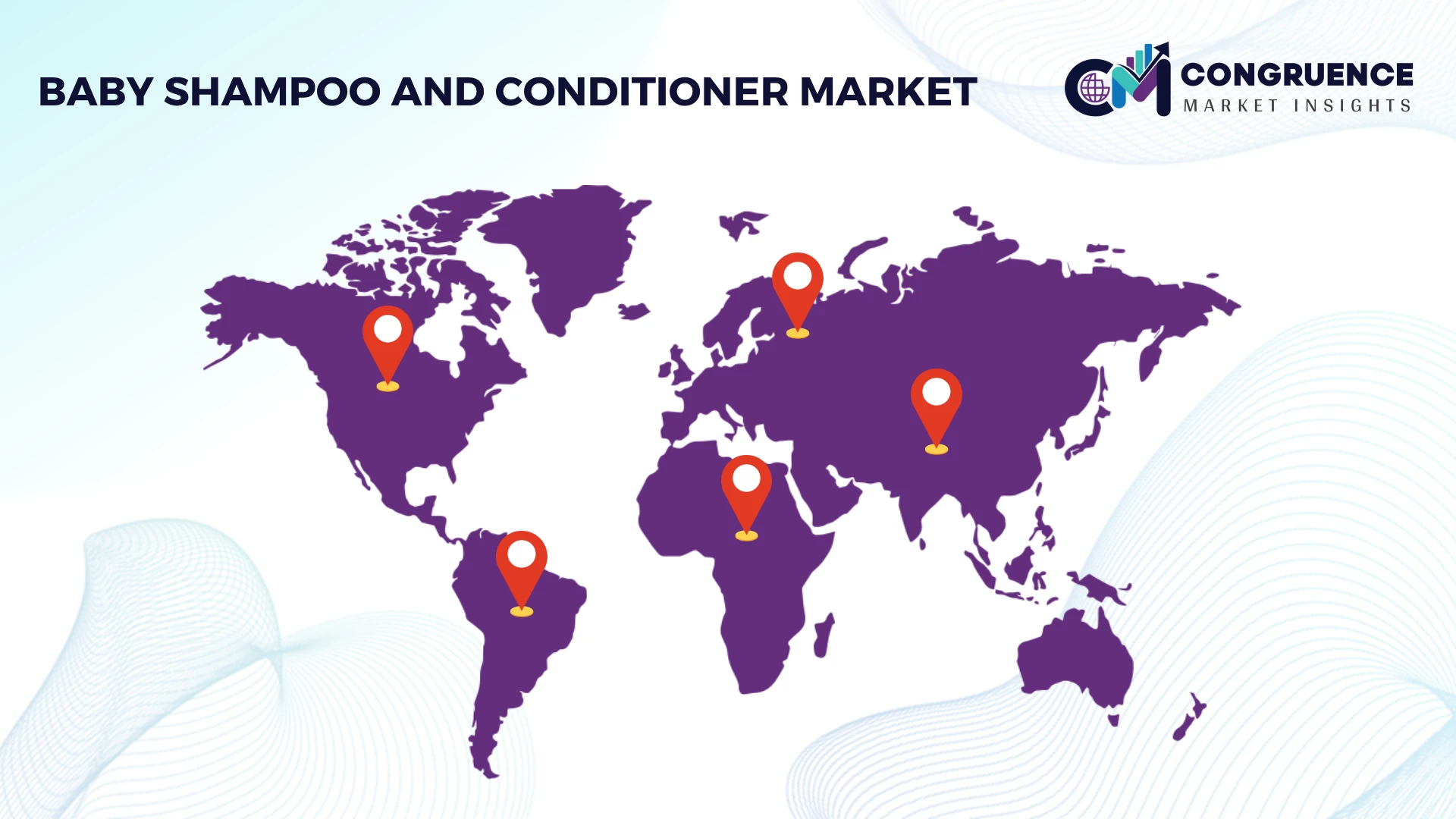
Asia-Pacific accounted for the largest market share at approximately 57.4% in 2025; however, Asia-Pacific is expected to register the fastest growth, expanding at a CAGR of approximately 5.7% between 2026 and 2033.
Premium Formulations and Product Safety Drive Market Differentiation
North America represents an estimated 11% of global demand, with the United States accounting for the majority of regional consumption. Market development is shaped by premium infant personal care, dermatologically tested formulations, fragrance-free products, and established pharmacy and supermarket distribution. Manufacturers are investing in formulation validation, automated filling, and digital inventory planning to maintain product consistency across retail and online channels. The US Modernization of Cosmetics Regulation Act has increased the importance of safety substantiation, facility registration, and product traceability. Rather than competing exclusively on cleansing performance, established brands are strengthening differentiation through ingredient transparency and specialized scalp-care formulations. Companies that combine documented product quality with efficient omnichannel distribution are better positioned to defend premium pricing and repeat purchases.
United States Market Outlook: The United States leads North American demand through established baby-care brands, advanced contract manufacturing, extensive retail coverage, and strong consumer recognition of specialized infant formulations. Its cosmetics regulatory framework reinforces the importance of documented safety assessments and manufacturing controls. Companies are expanding fragrance-free, hypoallergenic, and sensitive-skin product lines while using e-commerce analytics to improve assortment planning. Investment in packaging compatibility testing and automated quality inspection supports consistent product delivery across large retail networks.
Ingredient Transparency and Sustainable Packaging Reshape Competition
Europe accounts for an estimated 15% of global demand, supported by established personal-care manufacturers and consumer preference for gentle, clearly documented formulations. Germany, France, and the United Kingdom are important markets for premium infant hygiene products, including natural-positioned and dermatologically tested offerings. The EU Cosmetics Regulation requires responsible-person oversight, safety assessment, and product information documentation before products enter the market. Packaging sustainability is also becoming more commercially relevant as EU packaging rules move toward greater recyclability and waste reduction. Manufacturers are reviewing bottle materials, ingredient declarations, and packaging formats to reduce compliance friction across multiple national markets. Product launches increasingly require coordinated formulation, regulatory, and packaging decisions rather than isolated marketing changes.
Germany Market Outlook: Germany offers a strong base for baby-care products through established chemical and personal-care manufacturing capabilities, quality-focused retailers, and mature consumer-protection systems. Manufacturers serving this market must align product safety documentation with EU requirements while responding to demand for transparent ingredients and responsible packaging. Investments in recyclable container designs, packaging-material validation, and reliable supplier qualification can improve compliance readiness and strengthen retailer relationships without compromising infant-product safety.
Manufacturing Scale and Digital Retail Strengthen Market Leadership
Asia-Pacific accounts for approximately 57.4% of the global market, supported by extensive household demand, established regional manufacturers, and expanding access to branded infant personal-care products. China, India, Japan, and South Korea contribute through different competitive strengths, ranging from manufacturing scale and digital distribution to premium formulation development. China recorded 9.54 million births in 2024, underscoring the importance of value-added product differentiation as demographic growth moderates. India offers a contrasting opportunity through expanding organized retail, pharmacy access, and online product discovery. Manufacturers are adapting pack sizes, price tiers, and ingredient positioning to local purchasing behavior. The strategic priority is to combine cost-efficient production with localized portfolios instead of applying a single premium-product strategy across diverse markets.
China Market Outlook: China remains a strategically important market because of its large consumer base, domestic personal-care manufacturing capabilities, and sophisticated e-commerce ecosystem. Urban retail networks and cross-border commerce support the distribution of both domestic and international baby-care brands. Companies are strengthening digital product education, improving online assortment management, and differentiating formulations through mild surfactants and moisture-supporting ingredients. With 67% of China's population living in urban areas at the end of 2024, concentrated urban distribution networks offer operational advantages for product launches and replenishment planning.
Accessible Premiumization Expands Organized Baby-Care Demand
South America represents an estimated 8% of global demand, with Brazil serving as the principal market because of its population scale, established personal-care industry, and extensive pharmacy and supermarket networks. Argentina, Chile, and Colombia contribute through organized retail and demand for trusted infant hygiene brands. Market expansion depends on balancing formulation quality with affordability, particularly where currency fluctuations and imported ingredient costs affect shelf pricing. Manufacturers are responding through locally sourced packaging, regional distribution partnerships, and differentiated entry-level and premium product ranges. E-commerce improves access to specialized formulations beyond major urban centers, but uneven purchasing power and logistics costs complicate nationwide distribution. Companies that align local production and procurement with channel-specific pricing can improve availability without relying on persistent discounting.
Brazil Market Outlook: Brazil provides the strongest commercial platform in South America through established cosmetics manufacturing, extensive retail distribution, and a developed consumer personal-care market. Local production and contract manufacturing can help companies manage import exposure and adapt packaging to domestic price points. Brazil's cosmetics regulatory framework requires appropriate product classification, compliance, and documentation, making regulatory planning essential for new launches. Companies are prioritizing accessible pack sizes, pharmacy partnerships, and digital retail visibility to strengthen penetration while maintaining consistent product-quality standards.
Modern Retail Expansion Supports Branded Infant Care
The Middle East and Africa account for an estimated 9% of global demand, with Saudi Arabia, the United Arab Emirates, and South Africa serving as important commercial hubs. Demand is supported by organized retail, pharmacy networks, urban household purchasing, and access to international personal-care brands. Gulf markets offer opportunities for premium formulations, while several African markets prioritize affordability and dependable product availability. Manufacturers must manage import dependence, currency exposure, varied regulatory requirements, and differences in distribution infrastructure. Regional distributors and local manufacturing partners help improve replenishment and reduce dependence on long international supply routes. Companies that tailor pack sizes and pricing to local purchasing power can expand access while protecting margins and maintaining product consistency.
Saudi Arabia Market Outlook: Saudi Arabia offers a strategically relevant market through modern retail infrastructure, pharmacy distribution, and investment in domestic manufacturing under broader industrial diversification initiatives. Companies can strengthen market access through regional distribution agreements, locally adapted packaging, and compliance with applicable Saudi product-registration and cosmetics requirements. Retail concentration in major urban centers supports targeted product launches and replenishment planning. Manufacturers that establish dependable distributor relationships and maintain clear ingredient documentation can improve competitiveness across premium and mass-market infant-care categories.
The market pits global leaders Kenvue, Procter & Gamble, and Unilever against specialized brands including Mustela, Himalaya Wellness, and Pigeon. Global players compete through distribution scale, brand trust, and research capabilities, while specialist manufacturers differentiate through sensitive-skin formulations, natural ingredients, and targeted scalp care. The market remains fragmented, with the top five players estimated to hold approximately 25–35% combined share; this is an indicative estimate requiring validation. Competition centers on formulation credibility, shelf visibility, pricing, and packaging innovation. A 5–10% reduction in packaging material can lower resin consumption proportionately, while a 5% improvement in forecast accuracy can reduce inventory mismatches; both are operational targets, not measured industry averages. Kenvue is advancing refillable packaging, while P&G is exploring water-activated haircare formats. Regulatory documentation raises entry costs for smaller brands. Winning requires substantiated safety claims, reliable sourcing, efficient manufacturing, and differentiated products at competitive prices.
Formulation technology remains the principal differentiator, with manufacturers refining mild surfactant blends, pH control, preservative systems, and conditioning polymers to balance cleansing performance with infant skin and scalp compatibility. Instrumental stability testing, microbial challenge testing, and automated batch monitoring strengthen quality assurance compared with manual sampling alone. A 10–15% reduction in batch-release time is a potential operational target for digitally integrated facilities, not an established industry-wide result. Larger manufacturers benefit from established laboratories, while specialist brands use contract testing and formulation partnerships to accelerate product development.
Packaging technology is advancing through refillable pouches, mono-material structures, lightweight bottles, and post-consumer recycled plastics. Kenvue has reported refillable Johnson's Baby shampoo and bath-product pouches in Latin America, illustrating how packaging redesign can reduce reliance on conventional rigid containers. A 10–20% reduction in packaging material is a possible design target, subject to package specifications and product-protection testing. Compared with conventional multilayer packaging, compatible mono-material designs can simplify recycling streams, although local collection infrastructure determines actual recovery.
From 2026 to 2028, digital quality records, automated inspection, and data-assisted formulation screening will strengthen manufacturing consistency and development efficiency. P&G's November 2025 introduction of Gemz, a water-activated haircare format developed after 14 years of research, signals innovation beyond conventional liquid bottles, although it is not a baby-care product. Adoption remains uneven, with no reliable market-wide deployment percentage available. Companies combining validated formulations, packaging engineering, and scalable production will gain an advantage in premium positioning and regulatory readiness.
The report evaluates the global Baby Shampoo and Conditioner Market across product types, including baby shampoo, baby conditioner, and multifunctional cleansing formats; applications covering routine cleansing, scalp care, moisturizing, and detangling; and end-users comprising households, hospitals, maternity facilities, and childcare centers. Geographic coverage spans North America, Europe, Asia-Pacific, South America, and the Middle East and Africa, with country-level analysis of demand concentration, distribution infrastructure, manufacturing capabilities, and regulatory requirements.
Additional coverage examines mild surfactant systems, pH-balanced formulations, preservative technologies, automated quality control, refillable packaging, and recyclable materials. Competitive analysis profiles 14 market participants and evaluates product differentiation, distribution strategies, sourcing, and innovation priorities. The report supports investment planning, market-entry assessment, product portfolio development, pricing decisions, and expansion strategy for 2026–2033. Segment estimates and company positioning help decision-makers distinguish established demand pools from emerging opportunities in specialized infant hair care.
| Report Attribute/Metric | Report Details |
|---|---|
|
Market Revenue in 2025 |
USD 6,190.7 Million |
|
Market Revenue in 2033 |
USD 9,216.4 Million |
|
CAGR (2026 - 2033) |
5.1% |
|
Base Year |
2025 |
|
Forecast Period |
2026 - 2033 |
|
Historic Period |
2021 - 2025 |
|
Segments Covered |
By Type
By Application
By End-User
|
|
Key Report Deliverable |
Revenue Forecast, Growth Trends, Market Dynamics, Segmental Overview, Regional and Country-wise Analysis, Competition Landscape |
|
Region Covered |
North America, Europe, Asia-Pacific, South America, Middle East, Africa |
|
Key Players Analyzed |
Kenvue Inc., Procter & Gamble, Unilever PLC, Beiersdorf AG, Himalaya Wellness Company, Pigeon Corporation, Laboratoires Expanscience (Mustela), The Honest Company, Inc., Weleda AG, Sebapharma GmbH & Co. KG, Artsana S.p.A. (Chicco), Mothercare plc, California Baby |
|
Customization & Pricing |
Available on Request (10% Customization is Free) |




