
Reports
The Global Baby Safety Products Market was valued at USD 20,206.3 Million in 2025 and is anticipated to reach a value of USD 30,776.0 Million by 2033 expanding at a CAGR of 5.4% between 2026 and 2033. Growth is driven by stricter child-product safety standards, rising adoption of connected monitoring devices, demand for multifunctional home-safety products, and replacement of low-compliance products sold through fragmented online channels.
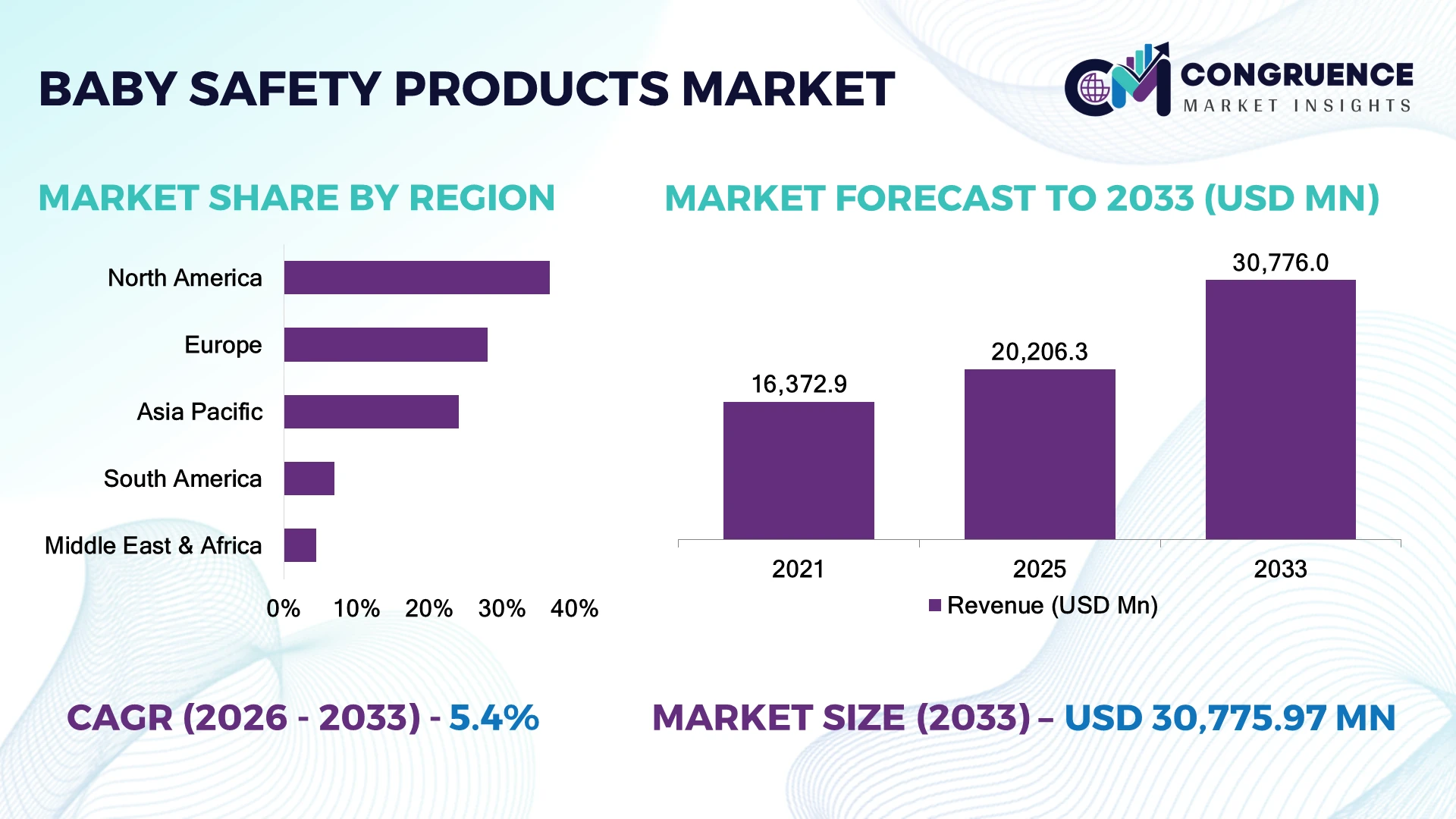
The United States represents the dominant commercial market, accounting for an estimated 34% of global demand, supported by established specialty retail, e-commerce, and stringent product testing. China remains the major manufacturing base, supplying a substantial share of gates, monitors, locks, and nursery accessories, while India is expanding as an alternative production location. In 2025, U.S. regulators recalled approximately 1,800 imported safety gates for entrapment and structural-compliance failures, reinforcing the commercial impact of certification and traceability.
Strategically, manufacturers should prioritize certified designs, traceable components, connected functionality, and diversified Asian sourcing to protect market access and reduce compliance-driven disruption.
Market Size & Growth: USD 20.21 billion in 2025 to USD 30.78 billion by 2033 at 5.4% CAGR, supported by stricter safety engineering and connected monitoring adoption.
Top Growth Drivers: Safety gates ~24%, baby monitors ~21%, and outlet and cabinet protection ~18% represent major demand contributors.
Short-Term Forecast: By 2028, automated monitoring and connected alerts can reduce manual safety-check activity by approximately 15–25%, while smart-device integration improves response visibility.
Emerging Technologies: AI-enabled baby monitors, connected temperature and movement sensors, smart locks, and tamper-resistant safety systems are strengthening premium product differentiation.
Regional Leaders: North America approaches USD 10.0 billion, Asia Pacific USD 8.5 billion, and Europe USD 6.5 billion by 2033, with connected and digitally distributed products gaining adoption.
Consumer/End-User Trends: Approximately 30–35% of premium buyers increasingly combine physical safety products with electronic monitoring, creating demand for integrated home-protection ecosystems.
Pilot/Case Example: 2026 connected-monitoring deployments target 15–20% reductions in manual checking activity through motion alerts, temperature monitoring, and real-time mobile notifications.
Competitive Landscape: Dorel Industries holds a leading branded position, competing with Newell Brands, Munchkin, Goodbaby, and Angelcare across gates, monitors, locks, nursery accessories, and connected safety products.
Regulatory & ESG Impact: U.S. durable infant-product requirements mandate certification for applicable products, while standardized testing can add approximately 3–7% to development costs but reduces compliance and recall exposure.
Investment & Funding: More than USD 500 million in cumulative product development, manufacturing expansion, connected-device integration, and safety-technology investment is supporting category modernization and supply-chain diversification.
Innovation & Future Outlook: Next-generation products are shifting toward AI-assisted monitoring, app-connected safety ecosystems, sustainable materials, tool-free installation, and predictive hazard detection.
The Baby Safety Products Market spans safety gates, cabinet and drawer locks, outlet covers, corner guards, baby monitors, bed rails, bath safety products, and home-proofing accessories. Connected monitoring represents approximately 30–35% of premium-category interest, while 2026 recalls of non-compliant safety gates are increasing retailer emphasis on certification and traceability. Manufacturers are therefore prioritizing integrated safety ecosystems and verified components, setting the foundation for strategic competition.
Baby safety products are becoming strategically important as regulatory compliance, connected monitoring, and product traceability increasingly determine retailer access and brand credibility. The category is shifting from individual protective accessories toward integrated home-safety ecosystems combining physical barriers, environmental sensors, cameras, alerts, and mobile controls. This transformation increases technology content while raising the importance of cybersecurity, software reliability, and component traceability.
Smart monitoring can reduce manual checking activity by approximately 15–25% compared with conventional periodic observation, while automated alerts provide continuous visibility. North America remains the strongest premium market because of stringent compliance and advanced e-commerce infrastructure, whereas China provides manufacturing scale and component availability. Europe places greater emphasis on material safety, durability, and product traceability.
During 2026–2028, manufacturers will increasingly integrate sensors with gates, monitors, locks, and nursery devices. A practical deployment model combines a connected baby monitor with temperature and movement alerts, allowing caregivers to manage multiple safety parameters through one interface. Companies are therefore increasing investment in electronics partnerships, software integration, supplier qualification, and regional inventory. The strongest competitive position will belong to manufacturers that combine certified physical protection with dependable connected technology, transparent sourcing, and rapid compliance response.
Connected monitoring is becoming a major growth catalyst, with approximately 30–35% of premium baby-safety buyers combining electronic monitoring with physical protection products. AI-enabled cameras, movement detection, temperature sensors, and mobile alerts can reduce manual checking activity by 15–25% while providing continuous visibility. In the United States, manufacturers are shifting from standalone monitors toward integrated nursery ecosystems following rapid adoption of connected-home devices. Companies are investing in sensor platforms, mobile applications, and electronics partnerships to strengthen product differentiation. The non-obvious advantage is cross-category bundling: brands can connect monitors with locks, gates, and environmental sensors, increasing accessory attachment rates while creating a stronger ecosystem-based competitive position.
Regulatory testing, certification, and material requirements create significant cost pressure, particularly for products combining mechanical and electronic components. Safety validation can add approximately 3–7% to development costs, while connected products can allocate 15–25% of bill-of-materials value to electronics and sensing components. U.S. recalls of non-compliant gates and nursery products demonstrate the commercial consequences of inadequate testing. Manufacturers are responding through dual-source qualification, standardized components, localized final assembly, and earlier compliance testing. The strategic pressure extends beyond manufacturing cost: changing a certified component late in development can trigger additional validation and delay launches by 5–10%. Pre-approved component libraries therefore provide a measurable competitive advantage.
AI-enabled hazard detection represents a high-value opportunity as manufacturers move beyond passive barriers toward predictive nursery protection. Advanced monitoring systems can identify movement, environmental changes, or unusual activity, potentially reducing manual observation requirements by 15–25%. Connected products currently represent approximately 30–35% of premium-category interest, leaving substantial room for deeper integration. U.S. and European brands are partnering with sensor, software, and electronics specialists rather than building complete technology stacks internally. A non-obvious opportunity is retrofit compatibility: standardized mounts and communication modules can add smart capabilities to existing monitors, gates, or nursery equipment. Companies investing in interoperable platforms can create recurring accessory and software opportunities while reducing hardware redesign cycles.
The transition toward connected baby safety introduces execution risks around cybersecurity, interoperability, sensor reliability, and long-term software support. Electronics can represent approximately 15–25% of advanced product bill-of-materials, while software integration can extend development schedules by 10–20%. In the United States and Europe, connected products must also maintain electrical, wireless, and child-product safety requirements simultaneously. Manufacturers are implementing encrypted communications, third-party security testing, standardized connectivity modules, and controlled firmware updates. The critical challenge is maintaining dependable protection when multiple devices interact: a connectivity failure must not compromise core physical safety functions. Companies therefore need redundant controls, long-term software support plans, and rigorous interoperability testing before scaling connected product ecosystems.
Smart Monitoring Moves Beyond Cameras: Approximately 30–35% of premium buyers now show interest in connected safety ecosystems, while movement and temperature alerts can reduce manual checking by 15–25%. Manufacturers are integrating environmental sensors and mobile notifications alongside video monitoring, shifting product value from surveillance hardware toward continuous nursery-condition management.
Certification Enters Procurement Earlier: Recent product recalls are pushing retailers and manufacturers to complete safety validation earlier in development cycles. Compliance testing can represent 3–7% of development expenditure, while pre-qualified components can shorten redesign-related delays by approximately 5–10%. Companies are expanding supplier audits and maintaining approved component libraries to protect launch schedules.
Physical Products Become Modular: Gates, locks, corner guards, and cabinet systems increasingly use standardized mounting and adjustment mechanisms. Modular architectures can reduce selected hardware variation by 10–15%, simplifying replacement-part inventories and installation. Manufacturers are responding with compatible product families, creating cross-selling opportunities while reducing the need to engineer completely separate mechanisms for each safety application.
Supply Chains Shift Toward Resilience: U.S.–China trade tensions and electronics volatility are encouraging manufacturers to qualify suppliers across India, Vietnam, Mexico, and other production hubs. Dual sourcing can reduce single-country component exposure by approximately 15–25%. Companies are also increasing regional inventory buffers and localized final assembly, prioritizing continuity for safety-critical products where stockouts can immediately affect retailer relationships.
Safety gates represent the leading Baby Safety Products segment with an estimated 24% share, supported by broad household applicability, relatively simple installation, and repeat demand as children move between developmental stages. Cabinet and drawer locks account for approximately 18%, while baby monitors contribute around 21%, reflecting the mature importance of both physical and electronic protection. Outlet covers, corner guards, bed rails, and bath-safety products collectively address narrower but essential hazard categories.
Baby monitors are the fastest-growing type, driven by movement detection, temperature sensing, two-way communication, and mobile alerts. Connected monitoring penetration within premium safety portfolios is approximately 30–35%, compared with much lower adoption of basic analog devices. Manufacturers are investing in AI-enabled detection, sensor integration, and interoperable platforms, while physical-safety brands are adding connected accessories. The strategic shift is toward integrated protection ecosystems rather than isolated products, favoring companies capable of combining certified hardware with dependable digital functionality.
Residential applications account for approximately 82% of Baby Safety Products demand, reflecting widespread use of gates, cabinet locks, outlet covers, monitors, corner guards, and bath-safety equipment within household environments. The fragmented nature of home layouts supports demand for multiple product categories per household rather than a single safety device. Commercial applications represent roughly 18%, covering childcare centers, hotels, healthcare settings, and other environments requiring higher durability and documented compliance.
Childcare and hospitality applications are the fastest-growing niche, supported by increased emphasis on controlled access, monitoring, and standardized safety procedures. Commercial installations can require approximately 20–30% greater product quantities per location than typical household deployments, particularly for gates and outlet protection. Manufacturers are responding with bulk packaging, reinforced construction, institutional warranties, and distributor partnerships. The business implication is a clear segmentation between design-led residential products and specification-driven institutional systems, with commercial buyers placing greater weight on lifecycle cost and replacement availability.
Households represent approximately 84% of Baby Safety Products purchases, making parents and caregivers the dominant end-user group. Purchasing decisions increasingly combine physical protection with monitoring capabilities, with approximately 30–35% of premium households showing interest in connected safety features. Parents prioritize easy installation, adjustability, non-toxic materials, and compatibility across different rooms. Institutional users account for approximately 16%, including childcare facilities, hospitality operators, and healthcare environments where durability and standardized deployment matter more than decorative design.
Childcare centers represent the fastest-growing institutional group because multiple rooms and children increase equipment intensity and replacement requirements. Institutional deployments can involve approximately 2–3 times the product volume of a typical household installation. Manufacturers are developing B2B catalogs, volume pricing, reinforced product variants, and replacement-part programs, while consumer brands are using distributor partnerships to access institutional procurement. The competitive opportunity lies in maintaining one certified product architecture while offering different installation, warranty, packaging, and service models for household and institutional buyers.
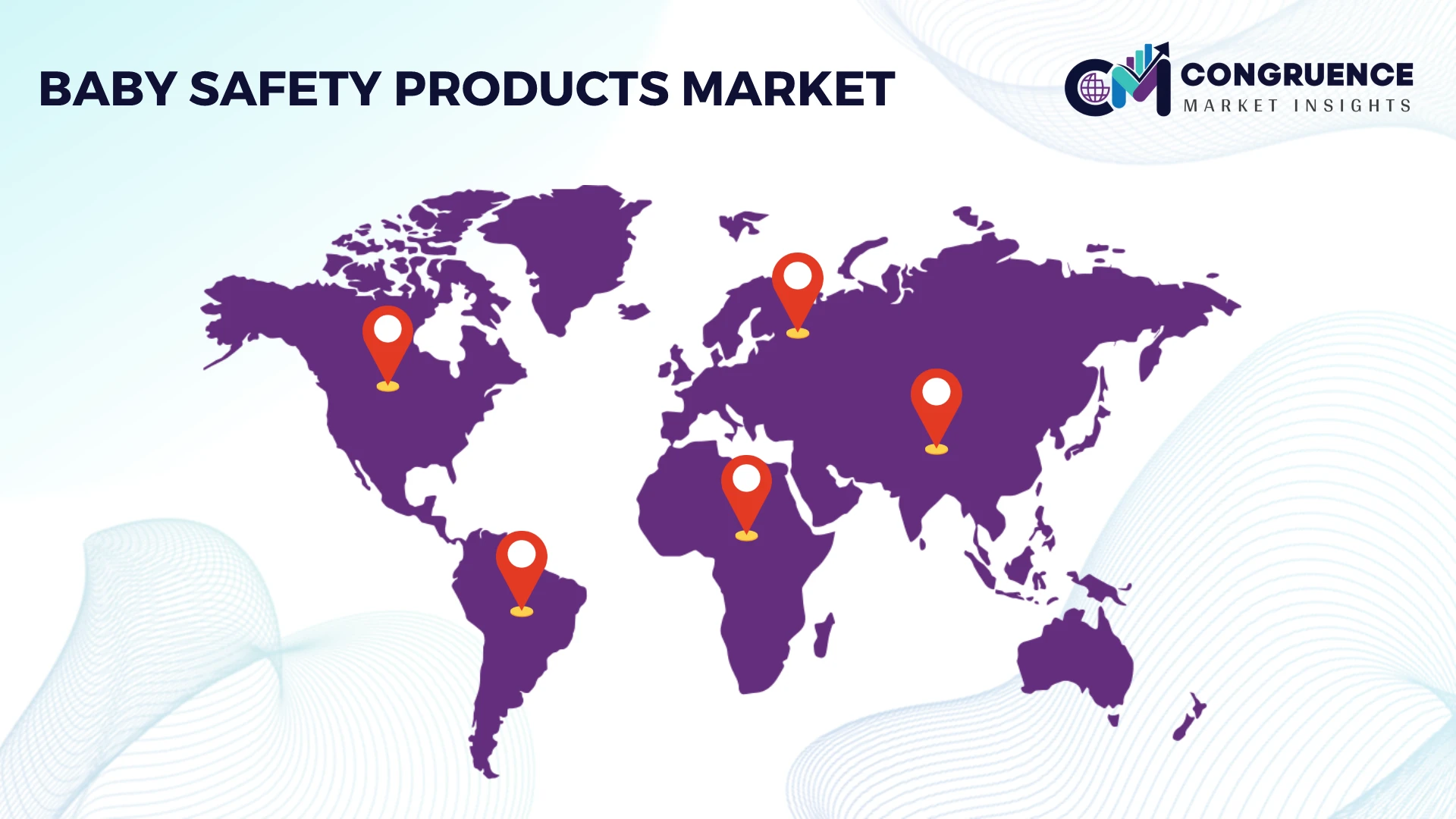
North America accounted for the largest market share at approximately 36.5% in 2025 however, Asia-Pacific is expected to register the fastest growth, expanding at a CAGR of 6.6% between 2026 and 2033.
Connected protection and compliance reshape premium demand
North America represents approximately 36.5% of global Baby Safety Products demand, led by the United States, where established specialty retail, e-commerce, and stringent product-safety requirements support category depth. Baby monitors, safety gates, cabinet locks, and outlet protection form the core product base, while connected monitoring is increasingly incorporated into premium portfolios. Approximately 30–35% of premium buyers show interest in integrated electronic safety features. U.S. manufacturers are strengthening supplier audits and certification workflows following recalls involving non-compliant nursery products. Companies are also diversifying selected electronics and plastic-component sourcing toward Mexico and Southeast Asia, targeting 15–25% lower single-country procurement exposure while maintaining regional distribution capabilities.
U.S. Market Outlook: The United States remains the region's principal consumption and innovation hub, supported by mature testing infrastructure and sophisticated online distribution. Connected monitors and sensor-enabled nursery products are gaining traction, while safety gates and home-proofing products remain high-volume categories. Manufacturers increasingly combine certified physical protection with mobile alerts and environmental sensing to strengthen premium differentiation.
Safety regulation drives material and product redesign
Europe accounts for approximately 28% of global Baby Safety Products demand, with Germany, the United Kingdom, France, and Italy representing major consumption markets. Product development increasingly emphasizes chemical safety, durability, recyclable materials, and traceable components. Approximately 20–25% of premium product specifications increasingly incorporate sustainability or material-transparency requirements. European retailers are also tightening supplier documentation and compliance screening, encouraging manufacturers to standardize approved materials and components. Companies are investing in modular product architectures that simplify repairs, replacement parts, and future compliance modifications while reducing dependence on single-use product designs.
Germany Market Outlook: Germany combines strong consumer-product engineering with demanding expectations for safety, durability, and material quality. Premium manufacturers increasingly use certified materials, tool-free installation systems, and modular components. Connected monitoring is also gaining relevance, particularly among premium nursery-product portfolios. Localized supplier qualification enables manufacturers to maintain consistent specifications while responding faster to changing European product-safety and sustainability requirements.
Manufacturing scale accelerates connected safety adoption
Asia-Pacific represents approximately 24% of global Baby Safety Products demand while serving as the principal manufacturing base for gates, monitors, locks, outlet protectors, and nursery accessories. China remains the largest production hub, supported by integrated plastics, electronics, molding, packaging, and assembly capabilities. Vietnam and India are gaining importance as complementary sourcing locations amid supply-chain diversification. Export-oriented factories increasingly deploy automated molding, CNC processes, and digital inspection, improving production consistency by approximately 3–5%. Chinese manufacturers are also expanding connected monitor portfolios for domestic e-commerce channels, combining competitive pricing with increasingly sophisticated sensor functionality.
China Market Outlook: China remains the strongest manufacturing center because of its integrated electronics and consumer-product supply chain. Large producers increasingly combine cameras, motion sensors, temperature monitoring, and mobile connectivity within compact nursery devices. Standardized electronic modules can reduce component complexity by approximately 10–15% across product families, allowing manufacturers to create multiple price tiers while accelerating product refresh cycles.
Brazilian retail expansion strengthens household safety adoption
South America represents approximately 7% of global Baby Safety Products demand, with Brazil accounting for the largest share of regional consumption. Demand centers on safety gates, cabinet locks, outlet protection, bed rails, and affordable monitoring devices, while e-commerce is expanding access beyond major metropolitan markets. Imported electronics and specialized plastic components remain exposed to currency and freight volatility. Brazilian distributors are therefore increasing domestic sourcing of basic mechanical components and consolidating supplier relationships. Localized procurement can reduce selected landed-cost exposure by approximately 8–12%. Manufacturers with adaptable packaging, voltage-compatible electronics, and broad distributor coverage are better positioned to scale across fragmented national markets.
Brazil Market Outlook: Brazil provides the strongest commercial platform in South America because of its large consumer base, established retail networks, and growing digital-commerce infrastructure. Approximately 35–40% of regional category demand is concentrated in Brazil. Manufacturers are increasingly combining locally sourced mechanical products with imported monitoring technology, creating cost-effective portfolios spanning entry-level home protection and connected premium products.
Premium retail infrastructure expands connected safety penetration
Middle East & Africa represents approximately 5% of global Baby Safety Products demand, with Saudi Arabia, the UAE, South Africa, and Egypt forming key commercial markets. Gulf economies show stronger penetration of premium imported nursery products through modern retail and e-commerce channels. Connected monitors, safety gates, cabinet locks, and home-proofing accessories are increasingly sold through specialized baby-care and online platforms. Premium connected products can command approximately 15–25% higher pricing when monitoring, environmental sensing, and mobile alerts are integrated. Distributors are expanding regional inventory buffers to manage import dependence and reduce replenishment delays.
Saudi Arabia Market Outlook: Saudi Arabia represents the region's strongest strategic market, supported by modern retail, high e-commerce usage, and expanding family-oriented hospitality infrastructure. Premium baby monitors and home-safety products benefit from demand for connected household technology. Regional distributors increasingly maintain localized inventory, targeting approximately 15–25% shorter replenishment cycles while expanding partnerships with European, North American, and Asian manufacturers.
Dorel Juvenile, Goodbaby, Munchkin, Angelcare, and Owlet compete across physical childproofing, nursery equipment, and connected monitoring, with established safety brands competing against technology-led specialists. The top five players collectively hold approximately 34% of global demand. Premium connected products command 15–25% higher pricing, while AI-enabled monitoring can reduce manual checking activity by 15–25%. Competition increasingly centers on certification, sensor accuracy, cybersecurity, supply reliability, and ecosystem integration. Dorel is strengthening safety-engineered product platforms, Goodbaby leverages manufacturing scale, while Owlet and Angelcare differentiate through connected monitoring. Chinese OEMs compete aggressively on cost and private-label flexibility, with some products priced 20–30% below premium branded alternatives. The competitive shift is toward integrated physical-digital safety ecosystems and tighter supply-chain control. Entry barriers include mandatory testing, certification, retailer qualification, electronics validation, and brand trust. Winning requires certified products, dependable connected technology, diversified sourcing, rapid compliance execution, and an integrated portfolio spanning everyday childproofing and advanced monitoring.
Current technology is moving beyond passive childproofing toward connected monitoring, sensor-enabled alerts, and digitally controlled nursery protection. AI-enabled cameras, motion detection, temperature sensing, and secure mobile connectivity can reduce manual checking activity by approximately 15–25%. Connected features currently appear in roughly 30–35% of premium safety-product portfolios. Owlet and Angelcare benefit from this shift through integrated monitoring ecosystems, while established physical-safety brands are adding electronic functionality through technology partnerships.
Emerging systems increasingly combine computer vision, cry analysis, environmental sensing, and cybersecurity controls. AI-assisted monitoring can improve event-detection efficiency by approximately 10–20%, while standardized wireless modules reduce selected integration complexity by 10–15%. Compared with conventional audio-only monitors, advanced video and sensor platforms provide substantially broader environmental visibility without requiring continuous caregiver observation. Premium technology-led brands gain differentiation, whereas established manufacturers benefit by integrating sensors into trusted physical-product portfolios.
Through 2026–2028, connected gates, smart locks, environmental sensors, and nursery monitors will increasingly operate as interoperable safety ecosystems. Secure cloud architecture and edge processing will become more important as product connectivity expands. Manufacturers investing early in standardized platforms can accelerate product launches by approximately 10–15% and reuse electronics across product families. The competitive advantage will favor companies combining certified physical protection, reliable sensing, cybersecurity, and scalable component architectures rather than treating connectivity as a standalone feature.
June 2025 Dorel Juvenile launched Safety 1st onBoard Slide DLX with a SafetySlide base extending nearly 8 inches. The design improves infant loading access while adding safety-focused convenience, strengthening Dorel’s differentiated engineering position in child passenger products. Source: prnewswire.com
September 2025 Owlet launched Dream Sight, a 2K HD video baby monitor, alongside next-generation Dream Duo. Dream Sight launched at $99.99, expanding premium monitoring accessibility while adding motion, sound, temperature, humidity, and two-way audio capabilities. Source: owletcare.com
October 2025 Owlet secured India’s CDSCO approval for Dream Sock and announced plans to launch Dream Sock, Dream Sight, and Dream Duo in early 2026. The company reported more than 2 million families across 30+ countries, supporting international expansion. Source: investors.owletcare.com
February 2026 Sanven Technology recalled approximately 10,400 Vevor retractable baby gates after violations of federal gate-safety requirements. The action underscores rising compliance pressure on online-marketplace products and strengthens the competitive advantage of manufacturers with validated designs. Source: cpsc.gov U.S. Consumer Product Safety Commission
The Baby Safety Products Market Report covers safety gates, cabinet and drawer locks, outlet covers, corner guards, baby monitors, bed rails, bath-safety products, infant walkers, and nursery protection accessories. Application analysis spans residential childproofing, childcare facilities, hospitality, healthcare, and other institutional settings. End-user coverage evaluates households, childcare operators, hospitality providers, healthcare facilities, and institutional buyers. Regional analysis includes North America, Europe, Asia Pacific, South America, and Middle East & Africa, with country-level assessment of manufacturing, consumption, distribution, and sourcing.
Technology coverage evaluates AI-enabled monitoring, motion and temperature sensors, connected cameras, cybersecurity, smart locks, machine vision, and interoperable nursery ecosystems. Quantitative analysis incorporates approximately 30–35% premium interest in connected safety features, supplier participation, product recalls, certification requirements, and sourcing diversification. The report supports investment planning, product development, market entry, manufacturing localization, partnerships, portfolio optimization, and competitive positioning through 2026–2033.
| Report Attribute/Metric | Report Details |
|---|---|
|
Market Revenue in 2025 |
USD 20,206.3 Million |
|
Market Revenue in 2033 |
USD 30,775.9 Million |
|
CAGR (2026 - 2033) |
5.4% |
|
Base Year |
2025 |
|
Forecast Period |
2026 - 2033 |
|
Historic Period |
2021 - 2025 |
|
Segments Covered |
By Type
By Application
By End-User
|
|
Key Report Deliverable |
Revenue Forecast, Growth Trends, Market Dynamics, Segmental Overview, Regional and Country-wise Analysis, Competition Landscape |
|
Region Covered |
North America, Europe, Asia-Pacific, South America, Middle East, Africa |
|
Key Players Analyzed |
Dorel Juvenile Group, Goodbaby International, Munchkin, Angelcare, Owlet, Newell Brands, Artsana Group, Summer Infant, Baby Brezza, Lascal, Dreambaby, Safety 1st, Regalo, Lindam |
|
Customization & Pricing |
Available on Request (10% Customization is Free) |




