
Reports
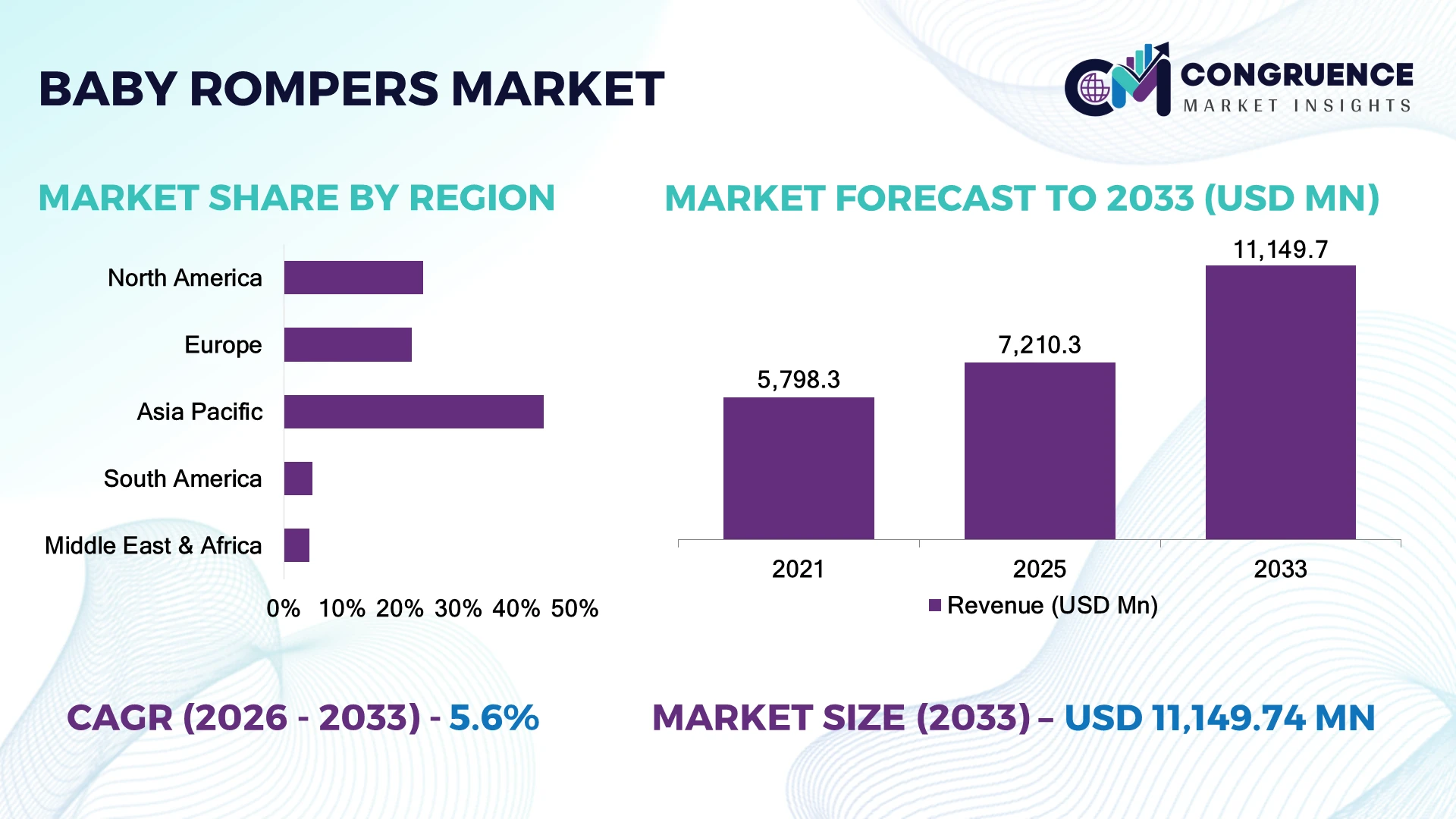
The Global Baby Rompers Market was valued at USD 7,210.3 Million in 2025 and is anticipated to reach a value of USD 11,149.7 Million by 2033 expanding at a CAGR of 5.6% between 2026 and 2033. Growth is driven by rising demand for organic infant apparel, premium babywear collections, sustainable textiles, and digitally enabled retail channels offering personalized sizing and rapid replenishment.
China accounts for approximately 34% of global baby romper production, supported by its integrated textile manufacturing ecosystem, advanced garment automation, and extensive export infrastructure. More than 57% of large-scale manufacturers now utilize automated cutting and digital production planning, compared with lower automation penetration in Bangladesh. Ongoing supply-chain diversification following global sourcing realignments in 2026 continues strengthening production resilience while encouraging investment across multiple Asian manufacturing hubs.
Manufacturers combining sustainable fabric sourcing, agile production, and omnichannel retail capabilities will secure stronger long-term competitive positioning.
Market Size & Growth: USD 7,210.3 million in 2025 reaching USD 11,149.7 million by 2033 at 5.6% CAGR, supported by premium infant apparel demand.
Top Growth Drivers: Organic fabrics (+31%), e-commerce sales (+28%), premium babywear (+22%).
Short-Term Forecast: By 2028, manufacturing efficiency improves 16% while inventory turnaround accelerates 19%.
Emerging Technologies: AI demand forecasting, automated cutting, and sustainable textile processing improve production agility.
Regional Leaders: Asia-Pacific (~USD 4.7 billion), North America (~USD 2.3 billion), Europe (~USD 2.1 billion), supported by premium apparel adoption.
Consumer/End-User Trends: Approximately 54% of parents prefer certified skin-friendly fabrics for infant clothing.
Pilot/Case Example: A 2026 smart apparel manufacturing initiative reduced material waste by nearly 18%.
Competitive Landscape: Top five brands control approximately 46% market share through design innovation and retail reach.
Regulatory & ESG Impact: Sustainable material adoption reduces textile waste by approximately 15% across participating manufacturers.
Investment & Funding: More than USD 2.6 billion supports textile automation, retail expansion, and sustainable production.
Innovation & Future Outlook: Recycled fibers, digital customization, and smart supply-chain analytics strengthen competitive differentiation.
The Baby Rompers market is evolving through sustainable fabrics, digital merchandising, and faster apparel replenishment models. Approximately 42% of newly launched premium collections incorporate organic cotton or recycled fibers, while apparel manufacturers increasingly diversify sourcing to improve supply resilience amid changing global trade dynamics. These structural shifts establish the foundation for the strategic transformation outlined below.
The Baby Rompers market is becoming strategically important as apparel companies compete through product quality, sustainable sourcing, and agile retail operations rather than basic manufacturing scale alone. Supply-chain diversification and near-shoring strategies introduced after recent global sourcing disruptions are encouraging brands to strengthen vendor networks, shorten production cycles, and improve inventory responsiveness. Digital retail expansion is further reshaping merchandising and customer engagement strategies across premium infant apparel.
AI-enabled demand forecasting improves inventory accuracy by approximately 24% compared with conventional planning methods while reducing excess stock by nearly 18%. China maintains leadership through manufacturing scale and vertically integrated textile production, whereas Türkiye is strengthening its position through shorter lead times and flexible apparel manufacturing for European brands. Over the next two to three years, more than 45% of premium baby apparel launches are expected to emphasize certified sustainable fabrics and digitally managed supply chains.
Leading apparel companies are expanding partnerships with certified textile suppliers, investing in automated garment production, and strengthening direct-to-consumer distribution channels. Brands deploying data-driven assortment planning and rapid replenishment models achieve faster market response and lower inventory risk. Companies combining sustainable material innovation, operational agility, omnichannel retail capabilities, and resilient sourcing strategies will establish enduring competitive advantage in the evolving Baby Rompers market.
Consumer preference for premium, skin-safe infant clothing is reshaping product development and retail strategies across the Baby Rompers market. Approximately 48% of parents now prioritize certified organic or hypoallergenic fabrics, while premium babywear purchases have increased by nearly 26% across urban retail channels. Digital-first brands report around 22% faster inventory turnover through demand-driven merchandising. India continues strengthening organic cotton production, providing apparel manufacturers with a more reliable raw material base amid evolving global sourcing strategies. This shift is encouraging brands to expand certified textile procurement, invest in automated garment manufacturing, and collaborate with sustainable fabric suppliers. Companies that combine product safety certifications with agile replenishment systems achieve stronger retail performance and higher customer retention.
Volatility in cotton prices, textile processing costs, and freight expenses continues affecting production economics for baby rompers. Natural fiber inputs account for nearly 38% of manufacturing costs, while premium organic cotton sourcing raises procurement expenses by approximately 17% compared with conventional fabrics. Bangladesh remains highly dependent on imported raw materials, exposing manufacturers to supply disruptions and longer procurement cycles. These pressures reduce pricing flexibility, complicate inventory planning, and compress operating margins for apparel brands. Companies are reducing exposure through multi-country sourcing strategies, localized supplier partnerships, long-term procurement contracts, and greater adoption of recycled fiber blends that improve supply stability without compromising product quality.
Digital apparel technologies are creating new growth opportunities through personalized sizing, on-demand manufacturing, and AI-enabled merchandising. Approximately 36% of premium babywear brands now utilize predictive analytics to optimize product assortment, while digital product customization improves inventory utilization by nearly 21%. Türkiye is strengthening its apparel manufacturing ecosystem through flexible production capabilities that support smaller production batches and faster export fulfillment. Brands are investing in digital product configuration platforms, expanding direct-to-consumer channels, and partnering with textile technology providers to improve responsiveness. A significant strategic opportunity lies in combining sustainable fabrics with personalized product offerings that reduce excess inventory while increasing customer lifetime value.
Meeting evolving infant apparel safety requirements while maintaining rapid production cycles remains a major execution challenge. Approximately 33% of manufacturers report longer product approval timelines due to expanding chemical safety and labeling requirements, while compliance testing increases development costs by nearly 14%. The European Union continues strengthening textile sustainability and product traceability expectations, requiring greater transparency across supply chains. These evolving requirements can delay product launches and increase operational complexity for globally distributed manufacturing networks. Companies must invest in digital traceability platforms, automated quality inspection systems, and supplier compliance programs to maintain competitive speed while ensuring consistent product safety and regulatory alignment.
Organic Fabrics Gain Preference: Organic and sustainably sourced fabrics now represent approximately 44% of newly launched premium baby romper collections, while certified textile usage has increased by nearly 20%. Retailers are expanding supplier partnerships and strengthening traceability programs as stricter sustainability expectations reshape sourcing decisions and improve long-term brand differentiation.
AI Refines Inventory Planning: AI-powered demand forecasting has improved inventory accuracy by approximately 23% while reducing excess stock by nearly 17%. Apparel manufacturers are integrating predictive merchandising platforms with production scheduling, enabling faster replenishment cycles and stronger retail responsiveness during seasonal demand fluctuations.
Nearshoring Reshapes Production Networks: Global sourcing diversification has increased regional manufacturing allocation by approximately 19%, reducing average delivery lead times by nearly 15%. Brands are expanding partnerships with manufacturers in Türkiye and Central America to improve supply-chain resilience, reduce logistics risk, and respond faster to changing retail demand.
Automation Improves Garment Efficiency: Automated fabric cutting and digital pattern engineering have increased production efficiency by approximately 18% while lowering material waste by nearly 16%. Rising labor costs in major apparel manufacturing hubs are accelerating factory modernization, prompting companies to invest in smart manufacturing systems and advanced production planning for higher operational consistency.
Organic cotton rompers account for approximately 41% of the Baby Rompers market, maintaining leadership through superior comfort, breathability, skin safety, and increasing regulatory preference for chemical-safe infant textiles. Their dominance is reinforced by premium brand positioning, broad retail availability, and strong parental preference for certified sustainable fabrics. Conventional cotton rompers remain widely adopted due to affordability and large-scale manufacturing efficiency, while blended fabric variants balance durability and cost for value-oriented product lines. Bamboo and other eco-friendly fiber rompers continue gaining strategic importance as brands diversify sustainable portfolios and respond to changing consumer purchasing behavior.
Bamboo fabric rompers represent the fastest-growing type as antimicrobial properties, moisture management, and environmental positioning attract premium consumers. Approximately 29% of newly introduced premium infant apparel collections now include bamboo-based products, while certified sustainable fabric utilization has increased by nearly 24% across leading babywear manufacturers. Companies are expanding partnerships with sustainable textile suppliers, investing in innovative fabric development, and introducing eco-certified collections to strengthen premium positioning. Investment priorities continue shifting toward differentiated natural fibers that support higher margins while aligning with evolving sustainability expectations.
A 2026 assessment by Textile Exchange highlighted continued expansion in preferred fiber adoption across the global apparel industry, with infant clothing remaining one of the fastest-growing categories for certified organic and sustainable textile integration.
Everyday wear represents approximately 52% of the Baby Rompers market, reflecting frequent replacement cycles, year-round demand, and broad product availability across offline and online retail channels. Parents prioritize comfort, durability, and easy-care fabrics, supporting consistent purchasing patterns throughout infancy. Sleepwear remains an established application due to demand for soft, breathable fabrics that comply with infant safety requirements. Seasonal wear and special occasion rompers continue serving niche premium segments where product differentiation, fashion design, and gifting behavior support higher-value purchases.
Special occasion wear is the fastest-growing application as premiumization and personalized infant fashion continue expanding globally. Approximately 31% of premium baby apparel launches now target gifting and celebration occasions, while online customization services have improved premium order volumes by nearly 20%. Companies are strengthening direct-to-consumer platforms, expanding limited-edition collections, and integrating digital personalization capabilities to capture higher-value purchases. Demand is steadily shifting toward differentiated apparel collections that combine premium aesthetics with sustainable materials and flexible manufacturing.
A 2025 enterprise retail survey conducted by the National Retail Federation reported continued growth in premium infant apparel purchases, with digitally influenced buying behavior becoming increasingly important across family-oriented retail channels.
Parents account for approximately 68% of Baby Rompers purchases, supported by continuous replacement requirements during early childhood, increasing awareness of certified infant-safe materials, and growing preference for premium babywear. Purchasing decisions are increasingly influenced by fabric quality, sustainability credentials, and omnichannel shopping experiences. Family members, including grandparents and relatives, continue representing a significant secondary buyer segment driven by gifting occasions. Institutional buyers such as hospitals and maternity centers maintain consistent procurement for newborn care, while childcare facilities contribute stable demand through bulk purchasing programs.
Online consumers represent the fastest-expanding buying segment as digital retail platforms improve product discovery, personalized recommendations, and direct brand engagement. Approximately 47% of premium infant apparel purchases are now influenced by digital channels, while subscription-based baby product programs have increased repeat purchasing by nearly 18%. Companies are investing in omnichannel strategies, loyalty programs, personalized marketing, and exclusive online collections to strengthen customer retention and lifetime value. Future competitive advantage increasingly depends on combining premium product positioning with seamless digital purchasing experiences.
A 2026 consumer purchasing assessment published by the International Council of Shopping Centers found that digitally assisted shopping continues to influence a growing share of infant apparel purchases, particularly within premium and sustainable product categories.
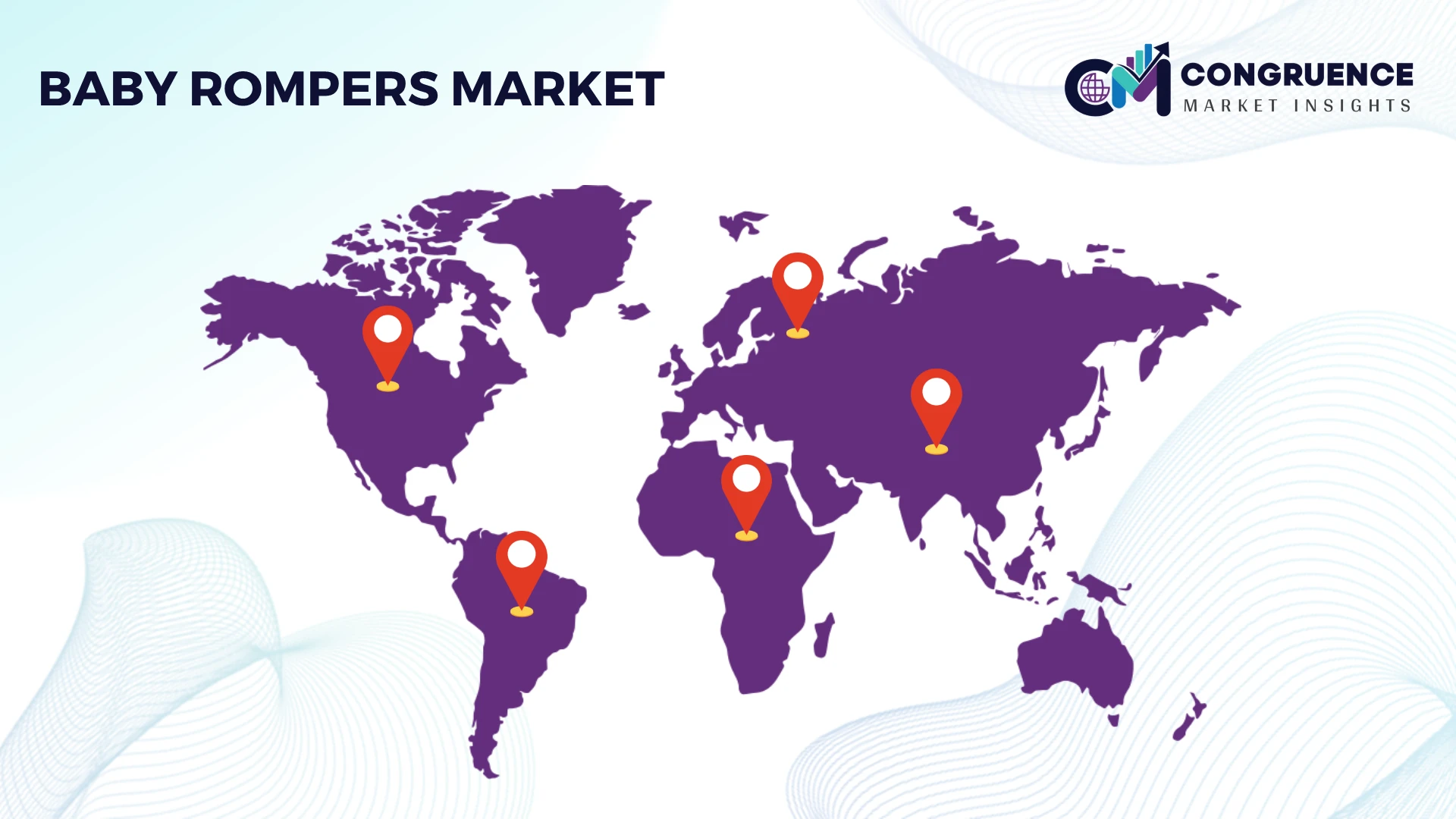
Asia-Pacific accounted for the largest market share at 44.6% in 2025 however, Middle East & Africa is expected to register the fastest growth, expanding at a CAGR of 6.4% between 2026 and 2033.
Premium Retail and Omnichannel Distribution Strengthen Market Position
North America represents approximately 24% of the global Baby Rompers market, supported by strong purchasing power, established premium apparel brands, and highly developed omnichannel retail networks. Consumer preference continues shifting toward certified organic fabrics, hypoallergenic materials, and digitally personalized shopping experiences. More than 58% of premium infant apparel sales now originate through integrated online and offline retail channels, enabling brands to optimize inventory allocation and customer engagement. Retailers are expanding automated distribution centers and strengthening partnerships with sustainable textile suppliers to improve replenishment speed and product availability. Operational competitiveness increasingly depends on rapid product launches, efficient fulfillment infrastructure, and certified supply-chain transparency rather than manufacturing scale alone.
United States Market Outlook: The United States remains the region's largest market through its mature infant apparel retail ecosystem, advanced e-commerce infrastructure, and strong consumer preference for premium baby products. Major apparel brands continue investing in AI-driven merchandising, warehouse automation, and direct-to-consumer platforms. Approximately 63% of premium infant apparel purchases involve digital product research before purchase, encouraging manufacturers to integrate personalized recommendations and faster fulfillment into retail operations while strengthening long-term customer retention.
Sustainability Standards Reshape Product Development
Europe accounts for approximately 22% of the global Baby Rompers market, driven by stringent textile safety regulations, increasing adoption of certified sustainable fabrics, and premium consumer preferences. Manufacturers continue modernizing production processes through recyclable packaging, traceable raw material sourcing, and environmentally responsible textile processing. Approximately 46% of premium infant apparel collections introduced across Europe now incorporate certified sustainable fibers. Companies are strengthening supplier qualification programs and investing in digital traceability systems that improve regulatory compliance while enhancing brand value across premium retail channels.
Germany Market Outlook: Germany leads the regional market through its advanced apparel retail infrastructure, strong consumer spending on premium children's clothing, and established sustainability standards. Retailers increasingly prioritize certified organic infant apparel supported by transparent sourcing practices. Nearly 39% of premium babywear product launches in Germany now emphasize eco-certified materials and low-impact manufacturing, encouraging suppliers to expand sustainable production partnerships and innovation across the textile value chain.
Manufacturing Scale Drives Global Supply Leadership
Asia-Pacific contributes approximately 44.6% of the Baby Rompers market and remains the world's primary apparel manufacturing hub through integrated textile supply chains, competitive production costs, and large-scale export capabilities. Automated garment production, digital production planning, and expanding sustainable textile manufacturing continue improving operational efficiency. Approximately 61% of global baby romper exports originate from manufacturers across Asia-Pacific, while investment in smart textile production continues accelerating. International apparel brands are strengthening long-term manufacturing partnerships and diversifying sourcing within the region to improve resilience and production flexibility.
China Market Outlook: China dominates regional manufacturing through its integrated textile ecosystem, automated apparel factories, and advanced export logistics. Large manufacturers continue investing in intelligent production systems, digital quality inspection, and sustainable fabric processing. Approximately 57% of large-scale baby apparel factories have adopted automated cutting and production planning technologies, strengthening manufacturing productivity while enabling rapid response to changing global retail demand.
Retail Modernization Expands Premium Apparel Demand
South America is experiencing steady development as organized retail expansion, improving e-commerce penetration, and growing demand for premium infant clothing reshape purchasing patterns. Brazil represents the largest share of regional consumption, supported by expanding domestic apparel manufacturing and stronger retail distribution networks. Approximately 27% of premium infant apparel sales now occur through digital commerce platforms, encouraging retailers to strengthen omnichannel capabilities. Manufacturers continue balancing production expansion with inflationary cost pressures by improving sourcing efficiency, strengthening regional supplier relationships, and optimizing inventory management.
Brazil Market Outlook: Brazil remains the region's largest operational market due to its established textile industry, diversified retail network, and expanding digital commerce ecosystem. Domestic manufacturers continue investing in higher-quality fabrics and localized production to reduce import dependence. Growing adoption of premium infant clothing has encouraged apparel brands to expand regional manufacturing partnerships while improving product availability across both traditional retailers and online marketplaces.
Retail Infrastructure Investment Accelerates Premium Adoption
The Middle East & Africa Baby Rompers market is advancing through expanding retail infrastructure, rising disposable incomes, and increasing investment in organized fashion distribution. Premium international babywear brands are strengthening regional presence through franchise partnerships and modern retail formats. Approximately 24% of newly opened specialty children's apparel stores now focus on premium and sustainable infant clothing collections. Distribution modernization, digital commerce expansion, and improved logistics networks are enabling faster product availability while supporting broader market accessibility across key urban centers.
United Arab Emirates Market Outlook: The United Arab Emirates leads regional premium baby apparel retail through advanced logistics infrastructure, high consumer purchasing power, and a strong international brand presence. Retailers continue expanding omnichannel sales strategies supported by modern fulfillment capabilities and premium shopping destinations. Approximately 35% of premium infant apparel purchases are now completed through integrated digital retail platforms, encouraging brands to strengthen localized inventory management and customer engagement strategies.
Global brands including Carter's, H&M, Gap, Inditex (Zara), and Mothercare compete with regional private-label retailers, while premium organic babywear specialists challenge fast-fashion companies through certified sustainable products and higher-quality fabrics. Retail private labels compete aggressively on pricing, whereas global brands emphasize design, safety, and omnichannel reach. The top five players collectively account for approximately 44% of the market. Competition centers on sourcing efficiency, product innovation, and retail responsiveness. Automated production reduces manufacturing lead times by nearly 18%, AI-driven inventory planning improves stock accuracy by approximately 23%, and sustainable material adoption increases premium product conversion by around 16%. Companies are expanding direct-to-consumer channels, strengthening supplier partnerships, introducing eco-certified collections, and integrating vertically across sourcing and retail operations. Competitive momentum continues shifting toward sustainable babywear and digital commerce. Strict infant safety compliance, certified textile sourcing, and resilient supply chains remain significant entry barriers. Winning requires differentiated product quality, agile sourcing, trusted certifications, and superior omnichannel execution.
Carter's, Inc.
H&M Group
Gap Inc.
Inditex S.A. (Zara)
Mothercare plc
FirstCry
Gerber Childrenswear LLC
Benetton Group
Cotton On Group
The Children's Place, Inc.
Hanna Andersson
NEXT plc
Mamas & Papas Ltd.
Modern baby romper manufacturing increasingly relies on automated fabric cutting, AI-enabled demand forecasting, digital pattern engineering, and sustainable textile processing. Approximately 58% of large apparel manufacturers have adopted automated cutting systems, improving material utilization by nearly 16%, while AI-supported inventory planning increases forecast accuracy by approximately 23%. These technologies reduce production waste, improve replenishment speed, and strengthen operational efficiency across omnichannel retail networks.
Emerging technologies include digital product customization, 3D apparel prototyping, RFID-enabled inventory tracking, and advanced organic fiber processing. Compared with conventional manual product development, digital design platforms shorten sample development cycles by approximately 28% while reducing prototype costs by nearly 20%. Global apparel brands with integrated sourcing, digital merchandising, and automated manufacturing capabilities gain stronger competitive advantages through faster product launches, higher inventory efficiency, and improved customer responsiveness.
Between 2026 and 2028, smart manufacturing, digital supply-chain visibility, and recyclable textile innovation will reshape premium infant apparel production. Companies investing in end-to-end production automation, AI merchandising, and certified sustainable material platforms will strengthen operational resilience and brand differentiation. Early adopters will achieve faster replenishment cycles, lower inventory risk, stronger customer loyalty, and greater flexibility as premium, eco-certified babywear becomes a defining competitive advantage.
February 2025 Carter's unveiled its Spring/Summer 2025 baby apparel collections featuring expanded functional designs and fashion-led infant essentials, strengthening premium positioning and accelerating seasonal assortment innovation across retail and digital channels. Source: Carter's
June 2025 Carter's released its 2024 Raise the Future Impact Report, reporting that over 80% of cotton sourced during 2024 came from preferred sustainable programs, reinforcing responsible sourcing and premium infant apparel positioning. Source: Carter's
May 2026 H&M announced its Laura Ashley kidswear collaboration for Spring/Summer 2026, expanding premium baby and children's apparel through heritage-inspired collections while strengthening differentiated product offerings across stores and online distribution. Source: PR Newswire
January 2026 Carter's partnered with Once Upon a Farm to introduce a limited-edition baby apparel collection featuring sustainably sourced PurelySoft™ fabrics, expanding premium infant offerings and reinforcing cross-brand consumer engagement. Source: Carter's Investor Relations.
The report provides comprehensive analysis of the Baby Rompers market across product types, applications, end-user segments, and major geographic markets. It evaluates organic cotton, conventional cotton, bamboo, blended fabrics, and other specialty materials while assessing demand across everyday wear, sleepwear, seasonal apparel, and special occasion clothing. The study further examines purchasing behavior among parents, family buyers, institutional users, and digital retail consumers, alongside technology adoption in automated garment manufacturing, AI-enabled merchandising, and sustainable textile production.
The assessment covers North America, Europe, Asia-Pacific, South America, and the Middle East & Africa, highlighting manufacturing concentration, retail deployment, sourcing strategies, and competitive positioning. More than 55% of premium apparel manufacturers are integrating digital production planning and automated manufacturing processes to improve operational efficiency. The report supports investment prioritization, sourcing strategy, product portfolio optimization, competitive benchmarking, and expansion planning by identifying emerging consumer trends, technology transitions, manufacturing shifts, and strategic opportunities expected to influence the market between 2026 and 2033.
| Report Attribute/Metric | Report Details |
|---|---|
|
Market Revenue in 2025 |
USD 7,210.3 Million |
|
Market Revenue in 2033 |
USD 11,149.7 Million |
|
CAGR (2026 - 2033) |
5.6% |
|
Base Year |
2025 |
|
Forecast Period |
2026 - 2033 |
|
Historic Period |
2021 - 2025 |
|
Segments Covered |
By Type
By Application
By End-User
|
|
Key Report Deliverable |
Revenue Forecast, Growth Trends, Market Dynamics, Segmental Overview, Regional and Country-wise Analysis, Competition Landscape |
|
Region Covered |
North America, Europe, Asia-Pacific, South America, Middle East, Africa |
|
Key Players Analyzed |
Carter's, Inc., H&M Group, Gap Inc., Inditex S.A. (Zara), Mothercare plc, FirstCry, Gerber Childrenswear LLC, Benetton Group, Cotton On Group, The Children's Place, Inc., Hanna Andersson, NEXT plc, Mamas & Papas Ltd. |
|
Customization & Pricing |
Available on Request (10% Customization is Free) |




