
Reports
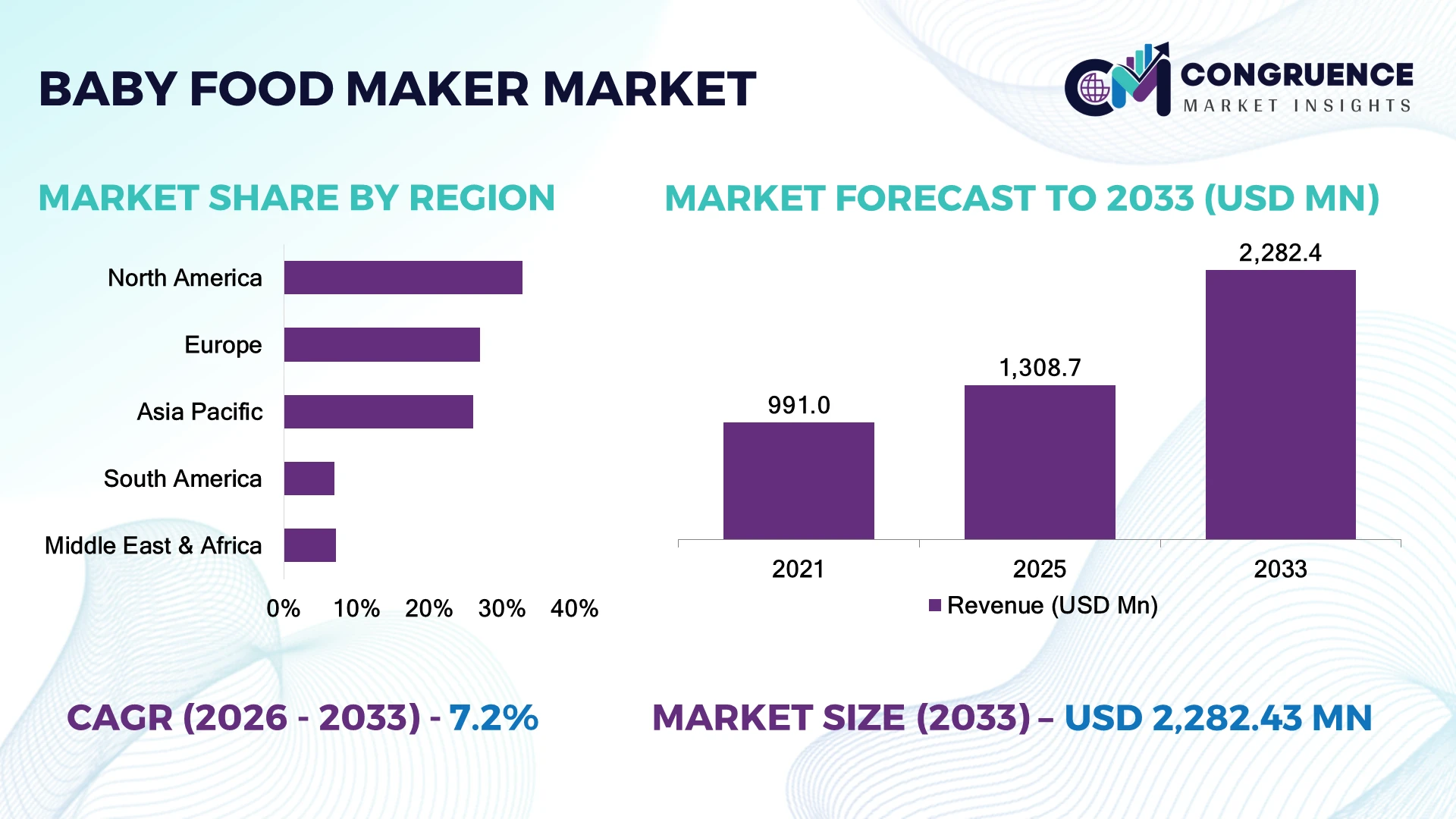
The Global Baby Food Maker Market was valued at USD 1,308.7 Million in 2025 and is anticipated to reach a value of USD 2,282.4 Million by 2033 expanding at a CAGR of 7.2% between 2026 and 2033. Growth is driven by multifunctional steam-and-blend appliances, rising preference for freshly prepared complementary foods, compact kitchen automation, and increasing demand for portion-controlled baby meals.
The United States represents the largest commercial market, supported by strong countertop-appliance penetration and premium connected-kitchen adoption, while China combines a large infant-product manufacturing base with rapidly expanding domestic e-commerce. U.S. premium appliance adoption is estimated at around 25–30% of category purchases, compared with approximately 15–20% in China. Supply-chain diversification following U.S.–China trade tensions is also encouraging Asian manufacturers to expand sourcing and assembly across Vietnam and India.
Strategically, manufacturers should prioritize multifunctionality, food-contact safety, compact designs, and localized supply chains to protect margins while expanding premium penetration.
Market Size & Growth: USD 1.31 billion in 2025 to USD 2.28 billion by 2033 at 7.2% CAGR, driven by integrated steam-blending and meal-preparation functionality.
Top Growth Drivers: Multifunctional appliances ~34%, convenience-led meal preparation ~27%, and fresh-food preparation ~22% represent leading demand catalysts.
Short-Term Forecast: By 2028, automated steaming and blending can reduce preparation time by 20–30% and energy consumption by approximately 8–12%.
Emerging Technologies: Smart controls, automated steaming, precision blending, self-cleaning systems, and app-enabled meal guidance are strengthening premium product differentiation.
Regional Leaders: North America approaches USD 0.70 billion, Asia Pacific USD 0.65 billion, and Europe USD 0.50 billion by 2033, with compact multifunctional appliances gaining adoption.
Consumer/End-User Trends: Multifunctional baby food makers account for approximately 60% of premium product preferences as parents consolidate steaming, blending, reheating, and sterilization functions.
Pilot/Case Example: 2026 product-development programs combining automated steam control and optimized blending target 15–25% faster meal preparation with more consistent textures.
Competitive Landscape: Philips Avent leads the premium category, competing with Béaba, Babymoov, NutriBullet, and Ninja across functionality, pricing, compactness, and digital integration.
Regulatory & ESG Impact: Food-contact compliance and BPA-free component requirements are pushing manufacturers toward safer materials, while recyclable packaging can reduce packaging-material use by approximately 10–20%.
Investment & Funding: More than USD 300 million in cumulative product-development, manufacturing, and connected-kitchen investment is supporting multifunctional small-appliance innovation and regional supply-chain expansion.
Innovation & Future Outlook: Next-generation models are shifting toward automated cooking programs, texture personalization, modular accessories, quieter motors, and connected nutrition ecosystems.
The Baby Food Maker Market centers on steam-and-blend systems, food processors, all-in-one cookers, portable preparation devices, and multifunctional countertop appliances, with approximately 60% of premium buyers favoring products combining multiple preparation functions. In 2026, manufacturers are emphasizing BPA-free food-contact materials, easier cleaning, compact footprints, and automated cooking cycles as regulatory scrutiny and appliance-component sourcing requirements intensify.
The Baby Food Maker Market is becoming strategically important as appliance manufacturers move from single-purpose processing toward integrated infant-meal preparation platforms. Steam, blending, reheating, and portion preparation are increasingly combined within one appliance, allowing brands to compete on workflow reduction rather than motor power alone. Food-contact safety and material transparency are also becoming stronger purchasing criteria as manufacturers respond to tighter scrutiny of infant-product components.
Advanced steam-and-blend systems can reduce preparation time by approximately 20–30% versus sequential stovetop cooking and manual blending, while automated programs improve repeatability. North America remains the strongest premium market, whereas China and other Asian manufacturing centers provide greater cost and component-scale advantages. Europe places greater emphasis on compact design, food-contact materials, energy efficiency, and sustainability.
During 2026–2028, companies are expected to prioritize quieter motors, self-cleaning functions, programmable texture control, and connected recipe ecosystems. A practical deployment model is the integrated countertop unit that steams vegetables, blends them immediately, and portions meals without transferring food between appliances. Manufacturers are therefore increasing investment in application engineering, electronics partnerships, and localized component sourcing. Competitive advantage will increasingly depend on combining safe materials, reliable automation, intuitive workflows, and cost-efficient manufacturing in a single differentiated platform.
Multifunctional cooking is the primary structural driver, with approximately 60% of premium buyers favoring appliances that combine steaming, blending, reheating, and food processing. Integrated workflows can reduce preparation time by 20–30% compared with sequential cooking and manual blending, while automated steam control improves texture consistency by approximately 10–15%. In the United States, premium appliance brands are increasingly combining programmable cooking with compact countertop architectures. Manufacturers are responding through platform-based product development, shared motors and control systems, and partnerships with electronics suppliers. The non-obvious advantage is SKU consolidation: modular cooking functions allow brands to address multiple preparation needs without proportionally increasing manufacturing complexity or inventory requirements.
Electronics, food-contact plastics, stainless-steel components, and precision motors create significant cost exposure, with imported components representing approximately 30–40% of manufacturing inputs for many globally sourced countertop appliances. Semiconductor and motor-price fluctuations can increase bill-of-materials costs by 5–10%, while food-contact compliance and testing can add another 3–6% to product-development expenditure. U.S. and European brands remain exposed to Asian component supply chains despite ongoing sourcing diversification. Manufacturers are responding through dual sourcing, longer-term supplier contracts, localized assembly, and standardized electronic platforms. The strategic pressure is not simply component pricing; frequent redesigns can trigger additional validation cycles, making modular hardware architectures increasingly valuable for maintaining product continuity.
Connected cooking and personalized food preparation create an emerging premium opportunity, with smart features appearing in approximately 10–15% of higher-end baby food maker concepts and app-based controls reducing manual programming steps by roughly 20–30%. U.S. technology-led brands are integrating cameras, sensors, programmable steam cycles, and guided recipes into compact appliances. Manufacturers are increasingly partnering with software and electronics specialists instead of developing complete connected platforms internally. A non-obvious opportunity lies in adaptive texture control, where sensor feedback can standardize puree consistency for different feeding stages. Companies investing in modular connectivity can extend product functionality through software updates and accessories, creating differentiation without frequent hardware redesigns.
Smart baby food makers introduce execution challenges around software reliability, sensor calibration, cybersecurity, and long-term compatibility. Connected electronics can represent approximately 15–25% of the bill of materials in advanced models, while firmware and app integration can extend development timelines by 10–20%. In the United States and Europe, manufacturers must also maintain rigorous food-contact and electrical-safety validation as electronic functionality expands. Companies are addressing these pressures through standardized communication modules, third-party cybersecurity testing, over-the-air software controls, and longer component qualification cycles. The critical challenge is maintaining appliance reliability after connectivity is added: a technically sophisticated platform has limited commercial value if software failures interrupt core cooking, steaming, or blending functions.
Integrated Functions Become Standard: Approximately 60% of premium buyers favor multifunctional appliances, while integrated steam-and-blend workflows reduce preparation time by 20–30%. Manufacturers are consolidating steaming, blending, reheating, and sterilization into single platforms, reducing countertop footprint and simplifying product portfolios. This is shifting competition from motor performance toward workflow efficiency and appliance versatility.
Food-Contact Materials Face Scrutiny: BPA-free plastics, stainless-steel food pathways, and improved sealing systems are becoming standard premium specifications. Material redesign can reduce selected packaging or component-related plastic usage by 10–20%, while automated compliance documentation shortens validation workflows by approximately 5–10%. Manufacturers are increasingly qualifying alternative materials before regulatory or retailer requirements force product redesigns.
Compact Designs Gain Urban Traction: Countertop footprint is becoming a stronger purchasing variable, particularly in dense U.S., Chinese, Japanese, and European households. Approximately 15–20% of new premium concepts emphasize compact architecture without removing core cooking functions. Manufacturers are adopting vertical layouts, removable reservoirs, and integrated storage to improve space utilization while maintaining usable batch capacity.
Supply Chains Become More Diversified: U.S.–China trade tensions and component sourcing volatility are accelerating procurement diversification across Vietnam, India, and Mexico. Manufacturers are increasingly qualifying dual suppliers for motors, control boards, and food-contact components, targeting 15–25% reductions in single-country sourcing exposure. The shift is also encouraging localized assembly, allowing brands to protect delivery schedules without duplicating complete manufacturing footprints.
Steam-and-blend baby food makers lead the market with an estimated 48% share, benefiting from integrated cooking and processing in a single countertop platform. Their ability to steam vegetables, fruits, and proteins before blending reduces transfers between appliances and supports consistent texture control. Conventional food processors and blenders account for approximately 27%, remaining attractive because of lower purchase prices and broader household utility. All-in-one cooking systems represent roughly 17%, while portable and specialty devices retain a smaller but strategically relevant niche.
All-in-one systems are the fastest-growing type, supported by consumer preference for fewer appliances and programmable preparation cycles. Their adoption is increasing as manufacturers combine steaming, blending, reheating, sterilization, and portion preparation. Companies are standardizing motors, heating modules, and control electronics across product families, potentially reducing component complexity by 10–15%. The investment priority is shifting toward multifunctional platforms that combine convenience with food-safety controls rather than standalone blending performance.
Home baby-food preparation accounts for approximately 82% of Baby Food Maker Market demand, reflecting the appliance’s primary role in household meal preparation. Parents use these systems for purees, mashed foods, steamed vegetables, and progressively textured meals, creating sustained demand for adjustable processing. Commercial and institutional preparation represents approximately 18%, covering childcare centers, hospitality operators, and specialized infant-care settings. Household models prioritize compactness and intuitive controls, while commercial units require higher batch capacity, durability, and easier cleaning.
Childcare and institutional food preparation is the fastest-growing application niche, with demand shifting toward appliances capable of processing larger batches and maintaining repeatable textures. Commercial workflows can require approximately 20–30% higher processing capacity than household use. Manufacturers are responding with larger vessels, removable food-contact components, and simplified sanitation cycles. The strategic opportunity lies in adapting consumer-grade automation for institutional environments without transferring unnecessary smart-home complexity into professional kitchens.
Households represent approximately 85% of Baby Food Maker Market purchases, making parents and caregivers the dominant buyer group. Demand is concentrated around compact appliances that reduce preparation steps while supporting multiple feeding stages. Parents increasingly prioritize steam cooking, blending consistency, dishwasher-safe components, and BPA-free food-contact materials. Commercial childcare and hospitality users account for approximately 15%, but their procurement is more specification-driven, emphasizing batch capacity, sanitation, durability, and replacement-part availability.
Childcare operators are the fastest-growing institutional end-user group as facilities increasingly require efficient preparation workflows for multiple children. Their equipment requirements can involve approximately 2–3 times the batch volume of typical household preparation. Manufacturers are responding through B2B distribution partnerships, larger processing vessels, extended warranties, and simplified cleaning architectures. Meanwhile, premium household brands are integrating guided recipes and programmable settings. The competitive implication is a two-tier strategy: consumer products win through convenience and design, while institutional models compete through throughput, serviceability, and operating consistency.
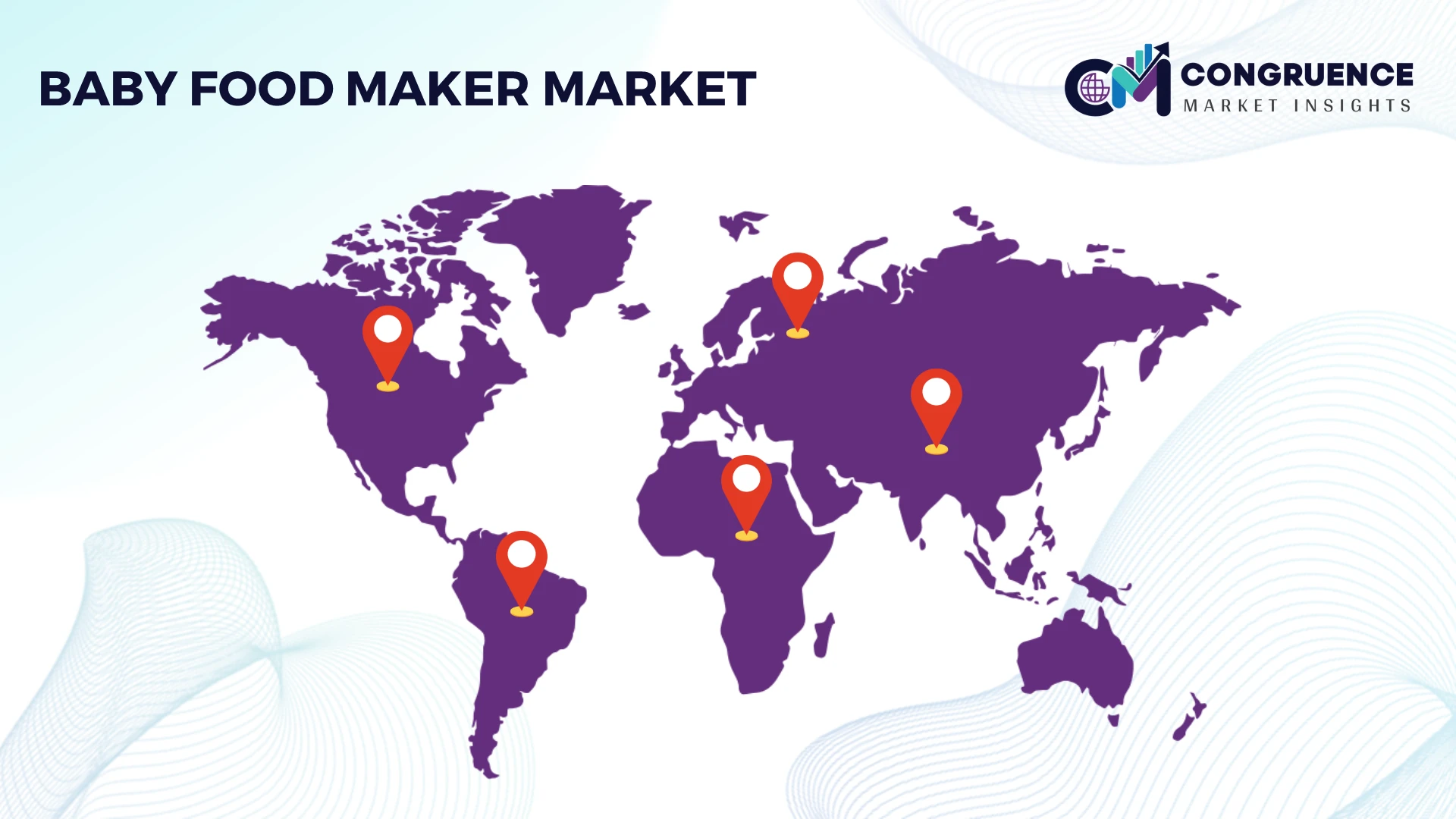
North America accounted for the largest market share at approximately 32.8% in 2025 however, Asia-Pacific is expected to register the fastest growth, expanding at a CAGR of 8.3% between 2026 and 2033.
Premium multifunctionality strengthens appliance differentiation
North America represents approximately 32.8% of global Baby Food Maker Market demand, led by the United States, where premium countertop appliances benefit from strong e-commerce penetration and established small-appliance infrastructure. Multifunctional steam-and-blend systems account for approximately 60% of premium product preferences, encouraging manufacturers to combine cooking, blending, reheating, and sterilization within compact platforms. U.S. brands are also increasing emphasis on BPA-free food-contact materials, dishwasher-safe components, and programmable controls. Direct-to-consumer distribution supports faster product launches and reduces reliance on physical retail expansion. Manufacturers are simultaneously diversifying electronics and motor sourcing beyond China, with dual-supplier strategies increasingly targeting 15–25% reductions in single-country component exposure.
U.S. Market Outlook: The United States remains the region's principal innovation and consumption center, supported by mature countertop-appliance distribution and strong premium-brand positioning. Connected and programmable functionality is gaining traction, while food-contact safety and electrical compliance remain essential qualification criteria. Manufacturers increasingly combine compact architectures with automated steaming and blending, enabling differentiated products without substantially increasing kitchen footprint.
Safety and sustainable design reshape premium specifications
Europe accounts for approximately 27% of global Baby Food Maker Market demand, with Germany, France, the United Kingdom, and Italy representing important consumption centers. European manufacturers emphasize BPA-free materials, recyclable packaging, energy efficiency, quiet operation, and simplified cleaning. Approximately 20–25% of premium product-development specifications increasingly incorporate sustainability or material-transparency requirements. Retailers are also favoring appliances with clear food-contact documentation and replaceable components. Companies are responding through modular product architectures and localized supplier qualification, reducing redesign exposure when material or component requirements change.
Germany Market Outlook: Germany combines strong appliance engineering capabilities with demanding consumer expectations for durability, safety, and resource efficiency. Premium baby food makers increasingly feature stainless-steel food pathways, automated programs, and detachable components. Manufacturers are using modular electronics and standardized heating assemblies to support product variants while controlling engineering complexity and maintaining compliance across multiple European markets.
Manufacturing scale accelerates multifunctional appliance adoption
Asia-Pacific represents approximately 26% of global Baby Food Maker Market demand and is the fastest-expanding production and consumption base. China remains the dominant manufacturing center, while Japan, South Korea, and India contribute through electronics, appliance engineering, and growing domestic demand. Export-oriented factories increasingly deploy CNC machining, automated assembly, and digital quality inspection, with automation capable of improving production consistency by approximately 3–5%. Chinese manufacturers are also developing compact steam-and-blend platforms for domestic e-commerce channels. Supply-chain diversification is strengthening Vietnam and India as complementary assembly and component locations.
China Market Outlook: China combines extensive small-appliance manufacturing infrastructure with sophisticated electronics and e-commerce distribution. Domestic brands increasingly integrate programmable cooking, touch controls, and compact vertical architectures. Export manufacturers are standardizing motors, heating modules, and control boards across product families, enabling approximately 10–15% lower component complexity while supporting multiple price tiers and faster product refresh cycles.
Urbanization strengthens demand for compact preparation systems
South America contributes approximately 7% of global Baby Food Maker Market demand, with Brazil representing the principal consumption and distribution center. Urban households increasingly favor compact appliances capable of replacing separate steaming and blending equipment, while online retail is improving access beyond major metropolitan areas. Imported motors, electronics, and specialized food-contact components remain significant cost inputs, exposing manufacturers to currency fluctuations and freight variability. Companies are responding through regional distributors, localized assembly, and broader domestic sourcing. Brazil's established appliance and food-processing ecosystem provides a practical base for adapting global designs to local voltage, packaging, and consumer requirements.
Brazil Market Outlook: Brazil represents the strongest commercial opportunity in South America because of its large consumer base, developed appliance distribution, and established domestic manufacturing capabilities. Local assemblers can reduce import exposure by sourcing selected housings, packaging, and mechanical components domestically. Approximately 35–40% of regional category demand is concentrated in Brazil, making nationwide distributor coverage strategically important for scaling premium and mid-range products.
Premium retail and hospitality infrastructure support category expansion
Middle East & Africa represents approximately 5% of global Baby Food Maker Market demand, with Saudi Arabia, the UAE, South Africa, and Egypt forming key commercial markets. Gulf consumers show stronger interest in premium imported appliances, while modern retail and e-commerce infrastructure improves availability of specialized infant-care products. Premium multifunctional models can command approximately 15–25% higher pricing where automated cooking, compact design, and food-contact safety features are bundled. Distributors are expanding regional inventories to reduce replenishment delays and manage import-dependent supply chains. Hospitality and family-oriented accommodation also create selective institutional demand.
Saudi Arabia Market Outlook: Saudi Arabia is the region's strongest strategic market, supported by modern retail infrastructure, high premium-appliance penetration, and expanding digital commerce. Baby food makers benefit from demand for compact, automated kitchen equipment among urban households. Regional distributors are increasingly maintaining localized inventory, helping reduce replenishment lead times by approximately 15–25% while supporting faster introduction of premium European and Asian appliance brands.
Béaba, Philips Avent, Baby Brezza, Babymoov, and nutribullet compete primarily through multifunctionality, premium materials, and distribution, while regional OEMs challenge them on price and private-label flexibility. The top five branded players collectively hold about 38% of global demand, indicating meaningful fragmentation. Price gaps of 15–25% separate entry and premium models, while automated steam-blend systems can cut preparation time 20–30%. Premium brands differentiate through glass or stainless-steel food-contact systems, programmable controls, and larger capacities; cost leaders emphasize simplified architectures and high-volume sourcing. Béaba is strengthening glass-and-steel positioning, Baby Brezza emphasizes one-step automation, and Babymoov expands multifunctional platforms. Competition is shifting toward safer materials, compact multifunctionality, and ecosystem accessories rather than standalone blending. Entry barriers include food-contact validation, appliance certification, tooling, retailer qualification, and trusted distribution and rapid market launches. Winning requires reliable safety compliance, efficient multifunctional engineering, strong channel coverage, and differentiated usability that justifies premium pricing while maintaining component availability.
Current technology is centered on integrated steam-and-blend architecture, automated cooking cycles, precision blending, and dishwasher-safe removable components. Approximately 60% of premium product concepts emphasize multifunctionality, while automated programs can reduce preparation time by 20–30%. Béaba combines glass and stainless steel construction with multi-stage processing, while Baby Brezza uses LCD-controlled one-step steaming and blending. These platforms improve workflow consistency and support premium positioning.
Emerging systems are adding sensor-based steam control, programmable texture settings, modular storage, and digital recipe ecosystems. Connected functionality remains niche, appearing in roughly 10–15% of premium concepts, but it enables guided preparation and product engagement beyond hardware. Compared with conventional stovetop cooking followed by separate blending, integrated systems reduce food transfers and preparation steps by approximately 25–35%. Premium brands benefit most because technology supports higher differentiation without requiring substantially larger footprints.
From 2026–2028, manufacturers will increasingly combine precision heating, quieter motors, controls, and adaptive texture programs. Automated quality controls can improve cooking repeatability by approximately 5–10%, while standardized electronic modules can reduce component complexity by 10–15%. The competitive advantage will favor brands with scalable platforms, food-contact materials, and electronics partnerships. Acting now matters because modular architectures enable faster product refreshes, localized variants, and accessory integration without redesigning the appliance.
April 2025 Baby Brezza’s Food Maker Deluxe entered a French consumer-testing program, offering automatic steaming and blending, 900 ml capacity, and three modes. The deployment strengthened European product visibility and validated demand for compact multifunctional preparation for parents. Source: consobaby.com
March 2025 Babymoov offered 20% reimbursement on Nutribaby appliances, capped at 500 claims. The promotion covered multifunctional cooking and sterilization products in France, supporting direct consumer acquisition and reinforcing the brand’s positioning around integrated infant-meal preparation and household convenience. Source: babymoov.com
November 2025 Baby Brezza launched Formula Pro Advanced in Japan through IVG Japan, expanding its automated infant-feeding appliance ecosystem into a new national market. The system prepares formula in 7 seconds, strengthening localized distribution and smart-appliance positioning nationwide. Source: prtimes.jp
October 2024 Béaba’s Babycook Neo was independently tested with a 1,250 ml glass bowl, 1,000 ml stainless-steel basket, and claimed 50% lower water and energy consumption versus Babycook Solo. The product reinforced premium material and eco-design differentiation in France. Source: danslachambredemesenfants.fr
The Baby Food Maker Market Report covers steam-and-blend systems, food processors, all-in-one cooking appliances, standalone baby food blenders, and portable preparation devices. Application coverage includes homemade purees, textured meals, batch preparation, reheating, defrosting, sterilization, and complementary-feeding preparation. End-user analysis evaluates households, childcare facilities, hospitality operators, and other institutional users. Regional assessment spans North America, Europe, Asia Pacific, South America, and Middle East & Africa, with country-level analysis of consumption, manufacturing, distribution, and sourcing.
Technology coverage evaluates automated steaming, precision blending, programmable controls, sensor-based cooking, food-contact materials, dishwasher-safe components, and connected recipe ecosystems. The report examines approximately 60% premium multifunctionality adoption, supplier positioning, component sourcing, product innovation, safety compliance, and channel strategies. Strategic analysis supports investment planning, market entry, product portfolio decisions, manufacturing localization, partnerships, competitive positioning, and expansion priorities through 2026–2033, including smart cooking and sustainable material opportunities.
| Report Attribute/Metric | Report Details |
|---|---|
|
Market Revenue in 2025 |
USD 1,308.7 Million |
|
Market Revenue in 2033 |
USD 2,282.4 Million |
|
CAGR (2026 - 2033) |
7.2% |
|
Base Year |
2025 |
|
Forecast Period |
2026 - 2033 |
|
Historic Period |
2021 - 2025 |
|
Segments Covered |
By Type
By Application
By End-User
|
|
Key Report Deliverable |
Revenue Forecast, Growth Trends, Market Dynamics, Segmental Overview, Regional and Country-wise Analysis, Competition Landscape |
|
Region Covered |
North America, Europe, Asia-Pacific, South America, Middle East, Africa |
|
Key Players Analyzed |
Béaba, Baby Brezza, Babymoov, Philips, nutribullet, Grownsy, Nuby, QOOC, Sage Spoonfuls, BEAR, EVLA's, Chefhandy |
|
Customization & Pricing |
Available on Request (10% Customization is Free) |




