
Reports
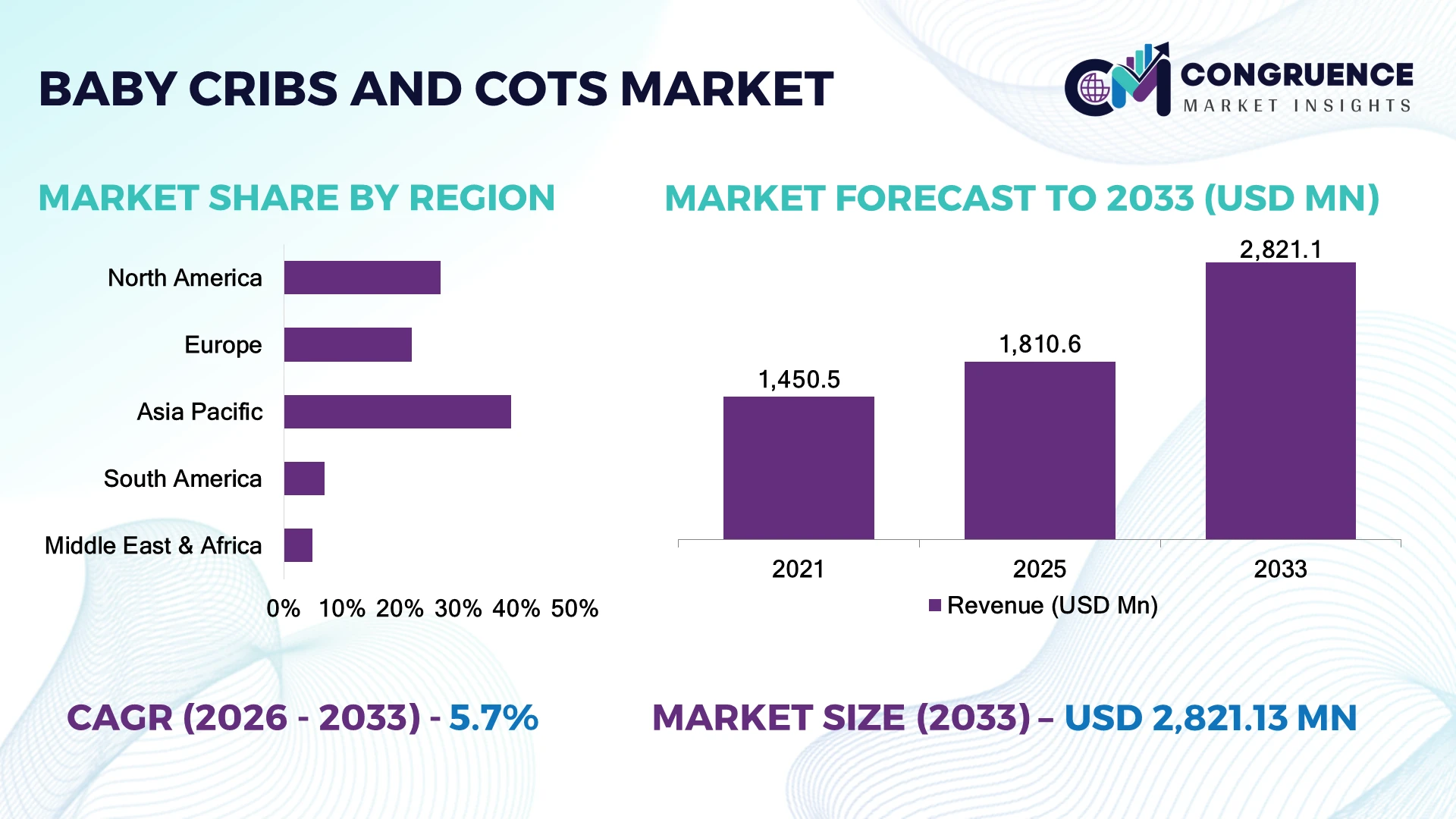
The Global Baby Cribs and Cots Market was valued at USD 1,810.6 Million in 2025 and is anticipated to reach a value of USD 2,821.1 Million by 2033 expanding at a CAGR of 5.7% between 2026 and 2033. Growth is driven by convertible crib adoption, stricter infant-safety requirements, e-commerce-led product discovery, and manufacturers shifting toward modular designs that extend product usability beyond infancy.
China holds approximately 34% of Asia Pacific baby nursery furniture demand and remains a major manufacturing hub, with roughly 70% of global nursery-furniture production concentrated there; India is emerging as a lower-cost alternative. U.S. manufacturers face tighter compliance requirements, while 2026 U.S. safety-standard updates are raising testing and certification requirements across infant sleep products.
Strategically, manufacturers should prioritize safety-certified, space-efficient, convertible designs while diversifying sourcing beyond China to manage tariff and supply-chain exposure.
The Baby Cribs and Cots Market is increasingly concentrated around convertible cribs, portable cots, bedside sleepers, multifunctional nursery furniture, and space-efficient designs, with online channels accounting for approximately 31% of purchasing activity. In 2026, stricter safety compliance and China-related trade tensions are encouraging regional sourcing diversification and greater emphasis on certified materials, traceable components, and modular manufacturing.
Baby cribs and cots are becoming strategically important because safety certification, product longevity, and manufacturing flexibility increasingly determine brand competitiveness rather than basic furniture functionality. Convertible designs now extend a single product across multiple developmental stages, strengthening consumer value while allowing manufacturers to capture higher lifetime value per household. The U.S. regulatory environment is also becoming more demanding, with updated infant-product standards increasing testing, certification, and traceability requirements.
Manufacturing technology is reinforcing this shift. CNC cutting and automated finishing can improve dimensional consistency by approximately 3–5% while reducing material-processing waste by 8–12% versus labor-intensive production. China retains the strongest manufacturing scale, whereas North America and Europe place greater emphasis on safety engineering, certification, sustainable materials, and premium design. Across 2026–2028, automated production and modular product architectures are positioned for wider deployment.
Companies are responding through regional warehousing, supplier diversification, application-specific partnerships, and investments in convertible platforms. Manufacturers combining certified safety performance, efficient production, and differentiated design will secure stronger retailer qualification and withstand supply-chain disruption, making operational resilience a decisive competitive advantage.
Convertible crib adoption is reshaping purchasing economics, with approximately 42% of buyers prioritizing products that transition across developmental stages and 24% favoring multifunctional nursery furniture. Manufacturers are responding with adjustable mattress platforms, removable side rails, and modular conversion kits that extend usable product life while supporting premium pricing. In the U.S., tighter infant-sleep safety requirements are accelerating engineering investment in structural stability and component testing. Companies are expanding modular product portfolios and standardizing hardware across models to reduce tooling complexity by approximately 10–15%. A non-obvious advantage is inventory efficiency: shared components allow brands to serve multiple price tiers without proportionally expanding SKU complexity.
Wood, metal hardware, coatings, packaging, and mandatory testing create significant cost pressure, with materials typically representing approximately 45–55% of manufacturing costs and compliance-related expenses adding 3–7% for regulated products. China-based manufacturers remain exposed to freight volatility and tariff changes affecting shipments into the U.S., while European producers face tighter chemical and material documentation. Companies are diversifying suppliers across Vietnam, India, and Mexico, negotiating longer-term material contracts, and increasing localized component sourcing. The key constraint is qualification continuity: replacing a certified component can trigger renewed testing and documentation, extending product-release cycles by 5–10%. Strategic sourcing therefore requires approved alternate suppliers before disruption occurs.
Connected nursery products are opening a higher-value segment, with smart monitoring features incorporated into roughly 10–15% of premium crib and cot concepts and digital manufacturing capable of reducing customization lead times by 15–25%. U.S. and European brands are integrating sensor-enabled sleep monitoring, adjustable lighting, and app-connected nursery ecosystems without altering core crib structures. Manufacturers are partnering with technology providers rather than developing electronics internally, reducing development complexity while accelerating launches. A particularly attractive opportunity is modular smart retrofitting: standardized mounting points can enable monitoring accessories to be added after purchase, creating recurring accessory demand. Companies investing in interoperable hardware platforms can capture value beyond the initial furniture sale.
Global manufacturers face increasing difficulty maintaining identical safety performance across diversified production networks, particularly when wood density, fastener tolerances, coatings, and assembly processes vary by supplier. Dimensional deviations of even 2–3% can affect component fit, while automated inspection can reduce defect detection time by approximately 20–30%. U.S. brands are strengthening digital quality records and supplier audits, while Chinese and Indian factories are expanding CNC machining and machine-vision inspection. The long-term challenge is integrating these systems without creating fragmented quality-control architectures. Companies must invest in standardized digital specifications, automated inspection, supplier certification, and workforce training to maintain consistent structural performance as production becomes more geographically distributed.
Convertible Architecture Becomes Standardized: Approximately 42% of buyers prioritize convertible designs, while modular hardware can reduce SKU complexity by 10–15%. Manufacturers are increasingly standardizing rails, brackets, and mattress platforms across product families. This shift improves inventory utilization and simplifies replacement-part management, making modularity an operational strategy rather than solely a consumer feature.
Compliance Drives Design Re-engineering: U.S. infant-sleep requirements are pushing manufacturers toward tighter component tolerances and stronger validation protocols. Digital quality records and automated inspection can reduce defect-detection time by 20–30%, while certification documentation increasingly influences retailer qualification. Companies are redesigning supplier-control workflows to maintain compliance across increasingly distributed production networks.
Smart Features Enter Premium Cribs: Connected monitoring features now appear in roughly 10–15% of premium product concepts, with manufacturers integrating sensors, lighting, and app connectivity through specialist partnerships. Rather than replacing traditional crib structures, brands are developing accessory-ready architectures, creating upgrade pathways and extending monetization beyond the initial furniture purchase.
Sourcing Moves Beyond China: Tariff exposure, freight volatility, and supply-chain concentration are accelerating sourcing diversification toward India, Vietnam, and Mexico. Alternative sourcing can reduce single-country procurement exposure by approximately 15–25% for selected components. Manufacturers are simultaneously qualifying secondary suppliers and localizing hardware production, turning geopolitical uncertainty into a catalyst for more resilient multi-country supply networks.
Convertible cribs lead the Baby Cribs and Cots Market with an estimated 42% share, supported by their ability to transition from infant crib to toddler bed and, in some designs, full-size bed. Their longer usable lifecycle improves perceived value and supports premium positioning. Standard full-size cribs remain a major mature segment at approximately 34%, benefiting from established safety specifications, broad retailer availability, and straightforward manufacturing. Non-full-size and portable cribs account for roughly 16%, serving smaller homes, travel, and flexible nursery configurations.
Convertible models are also the fastest-growing type, with adoption expanding as manufacturers standardize modular rails, mattress platforms, and conversion hardware. Leading brands are increasing investment in shared component architectures, reducing SKU complexity by approximately 10–15%. Portable designs remain strategically relevant for urban households and travel-oriented consumers. The business implication is clear: manufacturers increasingly compete on lifecycle functionality rather than initial purchase price.
Residential applications represent the dominant use case, accounting for approximately 78% of Baby Cribs and Cots Market demand because households typically require dedicated infant sleeping furniture during the first years of a child’s life. Direct-to-consumer and furniture-retail channels reinforce this concentration, while online purchasing is increasingly important for specification comparison, reviews, delivery, and assembly information. Commercial applications, including childcare facilities, hotels, and family accommodation, represent approximately 22% but require more durable construction and higher-use-cycle performance.
Childcare and hospitality applications are the fastest-developing niche, driven by requirements for commercial-grade cribs, replaceable components, and simplified sanitation. Commercial models can command approximately 10–20% higher pricing than comparable household products where reinforced construction and compliance documentation are included. Manufacturers are therefore developing dedicated commercial ranges rather than adapting consumer models. The operational implication is a split product strategy: residential brands prioritize design and conversion flexibility, while institutional suppliers emphasize durability, serviceability, and compliance.
Households account for approximately 80% of Baby Cribs and Cots Market purchases, reflecting the direct requirement for infant sleeping furniture and the predominance of residential nursery setups. Parents increasingly evaluate safety certification, convertible functionality, material composition, assembly complexity, and space efficiency simultaneously. Institutional buyers represent approximately 20%, with childcare centers and hospitality operators purchasing through more specification-driven procurement processes. Household demand favors visually differentiated products and bundled accessories, whereas institutional procurement prioritizes lifecycle cost, replacement availability, and standardized dimensions.
Childcare centers are the fastest-growing end-user niche, supported by expanding requirements for compliant commercial cribs and repeat replacement cycles. Institutional buyers can generate approximately 15–25% higher unit volumes per procurement contract than individual households, although purchasing is concentrated among fewer accounts. Manufacturers are responding through dedicated B2B catalogs, distributor partnerships, replacement-part programs, and volume pricing. The competitive advantage increasingly comes from serving both markets without compromising certification, component availability, or after-sales support.
Asia-Pacific accounted for the largest market share at approximately 39.0% in 2025 however, North America is expected to register the fastest growth, expanding at a CAGR of 6.4% between 2026 and 2033.

Safety-led product engineering strengthens premium positioning
North America represents approximately 27% of global Baby Cribs and Cots Market demand, with the United States accounting for the majority of regional consumption. Product qualification increasingly centers on structural durability, mattress-fit precision, chemical restrictions, and certification documentation. U.S. manufacturers are expanding convertible and modular portfolios, while retailers increasingly favor products with standardized safety testing and traceable components. Online channels represent roughly one-third of category purchases, strengthening direct-to-consumer distribution and reducing dependence on physical showroom space. Manufacturers are also diversifying selected hardware and wood-component sourcing toward Mexico and Southeast Asia to mitigate tariff and freight exposure. Premium brands are investing in CNC machining and automated inspection, improving dimensional consistency by approximately 3–5%.
U.S. Market Outlook: The United States remains the region's primary commercial and innovation hub, supported by extensive specialty retail, e-commerce infrastructure, and stringent infant-product compliance requirements. Convertible designs account for roughly 40% of consumer preference, encouraging manufacturers to develop longer-lifecycle platforms, replacement components, and accessory ecosystems. Safety engineering remains the strongest differentiator for premium positioning.
Circular materials and compliance reshape product specifications
Europe contributes approximately 22% of global Baby Cribs and Cots Market demand, with Germany, the United Kingdom, France, and Italy representing major consumption centers. European manufacturers increasingly emphasize certified timber, low-emission coatings, recyclable packaging, and repairable components as sustainability expectations become embedded in procurement. Approximately 25–30% of premium product development increasingly incorporates sustainability-related material or packaging specifications. Digital retail is also expanding product accessibility across fragmented national markets. Companies are responding through modular construction, localized assembly, and supplier qualification programs that reduce transportation intensity and simplify replacement-part availability.
Germany Market Outlook: Germany combines strong nursery-furniture manufacturing capabilities with demanding consumer expectations for product durability, safety, and material transparency. Domestic brands increasingly integrate FSC-certified wood, water-based finishes, and modular construction. Approximately 20% of premium nursery-furniture concepts increasingly emphasize certified or lower-impact materials, creating differentiation opportunities for manufacturers with traceable supply chains.
Manufacturing scale accelerates export-oriented product innovation
Asia-Pacific leads the global Baby Cribs and Cots Market with approximately 39% share, supported by China's manufacturing ecosystem and established furniture-component supply chains. China remains the principal production base, while Vietnam and India are gaining importance as alternative sourcing locations. The region supplies a substantial proportion of globally traded nursery furniture, with automated CNC cutting and precision woodworking increasingly deployed in export-oriented factories. Manufacturers are shifting toward standardized components, flat-pack construction, and modular designs to improve container utilization and reduce assembly complexity by approximately 10–15%. Exporters are simultaneously strengthening compliance testing to meet North American and European buyer specifications.
China Market Outlook: China remains the dominant manufacturing center because of its integrated wood processing, hardware, finishing, packaging, and export infrastructure. Large factories increasingly use CNC routing, automated edge processing, and digital quality inspection. Export-oriented producers are diversifying customer portfolios beyond North America, while standardized modular components help manufacturers shorten production changeovers by approximately 10%.
Domestic manufacturing gains from localized furniture supply
South America represents approximately 7% of global Baby Cribs and Cots Market demand, with Brazil accounting for the majority of regional consumption and manufacturing activity. Established woodworking and furniture clusters provide access to domestic timber processing, metal hardware, upholstery, and distribution networks. Local manufacturers increasingly compete through compact nursery furniture, convertible designs, and mid-priced products suited to urban households. E-commerce penetration is strengthening product discovery and expanding access beyond major cities. However, imported hardware and selected premium components remain exposed to currency fluctuations. Companies are responding through domestic component sourcing and supplier consolidation, with localized procurement potentially reducing landed-cost exposure by approximately 8–12%.
Brazil Market Outlook: Brazil offers the strongest manufacturing and distribution platform in South America, supported by a large domestic furniture industry and established woodworking capabilities. Producers are increasingly combining locally sourced wood with standardized imported hardware for convertible products. Approximately 35–40% of regional category demand is concentrated in Brazil, making retailer partnerships and nationwide distribution critical for scale.
Hospitality investment expands institutional nursery demand
Middle East & Africa accounts for approximately 5% of global Baby Cribs and Cots Market demand, with Gulf economies and South Africa representing important commercial centers. Luxury hospitality development in Saudi Arabia and the UAE is creating selective institutional demand for premium cribs, portable cots, and hotel nursery equipment. Hospitality and childcare applications together represent approximately 20% of regional demand, requiring durable construction, easy sanitation, and rapid replacement. Import dependence remains significant, encouraging distributors to maintain regional inventories and establish supplier agreements. Companies are increasingly using regional warehousing to reduce delivery lead times by approximately 15–25% for institutional customers.
Saudi Arabia Market Outlook: Saudi Arabia is the region's strongest strategic market, supported by hospitality expansion, family-oriented accommodation, and large-scale tourism infrastructure development. Premium hotels increasingly require compliant portable cribs and nursery equipment as part of family-service offerings. Regional distributors are expanding inventory coverage and supplier partnerships, while localized warehousing provides an important advantage in reducing replenishment delays.
IKEA and Delta Children compete with Babyletto, Storkcraft, and Child Craft, while Chinese OEMs compete against established Western brands on cost, scale, and private-label supply. The top five branded players together hold roughly 24% of demand, leaving a fragmented field. Price differences of 10–20% influence mass-market purchasing, while premium buyers accept 15–25% higher pricing for certified materials, convertible functionality, and design. Automated CNC production improves manufacturing consistency by 3–5%, giving scaled producers an advantage in repeat orders. Delta is expanding showroom exposure, Babyletto is extending products beyond infancy, and IKEA emphasizes standardized safety testing. Competition is shifting toward lifecycle value, modularity, traceable materials, and direct-to-consumer distribution as tariff pressure encourages sourcing diversification. Entry barriers include safety certification, retailer qualification, tooling investment, and supplier validation. Winning requires reliable compliance, efficient modular manufacturing, strong retail and digital distribution, and differentiated designs that justify premium pricing without sacrificing delivery reliability or component availability.
CNC machining and automated edge-finishing are becoming core production technologies, replacing labor-intensive cutting and drilling in factories. Automated workflows can improve dimensional consistency by 3–5% and reduce material-processing waste by 8–12%. Adoption is strongest among high-volume Chinese and Southeast Asian manufacturers, where standardized components support faster changeovers. Digital inspection using machine vision adds another 2–4% quality-control efficiency by detecting surface and dimensional defects earlier, reducing rework and strengthening retailer qualification.
Smart crib technology is the disruptive layer, combining AI-assisted movement detection, cameras, sound machines, and connected monitoring. Cradlewise demonstrates commercial deployment of this architecture, while conventional cribs remain largely passive products. Integrated smart platforms can reduce manual monitoring interventions by approximately 10–15% in workflows, giving technology-led brands differentiation and recurring software opportunities. Modular hardware also allows connected features to be added without redesigning the furniture platform.
From 2026–2028, manufacturers will increasingly integrate CNC production, machine vision, modular hardware, and connected electronics into unified product-development workflows. Compared with conventional manual production, digitally controlled manufacturing can deliver roughly 5–10% faster processing for standardized components. Large OEMs benefit through scale and repeatability, while premium innovators gain through customization. The competitive priority is shifting from furniture fabrication alone toward digitally controlled, safety-validated product ecosystems.
April 2025 Delta Children expanded its Las Vegas Market showroom to 3,000 square feet, up one-third from its previous space. The expansion improved product presentation and supported new crib launches, strengthening distribution, retailer engagement, and category visibility. Source: deltachildren.comDelta Children
May 2025 Cradlewise introduced Nurture Plans for all new cribs sold from May 8, including two years of Nurture Core at no extra cost. The subscription model created recurring software monetization while preserving the existing base price. Source: cradlewise.comCradlewise
May 2025 Maxi-Cosi entered nursery furniture with seven collections, including four debut collections at ABC Kids Expo. Convertible cribs transition across multiple configurations, extending product utility and enabling the brand to compete in premium nursery furnishings market.
October 2025 Modera recalled approximately 15,000 Pack N Play mattresses after CPSC determined they could create entrapment hazards. The action heightened scrutiny of mattress compatibility and reinforced compliance requirements for crib-adjacent products sold through online retail channels. Source: cpsc.gov U.S. Consumer Product Safety Commission
The Baby Cribs and Cots Market Report covers full-size cribs, convertible cribs, portable and non-full-size cots, and multifunctional nursery furniture across residential and commercial applications. End-user analysis covers households, childcare centers, hospitality operators, and other institutional buyers. Regional assessment spans North America, Europe, Asia Pacific, South America, and Middle East & Africa, with country-level evaluation of manufacturing, consumption, sourcing, and distribution. Approximately 42% of demand is associated with convertible designs, highlighting lifecycle functionality as a central competitive variable.
Technology coverage evaluates CNC machining, automated inspection, modular hardware, smart monitoring, AI-enabled sleep features, sustainable materials, and digital retail integration. The report assesses supplier positioning, safety compliance, sourcing diversification, product innovation, and institutional procurement patterns. Quantitative analysis supports investment planning, market-entry decisions, manufacturing localization, partnership development, portfolio optimization, and competitive positioning through 2026–2033, including emerging smart-crib and premium sustainable-furniture niches.
| Report Attribute/Metric | Report Details |
|---|---|
|
Market Revenue in 2025 |
USD 1,810.6 Million |
|
Market Revenue in 2033 |
USD 2,821.1 Million |
|
CAGR (2026 - 2033) |
5.7% |
|
Base Year |
2025 |
|
Forecast Period |
2026 - 2033 |
|
Historic Period |
2021 - 2025 |
|
Segments Covered |
By Type
By Application
By End-User
|
|
Key Report Deliverable |
Revenue Forecast, Growth Trends, Market Dynamics, Segmental Overview, Regional and Country-wise Analysis, Competition Landscape |
|
Region Covered |
North America, Europe, Asia-Pacific, South America, Middle East, Africa |
|
Key Players Analyzed |
Delta Children, Babyletto, Storkcraft, Child Craft, IKEA, DaVinci, Graco, Dream On Me, Sorelle Furniture, Million Dollar Baby Co., Cradlewise, Ubabub, Pottery Barn Kids, Nursery Works |
|
Customization & Pricing |
Available on Request (10% Customization is Free) |




