
Reports
The Global B2B Energy Services and Energy Contracting Market was valued at USD 3520 Million in 2025 and is anticipated to reach a value of USD 6419.3 Million by 2033 expanding at a CAGR of 7.8% between 2026 and 2033. Growth is being driven by corporate energy-cost optimization, expansion of energy-as-a-service models, and accelerated outsourcing of distributed energy assets and efficiency projects.
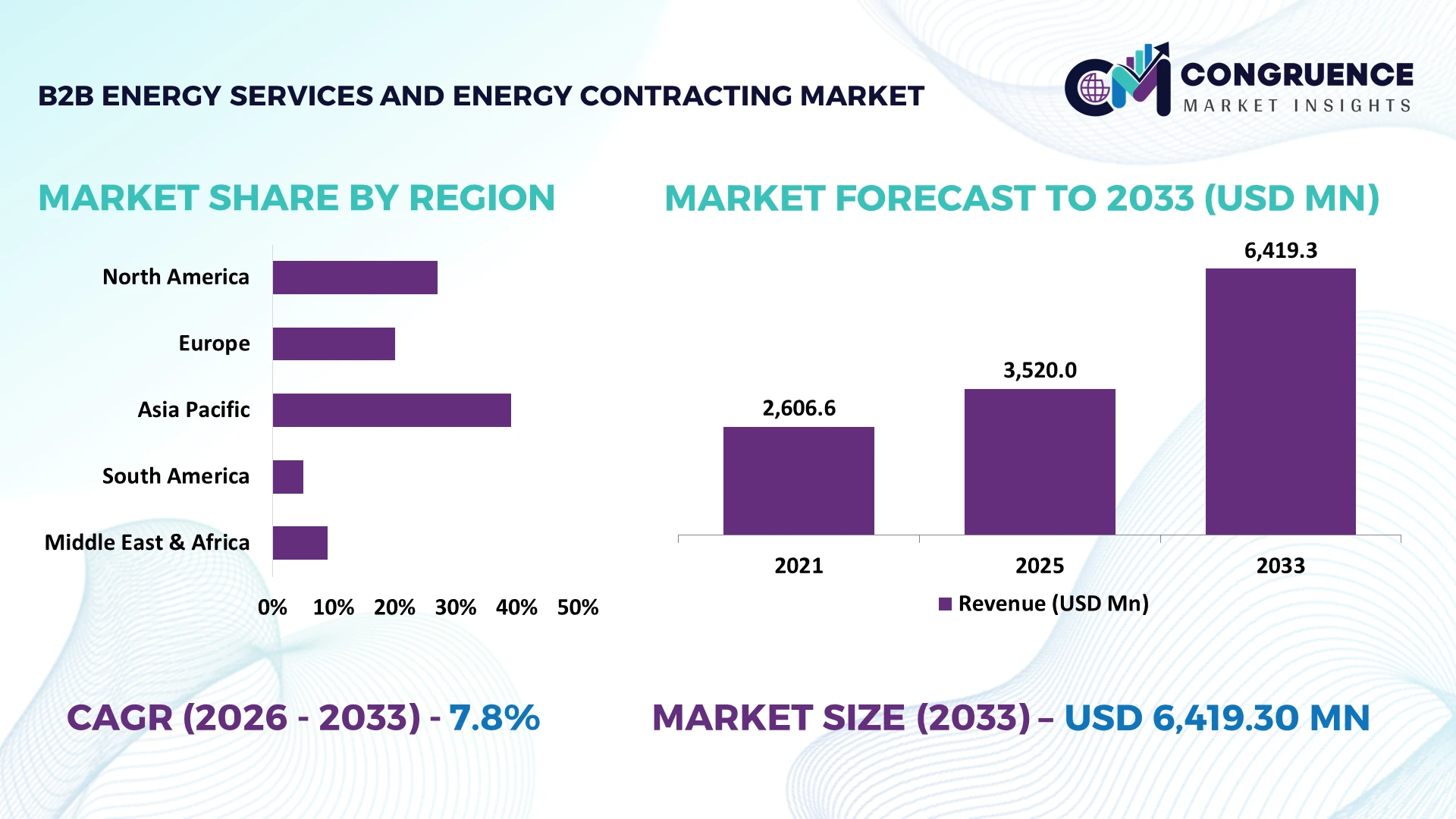
The United States remains the dominant country, representing approximately 31% of global B2B energy services activity, supported by commercial infrastructure modernization, industrial energy-efficiency programs, and expanding distributed generation contracts. More than 58% of large enterprises increasingly use outsourced energy-management or contracting models, compared with roughly 37% in Germany. The Inflation Reduction Act continues influencing clean-energy investment decisions, while European buyers emphasize energy-efficiency contracting and long-term procurement structures.
Strategic priority is shifting toward integrated contracting platforms that combine energy efficiency, renewable supply, storage, and digital energy management.
Market Size & Growth: USD 3520 Million in 2025 to USD 6419.3 Million by 2033 at 7.8% CAGR, driven by energy-as-a-service adoption and efficiency outsourcing.
Top Growth Drivers: Energy optimization 34%, renewable contracting 27%, distributed energy 21%.
Short-Term Forecast: By 2028, digital energy-management adoption is positioned to reduce enterprise energy costs by 12% and improve consumption efficiency by 15%.
Emerging Technologies: AI forecasting, automated demand response, and battery optimization can improve energy-management performance by 14%.
Regional Leaders: North America approaches USD 2200 Million, Europe USD 1700 Million, and Asia-Pacific USD 1500 Million, supported by expanding contracted energy solutions.
Consumer/End-User Trends: Approximately 61% of large enterprises prioritize outsourced energy optimization and long-term energy contracting.
Pilot/Case Example: A 2026 industrial energy-management deployment delivered a 16% reduction in peak electricity consumption through automated load optimization.
Competitive Landscape: Leading providers command approximately 28% combined share, with Siemens, Schneider Electric, ENGIE, Johnson Controls, and Honeywell competing across integrated services.
Regulatory & ESG Impact: Corporate decarbonization programs are driving approximately 19% higher adoption of renewable-linked energy contracts.
Investment & Funding: More than USD 2.4 Billion in strategic energy-service investment supports digital platforms, distributed assets, and contracting partnerships.
Innovation & Future Outlook: Integrated storage, AI optimization, flexible procurement, and performance-based contracts are reshaping enterprise energy strategies through 2030.
The B2B Energy Services and Energy Contracting Market is expanding across industrial facilities, commercial buildings, data centers, healthcare campuses, logistics sites, and manufacturing networks seeking predictable energy expenditure and measurable efficiency gains. Advanced energy-management platforms, performance-based contracts, and renewable-linked procurement are becoming increasingly important, with enterprise adoption approaching 60% among large energy users. In 2026, supply-chain volatility and evolving power-market regulations are strengthening the case for flexible contracting structures, creating a clear transition toward integrated energy services and strategic outsourcing.
B2B energy services are becoming strategically important as enterprises shift energy management from a facilities expense to a controllable operating asset. Volatile power prices, grid constraints, and decarbonization requirements are accelerating performance-based contracting and energy-as-a-service models. Around 61% of large enterprises increasingly outsource at least part of energy optimization, strengthening the role of specialized providers in investment planning and operational resilience.
Technology is widening the advantage. AI-enabled energy-management platforms can reduce peak consumption by approximately 12–15% versus conventional manual monitoring, while automated demand response improves load flexibility by about 10%. North American buyers emphasize distributed generation, storage, and flexible procurement, whereas German and Nordic enterprises prioritize efficiency retrofits and renewable-linked contracts. By 2028, integrated digital energy platforms are positioned to reach more than 65% adoption among large contracted energy users.
A practical deployment involves industrial campuses combining solar procurement, battery storage, automated load control, and performance-based energy contracts, reducing peak-demand exposure while improving procurement visibility. Providers are responding by forming technology partnerships, expanding distributed-energy portfolios, and bundling software with long-term service agreements. Competitive strength increasingly depends on measurable savings, flexible infrastructure, and the ability to manage energy assets as an integrated portfolio.
Rising electricity-price volatility and increasingly complex energy portfolios are pushing enterprises toward outsourced optimization and performance-based contracts. Approximately 61% of large energy users now prioritize third-party energy-management capabilities, while automated demand response can reduce peak consumption by 12% and improve load flexibility by nearly 10%. In the United States, data centers and manufacturing facilities are accelerating procurement of storage, renewable power, and flexible-load services as grid congestion intensifies. Energy-service companies are responding with bundled contracts covering efficiency upgrades, renewable procurement, storage, and digital monitoring. The non-obvious advantage is improved budget predictability: providers increasingly assume performance obligations, allowing customers to shift capital toward core production while maintaining measurable energy savings.
Complex tariff structures, fluctuating wholesale electricity prices, and inconsistent contract frameworks constrain standardized B2B energy-service deployment. Approximately 27% of enterprise energy programs require substantial contract customization, while energy-price volatility can alter projected savings by 10–15% across longer agreements. In India, differences between state-level power regulations and open-access requirements complicate multi-site contracting for industrial customers. Providers are reducing exposure through indexed pricing, diversified procurement portfolios, and multi-year supply agreements. However, excessive customization raises transaction costs and slows contract execution. The strongest operational response is standardized contract architecture combined with site-specific pricing mechanisms, enabling providers to preserve margin while giving customers clearer savings visibility.
AI forecasting, automated demand response, and distributed-energy orchestration are opening higher-value service models beyond conventional efficiency contracting. AI-based load forecasting can improve consumption prediction accuracy by approximately 15%, while coordinated battery dispatch reduces peak electricity exposure by around 13%. Japan's advanced manufacturing sector offers a strong opportunity for integrated energy-management platforms linking storage, renewable procurement, and production scheduling. Providers are investing in software capabilities and partnerships with battery, building-management, and grid-optimization companies. A particularly valuable opportunity lies in multi-site portfolio management, where one digital platform can optimize hundreds of facilities simultaneously. This shifts competition from individual energy projects toward recurring, data-driven energy performance services.
Scaling integrated energy contracts requires reliable interoperability between building-management systems, industrial controls, meters, storage assets, and utility interfaces. Approximately 34% of enterprise energy programs still require significant systems integration, while workforce shortages can extend commissioning schedules by nearly 15%. Cybersecurity exposure also increases as contracted assets become remotely managed and connected to cloud platforms. U.S. industrial campuses are responding by strengthening cybersecurity requirements and using standardized communication architectures during energy-system upgrades. Providers must invest in skilled commissioning teams, secure data infrastructure, and interoperable platforms while building partnerships with technology integrators. Long-term competitiveness will depend on delivering consistent performance across heterogeneous customer assets rather than simply adding more contracted capacity.
AI Reshapes Energy Operations: AI forecasting and automated controls are moving into multi-site energy portfolios, with digital optimization improving energy performance by 10–15% and reducing manual monitoring by nearly 20%. U.S. manufacturers are partnering with software providers to coordinate loads, storage, and procurement.
Contracting Models Become Flexible: Performance-based agreements and renewable-linked procurement are gaining traction as enterprises seek predictable energy costs. Flexible contracts now influence roughly 28% of new corporate energy programs, while indexed structures reduce exposure to price swings by about 12%. Providers are restructuring offerings around bundled services.
Efficiency Gains Drive Procurement: Energy efficiency is becoming a measurable competitiveness tool rather than a compliance exercise. Nearly 80% of industrial firms surveyed by the IEA in 2025 identified efficiency as important to competitiveness, while energy-management programs deliver more than 10% savings within three years. Providers are expanding audit-to-implementation services.
Renewable Contracting Gets Competitive: Competitive auctions and market-based procurement are reshaping renewable contracting, with auctions accounting for almost 60% of expected utility-scale renewable capacity additions during 2025–2030. China’s policy shift toward competitive pricing is accelerating procurement restructuring, pushing service companies toward integrated renewable, storage, and energy-management packages.
Energy Procurement remains the leading type, representing approximately 32% of market activity as enterprises prioritize predictable electricity costs, renewable sourcing, and portfolio diversification. Its scalability across multi-site operations gives procurement platforms a stronger position than standalone advisory services. Performance Contracting is the fastest-growing type, expanding adoption by roughly 16% as customers increasingly link provider compensation to verified savings. Energy Management follows closely, with digital monitoring and automated optimization improving operational visibility by nearly 14%, while Consulting Services remain important for regulatory planning, audits, and complex energy-transition programs.
The market is shifting from transactional electricity sourcing toward integrated contracts combining procurement, efficiency, and distributed assets. Companies are expanding renewable procurement capabilities, forming storage and software partnerships, and standardizing multi-site contracting frameworks. Performance-based structures increasingly attract capital because providers assume greater execution responsibility. This shift strengthens recurring service relationships while reducing customer reluctance to fund efficiency upgrades independently.
Energy Efficiency leads applications with approximately 38% market share because measurable cost reduction remains the most immediate justification for outsourced energy services. Industrial and commercial customers increasingly combine audits, automation, HVAC optimization, and demand management, with integrated programs reducing energy consumption by 10–15% in well-managed facilities. Carbon Management is the fastest-growing application, with adoption increasing approximately 18% as enterprises connect emissions targets with procurement and operational decisions. Renewable Energy remains strategically important, while Facility Management provides the operational layer for continuous building and asset optimization.
Demand is becoming more data-driven as enterprises require verified performance rather than broad sustainability claims. Companies are integrating energy meters, building-management platforms, renewable contracts, and carbon-accounting systems to improve reporting and operational control. Providers are responding with bundled service models and automated analytics, shifting investment toward measurable energy performance and recurring digital services rather than isolated retrofit projects.
Manufacturing represents approximately 36% of demand, reflecting continuous production schedules, high electricity intensity, and strong exposure to energy-price volatility. Large factories increasingly outsource procurement, monitoring, and efficiency optimization across multiple sites. Commercial Buildings form the fastest-growing end-user group, with adoption rising approximately 17% as owners address HVAC loads, building-performance requirements, and tenant expectations. Government facilities remain significant through public-sector efficiency programs, while Healthcare and Education increasingly use contracted services to modernize aging infrastructure without diverting capital from core functions.
Manufacturing buyers prioritize measurable savings and operational continuity, whereas commercial and institutional customers increasingly value integrated digital monitoring and long-term service agreements. Companies are tailoring pricing models, establishing sector-specific partnerships, and bundling energy management with facility services. Healthcare providers favor reliability-focused contracts, while education and government customers emphasize predictable budgets. The competitive opportunity is strongest for providers able to standardize delivery across dispersed facilities while maintaining site-level performance accountability.
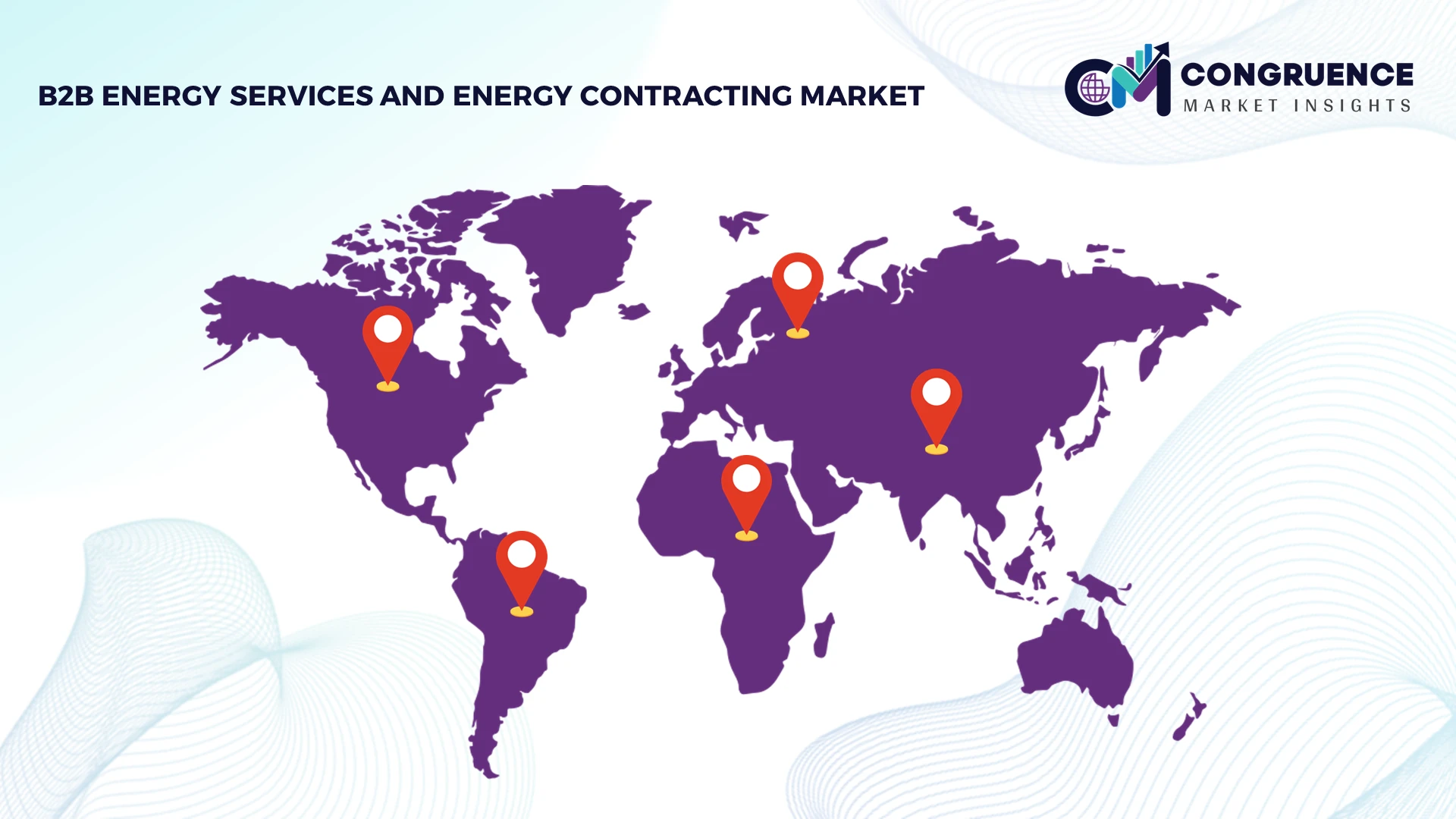
North America accounted for the largest market share at 31% in 2025 however, Asia-Pacific is expected to register the fastest growth, expanding at a 9.2% CAGR between 2026 and 2033.
Digital Energy Procurement Reshapes Enterprise Operations
North America holds approximately 31% of global B2B energy services activity, supported by industrial electrification, data-center expansion, distributed energy deployment, and sophisticated power markets. U.S. enterprises increasingly combine energy procurement, demand response, storage, and efficiency services through multi-year contracts. Approximately 64% of large commercial and industrial organizations now prioritize digital energy-management capabilities, strengthening demand for integrated service providers. Utility-scale renewable additions and grid congestion are also increasing the value of flexible procurement and load-management agreements. Providers are expanding software partnerships and performance-based contracting portfolios to address complex customer requirements. The strongest competitive shift is toward integrated energy platforms that combine procurement visibility with real-time asset optimization, improving operational resilience while reducing exposure to volatile electricity pricing.
United States Market Outlook: The United States remains the region's principal market because of its extensive industrial base, data-center infrastructure, mature energy-service ecosystem, and expanding distributed-energy investments. Around 62% of large enterprises use or actively evaluate outsourced energy-management solutions. Providers are prioritizing storage integration, renewable procurement, demand-response capabilities, and AI-based forecasting to strengthen customer retention and improve measurable contract performance.
Energy Security Accelerates Contract Restructuring
Europe accounts for approximately 27% of global market activity, with energy-intensive manufacturing, commercial infrastructure, and public facilities driving adoption of structured energy services. Energy-price volatility following disruptions to European gas supply chains has accelerated long-term procurement, efficiency contracting, and renewable power agreements. Nearly 59% of large enterprises are increasing attention to energy-cost optimization through contracted services. Germany, France, and the United Kingdom remain important deployment centers, while Nordic markets emphasize digital flexibility and renewable integration. Providers are restructuring contracts around energy performance, flexible procurement, and distributed assets rather than standalone consulting. Partnerships between energy-service companies, technology firms, and facility operators are strengthening bundled offerings and improving multi-site deployment efficiency.
Germany Market Outlook: Germany leads European demand through its energy-intensive manufacturing base, sophisticated industrial infrastructure, and strong efficiency requirements. Approximately 57% of major industrial enterprises prioritize structured energy-management programs. Providers are expanding performance contracting, digital monitoring, renewable procurement, and industrial efficiency partnerships to help manufacturers control energy exposure while maintaining production competitiveness.
Manufacturing Scale Drives Integrated Energy Services
Asia-Pacific represents approximately 25% of global B2B energy-service activity and is gaining strategic importance through manufacturing expansion, data-center construction, electrification, and industrial infrastructure investment. China, Japan, South Korea, India, and Singapore are developing distinct contracting models around renewable procurement, energy efficiency, and distributed generation. Enterprise adoption of digital energy-management systems has reached approximately 52% among large energy-intensive organizations in leading industrial markets. Manufacturers increasingly outsource energy optimization to reduce internal engineering requirements and improve operating visibility. Providers are localizing service teams, partnering with technology vendors, and developing multi-site contracting capabilities. The region's scale advantage is shifting competition toward standardized platforms that can be rapidly deployed across factories, logistics facilities, and commercial campuses.
China Market Outlook: China remains the leading Asia-Pacific market because of its manufacturing concentration, rapidly expanding renewable infrastructure, and large industrial electricity demand. More than 55% of major industrial enterprises increasingly integrate digital energy monitoring into operational planning. Service providers are strengthening local partnerships, renewable procurement capabilities, and automated energy-management solutions to serve geographically dispersed manufacturing portfolios.
Industrial Electrification Opens New Contracting Models
South America accounts for approximately 6% of global B2B energy services activity, with Brazil representing the principal demand center through manufacturing, mining, agribusiness, logistics, and commercial infrastructure. Renewable electricity availability is encouraging businesses to combine power procurement with efficiency and distributed-generation services. Approximately 38% of large Brazilian enterprises are increasing investment attention toward structured energy optimization and renewable procurement. Market fragmentation across electricity regulations and infrastructure creates execution complexity for multi-country contracts. Providers are responding through local partnerships, standardized service platforms, and flexible procurement structures. Mining and processing companies increasingly favor contracts that combine predictable energy costs with operational monitoring. This creates an important opportunity for providers capable of coordinating energy assets across geographically dispersed industrial sites.
Brazil Market Outlook: Brazil holds the strongest country position through its industrial scale, renewable-heavy electricity system, and expanding corporate energy procurement activity. Approximately 41% of large commercial and industrial buyers actively evaluate renewable-linked contracting models. Service providers are strengthening local technical teams, digital monitoring capabilities, and partnerships with renewable generators to improve contract flexibility and customer retention.
Industrial Diversification Accelerates Energy-Service Investment
The Middle East & Africa market is being reshaped by refinery modernization, petrochemical expansion, industrial diversification, and large-scale infrastructure development. Saudi Arabia and the United Arab Emirates are leading adoption as industrial projects increasingly incorporate efficiency management, renewable procurement, and distributed energy solutions. Approximately 34% of new large commercial and industrial developments increasingly include contracted energy optimization capabilities. Providers are establishing local partnerships and expanding performance-based service models to address complex infrastructure requirements. Data centers, airports, manufacturing zones, and petrochemical facilities are becoming important demand centers. The strategic shift is from traditional energy supply toward integrated services combining procurement, efficiency, digital monitoring, and asset management, enabling customers to improve energy visibility while limiting internal capital requirements.
Saudi Arabia Market Outlook: Saudi Arabia leads regional opportunity through industrial diversification, petrochemical infrastructure, and large-scale development programs. More than 40% of major new industrial developments increasingly evaluate integrated energy-management solutions. Providers are establishing local service partnerships and expanding renewable procurement, efficiency optimization, and digital monitoring capabilities to support energy-intensive facilities and large infrastructure projects.
The B2B Energy Services and Energy Contracting Market pits integrated energy-service leaders such as Schneider Electric, Siemens, ENGIE, Johnson Controls, and Honeywell against specialist energy consultants, renewable developers, utilities, and regional performance-contracting providers. The top five players collectively hold approximately 28% share, indicating a fragmented structure where scale competes with specialized execution. Competition centers on technology, contract flexibility, procurement capability, and service integration: AI-enabled platforms improve energy optimization by 12–15%, while performance-based models can reduce customer upfront capital requirements by 20–30%. Global providers are expanding through software partnerships, renewable procurement alliances, storage integration, and multi-site service contracts. Regional specialists compete through localized pricing and faster project execution. The competitive shift is toward integrated energy-as-a-service platforms combining procurement, efficiency, storage, and digital controls. High customer switching costs, technical expertise requirements, and complex regulatory compliance constrain new entrants. Winning requires measurable savings, scalable digital infrastructure, flexible contracting, and reliable multi-site execution.
Schneider Electric
Siemens
ENGIE
Johnson Controls
Honeywell International
Veolia
Ameresco
Enel X
Edison Energy
Trane Technologies
ABM Industries
Dalkia
Centrica Business Solutions
WSP Global
AI-enabled energy management, IoT metering, and automated demand-response platforms are becoming core technologies for B2B energy services. Approximately 55% of large enterprises now use advanced digital monitoring, improving energy efficiency by 12% and reducing manual analysis costs by 10%. Cloud-based analytics integrates procurement, facility controls, and distributed assets, giving providers faster visibility into consumption and stronger performance-based contracting capabilities.
Emerging technologies include digital twins, battery optimization, AI forecasting, and automated energy procurement. These systems improve load-forecasting accuracy by 15% and reduce peak-demand costs by 13%, while adoption across digitally mature enterprise portfolios approaches 40%. Compared with legacy spreadsheet-based monitoring, integrated platforms improve energy-management response speed by nearly 20%. Schneider Electric, Siemens, and technology-led providers benefit because their platforms combine software, controls, and lifecycle services into recurring contracts.
Disruptive models are moving toward autonomous energy orchestration, 24/7 renewable matching, virtual power plants, and storage-as-a-service. By 2028, integrated digital platforms are positioned to exceed 65% adoption among large contracted energy users, while automated optimization can improve portfolio performance by another 8–12%. Companies acting now can secure data advantages, strengthen customer retention, and capture higher-value recurring service contracts as energy procurement and infrastructure management converge. This shifts competition toward measurable verified savings.
July 2025 Schneider Electric agreed to acquire the remaining 35% of its India joint venture for €5.5 billion, strengthening its regional R&D and supply-chain hub. The transaction deepened local control over energy-management delivery, manufacturing coordination, expansion, and customer service capabilities. Source: se.com
November 2025 ENGIE won its first Indian battery-storage project, a 280 MW/560 MWh system under a national tender. The project strengthened its integrated renewable-and-storage contracting portfolio and expanded its Indian operational platform ahead of 2027 commissioning and commercial deployment programs. Source: engie.com
July 2025 Utility Dive reported Schneider Electric’s new supply-chain decarbonization platform, Zeigo Hub, enabling companies to engage suppliers and track emissions. The launch strengthens digital energy-service offerings by connecting procurement workflows with supplier decarbonization and emissions management capabilities directly globally. Source: utilitydive.com
December 2025 The U.S. Department of Energy reported more than $18 billion invested through federal performance-contracting projects, with average contracts reducing site energy use by at least 20%. The result strengthens performance contracting as a capital-efficient route to modernization nationwide. Source: energy.gov
The report evaluates B2B Energy Services and Energy Contracting across Energy Procurement, Energy Management, Performance Contracting, and Consulting Services. Coverage spans Energy Efficiency, Renewable Energy, Facility Management, and Carbon Management, with demand assessed across Manufacturing, Commercial Buildings, Government, Healthcare, and Education. Regional analysis covers North America, Europe, Asia-Pacific, South America, and Middle East & Africa, including emerging distributed-energy and digital-service applications.
The study examines AI-enabled energy management, automated demand response, battery optimization, digital twins, renewable procurement, and integrated energy platforms shaping enterprise contracting. Approximately 60% of large energy users increasingly prioritize outsourced optimization, while performance-based models strengthen capital flexibility. Competitive analysis covers leading providers, partnership structures, technology differentiation, and deployment strategies, supporting investment planning, geographic expansion, portfolio positioning, and strategic decisions through 2033.
| Report Attribute/Metric | Report Details |
|---|---|
Market Revenue in 2025 | USD 3520 Million |
Market Revenue in 2033 | USD 6419.3 Million |
CAGR (2026 - 2033) | 7.8% |
Base Year | 2025 |
Forecast Period | 2026 - 2033 |
Historic Period | 2021 - 2025 |
Segments Covered | By Type
By Application
By End-User
|
Key Report Deliverable | Revenue Forecast, Growth Trends, Market Dynamics, Segmental Overview, Regional and Country-wise Analysis, Competition Landscape |
Region Covered | North America, Europe, Asia-Pacific, South America, Middle East, Africa |
Key Players Analyzed | Schneider Electric, Siemens, ENGIE, Johnson Controls, Honeywell International, Veolia, Ameresco, Enel X, Edison Energy, Trane Technologies, ABM Industries, Dalkia, Centrica Business Solutions, WSP Global |
Customization & Pricing | Available on Request (10% Customization is Free) |




