
Reports
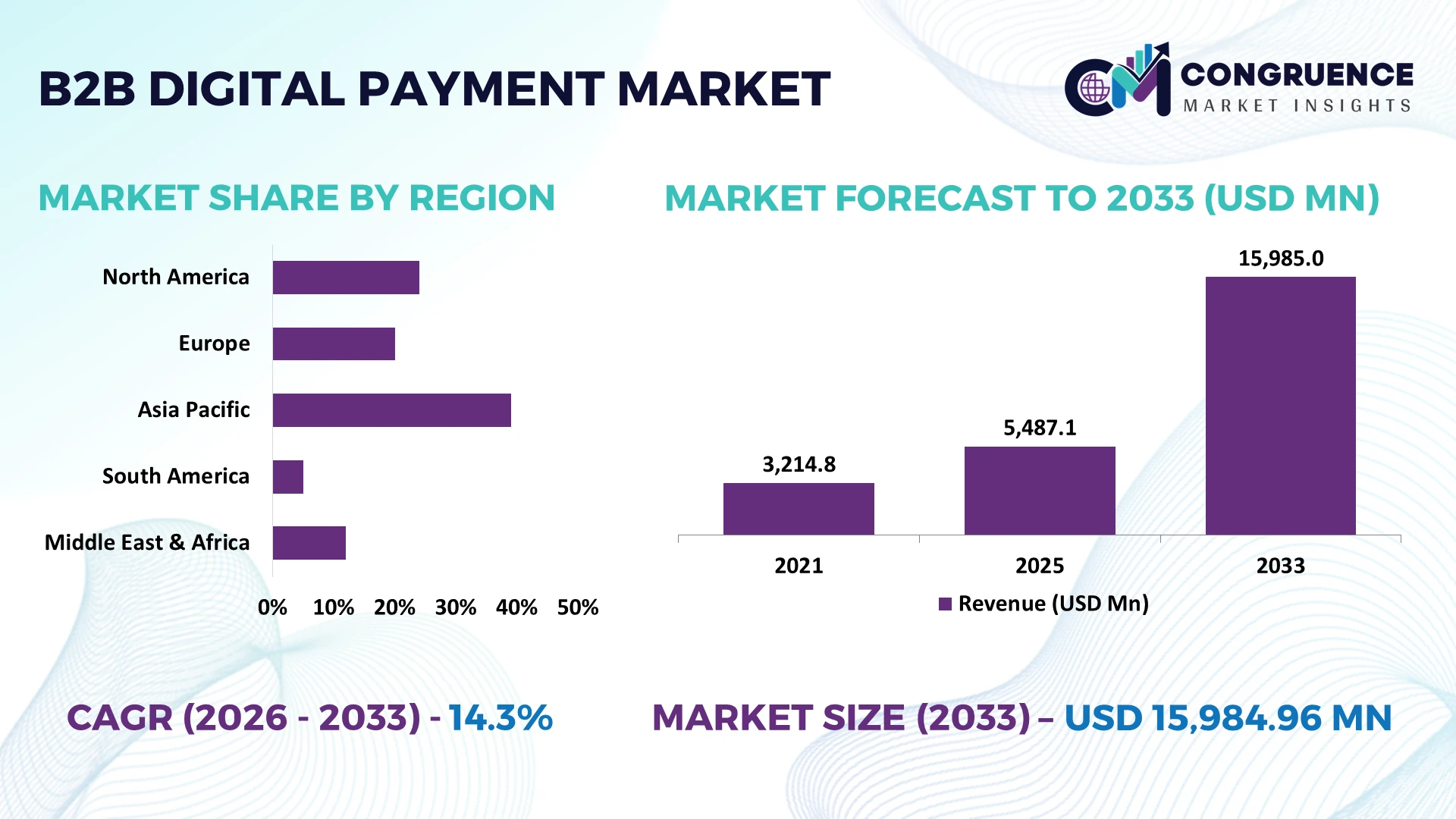
The Global B2B Digital Payment Market was valued at USD 5487.08 Million in 2025 and is anticipated to reach a value of USD 15984.96 Million by 2033 expanding at a CAGR of 14.3% between 2026 and 2033. Growth is driven by real-time payment rails, API-enabled embedded finance, automated invoice reconciliation, cross-border payment digitization, and the replacement of paper-based B2B payment workflows.
The United States remains a dominant market, supported by rapid enterprise adoption of real-time payment infrastructure and strong fintech investment across banking, manufacturing, retail, and professional services. India is a major technology-led challenger, with UPI accounting for more than 80% of digital payment transactions and processing billions of transactions monthly. The U.S. leads in enterprise payment infrastructure, while India leads in transaction-scale adoption.
The strategic priority is shifting toward integrated platforms combining instant settlement, AI fraud detection, ERP connectivity, and automated reconciliation.
Market Size & Growth: USD 5,487.08 million in 2025 is projected to reach USD 15,984.96 million by 2033 at a 14.3% CAGR, supported by real-time payments and automated B2B workflows.
Top Growth Drivers: Real-time payment adoption 66%, automated reconciliation 34%, and embedded-payment integration 29% are accelerating enterprise payment modernization.
Short-Term Forecast: By 2028, automated B2B payment workflows are positioned to reduce manual processing costs by 15% and improve reconciliation efficiency by 20%.
Emerging Technologies: AI fraud detection, API-based embedded payments, ISO 20022 messaging, and intelligent automation are strengthening transaction speed, security, and processing accuracy.
Regional Leaders: North America is projected at approximately USD 5.0 billion, Asia Pacific at USD 5.1 billion, and Europe at USD 3.8 billion by 2033, supported by expanding real-time payment infrastructure.
Consumer/End-User Trends: More than 80% of India’s digital payment activity is processed through UPI, demonstrating the rapid shift toward mobile-first and instant B2B transaction ecosystems.
Pilot/Case Example: India’s UPI ecosystem recorded approximately 30% year-on-year transaction-volume growth in FY2025-26, demonstrating the scalability of real-time payment infrastructure.
Competitive Landscape: PayPal, Stripe, JPMorgan Chase, Visa, and Mastercard remain key competitors, with platform differentiation increasingly centered on APIs, fraud prevention, and cross-border capabilities.
Regulatory & ESG Impact: EU instant-payment regulation requires euro transfers to reach recipients within 10 seconds, strengthening settlement efficiency and accelerating cross-border payment modernization.
Investment & Funding: More than USD 10 billion in recent fintech and payment infrastructure investment is being directed toward AI, cloud processing, fraud prevention, embedded finance, and real-time connectivity.
Innovation & Future Outlook: AI agents, programmable payments, digital identity, and automated treasury management are shifting competition from transaction processing toward intelligent financial orchestration.
The B2B Digital Payment Market is expanding beyond basic electronic transfers toward automated, intelligent, and embedded financial workflows. Demand is strongest across cross-border commerce, manufacturing, retail, logistics, professional services, and digitally integrated enterprises, where payment automation can reduce manual intervention by approximately 15%. Real-time settlement requirements, ISO 20022 adoption, and supply-chain digitization are accelerating platform upgrades, creating a strategic shift toward integrated payment ecosystems.
B2B digital payments are becoming a strategic infrastructure layer for enterprise competitiveness, cash-flow control, and supply-chain resilience rather than a back-office transaction function. In the U.S., 66% of businesses indicate they would use instant payments if offered by their primary financial institution, while 34% prioritize instant invoice and recurring-bill payments. The shift is accelerating as enterprises replace checks, with checks representing 26% of B2B payments in 2025.
Infrastructure modernization is creating a clear regional contrast. India processed 24,161.69 crore UPI transactions in FY2025-26, with UPI representing 85% of digital payments, while the U.S. is building enterprise-grade instant-payment capacity through FedNow, which had more than 1,400 participants by July 2025. Europe is simultaneously enforcing instant euro payments and payee verification, making regulatory modernization a competitive differentiator.
Over the next 2–3 years, enterprises will prioritize API-integrated payment orchestration, automated reconciliation, and fraud controls, targeting 15–20% reductions in manual processing. A practical deployment example is FedNow's expansion to higher-value business transactions, including a $1 million limit in 2025. Companies are therefore redirecting investment toward fintech partnerships, ERP integration, and real-time infrastructure, making payment intelligence a decisive source of operational advantage.
Real-time infrastructure is the strongest structural driver as enterprises demand faster settlement, tighter liquidity control, and automated reconciliation. In the U.S., 66% of businesses are likely to use instant payments when available, while 34% prioritize instant invoice payments and 29% prioritize just-in-time B2B transactions. FedNow exceeded 1,400 participants by July 2025, signaling expanding institutional connectivity. Companies are responding by integrating payment APIs directly into ERP, treasury, and accounts-payable platforms. The non-obvious advantage is improved supplier responsiveness: instant settlement enables businesses to synchronize payments with inventory and procurement cycles rather than fixed banking windows, strengthening working-capital efficiency and supply-chain coordination.
Legacy payment fragmentation remains a major constraint because enterprises must connect bank rails, ERP platforms, payment gateways, and compliance systems without disrupting existing workflows. In 2025, checks still accounted for 26% of surveyed B2B payments, while 79% of organizations reported payment-fraud attacks or attempts during 2024. Check fraud alone affected 63% of respondents. These conditions increase reconciliation workloads and security expenditure, particularly for U.S. companies operating across multiple payment methods. Businesses are responding through payment standardization, bank diversification, verification controls, and automated fraud monitoring. The key operational limitation is that faster settlement without stronger authentication can compress the time available to detect and reverse fraudulent transactions.
The next opportunity lies in embedding payments directly into procurement, invoicing, marketplaces, and treasury applications. U.S. businesses already show 38% interest in instant digital-wallet funding and 35% interest in faster payroll, while 34% prioritize recurring invoices. India provides a stronger scale benchmark: UPI represented 85% of digital payments in FY2025-26 and processed 24,161.69 crore transactions, with volume rising 30% year over year. Companies can translate this infrastructure model into B2B workflows through API orchestration, AI reconciliation, and programmable payments. Strategic investment is shifting toward fintech-bank partnerships and embedded finance ecosystems, where payment providers capture value by becoming workflow infrastructure rather than standalone transaction processors.
The central execution challenge is scaling instant payments without weakening cybersecurity, fraud controls, or compliance consistency. The 79% payment-fraud exposure reported by organizations demonstrates the intensity of the threat, while 63% experiencing check-fraud attempts highlights persistent vulnerability during migration from legacy methods. At the infrastructure level, FedNow introduced configurable account-activity thresholds and increased its transaction limit to $1 million in 2025 to support higher-value business use cases. Companies must therefore invest simultaneously in behavioral analytics, transaction monitoring, identity verification, and resilient API architecture. The strategic difficulty is maintaining low-friction payments while adding sufficient controls; competitive platforms will differentiate through risk intelligence embedded directly into payment execution rather than through separate security layers.
Instant Payments Reshape Workflows: U.S. businesses show 66% likelihood of using instant payments, while 34% prioritize instant invoice settlement and 29% favor just-in-time B2B payments. Enterprises are integrating real-time rails with treasury and ERP systems to shorten settlement cycles, improve liquidity visibility, and automate payment approvals.
Check Replacement Accelerates Migration: B2B check usage fell to 26% in 2025 from 33% in 2022, while ACH B2B volume increased 10% in Q3 2025. Enterprises are restructuring accounts-payable processes around ACH, virtual cards, and automated reconciliation, reducing manual processing while strengthening fraud controls and supplier-payment visibility.
Cross-Border Infrastructure Expands: Cross-border payment participation reached 87% of organizations in 2025, up 9 percentage points from 2022. Global supply-chain restructuring and regulatory modernization are driving multi-rail payment orchestration, automated compliance, and localized settlement partnerships. Companies increasingly prioritize interoperability across banking systems rather than dependence on a single payment rail.
Embedded Payments Gain Enterprise Traction: Digital-wallet funding is prioritized by 38% of U.S. businesses, while 35% prioritize faster payroll and 34% prioritize recurring invoices. Enterprises are embedding payments into procurement, payroll, and billing platforms, shifting investment toward API connectivity, workflow automation, and integrated financial operations rather than standalone transaction processing.
Bank Transfers represent the leading type, accounting for approximately 32% of B2B digital payment activity, supported by extensive banking connectivity, lower transaction costs, high-value transaction capability, and established treasury integration. Account-to-Account Payments are the fastest-growing type as enterprises adopt open-banking connectivity and instant-payment infrastructure. Their direct settlement model reduces intermediary dependence and improves transaction visibility. Card Payments remain important for controlled corporate spending, while Digital Wallets are expanding through platform commerce and mobile-first workflows. Payment Gateways retain strategic value by consolidating multiple payment methods through unified interfaces. Companies are therefore increasing investment in API-enabled bank transfers and A2A infrastructure while maintaining card capabilities for procurement controls and gateway partnerships for multi-method acceptance.
Supplier Payments represent the leading application, accounting for approximately 34% of B2B digital payment activity because recurring vendor obligations require predictable settlement, remittance visibility, and efficient reconciliation. Invoicing & Collections remain highly established as enterprises automate receivables and reduce manual matching. Cross-Border Payments are the fastest-growing application, supported by international sourcing, distributed supply chains, and demand for transparent settlement. Payroll Processing is becoming increasingly integrated with real-time payment infrastructure, while Subscription Payments are expanding through automated recurring billing. Companies are prioritizing supplier-payment automation, ERP connectivity, and multi-rail settlement to strengthen working-capital visibility. The strongest operational shift is linking payment execution directly with invoice approval, procurement, and supplier-management workflows.
Retail & E-Commerce represent the leading end-user group, accounting for approximately 29% of B2B digital payment activity due to high transaction frequency, extensive supplier networks, marketplace operations, and continuous reconciliation requirements. Financial Services remain infrastructure-intensive, while Manufacturing maintains strong demand for supplier settlement and procurement integration. Professional Services increasingly prioritize automated billing and recurring collections. Healthcare is adopting digital payments more selectively because compliance requirements and fragmented provider networks influence deployment. Financial Services and Retail & E-Commerce are among the strongest adopters of API-driven infrastructure. Companies are responding with vertical-specific payment platforms, embedded-finance partnerships, and automated reconciliation tools, while manufacturers increasingly connect payment systems with procurement and supply-chain management platforms.
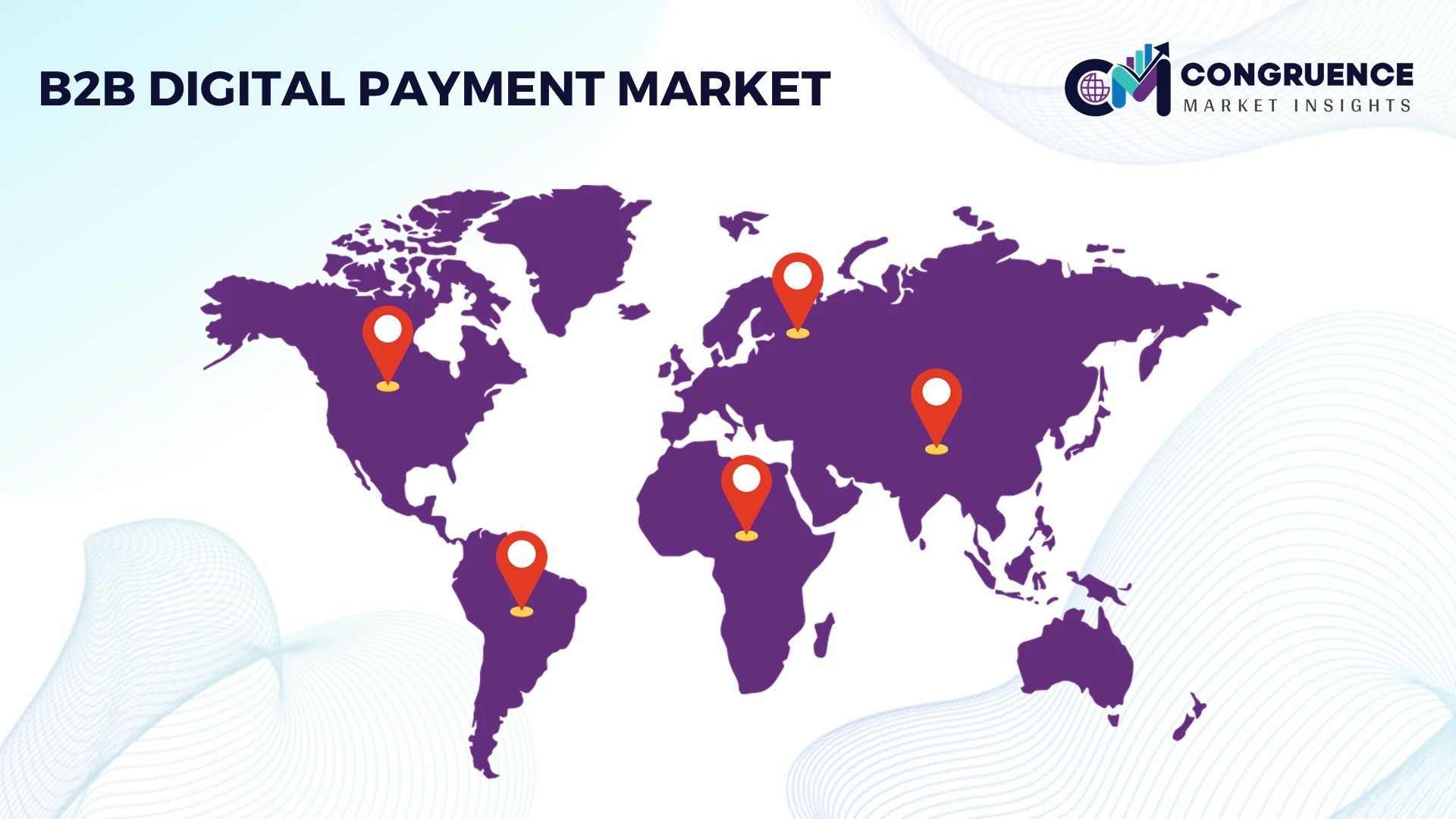
North America accounted for the largest market share at 36.4% in 2025 however, Asia-Pacific is expected to register the fastest growth, expanding at a CAGR of 16.8% between 2026 and 2033.
Real-Time Infrastructure Drives Enterprise Payment Modernization
North America remains the leading B2B digital payment market, supported by deep banking infrastructure, mature enterprise software ecosystems, and rapid deployment of instant-payment capabilities. The United States represents the regional center of activity, with FedNow exceeding 1,400 participating financial institutions by 2025 and supporting transaction limits of up to USD 1 million. Enterprise adoption is shifting from card-based and ACH workflows toward API-connected real-time payment orchestration, automated reconciliation, and embedded treasury services. Financial institutions, fintech platforms, and enterprise software providers are increasingly forming partnerships to integrate payment capabilities directly into procurement and accounting environments. Canada is also strengthening digital payment interoperability through real-time infrastructure modernization. The key competitive advantage is increasingly transaction intelligence rather than payment execution alone, with fraud analytics and automated liquidity management becoming important differentiators.
United States Market Outlook: The United States dominates North American B2B payment deployment because of its extensive banking network, enterprise technology base, and accelerating instant-payment infrastructure. FedNow's expansion to a USD 1 million transaction limit strengthens its relevance for higher-value commercial transactions. Large banks and fintech providers are prioritizing API integration, fraud monitoring, and embedded payment capabilities to capture enterprise migration from legacy payment methods.
Regulatory Modernization Reshapes Cross-Border Payments
Europe is undergoing structural payment modernization as regulatory requirements increasingly standardize instant settlement, verification, and interoperability. The European Union's Instant Payments Regulation requires euro transfers to reach recipients within 10 seconds while strengthening payee verification, accelerating migration away from conventional settlement cycles. Germany, the United Kingdom, France, and the Netherlands remain important enterprise payment centers, supported by sophisticated banking networks and strong fintech adoption. European manufacturers and distributors are increasingly connecting payment systems with procurement, invoicing, and treasury platforms to improve cross-border visibility. Sustainability also benefits from reduced paper-based documentation and more automated transaction processing. Banks and fintech companies are responding through instant-payment partnerships, compliance automation, and API-based payment infrastructure, while SEPA interoperability strengthens regional transaction standardization.
Germany Market Outlook: Germany represents a strategically important enterprise payment market because of its large manufacturing base, export orientation, and extensive supplier networks. Automotive, machinery, chemicals, and industrial technology companies increasingly require automated supplier payments and cross-border settlement. The country's strong banking infrastructure and European instant-payment requirements are encouraging enterprises to integrate real-time payment capabilities with ERP and treasury systems.
India and China Accelerate Digital Payment Scale
Asia-Pacific is the fastest-transforming market, supported by extensive manufacturing ecosystems, mobile-first payment adoption, and rapid financial infrastructure modernization. India provides the strongest real-time payment scale, with UPI processing approximately 24,161.69 crore transactions in FY2025-26 and accounting for about 85% of digital payments. China continues to benefit from highly developed mobile payment ecosystems and extensive digital commerce infrastructure. Japan, Singapore, South Korea, and Australia are advancing enterprise payment interoperability and cross-border settlement. Manufacturers and exporters are increasingly integrating payment platforms with supply-chain systems, digital marketplaces, and automated invoicing. Companies are investing in API infrastructure, localized payment partnerships, and AI-based fraud controls to manage transaction scale. The region's distinctive advantage is the ability to combine high digital-payment penetration with large manufacturing and export networks.
India Market Outlook: India is the most strategically significant country in Asia-Pacific because of its exceptional real-time payment scale, expanding fintech ecosystem, and digitally integrated enterprise environment. UPI processed more than 24,000 crore transactions during FY2025-26, creating a scalable infrastructure foundation for B2B applications. Banks, fintech providers, and enterprises are increasingly extending instant settlement, API connectivity, and automated reconciliation into commercial payment workflows.
Brazil Leads Regional Payment Digitization
South America is increasingly centered on Brazil, where instant-payment infrastructure has accelerated enterprise adoption and reduced dependence on traditional banking channels. Pix has become an important foundation for supplier settlement, collections, marketplace payments, and corporate transfers, encouraging businesses to integrate payment capabilities directly into digital platforms. Argentina, Colombia, and Chile are also expanding electronic payment infrastructure, although interoperability and enterprise integration remain uneven. Brazil's large retail, agricultural, manufacturing, and services sectors create significant B2B transaction volumes, while cross-border trade increases demand for faster settlement and improved foreign-exchange visibility. Companies are responding through fintech partnerships, API-enabled payment solutions, and localized merchant acquiring. The key limitation is fragmented infrastructure across countries, which increases integration complexity for multinational enterprises and encourages investment in multi-rail platforms capable of managing different banking and regulatory environments.
Brazil Market Outlook: Brazil leads South America's B2B digital payment transformation through Pix, which has achieved transaction penetration across virtually every major commercial sector. Its real-time infrastructure supports supplier payments, collections, payroll-related transfers, and marketplace settlements. Banks and fintech providers are increasingly integrating Pix into enterprise software, creating opportunities for automated reconciliation, embedded finance, and lower-cost commercial payment workflows.
Infrastructure Investment Accelerates Financial Digitization
The Middle East & Africa market is being shaped by financial-infrastructure modernization, government digitization programs, fintech investment, and expanding cross-border commerce. The United Arab Emirates and Saudi Arabia are emerging as important enterprise payment hubs because of advanced banking infrastructure, high smartphone penetration, and strong investment in financial technology. Saudi Arabia's instant-payment ecosystem is strengthening domestic transaction efficiency, while the UAE is developing broader digital finance and cross-border payment capabilities. African markets such as South Africa, Kenya, and Nigeria are progressing through mobile-money and instant-payment adoption, although infrastructure fragmentation remains a constraint. Companies are responding with fintech-bank partnerships, cloud payment platforms, digital identity integration, and localized settlement solutions. The strongest opportunity lies in connecting fragmented commercial payment ecosystems with standardized APIs and automated compliance capabilities.
United Arab Emirates Market Outlook: The UAE holds a strong strategic position because of its financial-services concentration, international trade activity, and government-backed digital transformation programs. Dubai and Abu Dhabi are attracting fintech investment and payment infrastructure development, while banks and technology providers are expanding API-based services. Cross-border commerce and high digital adoption are encouraging enterprises to prioritize faster settlement, automated compliance, and integrated treasury platforms.
The B2B digital payment market pits global payment networks such as Visa and Mastercard against fintech innovators including Stripe, PayPal, and Adyen, while major banks such as JPMorgan Chase compete through proprietary infrastructure and embedded treasury services. The top five players collectively hold an estimated 28% share, indicating a fragmented structure with strong room for specialized providers. Competition centers on transaction speed, integration depth, security, and pricing, with instant-payment capabilities improving settlement efficiency by 20–30% versus legacy workflows and automation reducing manual reconciliation by 15–25%. Players are expanding through banking partnerships, API ecosystems, embedded-finance platforms, and cross-border capabilities. The competitive shift is moving from payment processing toward intelligent payment orchestration, fraud analytics, and integrated working-capital management. High compliance requirements, banking connectivity, and enterprise integration complexity create substantial entry barriers. Winning requires scale, trusted infrastructure, seamless APIs, superior fraud controls, and localized payment capabilities.
PayPal Holdings, Inc.
Stripe, Inc.
Visa Inc.
Mastercard Incorporated
JPMorgan Chase & Co.
Fiserv, Inc.
Block, Inc.
Adyen N.V.
Wise plc
Airwallex
BILL Holdings, Inc.
Flywire Corporation
Checkout.com
Rapyd Financial Network Ltd.
Real-time payment rails, API-based payment orchestration, and automated reconciliation are now core technologies. Real-time infrastructure can reduce settlement delays by 90%+, while automated reconciliation can cut manual processing by 15–20%. Adoption is strongest among digitally mature enterprises, with U.S. RTPs accounting for nearly half of B2B purchasing spend in 2024. ERP-native APIs are replacing fragmented payment workflows, improving liquidity visibility and supplier coordination.
Emerging technologies include AI fraud detection, tokenized credentials, embedded finance, and intelligent payment routing. AI-enabled controls can improve fraud-detection performance by 20%, while tokenization reduces sensitive-data exposure and supports faster authorization. Visa’s 2024 commercial-fintech partnerships exceeded 650, reflecting a 30% year-over-year increase. Companies integrating payments into procurement, treasury, and accounting platforms gain stronger automation and lower reconciliation overhead.
Disruptive technologies are moving toward stablecoins, programmable payments, and AI-agent commerce. Stripe reported stablecoin payment volume doubling to approximately USD 400 billion in 2025, with an estimated 60% representing B2B activity. Compared with legacy correspondent transfers, blockchain-based settlement can move transactions from days to near-instant execution. From 2026–2028, enterprises combining AI, real-time rails, and programmable money will gain the strongest speed and working-capital advantages.
May 2025 Stripe launched an AI foundation model for payments and expanded stablecoin-powered financial accounts to 101 countries, while adding 25 payment methods. The expansion strengthens automated fraud management, global acceptance, and programmable B2B payment infrastructure. Source: Stripe
May 2025 Visa launched Commercial Integrated Partners, providing advanced APIs connecting fintech applications with Visa Commercial products. The program expands embedded B2B payment capabilities across financial institutions and business software, improving integration speed and enabling more seamless enterprise payment workflows. Source: Visa
May 2025 dLocal expanded its PayPal relationship to provide local payment processing across more than 40 additional emerging markets. The integration supports B2B and B2C flows without requiring local entities, reducing expansion complexity for international businesses entering fragmented markets. Source: dLocal
October 2025 Fiserv highlighted ACH modernization as B2B volumes increased 10.8% to 1.7 billion payments in Q1 2024, while Same Day ACH transactions rose 47%. Its cloud-native ACHNext platform targets faster processing, automated exceptions, stronger risk controls, and scalable institutional infrastructure. Source: Fiserv
The B2B Digital Payment Market Report evaluates payment transformation across Bank Transfers, Card Payments, Digital Wallets, Payment Gateways, and Account-to-Account Payments. Application coverage includes Supplier Payments, Payroll Processing, Invoicing & Collections, Cross-Border Payments, and Subscription Payments, while end-user analysis spans Retail & E-Commerce, Manufacturing, Healthcare, Financial Services, and Professional Services. The report assesses enterprise adoption, payment automation, interoperability, and emerging technology deployment.
Regional coverage includes North America, Europe, Asia-Pacific, South America, and Middle East & Africa, with country-level analysis focused on payment infrastructure, regulatory modernization, fintech ecosystems, and enterprise deployment. Technology assessment covers real-time payment rails, APIs, AI fraud detection, tokenization, embedded finance, and programmable payments. Competitive analysis supports investment planning, market-entry decisions, partnership strategies, expansion priorities, and positioning through 2026–2033, while identifying high-value niches and operational shifts shaping future payment ecosystems.
| Report Attribute/Metric | Report Details |
|---|---|
Market Revenue in 2025 | USD 5487.08 Million |
Market Revenue in 2033 | USD 15984.96 Million |
CAGR (2026 - 2033) | 14.3% |
Base Year | 2025 |
Forecast Period | 2026 - 2033 |
Historic Period | 2021 - 2025 |
Segments Covered | By Type
By Application
By End-User
|
Key Report Deliverable | Revenue Forecast, Growth Trends, Market Dynamics, Segmental Overview, Regional and Country-wise Analysis, Competition Landscape |
Region Covered | North America, Europe, Asia-Pacific, South America, Middle East, Africa |
Key Players Analyzed | PayPal Holdings, Inc., Stripe, Inc., Visa Inc., Mastercard Incorporated, JPMorgan Chase & Co., Fiserv, Inc., Block, Inc., Adyen N.V., Wise plc, Airwallex, BILL Holdings, Inc., Flywire Corporation, Checkout.com, Rapyd Financial Network Ltd. |
Customization & Pricing | Available on Request (10% Customization is Free) |




