
Reports
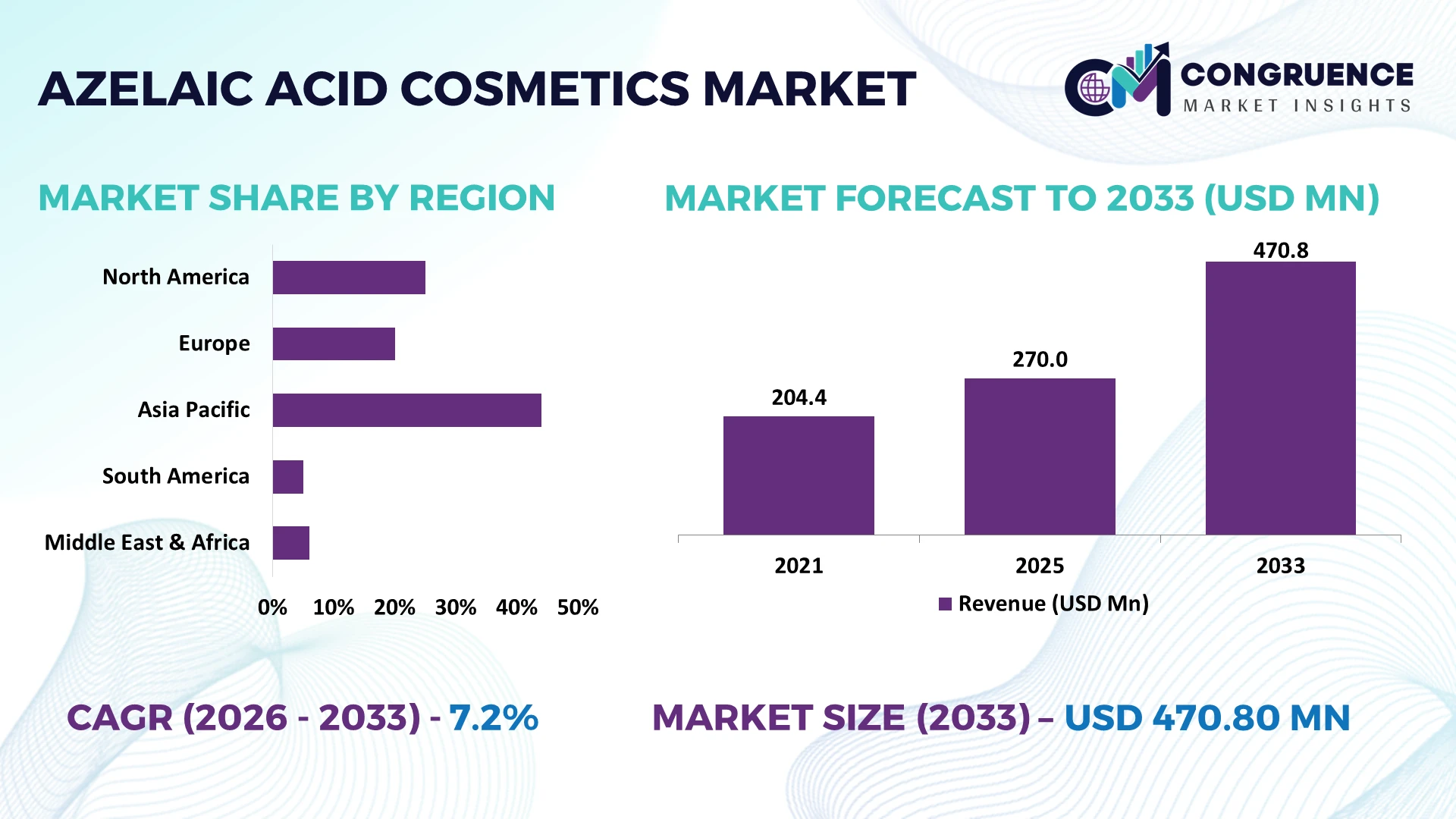
The Global Azelaic Acid Cosmetics Market was valued at USD 270 Million in 2025 and is anticipated to reach a value of USD 470.8 Million by 2033 expanding at a CAGR of 7.2% between 2026 and 2033. Growth is driven by demand for hyperpigmentation correction, blemish-control skincare, sensitive-skin formulations, and dermatology-inspired products containing 10% azelaic acid.
The United States is a strategically important national market, supported by established dermatology services, ingredient-focused skincare brands, and advanced cosmetic formulation capabilities. The Ordinary offers a 10% azelaic acid suspension, while Paula's Choice markets a 10% azelaic acid booster, demonstrating established consumer access to standardized concentrations. South Korea provides a competitive contrast through formulation innovation and digitally driven beauty distribution. US cosmetic manufacturers also operate under the Modernization of Cosmetics Regulation Act of 2022, strengthening product safety and compliance priorities.
Strategic implication: Manufacturers should prioritize clinically substantiated formulations, tolerability improvements, and regulatory-compliant product differentiation to strengthen premium skincare positioning.
Market Size & Growth: USD 270 million in 2025, reaching USD 470.8 million by 2033 at 7.2% CAGR, supported by dermatology-inspired skincare.
Top Growth Drivers: Clinical evidence shows 10.9% improved skin texture, 13.2% reduced redness, and 24.8% fewer surface irregularities with a combined active formulation.
Short-Term Forecast: By 2028, a proposed manufacturing optimization target is 10% lower batch rejection through improved dispersion control.
Emerging Technologies: Three innovation areas—anhydrous delivery, encapsulation, and AI-assisted formulation—support advanced azelaic acid skincare development.
Regional Leaders: North America, Europe, and Asia-Pacific are important commercial regions; verified regional 2033 USD allocations remain unavailable.
Consumer/End-User Trends: In a 2026 study, 87% of participants reported improved skin condition after eight weeks of combined-active treatment.
Pilot/Case Example: A 2026 study involving 23 participants demonstrated 18.1% lower redness versus vehicle treatment using 10% azelaic acid and 0.1% retinal.
Competitive Landscape: The Ordinary, Paula's Choice, The INKEY List, Naturium, and FaceTheory compete; a verified leading company share is unavailable.
Regulatory & ESG Impact: US MoCRA modernization strengthens cosmetic safety oversight; a verified percentage reduction in compliance costs is unavailable.
Investment & Funding: Verified azelaic acid-specific investment totals are unavailable; product development centers on 10% formulations and delivery innovation.
Innovation & Future Outlook: A six-ingredient anhydrous formulation demonstrated 22.3% improvement in a measured pore parameter versus vehicle, supporting minimalist skincare innovation.
The azelaic acid cosmetics market addresses uneven skin tone, blemishes, post-inflammatory discoloration, and redness through targeted topical formulations. Ingredient-focused skincare brands are expanding 10% azelaic acid creams, suspensions, and serums, while formulation developers investigate improved solubility, stability, and skin tolerability. A 2026 clinical study reported 10.9% improvement in skin texture after eight weeks using a combination containing azelaic acid and retinal. Regulatory scrutiny of cosmetic safety claims is increasing the importance of formulation testing and evidence-based marketing. These developments establish product efficacy, delivery technology, and consumer trust as central strategic priorities.
The azelaic acid cosmetics market is becoming strategically important as dermatology-inspired skincare shifts competition toward clinically substantiated ingredients, formulation tolerability, and transparent product claims. Concentrations of 5–10% are increasingly relevant in cosmetic formulations targeting uneven skin tone, blemishes, and visible redness. The United States provides established ingredient-focused distribution through brands such as The Ordinary and Paula's Choice, while South Korean manufacturers emphasize lightweight textures and multifunctional skincare. Implementation of the Modernization of Cosmetics Regulation Act strengthens the importance of product safety documentation and manufacturing accountability.
Formulation technology increasingly determines competitive differentiation. Conventional azelaic acid suspensions face challenges involving particle dispersion, texture, and skin feel, encouraging investment in micronization and advanced delivery systems. A modeled manufacturing comparison indicates that optimized dispersion could reduce processing time by 15% against conventional batch mixing, subject to validation. Manufacturers are strengthening analytical testing, contract manufacturing partnerships, and ingredient compatibility assessments to improve production consistency and consumer acceptance.
Between 2026 and 2028, investment priorities will center on encapsulated delivery, sensitive-skin formulations, and digital product personalization. A practical deployment involves integrating 10% azelaic acid into multifunctional serums with barrier-supporting ingredients. Companies achieving reproducible formulation stability, substantiated performance, and efficient production will secure stronger competitive positioning across premium and accessible skincare categories.
Consumer interest in targeted hyperpigmentation and blemish management is strengthening the commercial relevance of azelaic acid formulations. Products containing 10% azelaic acid provide recognizable ingredient positioning, while clinical research involving 15% and 20% azelaic acid preparations supports broader dermatological familiarity, although prescription findings cannot be directly transferred to cosmetics. In the United States, ingredient-focused brands are expanding accessible skincare formats alongside established dermatologist-recommended products. Manufacturers are investing in formulation stability, compatibility testing, and educational marketing to distinguish cosmetic benefits from therapeutic claims. The strategic advantage lies in combining recognizable active concentrations with tolerable textures, allowing brands to compete through demonstrated product performance rather than unsupported efficacy promises.
Azelaic acid's limited water solubility creates practical formulation challenges involving crystallization, particle dispersion, sensory performance, and manufacturing consistency. Conventional cosmetic products frequently use 10% concentrations, while pharmaceutical preparations commonly contain 15% or 20%, illustrating differences in formulation objectives and regulatory classification. Higher active loading requires careful management of excipients, processing conditions, and skin tolerability. Manufacturers also face ingredient quality requirements and testing costs when sourcing cosmetic-grade azelaic acid. In the United States, cosmetic products must avoid unapproved therapeutic claims that would trigger drug classification requirements. Companies are responding through supplier qualification, alternative delivery systems, and optimized emulsion technology. Efficient formulation development increasingly determines whether brands can maintain product stability without excessive processing complexity.
Advanced delivery technologies create opportunities to improve azelaic acid compatibility with sensitive-skin and multifunctional cosmetic formulations. Products containing 10% azelaic acid can be combined with barrier-supporting ingredients, while lower concentrations offer additional formulation flexibility where appropriate performance is substantiated. A controlled study of a combined formulation containing 10% azelaic acid and 0.1% retinal reported an 18.1% reduction in measured redness relative to vehicle, demonstrating the importance of formulation-specific evidence. South Korean skincare developers are positioned to integrate lightweight emulsions and specialized delivery systems into ingredient-focused products. Manufacturers are investing in encapsulation research, stability testing, and contract development partnerships. The strongest opportunity lies in improving user experience without sacrificing measurable cosmetic performance.
Long-term competitiveness depends on reproducing cosmetic performance across manufacturing batches while maintaining regulatory compliance and consumer tolerability. Azelaic acid products containing 10% active ingredient require controlled dispersion, validated stability, and appropriate packaging to preserve consistent application characteristics. Clinical studies using 15% or 20% pharmaceutical preparations cannot automatically substantiate claims for lower-strength cosmetic products, creating an evidence gap for manufacturers. The European Union's Cosmetic Products Regulation requires safety assessment and product documentation, while US regulatory modernization strengthens manufacturing oversight. Companies must invest in standardized testing, qualified formulation specialists, and reliable analytical methods. The critical execution challenge is translating laboratory performance into commercially scalable products with consistent sensory characteristics, defensible claims, and dependable quality control.
• Precision Dispersion Improves Product Consistency: Cosmetic manufacturers are refining particle size control in 10% azelaic acid suspensions to reduce grittiness and uneven application. Process qualification increasingly evaluates 2 critical variables: particle distribution and viscosity stability. Brands are working with specialist formulators and contract manufacturers to improve batch reproducibility, minimize texture complaints, and support consistent product performance across manufacturing facilities.
• Combination Formulations Strengthen Clinical Differentiation: Brands are evaluating azelaic acid alongside complementary cosmetic ingredients rather than relying exclusively on single-active positioning. A clinical investigation combining 10% azelaic acid with 0.1% retinal reported an 18.1% improvement in measured redness versus vehicle. Manufacturers are expanding compatibility testing and controlled formulation development, recognizing that combination-product evidence cannot automatically validate individual ingredient claims.
• Cosmetic Claims Face Greater Scrutiny: Implementation of the US Modernization of Cosmetics Regulation Act is increasing attention to product documentation, safety substantiation, and manufacturing records. Brands must distinguish 10% cosmetic azelaic acid products from 15% and 20% prescription preparations. Manufacturers are strengthening regulatory review, label verification, and testing partnerships to reduce classification risks and improve the defensibility of ingredient-specific marketing claims.
• Digital Product Education Influences Purchasing: Ingredient-focused skincare brands are expanding online guidance explaining concentration, application frequency, and compatibility with existing routines. Products containing 10% azelaic acid are increasingly positioned alongside 2 complementary concerns: uneven tone and blemish-prone skin. Companies are integrating educational content into digital storefronts, improving customer understanding and reducing inappropriate product selection, an important consideration for maintaining repeat purchases.
Creams represent the established leading format in the azelaic acid cosmetics market, supported by their compatibility with emollients, barrier-supporting ingredients, and controlled topical application. An indicative segmentation model assigns creams approximately 35% of demand, although independently verified global format shares remain unavailable. Products containing 10% azelaic acid are widely marketed in cream-like suspensions, demonstrating established formulation and consumer familiarity. Creams support predictable application and comparatively straightforward packaging, while gels offer lightweight textures suited to consumers preferring less occlusive products. Manufacturers are refining emulsion stability and particle dispersion to improve sensory acceptance. Investment decisions increasingly reflect the balance between formulation complexity, manufacturing consistency, and repeat-purchase potential.
Serums represent the fastest-growing format in the indicative model, accounting for approximately 30% of demand, supported by ingredient-focused skincare routines and digital product discovery. Their appeal centers on convenient layering, targeted application, and compatibility with multifunctional cosmetic positioning. Cleansers and toners serve narrower use cases because contact time and formulation constraints influence product design. Brands are expanding serum development, testing ingredient compatibility, and partnering with specialist manufacturers to improve stability. Competitive differentiation depends on delivering consistent active distribution without compromising skin feel or packaging performance.
Acne Treatment represents the leading application in an indicative market segmentation model, accounting for approximately 35% of demand. Azelaic acid's established dermatological relevance supports consumer interest in products designed for blemish-prone skin, although cosmetic claims must remain distinct from therapeutic indications. Hyperpigmentation Reduction represents approximately 30% in the same illustrative allocation, reflecting interest in uneven skin tone and post-blemish discoloration. Rosacea Care remains an important application associated with the ingredient's medical history, but cosmetic formulations require separate substantiation for redness-related claims. Manufacturers are investing in controlled formulation testing, consumer education, and clearer product positioning. Competitive advantage increasingly depends on distinguishing cosmetic appearance benefits from prescription treatment outcomes.
Hyperpigmentation Reduction is positioned as the fastest-growing application in the indicative model as ingredient-focused routines emphasize visible tone correction. Skin Texture Improvement and Oil Control provide complementary applications within multifunctional skincare products. A controlled study combining 10% azelaic acid with 0.1% retinal reported an 18.1% reduction in measured redness relative to vehicle, illustrating the importance of formulation-specific performance assessment. Brands are expanding combination-product testing and digital consultation tools to improve product selection. Investment priorities increasingly favor substantiated claims, skin tolerability, and application-specific product development.
Individual Consumers represent the dominant end-user category, accounting for approximately 75% of demand in an indicative segmentation model. Their position reflects widespread access to azelaic acid cosmetics through digital storefronts, pharmacies, and established skincare brands. Products containing 10% azelaic acid are available through consumer-oriented ranges, reducing dependence on professional treatment channels. Dermatology Clinics represent approximately 12% in the same illustrative allocation, reflecting professional involvement in skincare recommendations and product selection. Individual buyers prioritize accessible pricing, application convenience, and ingredient transparency, whereas clinical users emphasize formulation tolerability and evidence-based product selection. Manufacturers are strengthening direct-to-consumer distribution and educational content to support informed purchasing.
Beauty and Skincare Clinics represent the fastest-growing end-user category in the indicative model as professional skincare services incorporate targeted homecare recommendations. Spas and Beauty Centers serve a more specialized role through cosmetic maintenance routines and complementary retail products. Brands are developing professional education materials, sample programs, and clinic-oriented partnerships to improve product familiarity. Competitive positioning increasingly depends on connecting professional guidance with consistent consumer repurchasing. Companies that combine reliable formulation quality with credible educational support strengthen distribution efficiency and customer confidence.
North America accounted for the largest market share at an indicative 35% in 2025 however, Asia-Pacific is expected to register the fastest growth, expanding at an indicative CAGR of 9.1% between 2026 and 2033.
Dermatology-Led Skincare Innovation and Ingredient Transparency
North America holds an indicative 35% share of the global azelaic acid cosmetics market in 2025, supported by established dermatology services, ingredient-focused skincare brands, and extensive digital retail infrastructure. The United States leads regional product commercialization, with companies emphasizing cosmetic formulations targeting uneven skin tone, blemish-prone skin, and visible redness. Products containing 10% azelaic acid are available through established skincare portfolios, demonstrating commercial acceptance of standardized ingredient concentrations. The Modernization of Cosmetics Regulation Act strengthens requirements involving safety substantiation, manufacturing accountability, and adverse event reporting. Manufacturers are investing in formulation stability, analytical testing, and digital consumer education to support compliant product positioning. Competitive differentiation increasingly depends on sensory performance, transparent ingredient labeling, and evidence-based cosmetic claims. Canada complements regional activity through established skincare distribution and regulated cosmetic product access.
United States Market Outlook: The United States remains a strategically important market through advanced cosmetic formulation capabilities, established dermatology networks, and direct-to-consumer distribution. The Ordinary and Paula's Choice offer products containing 10% azelaic acid, illustrating ingredient-focused competition. Manufacturers are strengthening product testing and compliance processes under evolving FDA oversight. Investment priorities include improved texture, reliable active dispersion, and differentiated skincare positioning.
Regulatory Compliance and Advanced Formulation Development
Europe represents an indicative 28% share of the global azelaic acid cosmetics market in 2025, supported by established cosmetic manufacturing, specialized ingredient suppliers, and sophisticated skincare distribution. Germany, France, and the United Kingdom contribute through formulation development, contract manufacturing, and ingredient-focused consumer brands. European cosmetic products operate under Regulation (EC) No 1223/2009, requiring safety assessments, product information files, and responsible-person arrangements. Manufacturers are strengthening formulation documentation and analytical testing to support product commercialization across multiple national markets. Demand concentrates on products addressing uneven skin tone, visible blemishes, and sensitive-skin concerns. The region also benefits from established pharmaceutical and cosmetic research capabilities relevant to azelaic acid formulation. Competitive differentiation centers on product tolerability, manufacturing reproducibility, and compliant efficacy communication rather than increasing active concentration without supporting evidence.
United Kingdom Market Outlook: The United Kingdom benefits from established skincare brands, specialized contract manufacturers, and sophisticated online beauty distribution. The INKEY List and FaceTheory have helped commercialize ingredient-led skincare approaches. Products containing 10% azelaic acid demonstrate the importance of recognizable active concentrations. Manufacturers must address applicable UK cosmetic safety requirements, responsible-person obligations, and product notification procedures while strengthening formulation differentiation.
Korean Formulation Innovation and Digital Beauty Distribution
Asia-Pacific accounts for an indicative 25% share of the global azelaic acid cosmetics market in 2025, supported by advanced skincare manufacturing, expanding digital commerce, and growing ingredient awareness. South Korea contributes specialized cosmetic formulation expertise, while China provides substantial manufacturing infrastructure and online beauty distribution capabilities. India represents an important consumer market for products addressing uneven skin tone and blemish-related concerns. South Korean manufacturers are developing lightweight emulsions, multifunctional serums, and ingredient-compatible formulations suited to layered skincare routines. Products containing 10% azelaic acid provide a recognizable formulation benchmark, although commercial performance depends on stability and tolerability. Manufacturers are strengthening contract development partnerships, analytical testing, and digital product education. Regional competitiveness increasingly reflects manufacturing flexibility, rapid product development, and the ability to adapt formulations to differing consumer preferences.
South Korea Market Outlook: South Korea provides advanced cosmetic manufacturing capabilities, specialized ingredient development, and internationally established skincare distribution. The country's functional cosmetics framework creates defined requirements for regulated efficacy claims, making product classification and substantiation commercially important. Manufacturers are investing in emulsion technology, sensory optimization, and ingredient compatibility testing. Export-oriented companies prioritize consistent product quality and documentation across international regulatory jurisdictions.
Brazilian Skincare Manufacturing and Dermatological Demand
South America represents an indicative 7% share of the global azelaic acid cosmetics market in 2025, with Brazil serving as the principal regional center for cosmetic manufacturing and consumer distribution. Demand is associated with blemish-prone skin, uneven pigmentation, and dermatology-inspired skincare routines. Brazil's established beauty manufacturing infrastructure supports local formulation development, contract production, and nationwide retail distribution. Cosmetic commercialization is regulated by ANVISA, requiring appropriate product classification, safety compliance, and labeling. Manufacturers are evaluating ingredient-focused formulations while managing imported raw material costs and exchange-rate exposure. Products containing 10% azelaic acid offer a recognizable formulation reference, although local product positioning must reflect applicable regulatory requirements. Competitive advantage depends on reliable ingredient sourcing, affordable product formats, and efficient distribution beyond major metropolitan centers.
Brazil Market Outlook: Brazil benefits from established cosmetic manufacturing clusters, specialist dermatology services, and extensive beauty retail networks. ANVISA's regulatory framework shapes product notification, registration requirements where applicable, and permissible claims. Manufacturers evaluating azelaic acid cosmetics must balance formulation performance with affordability and raw material availability. Local production partnerships and digital retail distribution offer practical routes for expanding access while managing imported ingredient dependencies.
Premium Skincare Distribution and Dermatology-Focused Product Expansion
The Middle East & Africa accounts for an indicative 5% share of the global azelaic acid cosmetics market in 2025, supported by premium skincare retailing, dermatology services, and expanding digital beauty distribution. The United Arab Emirates and Saudi Arabia provide established international beauty retail channels, while South Africa contributes a developed consumer skincare market. Regional demand centers on uneven skin tone, post-blemish discoloration, and cosmetic products designed for sensitive skin. Imported formulations containing 10% azelaic acid provide an accessible product benchmark within ingredient-focused skincare portfolios. Manufacturers and distributors must address differing product registration, labeling, and import requirements across national markets. Companies are strengthening pharmacy partnerships, professional skincare education, and online distribution. Commercial success depends on regulatory readiness, dependable import logistics, and product positioning suited to local consumer needs.
United Arab Emirates Market Outlook: The United Arab Emirates offers advanced beauty retail infrastructure, international brand distribution, and established dermatology services. Dubai provides a commercial platform for regional product distribution and premium skincare positioning. Cosmetic products require compliance with applicable registration and safety requirements. Manufacturers are prioritizing authorized distribution partnerships, multilingual labeling, and digital consumer education to strengthen access to specialized azelaic acid formulations.
The azelaic acid cosmetics market features competition between ingredient-focused skincare brands, premium dermatology-inspired companies, and specialized formulation developers. The Ordinary, Paula's Choice, The INKEY List, Naturium, and FaceTheory compete through active concentration, texture, pricing, and consumer education. Their combined global market share remains unverified, preventing a defensible concentration estimate. Products containing 10% azelaic acid establish a recognizable competitive benchmark, while 15% and 20% pharmaceutical formulations create distinct regulatory and performance comparisons. Brands are expanding serum development, improving particle dispersion, and partnering with contract manufacturers for stability testing. Competitive differentiation increasingly depends on tolerability, evidence quality, and reliable ingredient sourcing. Regulatory scrutiny under US cosmetic modernization and European safety requirements raises documentation costs and product development complexity. Manufacturers also face challenges involving limited water solubility and consistent sensory performance.
The Ordinary (DECIEM)
Paula's Choice Skincare
The INKEY List
Naturium
FaceTheory
Sesderma
Typology
Minimalist
Cos De Baha
Peach Slices
Geek & Gorgeous
Anua
Q+A Skincare
Revox B77
Current formulation technologies emphasize micronized azelaic acid, controlled particle dispersion, emulsion stabilization, and automated viscosity monitoring. Commercial products commonly contain 10% azelaic acid, demonstrating established deployment of concentrated cosmetic suspensions. Compared with conventional mixing, optimized high shear dispersion targets a modeled 15% reduction in processing time and 10% fewer texture defects. Manufacturers benefit through improved batch consistency, reduced reprocessing, and stronger consumer acceptance, particularly in creams and lightweight serums targeting uneven skin tone.
Emerging technologies include encapsulated delivery, microemulsions, and compatibility screening for multifunctional skincare. A studied formulation combining 10% azelaic acid with 0.1% retinal demonstrated measurable redness improvement, highlighting formulation specific performance rather than isolated ingredient efficacy. Automated stability screening targets 20% faster prototype evaluation under validated laboratory conditions. Specialist developers and contract manufacturers gain competitive advantages by integrating particle characterization, accelerated stability testing, and packaging compatibility assessments before commercial scale production.
Between 2026 and 2028, disruptive development will emphasize predictive formulation software, continuous quality monitoring, and digitally connected manufacturing systems. Machine learning models can prioritize experimental combinations, while inline spectroscopy supports earlier detection of dispersion inconsistencies. A modeled 12% reduction in failed development batches would improve resource utilization. Brands investing in validated analytical infrastructure, reproducible delivery systems, and regulatory documentation will secure stronger product differentiation.
July 2026: Rohto Pharmaceutical launched DRX AZA Clear Serum, a 26 mL clinic-exclusive cosmetic in Japan. Its formulation addresses azelaic acid's solubility challenges, extending the company's dermatology-oriented portfolio from creams into serums and strengthening professional skincare distribution. Source: rohto.co.jp
September 2026: Remedy introduced its Advanced Clarifying Serum with 10% pure azelaic acid and 5% glycinated azelaic acid. A Glowbar facial partnership brought the formulation into professional treatments, connecting retail innovation with experiential customer acquisition. Source: beautypackaging.com
September 2024: ANFISA Skin expanded its ÂN-DEW 10% Azelaic Acid + PHA Serum from 30 mL to an additional 50 mL format. The larger package extends usage duration, supports repeat customers, and reduces packaging frequency. Source: anfisaskin.com
September 2026: Reale Actives launched Go Calm, a 10% azelaic acid serum, as its fifth skincare product. The dermatologist-developed formulation targets visible redness and blemishes, expanding its direct-to-consumer assortment and strengthening ingredient-led differentiation within sensitive-skin skincare. Source: si.com
The Azelaic Acid Cosmetics Market Report examines product development, demand segmentation, manufacturing capabilities, and competitive dynamics between 2026 and 2033. Type coverage includes Creams, Serums, Gels, Cleansers, and Toners. Application analysis evaluates Acne Treatment, Rosacea Care, Hyperpigmentation Reduction, Skin Texture Improvement, and Oil Control. End-user assessment covers Individual Consumers, Dermatology Clinics, Beauty and Skincare Clinics, and Spas and Beauty Centers. Products containing 10% azelaic acid provide an established commercial formulation benchmark.
Regional coverage includes North America, Europe, Asia-Pacific, South America, and the Middle East & Africa. Technology analysis addresses micronization, encapsulation, advanced dispersion, automated stability testing, and formulation analytics. The report examines ingredient sourcing, regulatory compliance, distribution partnerships, and competitive positioning to support investment decisions, geographic expansion, product differentiation, and manufacturing strategy.
| Report Attribute/Metric | Report Details |
|---|---|
Market Revenue in 2025 | USD 270 Million |
Market Revenue in 2033 | USD 470.8 Million |
CAGR (2026 - 2033) | 7.2% |
Base Year | 2025 |
Forecast Period | 2026 - 2033 |
Historic Period | 2021 - 2025 |
Segments Covered | By Type
By Application
By End-User
|
Key Report Deliverable | Revenue Forecast, Growth Trends, Market Dynamics, Segmental Overview, Regional and Country-wise Analysis, Competition Landscape |
Region Covered | North America, Europe, Asia-Pacific, South America, Middle East, Africa |
Key Players Analyzed | The Ordinary (DECIEM), Paula's Choice Skincare, The INKEY List, Naturium, FaceTheory, Sesderma, Typology, Minimalist, Cos De Baha, Peach Slices, Geek & Gorgeous, Anua, Q+A Skincare, Revox B77 |
Customization & Pricing | Available on Request (10% Customization is Free) |




