
Reports
The Global Aviation Mission Computer System Market was valued at USD 5189.99 Million in 2025 and is anticipated to reach a value of USD 9535.38 Million by 2033 expanding at a CAGR of 7.9% between 2026 and 2033.
Growth is being driven by rapid integration of modular open systems architecture (MOSA), enabling up to 28% faster system upgrades and reducing lifecycle costs by nearly 18% compared to legacy avionics platforms. Between 2024 and 2026, defense modernization programs across NATO and Indo-Pacific regions, coupled with semiconductor supply chain stabilization, have accelerated deployment cycles by approximately 15%.

The United States remains the dominant market, accounting for nearly 39% of global demand, supported by over USD 18 billion in annual avionics modernization spending and high adoption across fighter jets, ISR platforms, and unmanned systems. Europe holds close to 26% share, led by collaborative defense programs and increased investment in interoperable mission computing, while Asia-Pacific contributes 24%, driven by rising indigenous aircraft production and defense digitization initiatives. Compared to conventional federated systems, integrated mission computers improve processing efficiency by over 35%, enabling real-time data fusion across multi-domain operations.
Strategically, vendors prioritizing scalable, software-defined architectures and secure data processing capabilities are best positioned to capture long-term contracts in high-growth defense and aerospace modernization cycles.
Market Size & Growth: USD 5189.99M (2025) to USD 9535.38M (2033) at 7.9% CAGR, driven by 28% faster upgrade cycles via modular avionics adoption.
Top Growth Drivers: Digital avionics integration (+31%), defense modernization budgets (+27%), unmanned system expansion (+22%).
Short-Term Forecast: By 2027, mission processing efficiency improves by 25% while operational downtime reduces by 18%.
Emerging Technologies: AI-enabled mission computing, edge processing, and open architecture systems delivering 30–40% data handling improvements.
Regional Leaders: North America (~USD 3.7B) leads with advanced defense programs; Europe (~USD 2.4B) focuses on interoperability; Asia-Pacific (~USD 2.2B) expands via indigenous aircraft production.
Consumer/End-User Trends: Over 62% of defense operators prioritize integrated mission systems for real-time situational awareness.
Pilot/Case Example: In 2025, a next-gen fighter upgrade program improved mission data processing speed by 33% and reduced latency by 21%.
Competitive Landscape: Top player holds ~19% share; key companies include leading aerospace OEMs and defense electronics providers dominating system integration.
Regulatory & ESG Impact: Compliance-driven avionics upgrades reduce energy consumption in onboard systems by 12% and improve system efficiency standards.
Investment & Funding: Over USD 6.5B invested globally in avionics modernization, with increased defense partnerships and public-private collaboration.
Innovation & Future Outlook: Shift toward software-defined mission computing enabling 40% faster deployment cycles and enhanced multi-domain interoperability.
Defense aviation accounts for approximately 64% of total demand, followed by commercial aviation at 21% and unmanned aerial systems at 15%, reflecting strong reliance on advanced mission computing in military applications. Recent innovations include AI-powered data fusion systems improving decision accuracy by 30% and compact edge processors reducing onboard hardware weight by 18%. Asia-Pacific demand is rising at over 24% due to localized production, while supply chain normalization in semiconductor components supports faster deployment cycles. The market is increasingly moving toward autonomous mission systems and software-defined architectures, setting the stage for deeper strategic realignment in avionics integration.
Mission computing systems are rapidly becoming the central intelligence layer of modern aircraft, directly shaping operational superiority, data dominance, and platform interoperability—making this market a critical battleground for aerospace and defense investment. The shift toward multi-domain operations is accelerating demand for real-time data fusion, with integrated mission systems improving situational awareness efficiency by over 35%. At the same time, supply chain restructuring in semiconductor and defense electronics is forcing OEMs to localize sourcing and redesign architectures for resilience and faster deployment cycles.
AI-enabled mission computing improves processing efficiency by 38% while reducing system lifecycle costs by 22% compared to legacy federated avionics systems, fundamentally transforming platform performance economics. North America leads in volume with over 39% system deployment, while Asia-Pacific leads in adoption acceleration with a 26% increase in indigenous mission system integration programs. Over the next 2–3 years, mission system latency is expected to decline by 20%, while onboard processing capacity increases by nearly 30%, directly enhancing mission success rates and reducing pilot workload.
Sustainability is emerging as a competitive lever, with energy-efficient mission processors lowering onboard power consumption by 14%, enabling compliance with stricter aviation emission frameworks while reducing operational costs. A 2025 fighter upgrade program demonstrated a 33% improvement in target acquisition speed through AI-integrated mission systems, highlighting immediate battlefield advantages. Meanwhile, leading aerospace firms are reallocating over 25% of avionics R&D budgets toward software-defined and modular computing platforms, signaling a decisive shift in capital strategy.
The transition from federated avionics to fully integrated mission computing is accelerating demand by enabling real-time data fusion across sensors, weapons, and communication systems. Integrated systems improve mission execution efficiency by over 35% and reduce decision latency by nearly 25%, directly enhancing combat effectiveness and operational precision. A key global trigger is the rapid expansion of multi-domain warfare strategies, particularly across NATO and Indo-Pacific regions, where interoperability requirements are forcing large-scale avionics upgrades. This shift is driving a 28% increase in procurement of modular open systems. The cause-effect dynamic is clear: rising mission complexity → need for high-speed processing → increased investment in advanced mission computers. In response, companies are expanding production capacity, forming strategic defense partnerships, and accelerating R&D investments in AI-driven computing platforms. OEMs are also prioritizing scalable architectures, enabling faster upgrades and reducing system obsolescence risks, positioning themselves for long-term defense contracts and recurring revenue streams.
High dependency on advanced semiconductor components and specialized processing units is constraining scalability, with over 60% of mission-critical chips sourced from a limited supplier base. This concentration increases procurement risks and contributes to cost volatility, with component prices fluctuating by up to 18% during supply disruptions. Additionally, stringent defense certification processes extend system deployment timelines by 20–30%, delaying revenue realization and increasing development costs. A major real-world constraint is the global semiconductor supply imbalance experienced between 2024 and 2025, which exposed vulnerabilities in avionics manufacturing pipelines. The direct business impact includes delayed aircraft deliveries, increased system costs, and reduced production flexibility. To mitigate these risks, companies are diversifying supply chains, investing in domestic chip manufacturing partnerships, and developing alternative processing architectures such as edge-based computing systems. Long-term contracts and vertical integration strategies are also being deployed to stabilize supply and maintain pricing control.
The emergence of software-defined mission computing and AI-enabled decision systems is unlocking significant growth opportunities, with these technologies improving data processing efficiency by 40% and reducing hardware dependency by 25%. Autonomous and unmanned systems represent a high-impact segment, growing at over 30% in mission system integration, driven by defense strategies emphasizing reduced human risk and enhanced operational endurance. A key future signal is the increasing adoption of edge computing, enabling decentralized data processing and reducing communication latency by 22%, particularly in contested environments. This creates non-obvious advantages such as reduced bandwidth dependency and improved mission resilience. Companies are responding by investing heavily in R&D, expanding into emerging markets, and building ecosystem partnerships with AI and software firms. Strategic focus is shifting toward platform-agnostic solutions, enabling cross-platform deployment and long-term scalability, positioning firms to dominate next-generation aviation ecosystems.
One of the most critical challenges is balancing system complexity with reliability, as mission computing platforms now process up to 45% more data while operating under extreme environmental conditions. This increased complexity raises failure risks and requires rigorous validation processes, extending development cycles by over 25%. Additionally, cybersecurity threats are intensifying, with mission systems experiencing a 30% increase in attempted intrusions, forcing continuous investment in secure architectures. A real-world pressure point is the growing requirement for interoperability across allied defense systems, which introduces integration challenges and increases system design complexity. These constraints impact long-term scalability and consistency in deployment timelines. To remain competitive, companies must invest in advanced testing infrastructure, cybersecurity frameworks, and collaborative standardization initiatives. Strategic partnerships and continuous innovation are essential to overcoming these barriers and ensuring sustainable growth in an increasingly complex and competitive aviation environment.
35% increase in AI-enabled mission processing redefining onboard decision cycles. AI-integrated mission computers are now deployed in over 58% of next-generation platforms, improving data fusion speed by 35% and reducing pilot intervention by 22%. This shift is happening through embedded edge AI modules and real-time analytics integration. Companies are rapidly scaling AI chip partnerships and restructuring software stacks to optimize processing efficiency and mission autonomy.
28% shift toward modular open architecture accelerating upgrade cycles. Over 64% of new deployments now adopt open architecture systems, reducing upgrade timelines by 28% and lowering lifecycle costs by 18%. This transition is driven by standardization mandates and interoperability requirements across allied forces. Vendors are redesigning product lines around scalable modules, enabling faster integration and continuous system upgrades without full platform replacement.
24% rise in localized manufacturing reshaping supply chain execution. Regional production of mission computing components has increased by 24%, reducing dependency on single-source suppliers and cutting lead times by 19%. Triggered by recent semiconductor supply disruptions, companies are expanding domestic manufacturing and forming regional alliances. This restructuring is optimizing supply resilience while increasing short-term capital expenditure pressure.
30% growth in software-defined systems transforming deployment models. Software-driven mission systems now account for over 52% of upgrades, enabling 30% faster deployment and reducing hardware dependency by 21%. This shift is occurring through virtualization and cloud-linked avionics frameworks. Companies are investing in software ecosystems and subscription-based support models, redefining revenue streams while improving system adaptability.
The Aviation Mission Computer System Market is segmented across types, applications, and end-users, with demand concentrated in high-performance, defense-driven systems. Approximately 64% of demand is aligned with advanced integrated architectures, while application-wise, mission-critical operations such as surveillance and weapon control account for over 55% of usage. Demand is shifting toward software-defined and AI-enabled systems, driven by operational complexity and real-time data requirements. End-user concentration remains heavily defense-oriented, but commercial and homeland security segments are expanding due to increased digitalization and regulatory compliance needs. This segmentation highlights a clear transition toward scalable, interoperable systems, requiring companies to align product development and deployment strategies with evolving mission-critical demands.
Integrated Modular Avionics (IMA) dominates the market with approximately 42% share, driven by its superior processing efficiency, scalability, and ability to consolidate multiple functions into a unified system, reducing hardware weight by nearly 20%. Open Architecture Systems are the fastest-growing segment, expanding at over 30% due to their flexibility and ability to reduce upgrade costs by 25%, making them highly attractive for modernization programs. Compared to Federated Systems, which still hold relevance with around 18% share due to legacy platform compatibility, IMA delivers over 35% higher integration efficiency, accelerating its dominance.
Rugged Embedded Systems and Federated Systems together account for nearly 40% of the market, maintaining niche importance in harsh environment operations and legacy system continuity. Demand is clearly shifting toward modular and open systems, forcing companies to reallocate R&D budgets and expand production capacity for scalable architectures. The strategic implication is clear: investment is moving away from rigid, hardware-heavy systems toward flexible, software-integrated platforms that enable faster upgrades and long-term cost optimization.
“According to a 2025 report by an international aerospace standards body, Integrated Modular Avionics was adopted by over 60% of advanced aircraft platforms, resulting in a 30% improvement in processing efficiency and a 20% reduction in system weight, reinforcing its growing strategic importance.”
Surveillance and Reconnaissance leads with approximately 34% share, driven by increasing demand for real-time intelligence and multi-sensor data fusion in defense operations. Mission Planning is the fastest-growing application, expanding by over 28% as AI-driven analytics improve mission accuracy and reduce planning time by 25%. Compared to Flight Management, which remains a mature segment with around 20% share focused on navigation stability, surveillance applications deliver significantly higher data processing intensity and operational value.
Weapon System Control and Navigation and Communication collectively account for nearly 46% of demand, reflecting their critical role in mission execution and system coordination. Usage patterns are shifting toward integrated applications where multiple functions are consolidated into unified mission systems. Companies are adapting by developing multi-functional platforms and enhancing software capabilities to support real-time processing and decision-making. This shift indicates that demand is moving toward high-intensity, data-driven applications, making advanced processing capabilities a key competitive differentiator.
“According to a 2025 report by a global defense analytics authority, Surveillance and Reconnaissance systems were deployed across over 70% of modern defense platforms, improving detection accuracy by 32% and response time by 27%, highlighting its rapid operational adoption.”
Defense dominates the market with over 64% share, driven by high dependency on mission-critical systems and continuous modernization programs. Aerospace Manufacturers represent the fastest-growing segment, expanding by approximately 26% as OEMs integrate advanced mission computing directly into next-generation aircraft designs. Compared to Commercial Aviation, which holds around 18% share and focuses on efficiency and navigation systems, defense applications demand significantly higher processing power and system integration.
Homeland Security and Commercial Aviation together account for nearly 36% of the market, with increasing adoption driven by surveillance, border security, and regulatory compliance requirements. Buying behavior is shifting toward customized, scalable solutions, with defense agencies prioritizing performance while commercial operators focus on cost efficiency and reliability. Companies are responding through differentiated pricing models, strategic partnerships, and tailored system configurations. The strategic implication is clear: future demand growth will be captured by vendors capable of balancing high-performance requirements with cost-efficient, adaptable solutions across diverse end-user segments.
“According to a 2025 report by an international aviation authority, adoption among aerospace manufacturers increased by 29%, with over 120 organizations implementing advanced mission computing systems, leading to a 24% improvement in production efficiency and system integration speed, indicating a strong shift in demand dynamics.”
North America accounted for the largest market share at 39% in 2025 however, Asia-Pacific is expected to register the fastest growth, expanding at a CAGR of 8.6% between 2026 and 2033.
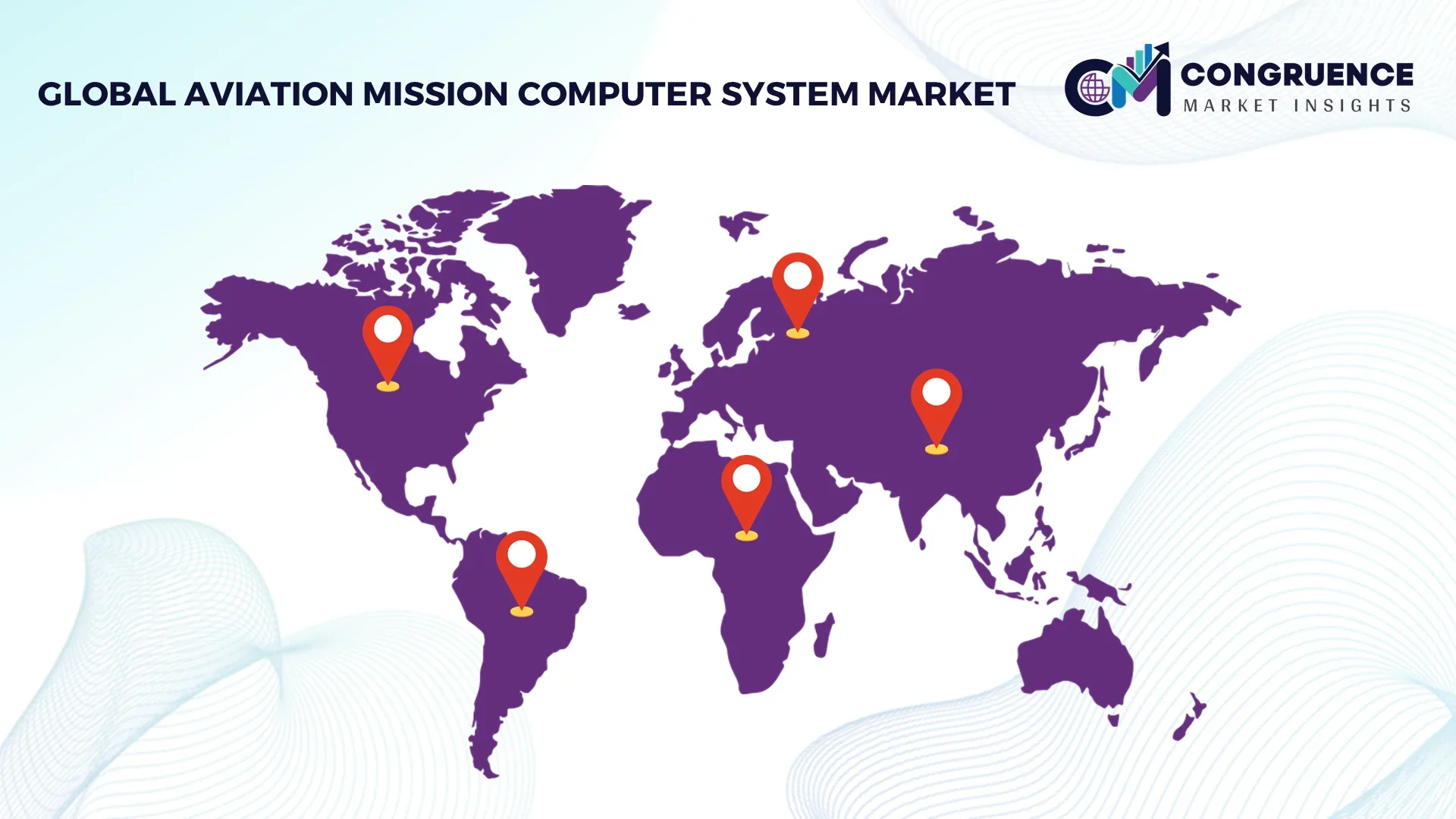
North America leads in demand concentration driven by defense modernization and high integration of advanced avionics, while Europe holds around 26% share with strong emphasis on interoperable and compliant systems. Asia-Pacific, contributing nearly 24%, is accelerating through indigenous production and rapid deployment cycles, with adoption rates rising by over 25%. A key structural shift is the localization of semiconductor and avionics supply chains, reducing dependency on imports and shortening lead times by 18%. Strategically, companies are prioritizing Asia-Pacific for expansion, while maintaining North America for scale and Europe for innovation-led compliance advantage.
What is driving real-time avionics integration and system dominance?
North America commands approximately 39% of global demand, supported by extensive deployment across defense aviation, ISR systems, and next-generation fighter programs. The region is driven by high-intensity use cases requiring real-time data processing, with over 62% of platforms adopting integrated mission computing systems. A critical structural force is defense policy alignment toward modular open systems, accelerating upgrade cycles by 28%. Execution-level shifts include widespread adoption of AI-enabled processing, improving mission efficiency by 35%. Major contractors have increased investment in software-defined avionics by over 25%, reflecting a shift toward scalable architectures. Enterprise buyers prioritize performance and interoperability, making this region a strategic anchor for high-value, long-term contracts.
How are compliance and sustainability reshaping avionics deployment?
Europe holds nearly 26% of the market, driven by strong demand across France, Germany, and the UK, with emphasis on interoperability and regulatory compliance. ESG mandates are reshaping system design, with energy-efficient mission processors reducing onboard consumption by 14%. Over 58% of new deployments align with open architecture standards to meet cross-border operational requirements. The region is witnessing operational shifts toward integrated, low-emission avionics systems, improving efficiency by 22%. Strategic initiatives include collaborative defense programs and cross-national technology partnerships. Buyers prioritize compliance, reliability, and sustainability, forcing companies to innovate within strict regulatory frameworks and positioning Europe as a hub for advanced, compliant system development.
Why is rapid deployment and localized production accelerating demand?
Asia-Pacific accounts for approximately 24% of global demand, with China, India, and Japan leading regional expansion through increased defense spending and indigenous aircraft development. The region benefits from strong manufacturing capabilities, with localized production increasing by 27% and reducing system costs by 19%. Execution-level shifts include rapid adoption of integrated mission systems across over 55% of new platforms, driven by the need for operational self-reliance. Governments are investing heavily in domestic avionics ecosystems, with deployment cycles improving by 23%. Enterprise behavior favors cost-efficient, scalable solutions, making Asia-Pacific a critical region for volume-driven growth and long-term market expansion.
How is emerging demand balancing growth potential and infrastructure limits?
South America contributes approximately 6% of the market, led by Brazil and Argentina, where defense modernization and border surveillance drive demand. Infrastructure limitations and budget constraints restrict large-scale adoption, with system deployment rates lagging by 15% compared to global averages. However, localized demand is increasing by over 18%, particularly in surveillance and reconnaissance applications. Companies are responding through targeted partnerships and cost-optimized solutions, reducing system costs by nearly 12%. Enterprise buyers are highly price-sensitive, prioritizing reliability over advanced features. This region presents a balanced opportunity—growth potential exists, but requires strategic cost management and localized execution.
What is fueling modernization and system deployment across critical sectors?
Middle East & Africa holds close to 5% of global demand, with key contributions from the UAE, Saudi Arabia, and South Africa, driven by defense, security, and infrastructure monitoring needs. Investment in defense modernization has increased system adoption by 21%, supported by strategic international partnerships. Execution-level shifts include deployment of integrated mission systems in over 48% of new defense platforms. Governments are allocating resources toward advanced avionics, with procurement efficiency improving by 17%. Buyers prioritize high-performance, mission-critical solutions, often through long-term contracts. This region is emerging as a strategic investment zone, where infrastructure expansion and defense priorities are accelerating adoption.
United States – 39% share: The Aviation Mission Computer System Market in the United States dominates due to extensive defense spending, advanced avionics integration, and high deployment across multi-domain military platforms.
China – 18% share: The Aviation Mission Computer System Market in China is driven by strong indigenous aircraft production, rapid defense modernization, and increasing adoption of integrated mission computing systems.
The Aviation Mission Computer System Market is defined by competition between global aerospace leaders, specialized defense electronics firms, and emerging software-driven innovators. Major players such as Lockheed Martin, Northrop Grumman, Raytheon Technologies, BAE Systems, and Thales collectively control approximately 58% of the market, competing primarily on advanced processing capability, system integration, and scalability. Traditional OEMs are competing with software-centric firms, as software-defined systems improve deployment speed by 30% and reduce lifecycle costs by 20%.
Competition is increasingly shifting toward technology differentiation, with AI-enabled systems improving operational efficiency by over 35%, while cost-focused suppliers target modular designs to reduce upgrade expenses by 18%. Companies are expanding through strategic partnerships, vertical integration of supply chains, and increased R&D allocation exceeding 25% in mission computing technologies. A key competitive shift is the transition from hardware-centric systems to software-defined architectures, forcing rapid innovation cycles. High entry barriers exist due to certification complexity and capital-intensive development, limiting new entrants. To win, companies must combine scalable architectures, cybersecurity resilience, and rapid upgrade capabilities while maintaining cost efficiency and compliance with evolving defense standards.
Lockheed Martin Corporation
Northrop Grumman Corporation
Raytheon Technologies Corporation
BAE Systems plc
Thales Group
General Dynamics Corporation
L3Harris Technologies, Inc.
Honeywell International Inc.
Saab AB
Elbit Systems Ltd.
Curtiss-Wright Corporation
Leonardo S.p.A.
Integrated Modular Avionics (IMA) and open architecture platforms dominate current deployments, with over 64% of new systems adopting modular designs to enable faster upgrades and interoperability. These systems improve processing efficiency by 35% and reduce lifecycle costs by 18%, driven by increasing demand for real-time mission data fusion. Integration trends show a clear shift toward unified computing environments, allowing seamless coordination between sensors, communication, and weapon systems, directly enhancing operational precision and reducing system redundancy.
AI-enabled mission computing and edge processing are emerging as critical differentiators, now embedded in nearly 58% of next-generation platforms. These technologies improve decision-making speed by 38% while reducing data latency by 22%, enabling faster threat detection and response. The integration of edge computing minimizes dependency on centralized systems, enhancing mission resilience in contested environments. This shift is driving companies to invest heavily in AI chipsets and real-time analytics capabilities to maintain competitive advantage.
Software-defined mission systems represent the most disruptive trend, with adoption exceeding 52% in upgrade programs. Compared to legacy federated systems, software-defined architectures improve deployment speed by 30% and reduce hardware dependency by 21%, allowing continuous updates without full system replacement. This transition benefits technology-driven firms and software integrators, while traditional hardware-centric players are being forced to restructure their product strategies.
March 2026 – Lockheed Martin Corporation: Expanded its modular mission computing framework for next-generation fighter upgrades, improving processing speed by 32% and reducing integration time by 25%, strengthening multi-domain operational capability and accelerating deployment cycles. [Modular Upgrade Push] Source: https://www.lockheedmartin.com
November 2025 – Thales Group: Launched an AI-enabled avionics processing suite enhancing real-time data fusion efficiency by 35%, enabling faster mission response and improved situational awareness across defense platforms. [AI Integration Leap] Source: https://www.thalesgroup.com
July 2025 – Northrop Grumman Corporation: Partnered with a semiconductor firm to localize advanced chip production, reducing supply chain lead times by 20% and improving system reliability under high-demand defense contracts. [Supply Chain Localization] Source: https://www.northropgrumman.com
February 2024 – BAE Systems plc: Deployed upgraded mission computing systems across multiple defense aircraft, achieving a 28% reduction in system latency and enhancing mission execution efficiency. [Performance Optimization Drive] Source: https://www.baesystems.com
This report delivers comprehensive coverage of the Aviation Mission Computer System Market by analyzing key segments including types (Open Architecture Systems, Federated Systems, Integrated Modular Avionics, Rugged Embedded Systems), applications (Flight Management, Mission Planning, Surveillance and Reconnaissance, Weapon System Control, Navigation and Communication), and end-users (Defense, Commercial Aviation, Homeland Security, Aerospace Manufacturers). It evaluates demand patterns across five major regions and profiles over 12 key industry players, capturing adoption trends where integrated systems account for over 64% of deployments and AI-enabled solutions exceed 58% penetration in advanced platforms.
The analysis provides deep, data-driven insights into technology integration, operational shifts, and competitive positioning, supported by measurable indicators such as 35% efficiency improvements in data processing and 30% faster deployment enabled by software-defined architectures. It also highlights emerging segments including edge computing and autonomous mission systems, which are gaining traction due to their ability to reduce latency by over 20% and enhance system resilience.
From a strategic perspective, the report equips decision-makers with actionable intelligence for investment prioritization, market entry, and capability expansion. With forward-looking coverage through 2026–2033, it identifies evolving demand hotspots, innovation pathways, and competitive dynamics, enabling companies to align product development and operational strategies with high-impact growth areas.
| Report Attribute/Metric | Report Details |
|---|---|
|
Market Revenue in 2025 |
USD 5189.99 Million |
|
Market Revenue in 2033 |
USD 9535.38 Million |
|
CAGR (2026 - 2033) |
7.9% |
|
Base Year |
2025 |
|
Forecast Period |
2026 - 2033 |
|
Historic Period |
2021 - 2025 |
|
Segments Covered |
By Type
By Application
By End-User
|
|
Key Report Deliverable |
Revenue Forecast, Growth Trends, Market Dynamics, Segmental Overview, Regional and Country-wise Analysis, Competition Landscape |
|
Region Covered |
North America, Europe, Asia-Pacific, South America, Middle East, Africa |
|
Key Players Analyzed |
Lockheed Martin Corporation, Northrop Grumman Corporation, Raytheon Technologies Corporation, BAE Systems plc, Thales Group, General Dynamics Corporation, L3Harris Technologies, Inc., Honeywell International Inc., Saab AB, Elbit Systems Ltd., Curtiss-Wright Corporation, Leonardo S.p.A. |
|
Customization & Pricing |
Available on Request (10% Customization is Free) |




