
Reports
The Global Autonomous Trains Market was valued at USD 11,266.5 Million in 2025 and is anticipated to reach a value of USD 20,243.6 Million by 2033 expanding at a CAGR of 7.6% between 2026 and 2033. Growth is being driven by CBTC modernization, GoA3/GoA4 metro deployment, AI-enabled train control, driver shortages, and investments in digitally integrated rail infrastructure.
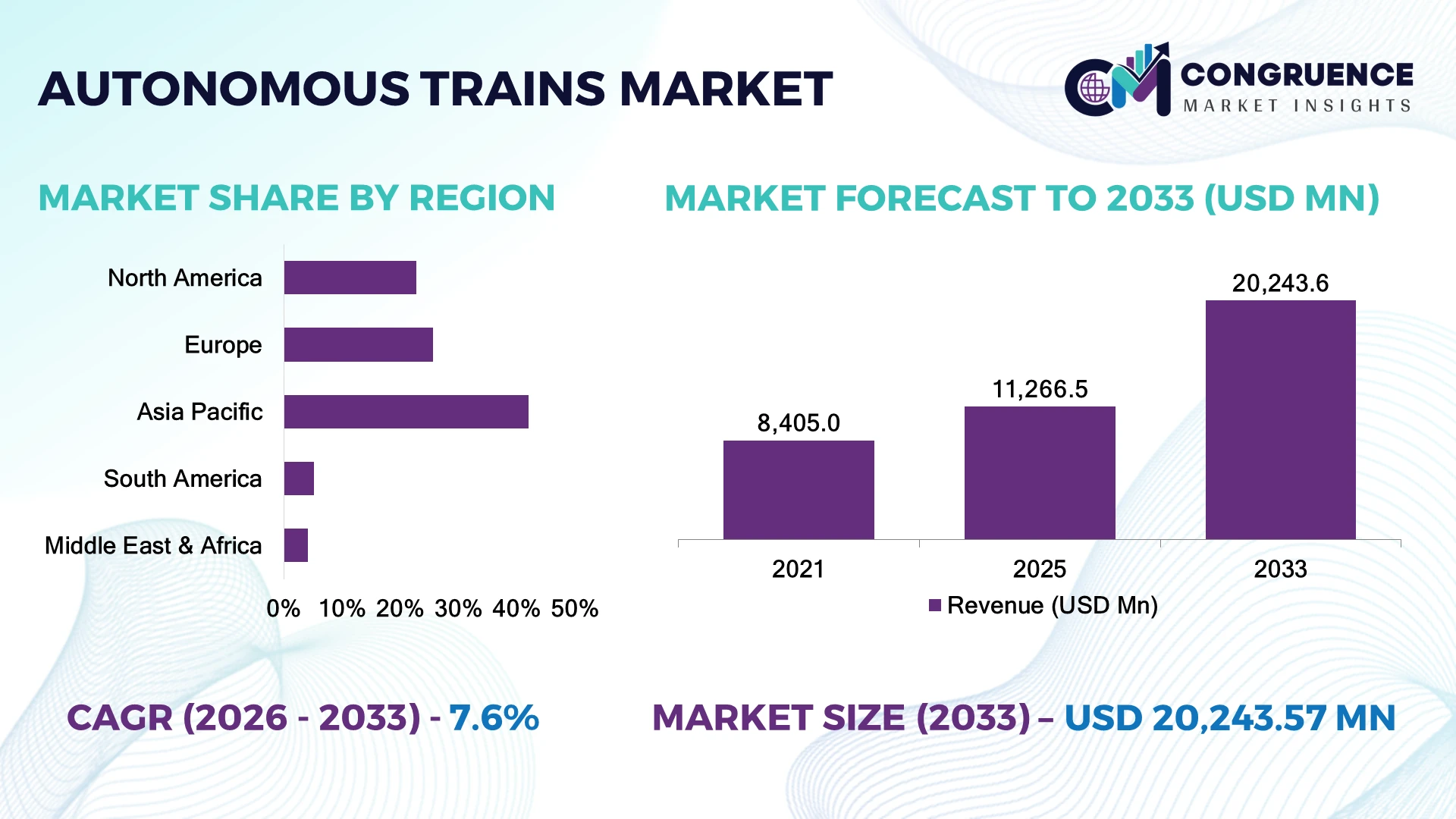
China represents the dominant country market, contributing approximately 17.9% of global demand in 2026, supported by extensive metro construction, high-speed rail investment, and rapid GoA deployment. India follows at roughly 4.2%, with metro automation accelerating across major urban projects. China operates autonomous metro systems across multiple cities, while Europe's 2026 push involving 18 countries for cross-border autonomous-transport testbeds signals stronger regulatory coordination. The strategic priority is shifting toward integrated signaling, rolling stock, connectivity, and automation platforms rather than standalone train procurement.
Market Size & Growth: USD 11,266.5 Million in 2025 is projected to reach USD 20,243.6 Million by 2033 at 7.6% CAGR, driven by CBTC upgrades and GoA4 metro deployment.
Top Growth Drivers: CBTC modernization 47.1%, passenger automation 61.4%, and metro/monorail deployment 47.7% are the strongest structural demand drivers.
Short-Term Forecast: By 2028, automated train control deployments are positioned to improve network capacity by 10–20% through shorter headways and optimized train movements.
Emerging Technologies: AI-based obstacle detection, 5G rail connectivity, digital twins, and moving-block signaling are shifting autonomous trains toward predictive and continuously optimized operations.
Regional Leaders: Asia-Pacific is positioned around USD 8.3 billion by 2033, Europe near USD 7.0 billion, and North America around USD 2.7 billion, with metro automation leading deployment.
Consumer/End-User Trends: Passenger transport represents approximately 61.4% of demand, while freight operators increasingly prioritize automated yard movements, predictive maintenance, and remote supervision.
Pilot/Case Example: In 2026, Siemens was selected for São Paulo Metro Line 4-Yellow's 3.3-km extension using GoA4-capable CBTC, extending automated mobility to more than 280,000 residents.
Competitive Landscape: Siemens Mobility, Alstom, Hitachi Rail, CRRC, and Thales lead integrated automation, signaling, and rolling-stock competition, with leading suppliers controlling approximately 70% of industry sales.
Regulatory & ESG Impact: Eighteen European countries backed cross-border autonomous-transport testbeds in 2026, strengthening interoperability while supporting lower-emission, higher-capacity rail operations.
Investment & Funding: The Europe’s Rail R2DATO program carries approximately EUR 160.8 million in total project cost, targeting ATO, ETCS Level 3, 5G connectivity, and scalable autonomous operation.
Innovation & Future Outlook: The market is shifting toward integrated GoA4 ecosystems combining AI, CBTC, digital twins, 5G, predictive maintenance, and centralized supervision, favoring suppliers with full-system capabilities.
The Autonomous Trains Market is moving beyond driverless metro pilots toward integrated automation across passenger and freight networks. CBTC already accounts for approximately 47% of deployments, while GoA4 projects are expanding in China, Europe, India, and Latin America. In 2026, regulatory coordination and infrastructure modernization are increasingly determining where autonomous rail systems can move from controlled deployment to scalable commercial operation.
Autonomous trains are becoming strategically important because rail operators are using automation to increase network capacity without proportional expansion of physical infrastructure or onboard staffing. The competitive focus is shifting from individual trainsets toward integrated ecosystems combining rolling stock, CBTC, communications, AI, signaling, and centralized operations. Europe's 2026 initiative involving 18 countries to coordinate cross-border autonomous-transport testbeds illustrates how regulatory interoperability is becoming an investment enabler.
Technology economics are also strengthening the case for automation. CBTC enables shorter headways and more precise train positioning than conventional fixed-block systems, with optimized automated operations capable of improving network capacity by approximately 10–20% in suitable metro environments. Asia-Pacific leads large-scale deployment, while Europe emphasizes interoperability and staged mainline automation; North America remains more focused on upgrading conventional rail infrastructure.
Over the next 2–3 years, operators are expected to prioritize GoA3/GoA4 metro conversions, AI-assisted maintenance, 5G connectivity, and digital signaling. São Paulo's Line 4-Yellow extension demonstrates the practical deployment model: proven CBTC and GoA4 technology are being integrated into network expansion rather than deployed as isolated pilots. Competitive advantage will increasingly favor suppliers capable of delivering interoperable automation platforms, lifecycle services, cybersecurity, and measurable capacity gains.
CBTC modernization is the primary structural driver as operators seek higher capacity from existing rail corridors. Automated metro systems can support approximately 10–20% higher capacity through tighter headways, while GoA3/GoA4 deployment is expanding beyond isolated metro networks into regional rail. In India, Alstom’s Mumbai Metro Line 4 program covers 39 driverless trainsets across a 35.3-km corridor, demonstrating the shift toward integrated rolling stock, signaling, and control systems. European programs are simultaneously advancing ATO over ETCS infrastructure. Suppliers are responding with integrated CBTC, onboard automation, cybersecurity, and lifecycle-maintenance packages. The strategic advantage is moving toward vendors that can modernize signaling and rolling stock simultaneously, reducing integration interfaces and deployment complexity.
Legacy signaling and fragmented rail infrastructure constrain autonomous train deployment because GoA3/GoA4 systems require reliable communications, train positioning, automated protection, and compatible control architectures. Retrofitting older corridors can increase project complexity by 20–30% compared with purpose-designed automated lines, while mixed fleets can require multiple interoperability interfaces. Europe’s transition toward ETCS-based automation illustrates the challenge: autonomous operation must coexist with existing signaling during migration. Operators are therefore adopting phased modernization, modular onboard systems, and supplier-neutral interfaces to control capital exposure. Companies with retrofit-compatible solutions gain an advantage because they can convert existing fleets rather than forcing operators into complete rolling-stock replacement. The immediate commercial pressure is reducing integration cost while maintaining safety certification across heterogeneous infrastructure.
Regional rail represents a significant next-stage opportunity as automation moves beyond closed metro environments. GoA4 systems support unattended operation, while AI-based perception and remote supervision enable deployment on lines where conventional metro automation architectures are impractical. Europe’s R2DATO program involves 77 partners and a total project cost of EUR 160.8 million, targeting scalable automation across mainline environments. India is also creating opportunities through new metro corridors and domestic engineering capabilities, including Alstom’s Bangalore-based team of more than 1,000 engineers supporting CBTC development. Suppliers are investing in modular ATO, perception systems, digital twins, and remote-control platforms. The non-obvious opportunity is retrofitting regional fleets with autonomous capabilities, creating software-led value without replacing entire trainsets.
Scaling autonomous trains across national networks requires consistent interoperability between CBTC, ETCS, onboard control, perception, communications, and operations-control systems. Europe’s R2DATO program is testing GoA3/GoA4 functionality with ERTMS/ETCS while addressing modular certification, remote driving, and safe train positioning. Cybersecurity is becoming equally critical as connected train architectures increase digital interfaces and remote-control pathways. Operators must manage mixed automation levels, degraded communications, low-adhesion conditions, and transitions between automated and conventional operation without compromising service continuity. Companies are investing in standardized onboard platforms, redundant positioning, secure communications, and scenario-based validation. Long-term competitiveness will depend on proving autonomous performance across diverse operating conditions, not simply demonstrating driverless operation on controlled test tracks.
GoA4 Metro Deployment Expands: Fully unattended GoA4 operation is moving from flagship projects into broader metro-network expansion. More than 70% of new automated metro projects in leading Asian and Middle Eastern markets increasingly specify high automation levels, while operators are integrating CBTC, platform-screen doors, and centralized control. Suppliers are packaging these systems together to shorten commissioning cycles and reduce integration interfaces.
AI Perception Enters Operations: AI-based object detection, obstacle recognition, and predictive diagnostics are moving toward operational rail environments. Computer-vision systems can improve incident-detection response by approximately 20–30% in controlled deployments, while predictive analytics can reduce unplanned maintenance events by 10–20%. Operators are increasingly combining onboard sensors with edge computing, shifting suppliers toward software-defined train-control architectures.
5G Connectivity Reshapes Control: Private 5G and advanced rail communications are increasingly replacing fragmented connectivity architectures for high-bandwidth monitoring and automated operations. Modern networks can reduce communication latency by more than 50% compared with legacy wireless configurations in suitable deployments. China, Germany, and South Korea are advancing connected-rail programs, prompting suppliers to integrate 5G-ready onboard systems, remote diagnostics, and cybersecurity into new rolling-stock platforms.
Automation Moves Beyond Metros: Autonomous technology is increasingly being engineered for regional and mainline rail rather than remaining concentrated in segregated metro environments. Europe’s R2DATO initiative involves 77 partners and EUR 160.8 million in project investment, targeting GoA3/GoA4 technologies compatible with ETCS. The shift is forcing suppliers to solve mixed-traffic, interoperability, and degraded-mode operations, creating stronger demand for modular automation platforms and digital validation.
Grade of Automation 4 (GoA4) is the leading type, accounting for approximately 48% of autonomous-train market demand, supported by unattended operation, tighter headways, centralized supervision, and strong suitability for new metro construction. GoA3 represents about 29%, retaining relevance where onboard staff are required for emergency or operational intervention, while GoA2 contributes approximately 23% and remains important for brownfield modernization. GoA4 is also the fastest-growing type as new urban rail projects increasingly specify driverless architecture from the design stage rather than retrofitting conventional systems.
The investment priority is shifting toward GoA4-compatible CBTC, perception systems, platform integration, and automated depot functions. More than 57% of global fully automated metro lines are concentrated in Asia-Pacific, reinforcing the region's role as the principal deployment market. Suppliers are responding through integrated rolling-stock and signaling packages, while brownfield specialists focus on staged GoA2-to-GoA4 upgrades. The commercial implication is clear: greenfield GoA4 projects favor full-system suppliers, whereas legacy networks create demand for modular automation and retrofit expertise.
The International Association of Public Transport reported that 60 urban agglomerations had at least one fully automated GoA4 metro line in its latest global statistics, with Asia-Pacific accounting for 57% of automated lines.
Passenger transportation is the leading application, representing approximately 72% of autonomous-train demand because metro, urban transit, and commuter systems offer controlled operating environments, predictable routes, and strong utilization of automation infrastructure. Freight transportation accounts for around 18%, while industrial and mining rail applications represent approximately 10%. Passenger automation remains the mature use case, but freight and industrial deployments are expanding faster as operators seek remote supervision, automated yard movements, and safer operations in repetitive environments.
Metro operators are increasingly specifying GoA4 at the procurement stage, while freight companies are prioritizing automation selectively around terminals, yards, and dedicated corridors. More than 1,000 km of metro infrastructure already operates automatically worldwide, demonstrating the commercial maturity of passenger deployment. Companies are adapting by bundling CBTC, automatic train operation, platform controls, and depot automation for passenger networks, while freight-focused suppliers emphasize ruggedized perception, remote-control systems, and interoperability with existing signaling. The strategic opportunity is shifting toward automation packages tailored to operating environment rather than one universal architecture.
The International Association of Public Transport reports that more than 1,000 km of metro infrastructure operates automatically worldwide, while fully automated lines already represent about 7% of metro infrastructure in operation.
Urban metro operators are the leading end-user group, accounting for approximately 61% of autonomous-train demand because they operate high-frequency services on controlled corridors and can capture direct benefits from automated headways, centralized supervision, and optimized depot operations. National and regional rail operators contribute approximately 24%, while freight, mining, and industrial operators represent around 15%. Metro operators remain the mature buyer segment, whereas mainline and industrial users are generating faster demand as autonomous technologies become compatible with ETCS, remote supervision, and advanced perception systems.
The buyer mix is consequently shifting from train procurement toward integrated lifecycle programs. More than 25% of global metro systems now have at least one fully automated line, creating a sizeable installed base for modernization, software upgrades, and maintenance services. Companies are targeting metro authorities with turnkey automation packages and long-term maintenance contracts, while regional and freight operators favor modular solutions that preserve existing rolling stock. For vendors, recurring software, cybersecurity, signaling upgrades, and fleet-management services are becoming increasingly important alongside new train deliveries.
Europe's Rail R2DATO program demonstrated autonomous passenger-train technology on a 24-km Czech test track in 2025, using LiDAR, sensors, and front-mounted cameras for independent obstacle detection and response.
Asia-Pacific accounted for the largest market share at 42.1% in 2025 however, Middle East & Africa is expected to register the fastest growth, expanding at a CAGR of 9.8% between 2026 and 2033.

Freight Automation Is Expanding Beyond Conventional Metro Use
North America represents approximately 22.8% of the global Autonomous Trains Market, with the U.S. accounting for most regional demand through freight automation, automated people movers, and advanced transit signaling. Unlike Asia's GoA4-heavy metro deployment, North American investment is concentrated on interoperability, positive train control integration, remote supervision, and automated yard operations. Freight rail remains particularly important because high network utilization creates a strong economic case for predictive maintenance and semi-autonomous control. Automated people-mover systems at airports and major transit hubs provide an established commercial base, while new projects increasingly combine communications-based train control with centralized operations. Suppliers are prioritizing retrofit-compatible architectures and partnerships with rail operators, reflecting the region's preference for upgrading existing fleets rather than replacing complete networks.
U.S. Market Outlook: The U.S. remains the dominant North American market because of its extensive freight network, large transit infrastructure, and mature signaling ecosystem. Positive Train Control has been deployed across more than 57,000 route miles, providing a digital foundation for further automation. Companies are increasingly targeting freight yards, inspection, remote operations, and predictive maintenance rather than relying exclusively on fully unattended passenger trains.
ETCS Integration Is Creating a Mainline Automation Path
Europe accounts for approximately 25.7% of global autonomous-train demand, supported by extensive rail modernization, ETCS deployment, and coordinated research into automated mainline operations. The market differs from Asia-Pacific's predominantly metro-led model because European operators must integrate automation with mixed traffic, legacy signaling, and cross-border interoperability. The R2DATO program involves 77 partners and EUR 160.8 million in project investment, accelerating development of GoA3 and GoA4 capabilities compatible with European rail standards. Germany, France, Switzerland, and the United Kingdom are particularly important for signaling modernization and digital rail programs. Suppliers are increasingly combining ATO, ETCS, digital twins, cybersecurity, and remote-control capabilities, positioning interoperable software as a critical differentiator.
Germany Market Outlook: Germany is Europe's strategic technology hub for autonomous mainline rail because of its extensive ETCS modernization, dense rail network, and strong engineering ecosystem. Deutsche Bahn's digital rail initiatives are creating demand for automated train operation, predictive maintenance, and centralized traffic management. More than 10,000 km of German railway infrastructure is targeted for digital signaling modernization, providing a substantial platform for future automation integration.
Large-Scale Metro Construction Is Accelerating GoA4 Adoption
Asia-Pacific holds approximately 42.1% of global Autonomous Trains Market demand, making it the largest deployment base due to extensive metro construction, high-density urban transport requirements, and strong domestic rolling-stock manufacturing. China leads regional automation activity, while Japan, South Korea, Singapore, and India are expanding digitally controlled metro networks. China has more than 10 cities operating fully automated metro lines, demonstrating the commercial maturity of GoA4 deployment. India is following with new metro corridors designed around advanced signaling and driverless operation. Manufacturers are responding with vertically integrated rolling stock, CBTC, platform systems, and control-center solutions, allowing operators to procure complete automation ecosystems rather than separate technologies.
China Market Outlook: China remains the region's strongest autonomous-train market because of its enormous urban rail construction pipeline and domestic manufacturing capacity. Fully automated metro systems are operating in cities including Beijing, Shanghai, Guangzhou, Shenzhen, and Chengdu. CRRC's vertically integrated engineering capabilities strengthen localization, while major metro projects increasingly specify advanced signaling and unattended operation from the initial design stage.
Metro Modernization Is Creating Targeted Automation Demand
South America represents approximately 5.2% of the global Autonomous Trains Market, with Brazil accounting for the largest share through São Paulo's extensive metro network and continued corridor expansion. Autonomous deployment remains concentrated in passenger metro systems rather than national mainline rail, reflecting infrastructure and financing constraints. São Paulo is nevertheless establishing a stronger technology base through driverless metro extensions and advanced signaling. Automated operations can improve headway management and network capacity by approximately 10–20% on suitable corridors, increasing the commercial value of CBTC upgrades. Companies are therefore pursuing turnkey contracts combining signaling, rolling stock, platform systems, and maintenance rather than standalone automation equipment. Public-sector procurement remains decisive, making financing structures and long-term service agreements important competitive tools.
Brazil Market Outlook: Brazil is the principal South American opportunity because São Paulo combines high passenger volumes with one of the continent's most developed metro systems. Line 4-Yellow operates with unattended train technology, providing an established operational reference for further automation. Suppliers are positioning around corridor extensions, CBTC modernization, fleet renewal, and long-term maintenance packages, while cost-efficient deployment remains essential for wider adoption.
New Urban Rail Hubs Are Embedding Automation From Day One
The Middle East & Africa accounts for approximately 4.2% of global Autonomous Trains Market demand, but Gulf countries are generating disproportionate investment in automated urban mobility. Saudi Arabia, the United Arab Emirates, and Qatar are prioritizing driverless metro and automated people-mover systems within digitally planned transport networks. Dubai's fully automated metro demonstrates the commercial maturity of unattended operation, while Saudi Arabia's new urban transport investments are emphasizing integrated signaling and centralized control. The region's greenfield infrastructure provides an advantage because automation can be designed into stations, depots, signaling, and rolling stock without extensive legacy retrofits. Suppliers are responding with turnkey platforms, localization partnerships, cybersecurity packages, and long-term operations contracts.
Saudi Arabia Market Outlook: Saudi Arabia is the region's strongest emerging market because Vision 2030-linked infrastructure programs are accelerating intelligent mobility investment. Riyadh Metro's six-line network spans approximately 176 km and incorporates automated train operation across its system. This large-scale deployment provides a foundation for future digital rail services, predictive maintenance, centralized supervision, and expanded automation as the country's urban transport infrastructure develops.
Siemens Mobility, Alstom, Hitachi Rail, CRRC, and Thales compete as global automation and signaling leaders, while regional rolling-stock suppliers and specialist software firms challenge them on cost and customization. The top five players are estimated to control about 62% of market value, creating a concentrated OEM-led structure. Competition centers on automation performance, signaling integration, lifecycle cost, and delivery capability: GoA4 systems can improve capacity by 10–20%, while predictive maintenance can reduce unplanned downtime by 15–25%. Global OEMs compete through turnkey contracts, long-term maintenance, and vertical integration; Asian suppliers emphasize manufacturing scale and pricing, while European firms differentiate through interoperability and ETCS expertise. The competitive shift is moving toward software-defined trains, AI perception, 5G connectivity, and retrofit solutions rather than standalone rolling stock. High safety-certification costs, installed-base relationships, and interoperability requirements create entry barriers. Winning requires automation, open interfaces, local delivery capability, cybersecurity, and lifecycle service depth.
Siemens Mobility
Alstom
Hitachi Rail
CRRC Corporation Limited
Thales Group
Wabtec Corporation
Mitsubishi Heavy Industries
CAF
Stadler Rail
Talgo
Knorr-Bremse
Hyundai Rotem
Kawasaki Heavy Industries
Toshiba Infrastructure Systems & Solutions
Communications-based train control (CBTC) remains the core automation technology, with GoA4 adding unattended operation. Compared with conventional fixed-block signaling, CBTC can shorten headways and increase corridor capacity by approximately 10–20%. AI-assisted perception is emerging alongside CBTC, using cameras, LiDAR, radar, and edge computing for obstacle detection and condition monitoring. By 2028, operators with integrated perception and control stacks will gain safety visibility and faster incident response than fleets relying on isolated signaling.
Digital twins, predictive maintenance, and 5G connectivity are moving autonomous trains toward optimized operations. Predictive analytics can reduce maintenance interventions by approximately 15–25%, while 5G-enabled communications can cut latency by more than 50% versus legacy wireless configurations. Adoption is strongest in metro projects, where automation is engineered into rolling stock, depots, platforms, and control centers. This favors Siemens Mobility, Alstom, Hitachi Rail, and CRRC because they integrate multiple subsystems.
From 2026–2028, the disruptive shift will be toward software-defined trains combining AI perception, digital twins, cloud-connected supervision, and modular automation. Retrofit-ready platforms improve deployment economics by avoiding complete fleet replacement, while automated depots reduce preparation labor. Operators standardizing data architecture and cybersecurity alongside CBTC will capture lifecycle efficiency and upgrade flexibility.
February 2026 Siemens Mobility and Stadler won a framework contract for 226 fully automated Copenhagen S-Bane trainsets, with an option for 100 more. The program targets 35% more departures and 10 million additional annual journeys, strengthening automation demand. Source: siemens.com
August 2025 Alstom secured Mumbai Metro Line 4 work covering 39 driverless six-car trainsets, CBTC signaling, and five years of maintenance across 35.3 km. The integrated contract strengthens India's localized autonomous-rail supply chain and expands GoA4 deployment commercially. Source: railjournal.com
April 2026 CRRC rolled out Hangzhou Metro's first fully automated train for Line 12, operating at up to 100 km/h. Permanent-magnet traction delivers more than 20% energy savings, strengthening the commercial case for intelligent, energy-efficient GoA4 fleet deployment. Source: crrcgc.cc
March 2026 Siemens Mobility demonstrated Finland's first ATO operation on an ETCS mainline over a 19-km route between Juurikorpi and Hamina. The GoA2 demonstration validates automated operation on existing infrastructure, advancing digital mainline migration and deployment economics. Source: Europe's Rail (Siemens Press)
The Autonomous Trains Market Report evaluates demand across GoA2, GoA3, and GoA4 automation levels, with coverage of passenger transportation, freight transportation, and industrial or mining applications. End-user analysis spans metro operators, national and regional rail authorities, freight operators, and industrial rail users. The assessment examines CBTC, ATO, ETCS, AI perception, 5G connectivity, digital twins, predictive maintenance, remote supervision, and autonomous depot operations.
Geographic coverage includes North America, Europe, Asia-Pacific, South America, and the Middle East & Africa, with detailed attention to China, India, the U.S., Germany, Brazil, and Saudi Arabia. The report evaluates deployment concentration, retrofit opportunities, greenfield projects, interoperability requirements, and supplier positioning. With GoA4 representing approximately 48% of demand, the analysis identifies investment priorities, expansion opportunities, technology gaps, partnership targets, and competitive positioning for 2026–2033.
| Report Attribute/Metric | Report Details |
|---|---|
|
Market Revenue in 2025 |
USD 11,266.5 Million |
|
Market Revenue in 2033 |
USD 20,243.6 Million |
|
CAGR (2026 - 2033) |
7.6% |
|
Base Year |
2025 |
|
Forecast Period |
2026 - 2033 |
|
Historic Period |
2021 - 2025 |
|
Segments Covered |
By Type
By Application
By End-User
|
|
Key Report Deliverable |
Revenue Forecast, Growth Trends, Market Dynamics, Segmental Overview, Regional and Country-wise Analysis, Competition Landscape |
|
Region Covered |
North America, Europe, Asia-Pacific, South America, Middle East, Africa |
|
Key Players Analyzed |
Siemens Mobility, Alstom, Hitachi Rail, CRRC Corporation Limited, Thales Group, Wabtec Corporation, Mitsubishi Heavy Industries, CAF, Stadler Rail, Talgo, Knorr-Bremse, Hyundai Rotem, Kawasaki Heavy Industries, Toshiba Infrastructure Systems & Solutions |
|
Customization & Pricing |
Available on Request (10% Customization is Free) |




