
Reports
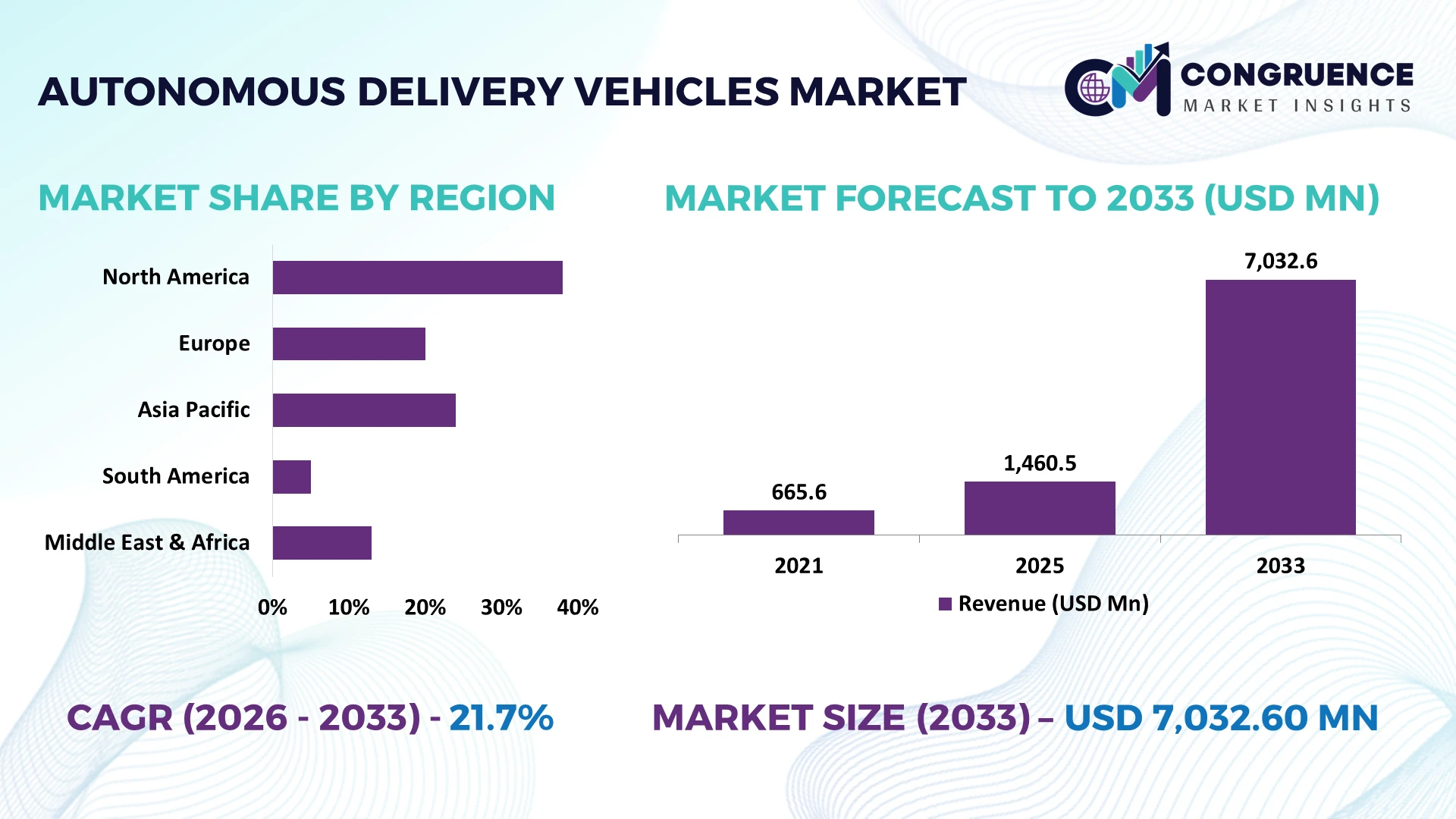
The Global Autonomous Delivery Vehicles Market was valued at USD 1460.52 Million in 2025 and is anticipated to reach a value of USD 7032.6 Million by 2033 expanding at a CAGR of 21.71% between 2026 and 2033. Growth is driven by AI-powered navigation, last-mile delivery automation, expanding e-commerce fulfillment networks, and deployment of low-speed autonomous vehicles across urban logistics corridors.
The United States represents a leading commercialization hub for autonomous delivery vehicles, supported by sidewalk robot deployments, autonomous trucking development, and partnerships between robotics companies and delivery platforms. Serve Robotics has outlined a deployment target of 2,000 robots, while its delivery technology supports Level 4 autonomy within defined operating domains. Compared with China, where autonomous delivery development emphasizes logistics parks and large-scale parcel distribution, the United States benefits from established food delivery platforms, university deployments, and regulatory experimentation across individual states.
Strategically, logistics operators should prioritize high-density delivery routes and repeatable autonomous operations, using fleet utilization and delivery cost per order as primary investment criteria.
Market Size & Growth: USD 1,460.52 million in 2025, reaching USD 7,032.6 million by 2033 at 21.71% CAGR, supported by AI-driven last-mile logistics automation.
Top Growth Drivers: Serve Robotics recorded 20-fold fleet expansion, 99.8% delivery completion, and over 10-fold merchant network growth.
Short-Term Forecast: By 2027, operators will prioritize delivery completion above 99% and higher daily robot utilization.
Emerging Technologies: Level 4 autonomy, AI-powered computer vision, and edge computing strengthen navigation across complex urban delivery environments.
Regional Leaders: North America leads commercialization; Asia-Pacific advances parcel automation; Europe expands robotic grocery delivery. Regional USD forecasts require validated allocations.
Consumer/End-User Trends: Serve's integration with Uber Eats and DoorDash provides access to platforms representing over 80% of U.S. food delivery.
Pilot/Case Example: In 2025, Serve Robotics deployed 2,000 robots, achieving 99.8% delivery completion across its expanding U.S. network.
Competitive Landscape: Starship Technologies, Serve Robotics, Nuro, Meituan, and Gatik compete across specialized delivery segments; consolidated market shares remain unverified.
Regulatory & ESG Impact: Zero-tailpipe-emission delivery robots support urban sustainability objectives, while Level 4 deployments require defined operating conditions.
Investment & Funding: Starship announced USD 50 million in Series C financing in 2025, reinforcing autonomous delivery fleet expansion.
Innovation & Future Outlook: Next-generation robotic fleets emphasize multimodal AI, autonomous charging, and integrated dispatch systems to improve operational scalability.
The Autonomous Delivery Vehicles Market is evolving through expanding applications in food delivery, grocery distribution, retail fulfillment, and short-distance parcel transportation. AI-based obstacle detection, advanced sensor fusion, and cloud-connected fleet orchestration are improving navigation reliability and deployment efficiency. Serve Robotics reported a 99.8% delivery completion rate, demonstrating commercial progress in autonomous sidewalk logistics. Meanwhile, China's automated parcel distribution initiatives and expanding U.S. delivery platform partnerships illustrate contrasting commercialization strategies. Increasing integration of robotics with urban fulfillment infrastructure is reshaping fleet economics, establishing operational scalability and regulatory readiness as central considerations for long-term competitive positioning.
Autonomous delivery vehicles are becoming strategically important as logistics operators restructure last-mile distribution around automated fulfillment, lower delivery costs, and predictable service availability. The transition from driver-dependent transportation to AI-enabled robotic fleets is changing competitive dynamics across food delivery, grocery distribution, and parcel logistics. Serve Robotics' expansion toward 2,000 deployed robots demonstrates how autonomous delivery networks are moving beyond isolated pilots. Companies are increasingly prioritizing fleet utilization, merchant integration, and operational density rather than geographic expansion alone.
Technology differentiation centers on autonomous navigation, sensor fusion, and remote fleet supervision. Compared with conventional courier delivery, robotic operations eliminate onboard driver requirements, although actual cost savings depend on delivery density and supervision expenses. The United States emphasizes sidewalk delivery robots and commercial platform partnerships, while China advances larger autonomous parcel vehicles for logistics distribution. Between 2026 and 2028, fleet utilization, autonomous operating hours, and successful deliveries per vehicle will become decisive performance indicators.
Serve Robotics' integration with Uber Eats illustrates how platform partnerships accelerate commercial deployment without requiring operators to establish independent customer acquisition networks. Meanwhile, logistics companies are directing investment toward route optimization, charging infrastructure, and centralized fleet management. Competitive advantage increasingly depends on achieving reliable, repeatable delivery economics across dense operating territories.
The transition toward automated last-mile fulfillment is accelerating autonomous delivery vehicle deployment across the United States and China. Serve Robotics reported a 99.8% delivery completion rate, demonstrating operational reliability in commercial sidewalk delivery. Its fleet expansion from approximately 100 robots toward 2,000 units represents a roughly 1,900% increase in targeted deployment capacity. Meanwhile, autonomous delivery vehicles eliminate onboard driver requirements, reducing direct dependence on courier availability. Partnerships with Uber Eats and DoorDash integrate robotic delivery into established ordering platforms, strengthening route density and customer accessibility. Operators are investing in AI navigation, remote supervision, and merchant onboarding to convert technological reliability into higher daily delivery throughput and stronger fleet economics.
Autonomous delivery vehicle commercialization faces structural constraints from inconsistent sidewalk infrastructure, expensive sensing components, and fragmented municipal operating requirements. In the United States, Serve Robotics relies on third-party manufacturers for robot assembly, creating exposure to component availability and production scheduling. Its 99.8% delivery completion rate still leaves a 0.2% unsuccessful delivery share, requiring operational recovery procedures. Furthermore, partnerships with platforms covering over 80% of U.S. food delivery concentrate commercial access among major intermediaries. Sidewalk width restrictions, pedestrian accessibility requirements, and battery charging availability complicate deployment planning. Manufacturers are responding through modular hardware architectures, supplier diversification, and localized maintenance networks. Standardizing replacement components and securing predictable production capacity remain essential for controlling fleet ownership costs.
Autonomous delivery operators are expanding beyond restaurant fulfillment into grocery distribution, healthcare logistics, and integrated robotic services. Starship Technologies' partnership with Uber Eats outlined an expansion from more than 2,700 robots toward 12,000 by 2027, representing a planned fleet increase exceeding 340%. Its cumulative delivery volume surpassed 9 million, demonstrating the potential of repeatable commercial operations. Serve Robotics' merchant network expanded more than tenfold during 2025, creating opportunities to improve robot utilization through diversified order sources. In the United States, operators are developing autonomous charging, AI fleet orchestration, and indoor delivery applications. Partnerships with retailers and healthcare providers enable companies to monetize existing navigation technologies across additional operating environments without rebuilding their autonomy platforms.
Scaling autonomous delivery networks requires consistent performance across unpredictable pedestrian environments, changing weather, complex intersections, and geographically distributed fleets. Serve Robotics expanded its operating fleet twentyfold during 2025 while maintaining a 99.8% delivery completion rate, establishing a demanding benchmark for commercial reliability. Its deployment across 20 cities and six metropolitan areas also demonstrates the complexity of coordinating distributed robotic operations. Even a 0.2% unsuccessful delivery rate translates into 200 unsuccessful deliveries per 100,000 attempts, making exception management commercially significant. Operators must strengthen remote assistance, cybersecurity protection, predictive maintenance, and automated incident classification. Investment in simulation environments and centralized fleet intelligence is essential to prevent operational complexity from eroding service consistency as deployment volumes increase.
Commercial Fleets Shift Toward Scale: Serve Robotics expanded its fleet approximately twentyfold during 2025, reaching 2,000 deployed robots while maintaining a reported 99.8% delivery completion rate. This transition toward larger operating fleets is increasing emphasis on maintenance scheduling, battery availability, and centralized dispatch. Operators are standardizing vehicle configurations to reduce servicing complexity and improve asset productivity.
Autonomous Trucking Enters Freight Operations: Aurora launched commercial driverless trucking operations in Texas in 2025, initially connecting Dallas and Houston across approximately 200 miles. The transition from supervised testing to driverless freight movement changes vehicle utilization planning and terminal coordination. Logistics companies are adapting freight scheduling, safety monitoring, and customer contracts to accommodate autonomous highway operations.
Drone Delivery Expands Retail Coverage: Walmart and Wing announced plans in 2025 to expand drone delivery to 100 additional stores, following operations at 18 Walmart locations in the Dallas area. The expansion emphasizes automated dispatch, lightweight payload handling, and localized launch infrastructure. Retailers are restructuring fulfillment workflows to accelerate short-distance deliveries without relying exclusively on road networks.
Navigation Systems Adapt to Urban Complexity: Autonomous delivery robots increasingly combine computer vision, lidar, and remote assistance to manage pedestrian interactions. Serve Robotics reported 99.8% delivery completion, leaving a 0.2% exception rate requiring operational attention. Companies are refining geofencing, incident classification, and remote intervention workflows, recognizing that supervision efficiency becomes increasingly important as autonomous fleet density rises.
Ground Delivery Robots Lead Commercial Deployment
Ground Delivery Robots represent an established segment of autonomous last-mile logistics, supported by comparatively accessible deployment infrastructure and integration with restaurant delivery platforms. Their market leadership is evident in Serve Robotics' deployment of 2,000 robots across 20 U.S. cities by December 2025. Its fleet expanded twentyfold within one year, demonstrating the scalability of standardized sidewalk delivery systems. These vehicles operate within defined geographic areas, using computer vision, obstacle detection, and remote assistance to maintain delivery reliability. Autonomous Delivery Vans serve larger payload requirements and broader road networks, making them relevant for urban distribution and scheduled retail replenishment.
Autonomous Delivery Drones are emerging as a high-growth technology segment, particularly for lightweight, time-sensitive orders. Wing and Walmart announced expansion to 150 additional stores in January 2026, targeting a network exceeding 270 locations by 2027. Self-Driving Delivery Trucks address longer-distance freight movements, emphasizing highway autonomy and terminal integration. Manufacturers are differentiating investments according to payload capacity, operating environment, and autonomy requirements, rather than pursuing a single vehicle architecture across all delivery applications.
Food and Grocery Delivery Dominates Commercial Adoption
Food and Grocery Delivery represents a leading application for autonomous delivery vehicles, benefiting from frequent transactions, localized merchant networks, and established digital ordering infrastructure. Serve Robotics expanded its merchant partnerships from approximately 400 to more than 4,500 during 2025, exceeding tenfold growth. Its integration with Uber Eats and DoorDash provides access to platforms collectively representing over 80% of U.S. food delivery activity. Autonomous ground robots are particularly suited to short-distance restaurant deliveries, while aerial systems improve fulfillment speed for lightweight grocery orders. Parcel and E-Commerce Delivery supports broader distribution networks, where automated dispatch and delivery consolidation influence operational efficiency.
Medical and Pharmaceutical Delivery is developing through specialized robotic transportation requiring controlled handling, secure transfer, and predictable service availability. Industrial Parts Delivery addresses factory campuses and industrial facilities where recurring material movements support production continuity. These applications emphasize reliability and integration rather than consumer-facing delivery speed. Companies are responding through application-specific payload compartments, automated order assignment, and partnerships with healthcare institutions and industrial operators. Investment priorities increasingly reflect delivery frequency, payload sensitivity, and operating environment.
Food Delivery Platforms Drive Fleet Integration
Food Delivery Platforms represent a major commercial buyer and deployment channel for autonomous delivery vehicles, supported by concentrated transaction volumes and established merchant relationships. Serve Robotics' integration with Uber Eats and DoorDash connects its fleet with platforms representing more than 80% of the U.S. food delivery market. E-Commerce and Retail Companies are expanding autonomous fulfillment through partnerships with specialized technology providers, reducing the need to develop proprietary robotic fleets. Walmart's collaboration with Wing illustrates this approach, combining existing retail infrastructure with autonomous aerial delivery capabilities.
Logistics and Courier Companies are investing in autonomous transportation for repeatable delivery routes and freight movements, emphasizing network integration and vehicle utilization. Healthcare Providers represent a developing end-user category, particularly for internal hospital transportation and time-sensitive medical deliveries. Manufacturing and Industrial Enterprises focus on predictable material transfers within controlled operating environments. Technology suppliers are adjusting commercialization strategies through fleet-as-a-service agreements, enterprise software integration, and specialized vehicle configurations. Competitive differentiation increasingly depends on operational reliability, deployment flexibility, and compatibility with existing enterprise logistics systems.
North America accounted for the largest market share in 2025; however, Asia-Pacific is expected to register the fastest growth between 2026 and 2033.

Commercial Fleet Expansion and Autonomous Logistics Integration
North America maintains a leading commercialization position in autonomous delivery vehicles, supported by established food delivery platforms, robotics developers, and autonomous freight operators. The United States anchors deployment activity through sidewalk delivery robots, driverless trucks, and emerging aerial fulfillment networks. Serve Robotics reached 2,000 deployed robots by December 2025, demonstrating increasing commercialization of automated last-mile distribution. Aurora's driverless freight operations in Texas illustrate the transition toward autonomous highway logistics. Canada contributes through autonomous vehicle research, industrial automation, and controlled-environment logistics applications. Regulatory fragmentation across U.S. states continues to influence deployment geography, encouraging operators to prioritize jurisdictions with established autonomous vehicle frameworks. Partnerships between technology developers, retailers, and logistics providers are improving commercialization efficiency by connecting robotic fleets with existing distribution infrastructure and established customer networks.
United States Market Outlook: The United States benefits from established autonomous vehicle testing ecosystems, advanced semiconductor capabilities, and extensive logistics infrastructure. Walmart and Wing announced plans in January 2026 to expand drone delivery across 150 additional stores. Meanwhile, Texas supports autonomous trucking through commercial highway operations, strengthening the country's position in both urban delivery automation and long-distance freight technology.
Regulatory Harmonization and Sustainable Urban Delivery
Europe's autonomous delivery vehicle industry is shaped by pedestrian accessibility regulations, urban sustainability policies, and demand for efficient short-distance distribution. Germany, the United Kingdom, Estonia, and Finland support robotic delivery development through technology research, commercial pilots, and logistics partnerships. Starship Technologies, founded in Estonia, has established substantial commercial operations through university campuses and residential delivery networks. Its autonomous robots have completed millions of deliveries, demonstrating the feasibility of repeatable low-speed logistics services. European deployment strategies increasingly emphasize controlled operating environments, predictable routes, and integration with established retail systems. The European Union's AI Act introduces additional compliance considerations for applicable artificial intelligence systems, reinforcing the importance of safety documentation and operational transparency. Companies are investing in sensor reliability, fleet supervision, and regulatory compliance to strengthen commercial scalability across jurisdictions with different pedestrian infrastructure requirements.
Germany Market Outlook: Germany offers a strong industrial foundation through automotive engineering, robotics research, and advanced manufacturing infrastructure. Its logistics sector supports autonomous vehicle applications involving industrial material transportation, warehouse connectivity, and commercial freight distribution. German companies benefit from established vehicle safety expertise and automated manufacturing capabilities, positioning the country as an important development center for autonomous navigation and industrial delivery platforms.
China-Led Deployment Scale and Manufacturing Integration
Asia-Pacific demonstrates strong autonomous delivery vehicle deployment potential through China's extensive e-commerce logistics infrastructure, electronics manufacturing capabilities, and automated parcel distribution networks. Chinese companies including JD Logistics, Meituan, and Neolix are advancing autonomous ground delivery technologies across urban distribution and commercial logistics environments. Neolix has reported cumulative deployments exceeding 10,000 autonomous delivery vehicles, reflecting increasing commercial adoption of low-speed road logistics. Japan is developing autonomous delivery applications in response to logistics workforce constraints, while South Korea combines advanced robotics capabilities with digitally connected distribution infrastructure. Regional manufacturers benefit from established battery production, electronic components, and vehicle assembly ecosystems. These supply-chain advantages support vehicle customization and manufacturing scale. Companies are prioritizing integrated fleet management, localized navigation systems, and partnerships with parcel operators to improve autonomous distribution performance across increasingly complex delivery networks.
China Market Outlook: China benefits from extensive parcel delivery infrastructure, advanced battery manufacturing, and domestic autonomous driving technology development. JD Logistics operates autonomous delivery systems within its broader smart logistics network, while Meituan develops robotic distribution solutions for food and retail fulfillment. Government-supported intelligent connected vehicle initiatives and dedicated testing environments strengthen commercialization pathways, allowing manufacturers to refine autonomous delivery technologies through repeated operational deployment.
Hybrid Delivery Networks and Urban Logistics Automation
South America's autonomous delivery vehicle market is developing through selective deployments addressing urban congestion, delivery accessibility, and last-mile distribution inefficiencies. Brazil represents an important commercialization center, supported by established food delivery platforms and domestic drone technology developers. In June 2026, iFood and Speedbird Aero introduced an integrated autonomous delivery route in Greater São Paulo, combining robotic pickup, drone transportation, and conventional courier fulfillment. The aerial segment covers 3.6 kilometers in approximately five minutes, demonstrating the operational advantages of multimodal delivery systems. The project addresses delivery routes experiencing nearly 50% order rejection because of difficult access conditions. Elsewhere, Chile and Colombia offer opportunities for controlled-environment logistics automation. Infrastructure fragmentation, airspace authorization, and limited dedicated robotic corridors encourage operators to prioritize targeted deployments rather than extensive autonomous fleet expansion.
Brazil Market Outlook: Brazil benefits from established digital commerce platforms, domestic aerospace expertise, and concentrated urban delivery demand. The iFood and Speedbird Aero partnership demonstrates how autonomous technology can complement existing courier networks without replacing every transportation stage. Brazilian operators are prioritizing drone-assisted routes, integrated dispatch systems, and localized infrastructure partnerships to improve fulfillment accessibility across complex metropolitan environments.
Smart City Investment and Autonomous Logistics Infrastructure
The Middle East & Africa market is increasingly influenced by government-backed smart mobility initiatives, logistics modernization, and autonomous vehicle testing infrastructure. The United Arab Emirates leads regional commercialization through regulatory development and dedicated autonomous mobility environments. Dubai's Self-Driving Transport Zone covers approximately 15 square kilometers across three operational areas, integrating autonomous delivery robots with other intelligent transportation systems. In September 2025, Dubai introduced a regulatory framework governing autonomous heavy vehicles, including licensing, technical requirements, and operational trials. Saudi Arabia is strengthening its autonomous logistics ecosystem through smart city development and advanced transportation infrastructure. Across Africa, adoption remains concentrated in specialized delivery applications, particularly medical logistics using autonomous drones. Companies are pursuing government partnerships, infrastructure integration, and controlled deployment environments to establish commercially viable operating networks.
United Arab Emirates Market Outlook: The UAE benefits from coordinated smart city policies, advanced telecommunications infrastructure, and dedicated autonomous mobility testing facilities. Abu Dhabi Mobility has introduced autonomous delivery vehicle pilots, while Dubai targets 25% autonomous transportation trips by 2030. Regulatory support for autonomous logistics vehicles strengthens opportunities for technology providers specializing in robotic delivery, connected fleet management, and automated distribution infrastructure.
Competition in autonomous delivery vehicles centers on Starship Technologies, Serve Robotics, Nuro, Neolix, and Meituan, alongside specialized operators including Gatik and Zipline. Starship and Serve compete in sidewalk robotics, while Neolix and Meituan emphasize road-based distribution. Nuro develops autonomous driving technology, whereas Gatik targets commercial freight transportation. Verified combined market share for the five leading companies remains unavailable because commercial deployments span different vehicle categories. Starship surpassed 10 million deliveries in 2026, while Serve reported 99.8% delivery completion, demonstrating contrasting advantages in operating scale and service reliability. Competitive differentiation increasingly depends on navigation accuracy, fleet utilization, manufacturing efficiency, and merchant integration. Companies are expanding through platform partnerships, proprietary autonomy software, and standardized hardware production. Regulatory approvals, extensive operational datasets, and fleet maintenance infrastructure create substantial entry barriers. Winning requires dependable autonomous performance, commercially sustainable deployment density, and strong integration with established logistics networks across diverse operating environments.
Starship Technologies
Serve Robotics Inc.
Nuro, Inc.
Neolix
Meituan
Gatik AI, Inc.
Zipline International Inc.
Wing Aviation LLC
Coco Robotics
Avride
Cartken Inc.
Kiwibot
Manna Air Delivery
Aurora Innovation, Inc.
Current autonomous delivery technologies combine computer vision, lidar, GPS positioning, and AI navigation to support robotic movement across sidewalks and designated roads. Serve Robotics reported 99.8% delivery completion during 2025, indicating operational maturity in controlled urban environments. Its deployment of 2,000 robots demonstrates increasing commercial adoption of centralized fleet supervision. Compared with conventional courier systems requiring onboard drivers for every delivery, autonomous robots remove 100% of onboard driving labor, although remote supervision and maintenance remain necessary.
Emerging technologies include multimodal sensor fusion, edge AI processors, and automated charging infrastructure. These systems reduce dependence on continuous cloud connectivity while supporting faster obstacle recognition and localized route decisions. Wing's expansion into additional Walmart locations demonstrates increasing integration between autonomous aerial delivery and retail fulfillment software. Operators are developing predictive battery management, geofenced navigation, and automated dispatch systems to improve fleet availability and delivery consistency.
Disruptive innovation centers on shared autonomy platforms, simulation-based training, and coordinated robotic fleet intelligence. Between 2026 and 2028, manufacturers will increasingly integrate vehicle telemetry, remote assistance, and predictive maintenance into unified operating systems. Technology developers with proprietary navigation datasets and established merchant partnerships gain competitive advantages through faster software refinement, stronger operational reliability, and lower deployment complexity.
October 2025: Serve Robotics deployed its 1,000th third-generation autonomous delivery robot, including over 380 units deployed during September. This manufacturing and deployment milestone strengthened its nationwide delivery capacity and demonstrated accelerating commercialization of standardized robotic fleets. Source: serverobotics.com
June 2025: Walmart announced a partnership expansion with Wing to introduce drone delivery at 100 additional stores across five U.S. cities. The initiative strengthened automated retail fulfillment, extended aerial delivery coverage, and improved access to rapid household deliveries. Source: walmart.com
May 2025: Aurora launched commercial driverless trucking between Dallas and Houston, completing over 1,200 miles without a driver. The deployment established a commercial autonomous freight service using Class 8 trucks, strengthening highway logistics automation and carrier integration. Source: aurora.tech
April 2025: Nuro secured USD 106 million in Series E funding to expand autonomous driving technology licensing. The strategic shift from proprietary delivery robot manufacturing toward software commercialization strengthened capital efficiency and enabled partnerships with automotive manufacturers and logistics operators. Source: techcrunch.com
The Autonomous Delivery Vehicles Market Report evaluates commercial deployment, technology adoption, competitive positioning, and operational developments between 2026 and 2033. Segmentation covers four vehicle types: Ground Delivery Robots, Autonomous Delivery Drones, Autonomous Delivery Vans, and Self-Driving Delivery Trucks. Application analysis examines food and grocery delivery, parcel and e-commerce distribution, medical and pharmaceutical transportation, and industrial parts delivery. End-user coverage includes retail enterprises, food delivery platforms, healthcare providers, logistics operators, and manufacturing companies.
Regional analysis encompasses North America, Europe, Asia-Pacific, South America, and the Middle East & Africa, emphasizing deployment maturity, regulatory frameworks, and infrastructure readiness. Technology assessment addresses AI navigation, sensor fusion, edge computing, fleet orchestration, and autonomous charging. Competitive benchmarking incorporates deployment scale, delivery reliability, partnerships, and commercialization strategies, supporting investment prioritization, geographic expansion, and technology selection decisions.
| Report Attribute/Metric | Report Details |
|---|---|
Market Revenue in 2025 | USD 1460.52 Million |
Market Revenue in 2033 | USD 7032.6 Million |
CAGR (2026 - 2033) | 21.71% |
Base Year | 2025 |
Forecast Period | 2026 - 2033 |
Historic Period | 2021 - 2025 |
Segments Covered | By Type
By Application
By End-User
|
Key Report Deliverable | Revenue Forecast, Growth Trends, Market Dynamics, Segmental Overview, Regional and Country-wise Analysis, Competition Landscape |
Region Covered | North America, Europe, Asia-Pacific, South America, Middle East, Africa |
Key Players Analyzed | Starship Technologies, Serve Robotics Inc., Nuro, Inc., Neolix, Meituan, Gatik AI, Inc., Zipline International Inc., Wing Aviation LLC, Coco Robotics, Avride, Cartken Inc., Kiwibot, Manna Air Delivery, Aurora Innovation, Inc. |
Customization & Pricing | Available on Request (10% Customization is Free) |




