
Reports
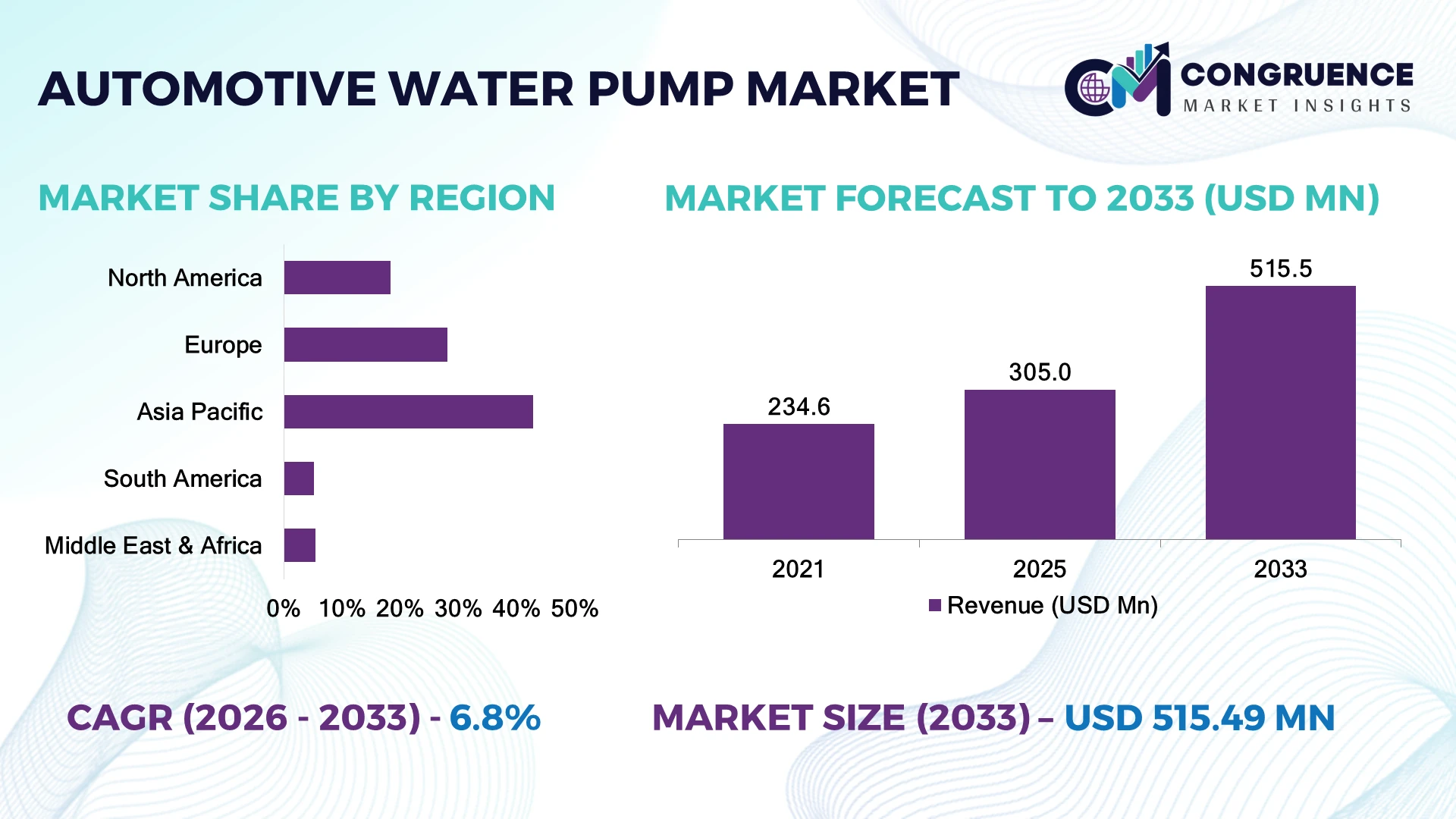
The Global Automotive Water Pump Market was valued at USD 305.0 Million in 2025 and is anticipated to reach a value of USD 515.5 Million by 2033 expanding at a CAGR of 6.78% between 2026 and 2033. Growth is driven by the shift from mechanically driven pumps toward electronically controlled thermal-management systems for hybrid and electric powertrains, where demand-based coolant circulation reduces parasitic energy losses and improves temperature control.
China remains the dominant country market, accounting for approximately 35–40% of global automotive water-pump demand, supported by its large vehicle-production base and rapid electrification. India is expanding localized thermal-component capacity, while Japan maintains advanced hybrid-pump adoption. China’s automotive manufacturing scale substantially exceeds India’s, while intelligent cooling systems can reduce pump energy consumption by more than 50% versus conventional mechanical systems.
Strategically, suppliers should prioritize electronically controlled pumps, localized production, and OEM partnerships in China and India to capture the transition toward advanced vehicle thermal management.
Market Size & Growth: The market reaches USD 305.0 million in 2025 and USD 515.5 million by 2033 at a 6.78% CAGR, supported by electrification and demand-controlled cooling.
Top Growth Drivers: Electrified powertrains contribute approximately 13–14% annual expansion in electric-pump adoption, while battery-cooling applications advance at about 13.66% and passenger-car electric-pump adoption at 13.65%.
Short-Term Forecast: By 2028, electronically controlled pump penetration is positioned to increase efficiency by roughly 5–10%, while optimized coolant circulation reduces auxiliary energy consumption substantially versus fixed-speed mechanical systems.
Emerging Technologies: BLDC motors, AI-enabled thermal controls, and lightweight advanced materials are reshaping pump architectures, with 12V systems representing about 83.8% of electric water-pump demand in one major market assessment.
Regional Leaders: Asia Pacific leads with approximately 42.8% share, Europe follows at 28.1%, and North America at 18.4%; China emphasizes EV thermal systems, Europe prioritizes regulatory efficiency, and North America accelerates localized electrification supply chains.
Consumer/End-User Trends: Passenger cars account for more than 60% of electric water-pump demand, while battery-cooling applications are gaining adoption as EV platforms require multiple dedicated thermal circuits.
Pilot/Case Example: In 2024, Rheinmetall secured an order in the low three-digit-million-euro range for several million electric coolant pumps for hybrid vehicles, with production extending through 2030.
Competitive Landscape: Pierburg leads with approximately 22% electric water-pump share, followed by Continental at about 15% and Aisin at 14.3%; Bosch and BorgWarner remain important technology competitors.
Regulatory & ESG Impact: Euro 7, CAFE, and China GB standards are accelerating demand for electronically controlled cooling, while intelligent systems have demonstrated approximately 1.1% fuel-consumption reduction and 5.3% lower hydrocarbon emissions in controlled testing.
Investment & Funding: A BorgWarner electrification project in Michigan represented USD 11.2 million in capital investment, while its San Luis Potosí expansion added 380 planned jobs, reflecting continued localization of advanced thermal and electrification manufacturing.
Innovation & Future Outlook: Next-generation pumps are moving toward 48V and high-voltage architectures, sensor-driven flow control, predictive thermal management, and integrated cooling modules, shifting competition from component pricing toward system-level efficiency and OEM integration.
Automotive Water Pump Market demand is increasingly concentrated around EV battery cooling, hybrid thermal management, high-efficiency passenger vehicles, and electronically controlled coolant circulation. Electric pumps already show substantially lower operating energy requirements than mechanical alternatives, while China, Japan, India, and South Korea are strengthening localized production networks. Geopolitical supply-chain restructuring is pushing suppliers toward regional manufacturing and dual sourcing, creating a stronger strategic case for flexible thermal-management platforms.
Automotive water pumps are becoming strategically important because thermal management has shifted from a supporting engine function into a core vehicle-efficiency and electrification technology. EV and hybrid architectures require precise cooling for batteries, inverters, motors, and power electronics, increasing the value of electronically controlled pump systems and integrated thermal modules.
Technology economics reinforce the transition. Controlled electric pumps can consume less than half the energy of mechanical pumps under comparable operating conditions, while intelligent cooling has demonstrated approximately 1.1% lower fuel consumption and 5.3% lower hydrocarbon emissions. Europe is driven by emissions regulation, whereas China combines manufacturing scale with rapid EV deployment; India is strengthening localization and supplier capacity.
Over the next 2–3 years, suppliers are expected to prioritize BLDC pumps, multi-circuit cooling, sensor-based controls, and higher-voltage architectures. Rheinmetall’s multi-million-unit hybrid-pump order extending through 2030 demonstrates how OEM programs are moving toward long-duration thermal-management supply agreements. Valeo’s creation of a dedicated Power division and its nearly USD 1 billion electrification partnership in India further illustrates the shift toward localized, integrated technology ecosystems. Competitive advantage will increasingly depend on efficiency, localization, software-enabled control, and reliable OEM integration.
Electrification is shifting pump demand from simple coolant circulation toward software-controlled thermal management. Battery-electric platforms require dedicated cooling for batteries, motors, and power electronics, while electric pumps can consume less than half the energy of mechanical alternatives in comparable operating conditions. Battery-cooling applications are advancing at approximately 13.66%, while passenger-car electric-pump adoption is expanding at about 13.65%. China’s aggressive EV manufacturing expansion and Europe’s tightening emissions framework are accelerating OEM redesigns. Suppliers are responding through BLDC technology, localized manufacturing, and integrated thermal modules. The strategic shift is clear: pump suppliers that integrate sensors, electronics, and control software gain greater specification influence than component-only manufacturers.
Higher component complexity remains a structural constraint as automotive pumps incorporate motors, controllers, sensors, seals, and advanced electronics. Electric water-pump systems carry higher upfront costs than conventional mechanical designs, creating adoption pressure in price-sensitive vehicle classes. Semiconductor and electronic-component exposure also creates procurement vulnerability, while global supply-chain disruptions and tariff changes continue to pressure automotive suppliers. MAHLE reported that 2025 operations faced supply-chain disruptions and new U.S. tariffs, illustrating the broader cost environment. Companies are mitigating exposure through regional sourcing, long-term contracts, manufacturing localization, and platform standardization. The operational priority is to reduce bill-of-material volatility without compromising pump reliability or thermal performance.
Multi-circuit thermal architecture creates a significant opportunity beyond conventional engine cooling. Electric vehicles require multiple cooling loops, increasing pump content per vehicle and creating demand for compact, electronically controlled systems. Battery-cooling applications are projected to expand at approximately 13.66%, while Asia Pacific represents about 39.49% of the automotive electric water-pump market. China, Japan, South Korea, and India offer strong opportunities because vehicle production, electrification, and component localization are developing simultaneously. Future systems will increasingly combine pumps with valves, sensors, controllers, and heat exchangers. Suppliers are positioning through R&D partnerships and regional production. The non-obvious opportunity lies in designing modular pump platforms that serve several voltage classes and cooling circuits, reducing OEM engineering time and supplier complexity.
The next phase of automotive water-pump deployment introduces integration challenges across electronics, software, battery systems, and vehicle thermal architectures. Pump systems increasingly operate across 12V, 24V, 48V, and high-voltage platforms, while electric pumps can range from roughly 100 watts to more than 600 watts depending on thermal load. Cybersecurity, sensor reliability, electromagnetic compatibility, functional safety, and software validation therefore become increasingly important. China, Germany, Japan, and the United States face different certification and OEM integration requirements, complicating global platform deployment. Companies must invest in validation laboratories, digital controls, engineering talent, and standardized interfaces. The strongest competitive position will belong to suppliers capable of delivering validated pump-control ecosystems rather than isolated hardware, particularly as thermal systems become software-managed vehicle subsystems.
Electronic Pump Architecture: Automakers are shifting from fixed-speed mechanical pumps toward electronically controlled units, with electric pump systems delivering energy reductions of more than 50% under variable-load conditions. Adoption is strongest in China, Germany, and Japan as hybrid and EV platforms require independent cooling circuits. Suppliers are responding with BLDC motors, integrated controllers, and compact pump modules, reducing parasitic losses while improving thermal-response speed.
Multi-Loop Thermal Control: Vehicle platforms increasingly use separate cooling loops for batteries, power electronics, motors, and cabin systems. Battery-cooling applications are expanding at approximately 13.66%, while passenger-car electric-pump adoption is around 13.65%. This architecture increases pump content per vehicle and shifts procurement toward modular assemblies. Companies are redesigning pump portfolios around multiple flow rates and voltage classes rather than single-purpose engine cooling.
Localized Supply Networks: China and India are accelerating domestic sourcing of motors, controllers, castings, and electronic components as automakers restructure supply chains. Localization programs are targeting 50%+ domestic content across selected EV component categories, while geopolitical trade restrictions are encouraging dual sourcing. Suppliers are establishing regional production and long-term OEM contracts to reduce logistics exposure, shorten lead times, and stabilize component availability.
Software-Managed Cooling: Thermal management is becoming increasingly software-defined, linking pump speed with temperature sensors and vehicle control units. Intelligent control can reduce fuel consumption by about 1.1% and hydrocarbon emissions by 5.3% in controlled applications. Euro 7 compliance and tighter efficiency requirements are accelerating deployment. Companies are integrating sensors, diagnostics, and predictive controls, creating a non-obvious shift from selling pumps to supplying programmable thermal-management systems.
The principal type split for automotive water pumps is mechanical water pumps and electric water pumps. Mechanical water pumps remain the larger installed base, accounting for approximately 62% of the market, because they remain standard across conventional internal-combustion platforms and benefit from mature manufacturing, low unit cost, and straightforward engine integration. Electric water pumps represent roughly 38% but are the fastest-growing type as hybrid and battery-electric architectures require independently controlled coolant circulation. Their variable-speed operation improves thermal precision and eliminates continuous mechanical loading.
The mature mechanical segment retains strategic importance in China, India, and Southeast Asia, where ICE vehicle production remains substantial, while electric pumps are gaining specification priority in Germany, Japan, South Korea, and China. Electric-pump adoption is increasing by roughly 10–15% annually across selected electrified applications, pushing suppliers toward BLDC designs, higher-voltage architectures, and integrated controllers. Companies are allocating more R&D toward electric platforms while maintaining cost-optimized mechanical portfolios for high-volume ICE programs. The business implication is a two-track investment model: defend mature mechanical volumes while building scalable electric-pump platforms.
Engine cooling remains the leading application, representing approximately 54% of automotive water-pump demand because conventional passenger vehicles and commercial vehicles continue to rely heavily on liquid-cooled combustion engines. Its established supply base, high replacement volume, and broad compatibility support sustained demand. However, battery cooling is the fastest-growing application, accounting for roughly 19% and gaining specification priority as EV manufacturers deploy dedicated circuits for battery packs, inverters, and electric motors.
Cabin heating and cooling represents approximately 15%, while transmission and other thermal-management applications account for the remaining 12%. Battery cooling is expanding at about 13.66%, materially faster than mature engine-cooling applications, changing pump content per vehicle. Chinese EV manufacturers are increasingly integrating multiple compact pumps into thermal-management modules, while European suppliers emphasize high-efficiency circulation and precise temperature control. Companies are therefore expanding multi-circuit portfolios, combining pumps with valves and sensors, and designing common platforms for different vehicle architectures. This shift makes thermal-system integration a stronger purchasing criterion than standalone pump cost.
Passenger vehicle manufacturers constitute the dominant end-user group, representing approximately 67% of automotive water-pump demand because of their significantly larger global production volumes and extensive installed vehicle base. Commercial vehicle manufacturers account for about 23%, supported by intensive cooling requirements in trucks, buses, and fleet applications, while other end-users contribute approximately 10%. Passenger vehicles also provide the strongest platform for electronic pump adoption as automakers introduce hybrid, EV, and high-efficiency powertrains.
Commercial vehicles remain strategically important because high utilization increases thermal loads and places greater emphasis on durability, uptime, and service intervals. Their electric-pump adoption is growing at approximately 8–10% in electrified fleet programs, while passenger-vehicle applications are advancing more rapidly as EV production scales. Companies are targeting passenger OEMs with compact, software-controlled pumps and commercial fleets with heavy-duty, high-reliability architectures. China is becoming a critical deployment market because of its combination of passenger EV manufacturing and electric commercial-vehicle adoption. The competitive implication is clear: passenger vehicles provide scale, while commercial platforms provide higher-value durability specifications and long-term fleet relationships.
Asia-Pacific accounted for the largest market share at 42.8% in 2025 however, South America is expected to register the fastest growth, expanding at a CAGR of 7.4% between 2026 and 2033.
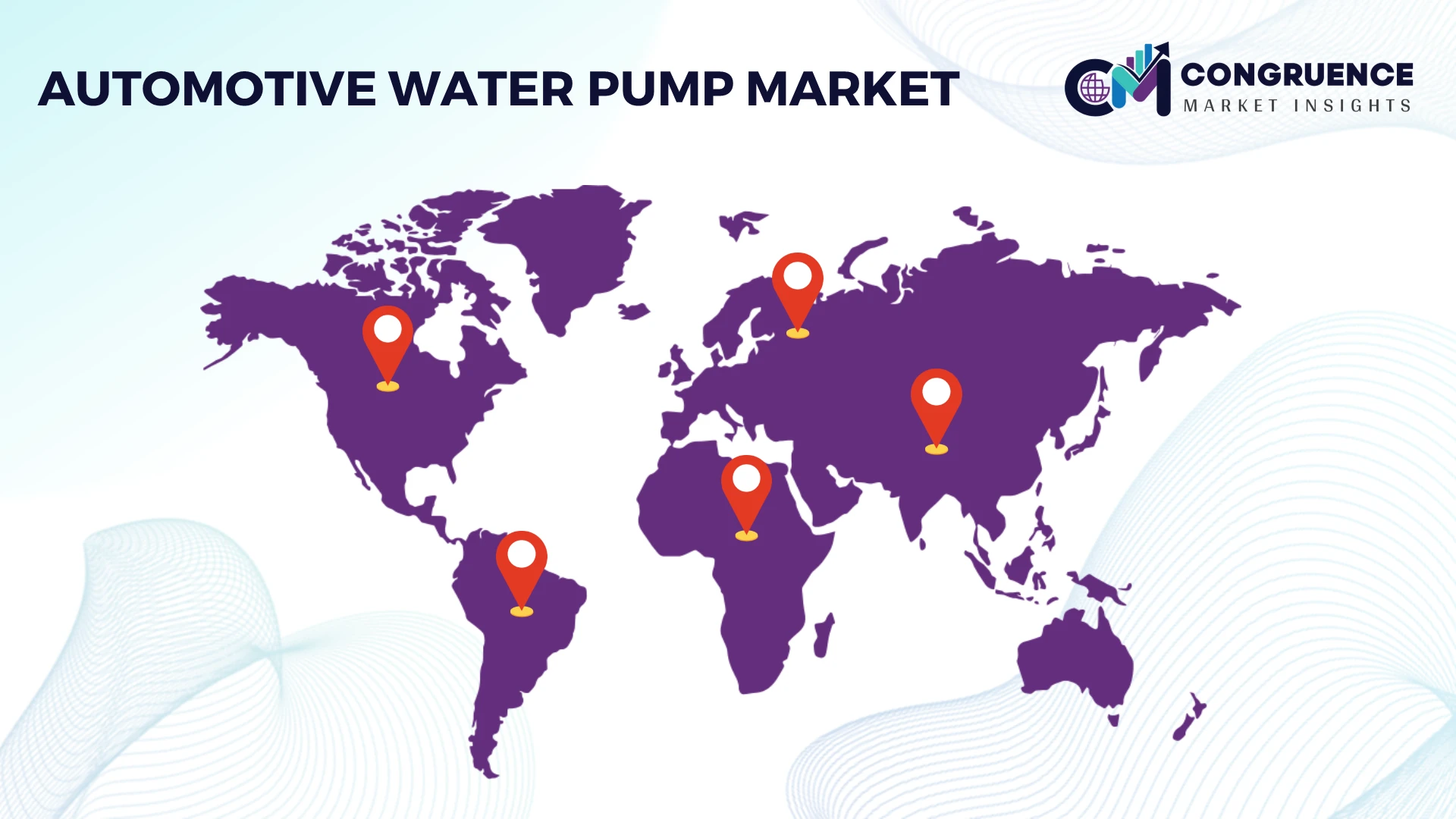
North America represents approximately 18.4% of the global automotive water pump market, supported by the United States’ large light-vehicle production base, expanding EV manufacturing, and strong demand for electronically controlled thermal-management components. Mexico is strengthening its role as a production hub for pumps, motors, and automotive electronics, while U.S. manufacturers are increasing domestic sourcing following supply-chain disruptions. Electric water pumps are gaining specification priority in hybrid and battery-electric platforms because independently controlled coolant circulation improves thermal precision and reduces parasitic loading. Investment is also moving toward integrated cooling modules rather than standalone pumps. The region’s strategic advantage lies in combining established OEM engineering capabilities with localized component production, allowing suppliers to shorten lead times while meeting increasingly stringent vehicle-efficiency and emissions requirements.
United States Market Outlook: The United States remains the region’s principal technology and vehicle-production center, supported by major OEM electrification programs and a substantial installed base of passenger and commercial vehicles. More than 1 million plug-in electric vehicles were sold in the country during 2024, reinforcing demand for battery, inverter, and motor cooling systems. Suppliers are expanding engineering partnerships and domestic production to reduce exposure to imported electronics and improve OEM responsiveness.
Europe contributes approximately 28.1% of global automotive water pump demand, with Germany, France, Italy, and the United Kingdom forming the principal automotive manufacturing centers. Regulatory tightening under Euro 7 is increasing emphasis on precise coolant-flow control, thermal efficiency, and component durability. German manufacturers are integrating electric pumps into hybrid and EV thermal architectures, while suppliers are developing compact BLDC systems and electronically managed coolant circuits. Battery-electric vehicles represented roughly 20% of new-car registrations across the European Union in 2024 when battery-electric and plug-in hybrid categories are considered together, reinforcing demand for dedicated thermal management. Companies are prioritizing localized engineering, modular pump platforms, and OEM partnerships to meet different voltage and cooling requirements. Europe’s competitive advantage increasingly rests on engineering precision and regulatory compliance rather than low-cost component production.
Germany Market Outlook: Germany remains Europe’s most strategically significant automotive water-pump market because of its concentration of premium OEMs, powertrain engineering centers, and Tier-1 suppliers. The country produced more than 4 million passenger vehicles in 2024, sustaining a large addressable base for replacement and original-equipment pump systems. Suppliers are emphasizing electronically controlled pumps capable of supporting hybrid, EV, and high-performance thermal architectures.
Asia-Pacific holds approximately 42.8% of global automotive water pump demand and remains the largest production center, led by China, Japan, South Korea, and India. China’s extensive vehicle manufacturing ecosystem gives pump suppliers direct access to high-volume OEM programs, while Japan and South Korea provide strong expertise in hybrid systems, precision motors, and automotive electronics. China produced more than 30 million vehicles in 2024, creating significant demand for both mechanical replacement pumps and advanced electric systems. India is simultaneously expanding domestic component manufacturing under its automotive localization initiatives. Suppliers are responding with regional factories, dual-sourcing arrangements, and scalable electric-pump platforms. The region’s non-obvious advantage is the ability to commercialize new pump architectures quickly because EV manufacturers, electronics suppliers, and thermal-system specialists increasingly operate within interconnected domestic supply networks.
China Market Outlook: China is the region’s dominant market, supported by the world’s largest automotive manufacturing base and rapid EV deployment. New-energy vehicles accounted for more than 40% of domestic passenger-vehicle retail sales during several months of 2025, accelerating demand for battery and power-electronics cooling. Domestic suppliers are increasing production of BLDC pumps, controllers, sensors, and integrated thermal modules to capture expanding OEM content.
South America accounts for approximately 5.2% of global automotive water pump demand, with Brazil representing the principal manufacturing and consumption center. Conventional engine-driven pumps remain dominant because Brazil, Argentina, and Colombia maintain substantial ICE vehicle fleets, but electronically controlled pumps are gaining relevance in hybrid, flex-fuel, and newer passenger-vehicle platforms. Brazil’s automotive industry produced more than 2.5 million vehicles in 2024, supporting replacement-parts demand and domestic component consumption. Currency volatility and dependence on imported electronic components continue to constrain rapid localization of advanced pumps. Manufacturers are therefore balancing cost-efficient mechanical portfolios with selective investment in electric pump production. Brazil’s expanding hybrid and low-carbon vehicle programs create an important transition pathway, particularly for suppliers capable of adapting thermal-management technologies to locally produced powertrains.
Brazil Market Outlook: Brazil is the region’s largest automotive production and aftermarket center, giving it the strongest installed base for water-pump replacement demand. The country’s growing hybrid-vehicle pipeline is creating new requirements for electronically controlled coolant circulation while its established flex-fuel ecosystem sustains mechanical-pump volumes. Suppliers are increasing local sourcing and adapting pump designs to Brazil’s diverse vehicle and operating conditions.
The Middle East & Africa region represents approximately 5.5% of global automotive water pump demand, with Saudi Arabia, the United Arab Emirates, South Africa, and Türkiye-linked supply routes shaping regional distribution. High ambient temperatures increase thermal loads on engines, transmissions, and electronic systems, making reliable coolant circulation operationally critical. Saudi Arabia’s Vision 2030 industrial diversification program is encouraging automotive manufacturing, mobility investment, and localized component ecosystems, while the UAE is expanding EV infrastructure and fleet electrification. South Africa remains an important manufacturing and export base, producing more than 600,000 vehicles annually. Suppliers are prioritizing high-durability pumps, improved sealing technologies, and electronically controlled systems for newer vehicle platforms. The strategic opportunity is strongest in fleet-heavy markets where preventive maintenance and thermal reliability directly influence vehicle uptime.
Saudi Arabia Market Outlook: Saudi Arabia offers the strongest transformation opportunity through industrial diversification, EV infrastructure development, and fleet modernization. The country has targeted more than 5,000 electric-vehicle charging points under its national mobility initiatives, supporting gradual electrified-vehicle adoption. Extreme operating temperatures also increase demand for robust thermal-management components, giving suppliers opportunities to position high-efficiency pumps around reliability, durability, and fleet uptime.
Bosch, DENSO, MAHLE, Valeo, and Aisin compete with Rheinmetall, BorgWarner, Hanon Systems, and regional suppliers. The structure remains concentrated, with the top five controlling approximately 59% of the thermal-pump market. Competition centers on technology, price, supply security, customization, and development speed. Technology leaders differentiate through brushless motors, sensor integration, high-voltage architectures, and integrated thermal modules; electronically controlled systems command roughly 10–20% higher component value than mechanical designs. Cost-focused suppliers counter through localized production and platform standardization, while OEM-linked players secure volume through co-development agreements. Asian manufacturers compete on scale and responsiveness, whereas European suppliers emphasize efficiency and engineering precision. The competitive shift is moving from standalone pumps toward software-controlled thermal systems combining pumps, valves, sensors, and controllers. Entry barriers include validation, qualification, intellectual property, and reliability testing. Winning suppliers will combine scalable manufacturing with advanced controls, localized supply chains, rapid customization, and long-term OEM integration rather than compete on price.
Robert Bosch GmbH
DENSO Corporation
MAHLE GmbH
Valeo S.A.
Aisin Corporation
Rheinmetall AG
BorgWarner Inc.
Hanon Systems
Continental AG
Johnson Electric Holdings Limited
Gates Corporation
Schaeffler AG
GMB Corporation
Davies Craig Pty Ltd.
Electric water pumps are replacing belt-driven units across hybrid and BEV architectures because variable-speed control matches coolant flow to thermal load. Modern brushless pumps can reduce CO2 emissions by up to 5%, while electronically controlled flow improves thermal precision. Adoption is strongest in battery, inverter, and motor cooling, where independent circuits require responsive circulation.
Integrated thermal modules are becoming the disruptive architecture. Valeo and MAHLE combine pumps, valves, sensors, heat exchangers, and control software to reduce interfaces and packaging. MAHLE’s intelligent thermal-management system for Mahindra’s BEVs reduced electric-compressor power consumption by 15–20%, while integrated designs can reduce pump count from four to three. This favors suppliers with electronics, software, and systems-engineering capabilities.
From 2026–2028, 48V and high-voltage coolant pumps, predictive diagnostics, and software-defined thermal controls will gain importance. Rheinmetall’s 800V CWA2000 demonstrates the transition toward high-voltage pumping, while Bosch’s latest 12V PDE pump delivers up to 1,200 liters per hour at 1.7 bar. Compared with fixed mechanical systems, electronically managed architectures deliver measurable efficiency and packaging advantages. Suppliers investing now in modular platforms, sensor integration, and OEM co-development will capture specification influence as thermal management becomes a vehicle-level performance differentiator, particularly across China, India, Germany, and North America globally now.
June 2024 — Rheinmetall secured a low three-digit-million-euro order for several million electric coolant pumps for hybrid vehicles. Production runs through 2030, extending long-term OEM integration and strengthening Rheinmetall’s position in electrified thermal-management supply chains globally across major vehicle programs. Source: rheinmetall.com
February 2024 — Schaeffler launched 11 INA electric auxiliary water pumps covering more than 50 million vehicles. The expansion strengthens aftermarket thermal-management coverage across combustion, hybrid, and electric platforms while giving workshops broader OE-standard repair options and wider service reach. Source: schaeffler.com
May 2025 — MAHLE began European sales of E-CARE Fluid, automating coolant-circuit evacuation, filling, and pressure testing. The system supports combustion, hybrid, and battery-electric vehicles, reducing manual service steps and positioning MAHLE for higher EV thermal-maintenance complexity across workshops. Source: mahle.com
September 2025 — Valeo unveiled Smart Thermal Management at IAA Mobility, combining smart control, heat-pump hardware, and coolant modules. Integrated with Predict4Range, the platform can recover up to 24% electric range, strengthening Valeo’s position in integrated EV thermal systems architecture. Source: valeo.com
The Automotive Water Pump Market Report covers mechanical and electric water pumps across passenger vehicles and commercial vehicles, with analysis of engine cooling, battery cooling, cabin thermal management, transmission cooling, and related applications. Coverage spans North America, Europe, Asia-Pacific, South America, and Middle East & Africa, with country-level emphasis on China, the United States, Germany, Japan, India, and Brazil.
The report evaluates established pump architectures alongside BLDC motors, electronically controlled flow systems, 48V and high-voltage pumps, integrated thermal modules, sensors, and software-enabled diagnostics. It examines demand concentration, regional manufacturing footprints, OEM sourcing patterns, aftermarket penetration, and emerging electrification requirements. Competitive analysis covers leading global suppliers and regional specialists, supporting decisions on capacity expansion, localization, partnerships, technology investment, product positioning, and supply-chain resilience. The 2026–2033 outlook identifies priority applications and deployment pathways where advanced thermal management is becoming increasingly critical.
| Report Attribute / MetricDetails | Details |
|---|---|
| Market Revenue (2025) | USD 305.0 Million |
| Market Revenue (2033) | USD 515.5 Million |
| CAGR (2026–2033) | 6.78% |
| Base Year | 2025 |
| Forecast Period | 2026–2033 |
| Historic Period | 2021–2025 |
| Segments Covered |
By Type
By Application
By End-User
|
| Key Deliverables | Revenue Forecast; Market Trends; Growth Drivers & Restraints; Technology Insights; Segmentation Analysis; Regional Insights; Competitive Landscape; Regulatory & ESG Overview; Recent Developments |
| Regions Covered | North America; Europe; Asia-Pacific; South America; Middle East & Africa |
| Companies Profiled | Robert Bosch GmbH; DENSO Corporation; MAHLE GmbH; Valeo S.A.; Aisin Corporation; Rheinmetall AG; BorgWarner Inc.; Hanon Systems; Continental AG; Johnson Electric Holdings Limited; Gates Corporation; Schaeffler AG; GMB Corporation; Davies Craig Pty Ltd. |
| Customization & Pricing | Available on Request (10% Customization Free) |




