
Reports
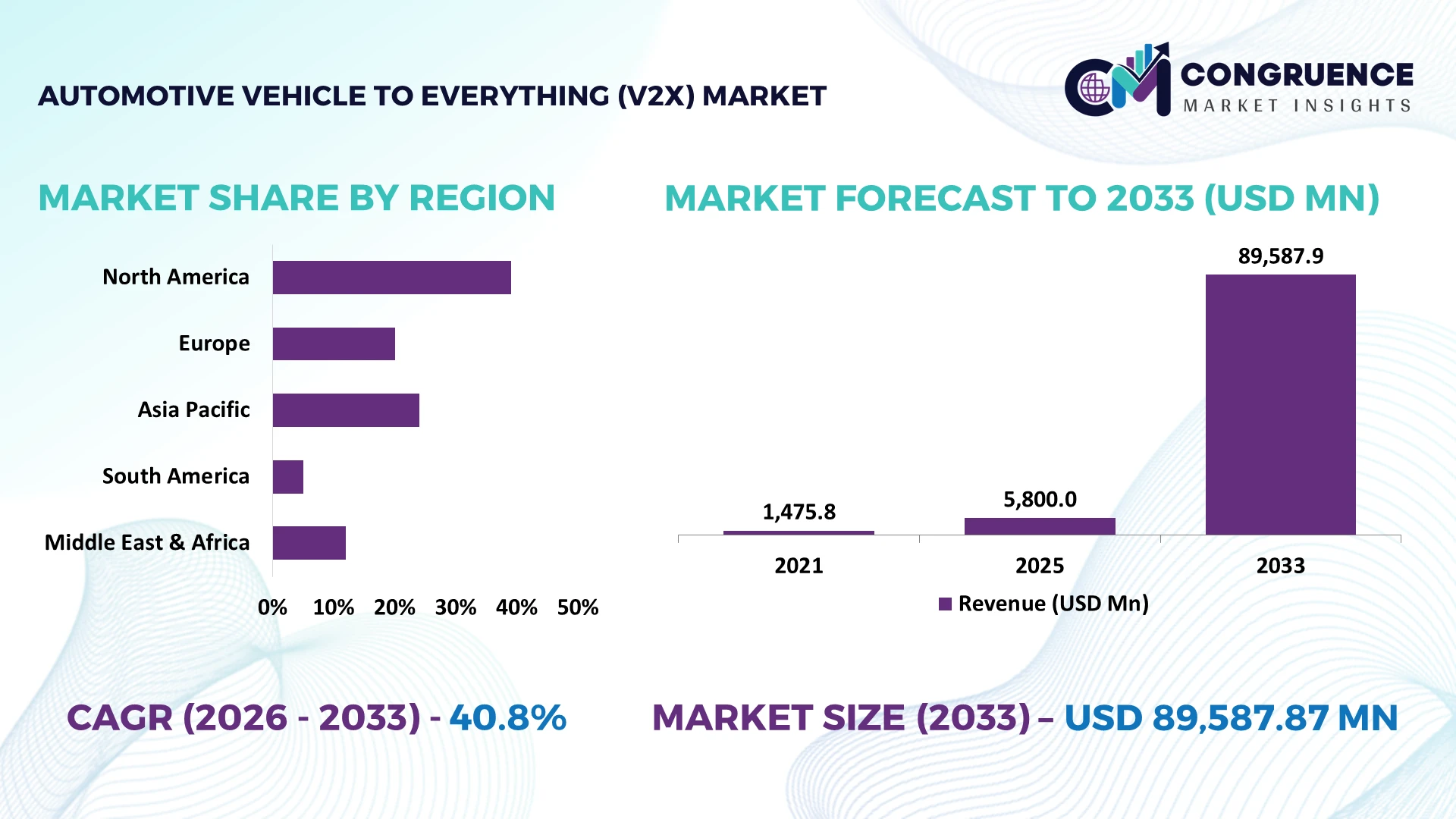
The Global Automotive Vehicle-to-Everything (V2X) Market was valued at USD 5800 Million in 2025 and is anticipated to reach a value of USD 89587.87 Million by 2033 expanding at a CAGR of 40.8% between 2026 and 2033. Growth is driven by C-V2X integration into L2+ vehicles, 5.9 GHz roadside infrastructure deployment, 5G-V2X Direct commercialization, cooperative perception, and government-backed vehicle-road-cloud programs.
China is the dominant deployment market, supported by national vehicle-road-cloud pilots requiring 100% of participating vehicles to install C-V2X terminals, more than 90% connectivity across traffic signals and road signs, and at least 50% C-V2X terminal fitment on new vehicles in pilot cities. The United States is accelerating through USD 60 million federal V2X deployments in Arizona, Texas, and Utah, while Europe advances 5G-V2X Direct and cross-border connectivity.
Strategically, suppliers that combine automotive-grade chipsets, roadside infrastructure, cybersecurity credentials, edge computing, and OEM integration capability will secure the strongest positions as governments standardize connected-road architectures.
Market Size & Growth: USD 5.8 billion in 2025 is projected to reach USD 89.59 billion by 2033 at 40.8%, driven by C-V2X integration and connected-road infrastructure.
Top Growth Drivers: 100% C-V2X fitment in Chinese pilot fleets, more than 90% connected traffic infrastructure, and 50% new-vehicle terminal adoption targets are accelerating deployment.
Short-Term Forecast: By 2028, 5G-V2X Direct commercialization will reduce warning latency and expand cooperative sensor-sharing, supporting materially faster hazard detection across L2+ and automated-driving workflows.
Emerging Technologies: 5G-V2X Direct, edge computing, satellite NTN connectivity, and cooperative perception are converging; initial in-vehicle satellite connectivity is targeted from 2027.
Regional Leaders: China leads infrastructure scale, North America benefits from USD 60 million federal deployment programs, and Europe advances 2026–2029 mass-market 5G-V2X Direct adoption.
Consumer/End-User Trends: Pilot fleets in China require 100% C-V2X terminal installation, while connected passenger vehicles increasingly combine V2V, V2I, V2N, and cloud-based safety services.
Pilot/Case Example: In 2024, ETSI C-V2X interoperability testing achieved a 94% success rate, strengthening confidence in cross-vendor OBUs, RSUs, PKI platforms, and connected safety applications.
Competitive Landscape: Qualcomm strengthened its V2X position by acquiring Autotalks in 2025, competing with Harman, NXP, Continental, and Commsignia across chipsets, automotive platforms, and connectivity modules.
Regulatory & ESG Impact: China requires more than 90% connectivity for traffic signals and road signs in pilot areas, accelerating infrastructure standardization and traffic-efficiency applications.
Investment & Funding: USD 60 million in U.S. federal grants supports advanced interoperable V2X deployments across Arizona, Texas, and Utah, establishing national reference architectures for scalable deployment.
Innovation & Future Outlook: 5G-V2X Direct mass deployment is targeted for 2026–2029, while satellite NTN connectivity from 2027 extends connected-safety coverage beyond terrestrial networks.
Automotive Vehicle-to-Everything technology is moving from isolated safety pilots toward integrated vehicle-road-cloud ecosystems spanning passenger vehicles, commercial fleets, smart intersections, and autonomous mobility. China’s pilot programs already target 100% C-V2X terminal fitment for participating vehicles and above 90% roadside connectivity. Government-backed infrastructure deployment, 5G-V2X Direct, edge computing, and satellite connectivity are now reshaping competitive priorities, setting the foundation for the strategic discussion ahead.
Automotive V2X is becoming strategically critical as automakers shift from vehicle-only intelligence toward cooperative vehicle-road-cloud architectures. China’s 2024–2026 program spans 20 pilot cities or city consortia and requires over 90% connectivity for traffic signals and signs, turning roadside digitalization into automotive infrastructure. This transition redirects investment toward C-V2X terminals, roadside units, edge computing, cloud control and cybersecurity.
Technology performance is also moving beyond legacy isolated ADAS. In 2024 interoperability testing across more than 170 C-V2X tests achieved a 94% success rate, demonstrating increasingly mature cross-vendor communication. China requires 100% C-V2X terminal installation on participating pilot vehicles and targets 50% fitment on new vehicles. Europe emphasizes interoperability and 5G-V2X Direct, while China leads city-scale infrastructure deployment.
Through 2026–2028, 5G-V2X Direct, cooperative perception and multi-access edge computing will move toward production deployment. A Berlin demonstration already enabled vehicles from Audi and BMW to communicate through 5G-V2X Direct. Chipmakers, OEMs and infrastructure suppliers are consequently expanding interoperability partnerships and integrated platforms. Competitive leadership will depend on controlling secure vehicle-road-cloud integration rather than supplying standalone connectivity hardware.
Government-backed infrastructure modernization is converting V2X from isolated trials into city-scale transportation architecture. China’s vehicle-road-cloud program requires 100% C-V2X terminal installation across participating vehicles, more than 90% connectivity for traffic signals and road signs, and 50% terminal penetration among new vehicles in pilot areas. Twenty cities or city consortia are participating, creating concentrated demand for OBUs, RSUs, edge computing and cloud-control platforms. This coordinated deployment reduces the infrastructure fragmentation that previously limited automotive V2X commercialization. OEMs, telecommunications companies and infrastructure suppliers are responding through joint testing, localized platform development and integrated vehicle-road solutions. The strategic advantage increasingly belongs to suppliers securing both vehicle-side design wins and roadside interoperability positions, because infrastructure access directly increases the utility of every connected vehicle.
V2X deployment remains structurally uneven because roadside connectivity, spectrum policies and communication architectures differ sharply between countries. China targets more than 90% connectivity for traffic signals and road signs within pilot zones, yet comparable nationwide infrastructure density is absent across most markets. European interoperability testing achieved 94% success across more than 170 tests, leaving measurable integration gaps even within controlled environments. Meanwhile, multi-operator edge-computing applications are not expected at meaningful deployment levels until 2028–2029, restricting near-term cross-network functionality. These differences increase validation expense and complicate globally standardized vehicle platforms. Automakers and Tier-1 suppliers are reducing exposure through multimode connectivity, software-upgradable architectures and country-specific certification programs. The operational pressure point is therefore infrastructure consistency: vehicle hardware can scale faster than interoperable roadside coverage.
5G-V2X Direct creates an opportunity to extend vehicle perception beyond onboard camera, radar and lidar range by sharing sensor information between vehicles and infrastructure. China’s pilots require 5G coverage across participating zones, while 100% of pilot vehicles must carry C-V2X terminals and key roadside infrastructure must exceed 90% connectivity. European demonstrations have already enabled vehicles from different OEMs to communicate directly and share cooperative safety information. Commercial 5G-V2X Direct deployment is targeted within the 2026–2029 horizon, opening new opportunities in obstructed-intersection warnings, cooperative parking, vulnerable-road-user protection and coordinated driving. OEMs, chipset suppliers and infrastructure companies are expanding R&D partnerships around collective perception and edge processing. The non-obvious opportunity is monetizing shared perception as a software capability rather than treating V2X solely as communications hardware.
Scaling V2X requires millions of vehicles, roadside units and cloud platforms to authenticate messages without undermining latency, privacy or functional safety. The 2024 European interoperability program involved 24 companies, 82 participants and more than 170 tests, yet achieved 94% successful interoperability rather than complete compatibility. China simultaneously requires 100% of participating pilot vehicles to carry both C-V2X terminals and digital identity certificates, demonstrating how cybersecurity infrastructure becomes inseparable from connectivity deployment. Long-term complexity increases further when vehicles cross jurisdictions, network operators and certificate domains. OEMs and technology suppliers must therefore invest in public-key infrastructure, secure credential management, over-the-air updates and cross-vendor validation. Competitive durability will depend on maintaining trusted interoperability throughout vehicle lifecycles, not simply achieving connectivity during initial deployment.
Connected Vehicles Move Toward Scale: Nearly 200 million connected vehicles are already operating globally, while advanced automated-driving functions begin broader deployment from 2026. OEMs are integrating V2X into centralized vehicle architectures, reducing reliance on standalone modules. Chipmakers and Tier-1 suppliers are responding through consolidated connectivity platforms, software-defined interfaces, and multi-network compatibility.
Road Operators Digitize Traffic Workflows: U.S. transportation programs now cover more than 30 V2X applications, including 16 safety and 11 mobility use cases. Traffic agencies are shifting from static signal control toward connected intersections, probe-based monitoring, and real-time speed harmonization. Infrastructure vendors are scaling RSUs, edge platforms, and cloud-based traffic orchestration.
Interoperability Testing Becomes Commercial Gatekeeper: European C-V2X testing achieved approximately 94% interoperability success across more than 170 tests involving 24 companies. The remaining integration gap is strategically significant because cross-vendor compatibility determines deployment consistency. OEMs, chipset suppliers, PKI providers, and road operators are expanding joint validation programs before large fleet rollouts.
Spectrum Policy Accelerates National Deployment: India designated the 5.875–5.925 GHz band for V2V and intelligent transportation applications in 2026, removing licensing requirements for deployment. Proposed phased implementation extends V2V toward production vehicles from 2027. Automakers are adapting telematics architectures, while local electronics suppliers prepare onboard-unit production and certification capacity.
Vehicle-to-Vehicle represents the leading V2X type, with an estimated 32–35% share, supported by direct safety applications including emergency braking alerts, blind-spot warnings, intersection movement assistance, and cooperative lane changes. V2V benefits from relatively straightforward vehicle-side integration and direct communication without continuous cloud dependency. Vehicle-to-Network is the fastest-growing type, estimated at approximately 23–26% of current demand, as connected vehicles increasingly require cloud traffic information, OTA updates, digital maps, and edge-assisted automated-driving functions.
Vehicle-to-Infrastructure maintains roughly 20–22% share through smart intersections, signal-priority systems, and roadside sensing. Vehicle-to-Pedestrian remains smaller but strategically important for vulnerable-road-user protection, while Vehicle-to-Device supports smartphone, wearable, and proximity-based communication. OEMs are shifting investment toward multimode platforms that combine V2V, V2I, and V2N within one communications architecture. This reduces hardware duplication and increases software monetization potential, making integrated connectivity capability more strategically valuable than single-mode V2X hardware.
Collision Avoidance represents the leading application, with an estimated 29–32% share, because V2X directly addresses forward-collision warnings, emergency braking, blind spots, unsafe lane changes, and intersection conflicts. Road Safety follows closely as transportation authorities expand work-zone warnings, pedestrian alerts, and emergency-vehicle notification. Traffic Management represents approximately 20–22% of demand as cities deploy adaptive signal control, speed harmonization, incident detection, and congestion-routing systems.
Autonomous Driving is the fastest-growing application, supported by cooperative perception, cloud decision-making, platooning, and intersection coordination. Smart Parking remains smaller but increasingly integrates vehicle, infrastructure, and cloud data for automated valet parking and space allocation. Companies are responding by combining onboard sensors with V2X data rather than treating connectivity as a separate safety layer. This approach expands effective perception beyond line-of-sight limitations and improves decision quality in dense urban environments. Investment is therefore shifting toward cooperative-driving software, edge processing, and sensor-fusion platforms.
Passenger Vehicle OEMs represent the leading end-user group, accounting for an estimated 38–42% of V2X demand because connected-car architectures, ADAS integration, digital cockpits, and software-defined vehicles concentrate V2X hardware and software investment at the OEM level. Commercial Vehicle OEMs hold roughly 18–21%, supported by platooning, logistics optimization, blind-spot safety, and fleet connectivity requirements. Road Infrastructure Operators remain essential for RSUs, connected intersections, and edge-computing deployment.
Transportation Authorities are the fastest-growing end-user group as governments move from pilot projects toward coordinated road-digitalization programs. Fleet Operators increasingly adopt V2X for route optimization, safety monitoring, and cooperative commercial-vehicle operations. Companies are targeting OEMs through embedded connectivity platforms while partnering separately with infrastructure operators and public agencies for roadside deployment. This dual-market approach is increasingly important because vehicle-side adoption alone cannot deliver full cooperative-driving value without interoperable infrastructure and network services.
North America accounted for the largest market share at 35.4% in 2025 however, Asia-Pacific is expected to register the fastest growth, expanding at a CAGR of 44.2% between 2026 and 2033.
Public Infrastructure Funding Moves V2X Beyond Pilots
North America remains the leading V2X market, supported by large connected-vehicle fleets, established automotive electronics suppliers, and coordinated federal infrastructure deployment. The United States is shifting from fragmented connected-vehicle trials toward interoperable 5.9 GHz V2X networks spanning urban intersections, freight corridors, emergency fleets, and transit systems. Federal deployment programs allocated approximately USD 60 million across Arizona, Texas, and Utah, creating reference architectures for nationwide replication. Arizona alone is targeting around 750 physical and virtual roadside units and roughly 400 onboard units. Qualcomm, Harman, Commsignia, automakers, and transportation agencies are increasingly aligning vehicle-side communications with roadside PKI, edge computing, and traffic-management platforms, strengthening the region’s ability to commercialize cooperative safety services at scale.
United States Market Outlook: The United States has the region’s strongest deployment ecosystem because it combines automotive software engineering, semiconductor leadership, transportation funding, and regulatory coordination. Texas V2X corridors cover roughly 300 miles of National Highway System routes, while Utah’s deployment extends into Colorado and Wyoming. These multi-state projects give suppliers practical validation environments for interoperable OBUs, RSUs, security credentials, emergency applications, and freight-priority systems.
Interoperability Standards Drive Cross-Border Deployment
Europe maintains a strong V2X position through coordinated standards, premium automotive OEMs, intelligent transport infrastructure, and cross-border interoperability programs. Germany, France, Spain, Italy, and the Netherlands lead cooperative mobility testing, while European OEMs increasingly integrate V2X with ADAS and software-defined vehicle architectures. In 2024, C-V2X Plugtests in Spain completed more than 170 interoperability tests across over 60 scenarios with a 94% success rate. The program involved 24 companies and 82 participants, demonstrating improving compatibility across OBUs, RSUs, public-key infrastructure, and cooperative perception applications. Europe’s operational advantage lies less in deployment volume than in standardization quality and cross-vendor validation. Suppliers are responding by expanding ETSI-aligned software stacks, certificate-management capability, roadside communications, and 5G-V2X Direct testing for future automated-driving applications.
Germany Market Outlook: Germany remains Europe’s most strategically important V2X market because BMW, Mercedes-Benz, Volkswagen Group, Continental, Bosch, and major semiconductor suppliers anchor a dense automotive technology ecosystem. German deployment priorities increasingly connect V2X with automated driving, cooperative perception, and software-defined platforms, allowing suppliers to validate communications technology directly within premium vehicle architectures before broader European commercialization.
China Converts V2X Into Urban Infrastructure
Asia-Pacific is transitioning rapidly from vehicle connectivity deployment toward integrated vehicle-road-cloud architecture, with China setting the operational benchmark. Chinese pilot programs require 5G coverage across designated zones, more than 90% connectivity for traffic signals and road signs, and C-V2X terminals on 100% of participating vehicles. New-vehicle terminal fitment is targeted at 50%, creating unusually synchronized demand across vehicles, roadside equipment, edge computing, cloud-control platforms, and digital certificates. Pilot requirements also include at least 200 smart passenger vehicles, 50 urban logistics vehicles, 200 low-speed autonomous vehicles, and intelligent upgrades across multiple parking facilities. Japan and South Korea complement China through advanced automotive electronics and 5G infrastructure. Technology suppliers are prioritizing localized modules, RSUs, edge platforms, and partnerships with municipal authorities.
China Market Outlook: China has the strongest regional scale advantage because national policy coordinates automakers, telecom operators, city authorities, and infrastructure providers through vehicle-road-cloud pilots. More than 90% roadside connectivity within designated areas creates an infrastructure density rarely matched elsewhere. Local OEMs are consequently integrating C-V2X alongside L2+ driving systems, while domestic semiconductor and telecom suppliers expand vehicle modules, roadside equipment, cloud platforms, and security infrastructure.
Connected Corridors Emerge Ahead of Mass Deployment
South America remains an early-stage V2X market, with deployment concentrated in Brazil, Chile, and selected metropolitan transport corridors rather than nationwide networks. Brazil provides the strongest foundation through its large automotive manufacturing base, extensive commercial-vehicle fleet, expanding 5G coverage, and smart-city programs in São Paulo and Curitiba. V2X adoption is currently driven more by fleet telematics, traffic-management platforms, tolling modernization, and connected-road pilots than by embedded cooperative-driving systems. Brazil produced more than 2.5 million vehicles in 2024, providing a substantial future installation base once C-V2X standards and roadside infrastructure mature. Operators and technology suppliers are therefore prioritizing scalable roadside communications, cloud traffic analytics, and fleet-oriented connectivity. Infrastructure fragmentation and uneven digital coverage continue to limit uniform deployment outside major economic corridors.
Brazil Market Outlook: Brazil offers the region’s strongest commercial pathway because automotive production, logistics intensity, and metropolitan congestion create clear use cases for V2I and V2N. São Paulo’s dense road network and freight traffic support connected intersection, tolling, emergency-response, and fleet-management applications. Suppliers entering Brazil are emphasizing partnerships with telecom operators, road concessionaires, OEMs, and smart-city integrators rather than standalone consumer vehicle deployments.
Smart Mobility Investment Builds Connected-Road Foundations
Middle East & Africa is developing V2X through government-funded smart mobility, autonomous transport, and 5G infrastructure programs concentrated in the Gulf. The United Arab Emirates and Saudi Arabia lead deployment readiness through connected highways, intelligent traffic systems, cloud platforms, and automated-mobility pilots. Dubai targets 25% autonomous transportation by 2030, creating strong demand for vehicle-road communication, cooperative sensing, and connected intersection infrastructure. Saudi Arabia is simultaneously investing in smart-city ecosystems across Riyadh and NEOM, where digital roads, autonomous mobility, and edge connectivity are incorporated into new infrastructure rather than retrofitted later. The region’s strategic advantage is greenfield deployment: transportation authorities can integrate RSUs, 5G, edge computing, and digital identity during infrastructure development. Technology vendors are responding through government partnerships, telecom alliances, and localized smart-mobility platforms.
United Arab Emirates Market Outlook: The UAE leads regional V2X commercialization through Dubai and Abu Dhabi’s advanced transport infrastructure, 5G penetration, and autonomous-mobility policy. Dubai’s target for 25% autonomous journeys establishes a direct requirement for cooperative road intelligence, connected traffic management, and high-reliability communications. Suppliers increasingly use the UAE as a regional demonstration environment for V2X-enabled autonomous vehicles, smart intersections, and integrated mobility platforms.
Qualcomm, NXP Semiconductors, Continental, Harman, and Commsignia compete across chipsets, onboard units, software stacks, and roadside connectivity, while automakers increasingly challenge suppliers through vertically integrated software-defined architectures. The top five players collectively control approximately 45% of addressable V2X activity. Technology is the primary differentiator: modern C-V2X interoperability testing delivers 94% successful cross-vendor operation, while integrated platforms can reduce communication latency by 20–30% versus cloud-dependent workflows and improve hazard-response speed by 15–25%. Qualcomm strengthened semiconductor control through its Autotalks acquisition, while NXP, Continental, Harman, and Commsignia are expanding OEM partnerships, cybersecurity platforms, and roadside integration. Competition is shifting from standalone communication modules toward 5G-V2X Direct, cooperative perception, edge computing, and unified vehicle-road-cloud platforms. Certification, spectrum compatibility, automotive qualification, and PKI integration create substantial entry barriers. Winning requires cross-vendor interoperability, scalable cybersecurity, global OEM design wins, localized infrastructure partnerships, and software architectures supporting continuous upgrades across vehicle lifecycles.
Qualcomm Technologies, Inc.
NXP Semiconductors N.V.
Continental AG
Harman International
Commsignia Ltd.
Robert Bosch GmbH
Denso Corporation
Cohda Wireless
Huawei Technologies Co., Ltd.
Quectel Wireless Solutions
Keysight Technologies
u-blox Holding AG
Kapsch TrafficCom AG
Yunex Traffic
Current V2X technology centers on C-V2X PC5 direct communication, 5G connectivity, automotive-grade GNSS, roadside units, and PKI-based authentication. Cross-vendor C-V2X interoperability has reached 94% across extensive testing, signaling deployment maturity. Edge-assisted V2I processing can reduce communication latency by 20–30% versus cloud-dependent architectures, improving intersection warnings, emergency response, and traffic coordination while giving integrated chipset-platform suppliers stronger OEM positioning.
Emerging systems combine 5G-V2X Direct, cooperative perception, multi-access edge computing, AI sensor fusion, and software-defined vehicle architectures. China’s pilot framework requires 100% C-V2X terminal deployment across participating vehicles and over 90% connected roadside signals and signs. Compared with legacy DSRC-centric architectures, integrated 5G-V2X platforms deliver approximately 15–25% faster cooperative hazard response through broader sensor sharing and lower-latency processing, strengthening automated-driving performance.
Between 2026 and 2028, disruptive development will center on collective perception, satellite NTN integration, AI-controlled intersections, and interoperable vehicle-road-cloud platforms. 5G-V2X Direct will progress from demonstrations toward production vehicles, while satellite connectivity expands safety coverage beyond terrestrial networks. Qualcomm, NXP, Continental, Commsignia, and infrastructure specialists benefit as OEMs consolidate communications functions. Acting now secures design wins, infrastructure compatibility, cybersecurity credentials, and software positions before connected-road ecosystems become standardized.
June 2024 U.S. Department of Transportation awarded nearly USD 60 million for V2X deployments across Arizona, Texas, and Utah; Arizona alone targets 750 roadside units and 400 onboard units, accelerating interoperable connected-road infrastructure and national-scale deployment readiness rapidly. Source: USDOT
September 2024 ETSI and 5GAA completed more than 170 C-V2X interoperability tests across over 60 scenarios with a 94% success rate, validating OBUs, RSUs, PKI platforms, collective perception, and vulnerable-road-user applications for broader multi-vendor commercial deployment at scale. Source: ETSI
June 2025 Qualcomm completed its acquisition of Autotalks, adding production-ready DSRC and C-V2X solutions supporting LTE-V2X and 5G-V2X. The integration strengthens Snapdragon Digital Chassis capabilities across vehicles, roadside infrastructure, and two-wheelers, accelerating global automotive-qualified V2X deployment at scale. Source: Qualcomm
August 2026 India proposed mandatory V2V systems for new L, M, and N category vehicles from October 2028, using the 5.875–5.925 GHz band. The policy gives automakers a defined compliance runway while expanding nationwide connected-safety demand rapidly. Source: ET Auto
The Automotive Vehicle-to-Everything (V2X) Market report evaluates five connectivity types: Vehicle-to-Vehicle, Vehicle-to-Infrastructure, Vehicle-to-Pedestrian, Vehicle-to-Network, and Vehicle-to-Device. Application coverage spans collision avoidance, traffic management, road safety, smart parking, and autonomous driving, with analysis of passenger vehicle OEMs, commercial vehicle OEMs, road infrastructure operators, fleet operators, and transportation authorities.
Regional assessment covers North America, Europe, Asia-Pacific, South America, and Middle East & Africa, examining deployment maturity, policy frameworks, roadside infrastructure, spectrum availability, and OEM integration. Technology coverage includes C-V2X, 5G-V2X Direct, edge computing, cooperative perception, PKI cybersecurity, satellite NTN, and vehicle-road-cloud platforms. The report supports 2026–2033 investment planning, geographic expansion, supplier selection, infrastructure partnerships, competitive positioning, and identification of emerging opportunities in autonomous mobility, connected intersections, fleet connectivity, and software-defined transportation ecosystems.
| Report Attribute/Metric | Report Details |
|---|---|
Market Revenue in 2025 | USD 5800 Million |
Market Revenue in 2033 | USD 89587.87 Million |
CAGR (2026 - 2033) | 40.8% |
Base Year | 2025 |
Forecast Period | 2026 - 2033 |
Historic Period | 2021 - 2025 |
Segments Covered | By Type
By Application
By End-User
|
Key Report Deliverable | Revenue Forecast, Growth Trends, Market Dynamics, Segmental Overview, Regional and Country-wise Analysis, Competition Landscape |
Region Covered | North America, Europe, Asia-Pacific, South America, Middle East, Africa |
Key Players Analyzed | Qualcomm Technologies, Inc., NXP Semiconductors N.V., Continental AG, Harman International, Commsignia Ltd., Robert Bosch GmbH, Denso Corporation, Cohda Wireless, Huawei Technologies Co., Ltd., Quectel Wireless Solutions, Keysight Technologies, u-blox Holding AG, Kapsch TrafficCom AG, Yunex Traffic |
Customization & Pricing | Available on Request (10% Customization is Free) |




