
Reports
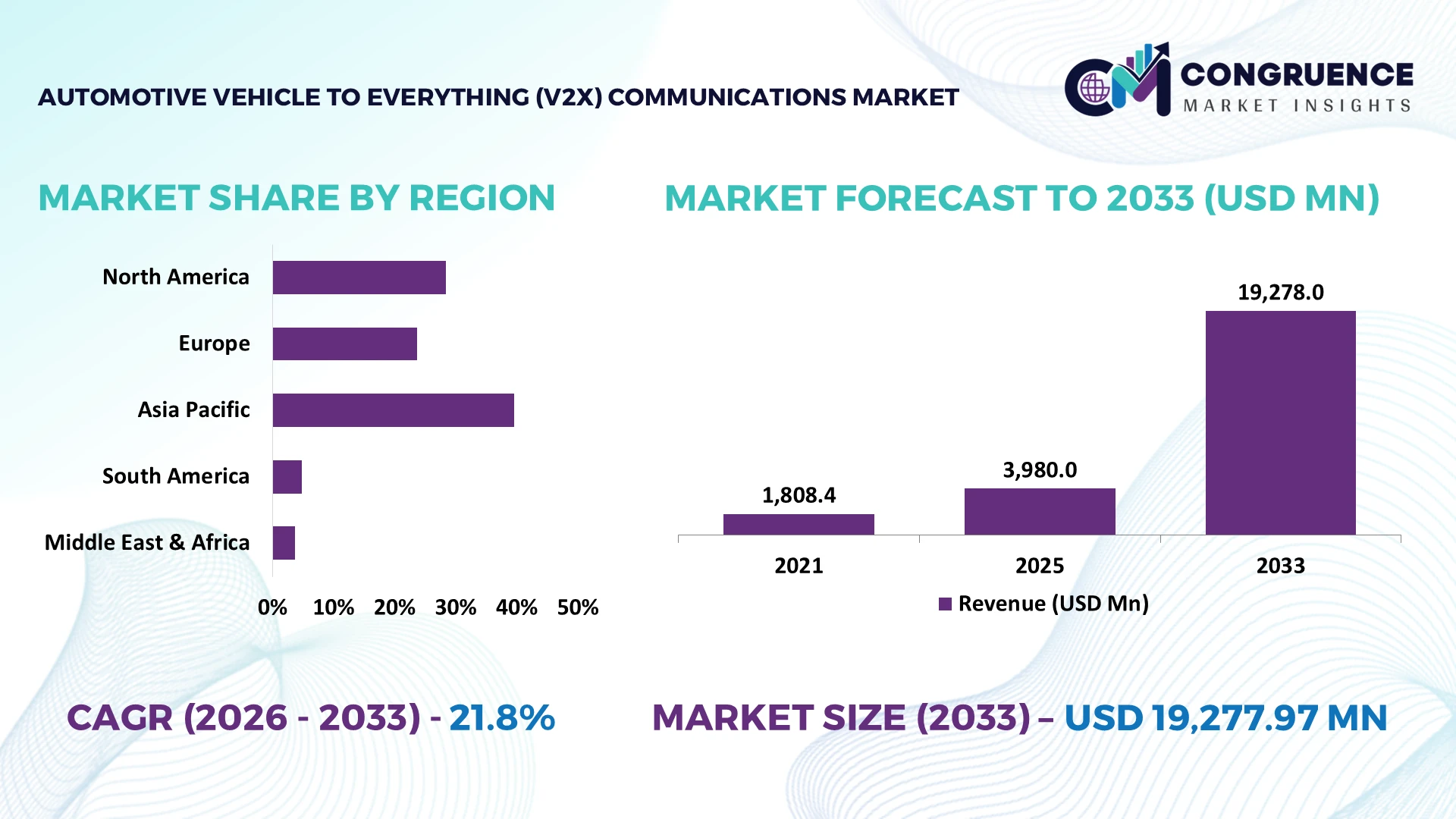
The Global Automotive Vehicle to Everything (V2X) Communications Market was valued at USD 3,980.0 Million in 2025 and is anticipated to reach a value of USD 19,278.0 Million by 2033 expanding at a CAGR of 21.8% between 2026 and 2033. Market growth is driven by cellular V2X deployment, intelligent transportation infrastructure modernization, advanced driver assistance system integration, and connected autonomous vehicle development.
China leads commercial V2X deployment, supported by over 4 million 5G base stations and 20 cities selected for vehicle-road-cloud integration pilots in 2024. Electric vehicles represented approximately 48% of Chinese new car sales in 2024, compared with around 10% in the United States. Government-backed digital infrastructure investments and technological competition with Western economies reinforce China's connected mobility ecosystem.
Automotive manufacturers and technology providers must prioritize interoperable communication platforms, localized infrastructure partnerships, and scalable cellular connectivity solutions to strengthen competitive positioning.
Market Size & Growth: USD 3,980.0 Million in 2025 to USD 19,278.0 Million by 2033, at 21.8% CAGR, driven by cellular V2X integration.
Top Growth Drivers: Connected vehicle integration (40%), intelligent transportation infrastructure (35%), and autonomous mobility development (25%), based on indicative driver weightings.
Short-Term Forecast: By 2028, optimized V2X deployments target 15–20% reductions in communication latency.
Emerging Technologies: Three transformative technologies include 5G NR-V2X, AI-enabled edge computing, and cooperative perception systems.
Regional Leaders: Indicative 2033 projections include Asia Pacific (USD 8,675.1 Million), North America (USD 5,012.3 Million), and Europe (USD 4,241.2 Million), supported by smart roads, cellular connectivity, and cooperative mobility, respectively.
Consumer/End-User Trends: Approximately 48% electric car penetration in China strengthens connected vehicle integration opportunities.
Pilot/Case Example: The 2024 U.S. V2X deployment initiative allocated USD 60 Million across three projects targeting measurable roadway safety improvements.
Competitive Landscape: Qualcomm holds an indicative 15% share, competing with Huawei, Bosch, Continental, and Autotalks.
Regulatory & ESG Impact: U.S. deployment objectives target V2X infrastructure across 20% of the National Highway System by 2028.
Investment & Funding: USD 60 Million in U.S. federal grants accelerates public-private connected transportation partnerships.
Innovation & Future Outlook: Release 16 and subsequent 3GPP standards accelerate advanced cooperative driving and software-defined vehicle connectivity.
The Automotive Vehicle to Everything (V2X) Communications Market encompasses collision avoidance, cooperative driving, traffic signal optimization, and intelligent fleet management applications. Advanced cellular communication modules and edge-based perception systems are transforming vehicle connectivity. With the United States targeting 20% highway infrastructure coverage by 2028, infrastructure-led commercialization is emerging as a critical factor shaping investment priorities and automotive technology strategies.
Automotive V2X communications are becoming strategically important as vehicle manufacturers transition from standalone safety systems toward cooperative, software-defined mobility ecosystems. Connected infrastructure enables vehicles to exchange real-time information with surrounding vehicles, pedestrians, and traffic management systems. The United States' national V2X deployment plan and China's vehicle-road-cloud integration initiatives are reshaping automotive electronics investment, telecommunications partnerships, and intelligent transportation procurement.
Unlike legacy cellular communication architectures operating through centralized networks, direct cellular V2X communication supports low-latency information exchange without continuous network dependence. Advanced 5G V2X use cases target communication reliability of up to 99.999% under specified operating conditions. China emphasizes coordinated urban infrastructure deployment, while the United States prioritizes roadway safety and highway connectivity. By 2028, U.S. deployment objectives target 20% National Highway System coverage.
China's selection of 20 cities for vehicle-road-cloud integration pilots demonstrates how roadside sensors, communication modules, and cloud platforms support cooperative perception. Qualcomm, Huawei, Bosch, and automotive manufacturers are aligning investments with cellular chipsets, interoperable software, and infrastructure partnerships. Competitive advantage increasingly depends on controlling communication architecture, reducing integration complexity, and delivering reliable connectivity across diverse transportation environments.
The integration of connected vehicle platforms with intelligent transportation infrastructure is accelerating automotive V2X communications adoption. Electric cars accounted for approximately 48% of new car sales in China in 2024, compared with around 10% in the United States, strengthening opportunities for digitally integrated vehicle architectures. The United States targets V2X deployment across 20% of its National Highway System by 2028. These developments increase requirements for automotive communication chipsets, onboard units, roadside units, and cooperative safety applications. Qualcomm, Huawei, and Bosch are advancing cellular connectivity platforms and infrastructure partnerships. Integrating V2X functionality during vehicle platform development reduces subsequent retrofit requirements and strengthens long-term supplier relationships with automotive OEMs.
Fragmented communication standards and substantial roadside infrastructure requirements constrain V2X commercialization. The United States allocated 45 MHz, equivalent to 60% of the original 75 MHz intelligent transportation spectrum, for unlicensed applications, leaving 40% for transportation safety communications. This spectrum restructuring requires equipment migration and revised communication architectures. Meanwhile, the national objective of covering 20% of the highway system by 2028 highlights the gradual pace of infrastructure availability. Limited roadside coverage weakens the immediate commercial value of infrastructure-dependent vehicle applications. Automotive suppliers and telecommunications companies are mitigating these constraints through multimode communication modules, shared infrastructure partnerships, and modular hardware designs. Deployment economics increasingly favor concentrated transportation corridors over geographically dispersed installations.
Next-generation cellular V2X creates opportunities beyond conventional collision warnings through cooperative perception, automated intersection management, and coordinated vehicle maneuvering. Advanced 5G communication requirements target reliability levels of up to 99.999%, while selected enhanced V2X applications specify reliability approaching 99.99%. These performance targets support safety-critical information exchange between vehicles and intelligent roadside infrastructure. China's vehicle-road-cloud integration program provides a commercial environment for developing shared perception services and infrastructure-assisted autonomous driving. Technology providers are investing in 5G NR-V2X chipsets, AI-enabled edge processing, and cloud-based traffic intelligence platforms. A particularly attractive opportunity involves infrastructure-generated perception data services that extend vehicle sensing capabilities without proportionately increasing onboard sensor hardware expenditure.
Maintaining secure, reliable communication across heterogeneous vehicle fleets presents a significant long-term execution challenge. Advanced V2X applications targeting 99.999% communication reliability allow only a 0.001% failure tolerance under defined performance conditions, creating demanding validation requirements. UNECE cybersecurity and software update regulations, implemented for all applicable new vehicles in the European Union from July 2024, intensify lifecycle compliance obligations. Automotive manufacturers must manage digital certificates, message authentication, software updates, and cross-platform interoperability throughout vehicle operating lifetimes. Qualcomm, Bosch, and other technology suppliers are strengthening security architectures, simulation environments, and collaborative testing capabilities. Sustainable commercialization requires continuous cybersecurity management and coordinated certification processes rather than isolated hardware qualification at initial vehicle production.
Consolidation of Automotive Communication Hardware: Automotive manufacturers are consolidating V2X, telematics, and positioning functions into integrated connectivity platforms. Combining three previously independent functions reduces electronic control unit requirements and simplifies vehicle wiring architecture. Suppliers including Qualcomm and Continental are developing integrated communication platforms targeting hardware cost reductions of 10–20%, improving manufacturing efficiency and platform standardization.
Migration Toward Cellular Communication Standards: The United States' allocation of 30 MHz within the 5.9 GHz spectrum for transportation safety communications is accelerating migration from legacy DSRC equipment toward cellular V2X. Equipment manufacturers are restructuring product portfolios around standardized communication modules, reducing duplicated development expenditure and supporting compatibility across multiple vehicle platforms.
Expansion of Virtual Testing Workflows: Automotive technology developers are combining software-in-the-loop, hardware-in-the-loop, and field testing to streamline V2X validation. Virtual testing environments target reductions of 20–30% in physical testing requirements. Companies are expanding automated simulation capabilities to identify communication failures earlier, particularly across complex intersections and mixed-connectivity traffic environments.
Centralized Management of Roadside Equipment: Transportation authorities are transitioning from individually maintained roadside units toward centralized device management platforms. Remote diagnostics and over-the-air updates target maintenance visit reductions of 15–25%, while supporting continuous equipment availability. Infrastructure suppliers are introducing subscription-based management services, transforming one-time hardware procurement into recurring operational relationships.
Cellular Vehicle-to-Everything (C-V2X) leads the market with an estimated 65.4% share in 2025, supported by scalable cellular infrastructure, direct communication capabilities, and compatibility with evolving automotive connectivity architectures. Its ability to support short-range safety messaging and wide-area network services strengthens commercial adoption across connected passenger vehicles and intelligent transportation systems. Dedicated Short-Range Communications (DSRC) accounts for an estimated 34.6% share, maintaining established applications across European cooperative transportation networks and legacy infrastructure deployments.
C-V2X also represents the fastest-growing technology segment, driven by the transition from LTE-based communication toward advanced 5G NR-V2X systems. Unlike DSRC, cellular technology offers broader integration opportunities with telecommunications networks and cloud-based mobility platforms. Qualcomm, Huawei, and Quectel are expanding automotive-grade chipset and communication module portfolios, while DSRC suppliers increasingly emphasize compatibility with installed infrastructure. Investment priorities are shifting toward flexible communication platforms that accommodate evolving connectivity standards without requiring complete hardware replacement, strengthening supplier opportunities across successive vehicle development cycles.
Vehicle-to-Vehicle (V2V) communication dominates the market with an estimated 35.8% share in 2025, reflecting extensive demand for collision warnings, emergency braking alerts, and cooperative driving functions. Vehicle-to-Infrastructure (V2I) represents approximately 28.4% of the market, supported by intelligent intersections, traffic signal coordination, and connected highway deployments. Automotive manufacturers prioritize these applications because they extend situational awareness beyond conventional onboard sensors, particularly in environments with restricted visibility and complex traffic movements.
Vehicle-to-Network (V2N) is the fastest-growing application, driven by expanding cloud-based mobility services, real-time traffic analytics, and network-assisted hazard notifications. Vehicle-to-Pedestrian (V2P) is gaining strategic importance through vulnerable road user protection systems integrating smartphones, roadside cameras, and vehicle communication platforms. Qualcomm, Bosch, Huawei, and telecommunications operators are strengthening application interoperability through integrated software development and infrastructure partnerships. Demand is shifting from isolated safety notifications toward continuous information exchange across transportation ecosystems, encouraging suppliers to develop reusable application frameworks that reduce customization requirements across different automotive platforms.
Automotive OEMs represent the leading end-user segment, accounting for an estimated 54.6% share in 2025, supported by factory-integrated communication modules, connected safety platforms, and standardized electronic architectures. Transportation authorities and infrastructure operators account for approximately 27.8%, reflecting procurement of roadside communication units, intelligent traffic controllers, and centralized transportation management systems. OEM purchasing remains concentrated around multiyear vehicle development programs, creating recurring component opportunities and stronger supplier relationships through platform-level qualification.
Fleet Operators represent the fastest-growing end-user segment as commercial transportation businesses integrate connected safety alerts, route optimization, and coordinated vehicle operations. Telecommunications Service Providers are strengthening their role through managed connectivity, edge computing infrastructure, and network-enabled mobility services. Unlike conventional automotive procurement, these emerging buyers prioritize service availability, operational performance, and lifecycle expenditure. Technology companies are responding through modular connectivity solutions, fleet-specific software customization, and collaborative infrastructure development. Competitive positioning increasingly depends on delivering commercially viable systems across both factory-installed automotive platforms and independently managed transportation networks.
Asia Pacific accounted for the largest market share at 39.5% in 2025 however, North America is expected to register the fastest growth, expanding at a CAGR of 23.5% between 2026 and 2033.
North America accounted for an estimated 28.4% market share in 2025, supported by advanced automotive electronics development, intelligent transportation infrastructure, and cellular communication technology leadership. The United States and Canada are integrating connected vehicle technologies into highway safety programs, commercial transportation networks, and urban traffic management systems. In 2024, the U.S. Department of Transportation allocated USD 60 million across three V2X deployment projects covering Arizona, Texas, and Utah. These initiatives strengthen demand for roadside communication units, automotive-grade chipsets, and interoperable safety applications. Automotive manufacturers and technology providers are prioritizing cellular V2X platforms that support standardized communication across different vehicle architectures. Infrastructure procurement increasingly emphasizes lifecycle management, cybersecurity, and compatibility with existing traffic control equipment, creating opportunities for suppliers offering integrated hardware, software, and maintenance solutions.
U.S. Market Outlook: The United States leads regional commercialization through its established automotive technology ecosystem, semiconductor capabilities, and coordinated transportation safety policies. National deployment objectives target V2X coverage across 20% of the National Highway System and 25% of signalized intersections in major metropolitan areas by 2028. Qualcomm, automotive OEMs, and infrastructure technology providers are positioning their product portfolios around interoperable communication platforms and scalable roadway connectivity.
Europe accounted for an estimated 23.6% market share in 2025, supported by established automotive manufacturing capabilities, coordinated transportation policies, and mature cooperative intelligent transport systems. Germany, France, and the Netherlands are integrating connected infrastructure with vehicle safety applications, traffic management platforms, and cross-border mobility services. The C-Roads initiative has brought together more than 18 European countries to support harmonized cooperative transportation deployments. Regional adoption encompasses both established ITS-G5 communication technology and emerging cellular V2X platforms, encouraging suppliers to develop interoperable solutions. Automotive manufacturers are increasingly integrating communication capabilities into software-defined vehicle architectures while addressing cybersecurity and data protection requirements. Investment priorities emphasize compatibility across national transportation networks, reducing fragmented infrastructure development and supporting scalable deployment of connected safety services throughout Europe's interconnected road corridors.
Germany Market Outlook: Germany maintains a strong competitive position through its automotive engineering capabilities, semiconductor ecosystem, and advanced vehicle safety technology development. The country produced approximately 4.1 million passenger cars in 2024, providing a substantial manufacturing base for factory-integrated connectivity solutions. Volkswagen, BMW, Mercedes-Benz, and automotive component suppliers are advancing connected vehicle architectures, cooperative driving applications, and communication system validation through industrial partnerships and dedicated testing environments.
Asia Pacific accounted for an estimated 39.5% market share in 2025, supported by extensive automotive manufacturing, advanced telecommunications infrastructure, and government-backed intelligent mobility programs. China, Japan, and South Korea are strengthening V2X commercialization through coordinated vehicle connectivity development and roadside infrastructure modernization. China selected 20 cities and urban clusters for vehicle-road-cloud integration pilots in 2024, accelerating collaboration between automotive manufacturers, telecommunications operators, and municipal authorities. Japan maintains established cooperative driving infrastructure, while South Korea is advancing cellular communication technologies and intelligent transportation platforms. Regional semiconductor manufacturing capabilities support competitive component sourcing and faster product commercialization. Companies including Huawei, Denso, and Hyundai Mobis are expanding integrated connectivity solutions, with investment increasingly concentrated on standardized communication modules, infrastructure-assisted perception, and scalable deployment across high-density urban transportation networks.
China Market Outlook: China dominates regional V2X deployment through coordinated industrial policies, extensive telecommunications coverage, and rapid connected vehicle development. The country operated approximately 4.25 million 5G base stations by the end of 2024, establishing a substantial foundation for network-assisted mobility applications. Huawei, SAIC Motor, and major telecommunications operators are developing integrated automotive communication ecosystems that connect vehicle platforms with intelligent traffic infrastructure and centralized mobility management services.
South America accounted for an estimated 4.8% market share in 2025, supported by commercial fleet modernization, expanding telecommunications infrastructure, and gradual intelligent transportation development. Brazil, Argentina, and Chile represent important markets for connected vehicle applications, particularly within freight transportation, urban mobility, and logistics operations. Brazil produced approximately 2.55 million motor vehicles in 2024, creating a substantial industrial foundation for automotive connectivity integration. Regional adoption remains concentrated in network-assisted vehicle services rather than extensive direct V2X communication infrastructure. Uneven telecommunications coverage and limited municipal infrastructure budgets constrain large-scale roadside equipment deployment. Automotive suppliers and telecommunications companies are addressing these limitations through modular communication systems, existing cellular network utilization, and fleet-focused partnerships. Commercial opportunities increasingly favor connectivity solutions that deliver immediate operational benefits without requiring comprehensive intelligent road infrastructure investments.
Brazil Market Outlook: Brazil leads regional development through its established automotive manufacturing ecosystem, expanding digital infrastructure, and extensive commercial transportation requirements. By December 2024, all 5,570 Brazilian municipalities had been cleared for 5G deployment within the 3.5 GHz spectrum band, although actual network availability remained uneven. Automotive manufacturers and telecommunications operators are leveraging this regulatory progress to support connected fleet services, vehicle telematics, and future network-assisted safety applications.
Middle East & Africa accounted for an estimated 3.7% market share in 2025, supported by smart city investments, transportation modernization, and expanding advanced telecommunications infrastructure. Saudi Arabia, the United Arab Emirates, and South Africa represent strategically important markets for connected mobility applications across urban transportation, logistics, and commercial vehicle operations. Dubai's autonomous transportation strategy targets converting 25% of transportation trips into autonomous journeys by 2030, strengthening the long-term relevance of cooperative vehicle communication technologies. Regional adoption remains concentrated around digitally advanced metropolitan areas, where intelligent traffic management infrastructure supports early connected mobility deployments. Technology providers are establishing partnerships with transportation authorities, telecommunications operators, and infrastructure developers to integrate communication capabilities into modernization projects. Investment priorities favor scalable network-assisted applications and infrastructure-compatible connectivity solutions that accommodate varying levels of transportation development.
Saudi Arabia Market Outlook: Saudi Arabia is strengthening connected mobility opportunities through transportation infrastructure modernization, automotive industrial development, and digital transformation initiatives under Vision 2030. The country targets annual production of more than 300,000 vehicles by 2030, supporting potential demand for factory-integrated automotive connectivity technologies. Partnerships between automotive manufacturers, telecommunications providers, and infrastructure developers are establishing foundations for intelligent fleet operations, connected road networks, and advanced vehicle communication applications.
The Automotive Vehicle to Everything (V2X) Communications Market exhibits moderate consolidation, with Qualcomm, Huawei, Bosch, Denso, and Continental's automotive successor Aumovio collectively representing an indicative 48% market share. Qualcomm and Huawei compete through semiconductor integration and cellular communication platforms, while Bosch, Denso, and Aumovio leverage established automotive OEM relationships and system integration capabilities. Cellular V2X represents an estimated 65.4% of technology demand, directing investment toward standardized communication chipsets. Automotive OEMs account for approximately 54.6% of procurement, intensifying competition for vehicle platform contracts. Suppliers are expanding telecommunications partnerships, integrating positioning technologies, and developing software-defined connectivity architectures. The competitive landscape is shifting from standalone communication modules toward integrated hardware, software, and infrastructure ecosystems. Automotive-grade certification, intellectual property requirements, cybersecurity compliance, and lengthy OEM qualification cycles create substantial entry barriers. Winning suppliers must combine competitive component economics, reliable communication performance, scalable manufacturing, and interoperable platforms that minimize integration expenditure across successive vehicle generations.
Qualcomm Technologies, Inc.
Huawei Technologies Co., Ltd.
Robert Bosch GmbH
Denso Corporation
Aumovio SE
NXP Semiconductors N.V.
Harman International
Cohda Wireless
Commsignia Inc.
Quectel Wireless Solutions Co., Ltd.
Ficosa International S.A.
Kapsch TrafficCom AG
Savari Inc. (part of SWARCO)
LG Electronics Inc.
Cellular V2X technology is reshaping automotive communication architectures through direct vehicle connectivity and network-assisted information exchange. Representing an estimated 65.4% of technology adoption, C-V2X supports scalable integration with existing telecommunications infrastructure. Compared with legacy centralized communication architectures, optimized direct communication targets latency reductions of 15–20%, improving hazard notification responsiveness. Integrated automotive communication chipsets additionally target hardware expenditure reductions of 10–15% through component consolidation.
Emerging 5G NR-V2X technology supports cooperative perception, coordinated vehicle maneuvering, and advanced automated driving applications. Selected safety-critical communication requirements target reliability of 99.999%, strengthening operational performance under defined conditions. AI-enabled edge computing reduces dependence on centralized processing, targeting response-time improvements of 20–30% in optimized deployments. Semiconductor manufacturers and telecommunications equipment suppliers benefit from increasing demand for integrated processing capabilities and automotive-grade connectivity platforms.
Between 2026 and 2028, software-defined communication architectures, digital certificate management, and over-the-air updates will increasingly influence automotive procurement. Remote diagnostic capabilities target maintenance intervention reductions of 15–25%, improving infrastructure lifecycle economics. The United States' objective of equipping 20% of its National Highway System with V2X infrastructure by 2028 reinforces commercialization opportunities. Suppliers prioritizing interoperable communication stacks, integrated cybersecurity, and scalable semiconductor architectures will strengthen OEM relationships while reducing deployment complexity across connected transportation networks worldwide.
June 2025: Qualcomm Technologies completed its acquisition of Autotalks, integrating V2X semiconductor solutions supporting two communication standards, DSRC and C-V2X, into its Snapdragon Digital Chassis portfolio. The acquisition strengthens automotive connectivity capabilities and accelerates commercialization across global vehicle manufacturing platforms. Source: qualcomm.com
January 2025: Commsignia secured OmniAir certification for its ITS-RS4 roadside unit, which supports three connectivity technologies: C-V2X, cellular, and Bluetooth. The certification strengthens interoperability assurance, facilitates infrastructure procurement, and supports commercial deployment of intelligent intersections and connected transportation safety applications. Source: commsignia.com
August 2025: Kapsch TrafficCom announced a partnership with the North Carolina Turnpike Authority to deploy production-level V2X tolling. The project combines two distinct technologies into one transaction, establishing a commercial framework for integrated connected vehicle payments and streamlined tolling operations. Source: kapsch.net
November 2026: Cohda Wireless reported progress supplying MK6 roadside and onboard equipment for Arizona's Connected Vehicle Acceleration Zone. The deployment supports four applications covering emergency vehicles, public transit, freight, and vulnerable road users, strengthening commercial opportunities in interoperable transportation infrastructure. Source: cohdawireless.com
The Automotive Vehicle to Everything (V2X) Communications Market Report provides comprehensive analysis across three segmentation categories: type, application, and end-user. Technology coverage includes Cellular V2X (C-V2X) and Dedicated Short-Range Communications (DSRC), alongside Vehicle-to-Vehicle (V2V), Vehicle-to-Infrastructure (V2I), Vehicle-to-Network (V2N), and Vehicle-to-Pedestrian (V2P) applications. End-user analysis encompasses automotive OEMs, transportation authorities and infrastructure operators, fleet operators, and telecommunications service providers.
The report evaluates market dynamics across North America, Europe, Asia Pacific, South America, and Middle East & Africa, emphasizing infrastructure readiness, regulatory developments, and connected vehicle adoption. Emerging technology coverage includes 5G NR-V2X, cooperative perception, edge computing, and integrated cybersecurity platforms. Competitive benchmarking, segmentation attractiveness, infrastructure investment analysis, and technology adoption assessments support strategic investment planning, geographic expansion, product development, supplier positioning, and commercial decision-making between 2026 and 2033.
| Report Attribute / Metric | Details |
|---|---|
| Market Revenue (2025) | USD 3,980.0 Million |
| Market Revenue (2033) | USD 19,278.0 Million |
| CAGR (2026–2033) | 21.8% |
| Base Year | 2025 |
| Forecast Period | 2026–2033 |
| Historic Period | 2021–2025 |
| Segments Covered |
By Type
By Application
By End-User
|
| Key Report Deliverables | Revenue Forecast; Market Trends; Growth Drivers & Restraints; Technology Insights; Segmentation Analysis; Regional Insights; Competitive Landscape; Regulatory & ESG Overview; Recent Developments |
| Regions Covered | North America; Europe; Asia-Pacific; South America; Middle East & Africa |
| Key Players Analyzed | Qualcomm Technologies, Inc.; Huawei Technologies Co., Ltd.; Robert Bosch GmbH; Denso Corporation; Aumovio SE; NXP Semiconductors N.V.; Harman International; Cohda Wireless; Commsignia Inc.; Quectel Wireless Solutions Co., Ltd.; Ficosa International S.A.; Kapsch TrafficCom AG; Savari Inc. (part of SWARCO); LG Electronics Inc. |
| Customization & Pricing | Available on Request (10% Customization Free) |




