
Reports
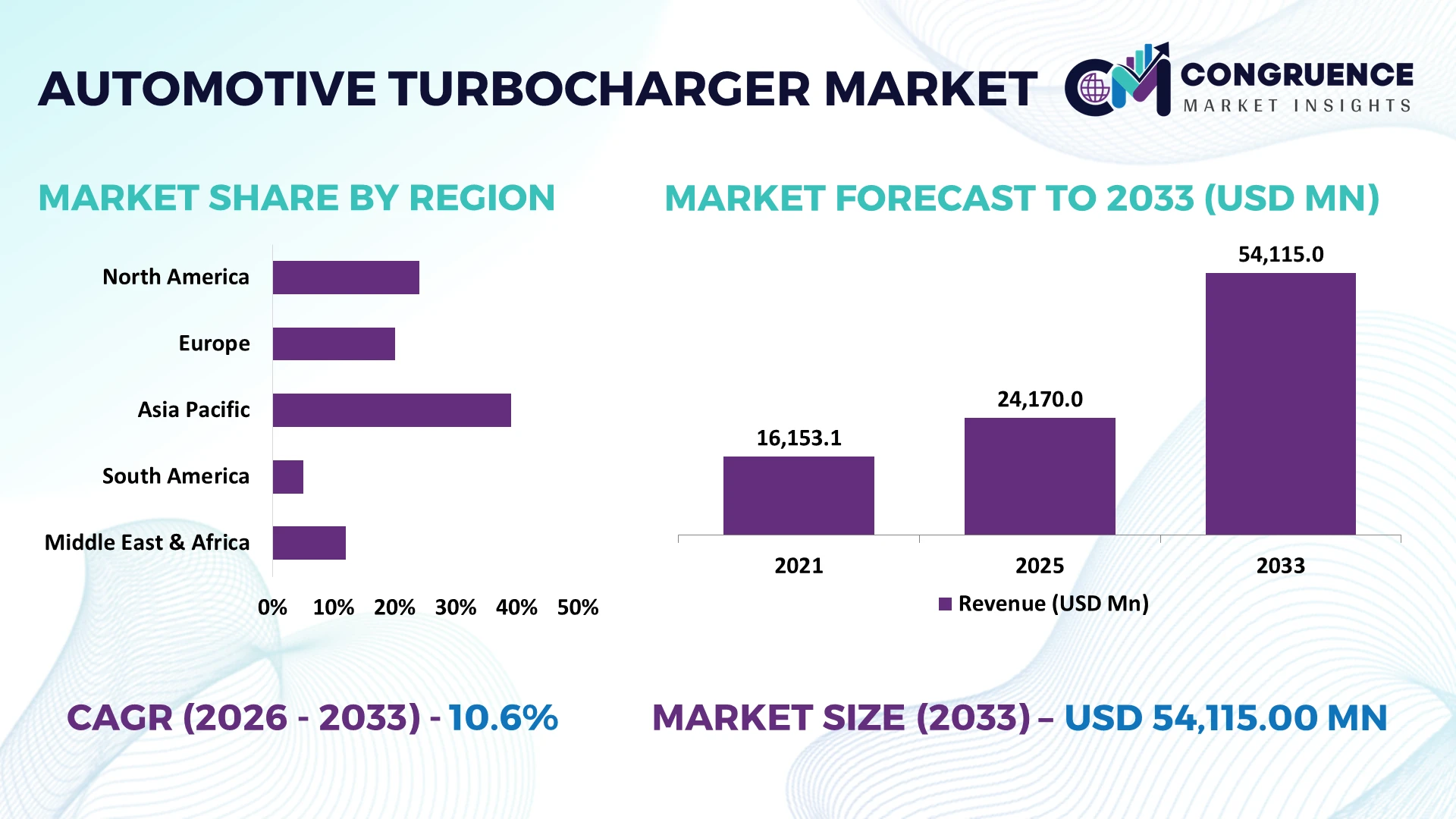
The Global Automotive Turbocharger Market was valued at USD 24170 Million in 2025 and is anticipated to reach a value of USD 54115 Million by 2033 expanding at a CAGR of 10.6% between 2026 and 2033. Growth is driven by engine downsizing, tighter emission standards, and rapid integration of electrically actuated wastegates, variable turbine geometry, and eTurbo systems into gasoline-hybrid powertrains.
China dominates the automotive turbocharger landscape through its 30%+ share of global vehicle production and expanding hybrid manufacturing base, while the United States recorded turbocharged gasoline-engine production penetration above 44% in 2024. China’s NEVs represented about 43% of domestic vehicle production in 2025, accelerating the shift toward hybrid-compatible boosting technologies. U.S. gasoline turbo production remained above 44%, highlighting a narrower but highly mature adoption base.
Strategically, suppliers prioritizing hybrid-ready boosting, localized manufacturing, and high-temperature materials gain the strongest competitive positioning as propulsion architectures diversify.
Market Size & Growth: USD 24.17 billion in 2025 is projected to reach USD 54.12 billion by 2033 at 10.6% CAGR, driven by engine downsizing and hybrid turbocharging.
Top Growth Drivers: Emission compliance contributes 31%, fuel-efficiency optimization 27%, and hybrid powertrain integration 22% to growth momentum.
Short-Term Forecast: By 2028, advanced electric actuation is positioned to reduce boost-response delays by 10% and improve control efficiency by 8%.
Emerging Technologies: eTurbo, variable turbine geometry, and AI-assisted calibration are reshaping high-performance turbocharger development.
Regional Leaders: Asia-Pacific approaches USD 22.2 billion by 2033, Europe USD 14.1 billion, and North America USD 11.5 billion, with hybrid-compatible adoption accelerating.
Consumer/End-User Trends: More than 44% of U.S. vehicle production used gasoline turbocharged engines in 2024, reinforcing turbocharged downsizing.
Pilot/Case Example: In 2025, BorgWarner secured hybrid turbocharger programs for 1.6-liter engines in Korea, with localized production scheduled for 2027.
Competitive Landscape: Garrett Motion leads at approximately 16%, followed by BorgWarner, Cummins, IHI, and Mitsubishi Heavy Industries.
Regulatory & ESG Impact: Euro 7, China 6b, and U.S. emissions rules are pushing suppliers toward electrically controlled boosting and lower-loss architectures.
Investment & Funding: More than USD 1 billion in combined industry investment and capacity expansion is targeting electrified boosting, advanced materials, and localized supply chains.
Innovation & Future Outlook: 400-volt eTurbo systems, silicon-carbide electronics, AI calibration, and hybrid integration are shifting competition from component supply toward complete propulsion efficiency.
The Automotive Turbocharger Market is gaining momentum across passenger cars, light commercial vehicles, SUVs, and hybrid powertrains as manufacturers pursue higher power density without enlarging engines. More than 44% of U.S. vehicle production used gasoline turbocharged engines in 2024, demonstrating established adoption. Electrically actuated wastegates, VTG systems, and eTurbo architectures are becoming central to emissions compliance and performance optimization. Meanwhile, China’s rapid hybrid expansion and evolving global trade policies are redirecting turbocharger supply chains toward localized production, advanced materials, and flexible regional sourcing. These shifts strengthen the strategic importance of technology-led supplier positioning.
The Automotive Turbocharger Market is becoming strategically important because automakers must extract higher power density from smaller engines while meeting tightening emissions targets and preserving driving performance. Turbocharging now influences engine architecture, sourcing strategies, and hybrid-system design, making boosting technology a competitive differentiator rather than a standalone component.
A major market shift is the restructuring of turbocharger supply chains around localized production, particularly in China, India, and North America. Advanced electric turbochargers and variable turbine geometry systems deliver faster boost response and can improve energy-management efficiency by roughly 5–10% versus conventional mechanically controlled systems. China combines high vehicle-production scale with rapid hybrid adoption, while Germany emphasizes premium performance, advanced materials, and precision engineering.
Over the next 2–3 years, hybrid-compatible turbocharger deployment is expected to expand as automakers integrate 48V architectures, electrically assisted boosting, and intelligent thermal management. A practical deployment example is the use of electrically actuated wastegates in downsized gasoline engines to improve transient response and emissions control. Suppliers are consequently increasing R&D spending, forming automaker partnerships, and localizing production. Competitive advantage will increasingly depend on integrated boosting expertise, manufacturing resilience, and software-enabled calibration.
Hybridization is strengthening turbocharger demand as automakers seek smaller engines without sacrificing output. Electrically assisted boosting can improve transient response by approximately 8–12%, while engine downsizing can reduce fuel consumption by 5–15% in suitable duty cycles. China’s rapidly expanding plug-in hybrid production is accelerating supplier localization, while Japanese manufacturers are integrating compact boosting systems with hybrid engine controls. Companies are responding through eTurbo development, 48V-compatible architectures, and joint calibration programs with OEMs. The non-obvious advantage is tighter coordination between turbochargers and electric motors, allowing suppliers to compete on complete powertrain efficiency rather than component specifications alone.
High-performance turbochargers remain exposed to nickel-based alloy, precision-bearing, actuator, and semiconductor cost pressures. Advanced turbine materials can account for roughly 10–20% higher component costs than conventional alternatives, while electronically controlled architectures add approximately 5–8% system complexity. European manufacturers also face stricter sourcing and traceability requirements, increasing procurement burdens. Supply disruptions affecting precision castings and electronic actuators can extend production lead times by several weeks. Companies are mitigating exposure through dual sourcing, localized machining, longer-term alloy contracts, and standardized actuator platforms. The key operational constraint is not turbocharger availability alone but maintaining consistent tolerances across increasingly complex electronically controlled assemblies.
Electrified turbocharging is opening a high-value opportunity as manufacturers combine exhaust energy recovery with electrical assistance. eTurbo systems can deliver roughly 10–15% faster boost response, while integrated energy recovery can improve overall powertrain efficiency by several percentage points. India represents an emerging opportunity as passenger-vehicle manufacturers expand turbocharged gasoline and hybrid offerings while increasing local component sourcing. Suppliers are investing in 48V and higher-voltage architectures, silicon-carbide power electronics, and software-based boost management. A distinctive opportunity lies in modular turbocharger platforms that serve multiple engine sizes, reducing engineering duplication and enabling suppliers to scale across OEM programs with fewer hardware variants.
Future turbocharger deployment increasingly depends on coordination among engine control units, electric motors, thermal systems, sensors, and after-treatment equipment. Calibration complexity can increase development workloads by 15–25% when mechanical boosting is combined with electrified control strategies. Germany’s premium vehicle programs illustrate the challenge, where high-performance requirements must coexist with stringent emissions and durability targets. Software compatibility, sensor reliability, thermal management, and cybersecurity now influence turbocharger performance alongside mechanical engineering. Companies must therefore invest in digital twins, automated calibration, hardware-in-the-loop testing, and specialized engineering teams. The strategic challenge is achieving repeatable system performance across diverse platforms without allowing integration complexity to erode launch speed or manufacturing consistency.
Electrified Boosting Gains Ground: eTurbo and electrically actuated wastegates are moving from premium programs into volume platforms, improving transient response by 8–12% and reducing calibration delays by about 10%. Automakers are expanding 48V integration and supplier partnerships as hybrid architectures scale.
Variable Geometry Expands: Variable-geometry turbochargers are gaining roughly 4–6 percentage points in new diesel and performance applications as manufacturers seek wider efficiency maps. German and Japanese suppliers are increasing automated calibration and precision manufacturing to manage tighter tolerances and reduce production variability.
Supply Chains Localize: Geopolitical trade friction and semiconductor constraints are pushing turbocharger makers toward dual sourcing, regional machining, and localized actuator production. Localization programs are targeting 15–20% shorter lead times, while suppliers are restructuring inventories and qualifying alternative casting and electronics vendors.
Hybrid Calibration Accelerates: Hybrid-electric vehicles are changing turbocharger workflow, with engine, motor, thermal, and boost controls increasingly calibrated as one system. EU hybrid registrations reached 34.5% in 2025, prompting OEMs to prioritize integrated software, thermal management, and compact boosting packages.
Single-Turbo systems remain the leading type, accounting for approximately 42% of automotive turbocharger demand because of their lower system complexity, broad OEM compatibility, and scalable manufacturing economics. Their strongest position remains in mainstream passenger cars and light commercial vehicles, where manufacturers prioritize packaging and cost control. Twin-Turbo systems hold around 21%, serving performance-oriented and larger-displacement applications where sequential or parallel boosting improves low-end response and peak power. Variable Geometry systems represent nearly 26% and are gaining share as electronically controlled turbine geometry delivers broader operating efficiency and tighter boost management.
Electric Turbo is the fastest-growing type, with adoption expanding at an estimated 15–18% annually across new hybrid and premium-engine programs. Its ability to provide near-instant boost assistance and coordinate with 48V electrical architectures is shifting investment toward integrated boosting. Garrett Motion, BorgWarner, and IHI are emphasizing eTurbo platforms, while OEM partnerships increasingly center on software calibration and system integration rather than hardware alone.
Passenger Cars lead the application landscape with approximately 67% of turbocharger demand, supported by high production volumes and widespread engine downsizing. Turbocharged gasoline engines remain important where automakers need compact powertrains without sacrificing output. Commercial Vehicles account for roughly 20%, with turbocharging remaining operationally critical for torque density, load carrying, and fuel efficiency. Performance Vehicles represent about 6%, maintaining strong demand for twin-turbo and advanced variable-geometry configurations where response and power density outweigh component cost.
Hybrid Vehicles are the fastest-growing application, expanding adoption by roughly 12–15% annually as manufacturers combine smaller combustion engines with electric assistance. EU hybrid-electric registrations reached 34.5% of new-car registrations in 2025, demonstrating how quickly hybrid architectures are becoming mainstream. This shift is encouraging suppliers to redesign turbochargers around thermal coordination, electronic actuation, and software-controlled boost strategies.
OEMs represent the dominant end-user group at approximately 61% of turbocharger demand because they control vehicle-platform specifications, engine architecture, sourcing approvals, and technology integration. Their purchasing decisions increasingly favor suppliers capable of delivering complete boosting systems rather than standalone hardware. Automotive Suppliers account for about 23%, providing actuators, turbine components, compressors, electronics, and calibration capabilities. Fleet Operators represent approximately 10%, with purchasing priorities centered on durability, fuel economy, and predictable maintenance costs across high-utilization vehicles.
Automotive Suppliers are the fastest-growing end-user group, with demand expanding around 9–12% as OEMs outsource advanced component development and pursue modular propulsion platforms. Suppliers are responding with co-development agreements, localized manufacturing, and integrated actuator-electronics packages. Aftermarket Service Providers retain roughly 6%, but their role is shifting toward diagnostic calibration and replacement of electronically controlled turbocharger assemblies rather than conventional mechanical servicing.
North America accounted for the largest market share at 28% in 2025 however, Asia-Pacific is expected to register the fastest growth, expanding at a CAGR of 12.1% between 2026 and 2033.

Hybridization and High-Efficiency Engine Platforms Reshape Demand
North America remains a technology-intensive automotive turbocharger market, supported by strong passenger-vehicle production, premium vehicle programs, and widespread adoption of turbocharged gasoline engines. The United States contributes the majority of regional demand, with turbocharged gasoline powertrains representing more than 40% of new light-vehicle production. Automakers are increasingly integrating electronically controlled wastegates, variable turbine geometry, and 48V-compatible boosting into downsized engines. Mexico strengthens the regional supply chain through vehicle and component manufacturing, allowing suppliers to reduce logistics exposure and support just-in-time production. BorgWarner, Garrett Motion, and Cummins continue expanding technology partnerships and localized manufacturing capabilities. The strategic shift is toward hybrid-compatible turbochargers that combine fast transient response with tighter emissions control, strengthening supplier value beyond conventional mechanical components.
United States Market Outlook: The United States leads regional technology adoption through its extensive OEM manufacturing base and established supplier ecosystem. More than 40% turbocharged gasoline penetration in light vehicles supports sustained demand for advanced boosting. Strong engineering capabilities, emissions compliance requirements, and investment in hybrid powertrains position U.S. manufacturers to accelerate electrically assisted turbocharger deployment.
Emission Compliance Accelerates Precision Boosting Technology
Europe remains a high-value automotive turbocharger market shaped by stringent emissions requirements, premium vehicle manufacturing, and advanced powertrain engineering. Germany anchors regional demand through its concentration of passenger-vehicle OEMs, performance platforms, and specialized component suppliers. Hybrid-electric vehicles represented more than 34% of new EU registrations in 2025, increasing demand for turbochargers engineered around thermal coordination and electrified powertrains. European manufacturers are prioritizing variable-geometry systems, electrically actuated wastegates, and lightweight turbine materials to improve efficiency while meeting increasingly demanding regulatory requirements. Supplier development programs increasingly combine mechanical engineering with software calibration and thermal-management expertise. The strategic implication is a transition from conventional turbocharger sourcing toward integrated propulsion partnerships, with technology qualification and emissions performance becoming stronger purchasing criteria.
Germany Market Outlook: Germany remains the region’s principal technology and manufacturing hub, supported by major vehicle producers, engineering clusters, and precision-component suppliers. Its premium vehicle industry creates strong demand for variable-geometry and twin-turbo systems, while rapid hybrid adoption is increasing investment in electronically controlled boosting and integrated thermal-management platforms.
Manufacturing Scale Drives Localization and Hybrid Integration
Asia-Pacific represents the largest manufacturing base for automotive turbocharger applications, led by China, Japan, South Korea, and India. China alone produced approximately 34.5 million vehicles in 2025, creating substantial demand for localized turbocharger production and component sourcing. Japanese manufacturers maintain strong positions in precision engineering and variable-geometry technology, while South Korea emphasizes compact hybrid powertrains and export-oriented production. India is expanding turbocharged gasoline and diesel applications as automakers increase local component content and introduce smaller high-output engines. Suppliers are responding with regional production facilities, OEM co-development programs, and modular architectures designed for multiple engine platforms. The region’s non-obvious advantage is its ability to combine large-scale manufacturing with rapid hybrid technology deployment, allowing suppliers to shorten development cycles while improving cost competitiveness.
China Market Outlook: China provides the strongest operational advantage through its enormous vehicle manufacturing ecosystem and extensive domestic component base. With approximately 34.5 million vehicles produced in 2025, manufacturers can scale turbocharger platforms rapidly. Hybrid powertrain expansion is encouraging suppliers to localize electric boosting, actuators, control electronics, and precision turbine components.
Flexible Engine Platforms Support Brazil-Led Demand
South America remains centered on Brazil’s large automotive manufacturing base, where turbocharged flex-fuel engines provide an important pathway toward higher power density and improved fuel efficiency. Brazil’s ethanol-oriented vehicle ecosystem encourages manufacturers to optimize turbocharger calibration for variable fuel characteristics, creating differentiated engineering requirements. Passenger cars account for the majority of regional turbocharger demand, while commercial vehicles sustain demand for durable high-torque systems. Argentina adds manufacturing capacity but remains more exposed to economic volatility and supply-chain fluctuations. Suppliers are emphasizing localized component sourcing and adaptable engine platforms to manage import exposure and production interruptions. Brazil’s automotive industry increasingly favors compact turbocharged engines that combine performance with fuel flexibility. The strategic opportunity lies in tailoring turbocharger systems to regional fuel infrastructure rather than simply replicating North American or European specifications.
Brazil Market Outlook: Brazil is the region’s strongest automotive production and technology hub, supported by established OEM plants, flexible-fuel infrastructure, and a mature component ecosystem. Turbocharged flex-fuel engines are gaining relevance as manufacturers seek higher efficiency without abandoning internal-combustion platforms. Localized sourcing and ethanol-compatible calibration strengthen supplier positioning.
Commercial Mobility and Fleet Modernization Shape Adoption
The Middle East & Africa market is driven by commercial vehicles, SUVs, heavy-duty applications, and fleet modernization rather than broad passenger-car electrification. Gulf markets favor high-output turbocharged engines for premium SUVs and performance vehicles, while South Africa provides a stronger manufacturing and component ecosystem. Turkey also contributes through vehicle production and export-oriented supply chains connecting European and Middle Eastern markets. High ambient temperatures and demanding operating conditions increase requirements for thermal durability, compressor efficiency, and robust lubrication systems. Suppliers are responding with upgraded cooling architectures, high-temperature alloys, and specialized aftermarket service networks. Fleet operators increasingly prioritize fuel efficiency and uptime, making turbocharger reliability commercially important. The region’s strongest opportunity is not volume alone but specialized boosting systems engineered for extreme heat, heavy loads, and extended operating cycles.
United Arab Emirates Market Outlook: The United Arab Emirates provides a strategically important premium-vehicle and fleet market, supported by high SUV penetration, advanced service infrastructure, and demanding operating conditions. Turbocharger suppliers benefit from strong aftermarket activity and growing preference for high-output engines. Advanced diagnostics and specialized maintenance capabilities increasingly differentiate service providers.
Garrett Motion, BorgWarner, IHI, Mitsubishi Heavy Industries, and Cummins compete directly across global turbocharger platforms, while regional suppliers challenge them on localized pricing and delivery. The top five players collectively control approximately 60% of the market, creating a moderately concentrated structure. Competition centers on technology, cost, supply resilience, customization, and response speed. Advanced electronically controlled systems command roughly 5–10% higher development value than conventional units, while localized production can reduce logistics costs by 8–15%. Garrett Motion and BorgWarner emphasize eTurbo innovation and OEM partnerships; IHI and Mitsubishi Heavy Industries leverage precision engineering, while Cummins strengthens heavy-duty applications and integrated powertrain solutions. Vertical integration of actuators, electronics, and calibration is becoming more important as hybrid architectures expand. Entry barriers remain high because OEM qualification, durability validation, manufacturing precision, and software integration require substantial investment. Winning increasingly requires scalable platforms, localized supply, rapid calibration, and deep OEM collaboration.
Garrett Motion
BorgWarner Inc.
IHI Corporation
Mitsubishi Heavy Industries, Ltd.
Cummins Inc.
Marelli Holdings Co., Ltd.
Continental AG
Hitachi Astemo, Ltd.
Rotomaster
BMTS Technology
Turbo Energy Limited
Ningbo Motor Industrial Co., Ltd.
Hunan Tyen Machinery Co., Ltd.
Melett Ltd.
Current turbocharger technology is shifting from mechanically controlled wastegates toward variable-geometry turbochargers, advanced compressor aerodynamics, and electronically managed actuators. Variable-geometry systems improve boost control and operating efficiency by about 3–5%, while advanced compressor designs can raise airflow by up to 10%. Adoption is strongest in premium, diesel, and hybrid platforms, giving suppliers with precision manufacturing and calibration capabilities a competitive advantage.
Emerging eTurbo systems integrate electric motors, power electronics, energy recuperation, and engine-control software. Garrett’s E-Turbo demonstrated 16% higher power, 10.5% higher torque, and 25% faster 60–100 km/h acceleration versus its conventional comparison system. Electrified boosting also supports engine downsizing while recovering exhaust energy. By 2026–2028, 48V and 400V architectures will increasingly integrate turbocharging with thermal and energy-management systems.
Disruptive development is moving toward silicon-carbide electronics, AI-assisted calibration, high-temperature materials, and hydrogen-compatible turbocharging. Garrett reports power-electronics efficiency approaching 98%, while high-speed E-Turbos exceed 200,000 rpm. Compared with conventional systems, electrically assisted boosting can deliver roughly four times the torque gradient at low engine speed. Early adopters among global OEMs and leading suppliers will gain faster response, tighter emissions control, and stronger platform differentiation.
February 2025 — BorgWarner extended wastegate turbocharger contracts with a major North American OEM for midsized gasoline engines powering SUVs and trucks through 2028+. The program strengthens long-term supply positioning and reinforces demand for proven, lightweight boosting technology. Source: borgwarner.com
April 2025 — Garrett Motion showcased its 3-in-1 E-Powertrain and E-Cooling Compressor at Auto Shanghai, alongside hybrid-optimized turbocharging solutions. More than a dozen pre-development programs were underway, strengthening its electrification pipeline and expanding technology integration opportunities. Source: garrettmotion.com
February 2026 — BorgWarner secured a VTG turbocharger program for a major European OEM’s hybrid-electric vehicle platform, with production scheduled for 2028. The technology incorporates a silencer and shot-peened compressor wheel, improving durability and strengthening hybrid-platform competitiveness. Source: borgwarner.com
July 2026 — BorgWarner secured a 400V eTurbo program with a major European OEM, delivering 20 kW continuous and 30 kW peak electrical power. Production begins in 2029, expanding electrified boosting capabilities and supporting energy recuperation for hybrid vehicles. Source: borgwarner.com
The Automotive Turbocharger Market Report covers Single-Turbo, Twin-Turbo, Variable Geometry, and Electric Turbo technologies across Passenger Cars, Commercial Vehicles, Performance Vehicles, and Hybrid Vehicles. End-user analysis includes OEMs, Automotive Suppliers, Fleet Operators, and Aftermarket Service Providers. The assessment spans North America, Europe, Asia-Pacific, South America, and Middle East & Africa, with country-level analysis emphasizing major manufacturing and technology hubs.
The report evaluates adoption of eTurbo systems, variable turbine geometry, advanced compressor aerodynamics, electronic actuation, high-temperature materials, and hybrid powertrain integration. It also examines deployment patterns, supply-chain localization, technology partnerships, regulatory influence, and competitive positioning. With passenger cars representing the largest application base and electric turbocharging emerging as a high-priority technology, the analysis supports investment planning, manufacturing expansion, supplier selection, partnership development, and competitive strategy through 2026–2033.
| Report Attribute/Metric | Report Details |
|---|---|
Market Revenue in 2025 | USD 24170 Million |
Market Revenue in 2033 | USD 54115 Million |
CAGR (2026 - 2033) | 10.6% |
Base Year | 2025 |
Forecast Period | 2026 - 2033 |
Historic Period | 2021 - 2025 |
Segments Covered | By Type
By Application
By End-User
|
Key Report Deliverable | Revenue Forecast, Growth Trends, Market Dynamics, Segmental Overview, Regional and Country-wise Analysis, Competition Landscape |
Region Covered | North America, Europe, Asia-Pacific, South America, Middle East, Africa |
Key Players Analyzed | Garrett Motion, BorgWarner Inc., IHI Corporation, Mitsubishi Heavy Industries, Ltd., Cummins Inc., Marelli Holdings Co., Ltd., Continental AG, Hitachi Astemo, Ltd., Rotomaster, BMTS Technology, Turbo Energy Limited, Ningbo Motor Industrial Co., Ltd., Hunan Tyen Machinery Co., Ltd., Melett Ltd. |
Customization & Pricing | Available on Request (10% Customization is Free) |




