
Reports
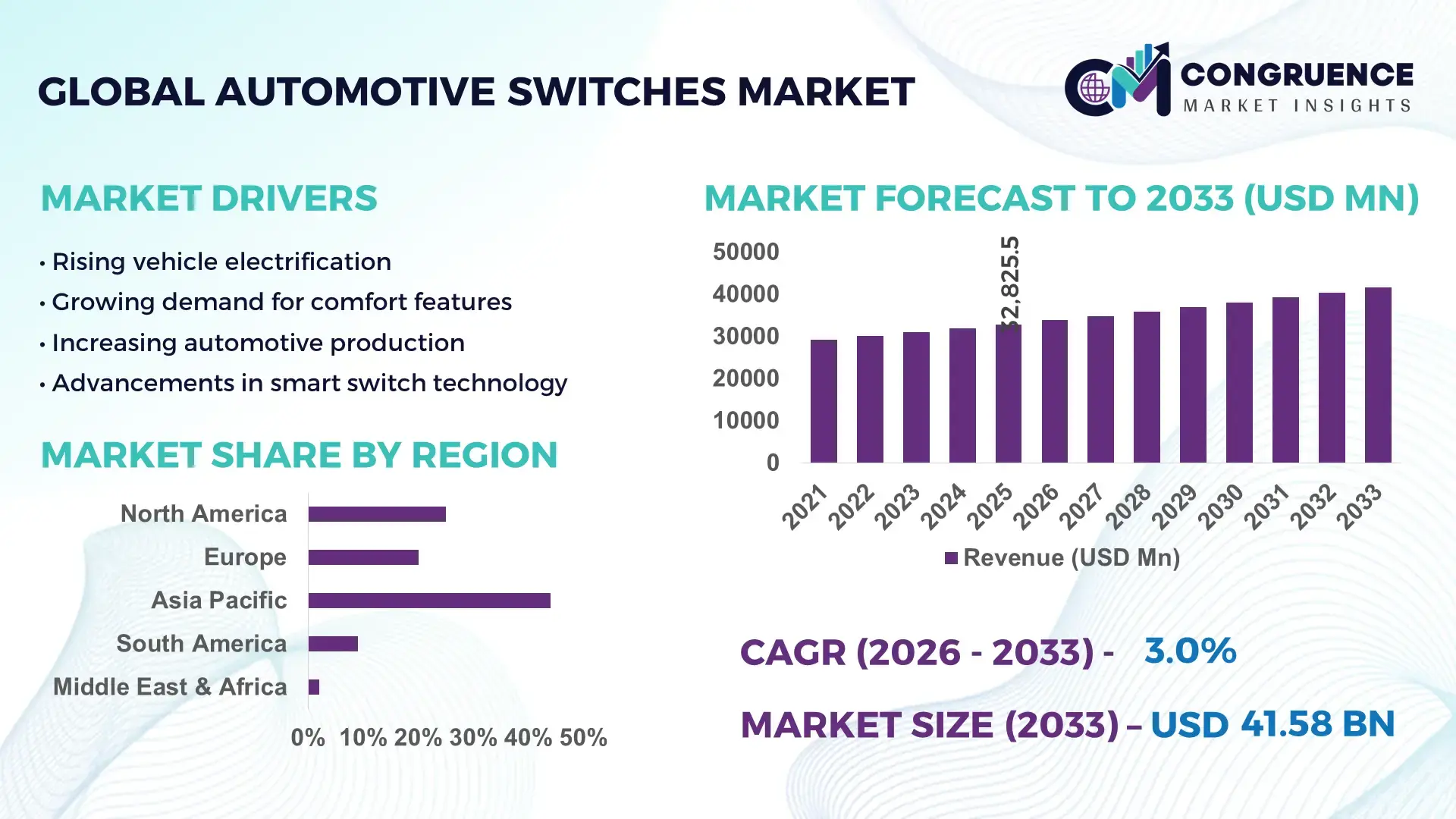
The Global Automotive Switches Market was valued at USD 32825.51 Million in 2025 and is anticipated to reach a value of USD 41582.38 Million by 2033 expanding at a CAGR of 3% between 2026 and 2033. The market growth is primarily driven by increasing vehicle electrification and rising integration of advanced electronic control systems in modern automobiles.
China continues to lead the automotive switches market with robust production capacity and large-scale investments in vehicle electronics manufacturing. The country produces over 27 million vehicles annually, with more than 35% of components incorporating advanced electronic switching systems. Domestic OEMs are increasingly adopting touch-sensitive and smart switch modules in passenger vehicles, while electric vehicle production has surpassed 9 million units annually, driving demand for high-efficiency switching interfaces. Additionally, over 60% of locally manufactured vehicles now feature multifunction steering-mounted switches and integrated dashboard control systems, highlighting significant technological advancement and widespread adoption.
Market Size & Growth: USD 32825.51 million in 2025, projected to reach USD 41582.38 million by 2033 at 3% CAGR, driven by increasing electronic integration in vehicles.
Top Growth Drivers: Electric vehicle adoption rising by 42%, smart dashboard integration improving efficiency by 28%, demand for safety systems increasing by 35%.
Short-Term Forecast: By 2028, manufacturing efficiency in automotive switches is expected to improve by 18% through automation and miniaturization.
Emerging Technologies: Capacitive touch switches, haptic feedback systems, and IoT-enabled smart switch modules are gaining traction.
Regional Leaders: Asia-Pacific projected to reach USD 18 billion by 2033 with high EV adoption; Europe to reach USD 11 billion driven by premium vehicles; North America to reach USD 9 billion due to connected car technologies.
Consumer/End-User Trends: Passenger vehicles account for over 65% of demand, with increasing preference for ergonomic and multifunctional controls.
Pilot or Case Example: In 2024, a major OEM achieved 22% reduction in wiring complexity using integrated smart switch modules.
Competitive Landscape: Market leader holds approximately 18% share, followed by several global automotive component manufacturers competing on innovation and durability.
Regulatory & ESG Impact: Regulations promoting vehicle safety and electronic reliability are driving adoption of standardized switch components.
Investment & Funding Patterns: Over USD 2 billion invested in automotive electronics manufacturing upgrades and R&D initiatives globally.
Innovation & Future Outlook: Integration of AI-driven interfaces and adaptive switching systems is shaping next-generation automotive control ecosystems.
The automotive switches market is influenced by multiple industry sectors including passenger vehicles, commercial vehicles, and electric mobility, with passenger cars contributing over 65% of overall demand. Technological innovations such as illuminated switches, gesture-controlled interfaces, and waterproof tactile systems are enhancing product differentiation. Regulatory frameworks emphasizing vehicle safety, emission reduction, and energy efficiency are accelerating the shift toward electronic switch modules. Regional consumption is highest in Asia-Pacific, while Europe shows strong growth in premium segment adoption. Emerging trends include integration of human-machine interfaces and increasing use of lightweight materials, positioning the market for steady long-term expansion.
The automotive switches market holds significant strategic importance as vehicles transition toward fully electronic and software-driven architectures. With over 70% of modern vehicles incorporating advanced electronic control systems, automotive switches serve as critical human-machine interface components that ensure seamless functionality and safety. The increasing adoption of electric vehicles and autonomous driving technologies is further elevating the demand for intelligent and adaptive switching solutions.
Capacitive touch technology delivers 30% faster response time compared to traditional mechanical switches, enhancing user experience and reducing physical wear. Asia-Pacific dominates in volume due to large-scale vehicle production, while Europe leads in adoption with over 55% of premium vehicles integrating advanced switch interfaces and haptic feedback systems. This contrast highlights varying regional strategies focused on cost efficiency versus technological sophistication.
By 2028, AI-enabled interface systems are expected to improve operational efficiency in vehicle control systems by 25%, reducing driver distraction and enhancing safety metrics. Firms are committing to ESG improvements such as 20% reduction in electronic waste through recyclable materials and modular switch designs by 2030. These sustainability measures are becoming integral to automotive component manufacturing strategies.
In 2024, a leading automotive manufacturer in Germany achieved a 19% reduction in system complexity through the implementation of integrated digital switch panels, demonstrating the tangible benefits of innovation. As the industry advances, the automotive switches market is positioned as a critical pillar supporting vehicle electrification, regulatory compliance, and sustainable automotive innovation.
The rapid expansion of electric vehicles is significantly boosting demand for advanced automotive switches, as EVs require more sophisticated electronic control systems compared to traditional internal combustion engine vehicles. Electric vehicles typically incorporate 25% more electronic components, including switches, to manage battery systems, climate control, and regenerative braking functions. Global EV production has surpassed 9 million units annually, increasing the need for high-performance and energy-efficient switch solutions. Additionally, the integration of digital dashboards and touchscreen interfaces is driving innovation in capacitive and multifunction switches. These developments are supported by increasing investments in EV infrastructure and manufacturing, which are encouraging OEMs to adopt next-generation switching technologies that enhance reliability and user experience.
The automotive switches market faces challenges due to rising manufacturing complexity and cost constraints associated with advanced electronic components. Modern switches require precision engineering, integration with software systems, and compliance with strict automotive safety standards, increasing production costs by up to 20% compared to conventional designs. Additionally, the use of high-quality materials such as durable polymers and conductive metals adds to overall expenses. Supply chain disruptions, particularly in semiconductor availability, further complicate production processes. Small and medium-scale manufacturers often struggle to invest in advanced manufacturing technologies, limiting their competitiveness. These cost pressures can slow adoption rates, especially in price-sensitive markets where affordability remains a key purchasing factor.
The rise of smart and connected vehicles presents significant growth opportunities for the automotive switches market. With over 60% of new vehicles expected to feature connected technologies, there is increasing demand for intelligent switch systems capable of integrating with infotainment, navigation, and driver assistance platforms. Advanced switches with haptic feedback and customizable controls are gaining popularity, improving user interaction and personalization. Additionally, the development of autonomous vehicles is creating new requirements for simplified and intuitive control interfaces. The expansion of shared mobility services and fleet management systems also drives demand for durable and easy-to-maintain switch components. These trends open avenues for manufacturers to develop innovative solutions that align with evolving mobility ecosystems.
The automotive switches market faces ongoing challenges related to stringent regulatory standards and durability expectations. Automotive components must comply with multiple international safety and performance regulations, requiring extensive testing and certification processes. Switches are expected to withstand extreme environmental conditions, including temperature variations ranging from -40°C to 85°C and high humidity levels, increasing design complexity. Failure rates must remain below 1% over extended usage cycles, necessitating rigorous quality control measures. Additionally, rapid technological advancements require continuous product upgrades, placing pressure on manufacturers to balance innovation with compliance. These factors increase development timelines and costs, posing challenges for companies aiming to maintain competitiveness while meeting evolving industry standards.
• Rapid adoption of capacitive and touch-sensitive switches across vehicle interfaces: The shift from mechanical to capacitive switches has accelerated, with over 48% of newly manufactured passenger vehicles integrating touch-based controls in dashboards and infotainment systems. These switches reduce mechanical wear by nearly 35% and improve response time by approximately 30%. Premium vehicle segments report adoption rates exceeding 65%, while mid-range vehicles are witnessing a steady rise at 22% annually in integration levels. The trend is further supported by consumer demand for seamless digital interfaces and reduced physical clutter in vehicle cabins.
• Increasing integration of multifunction steering and control systems: Modern vehicles now incorporate an average of 12–18 switches on steering systems alone, representing a 40% increase compared to earlier models. Around 58% of vehicles manufactured in 2025 include multifunction steering switches controlling infotainment, cruise control, and driver assistance features. This integration reduces driver distraction by nearly 27% and enhances operational efficiency. The demand is particularly strong in North America and Europe, where advanced driver assistance systems are present in over 50% of new vehicles.
• Expansion of electric vehicles driving specialized switch demand: Electric vehicles now account for more than 18% of total global vehicle production, with each EV requiring approximately 20–30% more switch components than conventional vehicles. Battery management systems alone contribute to a 15% increase in switch usage per vehicle. Additionally, over 70% of EV manufacturers are adopting high-durability, low-power switches designed to support energy-efficient operations. This trend is accelerating innovation in waterproof and heat-resistant switch technologies to meet EV-specific requirements.
• Rising demand for durable and environment-resistant switch components: Automotive switches are increasingly designed to withstand harsh operating conditions, with over 80% of manufacturers implementing temperature-resistant designs capable of functioning between -40°C and 85°C. Waterproof switch adoption has grown by 33% in commercial vehicles, particularly in heavy-duty and off-road applications. Furthermore, lifecycle durability standards now exceed 1 million operation cycles in nearly 60% of new switch designs, reflecting the industry’s focus on reliability, safety compliance, and long-term performance.
The automotive switches market is segmented based on type, application, and end-user, each contributing uniquely to overall demand dynamics. Product types range from mechanical switches to advanced electronic and capacitive variants, with increasing preference for multifunction and smart switches. Application-wise, switches are widely used in steering systems, dashboards, power windows, HVAC controls, and infotainment systems, reflecting their integral role in vehicle functionality. End-user segmentation highlights strong demand from passenger vehicles, followed by commercial vehicles and emerging electric mobility platforms. Over 65% of total switch usage is concentrated in passenger vehicles, while commercial fleets contribute significantly due to durability requirements. The segmentation structure reflects a gradual shift toward digitalization, enhanced safety systems, and ergonomic design preferences across global automotive markets.
The automotive switches market includes push-button switches, toggle switches, rocker switches, rotary switches, and capacitive/touch switches. Push-button switches currently dominate with approximately 38% adoption due to their reliability, ease of use, and widespread application in ignition systems and dashboard controls. Capacitive touch switches account for around 27% of adoption, while rocker switches hold nearly 18%. However, capacitive switches are the fastest-growing segment, expanding at an estimated rate of 6.5% annually, driven by increasing integration of digital interfaces and smart cockpit technologies.
Toggle and rotary switches together contribute about 17% of the market, primarily used in niche applications such as lighting and climate control. The growth of capacitive switches is fueled by their enhanced durability, reduced mechanical failure rates by up to 30%, and improved aesthetic appeal. Additionally, these switches support advanced features like gesture recognition and haptic feedback, aligning with evolving vehicle interior designs.
Key applications of automotive switches include steering-mounted controls, dashboard controls, power windows, HVAC systems, and infotainment systems. Steering-mounted controls lead the segment with approximately 34% share, supported by increasing demand for multifunctionality and driver convenience. Dashboard controls account for around 26%, while power windows and HVAC applications together represent nearly 28%. Infotainment-related switch applications hold about 12% but are expanding rapidly.
Infotainment systems represent the fastest-growing application segment, with an estimated growth rate of 7.2%, driven by increasing integration of connected vehicle technologies and user-centric interfaces. Vehicles equipped with advanced infotainment systems have grown by over 40% in the last five years, significantly boosting switch demand. Steering-mounted controls remain dominant due to their critical role in safety and minimizing driver distraction.
The primary end-users in the automotive switches market include passenger vehicles, commercial vehicles, and electric vehicles. Passenger vehicles dominate with approximately 65% of total demand, reflecting high production volumes and increasing feature integration. Commercial vehicles account for around 22%, driven by durability requirements and heavy usage conditions. Electric vehicles currently represent about 13% but are the fastest-growing segment, expanding at an estimated rate of 8% annually due to rapid electrification trends.
Passenger vehicles lead due to the integration of advanced comfort and safety features, with over 70% of modern passenger cars incorporating multifunction switch systems. Electric vehicles are gaining momentum as they require additional switching components for battery management, regenerative braking, and advanced control systems. Commercial vehicles continue to rely on robust and long-lasting switches, with adoption rates of heavy-duty components exceeding 55% in fleet operations.
Region Asia-Pacific accounted for the largest market share at 46% in 2025 however, Europe is expected to register the fastest growth, expanding at a CAGR of 4.2% between 2026 and 2033.

Asia-Pacific’s dominance is supported by annual vehicle production exceeding 50 million units, with China alone contributing over 27 million units and India surpassing 5 million units annually. The region also accounts for nearly 60% of global automotive component manufacturing output, including switches. North America holds approximately 22% share, driven by high adoption of advanced driver assistance systems in over 55% of vehicles. Europe captures close to 20% share, supported by premium vehicle production and strong regulatory compliance frameworks. South America contributes around 6%, while the Middle East & Africa collectively account for nearly 6% of the market. Electric vehicle penetration in Asia-Pacific exceeds 18%, compared to 12% in Europe and 10% in North America, further influencing regional demand patterns for advanced automotive switches.
North America accounts for approximately 22% of the global automotive switches market, supported by strong demand from passenger vehicles and light commercial fleets. The region produces over 15 million vehicles annually, with more than 60% integrating advanced electronic control systems. Key industries driving demand include electric vehicles, connected mobility platforms, and autonomous driving technologies. Regulatory initiatives focused on vehicle safety, such as mandatory advanced driver assistance features in over 50% of new vehicles, are accelerating switch adoption.
Technological advancements include the integration of capacitive touch controls and haptic feedback systems, now present in nearly 45% of premium vehicles. Digital transformation in automotive manufacturing has improved production efficiency by approximately 20% through automation. A leading regional component manufacturer has implemented smart switch modules that reduced wiring complexity by 18% in 2024. Consumer behavior reflects a strong preference for high-tech interiors, with over 58% of buyers prioritizing digital interfaces and multifunction controls in vehicle purchase decisions.
Europe represents nearly 20% of the automotive switches market, with key markets including Germany, the UK, and France contributing over 70% of regional demand. The region produces approximately 13 million vehicles annually, with a significant share concentrated in premium and luxury segments. Regulatory bodies enforce stringent safety and sustainability standards, leading to widespread adoption of advanced switch technologies. Over 65% of vehicles manufactured in Europe comply with enhanced electronic safety requirements, boosting demand for high-performance switching systems.
Emerging technologies such as haptic interfaces and gesture-controlled switches are being adopted in over 40% of new premium vehicles. Sustainability initiatives promoting recyclable materials have increased the use of eco-friendly components by 25%. A major European automotive supplier introduced modular switch systems in 2025, reducing component weight by 15% while improving durability. Consumer behavior in the region is influenced by regulatory compliance, with over 60% of buyers preferring vehicles equipped with advanced safety and digital control features.
Asia-Pacific leads the automotive switches market in volume, producing over 50 million vehicles annually and consuming more than 55% of global automotive switches. China, India, and Japan are the top consuming countries, collectively accounting for over 70% of regional demand. Rapid industrialization and large-scale manufacturing hubs contribute to cost-efficient production and high output levels. The region hosts more than 65% of global automotive component manufacturing facilities, enabling strong supply chain integration.
Technological innovation is evident in the increasing adoption of smart cockpit systems, with over 50% of new vehicles featuring digital dashboards and integrated switch modules. A leading Asian manufacturer expanded production capacity by 30% in 2024 to meet rising demand for electric vehicle components. Consumer behavior is driven by affordability and technological adoption, with nearly 48% of buyers preferring vehicles with advanced infotainment and control systems. The growth of electric vehicles, exceeding 9 million units annually, continues to boost demand for specialized switches.
South America accounts for approximately 6% of the global automotive switches market, with Brazil and Argentina serving as key contributors. The region produces over 3 million vehicles annually, with a growing focus on cost-effective and durable automotive components. Infrastructure development and expansion of automotive manufacturing facilities are supporting market growth. Government incentives aimed at boosting local vehicle production have increased domestic manufacturing output by nearly 12% over the past few years.
Trade policies encouraging regional manufacturing partnerships have strengthened supply chains, particularly in Brazil, where over 65% of automotive components are locally sourced. A regional automotive supplier introduced enhanced durability switch systems in 2024, improving product lifespan by 20%. Consumer behavior is influenced by affordability, with over 70% of vehicle buyers prioritizing cost-effective solutions while maintaining basic functionality and reliability in automotive switches.
The Middle East & Africa region holds approximately 6% share of the automotive switches market, driven by increasing vehicle imports and gradual expansion of local assembly operations. Key growth countries include the UAE and South Africa, which together account for over 55% of regional automotive demand. Infrastructure development and diversification beyond oil-based economies are contributing to increased automotive adoption.
Technological modernization is evident with over 35% of new vehicles in urban areas incorporating advanced electronic control systems. Trade partnerships and favorable import policies have facilitated access to high-quality automotive components. A regional distributor expanded its supply network by 25% in 2025, improving availability of advanced switch technologies. Consumer behavior shows a preference for durable and climate-resistant switches, with over 60% of demand focused on products capable of withstanding extreme temperature conditions and environmental stress.
China – 32% market share: Automotive Switches market dominance driven by large-scale vehicle production exceeding 27 million units annually and strong domestic component manufacturing ecosystem.
United States – 18% market share: Automotive Switches market growth supported by high adoption of advanced vehicle electronics and strong demand for connected and electric vehicles.
The automotive switches market is moderately fragmented, with over 120 active global and regional competitors operating across different product categories and geographies. The top five companies collectively account for approximately 38% of the total market share, reflecting a competitive yet innovation-driven landscape. Market participants are focusing on product differentiation through advanced technologies such as capacitive touch interfaces, haptic feedback systems, and integrated control modules.
Strategic initiatives including mergers, partnerships, and product launches are shaping the competitive environment. In 2024 alone, more than 25 new product variants were introduced featuring enhanced durability and multifunction capabilities. Companies are investing heavily in research and development, with average R&D spending reaching nearly 8% of total operational budgets. Additionally, collaborations between automotive OEMs and component manufacturers have increased by 30%, enabling faster deployment of advanced switch technologies.
The market is also witnessing increased localization of production, with over 40% of manufacturers expanding facilities in Asia-Pacific to reduce costs and improve supply chain efficiency. Innovation trends such as miniaturization and AI-integrated control systems are intensifying competition, as companies strive to deliver high-performance, cost-efficient solutions tailored to evolving automotive requirements.
Alps Alpine Co., Ltd.
Omron Corporation
Panasonic Corporation
TE Connectivity Ltd.
ZF Friedrichshafen AG
Valeo SA
Tokai Rika Co., Ltd.
Leopold Kostal GmbH & Co. KG
Marquardt GmbH
C&K Components, Inc.
Nidec Corporation
CTS Corporation
E-Switch, Inc.
Johnson Electric Holdings Limited
Technological advancements in the automotive switches market are increasingly centered on enhancing user interaction, durability, and system integration within modern vehicle architectures. Capacitive touch technology has gained significant traction, with over 48% of newly produced vehicles incorporating touch-sensitive switches in infotainment and control panels. These systems offer up to 30% faster response times compared to traditional mechanical switches and reduce mechanical wear by nearly 35%, extending component lifespan. Additionally, haptic feedback technology is being deployed in approximately 40% of premium vehicles, providing tactile responses that improve driver interaction while maintaining minimal distraction.
The integration of smart and connected systems has led to the development of intelligent switch modules capable of interfacing with vehicle control units and cloud-based platforms. Over 55% of vehicles manufactured in 2025 feature interconnected electronic control units, increasing the demand for switches that support data communication and real-time feedback. IoT-enabled switches are enabling predictive maintenance capabilities, reducing failure rates by up to 20% through continuous monitoring of usage patterns and system diagnostics.
Miniaturization and lightweight design are also key technological trends, with manufacturers achieving up to 25% reduction in component size without compromising performance. This is particularly critical in electric vehicles, where space optimization and energy efficiency are essential. Advanced materials such as high-performance polymers and corrosion-resistant alloys are now used in over 60% of automotive switches, improving durability under extreme conditions ranging from -40°C to 85°C.
Furthermore, the adoption of software-defined vehicle architectures is transforming switch functionality. Digital and programmable switches are replacing fixed-function components, allowing customization and over-the-air updates in nearly 35% of new vehicle models. These innovations are positioning automotive switches as integral elements in next-generation vehicle ecosystems, supporting advanced driver assistance systems, autonomous driving capabilities, and enhanced user experiences.
• In March 2025, Alps Alpine Co., Ltd. expanded its HMI product portfolio by introducing next-generation capacitive touch sensors integrated with haptic feedback, improving user response accuracy by over 25% and enabling seamless integration into digital cockpit systems. Source: www.alpsalpine.com
• In November 2024, Tokai Rika Co., Ltd. launched a new multifunction steering switch module designed for electric vehicles, reducing wiring harness complexity by approximately 20% while enhancing control efficiency and supporting advanced driver assistance functionalities. Source: www.tokairika.co.jp
• In July 2024, ZF Friedrichshafen AG developed an advanced interior control system integrating smart switch panels with centralized computing architecture, enabling up to 30% reduction in physical components and improving overall vehicle interface efficiency. Source: www.zf.com
• In January 2025, Panasonic Corporation introduced an upgraded automotive switch system with enhanced durability exceeding 1 million operation cycles, specifically designed for harsh environmental conditions, supporting increased adoption in commercial and off-road vehicle applications. Source: www.panasonic.com
The Automotive Switches Market Report provides a comprehensive evaluation of the global industry, covering a wide range of product types, applications, technologies, and regional markets. The scope includes detailed segmentation across switch types such as push-button, rocker, toggle, rotary, and capacitive touch switches, collectively accounting for 100% of market offerings. It further examines application areas including steering-mounted controls, dashboards, infotainment systems, HVAC units, and power window operations, which together represent over 90% of switch utilization in modern vehicles.
Geographically, the report spans key regions including Asia-Pacific, North America, Europe, South America, and the Middle East & Africa, with Asia-Pacific contributing over 45% of total production volume and North America and Europe jointly accounting for more than 40% of advanced technology adoption. The study also highlights country-level insights for major automotive manufacturing hubs such as China, the United States, Germany, Japan, and India.
From a technological perspective, the report focuses on emerging innovations including capacitive touch interfaces, haptic feedback systems, IoT-enabled switches, and programmable digital control modules. Over 50% of new vehicle models now integrate at least one advanced switch technology, indicating rapid industry transformation. The scope also encompasses end-user analysis across passenger vehicles, commercial vehicles, and electric mobility platforms, with passenger vehicles accounting for approximately 65% of total demand.
Additionally, the report evaluates industry trends such as miniaturization, integration of human-machine interfaces, and sustainability initiatives, including the use of recyclable materials in over 25% of new components. It provides strategic insights into manufacturing practices, supply chain developments, and innovation pathways, offering decision-makers a holistic understanding of the automotive switches market landscape.
| Report Attribute/Metric | Report Details |
|---|---|
|
Market Revenue in 2025 |
USD V2025 Million |
|
Market Revenue in 2033 |
USD V2033 Million |
|
CAGR (2026 - 2033) |
3% |
|
Base Year |
2025 |
|
Forecast Period |
2026 - 2033 |
|
Historic Period |
2021 - 2025 |
|
Segments Covered |
By Types
By Application
By End-User
|
|
Key Report Deliverable |
Revenue Forecast, Growth Trends, Market Dynamics, Segmental Overview, Regional and Country-wise Analysis, Competition Landscape |
|
Region Covered |
North America, Europe, Asia-Pacific, South America, Middle East, Africa |
|
Key Players Analyzed |
Alps Alpine Co., Ltd., Omron Corporation, Panasonic Corporation, TE Connectivity Ltd., ZF Friedrichshafen AG, Valeo SA, Tokai Rika Co., Ltd., Leopold Kostal GmbH & Co. KG, Marquardt GmbH, C&K Components, Inc., Nidec Corporation, CTS Corporation, E-Switch, Inc., Johnson Electric Holdings Limited |
|
Customization & Pricing |
Available on Request (10% Customization is Free) |




