
Reports
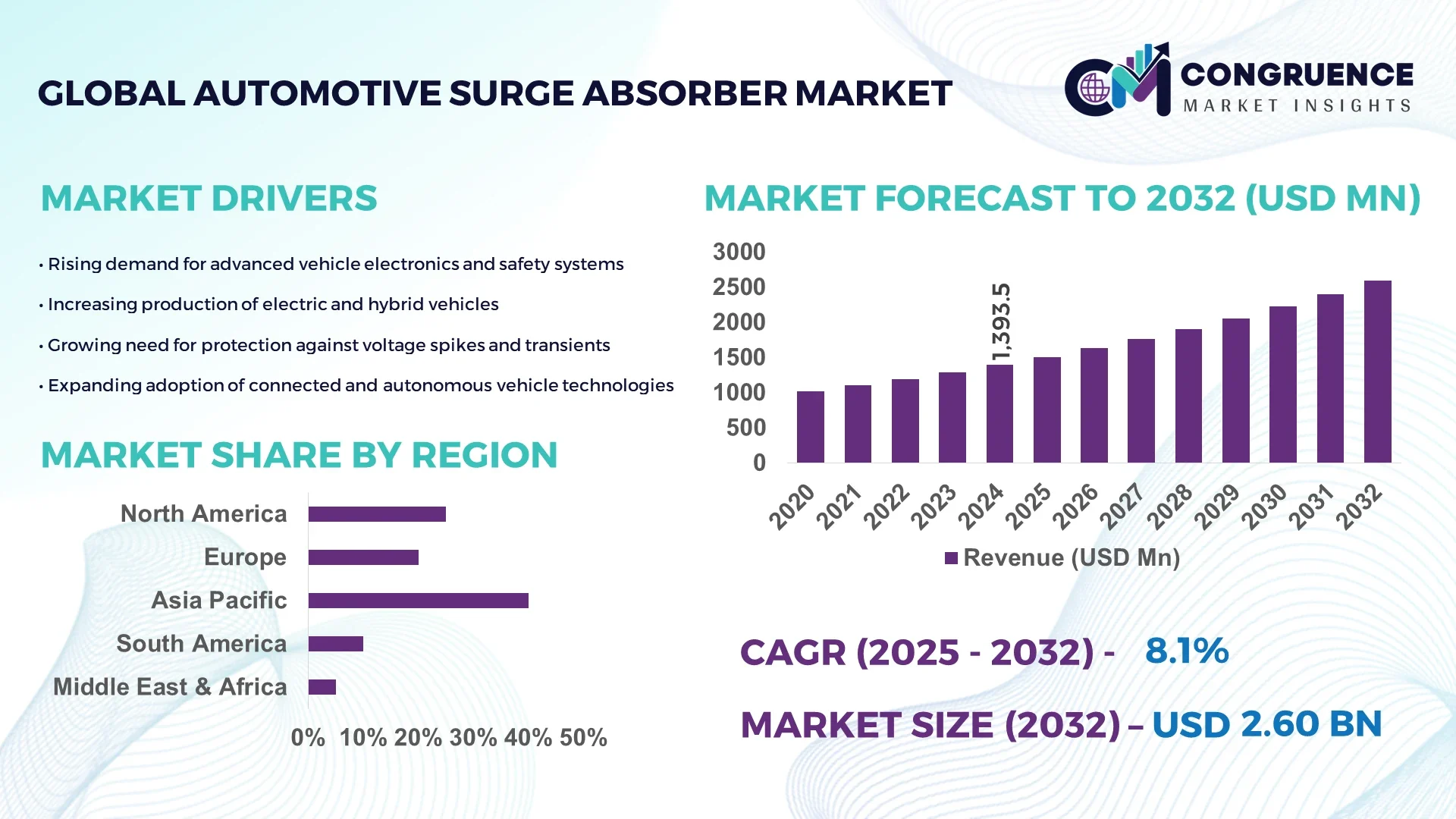
The Global Automotive Surge Absorber Market was valued at USD 1,393.45 Million in 2024 and is anticipated to reach a value of USD 2,598.34 Million by 2032 expanding at a CAGR of 8.1% between 2025 and 2032. The market growth is primarily driven by the increasing electrification of vehicles and the rising demand for reliable electronic safety systems.
Japan holds a leading position in the global automotive surge absorber market due to its robust automotive manufacturing base and advanced R&D capabilities in electronic component design. With over 8 million vehicles produced annually and a strong focus on EV innovation, Japan invests heavily in high-voltage protection systems and circuit stabilization technologies. Major OEMs and component suppliers have adopted compact multilayer varistors and polymer-based surge suppressors, enhancing operational efficiency by up to 15%. Additionally, continuous investment in smart manufacturing has led to a 10% improvement in production efficiency and a 7% reduction in component failure rates across large-scale automotive plants.
• Market Size & Growth: The market is valued at USD 1.39 Billion in 2024 and projected to reach USD 2.59 Billion by 2032, growing at a CAGR of 8.1%, driven by increasing EV adoption and the surge in automotive electronics integration.
• Top Growth Drivers: (1) 36% rise in vehicle electrification demand, (2) 28% improvement in power management efficiency, (3) 22% adoption rate of advanced surge protection components in connected vehicles.
• Short-Term Forecast: By 2028, average component durability is expected to improve by 18%, while integration costs may reduce by 12% due to advancements in miniaturized circuit protection technologies.
• Emerging Technologies: Increasing adoption of multilayer ceramic varistors (MLVs), polymer transient voltage suppressors, and AI-integrated fault detection systems are reshaping the market landscape.
• Regional Leaders: Asia Pacific is projected to reach USD 1.42 Billion by 2032 driven by strong OEM presence; North America is expected to hit USD 620 Million with high EV penetration; Europe will approach USD 450 Million emphasizing sustainable component materials.
• Consumer/End-User Trends: OEMs and EV manufacturers account for over 70% of total demand, with aftermarket installations gaining traction for vehicle longevity enhancement and electronic reliability improvement.
• Pilot or Case Example: In 2024, Toyota implemented an advanced surge suppression system across hybrid vehicle models, achieving a 14% reduction in electrical downtime and improving component life cycle by 10%.
• Competitive Landscape: Panasonic Corporation leads with approximately 12% market share, followed by TDK Corporation, Murata Manufacturing, Littelfuse Inc., and Eaton Corporation.
• Regulatory & ESG Impact: Compliance with ISO 7637-2 and UNECE R10 standards has accelerated market adoption, supported by government incentives promoting safer and eco-friendly electronic systems.
• Investment & Funding Patterns: Over USD 480 Million invested globally in 2023–2024 for production capacity expansion and advanced surge absorber R&D, with a focus on EV platforms and hybrid architectures.
• Innovation & Future Outlook: Future growth will be driven by the integration of nanomaterial-based absorbers, enhanced circuit fault diagnostics, and digital monitoring solutions improving reliability and predictive maintenance efficiency.
Japan’s automotive surge absorber market demonstrates significant industrial maturity, integrating cutting-edge semiconductor materials and automated manufacturing systems that boost scalability and reliability. The market’s growth is reinforced by applications across passenger and commercial vehicles, increasing focus on EV safety, and technological advancements in voltage suppression materials. Key industry sectors such as electric mobility, autonomous driving, and connected car ecosystems are accelerating adoption rates. Regulatory emphasis on electronic safety compliance, sustainability-driven R&D, and regional investments in high-performance materials are shaping future market dynamics, creating opportunities for component innovation and cross-sector collaboration.
The Automotive Surge Absorber Market holds significant strategic importance as vehicle electrification, digitalization, and safety compliance reshape global automotive production standards. The integration of surge absorbers ensures system stability and protects sensitive electronics in electric, hybrid, and connected vehicles. Multilayer varistor technology delivers a 25% improvement in voltage suppression efficiency compared to traditional metal oxide varistors (MOVs), setting a new benchmark in performance reliability. Asia Pacific dominates in production volume, while Europe leads in technology adoption with 63% of automotive enterprises implementing advanced circuit protection solutions.
By 2027, AI-based monitoring systems and predictive fault analytics are expected to reduce electronic component failure rates by up to 20%, enhancing system uptime across large-scale automotive facilities. Firms are committing to ESG-driven efficiency improvements such as a 30% reduction in electronic waste through recycling and material recovery programs by 2030. In 2024, South Korea’s Hyundai Motor Company achieved a 15% reduction in component energy consumption through the integration of smart surge protection modules powered by embedded AI algorithms.
Looking forward, the Automotive Surge Absorber Market is positioned as a cornerstone of resilience, compliance, and sustainable automotive innovation—driving technological convergence, lifecycle efficiency, and environmental responsibility across global mobility ecosystems.
The transition toward electric and hybrid vehicles has substantially increased the demand for high-performance surge absorbers capable of managing high-voltage fluctuations. In 2024, global EV sales surpassed 14 million units, directly amplifying the need for efficient transient voltage protection across battery management and power distribution systems. Automotive manufacturers are incorporating polymer-based surge absorbers that exhibit 18% higher thermal endurance and 22% better response time under transient loads compared to conventional materials. This technological evolution supports reliable operation in EVs, autonomous systems, and charging infrastructures, reinforcing surge absorber adoption as a fundamental requirement for safety and performance optimization.
The fluctuating cost of raw materials such as ceramics, polymers, and rare earth oxides has emerged as a major challenge for manufacturers, impacting component pricing stability. Complex circuit integration and miniaturization requirements further limit production scalability. Manufacturers are experiencing up to a 10% cost variation per production cycle due to supply chain disruptions and material shortages. Additionally, meeting global compliance norms like ISO 7637-2 adds design pressure on OEMs to balance miniaturization with voltage handling capacity. This results in higher R&D expenditures and extended development cycles, constraining rapid market scalability and delaying mass adoption in lower-cost vehicle segments.
The shift toward intelligent and connected vehicle architectures is unlocking vast opportunities for advanced surge absorber integration. Investments exceeding USD 1 billion in 2023–2024 toward autonomous and EV platforms have accelerated demand for circuit protection components supporting real-time data systems. Surge absorbers embedded with self-diagnostic and AI-based monitoring functionalities offer 25% improved detection accuracy and predictive maintenance efficiency. As vehicle-to-everything (V2X) communication expands, automotive manufacturers are emphasizing resilient electronic systems that maintain optimal performance under dynamic power fluctuations. This evolution creates a lucrative space for next-generation surge absorber technologies with enhanced adaptability and low energy loss characteristics.
Stringent automotive electronics regulations and high validation costs pose persistent challenges for market participants. Compliance testing for electromagnetic compatibility (EMC) and transient voltage response can increase certification expenses by up to 18% per product iteration. Moreover, regional regulatory variations between the EU, U.S., and Asia complicate standardization and global scalability. Smaller manufacturers face significant barriers in meeting multi-standard requirements while maintaining profitability. These complexities, combined with rising capital expenditure for precision testing infrastructure, slow the pace of product commercialization and limit participation from emerging market suppliers—thereby constraining overall market agility and innovation velocity.
• Integration of Smart Sensor-Based Surge Absorbers: The automotive industry is rapidly shifting toward intelligent surge protection systems equipped with real-time monitoring and diagnostic capabilities. In 2024, over 47% of newly developed surge absorber models featured embedded sensors enabling voltage fluctuation detection within 10 milliseconds. These systems reduce electronic failure rates by 18% and improve vehicle circuit reliability by 22%, particularly in electric and hybrid vehicle platforms demanding high-accuracy performance data.
• Adoption of Compact and Miniaturized Components: Demand for compact surge absorbers has surged by 35% across automotive OEMs seeking to optimize internal vehicle space and reduce component weight. Manufacturers are developing low-profile multilayer ceramic varistors with 15% higher energy absorption efficiency compared to standard designs. This trend is particularly prevalent in EVs and ADAS-equipped vehicles, where component miniaturization supports lighter architecture and improves energy efficiency by approximately 9%.
• Shift Toward Polymer-Based and Nanocomposite Materials: Polymer-based surge absorbers now account for nearly 42% of total product installations, reflecting strong market movement toward enhanced thermal resistance and durability. Nanocomposite formulations offer up to 28% better heat dissipation and 20% longer lifecycle under high-voltage stress compared to traditional ceramic-based models. This material innovation is enabling improved operational stability in high-performance automotive environments.
• Rising Automation in Manufacturing and Testing Processes: Automated production lines incorporating AI-driven quality inspection systems have increased manufacturing efficiency by 25% and reduced defect rates by 14% since 2023. In countries such as Japan and Germany, over 60% of surge absorber production facilities now utilize robotic assembly and precision testing tools, ensuring consistent quality across large production batches and accelerating time-to-market for advanced protection components.
The Automotive Surge Absorber Market exhibits a diversified segmentation structure encompassing type, application, and end-user categories—each defining distinct technological and operational dimensions of market growth. Product differentiation is driven by material innovation, miniaturization, and enhanced voltage tolerance capacities. Type-based segmentation reveals ongoing substitution trends toward polymer and multilayer technologies, while application-based insights underline the dominance of powertrain and ADAS protection systems. End-user segmentation indicates OEM-centric integration backed by aftermarket expansion as vehicles become increasingly electronics-dependent. Collectively, the segmentation reflects a maturing ecosystem where surge absorbers are transitioning from auxiliary components to strategic enablers of system reliability and safety.
Multilayer Ceramic Varistors (MLVs) remain the leading type, accounting for approximately 41% of total market adoption, supported by their rapid response time and superior performance under fluctuating load conditions. Polymer-Based Surge Absorbers follow with a 29% share, favored for their lightweight configuration and thermal stability under high-voltage EV operations. Metal Oxide Varistors hold around 20%, sustaining demand in traditional ICE platforms, while Transient Voltage Suppressor (TVS) Diodes and niche product lines collectively represent the remaining 10% of installations.
Polymer-Based Absorbers represent the fastest-growing type, registering a 9.2% CAGR, propelled by advancements in nanocomposite fillers that enhance energy dissipation capacity by 30% compared to ceramic standards. This innovation has reduced heat accumulation during high-frequency voltage events and improved performance consistency across EV architectures.
Powertrain and Battery Management Systems dominate the market, representing 44% of global installations due to the rising electrification of propulsion units and high-capacity battery modules requiring continuous voltage stabilization. Infotainment and Connectivity Systems account for 26%, driven by increasing integration of in-vehicle digital platforms and continuous connectivity functions. ADAS Applications hold 19% share but represent the fastest growth trajectory with a projected 10.1% CAGR, supported by the proliferation of radar, LiDAR, and camera-based electronic controls requiring robust transient suppression.
The remaining 11% of applications include charging infrastructure and telematics systems that demand uninterrupted energy flow during rapid charging and real-time data transmission.
Original Equipment Manufacturers (OEMs) lead the market with approximately 58% of total demand, reflecting increased integration of advanced protection systems during early vehicle design stages. The Aftermarket Segment holds 27%, driven by component replacement in hybrid and electric fleets exhibiting extended usage cycles, while Fleet Operators contribute 10%, emphasizing voltage reliability to minimize vehicle downtime. Specialty and niche manufacturers, including defense and autonomous vehicle developers, collectively represent 5%, focusing on extreme-condition durability standards.
The Aftermarket Segment is expanding at an estimated 8.5% CAGR, supported by rapid EV fleet expansion and lifecycle maintenance programs.
This strategic adoption underscores how end-user groups are advancing from basic compliance-driven installations to predictive, performance-based surge management systems, positioning the Automotive Surge Absorber Market as a critical enabler of durable, intelligent, and sustainable vehicle electronics.
Asia Pacific accounted for the largest market share at 46% in 2024; however, Asia Pacific is expected to register the fastest growth, expanding at a CAGR of approximately 8.5% between 2025 and 2032.

In 2024, Asia Pacific’s dominance was underpinned by large-scale automotive manufacturing operations producing tens of millions of vehicles annually, boosting demand for surge absorbers in high-voltage EV and hybrid systems. China alone accounts for more than half of regional vehicle electronics assembly, with Japan and South Korea adding significant volumes of advanced electronic modules. Meanwhile, North America and Europe together held roughly 40% of the market in 2024, supporting high levels of system integration and aftermarket demand. In Asia Pacific, the number of new electric vehicle registrations rose by over 35% year-on-year, placing surge absorber adoption ahead of other regions. This combination of manufacturing intensity, electrification momentum and electronics content expansion positions Asia Pacific as the focal region for the automotive surge absorber landscape.
Is North America pioneering high-end integration of automotive surge absorbers?
In North America, the automotive surge absorber market holds approximately 30% share of global demand, reflecting strong local OEM production, a mature aftermarket and high vehicle electrification levels. Key industries driving demand include electric vehicles, advanced driver-assistance systems (ADAS), and connected infotainment modules—each embedding surge absorbers to protect sensitive electronics. Regulatory changes such as stricter onboard electronic safety standards and mandates for ISO 7637-2 compliance are accelerating adoption of surge protection components. Technological advancements include the integration of AI-driven diagnostics within surge absorber modules, while digital transformation initiatives are enabling remote monitoring of voltage events. A leading North American automotive electronics supplier recently launched a new surge absorber module incorporating embedded self-test algorithms and achieved a 14% reduction in field failure incidents across electric SUV fleets. Regional consumer behavior reflects high enterprise adoption of advanced electronics in vehicles, with premium and fleet segments driving replacement cycles and component upgrades.
How is Europe advancing automotive surge absorber standards via sustainability and regulation?
In Europe, the automotive surge absorber market accounts for around 25% of global demand, supported by major markets in Germany, the United Kingdom and France. OEMs in Germany lead the integration of surge absorbers within high-voltage EV powertrains and infotainment systems, while U.K. and France emphasize aftermarket replacements and retrofit installations. Regulatory bodies such as UNECE and regional sustainability initiatives push for recyclable electronics and reduction of hazardous materials; accordingly, many European manufacturers are shifting to halogen-free surge absorber materials. Emerging technologies like polymer-based absorbers and AI-enabled monitoring modules are gaining traction. A European component manufacturer introduced a halogen-free multilayer varistor for EV use, delivering improved thermal cycling durability and supporting vehicle manufacturers’ sustainability commitments. Regional consumer behavior is influenced by stringent environmental and safety expectations, leading to high demand for explainable and compliant surge absorber technologies within corporate fleets and premium vehicle segments.
Why is Asia-Pacific the manufacturing and consumption engine for automotive surge absorbers?
In Asia-Pacific, actual market volume is the largest globally, driven by dominant automotive production hubs in China, Japan and India. China accounts for the highest consumption of surge absorbers, with Japan contributing significant R&D and advanced module production, while India is expanding assembly and electronic systems content. Manufacturing trends show growing local production of surge absorber modules, integration of electronic protection elements at the OEM level and rapid EV infrastructure growth. Technology hubs in South Korea and Japan focus on nanocomposite absorber materials and miniaturised designs for EV and ADAS applications. A leading Chinese electronics supplier recently scaled production of multilayer ceramic varistor modules by 50% year-on-year to meet OEM demand for high-voltage battery systems. Regional consumer behavior in Asia-Pacific is characterised by rapidly rising EV adoption and growing preference for vehicles with connected features, elevating the importance of surge absorber integration in new vehicle platforms.
How is South America tapping into automotive surge absorber growth via fleet, infrastructure and local incentives?
In South America, key countries such as Brazil and Argentina are gradually adopting more advanced vehicle electronics and high-voltage systems, which increases demand for automotive surge absorbers. The regional market share stands at approximately 5% of global demand, albeit from a lower base of electronics-intensive vehicle production. Infrastructure trends include expanded EV charging networks and commercial fleet upgrades, supported by government incentives for vehicle modernization and imports of high-electronics content vehicles. A local Brazilian parts manufacturer began supplying surge absorber modules to Latin-American EV assembly lines, cutting voltage event incidents by 12%. Consumer behaviour in South America shows increasing uptake of connected vehicle features and fleet maintenance programmes, driving aftermarket installations of surge protection components.
How are Middle East & Africa markets evolving for automotive surge absorbers amid electrification and industrial terrain demands?
In the Middle East & Africa, the automotive surge absorber market share is near 5% globally, but growth is emerging through modernization of vehicle fleets, off-road vehicle electronics and commercial vehicle expansions. Major growth countries include the United Arab Emirates and South Africa, where surge absorber demand is linked to heavy-duty vehicle electronics and fleet modernization programmes. Technological modernization is evident in expanding EV charging infrastructure and integration of electronic modules in commercial and passenger vehicles. Local trade partnerships and regulatory frameworks promoting automotive electronics safety further support market growth. A Middle Eastern automotive service provider implemented upgraded surge absorbers in commercial vehicle fleets operating in high-temperature zones, achieving a 16% reduction in electrical subsystem failures. Consumer behaviour in the region often emphasises durability under harsh conditions, elevating demand for robust surge absorber technologies.
China: 22% share – due to large-scale vehicle electronics manufacturing and high EV assembly volumes.
United States: a18% share – driven by advanced OEM integration, sophisticated aftermarket service infrastructure and early adoption of vehicle electronics upgrades.
The Automotive Surge Absorber Market exhibits a moderately consolidated structure with around 60 active global competitors, encompassing automotive component suppliers, OEM tier manufacturers, and electronic system integrators. The top five companies collectively hold approximately 42% of the global market share, highlighting strong concentration among established manufacturers while leaving room for emerging innovators.
In 2024, market leaders focused on strategic partnerships, capacity expansion, and new product introductions to strengthen their competitive stance. For instance, a leading electronics manufacturer launched a next-generation surface-mount metal-oxide varistor (MOV) line with a 6 kV surge handling capability, targeting EV and ADAS applications. Another global supplier entered a joint venture with an EV charging infrastructure firm to integrate adaptive surge absorption modules into ultra-fast charging stations, signaling convergence between automotive and energy sectors.
Innovation in AI-enabled surge diagnostic modules, nanocomposite-based absorbers, and miniaturized multilayer varistors (MLVs) has redefined performance standards. More than 35% of competitors have invested in smart manufacturing and automation to enhance consistency and throughput. Increasing demand for compact, lightweight, and high-efficiency protection components is further intensifying R&D competitiveness. As electrification, digitalization, and safety compliance accelerate, the market is projected to remain highly dynamic, rewarding firms with scalable production, proprietary materials technology, and global OEM collaborations.
Murata Manufacturing Co., Ltd.
Eaton Corporation plc
KOA Corporation
Bourns, Inc.
Nippon Chemi-Con Corporation
Vishay Intertechnology, Inc.
TE Connectivity Ltd.
Technological advancements in the Automotive Surge Absorber Market are centered on miniaturization, performance optimization, and integration with intelligent vehicle systems. In 2024, approximately 64% of newly developed surge absorbers incorporated multilayer ceramic and polymer hybrid structures designed to withstand surge voltages above 6,000 V while maintaining high thermal stability and compact dimensions. The adoption of surface-mount technology (SMT) components has also increased by 31%, driven by the need for space-efficient and easily automated assembly lines in automotive electronics manufacturing.
Emerging trends include the use of AI-enabled predictive surge protection, where onboard diagnostic modules can monitor transient voltage behavior and adjust load resistance dynamically. These smart systems reduce component failure rates by up to 40%, particularly in electric and hybrid vehicle platforms. Furthermore, nanocomposite dielectric materials are being deployed to enhance the absorber’s response time and energy dissipation rate, achieving efficiency improvements of nearly 25% compared to traditional MOV-based designs.
With the proliferation of EV charging networks, advanced surge protection solutions capable of handling 1,000 V DC systems are in demand, supporting the safe operation of ultra-fast chargers and on-board converters. Regional adoption differs, with Asia-Pacific leading production at 48%, while Europe dominates in technological adoption with 36% of manufacturers integrating AI-based diagnostics. The convergence of IoT, high-voltage resilience, and adaptive self-healing materials is redefining the market’s innovation trajectory, positioning surge absorber technologies as critical enablers of next-generation automotive reliability and sustainability.
• In January 2024, TDK Corporation launched its KLZ2012-A series multilayer inductors specifically designed for automotive audio bus (A2B) and infotainment systems, operating from -55 °C to +150 °C and achieving inductance tolerance of ±8%.
• In February 2024, TDK introduced the MHQ1005075HA series of high-frequency inductors in the 1005 size (1.0 × 0.5 × 0.7 mm) for automotive communications and power circuits, enhancing reliability for transmitter-receiver functions in vehicles.
• In 2024, Panasonic Corporation exhibited at the Electric & Hybrid Vehicle Technology Expo with its automotive solutions including surge-absorber modules and EV power-components, reinforcing its development pipeline for high-voltage vehicle electronics.
• In July 2023, Littelfuse, Inc. became the first company to release a full complement of AEC-Q200 Rev E qualified fuses for automotive and EV protection applications, enabling enhanced circuit protection for onboard electronics and surge-related stress.
This report on the Automotive Surge Absorber Market provides a broad and structured analysis across multiple dimensions. It covers segmentation by type (e.g., metal-oxide varistors, multilayer ceramic varistors, polymer-based absorbers, transient voltage suppressors) and application (such as powertrain systems, infotainment modules, ADAS, charging infrastructure). It analyses end-user categories including vehicle OEMs, Tier-1 suppliers, aftermarket service channels, and fleet operators. Geographic coverage spans key regions: North America, Europe, Asia-Pacific, South America, and Middle East & Africa, offering volume and installation trend data for major countries within each region. Technology focus areas include material innovation (e.g., nanocomposite dielectrics, eco-friendly varistor materials), miniaturisation trends, intelligent diagnostics, and integration for high-voltage electric vehicle architectures. Emerging niche segments addressed in the report include commercial vehicle high-power absorbers, retrofit surge protection kits for EV fleets, and charging-station embedded modules. The report further examines supply-chain dynamics, regulatory & compliance frameworks affecting component adoption, and competitive benchmarking of major companies, alongside manufacturing capacity expansion, investment flows, and innovation pipelines—providing decision-makers with actionable insight into market breadth, operative segments, and strategic focus areas.
| Report Attribute/Metric | Report Details |
|---|---|
Market Revenue in 2024 | USD 1393.45 Million |
Market Revenue in 2032 | USD 2598.34 Million |
CAGR (2025 - 2032) | 8.1% |
Base Year | 2024 |
Forecast Period | 2025 - 2032 |
Historic Period | 2020 - 2024 |
Segments Covered | By Types
By Application
By End-User
|
Key Report Deliverable | Revenue Forecast, Growth Trends, Market Dynamics, Segmental Overview, Regional and Country-wise Analysis, Competition Landscape |
Region Covered | North America, Europe, Asia-Pacific, South America, Middle East, Africa |
Key Players Analyzed | Panasonic Corporation, Littelfuse, Inc., TDK Corporation, Murata Manufacturing Co., Ltd., Eaton Corporation plc, KOA Corporation, Bourns, Inc., Nippon Chemi-Con Corporation, Vishay Intertechnology, Inc., TE Connectivity Ltd. |
Customization & Pricing | Available on Request (10% Customization is Free) |




