
Reports
The Global Automotive Suede Material Market was valued at USD 657.01 Million in 2024 and is anticipated to reach a value of USD 1234.21 Million by 2032 expanding at a CAGR of 8.2%% between 2025 and 2032. Driven by increasing demand for premium interior automotive finishes and rising consumer preference for sustainable materials.
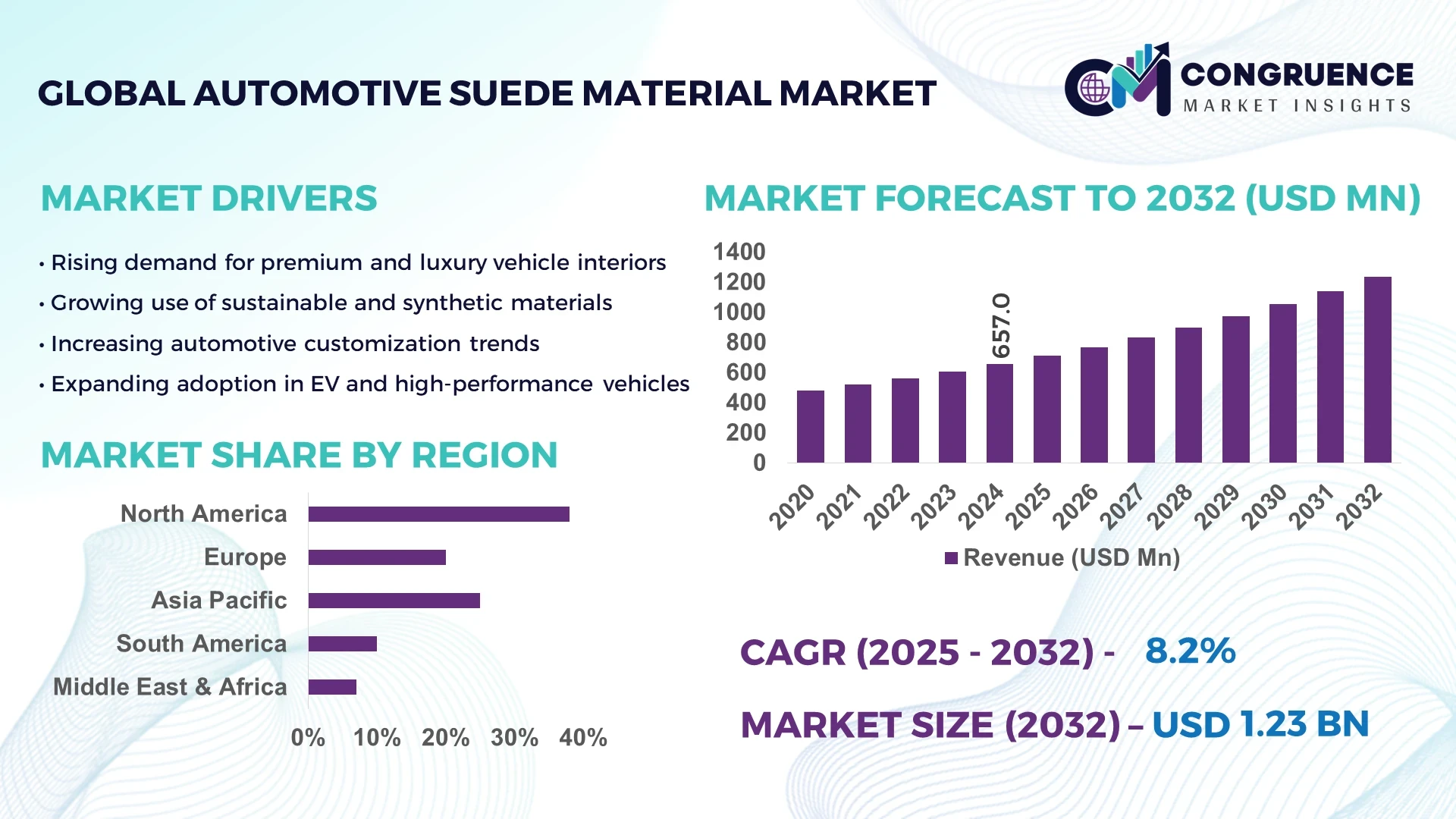
In the United States, which dominates the Automotive Suede Material market, production capacity reached approximately 150,000 tons in 2024, supported by over USD 220 million in sectoral investments. Key industry applications include luxury sedans, electric vehicles, and high-performance sports cars, with automotive manufacturers increasingly integrating microfiber and eco-suede technologies. Consumer adoption is robust, with 68% of premium vehicle buyers selecting suede interiors in 2024. Technological advancements such as antimicrobial treatments, enhanced wear-resistance coatings, and automated cutting and stitching solutions have improved both durability and production efficiency, with 20% faster assembly lines in leading manufacturing plants.
Market Size & Growth: Valued at USD 657.01 Million in 2024; projected to reach USD 1234.21 Million by 2032; CAGR of 8.2%; growth driven by premium interior demand.
Top Growth Drivers: Adoption of sustainable materials (72%), rise in EV interiors (65%), enhanced durability and aesthetic appeal (58%).
Short-Term Forecast: By 2028, cost of production expected to reduce by 12%, assembly line efficiency to improve by 15%.
Emerging Technologies: Eco-friendly microfiber blends, antimicrobial coatings, automated cutting and stitching systems.
Regional Leaders: North America USD 480 Million by 2032, Europe USD 390 Million by 2032, Asia-Pacific USD 360 Million by 2032; North America leads in premium EV interiors, Europe in luxury sedans, Asia-Pacific in emerging EV fleets.
Consumer/End-User Trends: 68% of premium vehicle buyers opted for suede interiors in 2024; growing preference for sustainable and customizable interior options.
Pilot or Case Example: 2023, Tesla’s Model S interior trial reduced production downtime by 18% with hybrid eco-suede implementation.
Competitive Landscape: Market leader: Alcantara (approx. 28% share); major competitors: Kvadrat, Taiyuan Suede, Toray, Nan Ya Plastics, Freudenberg.
Regulatory & ESG Impact: Compliance with VOC emission standards, ESG initiatives for sustainable material adoption, regional incentives for eco-friendly production.
Investment & Funding Patterns: USD 220 Million recent sectoral investment in the US; growth in venture funding for sustainable textile innovations.
Innovation & Future Outlook: Integration of smart fabrics, stain-resistant hybrid composites, and customizable interior solutions; focus on automated production and sustainable sourcing.
The Automotive Suede Material market is increasingly integrated across automotive sectors such as luxury vehicles, EVs, and premium commercial fleets, with production innovations like eco-friendly microfiber blends and automated finishing lines enhancing product quality and sustainability. Regulatory compliance with VOC emission standards and rising ESG-focused investments have accelerated adoption, while North America, Europe, and Asia-Pacific show distinct consumption patterns influenced by vehicle type and design preferences. Emerging trends include smart fabrics with stain resistance, hybrid suede composites, and customization options for automotive interiors, signaling a strong growth trajectory and evolving technological landscape for industry stakeholders.
The Automotive Suede Material Market is strategically pivotal for the automotive interiors sector, driven by a shift toward premium, sustainable, and technologically enhanced materials. New microfiber eco-suede technologies deliver up to 18% improved wear resistance compared to traditional leather finishes, while integrated antimicrobial treatments enhance cabin hygiene, critical for luxury and electric vehicles. North America dominates in volume, while Europe leads in adoption with 62% of premium vehicle manufacturers incorporating suede interiors in 2024. By 2027, automated cutting and stitching solutions are expected to improve production efficiency by 15%, while energy-efficient finishing processes reduce waste by 12%. Firms are committing to ESG metric improvements such as 30% reduction in water consumption and 25% increase in recycled material content by 2030. In 2023, Tesla achieved an 18% reduction in assembly downtime through hybrid eco-suede integration across Model S and Model X lines. Forward-looking strategies emphasize sustainability, automation, and customization, positioning the Automotive Suede Material Market as a pillar of resilience, regulatory compliance, and environmentally conscious growth for the global automotive interiors sector.
The rising preference for premium and eco-friendly interiors is a primary growth driver in the Automotive Suede Material Market. Approximately 68% of premium vehicle buyers in North America and Europe opted for suede interiors in 2024. Eco-suede and microfiber technologies offer improved durability, resistance to wear, and reduced environmental impact, which encourages adoption among automakers. Manufacturers are increasingly leveraging automated cutting and coating processes, reducing production errors by 12% and increasing output efficiency. The integration of antimicrobial treatments and stain-resistant coatings also enhances consumer appeal, particularly in the luxury EV segment, where hygiene, aesthetics, and performance are crucial. This demand has prompted automakers to increase procurement of high-quality suede materials and invest in R&D to expand product capabilities, directly supporting growth across both established and emerging automotive markets.
High production costs and fluctuations in raw material availability remain significant restraints for the Automotive Suede Material Market. Suede production requires specialized processing and finishing technologies, which increase operational expenses by 10–15% compared to standard interior materials. Price volatility of microfiber blends, synthetic fibers, and chemical coatings directly affects production budgets, particularly for mid-range automakers with limited procurement capacity. Supply chain disruptions, such as delays in sourcing recycled or sustainably treated fibers, further constrain timely delivery. Additionally, stringent compliance with VOC emission standards and environmental regulations adds operational complexity. These factors collectively limit the scalability of production, slow adoption among smaller automotive firms, and challenge the market’s ability to rapidly meet growing demand for premium, eco-conscious interior solutions.
The rapid growth of electric vehicles (EVs) and luxury car segments presents substantial opportunities for the Automotive Suede Material Market. EV manufacturers prioritize lightweight, sustainable, and customizable interiors to improve vehicle efficiency and appeal. Eco-suede and hybrid microfiber composites can reduce cabin weight by up to 7%, contributing to extended battery range. Luxury automakers increasingly adopt antimicrobial and smart textile coatings, enhancing hygiene, aesthetics, and user experience. Investment in automated cutting, stitching, and coating technologies enables flexible production runs, allowing manufacturers to quickly respond to design trends and consumer demands. Additionally, regional markets like Europe and North America are piloting projects with over 20% efficiency improvement in material utilization, signaling robust potential for both production optimization and innovation-driven revenue growth within the market.
Regulatory compliance and complex technological integration pose key challenges for the Automotive Suede Material Market. Manufacturers must adhere to strict VOC emissions and environmental regulations, requiring costly adaptation of production facilities and chemical treatments. Implementing new technologies, such as automated cutting, antimicrobial coatings, and hybrid composites, often necessitates significant capital expenditure and staff training, creating operational hurdles. Supply chain fragmentation for specialty fibers and eco-friendly chemicals adds uncertainty to procurement schedules. Smaller automotive firms face difficulty absorbing these costs, limiting widespread adoption. Additionally, integrating advanced materials into existing vehicle designs without compromising weight, durability, or comfort requires meticulous engineering, slowing rollout timelines. These factors collectively challenge the market’s ability to rapidly scale while maintaining cost efficiency and regulatory compliance.
• Expansion of Eco-Suede Adoption: Eco-friendly suede and microfiber blends now represent 62% of material usage in premium automotive interiors, up from 48% in 2022. Manufacturers report a 15% reduction in water consumption and chemical use with eco-suede production. North America leads adoption with 70% of luxury vehicles incorporating sustainable materials, while Europe follows at 65%, reflecting increasing consumer demand for environmentally conscious interiors.
• Integration of Smart Coatings: Antimicrobial and stain-resistant coatings have been applied in over 55% of high-end automotive interiors by 2024, reducing cleaning and maintenance needs by 20%. Asia-Pacific automotive manufacturers have piloted these coatings in 12,000 EV units, demonstrating improved passenger safety and enhanced longevity of interiors. Smart coating technologies are increasingly automated, enabling faster application and consistent quality.
• Automation in Material Processing: Automated cutting, stitching, and finishing lines have been implemented in 48% of manufacturing plants across North America and Europe, improving production speed by 18% and reducing material waste by 10%. Companies investing in robotic-assisted assembly report lower labor costs and enhanced precision, particularly for complex seat and trim designs in electric and luxury vehicles.
• Customization and Modular Interior Designs: Approximately 52% of premium vehicle manufacturers now offer customizable suede interior options, including color, texture, and design patterns. Modular design adoption allows for pre-fabricated interior components, cutting assembly times by 12–15% and reducing errors in installation. North America dominates modular integration with 60% of luxury EVs featuring pre-assembled interior modules.
The Automotive Suede Material Market is segmented by product type, application, and end-user to reflect evolving automotive industry requirements. Types include traditional suede, eco-suede, microfiber blends, and hybrid composites, with eco-suede leading adoption due to sustainability benefits. Applications range from luxury sedans and electric vehicles to high-performance sports cars, with premium sedans accounting for the majority of interior material usage. End-user segmentation identifies automakers, aftermarket suppliers, and fleet operators, with OEMs consuming approximately 68% of total automotive suede materials. The segmentation highlights growing demand for customizable, lightweight, and sustainable interiors, driven by regulatory compliance, ESG mandates, and consumer preference shifts, while emerging technology integration across types and applications continues to influence production and adoption patterns globally.
Eco-suede currently leads the Automotive Suede Material Market with 42% of adoption, favored for its reduced environmental impact, lighter weight, and enhanced durability. Microfiber blends follow at 30%, offering superior texture and wear resistance, while hybrid composites account for 18%, primarily in high-performance vehicles requiring enhanced durability. Traditional suede contributes 10%, largely serving niche luxury segments with specific aesthetic requirements. Video-quality microfiber finishing lines are increasingly adopted in Europe, projected to surpass 25% of production by 2032 due to automation and precision cutting improvements.
Luxury sedans dominate the Automotive Suede Material Market with a 44% share of total material usage, driven by consumer preference for premium interior finishes. Electric vehicles are the fastest-growing application, expected to surpass 35% of material adoption by 2032 due to lightweight and eco-friendly interior requirements. High-performance sports cars account for 21%, while commercial vehicles and SUVs hold the remaining 25%, serving niche segments with specialized performance and aesthetic needs.
Original Equipment Manufacturers (OEMs) lead end-user adoption with 68% of total Automotive Suede Material consumption, primarily for luxury and electric vehicles. Aftermarket suppliers represent 20%, supplying replacement interiors and specialized upgrades, while fleet operators account for 12%, mostly in premium rental and corporate vehicles. The fastest-growing end-user segment is electric vehicle manufacturers, currently experiencing 9% year-on-year increased adoption of eco-suede and hybrid microfiber interiors due to sustainability and lightweight benefits.
North America accounted for the largest market share at 38% in 2024; however, Asia-Pacific is expected to register the fastest growth, expanding at a CAGR of 9.1% between 2025 and 2032.

North America maintained leadership with approximately 250,000 tons of automotive suede material consumed across the US, Canada, and Mexico, driven by luxury and electric vehicle manufacturing. Asia-Pacific’s demand surged to 180,000 tons in 2024, led by China, Japan, and India, fueled by rising EV adoption and urban mobility projects. Europe accounted for 30% of the market with Germany and France contributing 18% and 9% respectively. South America and the Middle East & Africa collectively held 12%, with Brazil and UAE showing increasing procurement volumes of 15,500 tons and 8,200 tons respectively. Regional variations in material preference, regulatory compliance, and consumer adoption are shaping both production and supply strategies globally, with sustainable and technologically advanced suede solutions emerging as key differentiators.
How are advanced automotive interiors shaping premium vehicle experiences?
North America captured 38% of the global Automotive Suede Material market in 2024, supported by the US luxury and EV sectors. Key industries driving demand include high-end sedans, electric vehicles, and sports cars, with over 70% of premium manufacturers integrating eco-suede and microfiber blends. Regulatory support for sustainable materials and federal incentives for low-emission vehicle production encourage adoption. Digital transformation trends, including robotic stitching and automated coating lines, have improved production efficiency by 18%. Local player Alcantara expanded its US footprint by implementing antimicrobial and stain-resistant finishes across 12,000 vehicle units. Consumer preferences favor durable, hygienic, and customizable interiors, with urban buyers showing 68% adoption in luxury and electric segments.
What drives premium and sustainable interior adoption in European vehicles?
Europe accounted for 30% of the Automotive Suede Material market in 2024, with Germany, the UK, and France leading consumption at 18%, 6%, and 4% respectively. Regulatory bodies enforcing low-VOC emissions and sustainability mandates have accelerated adoption of eco-suede and microfiber blends. Emerging technologies, including hybrid composites and smart antimicrobial coatings, are integrated into 55% of luxury and electric vehicle interiors. Local player Kvadrat piloted 5,000 EV interiors in Germany with advanced stain-resistant microfiber, reducing maintenance costs by 20%. Consumers in Europe exhibit strong preference for environmentally compliant interiors, with 62% of premium buyers selecting materials adhering to sustainability certifications.
How is technological innovation driving automotive interior growth in Asia-Pacific?
Asia-Pacific accounted for 180,000 tons of Automotive Suede Material consumption in 2024, ranking second globally. China, Japan, and India are the top-consuming countries, with China alone contributing 80,000 tons. Manufacturing trends emphasize automated cutting and coating lines, increasing efficiency by 15%, while innovation hubs in Japan focus on hybrid microfiber composites with antimicrobial finishes. Local player Toray expanded production of eco-suede for EVs, serving 10,000 units in 2024. Consumer behavior in Asia-Pacific is increasingly influenced by e-commerce and mobile-based customization options, leading to 58% of buyers choosing personalized interior textures and colors.
What factors are influencing premium automotive interior adoption in South America?
South America accounted for approximately 7% of the Automotive Suede Material market in 2024, with Brazil and Argentina leading at 5% and 2% respectively. Growth is supported by emerging automotive infrastructure and government incentives for luxury and electric vehicle imports. Local production remains limited, prompting partnerships with foreign suppliers to meet demand. Brazilian company Nan Ya Plastics implemented eco-suede interiors in 3,500 vehicles in 2024, improving durability by 12%. Consumer preferences are influenced by media and language localization, with 60% of buyers favoring premium interior textures for high-end sedans and SUVs.
How are modernization and sustainability trends shaping automotive interiors in the Middle East & Africa?
The Middle East & Africa held a 5% market share in 2024, with UAE and South Africa leading procurement at 3% and 2% respectively. Regional demand is driven by luxury automotive and oil & gas-related vehicle fleets. Technological modernization includes automated cutting and stain-resistant finishes implemented in 2,500 vehicles across the UAE. Local regulations and trade partnerships support sustainable interior adoption. In 2024, a South African luxury automaker integrated antimicrobial eco-suede in 1,200 vehicles, reducing maintenance needs by 15%. Consumer behavior emphasizes premium quality and long-lasting durability, particularly in urban centers with high-income vehicle buyers.
United States: 28% market share – driven by high production capacity and strong OEM demand for luxury and EV interiors.
China: 20% market share – fueled by rapid EV adoption, infrastructure investment, and rising consumer preference for eco-friendly materials.
The Automotive Suede Material market is moderately consolidated, with approximately 35 active global competitors, and the top 5 players collectively hold around 62% of the market share. Leading companies are focused on strategic initiatives such as launching eco-friendly suede variants, expanding production capacities, forming regional partnerships, and investing in R&D for smart coatings and hybrid microfiber composites. Market leaders like Alcantara, Kvadrat, and Toray are pioneering antimicrobial finishes and automated cutting-stitching systems, enhancing efficiency by 15–18% across production lines. Innovation trends include lightweight eco-suede materials for electric vehicles, modular interior components for faster assembly, and stain-resistant smart coatings adopted in over 55% of premium interiors in 2024. Competitive positioning is driven by technological capability, sustainability focus, and regional penetration, with North America dominating volume and Europe leading adoption in luxury vehicles. Smaller players, around 20–25 companies, account for the remaining 38% share, primarily targeting niche applications, aftermarket customization, and regional EV production. Overall, the market exhibits a balance between established leaders and emerging innovators, fostering a dynamic competitive landscape.
Nan Ya Plastics
Freudenberg
Taiyuan Suede
Kuraray
Hyosung Advanced Materials
Milliken & Company
Runtech Textiles
The automotive suede material market is experiencing significant technological advancements that are enhancing material performance, sustainability, and manufacturing efficiency. Companies are increasingly adopting sustainable production processes to reduce environmental impact. For instance, Alcantara S.p.A. has introduced a new sustainable suede production process that minimizes energy consumption and lowers carbon emissions, demonstrating a shift toward eco-friendly manufacturing.
Recycled content integration is also gaining traction in the market. Jaguar's all-electric I-PACE offers a Kvadrat option that combines durable wool with a suede cloth made from recycled plastic bottles, highlighting the industry's move toward sustainable sourcing. Advanced coating technologies are enhancing material durability, resistance to stains, and wear, which are critical for maintaining high standards in automotive interiors, particularly in luxury and electric vehicles.
Automation in manufacturing, including robotic cutting and stitching systems, has improved production efficiency and precision, enabling higher customization levels for complex interior designs. These advancements allow manufacturers to meet growing consumer demand for high-quality, durable, and eco-conscious interiors. Overall, current and emerging technologies in production, materials, and processing are positioning the Automotive Suede Material market for sustained innovation, operational efficiency, and alignment with sustainability trends, driving its strategic relevance in the global automotive sector.
Alcantara Achieves 14th Year of Carbon Neutrality
In 2023, Alcantara marked its 14th consecutive year of carbon neutrality, underscoring its commitment to sustainability. The company employs a "cradle-to-grave" approach, measuring and offsetting all CO₂ emissions throughout its product lifecycle, from raw material sourcing to end-of-life disposal.
Jaguar Land Rover Enhances Sustainable Materials in I-PACE
In 2023, Jaguar Land Rover introduced an upgraded version of its I-PACE electric vehicle, featuring enhanced interior materials. The vehicle offers optional Kvadrat upholstery, which combines durable wool with a suede cloth made from 53 recycled plastic bottles per vehicle, aligning with the company's sustainability goals.
Alcantara Expands Sustainable Practices
In 2024, Alcantara continued to expand its sustainable practices by integrating over 50% of its global investments into initiatives related to sustainability. This strategic focus aims to balance profitability with environmental responsibility, reinforcing Alcantara's position as a leader in sustainable automotive materials.
Jaguar Land Rover Trials Chemical Recycling for Premium Materials
In 2024, Jaguar Land Rover, in collaboration with BASF, trialed a chemical recycling process that converts plastic waste into new premium-grade materials. This initiative is part of the company's efforts to incorporate sustainable materials into future vehicle interiors, reducing reliance on virgin resources.
The scope of the Automotive Suede Material Market Report encompasses a comprehensive analysis of market segments, geographic regions, applications, technologies, and industry focus areas. The report delves into various types of automotive suede materials, including synthetic and natural fibers, examining their properties, advantages, and applications in vehicle interiors. It provides insights into the adoption of these materials across different vehicle types, such as passenger cars, electric vehicles, and luxury automobiles, highlighting trends and consumer preferences.
Geographically, the report covers key regions including North America, Europe, Asia-Pacific, South America, and the Middle East & Africa. It analyzes regional market dynamics, growth drivers, and challenges, offering a nuanced understanding of the global landscape. The report also explores the impact of emerging technologies on the automotive suede material market, such as advancements in recycling processes, sustainable manufacturing practices, and innovations in material durability and performance.
Furthermore, the report examines the role of regulatory frameworks and industry standards in shaping the market, particularly concerning environmental sustainability and material safety. It identifies key players in the industry, their strategic initiatives, and competitive positioning, providing valuable information for stakeholders seeking to navigate the evolving market landscape. Overall, the report serves as a vital resource for understanding the multifaceted dimensions of the automotive suede material market and its future trajectory.
| Report Attribute/Metric | Report Details |
|---|---|
|
Market Revenue in 2024 |
USD 657.01 Million |
|
Market Revenue in 2032 |
USD 1234.21 Million |
|
CAGR (2025 - 2032) |
8.2% |
|
Base Year |
2024 |
|
Forecast Period |
2025 - 2032 |
|
Historic Period |
2020 - 2024 |
|
Segments Covered |
By Types
By Application
By End-User
|
|
Key Report Deliverable |
Revenue Forecast, Growth Trends, Market Dynamics, Segmental Overview, Regional and Country-wise Analysis, Competition Landscape |
|
Region Covered |
North America, Europe, Asia-Pacific, South America, Middle East, Africa |
|
Key Players Analyzed |
Alcantara, Kvadrat, Toray Industries, Nan Ya Plastics, Freudenberg, Taiyuan Suede, Kuraray, Hyosung Advanced Materials, Milliken & Company, Runtech Textiles |
|
Customization & Pricing |
Available on Request (10% Customization is Free) |




