
Reports
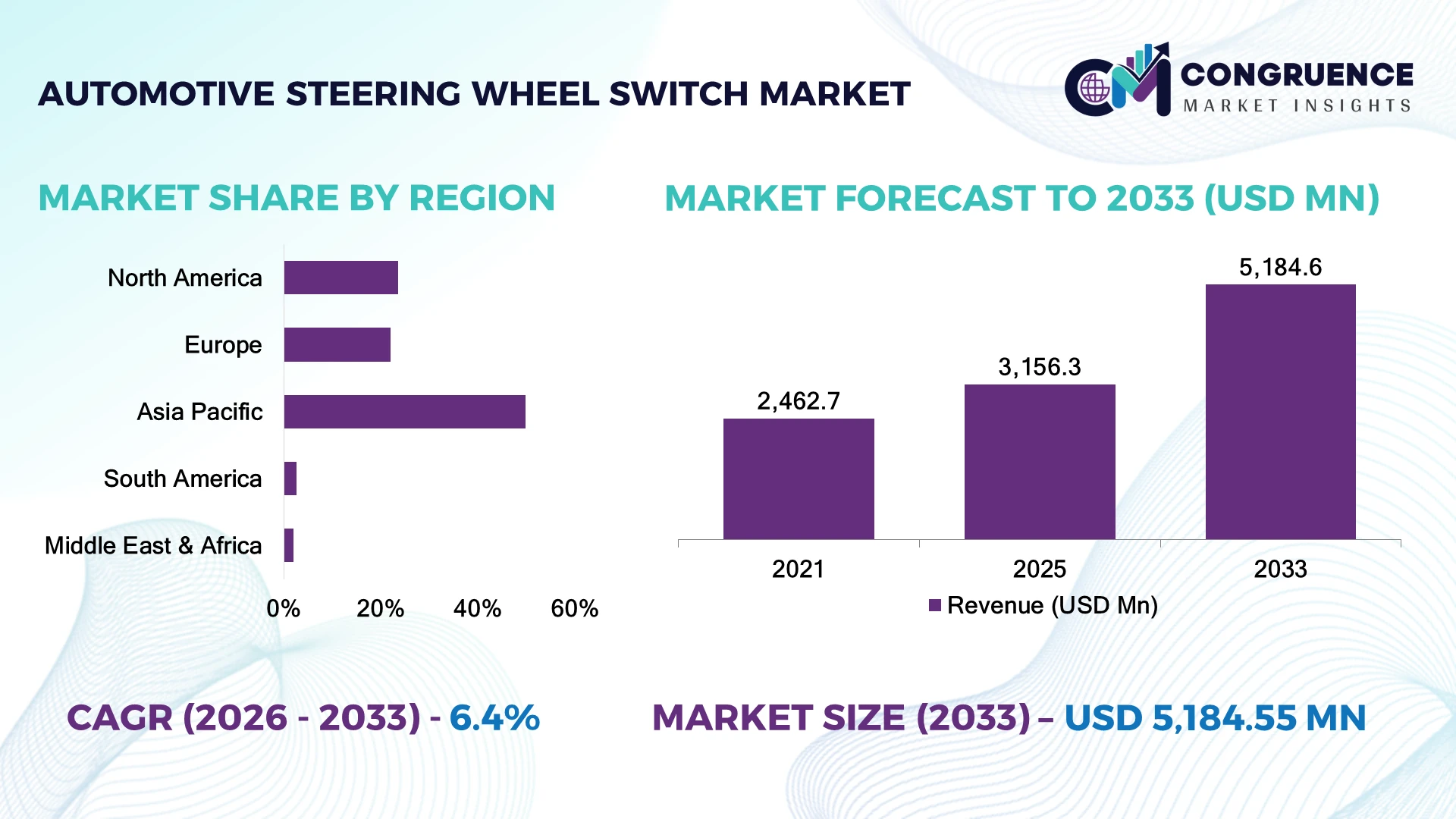
The Global Automotive Steering Wheel Switch Market was valued at USD 3,156.3 Million in 2025 and is anticipated to reach a value of USD 5,184.6 Million by 2033 expanding at a CAGR of 6.4% between 2026 and 2033. Growth is driven by increasing integration of advanced driver assistance systems, multifunction steering wheels, connected vehicle controls, and software-defined vehicle architectures.
China leads the Automotive Steering Wheel Switch market with approximately 36% of global vehicle production, supported by large-scale EV manufacturing, intelligent cockpit investments, and localized automotive electronics supply chains. Compared with Germany, which emphasizes premium human-machine interface engineering, China deploys multifunction steering wheel controls in nearly 79% of newly produced passenger vehicles. Ongoing geopolitical supply-chain diversification is encouraging automotive suppliers to regionalize electronic component manufacturing and strengthen sourcing resilience.
Manufacturers investing in intelligent switch technologies, localized electronics production, and software-integrated cockpit systems are securing long-term competitive advantage.
Market Size & Growth: USD 3,156.3 million (2025) to USD 5,184.6 million (2033) at 6.4% CAGR, driven by connected cockpit technologies and vehicle electrification.
Top Growth Drivers: ADAS integration (+32%), electric vehicles (+29%), digital cockpit adoption (+24%).
Short-Term Forecast: By 2028, switch assembly efficiency improves 18% while production defects decline 15%.
Emerging Technologies: Capacitive touch controls, haptic feedback, and AI-enabled cockpit interfaces accelerate product evolution.
Regional Leaders: Asia-Pacific, Europe, and North America strengthen production through intelligent vehicle platform expansion.
Consumer/End-User Trends: Approximately 74% of newly launched passenger vehicles feature multifunction steering wheel switches.
Pilot/Case Example: A 2026 cockpit automation program reduced assembly time by 14% while improving functional testing accuracy by 19%.
Competitive Landscape: Leading suppliers control approximately 49% market share through automotive electronics expertise and OEM partnerships.
Regulatory & ESG Impact: Smart steering controls improve driver focus, reducing manual dashboard interaction by approximately 21%.
Investment & Funding: More than USD 3.4 billion supports automotive electronics expansion and regional supply-chain localization.
Innovation & Future Outlook: Software-defined controls and integrated haptic interfaces are reshaping next-generation vehicle interiors.
The Automotive Steering Wheel Switch market is advancing across passenger vehicles, electric vehicles, premium mobility platforms, and commercial vehicles requiring intuitive human-machine interaction. Approximately 68% of newly developed digital cockpit platforms incorporate multifunction steering controls to improve operational safety and driver convenience. Continued localization of automotive electronics manufacturing and software-defined vehicle development is strengthening long-term innovation priorities, creating a strong transition into the strategic market discussion.
Automotive steering wheel switches have become a strategic component within intelligent cockpit ecosystems as automakers compete through digital user experience, safety integration, and software-defined vehicle functionality. Supply-chain regionalization and increasing semiconductor localization are encouraging automotive suppliers to invest in advanced switch modules, integrated electronic controls, and scalable production platforms that support next-generation vehicle architectures.
Capacitive touch and haptic-enabled steering wheel switches improve input responsiveness by approximately 24% while reducing mechanical wear by nearly 17% compared with conventional mechanical switches. China leads large-scale deployment through high-volume EV manufacturing, whereas Germany focuses on premium cockpit innovation and advanced ergonomic integration. During the next two to three years, adoption of multifunction steering interfaces integrated with ADAS, voice control, and over-the-air software platforms is expected to accelerate across mainstream and premium vehicle segments.
Automotive suppliers are expanding partnerships with vehicle OEMs, increasing investment in intelligent cockpit electronics, and developing modular steering switch platforms compatible with multiple vehicle architectures. Premium electric vehicles increasingly integrate configurable steering controls that simplify driver interaction while reducing dashboard complexity. Companies combining software integration, ergonomic design, manufacturing flexibility, and functional safety expertise will establish stronger competitive positioning as intelligent vehicle interiors become a defining differentiator across the global automotive industry.
The rapid transition toward software-defined vehicles and intelligent cockpit architectures is driving widespread deployment of multifunction steering wheel switches. Approximately 76% of newly introduced passenger vehicle platforms integrate steering-mounted controls for infotainment, ADAS, and voice assistant functions, while capacitive switch technologies improve response accuracy by nearly 22%. China's expanding EV manufacturing ecosystem and mandatory intelligent safety features are increasing demand for integrated human-machine interface components. This shift enables automakers to reduce dashboard complexity while improving driver ergonomics and operational safety. Automotive suppliers are expanding intelligent switch production, investing in haptic interface technologies, and strengthening partnerships with OEMs to develop configurable steering modules compatible with multiple vehicle platforms. Early software integration has become a decisive competitive differentiator.
Automotive steering wheel switches rely heavily on microcontrollers, sensors, flexible printed circuits, and specialty electronic components, exposing manufacturers to procurement volatility. Electronic components account for approximately 46% of total module manufacturing costs, while premium semiconductor lead times remain nearly 18% above pre-disruption levels for selected automotive-grade devices. Japan's dependence on specialized semiconductor materials continues influencing component sourcing strategies across automotive electronics. These constraints increase inventory costs, delay vehicle production schedules, and compress supplier margins. Manufacturers are reducing exposure through regionalized electronics sourcing, long-term semiconductor procurement agreements, dual-supplier qualification strategies, and modular switch designs that improve component interchangeability without compromising functional performance.
Advanced haptic feedback, programmable steering controls, and touch-sensitive interfaces are creating new value opportunities for automotive steering wheel switch manufacturers. Next-generation haptic technologies improve driver interaction accuracy by approximately 26% while reducing physical switch count by nearly 20%, supporting cleaner cockpit layouts. South Korea's automotive electronics ecosystem continues accelerating investment in software-controlled vehicle interfaces integrated with artificial intelligence and voice recognition. Suppliers are expanding research partnerships, developing configurable steering modules, and investing in over-the-air software compatibility. A unique strategic opportunity lies in transforming steering wheel switches into adaptive control platforms capable of evolving through software updates instead of hardware redesign.
As steering wheel switches become integrated with ADAS, autonomous driving functions, and vehicle software platforms, validation requirements are becoming significantly more demanding. Approximately 34% of automotive electronics suppliers identify software-hardware integration testing as the primary engineering challenge, while functional verification workloads have increased by nearly 24% for intelligent cockpit systems. Germany's premium automotive manufacturers continue raising qualification standards for safety-critical driver interface components. Companies must strengthen cybersecurity validation, software verification, hardware redundancy, and digital simulation capabilities to maintain deployment consistency. Long-term competitiveness increasingly depends on system-level validation expertise rather than standalone switch manufacturing capabilities.
Capacitive Controls Replace Buttons: Capacitive steering wheel switches now represent approximately 31% of newly launched premium vehicle platforms, while mechanical switch usage has declined by nearly 14%. Intelligent cockpit development and stricter driver distraction requirements are accelerating adoption. Suppliers are expanding haptic technologies and automated electronics assembly to improve responsiveness and design flexibility.
Software-Configurable Interfaces Expand: Configurable steering controls improve feature personalization by approximately 23% while reducing physical switch variants by nearly 18%. A notable operational shift is closer collaboration between automotive software developers and component manufacturers, enabling faster feature deployment through software updates instead of extensive hardware redesigns across multiple vehicle models.
Integrated Module Manufacturing Grows: Automotive suppliers are consolidating steering switches, sensors, illumination, and control electronics into unified modules, reducing assembly complexity by approximately 17% and improving production efficiency by nearly 15%. Continued vehicle platform standardization is encouraging manufacturers to automate module assembly and strengthen partnerships with Tier-1 electronics suppliers.
Localized Electronics Production Strengthens: Regional manufacturing expansion has reduced component logistics time by approximately 19% while improving supply continuity by nearly 16%. Automotive manufacturers are restructuring sourcing strategies following semiconductor supply disruptions, prompting steering wheel switch suppliers to establish localized production, dual-sourcing programs, and digitally connected manufacturing operations for greater resilience.
Multifunction steering wheel switch modules account for approximately 63% of the global Automotive Steering Wheel Switch market, reflecting widespread deployment across passenger vehicles, electric vehicles, and premium mobility platforms. Their dominance stems from the ability to consolidate infotainment, voice control, cruise control, and driver assistance functions into a single ergonomic interface, reducing dashboard complexity and wiring requirements. Conventional mechanical switch assemblies continue serving entry-level vehicle platforms due to lower production costs, while illuminated and hybrid touch-enabled switches maintain strategic relevance for mid-range models requiring improved user experience.
Capacitive and haptic steering wheel switches represent the fastest-growing type as software-defined vehicles increasingly require configurable control interfaces. Advanced touch-enabled systems improve driver interaction efficiency by approximately 23% while reducing physical switch count by nearly 19%. Around 41% of newly developed premium steering systems now integrate programmable control layouts supporting over-the-air software updates. Automotive suppliers are expanding investments in haptic technologies, collaborating with cockpit electronics providers, and developing modular switch architectures compatible with multiple vehicle platforms, shifting investment priorities toward intelligent human-machine interface solutions.
A 2026 enterprise assessment from the European Association of Automotive Suppliers indicated that multifunction and touch-enabled steering controls are becoming standard equipment across new intelligent cockpit programs, reflecting accelerating integration of digital driver interfaces.
Passenger vehicles represent approximately 72% of global Automotive Steering Wheel Switch demand due to large-scale production, increasing digital cockpit adoption, and rising integration of advanced driver assistance features. High production volumes, broad model diversity, and consumer demand for convenience functions continue concentrating deployment within this segment. Commercial vehicles remain an important market for durable multifunction steering controls supporting fleet operations, while luxury and performance vehicles continue pioneering premium haptic and programmable interface technologies that later expand into mass-market platforms.
Electric passenger vehicles are the fastest-growing application as manufacturers increasingly integrate centralized cockpit controls with intelligent vehicle operating systems. Steering-mounted multifunction controls reduce dashboard interaction by approximately 21%, while digital interface adoption has increased by nearly 27% across newly launched EV platforms. Suppliers are scaling automated electronics assembly, strengthening OEM partnerships, and integrating steering controls with voice recognition and ADAS functions. Demand is shifting toward software-configurable steering interfaces that improve driver safety, reduce cockpit complexity, and support continuous feature upgrades throughout the vehicle lifecycle.
A 2025 automotive manufacturer survey found that most newly introduced electric passenger vehicle platforms incorporated multifunction steering wheel controls as a primary interface for infotainment, driver assistance, and connected vehicle functions.
Original equipment manufacturers (OEMs) account for approximately 81% of global Automotive Steering Wheel Switch procurement because steering controls are integrated during vehicle assembly and validated as part of complete cockpit systems. Their purchasing decisions emphasize functional safety, platform compatibility, production scalability, and long-term supply reliability. The aftermarket remains strategically relevant for replacement components and vehicle customization, particularly in aging vehicle fleets, but procurement volumes remain significantly lower than factory-installed demand.
Premium electric vehicle OEMs represent the fastest-growing end-user group as intelligent cockpit technologies become a defining competitive differentiator. Approximately 36% of newly awarded steering switch development programs involve configurable digital interfaces, while integrated software validation requirements have increased by nearly 24%. Suppliers are responding through platform-specific customization, joint development agreements with vehicle manufacturers, and flexible production systems supporting multiple vehicle architectures. Future demand is concentrating among OEMs capable of rapidly commercializing software-defined vehicle platforms, encouraging suppliers to prioritize engineering collaboration over component-only supply relationships.
According to a 2026 industry assessment by the International Organization of Motor Vehicle Manufacturers, factory-installed multifunction steering wheel controls continue expanding across newly produced passenger vehicles as OEMs standardize intelligent cockpit technologies and advanced driver assistance integration.
Asia-Pacific accounted for the largest market share at 49.8% in 2025 however, Middle East & Africa is expected to register the fastest growth, expanding at a CAGR of 7.3% between 2026 and 2033.

Advanced Cockpit Electronics Accelerate Platform Integration
North America accounts for approximately 23.6% of the global Automotive Steering Wheel Switch market, driven by strong adoption of connected vehicles, premium pickup trucks, electric vehicles, and advanced driver assistance systems. Vehicle manufacturers increasingly integrate multifunction steering wheel controls with digital cockpit platforms, reducing dashboard complexity while improving driver interaction. More than 68% of newly launched premium vehicle models in the region feature configurable steering wheel controls linked to infotainment and safety systems. Automotive electronics suppliers are expanding localized manufacturing and investing in automated module assembly to strengthen supply-chain resilience and support higher production flexibility across multiple vehicle platforms.
United States Market Outlook: The United States leads the regional market through its large automotive manufacturing base, advanced software-defined vehicle development, and strong automotive electronics ecosystem. Major OEMs continue integrating steering wheel switches with voice assistants, ADAS, and connected vehicle platforms. Approximately 71% of newly introduced electric vehicle platforms incorporate multifunction steering controls as standard equipment, encouraging suppliers to expand intelligent cockpit engineering and localized electronics production.
Premium Vehicle Innovation Drives Interface Evolution
Europe remains a technology-intensive market where premium vehicle manufacturers prioritize ergonomic steering controls, functional safety, and intelligent cockpit integration. Approximately 29% of regional demand originates from luxury and premium vehicle production, encouraging suppliers to develop capacitive touch controls, illuminated switches, and haptic feedback technologies. Platform standardization and increasing software integration are supporting modular steering control systems that simplify manufacturing while improving product consistency across multiple vehicle models.
Germany Market Outlook: Germany dominates the European market through its premium automotive manufacturing capabilities, advanced vehicle electronics expertise, and leadership in intelligent cockpit development. Automotive suppliers collaborate closely with OEM engineering teams to integrate steering wheel controls with digital instrument clusters and autonomous driving functions. Nearly 63% of premium passenger vehicles manufactured in Germany feature advanced multifunction steering wheel interfaces with integrated driver assistance controls.
High-Volume Manufacturing Sustains Market Leadership
Asia-Pacific leads the Automotive Steering Wheel Switch market with approximately 49.8% global share, supported by extensive passenger vehicle manufacturing, electric vehicle production, and vertically integrated automotive electronics supply chains. China, Japan, and South Korea continue expanding intelligent cockpit manufacturing capacity while increasing adoption of multifunction steering wheel technologies across mainstream vehicle segments. Around 76% of regional electric vehicle production incorporates steering-mounted controls integrated with connected infotainment and ADAS platforms. Suppliers are expanding automated electronics production and strengthening OEM partnerships to improve manufacturing efficiency and platform scalability.
China Market Outlook: China remains the largest national market due to its dominant vehicle manufacturing capacity, expanding electric mobility sector, and advanced automotive electronics ecosystem. Domestic suppliers increasingly produce software-compatible steering wheel modules supporting intelligent cockpit architectures. Approximately 79% of newly launched passenger vehicles manufactured in China are equipped with multifunction steering wheel switches, reflecting rapid adoption of connected driving technologies and localized electronics production.
Vehicle Manufacturing Modernization Supports Demand
South America is experiencing steady demand for automotive steering wheel switches as vehicle manufacturers modernize production facilities and increase localization of automotive components. Brazil continues leading regional consumption through passenger vehicle assembly and commercial vehicle production. Approximately 58% of steering wheel switch demand originates from locally assembled passenger vehicles, while suppliers expand partnerships with regional OEMs to improve supply continuity. Infrastructure development and manufacturing investments are strengthening production capability, although selected electronic components remain dependent on imports, influencing production planning and inventory management.
Brazil Market Outlook: Brazil anchors regional market activity through its established automotive manufacturing industry and expanding localization initiatives. Vehicle manufacturers continue increasing adoption of multifunction steering controls across compact passenger vehicles and utility models. Nearly 61% of domestically assembled passenger vehicles now integrate steering-mounted infotainment and communication controls, encouraging component suppliers to strengthen regional engineering and assembly operations.
Automotive Industrialization Expands Component Opportunities
The Middle East & Africa market is advancing through industrial diversification, automotive assembly expansion, and investments in localized vehicle manufacturing. Governments are encouraging higher domestic component production, creating opportunities for steering wheel switch suppliers supporting passenger and commercial vehicle assembly. Approximately 37% of new automotive manufacturing investments include localized electronics and interior component production. Companies are strengthening regional distribution networks while adapting modular steering control systems to support emerging vehicle assembly programs and improve supply-chain responsiveness.
Saudi Arabia Market Outlook: Saudi Arabia represents the region's strongest opportunity through ongoing automotive manufacturing investments, industrial diversification policies, and expanding electric vehicle initiatives. New vehicle assembly facilities are increasing demand for locally sourced interior electronics and multifunction steering components. Approximately 30% of recently announced automotive manufacturing projects include plans for localized automotive component production, encouraging suppliers to establish regional partnerships and technical support capabilities.
Automotive steering wheel switch suppliers including Valeo, Alps Alpine, Tokai Rika, Marquardt, and Leopold Kostal compete for global OEM programs, while regional electronics manufacturers challenge through cost-efficient production and localized engineering support. The top five suppliers collectively control approximately 54% of the global market. Competition centers on functional safety, haptic technologies, software integration, and manufacturing flexibility rather than component pricing alone. Advanced modular switch platforms reduce assembly complexity by nearly 19%, while localized production lowers logistics costs by approximately 14%. Companies are expanding intelligent cockpit portfolios, forming long-term OEM partnerships, integrating electronics with steering modules, and investing in software-defined vehicle compatibility. The competitive shift favors suppliers delivering capacitive interfaces, hands-on detection, and over-the-air update capability as intelligent cockpit architectures become standard. Functional safety certification, OEM validation cycles, and engineering integration remain significant entry barriers. Winning requires software-enabled innovation, manufacturing scale, platform customization, and dependable global delivery.
Valeo
Alps Alpine Co., Ltd.
Tokai Rika Co., Ltd.
Marquardt Group
Leopold Kostal GmbH & Co. KG
Toyodenso Co., Ltd.
LS Automotive Technologies
Preh GmbH
Toyoda Gosei Co., Ltd.
Omron Corporation
Methode Electronics, Inc.
CTS Corporation
Automotive steering wheel switch technology is rapidly evolving from conventional mechanical buttons toward capacitive touch controls, haptic feedback, programmable interfaces, and integrated hands-on detection systems. Around 69% of newly developed premium cockpit platforms now incorporate multifunction electronic steering controls. Advanced haptic systems improve driver input accuracy by approximately 24%, while integrated electronic architectures reduce wiring complexity by nearly 18%, enabling lighter steering modules and simplified vehicle assembly.
Emerging technologies include AI-enabled human-machine interfaces, force-sensing controls, software-defined steering functions, and over-the-air configurable switch modules. Compared with conventional mechanical switches, capacitive and active haptic interfaces improve response consistency by approximately 27% while reducing component wear by nearly 20%. Premium OEMs and intelligent cockpit suppliers gain the greatest competitive advantage because configurable steering controls support faster feature deployment, platform standardization, and greater software flexibility without extensive hardware redesign.
Between 2026 and 2028, steering wheel switches will increasingly function as centralized driver interaction hubs integrating autonomous driving controls, biometric sensing, and digital cockpit software. Suppliers investing in intelligent electronics, cybersecurity validation, and modular software-compatible platforms will strengthen OEM relationships, accelerate vehicle platform integration, and improve long-term competitiveness as software-defined vehicles reshape automotive electronics.
May 2025 Toyoda Gosei developed a new steer-by-wire steering wheel for the Lexus RZ, introducing a compact yoke-style design that reduces steering rotation requirements and enhances driver operability for next-generation steering systems. Source: toyoda-gosei.com
August 2025 Marquardt expanded its intelligent steering wheel platform by integrating Hands-on Wheel Detection, lighting, heating, and electronic control into a single modular system, reducing wiring complexity while supporting functional safety requirements up to ASIL D. Source: marquardt.com
July 2025 Alps Alpine initiated external software license sales for software-defined vehicles while strengthening intelligent automotive electronics capabilities, supporting broader deployment of configurable cockpit control technologies across global vehicle platforms. Source: alpsalpine.com
June 2025 Valeo expanded its steering wheel electronics portfolio with integrated hands-on detection, heating, and steering switch solutions that reduce steering wheel variants from three to one while lowering system costs by approximately 40%. Source: Valeo Product Portfolio.
This report provides a comprehensive assessment of the Automotive Steering Wheel Switch market across product types, vehicle applications, end-user categories, and major global regions. It evaluates multifunction mechanical switches, capacitive touch interfaces, haptic controls, and programmable steering modules deployed across passenger vehicles, commercial vehicles, electric vehicles, and premium automotive platforms. The study also examines intelligent cockpit integration, software-defined vehicle architectures, functional safety requirements, and evolving automotive electronics ecosystems.
The report analyzes deployment patterns, technology adoption, competitive positioning, and manufacturing strategies shaping the industry between 2026 and 2033. More than 70% of intelligent cockpit programs now incorporate multifunction steering controls, highlighting the industry's transition toward integrated driver interfaces. Strategic insights support supplier expansion planning, OEM partnership development, technology investment, product differentiation, localization strategies, and competitive benchmarking while identifying emerging opportunities across connected vehicles, autonomous driving platforms, and next-generation human-machine interface technologies.
| Report Attribute/Metric | Report Details |
|---|---|
|
Market Revenue in 2025 |
USD 3,156.3 Million |
|
Market Revenue in 2033 |
USD 5,184.6 Million |
|
CAGR (2026 - 2033) |
6.4% |
|
Base Year |
2025 |
|
Forecast Period |
2026 - 2033 |
|
Historic Period |
2021 - 2025 |
|
Segments Covered |
By Type
By Application
By End-User
|
|
Key Report Deliverable |
Revenue Forecast, Growth Trends, Market Dynamics, Segmental Overview, Regional and Country-wise Analysis, Competition Landscape |
|
Region Covered |
North America, Europe, Asia-Pacific, South America, Middle East, Africa |
|
Key Players Analyzed |
Valeo, Alps Alpine Co., Ltd., Tokai Rika Co., Ltd., Marquardt Group, Leopold Kostal GmbH & Co. KG, Toyodenso Co., Ltd., LS Automotive Technologies, Preh GmbH, Toyoda Gosei Co., Ltd., Omron Corporation, Methode Electronics, Inc., CTS Corporation |
|
Customization & Pricing |
Available on Request (10% Customization is Free) |




