
Reports
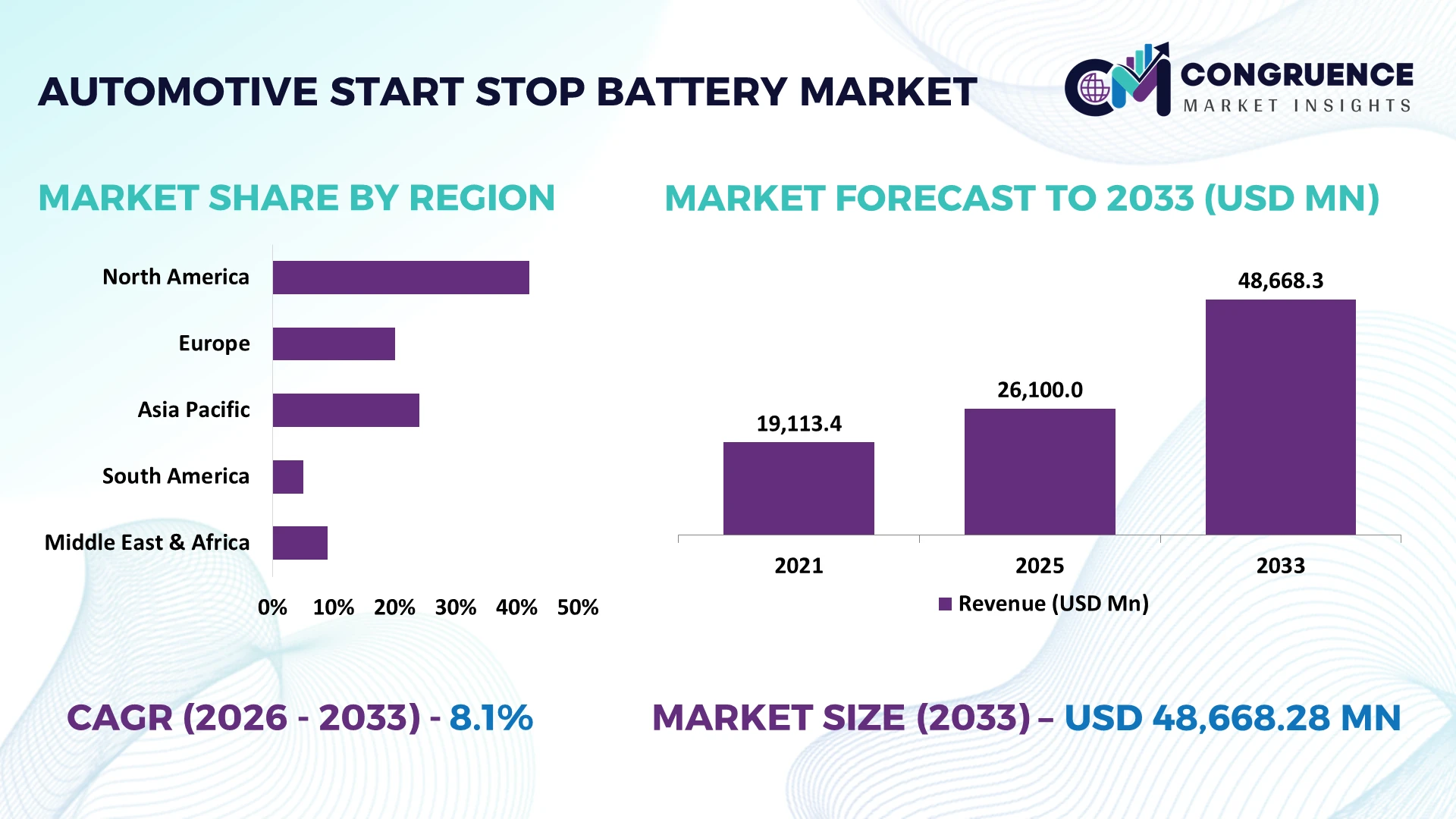
The Global Automotive Start Stop Battery Market was valued at USD 26100 Million in 2025 and is anticipated to reach a value of USD 48668.28 Million by 2033 expanding at a CAGR of 8.1% between 2026 and 2033. Growth is driven by wider AGM and EFB deployment in fuel-efficient ICE and hybrid vehicles, where repeated engine cycling and higher electrical loads require batteries with faster recharge and deeper cycling capability.
Germany represents the dominant country market, accounting for approximately 20.5% of Europe’s automotive start-stop battery market, supported by more than 4 million annual vehicle production and strong OEM integration across Volkswagen, BMW, and Mercedes-Benz. AGM batteries accounted for approximately 82.7% of Europe’s segment, reflecting strong adoption of high-cycle battery technology. France follows as another major European market, while Germany retains a manufacturing-scale advantage. Europe’s automotive transition toward electrification and stricter emissions requirements is further strengthening demand for advanced low-voltage battery systems.
Strategically, suppliers should prioritize AGM capacity, OEM partnerships, localized manufacturing, and recycling infrastructure to capture growth as emissions regulations and vehicle electrification reshape battery procurement.
Market Size & Growth: USD 26.1 billion in 2025 to USD 48.67 billion by 2033 at 8.1% CAGR, supported by AGM adoption and higher electrical loads in modern vehicles.
Top Growth Drivers: 5–8% fuel-saving potential, 82.7% AGM penetration in Europe, and 53% start-stop technology share of European workshop sales value.
Short-Term Forecast: By 2028, advanced AGM deployment is positioned to improve battery cycling durability by approximately 20–30% compared with conventional flooded batteries.
Emerging Technologies: AGM, EFB, lithium-ion auxiliary batteries, and intelligent battery-management systems are increasing charge acceptance and cycling performance by approximately 15–30%.
Regional Leaders: Europe is projected at approximately USD 17.8 billion by 2033, North America at USD 14.5 billion, and Asia Pacific at USD 12.9 billion, with AGM and EFB adoption expanding across OEM platforms.
Consumer/End-User Trends: Passenger vehicles account for approximately 83% of European demand, while replacement requirements are increasing as start-stop-equipped vehicle fleets mature.
Pilot/Case Example: 2024 localized AGM deployment in India demonstrated approximately 150% higher durability than conventional maintenance-free batteries, strengthening the case for advanced battery architectures.
Competitive Landscape: Clarios holds approximately 30–35% of the European automotive battery market, competing with Exide Technologies, GS Yuasa, East Penn Manufacturing, and EnerSys.
Regulatory & ESG Impact: EU circular-economy requirements are increasing pressure for recyclable battery materials and closed-loop recovery, while hybrid vehicles reached approximately 34.5% of European new-car registrations in 2025.
Investment & Funding: More than USD 2.5 billion in UK battery-sector commitments through 2030 are supporting manufacturing expansion, technology development, and regional supply-chain localization.
Innovation & Future Outlook: Next-generation growth is shifting toward lithium-ion auxiliary systems, intelligent battery monitoring, faster charging, higher cycle life, and localized recycling, moving competition toward lifecycle performance and OEM integration.
Demand is concentrating on AGM and EFB batteries for passenger vehicles, hybrid platforms, and light commercial fleets where frequent engine cycling increases battery workload. AGM represented approximately 82.7% of Europe’s start-stop battery segment, demonstrating strong adoption of high-cycle battery technology. Recent product development is moving toward lithium-ion auxiliary systems, intelligent battery-management technologies, and improved charge acceptance. An emerging trend is regional supply-chain localization, as automakers strengthen sourcing near vehicle assembly facilities to reduce logistics exposure and meet evolving emissions and circular-economy requirements, increasing the strategic importance of localized manufacturing and recycling capacity.
Automotive start-stop batteries are becoming strategically important because vehicle electrification is increasing low-voltage electrical loads while emissions regulations continue pushing automakers toward greater efficiency without fully replacing internal-combustion platforms. AGM batteries represented approximately 82.7% of Europe’s start-stop battery segment, demonstrating strong migration toward high-cycle battery architectures. Over the next 2–3 years, procurement priorities will increasingly center on cycle durability, charge acceptance, thermal stability, and compatibility with regenerative braking, directly influencing OEM sourcing and supplier qualification.
Technology selection is reshaping battery economics and performance. AGM batteries deliver substantially higher cycling capability than conventional flooded batteries, while EFB provides a lower-cost option for moderate start-stop applications. India illustrates this transition through localized AGM adoption in passenger-vehicle production, with testing indicating approximately 150% higher durability than conventional maintenance-free batteries. Germany remains highly integrated with advanced OEM battery platforms, while India is expanding domestic manufacturing to reduce dependence on imported technologies. This contrast is creating distinct investment priorities across mature and emerging automotive production markets.
Supply-chain restructuring is becoming equally important as battery regulations increase recycling, material recovery, and traceability requirements. Lead-acid recycling efficiency targets are moving toward 80% by 2030, encouraging manufacturers to strengthen recycling partnerships, localized sourcing, and material tracking. Companies combining advanced battery chemistry, OEM integration, regional manufacturing, and closed-loop recovery will gain stronger control over procurement costs and production continuity, making lifecycle management an increasingly important competitive differentiator.
The shift from conventional flooded batteries toward AGM and EFB architectures is the primary structural driver, with AGM accounting for approximately 82.7% of Europe’s start-stop battery segment. Frequent engine cycling and regenerative braking increase battery workload, accelerating demand for higher cycle durability and faster charge acceptance. India’s localization of AGM technology for domestic vehicle production demonstrates how OEMs are integrating advanced batteries directly into vehicle platforms. Manufacturers are responding through localized production, OEM procurement agreements, and technology partnerships. The strategic advantage is shifting toward batteries engineered for repeated cycling and higher electrical loads rather than conventional replacement applications, strengthening supplier relevance within vehicle-platform development.
Battery manufacturers face structural exposure to raw-material prices, energy costs, and geographically concentrated processing capacity. European producers face additional pressure from imported material dependencies and elevated industrial energy costs, increasing the importance of regional sourcing. Lead-acid recycling efficiency requirements are moving from approximately 75% toward 80% by 2030, adding process-control and compliance costs. These pressures can reduce manufacturing margins when companies lack integrated recycling or long-term material contracts. Manufacturers are responding through multi-year supply agreements, regional recycling networks, and greater recycled-material utilization. The key operational insight is that controlling recovered material streams can reduce procurement volatility while strengthening compliance and production continuity.
Localized manufacturing creates an opportunity to capture OEM demand for batteries engineered around high-cycle vehicle architectures. AGM already represents approximately 82.7% of Europe’s start-stop battery segment, while India is expanding domestic production of advanced AGM technology. Over the next 2–3 years, suppliers can extend into lithium-ion auxiliary systems, intelligent battery monitoring, and higher charge-acceptance designs as vehicle electrical loads increase. Recycling requirements targeting approximately 90% recovery of selected critical metals by 2027 further strengthen the case for integrated recovery ecosystems. Companies investing in regional production, battery diagnostics, and closed-loop partnerships can reduce logistics exposure while creating differentiated lifecycle-service capabilities and stronger OEM relationships.
Future competitiveness depends on managing increasingly complex battery architectures, vehicle electronics, diagnostics, and regulatory requirements simultaneously. Lead-acid recycling efficiency targets are moving toward approximately 80% by 2030, while recovery requirements for selected materials approach 90% by 2027. Battery traceability requirements are also increasing, adding data-management and documentation demands across manufacturing and aftermarket channels. These obligations raise testing, certification, software, and recycling-system complexity. Manufacturers must invest in digital traceability, automated quality controls, engineering capabilities, and recycling partnerships to maintain consistent deployment. The critical operational challenge is synchronizing product engineering with compliance data and recovery infrastructure, particularly for suppliers serving multiple vehicle platforms and international production locations.
AGM Adoption Moves Upmarket: AGM batteries account for roughly 47% of global start-stop battery demand, as higher cycling capability and stronger charge acceptance support vehicles with regenerative braking. European OEM programs are increasing AGM specifications, while suppliers expand premium production capacity and reduce dependence on conventional flooded designs.
Hybrid Integration Reshapes Demand: Hybrid vehicles represented 34.5% of EU new-car registrations in 2025, increasing demand for batteries capable of supporting frequent cycling and auxiliary electrical loads. Germany, France, Italy, and Spain together represented about 72% of EU hybrid registrations, prompting suppliers to strengthen OEM integration and platform-specific battery engineering.
Localized Supply Chains Accelerate: Battery producers are shifting procurement closer to vehicle assembly hubs as logistics volatility and tighter recycling requirements increase supply-chain costs. European recycling targets are moving toward 80% efficiency for lead-acid batteries by 2030, encouraging manufacturers to expand local recycling partnerships, recovered-material sourcing, and traceability systems.
Intelligent Battery Monitoring Expands: Advanced battery-management and diagnostic systems are increasingly integrated into start-stop platforms, improving state-of-charge monitoring and replacement timing by approximately 10–15%. Manufacturers are combining sensors, diagnostics, and battery data with aftermarket service networks, reducing premature replacement and creating additional value through predictive maintenance and fleet-service contracts.
AGM batteries lead the market with an estimated 47% share, supported by superior cycling durability, high charge acceptance, and compatibility with regenerative braking. EFB batteries follow at approximately 36%, retaining strong adoption where automakers require start-stop functionality at lower system cost. Flooded lead-acid remains relevant in conventional and cost-sensitive applications, while lithium-ion and gel batteries occupy specialized positions. Companies are prioritizing AGM capacity expansion and EFB platform optimization, while lithium-ion development is gaining investment for advanced auxiliary applications. The key shift is not simply from older to newer chemistry, but toward matching battery architecture with vehicle electrical intensity.
Lithium-ion represents a smaller base but is gaining strategic attention as higher electrical loads and compact packaging requirements increase. Its adoption remains constrained by cost and thermal-management requirements, while gel batteries retain niche relevance where vibration resistance and maintenance characteristics matter. Manufacturers are therefore balancing mature lead-acid scale with targeted lithium-ion R&D, partnerships, and premium product portfolios.
Passenger Cars represent the leading application, accounting for approximately 62% of start-stop system demand and forming the largest deployment base for AGM and EFB batteries. High production volumes, widespread stop-start functionality, and growing electrical loads sustain demand across Germany, China, Japan, and India. Commercial Vehicles hold a smaller but operationally intensive position because frequent routes increase cycling requirements. Companies are tailoring battery specifications to vehicle duty cycles, expanding OEM fitment programs, and increasing aftermarket availability to capture replacement demand as installed fleets mature.
Hybrid Vehicles are the fastest-expanding application, supported by increasing electrified powertrain penetration and greater dependence on auxiliary battery systems. Start-Stop Systems remain fundamental across conventional and hybrid architectures, while Micro-Hybrid Vehicles provide a cost-efficient transition path where full electrification is economically less practical. Suppliers are responding with higher-cycle AGM products, lithium-ion development, and integrated battery-management systems.
Automotive OEMs represent the dominant end-user group, estimated at approximately 55% of market demand, because factory-fit battery specifications determine technology selection across new vehicle platforms. OEM procurement increasingly favors AGM and EFB products engineered around start-stop frequency, regenerative braking, and electrical load profiles. The Automotive Aftermarket remains critical for replacement volumes as installed fleets age, while Passenger Vehicle Owners increasingly encounter battery replacement decisions tied to electronic diagnostics. Manufacturers are responding through long-term OEM contracts, platform-specific engineering, and expanded authorized replacement networks.
Fleet Operators represent the fastest-growing strategic buyer group as high vehicle utilization increases battery cycling intensity and makes downtime more costly. Commercial Vehicle Owners remain important in delivery, logistics, and service fleets where reliability directly affects operating schedules. Suppliers are targeting these customers through fleet contracts, predictive diagnostics, bulk pricing, and customized replacement programs. The emerging competitive advantage is shifting toward lifecycle service capability rather than battery-unit sales alone.
North America accounted for the largest market share at 28% in 2025 however, Asia-Pacific is expected to register the fastest growth, expanding at a CAGR of 9.2% between 2026 and 2033.
OEM Electrification Supports Premium Battery Demand
North America represents approximately 28% of global automotive start-stop battery demand, supported by high passenger-vehicle ownership, expanding hybrid deployment, and established aftermarket distribution. The United States concentrates most regional demand, while Mexico strengthens its role as an automotive manufacturing and component-export hub. AGM adoption is increasing across premium and hybrid platforms as manufacturers accommodate higher electrical loads and regenerative braking. Battery suppliers are expanding OEM agreements and regional distribution rather than relying solely on replacement sales. More than 40% of newly produced light vehicles in major North American manufacturing programs increasingly incorporate enhanced electrical-management functions, strengthening demand for higher-cycle batteries. The operational priority is shifting toward platform-specific battery specifications, localized inventory, and faster replacement diagnostics, particularly as vehicle electronics increase service complexity.
United States Market Outlook: The United States remains the region’s principal demand center, supported by large vehicle production, extensive aftermarket infrastructure, and strong hybrid penetration. Battery manufacturers are prioritizing OEM qualification and nationwide distribution coverage. The country’s large installed vehicle base also creates recurring replacement demand, strengthening the role of service networks and fleet-oriented battery supply agreements.
Regulation Accelerates High-Cycle Technology Adoption
Europe remains a technology-intensive automotive battery market, with approximately 83% AGM penetration within the regional start-stop segment. Germany, France, Italy, and Spain account for a substantial share of vehicle production and replacement demand, while strict emissions requirements continue encouraging start-stop and hybrid architectures. European manufacturers are increasing battery-system integration with regenerative braking and sophisticated energy-management controls. Recycling requirements are also reshaping procurement, with lead-acid recycling efficiency targets approaching 80% by 2030. Companies are responding through localized manufacturing, recovered-material sourcing, and closed-loop partnerships. The non-obvious shift is that compliance infrastructure is becoming a supply-chain asset, allowing suppliers with recycling capabilities and traceability systems to strengthen OEM relationships while reducing exposure to primary raw-material volatility.
Germany Market Outlook: Germany is the leading European automotive manufacturing hub and a major center for advanced start-stop battery integration. Production exceeding 4 million vehicles annually provides substantial OEM demand, while Volkswagen, BMW, and Mercedes-Benz support sophisticated battery specifications. Suppliers are emphasizing AGM capacity, engineering partnerships, and localized production to align battery performance with premium vehicle electrical architectures.
Manufacturing Scale Drives Localization
Asia-Pacific combines the largest automotive manufacturing base with rapidly expanding start-stop and hybrid deployment, giving the region approximately 34% of global demand. China dominates vehicle production scale, while Japan, South Korea, and India contribute advanced battery engineering and expanding domestic manufacturing. More than 30 million vehicles are produced annually across major Asian manufacturing economies, creating substantial OEM and replacement-battery requirements. India is increasing localized AGM production, while Chinese manufacturers are integrating advanced battery-management systems into increasingly electrified vehicle platforms. Suppliers are responding through joint ventures, local plants, OEM qualification programs, and expanded recycling networks. The strategic advantage increasingly comes from proximity to vehicle assembly rather than export-only models, reducing logistics exposure and improving response times for high-volume automotive customers.
China Market Outlook: China provides the region’s strongest manufacturing platform, supported by the world’s largest automotive production ecosystem and extensive domestic component supply chains. Vehicle production exceeding 30 million units annually creates significant battery-platform demand. Suppliers are increasing localization, automated production, and OEM partnerships to serve high-volume passenger and hybrid vehicle programs while reducing dependence on imported components.
Replacement Demand Supports Regional Expansion
South America is primarily an aftermarket-driven market, with Brazil accounting for the largest share of regional automotive activity and battery consumption. Passenger vehicles represent the core demand base, while commercial fleets generate higher cycling intensity because of frequent urban and intercity operation. Start-stop penetration remains below mature European levels, creating a gradual transition from flooded lead-acid toward EFB and AGM technologies. Brazil’s automotive manufacturing base supports localized battery assembly and distribution, while currency volatility and imported-component exposure remain operational constraints. Manufacturers are responding through regional production, dealer partnerships, and broader aftermarket inventory. The strongest opportunity lies in upgrading replacement demand as newer vehicle generations enter the installed fleet, rather than depending solely on rapid technology conversion.
Brazil Market Outlook: Brazil is the region’s principal automotive manufacturing and aftermarket center, producing more than 2 million vehicles annually. Its extensive passenger-vehicle fleet creates recurring replacement demand, while expanding availability of start-stop-equipped models is increasing requirements for EFB and AGM batteries. Manufacturers are strengthening local distribution and production to manage logistics costs and currency exposure.
Fleet Modernization Supports Premium Battery Uptake
Middle East & Africa demand is shaped by vehicle modernization, commercial fleets, premium passenger vehicles, and harsh operating environments. Gulf markets show stronger adoption of advanced battery technologies because high temperatures and intensive air-conditioning loads increase electrical-system stress. Saudi Arabia and the United Arab Emirates are important demand centers, while South Africa provides the region’s strongest automotive manufacturing base. AGM batteries are gaining relevance in premium and start-stop-equipped vehicles, with advanced battery systems commanding a growing share of replacement demand. Suppliers are expanding distributor networks, improving heat-resistant product designs, and strengthening fleet partnerships. The operational differentiator is thermal durability: battery suppliers that engineer products for extreme temperatures can reduce premature replacement and improve fleet uptime.
Saudi Arabia Market Outlook: Saudi Arabia represents a strategically important automotive aftermarket because high temperatures, extensive vehicle usage, and substantial commercial fleets increase battery stress. The country’s vehicle electrification and mobility-modernization initiatives are also increasing interest in advanced electrical architectures. Suppliers are strengthening distribution coverage and emphasizing high-temperature AGM and EFB products for demanding operating conditions.
Clarios, Exide Technologies, GS Yuasa, East Penn Manufacturing, and EnerSys compete across OEM and aftermarket channels, while regional battery manufacturers challenge them through cost-focused production and localized distribution. The top five players collectively account for approximately 35–40% of the organized global market, leaving substantial space for regional suppliers. Competition centers on battery durability, charge acceptance, manufacturing scale, replacement availability, and OEM qualification. AGM products command premium positioning, with advanced technologies typically carrying 15–30% higher unit pricing than conventional flooded batteries. Companies are expanding localized plants, forming OEM partnerships, integrating recycling operations, and developing battery-monitoring systems to differentiate beyond price. The competitive shift is moving from basic lead-acid manufacturing toward platform-specific engineering, closed-loop material management, and intelligent diagnostics. Entry barriers remain significant because automotive qualification cycles, recycling infrastructure, quality certification, and large-scale production require substantial capital. Winning suppliers therefore need technology credibility, reliable supply, OEM integration, and cost-efficient regional manufacturing.
Clarios
Exide Technologies
GS Yuasa Corporation
East Penn Manufacturing Co.
EnerSys
Panasonic Holdings Corporation
Robert Bosch GmbH
FIAMM Energy Technology
Amara Raja Energy & Mobility
Leoch International Technology
Hankook & Company
Furukawa Battery Company
Sebang Global Battery
Banner Batteries
AGM and EFB batteries remain the core technologies for start-stop vehicles, with AGM delivering higher cycling durability and charge acceptance under regenerative braking. AGM can provide up to 4x the cycle life of conventional batteries, while EFB offers a lower-cost architecture for moderate cycling loads. Advanced AGM deployment is strongest in premium and high-electrical-load platforms, improving battery reliability and reducing replacement frequency. Companies are integrating battery-management diagnostics to optimize state-of-charge and charging profiles.
Emerging systems combine high-dynamic-charge-acceptance materials, carbon additives, improved separators, and intelligent monitoring. GS Yuasa’s renewed ECO.R Revolution reported 108% improved actual-use durability and 150% faster charging in proprietary testing. Compared with legacy flooded batteries, AGM technology can deliver more than 2x cycle life, giving OEMs and fleet operators stronger uptime economics. Digital diagnostics further support predictive replacement, inventory planning, and service-network efficiency.
From 2026 to 2028, lithium-ion auxiliary batteries, sodium-ion low-voltage systems, and connected diagnostics will move from targeted development toward broader platform integration. Adoption will concentrate where electrical loads, packaging constraints, and hybrid architectures justify higher technology costs. Suppliers with OEM validation, localized production, and advanced recycling capabilities will benefit most as automakers demand faster charging, longer service life, and traceable battery performance across platforms.
April 2024 Clarios secured an automaker contract for AGM batteries, delivering improved rechargeability and up to 80% lower CO2 emissions versus AGM. The North American launch strengthens OEM integration and positions charge-acceptance technology as a competitive differentiator.
January 2025 Exide Technologies launched the EK013 AGM auxiliary battery, extending aftermarket coverage to five million European vehicles. The 12V, 1.2Ah unit supports drivetrain electronics and electric oil pumps, expanding replacement portfolio and strengthening workshop coverage.
May 2025 GS Yuasa renewed its ECO.R Revolution series for idling-stop vehicles, reporting 108% improved durability and 150% faster charging in tests. The July launch strengthens positioning around longer service intervals, rapid recharge, and high-cycle performance.
March 2026 ACEA reported hybrid-electric vehicles captured 38.7% of EU new-car registrations in January-February, while battery-electric vehicles reached 18.8%. The shift toward electrified platforms increases requirements for robust 12V auxiliary systems and advanced start-stop architectures.
The report covers Automotive Start Stop Battery technologies across AGM, EFB, Flooded Lead-Acid, Lithium-Ion, and Gel Batteries, with application analysis spanning Passenger Cars, Commercial Vehicles, Hybrid Vehicles, Start-Stop Systems, and Micro-Hybrid Vehicles. End-user coverage includes Automotive OEMs, Automotive Aftermarket, Passenger Vehicle Owners, Fleet Operators, and Commercial Vehicle Owners. The analysis evaluates technology adoption, deployment intensity, battery performance, replacement patterns, and shifting procurement priorities.
Regional coverage includes North America, Europe, Asia-Pacific, South America, and Middle East & Africa, with country-level analysis focused on major manufacturing and demand centers. The report examines advanced charge-acceptance systems, battery-management technologies, localized production, recycling integration, and emerging auxiliary battery architectures. Company-level analysis covers 10–14 major participants, supporting investment planning, capacity expansion, OEM partnership decisions, competitive positioning, and technology strategy through 2026–2033.
| Report Attribute/Metric | Report Details |
|---|---|
Market Revenue in 2025 | USD 26100 Million |
Market Revenue in 2033 | USD 48668.28 Million |
CAGR (2026 - 2033) | 8.1% |
Base Year | 2025 |
Forecast Period | 2026 - 2033 |
Historic Period | 2021 - 2025 |
Segments Covered | By Type
By Application
By End-User
|
Key Report Deliverable | Revenue Forecast, Growth Trends, Market Dynamics, Segmental Overview, Regional and Country-wise Analysis, Competition Landscape |
Region Covered | North America, Europe, Asia-Pacific, South America, Middle East, Africa |
Key Players Analyzed | Clarios, Exide Technologies, GS Yuasa Corporation, East Penn Manufacturing Co., EnerSys, Panasonic Holdings Corporation, Robert Bosch GmbH, FIAMM Energy Technology, Amara Raja Energy & Mobility, Leoch International Technology, Hankook & Company, Furukawa Battery Company, Sebang Global Battery, Banner Batteries |
Customization & Pricing | Available on Request (10% Customization is Free) |




