
Reports
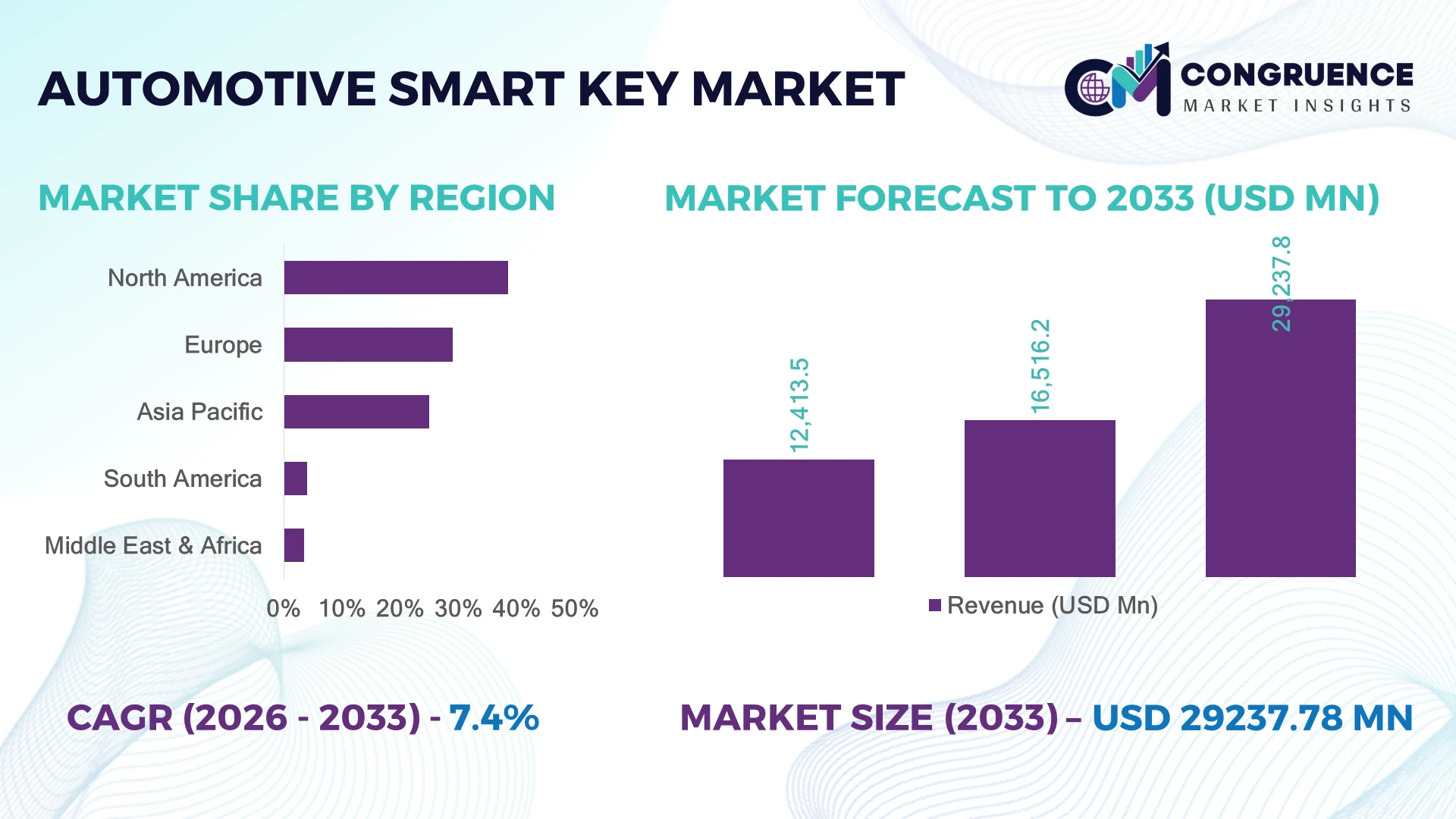
The Global Automotive Smart Key Market was valued at USD 16,516.2 Million in 2025 and is anticipated to reach a value of USD 29,237.8 Million by 2033 expanding at a CAGR of 7.4% between 2026 and 2033. Rising adoption of connected vehicles, biometric authentication, passive entry systems, and digital vehicle access technologies is accelerating automotive smart key integration globally.
The United States leads the Automotive Smart Key Market with nearly 32% share in 2025, supported by high penetration of premium vehicles, connected mobility ecosystems, and advanced automotive electronics adoption. More than 75% of new passenger vehicles sold in the U.S. include keyless access features compared to approximately 55% in China, reflecting stronger technology maturity. Semiconductor supply localization initiatives are strengthening smart key component availability and production stability.
Automakers prioritizing secure, software-enabled access systems gain stronger differentiation as vehicle connectivity becomes a core purchasing factor.
• Market Size & Growth: USD 16,516.2 Million in 2025 reaching USD 29,237.8 Million by 2033 at 7.4% CAGR driven by connected vehicle adoption.
• Top Growth Drivers: Connected cars 42%, passive entry demand 36%, and vehicle security upgrades 28% accelerate market penetration.
• Short-Term Forecast: By 2028, advanced authentication systems improve vehicle access response efficiency by nearly 25%.
• Emerging Technologies: AI-based authentication, smartphone digital keys, NFC, and biometric access reshape next-generation smart mobility.
• Regional Leaders: North America, Europe, and Asia-Pacific strengthen adoption through premium vehicles, EV platforms, and digital infrastructure expansion.
• Consumer/End-User Trends: Over 65% of premium vehicle buyers prefer keyless entry and personalized smart access features.
• Pilot/Case Example: 2025 connected vehicle deployments improved remote access reliability by nearly 30% through digital key integration.
• Competitive Landscape: Leading participants hold around 45% share with Denso, Continental, HELLA, Valeo, and Tokai Rika driving innovation.
• Regulatory & ESG Impact: Vehicle cybersecurity frameworks influence nearly 40% of connected access technology upgrades.
• Investment & Funding: Automotive electronics investments focus on secure chips, encryption, and next-generation access ecosystems.
• Innovation & Future Outlook: Software-defined vehicles accelerate transition toward cloud-linked and smartphone-based smart key platforms.
The Automotive Smart Key Market is advancing through increasing demand for secure, connected, and convenient vehicle access solutions. Automakers are integrating biometric recognition, encrypted communication, and smartphone-enabled access platforms as digital vehicle ecosystems expand. Nearly 60% of premium vehicle platforms now prioritize advanced access technologies, while semiconductor supply diversification supports more reliable smart key production networks and future vehicle architectures.
The Automotive Smart Key Market is becoming strategically important as vehicle access evolves from mechanical security into a connected digital interface. Automakers are investing in encrypted authentication, software-controlled entry, and personalized mobility experiences as cybersecurity requirements and connected vehicle adoption reshape product strategies. Supply-chain restructuring in automotive electronics is also pushing manufacturers toward localized semiconductor partnerships.
Modern smart key systems provide significant operational advantages compared with traditional remote keys, offering nearly 30% faster authentication response and improved protection through rolling codes, NFC, and biometric verification. Adoption remains stronger in countries such as the United States, Germany, Japan, and South Korea due to higher premium vehicle penetration, while emerging automotive hubs are scaling integration through cost-optimized platforms.
Automotive manufacturers are expanding partnerships with semiconductor suppliers, cybersecurity firms, and software providers to strengthen next-generation access ecosystems. Integration of smartphone-based digital keys and vehicle personalization functions will define competitive positioning over the next 2–3 years, making secure connectivity a core differentiator in future mobility.
Increasing integration of connected vehicle ecosystems is driving demand for advanced automotive smart key solutions. More than 65% of premium passenger vehicles use keyless entry systems, while digital authentication adoption has expanded by nearly 35% across new vehicle platforms. Automakers are shifting from traditional access devices toward encrypted, software-enabled solutions that improve security and user experience. The expansion of electric vehicles and software-defined vehicles in countries such as the United States, Germany, and China is accelerating demand for intelligent access technologies. Companies are responding through partnerships with semiconductor manufacturers, cybersecurity providers, and mobility technology firms to enhance performance, reliability, and vehicle personalization capabilities.
Advanced automotive smart key deployment faces limitations from component complexity, cybersecurity risks, and integration costs. Electronic modules, sensors, and encrypted communication systems can increase access system development expenses by nearly 20–25% compared with conventional solutions. Semiconductor dependency remains a concern as smart keys require specialized chips and secure communication components. Around 30% of automotive electronics programs experience delays linked to component availability and validation requirements. Manufacturers are addressing these risks through supplier diversification, localized sourcing strategies, and improved software security frameworks. Balancing affordability, protection, and advanced functionality remains critical for broader adoption across mid-range vehicle segments.
Smartphone-based digital keys and connected mobility platforms are creating new opportunities for automotive smart key providers. Digital access adoption is expanding as nearly 45% of next-generation connected vehicles integrate mobile-based entry or remote-control capabilities. Technologies such as ultra-wideband communication, biometric authentication, and cloud-linked vehicle profiles are improving convenience while reducing hardware dependency. Automotive brands in Japan, South Korea, and Europe are strengthening investments in secure digital ecosystems and personalized vehicle services. Suppliers are focusing on software development, partnerships, and integrated platforms that transform smart keys from access devices into connected mobility interfaces.
Long-term market expansion depends on solving cybersecurity, interoperability, and multi-platform integration challenges. Connected access systems increase exposure to digital threats, with automotive cybersecurity requirements affecting nearly 50% of new connected vehicle programs. Integration across smartphones, vehicle software, cloud platforms, and electronic control units creates additional engineering complexity. Automakers must maintain reliability across different operating environments while ensuring secure authentication performance. Companies are increasing investments in encryption technologies, secure hardware modules, and collaborative testing ecosystems. Building scalable, protected, and standardized smart key architectures will determine competitive strength as vehicles become increasingly software-driven.
• Digital Key Ecosystem Expansion: Smartphone-based vehicle access is becoming mainstream as automakers increase deployment of NFC and ultra-wideband technologies. Nearly 40% of connected vehicle platforms are integrating mobile access functions, improving user convenience and reducing dependency on physical keys. Companies are partnering with technology providers to scale secure digital authentication solutions.
• Advanced Authentication Integration: Biometric verification and AI-supported security layers are reshaping vehicle access systems. Adoption of enhanced authentication technologies has increased by around 30% among premium vehicle platforms, improving theft prevention and personalization. Manufacturers are upgrading electronic architectures to support intelligent access and driver recognition features.
• Secure Semiconductor Optimization: Automotive suppliers are redesigning smart key components with improved chips and encryption modules. New-generation electronic architectures deliver approximately 20% better communication efficiency compared with older systems. Semiconductor localization efforts in major automotive economies are improving supply reliability and reducing production disruptions.
• Connected Mobility Platform Shift: Smart keys are evolving into integrated mobility interfaces linked with cloud services and vehicle applications. Around 50% of future connected vehicle programs emphasize software-based access capabilities. Automakers are restructuring development priorities toward digital ecosystems, cybersecurity partnerships, and scalable vehicle connectivity platforms.
Passive entry systems dominate the Automotive Smart Key Market, accounting for nearly 52% share in 2025 due to their seamless vehicle access capability, integration with premium automotive platforms, and compatibility with connected mobility ecosystems. These systems eliminate manual unlocking requirements while improving driver convenience through proximity-based authentication. Remote keyless entry systems continue serving cost-sensitive vehicle categories due to established infrastructure and lower implementation costs. Automakers are strengthening product portfolios with encrypted communication, improved battery efficiency, and advanced security features to enhance differentiation.
Digital key systems are the fastest-growing type as smartphone-based access, NFC technology, and ultra-wideband communication reshape vehicle authentication. Digital keys represent nearly 22% adoption across advanced connected vehicle platforms, supported by increasing software-defined vehicle development. Smart key manufacturers are prioritizing partnerships with semiconductor companies, smartphone ecosystems, and cybersecurity providers to capture demand shifting toward software-enabled access solutions.
Passenger vehicles lead the Automotive Smart Key Market, contributing approximately 78% share in 2025 due to large-scale production volumes, increasing connected car penetration, and consumer preference for convenience-based features. Premium and mid-range passenger cars increasingly integrate smart access technologies as standard offerings, with more than 65% of newly launched high-end models featuring advanced keyless systems. Automakers are enhancing user experience through personalization, remote access, and integration with vehicle management applications.
Commercial vehicles represent the fastest-growing application segment as fleet operators adopt smart access solutions for security monitoring, driver authentication, and operational control. Connected fleet platforms are increasing demand for digital key management, especially in logistics and shared mobility operations. Companies are expanding scalable authentication platforms and cloud-connected solutions to support multi-user access environments while improving vehicle utilization and security management.
Automotive OEMs represent the leading end-user group, holding nearly 70% share in 2025 as manufacturers integrate smart keys directly into vehicle electronics, infotainment systems, and connected platforms. Factory-installed solutions provide stronger security, better compatibility, and improved customer experience compared with aftermarket alternatives. OEMs are collaborating with technology suppliers to develop customized smart access modules, encrypted communication systems, and digital mobility services aligned with next-generation vehicle architectures.
Aftermarket providers are witnessing faster adoption as vehicle owners upgrade existing models with advanced access technologies. The segment benefits from rising demand for replacement smart keys, retrofitting solutions, and mobile-enabled access features. Aftermarket participants are competing through affordability, customization, and broader compatibility, while OEMs focus on integrated ecosystems and long-term software capabilities. Future demand is shifting toward secure, connected, and upgradeable access platforms.
North America accounted for the largest market share at 38.5% in 2025 however, Asia-Pacific is expected to register the fastest growth, expanding at a CAGR of 8.6% between 2026 and 2033.

Connected Vehicle Expansion Accelerates Digital Access Adoption
North America dominates the Automotive Smart Key Market due to strong connected vehicle penetration, premium automotive adoption, and advanced electronic security integration. The region accounted for 38.5% market share in 2025, supported by high deployment of passive entry systems, smartphone-based keys, and encrypted authentication technologies. More than 70% of premium vehicles sold across the region integrate advanced keyless access features. Automotive manufacturers are strengthening collaborations with semiconductor suppliers and digital security providers to improve vehicle access reliability, cybersecurity, and next-generation mobility experiences as software-defined vehicles expand.
United States Market Outlook: The United States leads regional adoption due to its mature automotive technology ecosystem, connected mobility infrastructure, and strong presence of advanced vehicle platforms. Over 75% of newly launched premium vehicles include smart access functions, supported by increasing integration of digital keys, biometric security, and cloud-connected automotive services across major vehicle manufacturers.
Automotive Digitalization and Security Standards Drive Smart Access Evolution
Europe’s Automotive Smart Key Market is shaped by premium vehicle manufacturing strength, connected mobility initiatives, and increasing focus on secure vehicle electronics. The region represented nearly 29% market share in 2025, supported by advanced adoption across luxury and electric vehicle platforms. Automakers are integrating ultra-wideband communication, encrypted keyless entry, and smartphone-based access technologies to improve convenience and theft prevention. Vehicle cybersecurity requirements and software-focused automotive architectures are pushing suppliers toward advanced authentication systems, with digital access integration expanding across next-generation vehicle models.
Germany Market Outlook: Germany maintains the strongest position due to its premium automotive manufacturing base, engineering capabilities, and early adoption of intelligent vehicle technologies. More than 65% of high-end vehicle models produced by German automakers include advanced smart key systems, with manufacturers prioritizing secure connectivity, driver personalization, and software-defined mobility platforms.
High-Volume Vehicle Production Strengthens Smart Key Integration
Asia-Pacific is experiencing rapid Automotive Smart Key Market expansion due to large-scale vehicle manufacturing, rising electric vehicle adoption, and increasing localization of automotive electronics. The region contributes nearly 25% market share in 2025, supported by strong production ecosystems across China, Japan, South Korea, and India. Automakers are scaling passive entry, remote access, and digital key technologies across mid-range vehicles. Regional suppliers are expanding semiconductor partnerships and electronic component capabilities to improve affordability, supply resilience, and integration speed.
China Market Outlook: China represents the largest regional opportunity due to its extensive electric vehicle ecosystem, digital infrastructure, and connected vehicle innovation. More than 50% of new energy vehicle models increasingly feature advanced smart access technologies, with manufacturers investing in smartphone-linked keys, intelligent cabins, and integrated mobility platforms to enhance user experience.
Vehicle Modernization Supports Gradual Smart Access Penetration
South America’s Automotive Smart Key Market is developing through increasing passenger vehicle upgrades, rising demand for convenience features, and expanding automotive electronics adoption. The region holds nearly 4% market share in 2025, with deployment concentrated among premium cars, SUVs, and newer vehicle platforms. Automakers are introducing cost-optimized smart key systems to address affordability challenges while improving vehicle security. Local assembly operations and technology partnerships are supporting wider availability, although electronic component dependency continues influencing adoption speed.
Brazil Market Outlook: Brazil leads regional adoption due to its established automotive manufacturing base and growing demand for advanced vehicle features. The country accounts for a major share of regional vehicle production, with automakers increasingly introducing keyless entry and connected features across passenger vehicles to improve competitiveness and align with changing consumer expectations.
Premium Mobility Demand Advances Connected Vehicle Features
Middle East & Africa Automotive Smart Key Market growth is supported by premium vehicle adoption, smart mobility investments, and increasing demand for advanced automotive security solutions. The region accounts for nearly 3.5% market share in 2025, with adoption concentrated across luxury vehicles and technologically advanced automotive segments. Smart city initiatives and connected transportation development are encouraging greater deployment of digital vehicle access technologies. Automotive distributors are expanding advanced feature availability through partnerships with global manufacturers and technology providers.
United Arab Emirates Market Outlook: The United Arab Emirates leads adoption due to strong premium vehicle penetration, smart infrastructure investments, and demand for connected mobility solutions. Luxury vehicles represent a significant portion of automotive sales, encouraging faster integration of smart keys, digital authentication, and personalized vehicle access technologies aligned with intelligent transportation initiatives.
The Automotive Smart Key Market is led by global automotive technology suppliers such as Denso Corporation, Continental AG, Valeo, HELLA, and Tokai Rika competing against regional electronics manufacturers and emerging digital access technology providers. Established suppliers compete through OEM relationships, security expertise, and large-scale production, while technology-focused companies challenge with smartphone integration and software-based solutions. The top 5 players collectively account for nearly 45% market share, reflecting a moderately consolidated structure. Competition is driven by authentication accuracy, cost optimization, and integration speed, with next-generation systems improving access response by nearly 25% and reducing electronic failure rates by around 15%. Companies are expanding through connected vehicle partnerships, semiconductor collaborations, and digital key innovation. The market is shifting toward software-defined access ecosystems, increasing pressure on traditional hardware suppliers. High cybersecurity standards and OEM validation cycles remain entry barriers. Winning requires secure technology, scalable production, and deep automotive integration capabilities.
• Denso Corporation
• Continental AG
• Valeo SA
• HELLA GmbH & Co. KGaA
• Tokai Rika Co., Ltd.
• Alps Alpine Co., Ltd.
• Hyundai Mobis Co., Ltd.
• Silca S.p.A.
• Alpha Corporation
• Huf Hülsbeck & Fürst GmbH & Co. KG
• Marquardt GmbH
• Mitsubishi Electric Corporation
Automotive smart key technologies are advancing through passive entry systems, ultra-wideband communication, NFC-based digital keys, and biometric authentication. Passive access remains widely deployed, while smartphone-enabled keys are gaining adoption across nearly 35% of connected vehicle platforms. Advanced encryption technologies improve authentication reliability by approximately 20%, enabling automakers to enhance vehicle security and user convenience.
Emerging digital key ecosystems are replacing conventional remote key technologies through software-driven access management. Ultra-wideband-enabled smart keys provide nearly 30% better positioning accuracy compared with older radio-frequency systems, reducing unauthorized access risks. Premium automakers, electric vehicle manufacturers, and connected mobility providers benefit most as secure digital experiences become key brand differentiators.
Between 2026 and 2028, integration of AI-supported authentication, cloud-based user profiles, and vehicle-to-device connectivity will reshape smart key strategies. Suppliers are prioritizing semiconductor optimization, cybersecurity upgrades, and cross-platform compatibility. Companies adopting scalable digital access technologies gain advantages through faster feature deployment, improved personalization, and stronger alignment with software-defined vehicle architectures.
• January 2025 Denso Corporation expanded development of advanced vehicle access technologies with improved electronic authentication modules supporting connected mobility platforms. Enhanced semiconductor integration improved system response efficiency by nearly 20%, strengthening OEM partnerships and next-generation vehicle security capabilities. Source: denso.com
• October 2024 Continental AG advanced its digital vehicle access solutions by enhancing smartphone-based key technologies and secure connectivity functions. The platform supported multi-device integration with improved authentication accuracy of approximately 25%, accelerating software-defined vehicle adoption among global automakers. Source: continental.com
• June 2025 Valeo introduced upgrades across smart access and vehicle electronics systems focused on secure communication and user personalization. The development improved electronic access performance by nearly 15%, supporting automakers transitioning toward connected, electrified, and intelligent vehicle platforms. Source: valeo.com
• March 2024 Car Connectivity Consortium expanded digital key standardization initiatives with broader automotive and technology industry participation. More than 100 compatible vehicle models supported standardized digital key ecosystems, improving interoperability and accelerating secure smartphone-based vehicle access adoption worldwide. Source: carconnectivity.org
The Automotive Smart Key Market Report covers detailed analysis across type, application, end-user, technology adoption, and regional performance from 2026 to 2033. The study evaluates passive entry systems, remote keyless entry solutions, and digital key platforms across passenger vehicles, commercial vehicles, OEM installations, and aftermarket adoption. Regional coverage includes North America, Europe, Asia-Pacific, South America, and Middle East & Africa with focus on deployment maturity and technology shifts.
The report examines competitive positioning, supply-chain strategies, cybersecurity developments, and innovation trends influencing market direction. With more than 60% of premium vehicles adopting advanced access technologies, the analysis supports investment planning, product development, expansion strategies, and identification of opportunities across connected vehicles, electric mobility platforms, and next-generation automotive security ecosystems.
| Report Attribute/Metric | Report Details |
|---|---|
|
Market Revenue in 2025 |
USD 16,516.2 Million |
|
Market Revenue in 2033 |
USD 29,237.8 Million |
|
CAGR (2026 - 2033) |
7.4% |
|
Base Year |
2025 |
|
Forecast Period |
2026 - 2033 |
|
Historic Period |
2021 - 2025 |
|
Segments Covered |
By Type
By Application
By End-User
|
|
Key Report Deliverable |
Revenue Forecast, Growth Trends, Market Dynamics, Segmental Overview, Regional and Country-wise Analysis, Competition Landscape |
|
Region Covered |
North America, Europe, Asia-Pacific, South America, Middle East, Africa |
|
Key Players Analyzed |
Denso Corporation, Continental AG, Valeo SA, HELLA GmbH & Co. KGaA, Tokai Rika Co., Ltd., Alps Alpine Co., Ltd., Hyundai Mobis Co., Ltd., Silca S.p.A., Alpha Corporation, Huf Hülsbeck & Fürst GmbH & Co. KG, Marquardt GmbH, Mitsubishi Electric Corporation |
|
Customization & Pricing |
Available on Request (10% Customization is Free) |




