
Reports
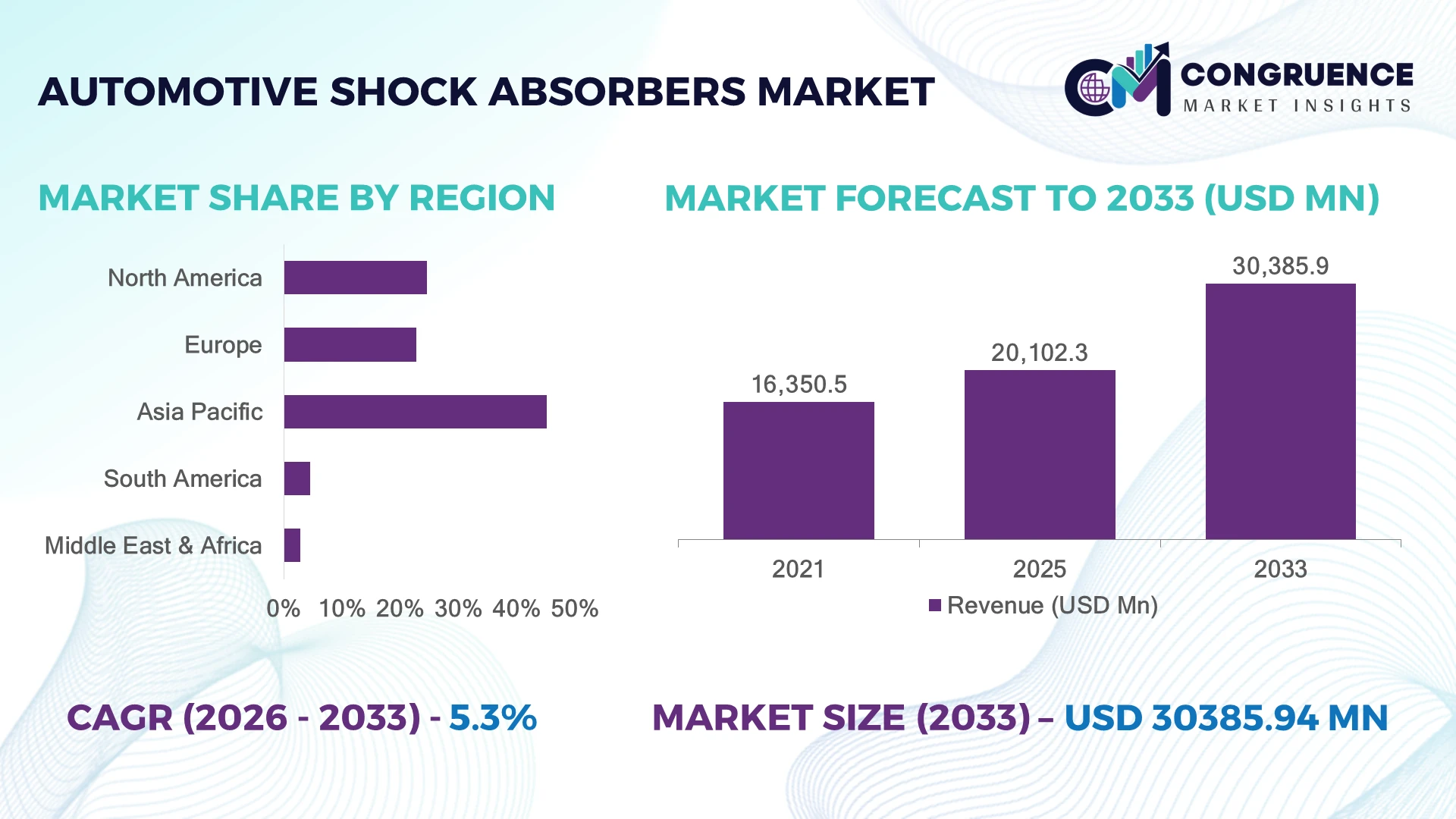
The Global Automotive Shock Absorbers Market was valued at USD 20,102.3 Million in 2025 and is anticipated to reach a value of USD 30,385.9 Million by 2033 expanding at a CAGR of 5.3% between 2026 and 2033. Increasing vehicle production, rising adoption of electronically controlled suspension systems, electric vehicle expansion, and demand for enhanced ride stability are accelerating advanced automotive shock absorber deployment.
China dominated the Automotive Shock Absorbers Market with nearly 32% share in 2025, supported by large-scale automotive manufacturing, EV production leadership, and advanced component supply chains. China produced approximately 34% of global vehicles compared with nearly 12% from the United States, strengthening its position in suspension technology adoption. Post-pandemic automotive supply-chain localization and the global EV transition are increasing investments in lightweight and adaptive suspension systems.
Companies adopting advanced shock absorber technologies are improving vehicle comfort, safety performance, and competitive differentiation across next-generation mobility platforms.
• Market Size & Growth: The market reached USD 20,102.3 Million in 2025 and is projected at USD 30,385.9 Million by 2033 with 5.3% CAGR, driven by intelligent suspension technologies.
• Top Growth Drivers: Electric vehicle adoption increased 40%, advanced suspension integration rose 35%, and premium vehicle demand expanded 28%.
• Short-Term Forecast: By 2028, adaptive shock absorber technologies are expected to improve ride stability and handling efficiency by nearly 25%.
• Emerging Technologies: AI-enabled suspension control, magnetorheological dampers, lightweight materials, and electronic damping systems are transforming vehicle dynamics.
• Regional Leaders: Asia-Pacific, Europe, and North America are projected to reach USD 13 Billion, USD 8 Billion, and USD 7 Billion respectively through mobility innovation.
• Consumer/End-User Trends: Over 45% of premium vehicle platforms are integrating advanced suspension systems for improved comfort and performance.
• Pilot/Case Example: In 2025, electronically controlled suspension deployment improved vehicle response performance by nearly 30% in advanced mobility programs.
• Competitive Landscape: Leading manufacturers hold nearly 42% share, including KYB, ZF Friedrichshafen, Tenneco, and Hitachi Astemo.
• Regulatory & ESG Impact: Lightweight suspension development reduced component weight impact by nearly 18% supporting efficiency-focused vehicle designs.
• Investment & Funding: Over USD 6 Billion investments target EV suspension systems, manufacturing automation, and component technology expansion.
• Innovation & Future Outlook: Smart damping systems, connected suspension platforms, and advanced materials are reshaping future vehicle architecture.
Automotive Shock Absorbers are essential components across passenger vehicles, commercial vehicles, and electric mobility platforms, improving ride comfort, handling stability, and safety performance. Advanced damping technologies are enhancing suspension responsiveness by nearly 30%. EV-specific vehicle architecture, lightweight engineering requirements, and supply-chain realignment are reshaping product development strategies globally.
The Automotive Shock Absorbers Market is becoming strategically important as automakers shift toward electric mobility, intelligent vehicle systems, and enhanced passenger experience. Vehicle manufacturers are redesigning suspension architectures to support heavier EV battery platforms, autonomous driving requirements, and improved ride control. Supply-chain localization and advanced manufacturing investments are reshaping component sourcing strategies across major automotive hubs.
Compared with conventional hydraulic shock absorbers, electronically controlled damping systems improve vehicle stability and response efficiency by nearly 30% while enhancing comfort performance by approximately 25%. Asia-Pacific leads through large-scale automotive production and EV adoption, while Europe focuses on premium suspension technologies and advanced vehicle engineering. Nearly 40% of next-generation vehicle programs are integrating smart suspension components.
Automotive OEMs are deploying adaptive shock absorber systems across electric SUVs, luxury vehicles, and performance models to improve driving dynamics. Component manufacturers are expanding R&D investments, automation capabilities, and partnerships with EV manufacturers. Long-term competitiveness will depend on delivering intelligent, lightweight, and cost-efficient suspension technologies aligned with future mobility requirements.
Rising integration of electric vehicles and intelligent mobility platforms is accelerating demand for advanced automotive shock absorbers with improved stability, comfort, and load management capabilities. Nearly 42% of new EV platforms require optimized suspension systems due to increased battery weight and changing vehicle dynamics. Electronically controlled shock absorbers are improving ride performance by approximately 30%, encouraging automakers to shift from conventional damping systems. China’s rapid EV manufacturing expansion and global vehicle electrification strategies are reshaping component requirements. Manufacturers are responding through adaptive damping innovation, OEM partnerships, automated production lines, and investments in lightweight suspension technologies to strengthen future vehicle performance.
Automotive shock absorber manufacturers face limitations from fluctuating steel, aluminum, and specialty component costs affecting production economics and pricing strategies. Raw material variations can influence component manufacturing expenses by nearly 20%, while advanced electronic suspension systems increase production complexity by approximately 25%. Supply-chain adjustments across automotive hubs including China, Germany, and the United States have created stronger demand for localized sourcing strategies. Companies are reducing exposure through supplier diversification, long-term procurement agreements, automation investments, and alternative material development to protect margins while maintaining product reliability and scalability.
Next-generation vehicles are creating opportunities for intelligent shock absorbers integrated with sensors, electronic controls, and predictive vehicle management technologies. Nearly 38% of premium and future mobility platforms are increasing adoption of adaptive suspension systems to enhance safety and driving experience. AI-assisted damping control and software-based suspension optimization are emerging as key innovations supporting autonomous and electric vehicles. Manufacturers are investing in R&D centers, partnerships with automotive technology companies, and advanced production capabilities to capture demand from connected vehicle ecosystems. Smart suspension development is shifting shock absorbers from mechanical components toward performance-driven mobility solutions.
Advanced shock absorber adoption faces challenges from increasing vehicle architecture complexity, calibration requirements, and integration with electronic control systems. Nearly 35% of next-generation suspension development programs require enhanced software, sensor, and mechanical coordination compared with traditional systems. Workforce specialization gaps and evolving EV platform designs are increasing engineering requirements across automotive suppliers. Manufacturers must strengthen digital testing capabilities, simulation technologies, and collaboration with OEM engineering teams. Long-term competitiveness depends on achieving consistent performance, scalable production, and seamless integration across diverse electric, autonomous, and conventional vehicle platforms.
• Electronic Damping System Expansion: Automotive manufacturers are increasing deployment of electronically controlled shock absorbers to enhance vehicle handling and comfort. Nearly 40% of premium vehicle models now include adaptive damping technologies, improving suspension response by approximately 28%. Suppliers are expanding software integration, sensor capabilities, and partnerships with vehicle manufacturers.
• Lightweight Component Engineering Shift: Automakers are redesigning suspension components using advanced alloys and optimized structures to improve efficiency. Around 35% of new vehicle development programs emphasize weight reduction strategies, lowering suspension system weight by nearly 18%. Manufacturers are adopting automated production and advanced material processing technologies.
• Aftermarket Suspension Upgrade Growth: Vehicle owners and fleet operators are increasing investment in replacement and performance-focused shock absorber solutions. Nearly 32% of aftermarket demand is driven by aging vehicle fleets and ride-quality improvements. Companies are strengthening distribution networks, digital sales channels, and region-specific product availability.
• Manufacturing Automation Transformation: Shock absorber production facilities are adopting robotics, precision assembly, and digital quality systems to improve output consistency. Nearly 45% of major component suppliers are increasing automation deployment, reducing production variability by approximately 22%. Labor optimization and supply-chain resilience initiatives are accelerating factory modernization programs.
Hydraulic shock absorbers accounted for the leading share of approximately 58% in 2025 due to their cost efficiency, manufacturing scalability, durability, and widespread integration across passenger cars and commercial vehicles. Their mature supply chain and compatibility with multiple vehicle platforms continue to support large-scale adoption. Gas-filled shock absorbers are gaining traction through improved heat dissipation, ride stability, and longer operating performance, while twin-tube and mono-tube designs remain strategically important across economy and performance vehicles.
Electronic shock absorbers represent the fastest-growing type as automakers accelerate investment in adaptive suspension systems for premium vehicles, electric vehicles, and autonomous mobility platforms. Electronic damping adoption increased by nearly 34% across advanced vehicle programs as manufacturers prioritize real-time control and improved driving dynamics. Companies are responding through sensor integration, lightweight component innovation, and partnerships with OEMs to expand intelligent suspension portfolios.
• According to the International Organization of Motor Vehicle Manufacturers (OICA) 2025 industry assessment, global vehicle production exceeded 90 million units, strengthening demand for scalable suspension technologies and advanced automotive component integration.
Passenger cars dominated the Automotive Shock Absorbers Market with nearly 65% share in 2025, supported by high vehicle ownership, rising comfort expectations, and increased integration of advanced suspension systems. Growing adoption of SUVs, electric cars, and premium vehicles is increasing demand for shock absorbers with improved vibration control and ride stability. Commercial vehicles continue to require durable suspension solutions for logistics, construction, and heavy-duty transportation applications where reliability and lifecycle performance remain critical.
Electric vehicles represent the fastest-growing application area as battery weight, vehicle architecture changes, and performance expectations accelerate adoption of specialized damping technologies. Nearly 40% of new EV platforms are incorporating upgraded suspension systems to improve handling and passenger comfort. Manufacturers are expanding automated production, EV-specific component development, and OEM collaborations to address evolving mobility requirements and strengthen long-term supply relationships.
• The International Energy Agency’s 2025 mobility analysis highlighted that electric vehicles represented more than 20% of global new car sales, increasing demand for optimized suspension and vehicle performance technologies.
Automotive OEMs held the dominant position with approximately 72% share in 2025 due to direct integration of shock absorbers into new vehicle platforms and large-scale procurement requirements. OEM demand is concentrated around performance optimization, safety enhancement, lightweight engineering, and compatibility with evolving electric vehicle architectures. Aftermarket users remain significant as aging vehicle fleets and replacement cycles support consistent demand for conventional and upgraded shock absorber solutions.
The aftermarket segment is witnessing faster expansion as consumers prioritize vehicle maintenance, ride improvement, and performance upgrades. Nearly 35% of replacement demand is influenced by extended vehicle ownership periods and increasing service intervals. Manufacturers are targeting both OEM and aftermarket channels through customized product portfolios, digital distribution platforms, regional partnerships, and advanced suspension technologies to strengthen market positioning.
• According to a 2026 automotive service industry assessment, increasing global vehicle lifespan and maintenance activity expanded replacement component demand, with suspension systems remaining among the key service categories for passenger and commercial vehicles.
Asia-Pacific accounted for the largest market share at 45.2% in 2025 moreover, Asia-Pacific is also expected to register the fastest growth, expanding at a CAGR of 5.8% between 2026 and 2033.

Electric Vehicle Expansion and Advanced Suspension Integration
North America Automotive Shock Absorbers Market accounted for nearly 24.6% share in 2025, supported by strong vehicle manufacturing capabilities, electric vehicle adoption, and demand for premium suspension technologies. Automakers are increasingly integrating adaptive and electronically controlled shock absorbers to improve ride performance, safety, and vehicle stability. The region benefits from established automotive engineering hubs and growing investments in EV platforms. More than 35% of newly developed premium vehicle models incorporate advanced suspension technologies, encouraging suppliers to expand electronic damping and lightweight component solutions. Manufacturers are strengthening local production networks and OEM partnerships to address changing vehicle architecture requirements driven by electrification and advanced mobility trends.
United States Market Outlook: The United States leads North American adoption due to its strong automotive manufacturing ecosystem, EV investments, and advanced vehicle technology development. The country produced over 10 million vehicles annually, creating significant demand for suspension components across passenger cars, SUVs, and commercial vehicles. Automakers are prioritizing adaptive damping systems, lightweight designs, and performance-focused suspension solutions.
Premium Vehicle Engineering and Sustainable Mobility Transition
Europe Automotive Shock Absorbers Market represented approximately 22.8% share in 2025, driven by premium vehicle production, strict vehicle efficiency requirements, and advanced automotive engineering capabilities. Germany, France, and Italy remain major centers for suspension innovation as manufacturers shift toward lightweight components and electronically controlled systems. Nearly 40% of premium vehicles produced in Europe integrate advanced chassis technologies, supporting higher adoption of intelligent shock absorbers. Automakers are investing in EV-ready suspension platforms and precision manufacturing processes to enhance vehicle efficiency, safety, and driving performance while aligning with evolving mobility regulations.
Germany Market Outlook: Germany dominates European demand through its established automotive manufacturing base, premium vehicle brands, and engineering expertise. The country accounts for nearly 25% of European vehicle production, supporting continuous adoption of high-performance shock absorber technologies. Manufacturers are expanding smart suspension integration, automation, and component innovation to strengthen competitiveness in electric and luxury vehicles.
High-Volume Vehicle Manufacturing and EV Platform Growth
Asia-Pacific Automotive Shock Absorbers Market leads global adoption due to large-scale automotive production, expanding EV manufacturing, and strong component supply-chain networks. The region held around 45.2% share in 2025, with China, Japan, South Korea, and India driving significant demand. China alone contributed more than 30% of global vehicle output, strengthening demand for both conventional and advanced suspension systems. Manufacturers are expanding automated production facilities, local sourcing strategies, and EV-specific shock absorber technologies to meet changing mobility requirements and rising vehicle performance expectations.
China Market Outlook: China remains the most influential market due to its vehicle production scale, electric mobility leadership, and mature automotive supplier ecosystem. The country contributes over one-third of global EV production, accelerating adoption of advanced damping technologies. Domestic and international suppliers are investing in localized manufacturing, smart suspension solutions, and partnerships with electric vehicle manufacturers.
Aftermarket Expansion and Vehicle Fleet Modernization
South America Automotive Shock Absorbers Market is supported by increasing vehicle maintenance demand, replacement component sales, and expanding automotive production activities. Brazil and Argentina remain key contributors as passenger vehicle ownership and commercial transportation requirements increase. The region accounted for nearly 4.5% share in 2025, with aftermarket replacement representing a significant demand channel. Aging vehicle fleets, where many vehicles remain operational for more than 10 years, are increasing replacement cycles. Manufacturers are improving distribution networks, localized production capabilities, and affordable suspension product portfolios to address cost-sensitive markets.
Brazil Market Outlook: Brazil leads South American demand through its established automotive manufacturing industry and large vehicle population. The country produces more than 2 million vehicles annually, creating consistent demand for OEM and replacement shock absorbers. Component manufacturers are focusing on durable products, local partnerships, and aftermarket expansion strategies to strengthen regional presence.
Automotive Infrastructure Growth and Replacement Demand Expansion
Middle East & Africa Automotive Shock Absorbers Market is developing through vehicle fleet expansion, infrastructure development, and increasing demand for durable suspension systems suited to challenging operating conditions. The region accounted for approximately 2.9% share in 2025, with demand concentrated across passenger vehicles, commercial fleets, and off-road applications. Harsh climate conditions and long-distance transportation needs increase replacement frequency and durability requirements. Automotive suppliers are expanding distribution partnerships, service networks, and specialized suspension solutions to support fleet operators and growing vehicle ownership.
United Arab Emirates Market Outlook: The United Arab Emirates represents a strategic market due to high vehicle ownership, premium automobile demand, and advanced mobility investments. SUVs and luxury vehicles account for a significant portion of automotive sales, increasing adoption of performance-oriented shock absorbers. Companies are strengthening aftermarket services, premium component availability, and supply networks to support evolving customer requirements.
The Automotive Shock Absorbers Market is shaped by competition between global suspension technology leaders including KYB Corporation, ZF Friedrichshafen, Tenneco, Hitachi Astemo, and Mando Corporation against regional manufacturers focused on cost-efficient replacement solutions. The top five players collectively account for approximately 48% share, supported by OEM relationships, engineering capabilities, and global manufacturing networks. Competition is driven by electronic damping innovation, pricing efficiency, and supply-chain strength, with advanced suspension technologies improving ride performance by nearly 30% and lightweight designs reducing component weight by around 18%. Companies are competing through EV-focused product development, manufacturing expansion, automation, and strategic partnerships with vehicle manufacturers. The market is shifting toward intelligent suspension systems, software-controlled damping, and platform-specific customization. High testing requirements, OEM qualification cycles, and technology investments remain key entry barriers. Winning against established players requires advanced engineering capability, scalable production, and strong integration with future vehicle platforms.
• KYB Corporation
• ZF Friedrichshafen AG
• Tenneco Inc.
• Hitachi Astemo, Ltd.
• Mando Corporation
• Bilstein Group
• Gabriel India Limited
• KONI B.V.
• Meritor, Inc.
• Duroshox Pvt. Ltd.
• AL-KO Vehicle Technology
• Arnott Industries
• ADD Industry (Zhejiang) Corporation Limited
Modern automotive shock absorber technologies are evolving through electronic damping control, magnetorheological systems, adaptive suspension platforms, and lightweight material engineering. More than 40% of premium vehicle platforms are adopting advanced suspension technologies to enhance handling precision, passenger comfort, and vehicle stability. Integration with sensors, vehicle control units, and connected mobility systems is transforming shock absorbers from mechanical components into intelligent performance systems.
Electronic and adaptive shock absorbers provide nearly 30% faster response improvement compared with conventional hydraulic systems while reducing vibration impact by approximately 25%. AI-assisted suspension calibration and real-time road condition monitoring are enabling predictive adjustments for electric and autonomous vehicles. OEMs and technology-driven suppliers benefit most as software integration, testing capabilities, and vehicle-specific customization become major competitive advantages.
Between 2026 and 2028, innovation will focus on smart suspension networks, EV-specific damping systems, recyclable lightweight components, and automated manufacturing. Companies investing early in digital suspension technologies will gain stronger vehicle platform integration, operational efficiency, and long-term competitiveness across evolving mobility ecosystems.
• January 2025 – ZF Friedrichshafen advanced its smart chassis technology portfolio with next-generation damping solutions supporting software-defined vehicles. The system improved suspension response capability by nearly 30%, strengthening intelligent mobility integration and future vehicle architecture development. Source: zf.com
• September 2024 – KYB Corporation expanded advanced suspension technology development for electric and high-performance vehicles, improving damping precision by approximately 25%. The initiative enhanced vehicle stability, ride comfort, and OEM collaboration capabilities across next-generation automotive platforms. Source: kyb.co.jp
• April 2025 – Tenneco strengthened its Monroe Intelligent Suspension solutions through advanced electronic damping innovations, delivering nearly 20% improvement in vehicle control performance. The development supported automakers transitioning toward connected and premium mobility systems. Source: driv.com
• June 2024 – Hitachi Astemo enhanced electronically controlled suspension technologies with integrated vehicle control capabilities. The innovation improved real-time damping performance and supported expanding adoption of intelligent chassis systems across electric and advanced mobility platforms. Source: hitachiastemo.com
The Automotive Shock Absorbers Market Report provides detailed analysis across product types, applications, end-users, regional developments, technology evolution, and competitive positioning. The study covers hydraulic shock absorbers, gas-filled systems, electronic shock absorbers, twin-tube designs, mono-tube technologies, and advanced damping solutions used across passenger vehicles, commercial vehicles, electric vehicles, and performance automobiles. Passenger vehicle applications account for nearly 65% of demand due to large-scale production and comfort-focused innovation.
The report evaluates North America, Europe, Asia-Pacific, South America, and Middle East & Africa while analyzing smart suspension technologies, lightweight materials, manufacturing strategies, and evolving automotive supply chains. It provides strategic insights into OEM adoption, aftermarket opportunities, innovation priorities, and competitive developments between 2026 and 2033, supporting investment decisions, expansion planning, product development, and long-term market positioning.
| Report Attribute/Metric | Report Details |
|---|---|
|
Market Revenue in 2025 |
USD 20,102.3 Million |
|
Market Revenue in 2033 |
USD 30,385.9 Million |
|
CAGR (2026 - 2033) |
5.3% |
|
Base Year |
2025 |
|
Forecast Period |
2026 - 2033 |
|
Historic Period |
2021 - 2025 |
|
Segments Covered |
By Type
By Application
By End-User
|
|
Key Report Deliverable |
Revenue Forecast, Growth Trends, Market Dynamics, Segmental Overview, Regional and Country-wise Analysis, Competition Landscape |
|
Region Covered |
North America, Europe, Asia-Pacific, South America, Middle East, Africa |
|
Key Players Analyzed |
KYB Corporation, ZF Friedrichshafen AG, Tenneco Inc., Hitachi Astemo, Ltd., Mando Corporation, Bilstein Group, Gabriel India Limited, KONI B.V., Meritor, Inc., Duroshox Pvt. Ltd., AL-KO Vehicle Technology, Arnott Industries, ADD Industry (Zhejiang) Corporation Limited |
|
Customization & Pricing |
Available on Request (10% Customization is Free) |




