
Reports
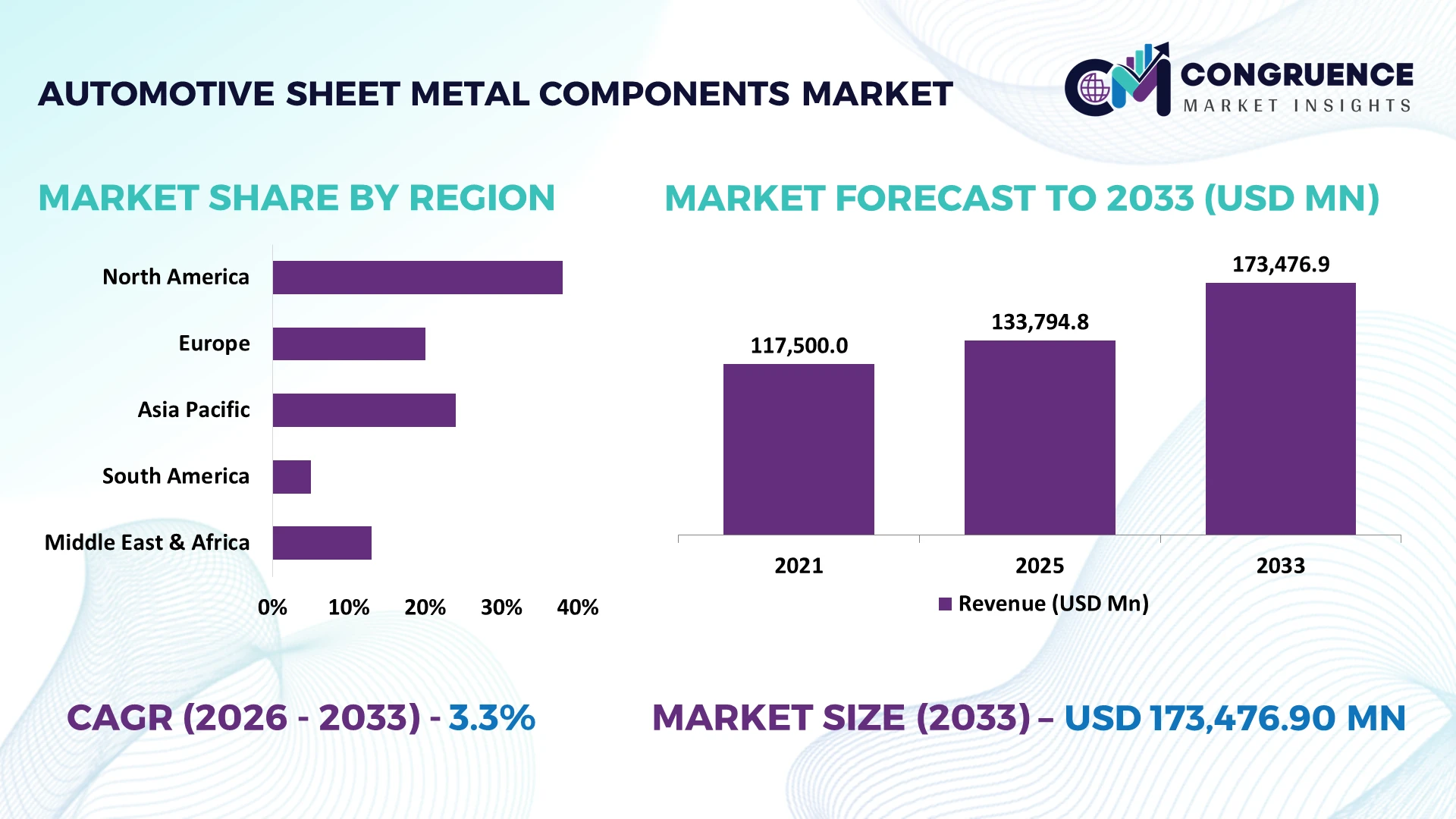
The Global Automotive Sheet Metal Components Market was valued at USD 133794.77 Million in 2025 and is anticipated to reach a value of USD 173476.9 Million by 2033 expanding at a CAGR of 3.3% between 2026 and 2033. Growth is driven by electric vehicle battery enclosure production, advanced high strength steel adoption, lightweight body structures, and increasing automation of automotive stamping and welding operations.
China dominates automotive sheet metal component manufacturing, producing approximately 31.28 million vehicles in 2024, representing nearly 34% of global vehicle production, compared with approximately 10.56 million vehicles manufactured in the United States. China's automotive manufacturing ecosystem integrates high capacity stamping plants, robotic welding lines, and advanced steel processing facilities. BYD, SAIC Motor, and Geely support localized component production, while investments in gigacasting alternatives, automated stamping, and lightweight battery enclosures strengthen domestic supply chains amid international automotive trade restrictions.
Strategically, suppliers should prioritize lightweight structural components and localized stamping capacity, targeting China's approximately 34% global vehicle production contribution and expanding electric vehicle manufacturing requirements.
Market Size & Growth: USD 133,794.77 million in 2025, reaching USD 173,476.9 million by 2033 at 3.3% CAGR, supported by lightweight vehicle structures and electric vehicle platforms.
Top Growth Drivers: Electric vehicle sales penetration exceeding 20% globally, advanced high strength steel adoption in vehicle structures, and lightweighting targets of 10% to 15%.
Short Term Forecast: By 2027, automated stamping optimization targets 12% lower material scrap and 10% higher production throughput across modernized automotive component facilities.
Emerging Technologies: AI defect detection, servo press automation, and laser welded blanks support 3 critical improvements in precision, material utilization, and structural performance.
Regional Leaders: Indicative 2033 allocations place Asia Pacific at USD 86,738.45 million, Europe at USD 34,695.38 million, and North America at USD 31,225.84 million, reflecting vehicle production localization.
Consumer/End User Trends: Electric vehicles exceeded 20% of global new car sales in 2024, increasing requirements for battery enclosures and lightweight structural sheet metal components.
Pilot/Case Example: A proposed 2027 automated stamping pilot targets 15% fewer dimensional defects through machine vision inspection and closed loop press monitoring.
Competitive Landscape: Gestamp, Magna International, Martinrea, Benteler, and JBM Auto compete in automotive metal components; individual global market shares require verification.
Regulatory & ESG Impact: European vehicle emissions requirements accelerate lightweighting, while optimized sheet metal processing targets 10% lower material waste.
Investment & Funding: An illustrative USD 100 million modernization program prioritizes servo presses, automated welding, and localized electric vehicle component production.
Innovation & Future Outlook: Next generation automotive sheet metal systems integrate 3 priorities: high strength alloys, digitally monitored forming, and recyclable lightweight structures.
The Automotive Sheet Metal Components Market is undergoing structural transformation as automakers redesign vehicle bodies around electrification, crash performance, and material efficiency. Advanced high strength steel, aluminum sheet forming, and laser welded blanks support lightweight body panels, structural reinforcements, and battery protection assemblies. China's large vehicle production base anchors manufacturing scale, while European manufacturers emphasize precision forming and lower carbon steel sourcing. Global electric vehicle sales surpassed 17 million units in 2024, representing more than 20% of new car sales. Suppliers investing in automated stamping, flexible tooling, and integrated welding capabilities are strengthening their position within evolving automotive production networks.
Automotive sheet metal components are becoming strategically important as vehicle manufacturers redesign body structures for electrification, crash protection, and manufacturing efficiency. Electric vehicles represented more than 20% of global new car sales in 2024, accelerating demand for battery enclosures, structural reinforcements, and lightweight body panels. China's manufacturing scale supports integrated stamping operations, while European automakers prioritize material traceability and lower carbon steel procurement. Trade restrictions and regional sourcing requirements are encouraging suppliers to establish production capacity closer to vehicle assembly plants.
Advanced servo stamping systems provide programmable forming control, with optimized installations targeting 10% to 15% lower material waste compared with conventional mechanical presses. Laser welded blanks enable variable sheet thickness within individual components, improving material placement and structural performance. During 2026 to 2028, manufacturers are expected to expand automated dimensional inspection and flexible tooling adoption. India's expanding automotive manufacturing base creates additional opportunities for localized precision stamping, contrasting with Germany's established expertise in advanced steel forming.
A practical deployment combines servo presses, robotic welding, and digital inspection for electric vehicle battery enclosure production. Such configurations target 15% fewer dimensional defects through synchronized process monitoring. Suppliers are expanding engineering partnerships, investing in flexible production cells, and strengthening material procurement agreements. Competitive advantage increasingly depends on forming precision, adaptable production capacity, and consistent component qualification.
Electric vehicle manufacturing is accelerating demand for advanced automotive sheet metal components, particularly battery enclosures, underbody reinforcements, and crash management structures. Electric vehicles exceeded 20% of global new car sales in 2024, while China's electric vehicle sales penetration surpassed 40%, strengthening domestic component production requirements. Advanced high strength steel enables targeted vehicle structural weight reductions of 10% to 15% through optimized component design. China's integrated automotive manufacturing ecosystem supports large scale stamping and welding operations, encouraging suppliers to expand production near vehicle assembly facilities. Companies including Gestamp and Magna are investing in advanced forming technologies and electrification compatible structural solutions. Competitive differentiation increasingly depends on lightweight performance, crashworthiness, and efficient component integration.
Automotive sheet metal component manufacturers face cost pressure from steel and aluminum price fluctuations, specialized alloy availability, and energy intensive forming operations. Advanced high strength steel grades require precise processing conditions, increasing tooling complexity compared with conventional mild steel components. Material expenditure can represent approximately 50% to 70% of stamped component manufacturing costs, depending on product specifications. Steel procurement price movements of 10% can materially affect supplier margins when contractual adjustments are delayed. European manufacturers also face industrial energy cost exposure, while international trade measures complicate sourcing decisions. Suppliers are strengthening long term steel procurement agreements, expanding regional sourcing networks, and optimizing blank layouts. Profitability increasingly depends on material yield management and contractual cost recovery mechanisms.
Advanced sheet metal forming technologies create opportunities for automotive suppliers targeting lightweight vehicle structures and more efficient manufacturing processes. Laser welded blanks can support 10% to 15% reductions in component weight through optimized material thickness distribution, depending on structural design. AI assisted defect detection offers potential inspection efficiency improvements of 15% to 20% compared with conventional manual quality checks. Germany's automotive engineering ecosystem supports development of precision forming technologies, while India's expanding vehicle production creates opportunities for localized component manufacturing. Suppliers are investing in digital process monitoring, advanced steel processing, and integrated welding systems. Partnerships between steel producers and automotive component manufacturers strengthen material development. Closed loop steel scrap recovery provides an additional opportunity to improve resource utilization without compromising component quality.
Scaling advanced automotive sheet metal manufacturing presents technical challenges involving springback control, dimensional consistency, and compatibility with evolving vehicle architectures. High strength steel forming requires precise die compensation and process calibration to maintain structural accuracy. Manufacturers implementing advanced stamping systems often target dimensional rejection reductions of 10% to 15% through improved simulation and automated inspection. Electric vehicle battery enclosure production introduces additional requirements for sealing integrity, corrosion resistance, and crash protection. German and Japanese automotive suppliers face demanding qualification procedures, while Indian manufacturers expanding advanced stamping capacity must strengthen specialized engineering skills. Companies are investing in forming simulation, automated metrology, and workforce development. Long term competitiveness depends on maintaining production consistency across increasingly complex vehicle platforms.
Tailored Blanking Improves Material Utilization: Automotive stamping suppliers are adopting optimized blank nesting and precision cutting to improve steel sheet utilization. Advanced nesting software targets 8% to 12% lower offcut generation, while automated blank feeding improves handling efficiency by approximately 10%. German manufacturers are upgrading cutting operations as steel procurement pressures encourage tighter material control. Suppliers are integrating digital nesting platforms with stamping schedules to reduce inventory losses.
Hot Stamping Expands Crash Structure Applications: Automotive manufacturers are increasing press hardened steel applications in passenger safety structures. Hot formed components commonly achieve tensile strengths near 1,500 MPa, compared with approximately 600 MPa for selected conventional automotive steels. Improved forming controls target 10% fewer dimensional deviations. Chinese and European suppliers are expanding hot stamping capacity and strengthening die cooling technology to improve crash performance and production repeatability.
Flexible Stamping Cells Support Platform Variants: Vehicle manufacturers are increasing production flexibility to accommodate multiple body configurations within shared facilities. Programmable tooling systems target 15% faster model changeovers and approximately 10% higher equipment utilization. India's expanding automotive manufacturing operations encourage suppliers to introduce adaptable stamping cells and standardized tooling interfaces. Manufacturers are restructuring production layouts to reduce dedicated tooling requirements while improving responsiveness to changing vehicle specifications.
Digital Die Maintenance Gains Priority: Automotive component suppliers are introducing sensor based die condition monitoring to reduce unexpected production interruptions. Predictive maintenance configurations target 15% lower unplanned downtime and 10% longer tooling service intervals. Japanese automotive suppliers emphasize standardized maintenance records and automated wear monitoring. Manufacturers are integrating press cycle data with maintenance scheduling, improving die availability and reducing production disruption across high volume stamping facilities.
Body Panels represent an estimated 32% of the global automotive sheet metal components market, supported by extensive use in vehicle doors, hoods, roofs, fenders, and exterior assemblies. Their manufacturing scale reflects standardized stamping operations and established steel processing infrastructure. Automotive manufacturers prioritize surface quality, dimensional accuracy, and efficient material utilization across large production volumes. Chassis Components remain important for vehicle stability and load distribution, particularly in commercial vehicle manufacturing. Advanced stamping operations can target 10% to 15% improvements in material utilization through optimized blank layouts and controlled forming processes. Suppliers are expanding automated stamping capabilities and investing in precision die engineering to strengthen production consistency.
Structural Components represent the fastest expanding category, supported by increasing integration of advanced high strength steel and reinforced vehicle architectures. Exhaust Components and Engine Components retain established demand from conventional vehicle production, while Brackets and Reinforcements support structural assembly and component mounting. Press hardened steel components can achieve tensile strengths near 1,500 MPa, supporting improved crash protection. Manufacturers are strengthening hot stamping capabilities, developing tailored blanks, and expanding engineering partnerships with automotive OEMs.
Passenger Cars account for an estimated 58% of automotive sheet metal component demand, reflecting extensive production volumes and widespread use of stamped body panels, structural reinforcements, and chassis assemblies. Global passenger car manufacturing remains concentrated in China, Japan, Germany, India, and the United States, supporting established component supply networks. Vehicle manufacturers emphasize production efficiency, dimensional consistency, and scalable stamping operations. Light Commercial Vehicles contribute substantial demand through cargo body structures, chassis reinforcements, and specialized mounting components. Heavy Commercial Vehicles require durable sheet metal assemblies capable of supporting demanding operating conditions and higher structural loads.
Electric Vehicles represent the fastest expanding application, driven by increasing battery enclosure production and redesigned vehicle body architectures. Electric vehicles accounted for more than 20% of global new car sales in 2024, strengthening demand for lightweight structural assemblies. Advanced high strength steel configurations can support targeted weight reductions of 10% to 15% through optimized component design. Suppliers are expanding battery protection component production, developing flexible stamping systems, and strengthening relationships with electric vehicle manufacturers. Investment increasingly prioritizes adaptable tooling and localized component manufacturing.
OEMs account for an estimated 45% of global automotive sheet metal component demand, supported by direct vehicle assembly requirements, integrated stamping operations, and established supplier procurement networks. Major vehicle manufacturers maintain strict dimensional accuracy, crash performance, and material traceability requirements for body structures and structural components. Automotive Tier 1 Suppliers represent another significant purchasing category, providing engineered assemblies and integrated metal structures to vehicle manufacturers. Advanced production systems can target 10% to 15% reductions in dimensional defects through automated inspection and controlled forming operations. Suppliers are expanding localized manufacturing facilities and strengthening engineering collaboration with vehicle manufacturers.
Automotive Tier 2 Suppliers represent the fastest expanding end user category as manufacturers increasingly outsource specialized stamping, precision blanks, and fabricated metal components. These suppliers benefit from growing requirements for flexible production capacity and specialized material processing. Aftermarket Manufacturers retain demand for replacement body panels and structural repair components. Automated stamping optimization can target approximately 10% lower material waste through improved blank utilization. Companies are investing in precision tooling, digital quality systems, and regional manufacturing partnerships to strengthen supply reliability and customer retention.
Asia Pacific accounted for the largest market share at an estimated 50% in 2025 however, Asia Pacific is expected to register the fastest growth, expanding at an indicative CAGR of 4.1% between 2026 and 2033.
Automotive Manufacturing Localization and Advanced Stamping Integration
North America accounted for an estimated 18% of global automotive sheet metal component demand in 2025, supported by established vehicle manufacturing operations across the United States, Mexico, and Canada. Regional automotive production exceeded 16 million vehicles in 2024, generating substantial requirements for stamped body panels, chassis assemblies, and structural reinforcements. The United States emphasizes advanced manufacturing technologies, while Mexico provides competitive production capacity for automotive component suppliers. The United States Mexico Canada Agreement encourages regional sourcing and integrated automotive supply chains, with qualifying passenger vehicles subject to a 75% regional value content requirement. Manufacturers including Magna International, Martinrea International, and Gestamp maintain production networks serving major automotive assembly operations. Investment priorities include automated stamping lines, robotic welding, and precision dimensional inspection. Suppliers increasingly position manufacturing facilities near vehicle assembly plants to reduce logistics exposure and improve production scheduling.
United States Market Outlook: The United States maintains a strategically important automotive sheet metal manufacturing ecosystem supported by General Motors, Ford, Tesla, and established component suppliers. Domestic vehicle production reached approximately 10.56 million units in 2024, sustaining extensive requirements for structural assemblies and exterior body components. Michigan, Ohio, and Tennessee support concentrated stamping and automotive manufacturing operations. Suppliers emphasize advanced high strength steel processing, integrated body structures, and manufacturing flexibility to accommodate conventional and electric vehicle platforms.
Precision Forming Modernization and Low Carbon Steel Integration
Europe represented an estimated 20% of global automotive sheet metal component demand in 2025, supported by advanced manufacturing capabilities across Germany, Spain, France, Italy, and Central Europe. Germany maintains extensive expertise in precision stamping, automotive engineering, and advanced steel processing. European manufacturers increasingly prioritize material traceability, energy efficient forming, and recyclable automotive structures. The European Union's Carbon Border Adjustment Mechanism enters its definitive phase in 2026, increasing the importance of emissions documentation for covered imported steel and aluminum inputs. Automotive component manufacturers are strengthening partnerships with steel producers to secure advanced material grades and improve production sustainability. Gestamp and Benteler support advanced structural component development through established European manufacturing networks. Investment priorities include hot stamping, laser welded blanks, and automated dimensional inspection. Competitive positioning increasingly depends on precision engineering, material efficiency, and regulatory compliance capabilities.
Germany Market Outlook: Germany remains a major automotive sheet metal component manufacturing center, supported by Volkswagen, BMW, Mercedes Benz, and established engineering suppliers. Domestic passenger car production reached approximately 4.1 million units in 2024, supporting extensive requirements for stamped structural assemblies. German manufacturers emphasize press hardened steel, precision die engineering, and integrated body structures. Industrial research institutions and automotive suppliers collaborate on advanced forming simulation, material optimization, and automated quality inspection to strengthen manufacturing competitiveness.
Vehicle Production Scale and Integrated Component Supply Chains
Asia Pacific dominated the global automotive sheet metal components market with an estimated 50% share in 2025, supported by concentrated automotive manufacturing operations across China, Japan, India, and South Korea. China produced approximately 31.28 million vehicles in 2024, establishing substantial demand for stamped body structures, chassis components, and precision metal assemblies. Japan maintains advanced manufacturing expertise in automotive steel processing and high accuracy stamping technologies. India contributes expanding passenger vehicle and commercial vehicle manufacturing capacity, strengthening regional component localization. Chinese manufacturers benefit from integrated steel production, automated stamping operations, and extensive automotive supplier networks. Electric vehicle manufacturing encourages specialized battery protection structures and advanced material processing. Suppliers are expanding precision tooling capabilities, developing flexible manufacturing systems, and strengthening relationships with domestic vehicle producers. Competitive advantages center on production scalability, material availability, and rapid component engineering.
China Market Outlook: China leads global automotive production through established manufacturing clusters in Guangdong, Shanghai, Jiangsu, and Zhejiang. BYD, SAIC Motor, Geely, and Changan support extensive localized component procurement. New energy vehicle production exceeded 12 million units in 2024, creating significant requirements for battery enclosures and reinforced underbody structures. Domestic suppliers are investing in automated forming, precision welding, and integrated material processing to support high volume vehicle manufacturing and export requirements.
Automotive Production Recovery and Localized Component Manufacturing
South America accounted for an estimated 8% of global automotive sheet metal component demand in 2025, supported by established vehicle manufacturing operations in Brazil and Argentina. Brazil represents the principal regional production center, with automotive manufacturing exceeding 2.5 million vehicles in 2024. Passenger vehicle production generates substantial demand for stamped body panels, structural reinforcements, and chassis components. Argentina contributes additional manufacturing activity through passenger vehicle and commercial vehicle assembly operations. Regional suppliers emphasize cost efficient stamping, localized steel procurement, and flexible component production. Currency volatility and imported equipment costs influence investment decisions, encouraging manufacturers to strengthen domestic sourcing arrangements. Automotive component producers are modernizing selected stamping facilities and expanding partnerships with established vehicle manufacturers. Competitive positioning depends on reliable component delivery, production flexibility, and effective material cost management.
Brazil Market Outlook: Brazil maintains a significant automotive manufacturing ecosystem concentrated in São Paulo, Minas Gerais, Paraná, and Bahia. Volkswagen, Stellantis, General Motors, and Toyota support extensive demand for automotive metal components. Domestic automotive production increased approximately 10% in 2024 compared with 2023, strengthening utilization across component manufacturing facilities. Suppliers are expanding automated stamping operations, improving die maintenance capabilities, and developing localized production arrangements to reduce imported component dependency.
Automotive Industrialization and Manufacturing Infrastructure Expansion
Middle East & Africa represented an estimated 4% of global automotive sheet metal component demand in 2025, with South Africa and Morocco maintaining established vehicle manufacturing capabilities. Morocco has developed a significant automotive export manufacturing ecosystem supported by Renault and Stellantis production operations. South Africa maintains established passenger vehicle and commercial vehicle assembly facilities requiring stamped body structures and chassis components. Saudi Arabia is expanding automotive manufacturing ambitions through industrial diversification initiatives and electric vehicle production investments. Morocco produced approximately 559,000 vehicles in 2024, demonstrating the scale of its automotive manufacturing infrastructure. Regional suppliers are strengthening localized component production, developing industrial partnerships, and improving access to precision stamping equipment. Investment priorities include automotive supplier parks, manufacturing workforce development, and integrated component logistics. Long term competitiveness depends on supplier localization and consistent production quality.
Morocco Market Outlook: Morocco has established automotive manufacturing clusters around Tangier and Kenitra, supported by integrated export logistics and industrial supplier networks. Renault and Stellantis manufacturing operations generate demand for stamped automotive body panels and structural components. Morocco's automotive ecosystem benefits from proximity to European vehicle markets and established port infrastructure. Suppliers are expanding localized component production, improving precision forming capabilities, and strengthening relationships with international vehicle manufacturers to support manufacturing integration.
The Automotive Sheet Metal Components Market features competition between global structural specialists Gestamp, Magna International, Martinrea International, Benteler, and JBM Auto, alongside regional stamping suppliers serving domestic vehicle manufacturers. The leading five companies hold an estimated combined 22% market share, reflecting fragmented component procurement across automotive platforms. Gestamp and Benteler emphasize advanced structural engineering, while Magna and Martinrea compete through integrated manufacturing capabilities and regional production networks. Automated stamping optimization targets 10% to 15% lower material waste, while precision inspection systems support approximately 12% fewer dimensional defects. Manufacturers are expanding localized production, strengthening steel procurement partnerships, and investing in flexible forming technologies. Competition increasingly favors suppliers capable of integrating advanced materials, structural engineering, and automated manufacturing. High tooling investment, vehicle platform qualification, and production consistency requirements create substantial entry barriers. Winning requires precision, dependable supply, engineering collaboration, and disciplined manufacturing costs across automotive programs.
Gestamp Automoción, S.A.
Magna International Inc.
Martinrea International Inc.
Benteler International AG
JBM Auto Limited
KIRCHHOFF Automotive GmbH
Tower International
Aisin Corporation
CIE Automotive S.A.
Shiloh Industries, Inc.
voestalpine AG
KLT Automotive and Tubular Products Limited
Unipres Corporation
GEDIA Automotive Group
Current automotive sheet metal manufacturing combines servo stamping, hot forming, laser welding, and robotic assembly to meet demanding dimensional and crashworthiness specifications. Press hardened steel achieves tensile strengths approaching 1,500 MPa, enabling thinner structural sections without sacrificing protection. Compared with conventional mechanical presses, optimized servo stamping installations target 10% to 15% faster forming cycles. Automated dimensional inspection can reduce quality verification time by approximately 20%, strengthening production consistency across automotive body manufacturing operations.
Emerging technologies include AI assisted defect detection, digital twins, and adaptive die compensation. Machine vision systems target 15% fewer undetected surface defects, while simulation driven tooling adjustments can reduce prototype iterations by approximately 20%. Advanced forming simulation supports production planning for complex geometries and mixed material structures. German precision suppliers benefit from engineering intensive applications, whereas Chinese manufacturers leverage automated production scale. Integration increasingly connects press sensors, inspection systems, and manufacturing execution platforms.
Between 2026 and 2028, disruptive developments will emphasize intelligent forming control, automated material traceability, and digitally connected stamping facilities. Real time process monitoring can target 12% lower unplanned downtime, while adaptive tooling strategies support 10% faster product changeovers. Suppliers investing in predictive analytics, integrated metrology, and flexible manufacturing architectures strengthen qualification performance, production resilience, and competitiveness across evolving automotive platforms and global procurement networks.
September 2026: Gestamp inaugurated its fifth Indian manufacturing plant in Gujarat, strengthening localized automotive component production. Its Indian operations now include 14 stamping lines, supporting vehicle body structures, chassis assemblies, and closer integration with domestic automotive manufacturers. Source: gestamp.com.
June 2024: Martinrea International announced an investment approaching CAD 35 million to expand its Ridgetown facility with a 3,000 tonne stamping press. The expansion supports larger structural components, battery enclosures, and improved manufacturing capabilities for automotive customers. Source: martinrea.com.
January 2025: Aotto reported deploying an automated hot forming line for Faway Benteler Automotive Components in Tianjin, achieving production speeds exceeding 5.2 strokes per minute. The installation strengthens manufacturing productivity and precision for advanced automotive structural components. Source: aottotech.com.
December 2025: BENTELER completed modernization of its Raufoss aluminum casthouse in Norway, increasing recycled aluminum utilization from approximately 30% to 40%. The expansion strengthens material circularity, reduces production emissions, and supports automotive manufacturers pursuing lower carbon components. Source: benteler.com.
The Automotive Sheet Metal Components Market Report examines manufacturing technologies, procurement patterns, competitive positioning, and industrial developments between 2026 and 2033. Type segmentation covers Body Panels, Chassis Components, Structural Components, Exhaust Components, Engine Components, and Brackets and Reinforcements. Application coverage includes Passenger Cars, Light Commercial Vehicles, Heavy Commercial Vehicles, and Electric Vehicles. End user analysis evaluates OEMs, Automotive Tier 1 Suppliers, Automotive Tier 2 Suppliers, and Aftermarket Manufacturers, emphasizing production integration, quality requirements, and sourcing strategies.
Regional assessment covers North America, Europe, Asia Pacific, South America, and Middle East & Africa, including major manufacturing hubs in China, Germany, India, and the United States. Technology analysis evaluates servo stamping, hot forming, laser welding, and digital inspection. Competitive assessment supports capacity investment, supplier partnerships, manufacturing localization, and advanced component development decisions.
| Report Attribute/Metric | Report Details |
|---|---|
Market Revenue in 2025 | USD 133794.77 Million |
Market Revenue in 2033 | USD 173476.9 Million |
CAGR (2026 - 2033) | 3.3% |
Base Year | 2025 |
Forecast Period | 2026 - 2033 |
Historic Period | 2021 - 2025 |
Segments Covered | By Type
By Application
By End-User
|
Key Report Deliverable | Revenue Forecast, Growth Trends, Market Dynamics, Segmental Overview, Regional and Country-wise Analysis, Competition Landscape |
Region Covered | North America, Europe, Asia-Pacific, South America, Middle East, Africa |
Key Players Analyzed | Gestamp Automoción, S.A., Magna International Inc., Martinrea International Inc., Benteler International AG, JBM Auto Limited, KIRCHHOFF Automotive GmbH, Tower International, Aisin Corporation, CIE Automotive S.A., Shiloh Industries, Inc., voestalpine AG, KLT Automotive and Tubular Products Limited, Unipres Corporation, GEDIA Automotive Group |
Customization & Pricing | Available on Request (10% Customization is Free) |




