
Reports
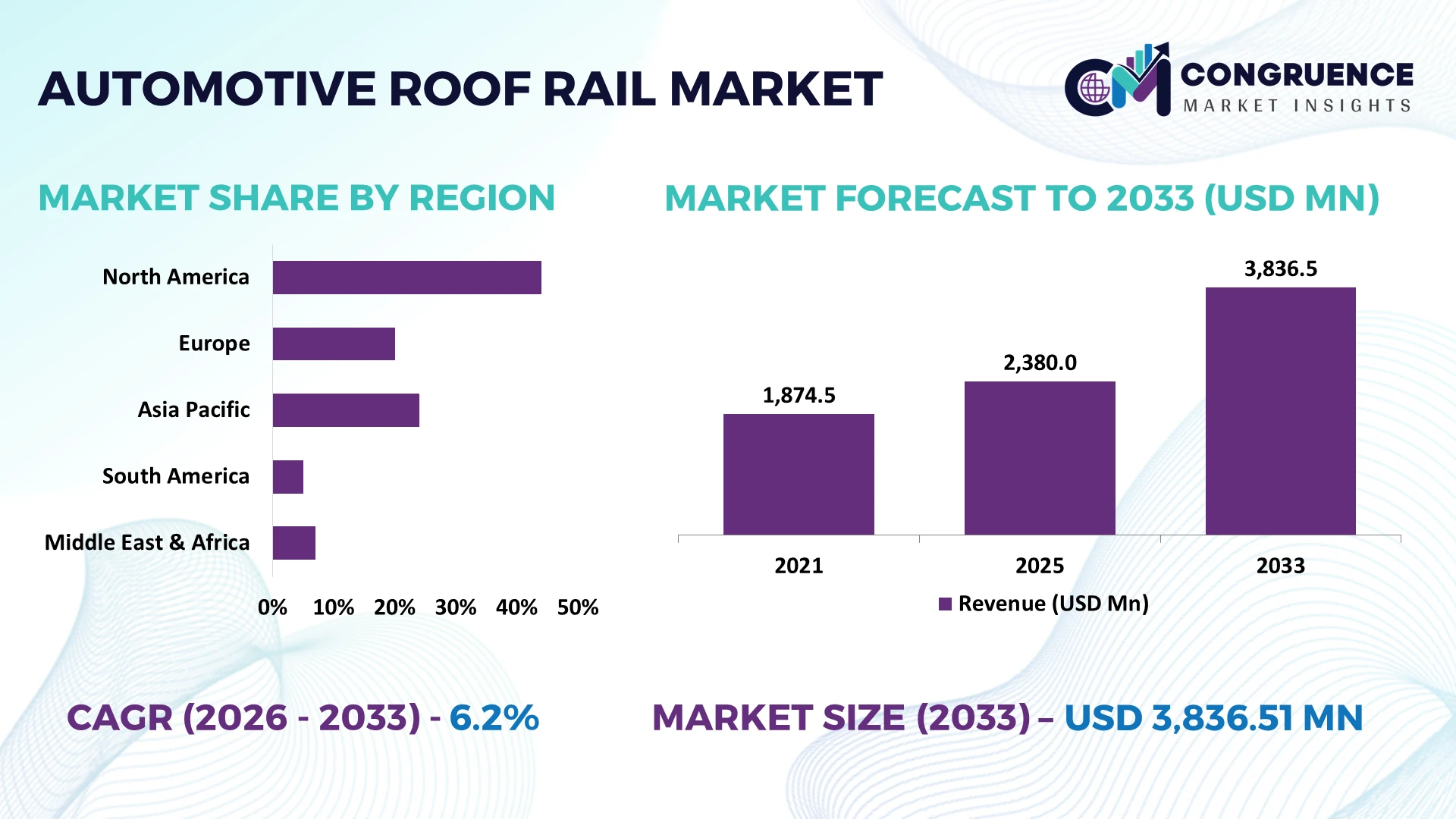
The Global Automotive Roof Rail Market was valued at USD 2380 Million in 2025 and is anticipated to reach a value of USD 3836.51 Million by 2033 expanding at a CAGR of 6.15% between 2026 and 2033. Growth is driven by the sustained SUV/crossover vehicle mix, factory-integrated cargo systems, lightweight aluminum structures, aerodynamic rail designs, and increasing OEM fitment across electric SUVs.
China is the dominant manufacturing demand center, producing 34.53 million vehicles in 2025, equivalent to approximately 35.8% of global output, versus India’s 6.49 million. Chinese NEV production reached 16.63 million units, up 29%, strengthening demand for lightweight exterior systems on electric SUVs. Meanwhile, EU tariffs on Chinese EVs are accelerating localized production and supplier-network restructuring. China’s 34.53 million vehicles represented more than five times India’s production, giving roof-rail suppliers substantially greater platform-scale sourcing opportunities.
Strategically, suppliers should prioritize China-linked SUV platforms, lightweight integrated rails, and localized OEM programs while diversifying production against escalating automotive trade barriers.
Market Size & Growth: USD 2,380 million in 2025 reaches USD 3,836.51 million by 2033 at 6.15%, supported by SUV-heavy vehicle portfolios and integrated cargo systems.
Top Growth Drivers: China vehicle production increased 10.4%, NEV production rose 29%, and global vehicle output advanced 3.9% in 2025.
Short-Term Forecast: By 2028, suppliers will prioritize platform consolidation and lightweighting; a defensible industry-wide roof-rail cost-reduction percentage is not publicly established.
Emerging Technologies: Lightweight aluminum rails, flush aerodynamic systems, modular attachment interfaces, and sensor-compatible integrated roof structures are becoming central to next-generation SUV design.
Regional Leaders: Asia-Pacific produced 59.2 million vehicles, Europe 17.2 million, and the Americas 18.74 million in 2025; roof-rail-specific regional USD splits are not independently established.
Consumer/End-User Trends: SUVs represented almost 50% of global car sales in 2025, sustaining the strongest vehicle-format linkage with roof rails and rooftop cargo accessories.
Pilot/Case Example: In 2025, electric SUVs achieved over 55% powertrain electrification in China, accelerating OEM attention to weight-efficient exterior components.
Competitive Landscape: OEM suppliers compete on platform integration, finish quality, lightweighting and manufacturing proximity; a verified global leader share is not publicly disclosed.
Regulatory & ESG Impact: EU battery-electric share reached 17.4% in 2025 versus 13.6% in 2024, reinforcing lightweight component engineering for electrified platforms.
Investment & Funding: China manufactured 34.53 million vehicles in 2025; a comparable verified global investment total specifically attributable to automotive roof rails is unavailable.
Innovation & Future Outlook: Large vehicles represented almost 70% of available electric models in 2025, strengthening the addressable platform base for advanced integrated roof systems.
Automotive roof rail demand is concentrating around SUVs, crossovers, electric utility vehicles, and adventure-oriented passenger models where integrated cargo functionality remains a purchase differentiator. SUVs represented almost 50% of worldwide car sales in 2025, while lightweight aluminum construction, flush rails, modular mounting interfaces, and aerodynamic profiles are advancing product design. Trade barriers affecting China-made EVs are simultaneously pushing suppliers toward localized OEM sourcing and manufacturing strategies.
Automotive roof rails are moving from styling accessories toward integrated vehicle architecture as SUVs, crossovers, electrification, and modular cargo systems reshape OEM sourcing. SUVs represented almost 50% of global car sales in 2025, while electric vehicles reached one-quarter of new-car sales. This mix increases demand for lightweight rails engineered around panoramic roofs, aerodynamic targets, and platform-specific attachment systems. Trade-policy changes are simultaneously encouraging suppliers to regionalize production nearer assembly plants.
Material engineering is becoming the clearest performance lever. Advanced mixed-material automotive roof structures have demonstrated approximately 49% mass reduction versus conventional steel-intensive designs, illustrating the lightweighting potential available around upper-body systems. China provides unmatched deployment scale, producing 34.53 million vehicles in 2025, while Europe produced 17.2 million and placed greater emphasis on carbon compliance and localized EV sourcing. Suppliers therefore balance Chinese manufacturing scale against European engineering specialization.
Through 2026–2028, electrified SUVs, flush rails, recyclable aluminum, and modular mounting systems will dominate product development. China’s electric vehicles already represented nearly 55% of domestic car sales in 2025. Suppliers are expanding extrusion capabilities, co-developing platform-specific systems with OEMs, and localizing finishing operations. Competitive advantage will depend on combining lightweight construction, aerodynamic integration, design flexibility, and dependable localized supply.
SUV proliferation is the strongest structural driver for automotive roof rails because these vehicles combine cargo utility, lifestyle positioning, and higher factory-fitment potential. SUVs represented almost 50% of global car sales in 2025, while large vehicles accounted for nearly 70% of available electric models. China intensified this shift, with electric SUVs achieving more than 55% powertrain electrification. Roof-rail suppliers consequently gain larger addressable programs as OEMs expand crossover and electric-SUV portfolios. The transition toward flush rails and integrated crossbar interfaces also increases engineering content per vehicle. Suppliers are responding through dedicated aluminum extrusion capacity, platform-specific mounting systems, and earlier design collaboration with automakers. Strategically, the key opportunity is securing platform nomination before vehicle architecture is frozen, rather than competing only at component-purchasing stage.
Cross-border sourcing has become structurally more difficult as automotive trade measures reshape component economics and production footprints. The European Union applies countervailing duties of 17.0% on BYD EVs, 18.8% on Geely, and 35.3% on SAIC vehicles manufactured in China. At the same time, European vehicle production declined 0.8% in 2025, limiting volume leverage for suppliers building additional local capacity. Roof-rail manufacturers exposed to Chinese extrusion, machining, coating, or assembly networks therefore face more complex localization decisions and smaller production runs when programs are redistributed. Companies are reducing exposure by dual-sourcing aluminum profiles, localizing surface finishing, and signing regional OEM supply contracts. The operational constraint is scale fragmentation: localization improves resilience but can raise tooling utilization and per-unit manufacturing costs when model volumes are dispersed.
Electric vehicles create a differentiated opportunity because roof-mounted components increasingly sit within broader vehicle-mass and aerodynamic optimization programs. Electric cars represented 25% of worldwide new-car sales in 2025, while China approached a 55% electric sales share and Europe reached 28%. Advanced lightweight roof architectures have demonstrated mass reductions approaching 49% versus conventional steel-intensive designs, highlighting the engineering value of aluminum, high-strength steel, composites, and optimized joining. Roof-rail suppliers can capture more value by moving beyond decorative rails toward lightweight structural mounting interfaces, flush aerodynamic designs, and accessory-ready modular systems. Companies are investing in extrusion optimization, recyclable alloys, integrated sealing, and co-development with electric-SUV manufacturers. A non-obvious opportunity is accessory ecosystem control: standardized rail interfaces can extend supplier participation into crossbars, bicycle carriers, roof boxes, and outdoor-mobility attachments.
Future roof-rail programs must reconcile styling, roof strength, aerodynamics, corrosion resistance, panoramic glazing, and increasingly diverse vehicle architectures without adding excessive mass. Almost 70% of electric models available globally in 2025 were large vehicles, while China offered more than 1,100 car models and expanded its electric-model count by roughly 25%. That proliferation increases tooling variants, validation workloads, mounting-interface complexity, and program-management demands for suppliers serving multiple OEM platforms. Flush systems also require tighter tolerance control than traditional raised rails because sealing, surface alignment, and hidden fastening directly affect perceived quality and wind performance. Companies must invest in simulation, automated inspection, flexible tooling, corrosion testing, and OEM engineering partnerships. The strategic challenge is therefore not demand generation but scalable customization: suppliers that cannot standardize underlying architectures while adapting visible design elements will lose cost competitiveness as model proliferation accelerates.
Flush Designs Replace Raised Profiles: OEM styling is shifting toward low-profile roof architecture as aerodynamic detailing becomes more important on electrified vehicles. Large vehicles represented almost 70% of available electric models in 2025, versus roughly 55% in 2020. Suppliers are redesigning rails with concealed fasteners, tighter extrusion tolerances, and integrated sealing, reducing visual bulk while simplifying OEM assembly and improving compatibility with panoramic roofs.
EV-Specific Fitments Expand Rapidly: China offered more than 1,100 car models in 2025, while its electric-model count increased roughly 25%. Accessory manufacturers are responding with additional roof-rack and rail configurations tailored to Chinese EV brands rather than relying on universal mounting kits. This shift increases engineering variants but improves fit accuracy, installation speed, and OEM-accessory integration across rapidly changing vehicle platforms.
Cargo Ecosystems Gain Strategic Importance: Roof rails increasingly operate as foundations for broader transport ecosystems rather than standalone components. Sport and cargo carriers represent about 50% of Thule’s business, and its products reach 138 markets. Companies are refreshing roof racks alongside boxes, bicycle carriers, and modular mounts, using shared interfaces to increase attachment compatibility and capture more customer spending across outdoor-mobility use cases.
Manufacturing Footprints Become More Flexible: Global vehicle production reached 96.4 million units in 2025, while Asia-Pacific generated more than 61% of output. Suppliers are aligning extrusion, machining, coating, and assembly closer to major vehicle plants as trade barriers disrupt centralized sourcing. Flexible tooling and regional supplier partnerships now reduce logistics exposure and accelerate model-specific roof-rail launches.
Raised Roof Rails lead the type segmentation with an estimated 42% share in 2025, supported by established installation architecture, visible utility, and broad compatibility with crossbars and cargo accessories. Their mature design reduces tooling complexity and remains common across conventional SUVs, utility vehicles, and adventure-focused platforms. Flush Roof Rails account for approximately 34% and represent the fastest-expanding type as OEMs pursue cleaner rooflines, improved aerodynamics, and closer integration with panoramic glazing and electric-SUV styling.
Fixed Roof Rails represent about 16% of segment demand, serving platforms where permanent structural mounting and predictable load performance take priority over modularity. Removable Roof Rails hold approximately 8%, appealing to buyers prioritizing occasional cargo use and design flexibility. Suppliers are shifting engineering resources toward flush systems while protecting raised-rail programs through modular crossbar compatibility and lower-cost standardized extrusions. Investment is increasingly directed toward precision machining, hidden fastening, automated surface finishing, and platform-specific integration, making design sophistication more important than simple rail production scale.
Luggage Carrying remains the leading application, representing an estimated 43% of roof-rail usage because roof boxes, cargo baskets, and travel accessories rely directly on secure upper-body mounting. Roof Rack Mounting follows at approximately 30%, reflecting its role as the structural interface connecting vehicles with multiple accessory formats. Bicycle Transportation accounts for around 17% and is the fastest-expanding application as premium bicycle carriers, e-bike transport, and outdoor recreation increase demand for specialized load-management systems.
Sports Equipment Transport represents the remaining approximately 10%, covering skis, boards, kayaks, and other activity-specific cargo. Manufacturers are responding by standardizing rail interfaces while expanding application-specific carriers that attach without complex vehicle modification. The commercial shift is important: suppliers increasingly compete on ecosystem compatibility rather than individual components. Automated fitment databases, vehicle-specific mounting kits, and modular locking systems reduce installation errors and allow one roof-rail architecture to support several accessory categories, strengthening aftermarket attachment sales while improving OEM accessory-program economics.
Passenger Vehicle Owners represent the largest end-user group with an estimated 48% share, reflecting aftermarket replacement, recreational transport, luggage capacity, and personalization requirements across SUVs and crossovers. Automotive OEMs account for approximately 35% and form the fastest-expanding buyer group as roof rails become factory-integrated styling and utility features rather than dealer-added accessories. OEM procurement also creates higher-volume contracts and tighter requirements for corrosion resistance, dimensional accuracy, crash performance, and visual consistency.
Fleet Operators represent about 11% of demand, concentrating purchases in utility, service, tourism, and specialized transport fleets where additional cargo capacity improves vehicle utilization. Car Rental Companies account for roughly 6%, with adoption concentrated in premium SUVs, holiday destinations, and outdoor-recreation fleets. Suppliers are targeting OEMs through platform-development partnerships while serving vehicle owners through modular aftermarket ecosystems and model-specific kits. Fleet and rental customers receive simplified mounting solutions and durable standardized systems. Competitive positioning increasingly depends on serving factory-fit and aftermarket channels without duplicating engineering platforms.
Asia-Pacific accounted for the largest market share at 43% in 2025 however, Asia-Pacific is expected to register the fastest growth, expanding at a CAGR of 7.2% between 2026 and 2033.

SUV Scale Sustains Premium Fitment
North America represented an estimated 24% of automotive roof rail demand in 2025, supported by one of the world’s strongest SUV, crossover, pickup-derived utility, and outdoor-accessory ecosystems. The United States produced approximately 10.6 million vehicles in 2025, providing substantial OEM sourcing scale for extruded aluminum rails, flush systems, and integrated mounting hardware. High adoption of large vehicles supports factory-installed rails and aftermarket crossbars, bicycle carriers, and cargo boxes. Suppliers increasingly combine OEM platform programs with accessory-channel distribution, reducing dependence on either channel. Regional production localization is also becoming strategically important as tariff restructuring affects imported vehicles and components. Manufacturers are responding through localized machining, finishing, automated inspection, and vehicle-specific mounting systems designed around increasingly complex panoramic-roof and EV architectures.
United States Market Outlook: The United States remains the region’s decisive market because utility vehicles dominate consumer preferences and support premium cargo-accessory spending. Light trucks, including SUVs, crossovers and pickups, represent roughly 80% of new light-vehicle sales. This vehicle mix creates a structurally attractive installed base for factory rails and aftermarket systems, encouraging suppliers to prioritize domestic OEM programs, specialized accessory distribution, and modular mounting solutions.
Electrification Accelerates Integrated Roof Design
Europe accounted for an estimated 22% of market demand in 2025, with Germany, Spain, Czechia, France, and Slovakia providing concentrated automotive manufacturing capacity. Approximately 17.2 million vehicles were produced across Europe during 2025. Battery-electric cars captured 17.4% of EU registrations, up from 13.6% in 2024, strengthening engineering emphasis on vehicle mass, aerodynamic drag, and integrated exterior architecture. Flush aluminum rails consequently gain relevance on electric SUVs and premium crossovers where styling and aerodynamic performance converge. European OEMs also require strong recyclability, corrosion resistance, and surface-quality consistency from suppliers. Manufacturers are responding through lightweight alloys, low-profile mounting structures, automated extrusion finishing, and co-engineering programs. Localized component sourcing is gaining importance as carbon requirements and trade measures reshape established automotive supply chains.
Germany Market Outlook: Germany combines premium SUV engineering with substantial vehicle manufacturing and sophisticated Tier-1 supply networks. Domestic factories produced approximately 4.15 million passenger cars in 2025, with electric-car production exceeding 1.2 million units. This electrification scale supports demand for precisely engineered flush rails, lightweight extrusions, concealed fastening, and premium finishes while giving suppliers opportunities for early-stage collaboration with Volkswagen Group, BMW, and Mercedes-Benz platform engineering teams.
Production Scale Drives Platform Localization
Asia-Pacific held approximately 43% of automotive roof rail demand in 2025, underpinned by 59.2 million vehicles produced across the region. China alone manufactured 34.53 million vehicles, while India reached 6.49 million and Japan produced approximately 8.2 million. This manufacturing concentration gives component suppliers exceptional scale for OEM-integrated rails while expanding the addressable base across SUVs and electrified crossovers. China’s NEV production reached 16.63 million units, accelerating adoption of flush, lightweight, and model-specific roof architecture. Suppliers are localizing aluminum extrusion, machining, coating, assembly, and tooling near automotive clusters to shorten development cycles. Rapid platform proliferation is also encouraging flexible manufacturing cells capable of handling multiple rail geometries. Competitive advantage increasingly comes from combining high-volume economics with the ability to accommodate frequent EV model launches and localized styling requirements.
China Market Outlook: China is the pivotal country because approximately 48% of its 2025 vehicle production consisted of new-energy vehicles. Domestic manufacturers are launching electric SUVs across mass-market and premium price points at unusually high frequency, increasing roof-system engineering variants. Suppliers capable of rapid tooling, automated aluminum processing, and direct integration with BYD, Geely, Chery, SAIC, and other Chinese OEM programs gain superior platform-access opportunities.
Brazilian SUV Production Anchors Demand
South America represented an estimated 6% of automotive roof rail demand in 2025, with Brazil providing the region’s primary manufacturing and consumer base. Brazil produced approximately 2.64 million vehicles, placing it among the world’s ten largest automotive manufacturing countries. SUV and crossover portfolios from Stellantis, Volkswagen, General Motors, Toyota, Renault, and Chinese entrants support factory-installed and dealer-accessory roof systems. Localization is strategically important because imported component costs, currency movements, and logistics complexity can weaken margins on price-sensitive vehicle programs. Suppliers are therefore aligning extrusion, plastic-component, finishing, and assembly operations with established Brazilian automotive clusters. Chinese OEM expansion is creating an additional sourcing channel, while flex-fuel and electrified vehicle investment gradually diversifies platform requirements. Infrastructure and purchasing-power disparities outside major markets continue to constrain broader aftermarket penetration.
Brazil Market Outlook: Brazil combines established OEM production with accelerating Chinese automotive investment. BYD’s Bahia manufacturing complex is designed for initial annual capacity of 150,000 vehicles, with expansion potential to 300,000 units. This localization strengthens opportunities for domestic roof-rail sourcing, particularly on SUVs and electrified models, while creating competitive pressure for suppliers historically aligned with European, Japanese, and U.S. vehicle manufacturers.
Localization Creates New Supplier Openings
Middle East & Africa accounted for an estimated 5% of automotive roof rail demand in 2025, characterized by strong imported-SUV consumption in Gulf countries and emerging vehicle manufacturing in Morocco and South Africa. Morocco produced more than 550,000 vehicles in 2025, supported by Renault and Stellantis manufacturing ecosystems and increasingly localized component sourcing. South Africa remains another important production and export base, while Saudi Arabia is building domestic automotive capabilities around new assembly investments and electric mobility. Roof rails benefit from the region’s preference for SUVs, crossovers, recreational vehicles, and utility-oriented models, particularly in Gulf markets. Suppliers are pursuing OEM localization programs, regional distribution partnerships, and heat- and corrosion-resistant finishes suited to demanding climates. Manufacturing remains concentrated, making proximity to Morocco and South Africa more strategically valuable than broad regional production coverage.
Morocco Market Outlook: Morocco provides the strongest manufacturing platform through established export-oriented automotive clusters around Tangier and Kenitra. Automotive localization has created an extensive supplier ecosystem connected with European production networks, while Stellantis is expanding Kenitra capacity toward 535,000 vehicles annually. This scale creates opportunities for roof-rail suppliers combining competitive manufacturing costs, European-standard quality control, aluminum processing, and short logistics routes into EU vehicle programs.
JAC Products, Thule Group, Minth Group, Magna International and Atera compete across OEM-integrated and aftermarket roof systems, while specialist suppliers challenge diversified Tier-1 groups through platform customization. The top five participants represent an estimated 38% of market activity, leaving substantial share distributed among regional manufacturers. Competition centers on lightweighting, fitment accuracy, surface quality and localized delivery. Aluminum-intensive systems can reduce component mass by roughly 20–40% versus comparable steel architectures, while standardized modular interfaces can cut platform-specific component complexity by approximately 15–25%. Players compete through OEM co-development, automated extrusion and finishing, regional manufacturing, accessory ecosystems and vehicle-specific product launches. The competitive shift favors flush aerodynamic systems and integrated cargo interfaces over conventional raised designs. Qualification cycles, tooling investment, corrosion validation and OEM platform relationships create substantial entry pressure. Winning requires early vehicle-program involvement, scalable lightweight manufacturing, rapid customization, consistent quality and supply proximity across automotive production hubs.
JAC Products
Thule Group
Minth Group
Magna International
Atera GmbH
Yakima Products, Inc.
Rhino-Rack
Cruzber S.A.
Perrycraft, Inc.
VDL Hapro
Mont Blanc Group AB
Menabo Group
Aguri Limited
Prorack
Current roof-rail engineering prioritizes aluminum extrusion, automated machining, corrosion-resistant coatings, and aerodynamic profiling. Lightweight aluminum structures typically reduce mass 20–30% versus comparable steel designs, supporting vehicle efficiency without sacrificing load capability. Flush rails are gaining OEM deployment on SUVs and EVs because tighter roof integration lowers drag and wind noise. Suppliers with automated extrusion, CNC finishing, and inline inspection gain dimensional consistency, faster launches, and lower rework.
Emerging systems combine modular mounting interfaces, mixed materials, digital fitment databases, and integrated roof architecture. Advanced composite components can cut weight 25–40% versus aluminum alternatives, while vehicle-specific digital fitment reduces installation errors and shortens accessory selection. Adoption is strongest across premium SUVs, electric crossovers, and outdoor-oriented vehicles where roof boxes, bicycle carriers, and sports mounts create recurring accessory demand. OEM-aligned suppliers benefit through larger platform contracts and aftermarket ecosystem sales.
Through 2026–2028, disruptive development will center on sensor-compatible rails, recyclable alloys, embedded wiring, and digitally configured cargo systems. Compared with legacy raised steel rails, next-generation lightweight flush architectures can deliver roughly 20–30% mass improvement while improving aerodynamic integration. Suppliers investing now secure earlier OEM engineering involvement, accessory compatibility, and stronger positioning as EV platforms demand lower weight, tighter tolerances, and faster model-specific customization.
April 2024 Rhino-Rack launched Pioneer Series 6, cutting aerodynamic drag 60%, weight 20%, and adding 25% more usable mounting channels versus its predecessor. The redesign improves payload efficiency and highway refinement while expanding modular cargo flexibility for users. Source: OverlandExpo.
February 2025 Yakima introduced its Spring 2025 product line, expanding cargo and bicycle transport systems after 45 years in the category. The rollout strengthens vehicle-specific accessory coverage and supports higher attachment sales across outdoor recreation channels worldwide today. Source: OutdoorIndustry.
April 2025 Minth Group disclosed securing roof-rack business for one of North America’s best-selling vehicle models while expanding local supply capabilities. The contract deepens OEM integration and strengthens Minth’s position successfully in high-volume exterior-component programs across North America. Source: MinthGroup.
February 2026 Thule reported its largest-ever Sport & Cargo Carriers portfolio upgrade, a category representing about 50% of sales. Updated roof racks, boxes, and bike carriers delivered positive sales effects, reinforcing innovation-led accessory ecosystem competition globally during 2025. Source: ThuleGroup.
The report covers Raised Roof Rails, Flush Roof Rails, Fixed Roof Rails, and Removable Roof Rails across Luggage Carrying, Roof Rack Mounting, Bicycle Transportation, and Sports Equipment Transport applications. End-user analysis spans Passenger Vehicle Owners, Automotive OEMs, Fleet Operators, and Car Rental Companies, with regional coverage across North America, Europe, Asia-Pacific, South America, and Middle East & Africa. Raised rails hold about 42% of type demand, while flush systems are gaining platform relevance.
Technology coverage includes lightweight aluminum extrusion, composite structures, automated machining, aerodynamic profiling, corrosion-resistant coatings, digital fitment, modular mounting interfaces, and sensor-compatible roof integration. The report evaluates OEM sourcing, aftermarket ecosystems, localization, EV platform design, regulatory pressures, and supplier competition through 2026–2033. It supports investment planning, plant localization, product-roadmap decisions, partnership strategy, and competitive positioning across factory-fit and aftermarket channels.
| Report Attribute/Metric | Report Details |
|---|---|
Market Revenue in 2025 | USD 2380 Million |
Market Revenue in 2033 | USD 3836.51 Million |
CAGR (2026 - 2033) | 6.15% |
Base Year | 2025 |
Forecast Period | 2026 - 2033 |
Historic Period | 2021 - 2025 |
Segments Covered | By Type
By Application
By End-User
|
Key Report Deliverable | Revenue Forecast, Growth Trends, Market Dynamics, Segmental Overview, Regional and Country-wise Analysis, Competition Landscape |
Region Covered | North America, Europe, Asia-Pacific, South America, Middle East, Africa |
Key Players Analyzed | JAC Products, Thule Group, Minth Group, Magna International, Atera GmbH, Yakima Products, Inc., Rhino-Rack, Cruzber S.A., Perrycraft, Inc., VDL Hapro, Mont Blanc Group AB, Menabo Group, Aguri Limited, Prorack |
Customization & Pricing | Available on Request (10% Customization is Free) |




