
Reports
The Global Automotive Repair Spray Gun Market was valued at USD 1,578.9 Million in 2025 and is anticipated to reach a value of USD 2,652.6 Million by 2033 expanding at a CAGR of 6.7% between 2026 and 2033. Growing collision repair volumes, VOC-compliant refinishing regulations, and rising adoption of high-transfer-efficiency HVLP and digital pressure-controlled spray systems are accelerating replacement demand across professional body shops.
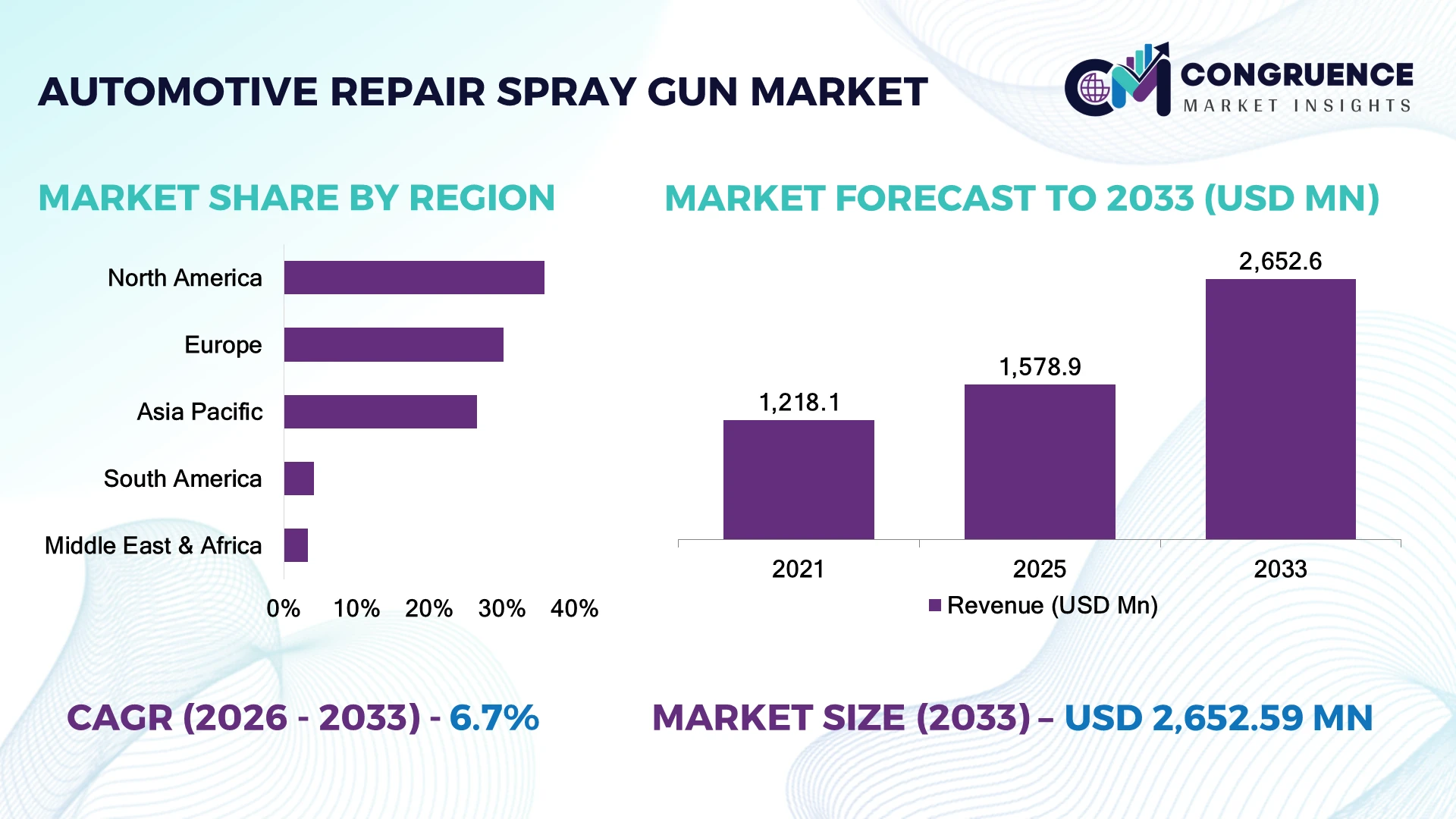
The United States leads the market with an estimated 31% global share, supported by more than 40,000 collision repair facilities, sustained investment in advanced refinishing equipment, and widespread adoption of HVLP spray technology exceeding 78% among professional repair centers. Compared with Germany, where premium OEM-certified repair networks emphasize precision finishing, the U.S. processes significantly higher repair volumes driven by a larger vehicle parc. Continued supply-chain diversification following recent geopolitical trade realignments has further encouraged regional production and equipment sourcing resilience.
This operating environment favors manufacturers offering precision, compliance, and productivity advantages through technologically advanced automotive repair spray gun solutions.
Market Size & Growth: USD 1,578.9 million in 2025, reaching USD 2,652.6 million by 2033 at 6.7% CAGR, driven by advanced collision repair technologies.
Top Growth Drivers: HVLP adoption 78%, vehicle repair demand +11%, OEM refinishing standards +15%.
Short-Term Forecast: By 2028, paint transfer efficiency improves 18% while coating waste declines 14%.
Emerging Technologies: Smart pressure control, HVLP optimization, and electrostatic systems improve finish consistency by 20%.
Regional Leaders: North America, Europe, and Asia-Pacific lead, supported by expanding certified body-shop networks.
Consumer/End-User Trends: Nearly 70% of professional workshops prefer lightweight ergonomic spray guns for productivity.
Pilot/Case Example: 2026 digital spray optimization programs reduced repaint rates by approximately 16%.
Competitive Landscape: Leading suppliers collectively hold about 48% market share, led by SATA, ANEST IWATA, DeVilbiss, and Sagola.
Regulatory & ESG Impact: VOC-compliant coating processes reduce overspray emissions by approximately 25%.
Investment & Funding: More than USD 450 million supports production expansion, automation, and regional manufacturing diversification.
Innovation & Future Outlook: AI-assisted spray calibration and connected equipment strengthen quality, repeatability, and workshop efficiency.
The Automotive Repair Spray Gun Market is evolving through demand from collision repair centers, OEM-authorized workshops, and commercial fleet maintenance providers. Lightweight composite spray guns, digital pressure regulation, and high-efficiency atomization technologies improve coating utilization by nearly 18%. Stricter environmental compliance and localized manufacturing strategies are accelerating adoption of precision refinishing equipment, setting the foundation for broader strategic market transformation.
The automotive repair spray gun market has become strategically important as repair quality, workshop productivity, and environmental compliance increasingly determine competitive differentiation across the collision repair industry. VOC regulations, digital workflow integration, and localized equipment manufacturing are encouraging repair centers to replace conventional spray systems with precision-controlled alternatives that improve finish consistency while reducing operational waste.
Modern HVLP and digital pressure-regulated spray guns deliver approximately 20% higher transfer efficiency than conventional high-pressure equipment while lowering paint consumption by nearly 15%. North America maintains leadership through mature collision repair infrastructure and OEM-certified body shops, whereas Asia-Pacific is expanding rapidly with growing vehicle ownership and investments in independent repair networks. Over the next two to three years, digital calibration features are expected to become standard across premium repair equipment, improving technician productivity and coating consistency.
Manufacturers are strengthening distribution partnerships, expanding regional assembly capacity, and introducing modular spray platforms compatible with multiple coating formulations. Workshops adopting connected spray technologies and operator training programs achieve faster turnaround times, lower material costs, and improved refinishing quality, positioning themselves for sustained competitiveness in an increasingly quality-driven automotive aftermarket.
Stricter refinishing quality standards and higher repair throughput requirements are driving replacement of conventional spray guns with precision HVLP and LVLP systems. More than 72% of OEM-certified body shops now prioritize high-transfer-efficiency equipment, while digital pressure regulation reduces paint consumption by approximately 15% and improves finish consistency by nearly 18%. Germany's tighter VOC compliance requirements and the United States' expanding certified collision repair networks are accelerating technology upgrades across independent workshops. This shift increases demand for lightweight composite spray guns with integrated pressure monitoring. Manufacturers are responding through product portfolio expansion, ergonomic redesigns, and partnerships with paint suppliers to deliver optimized coating systems. A key strategic advantage now lies in integrating spray equipment with standardized refinishing workflows that reduce rework while improving technician productivity.
Premium automotive repair spray guns depend on precision air caps, stainless steel fluid passages, and advanced nozzle assemblies whose manufacturing remains concentrated among specialized suppliers. Raw material and precision machining costs have increased production expenses by approximately 12%, while delivery lead times for critical components remain 15% longer than pre-disruption levels. VOC compliance requirements also require frequent product redesign and certification, increasing development costs for manufacturers. Smaller distributors and independent workshops face slower equipment replacement cycles because of higher acquisition costs. Companies are reducing exposure by localizing component sourcing, expanding regional assembly operations, negotiating long-term supplier agreements, and introducing modular platforms with interchangeable parts. Operational resilience increasingly depends on supply-chain flexibility rather than manufacturing scale alone.
Connected refinishing technologies are creating opportunities beyond conventional spray equipment sales. Smart spray guns equipped with digital pressure monitoring, wireless diagnostics, and operator guidance improve coating utilization by nearly 20% while reducing overspray by approximately 16%. Japan and South Korea are accelerating adoption of Industry 4.0-enabled body shop operations where connected refinishing equipment integrates with digital repair planning systems. Manufacturers are investing in software-enabled maintenance services, AI-assisted spray optimization, and cloud-based performance analytics to create recurring revenue models. A particularly attractive opportunity lies in retrofit kits that modernize existing equipment at substantially lower cost than complete replacement, allowing independent workshops to achieve productivity gains without major capital investment.
Advanced automotive repair spray guns increasingly require digital calibration, pressure optimization, and coating parameter management that exceed traditional technician skill sets. Nearly 34% of repair workshops report shortages of technicians qualified to operate advanced refinishing systems, while improper equipment calibration can reduce transfer efficiency by more than 20%. Australia and Canada continue expanding vocational training for collision repair specialists, yet workforce development has not matched technology deployment. Manufacturers must invest in digital training platforms, certification programs, remote technical assistance, and intuitive user interfaces to improve adoption consistency. Long-term competitiveness will depend on simplifying advanced spray technologies without compromising coating quality, operational repeatability, or regulatory compliance.
Smart Spray Gun Integration Digital pressure monitoring and automatic parameter adjustment are transforming refinishing operations. Connected spray systems improve coating consistency by approximately 18% while reducing material waste by 15%. Professional repair centers are integrating these tools into digital workflow platforms, enabling faster technician setup, improved repeatability, and standardized repair quality across multi-location service networks.
High-Efficiency Atomization Expansion Advanced HVLP and LVLP atomization technologies continue replacing conventional high-pressure equipment as environmental regulations tighten. Transfer efficiency has improved by nearly 20%, while overspray declines by approximately 17%. Manufacturers are expanding lightweight ergonomic product lines and collaborating with coating suppliers to optimize equipment performance for low-VOC paint systems.
Localized Manufacturing Strategies Supply-chain diversification is reshaping production footprints as manufacturers reduce dependence on single-region sourcing. Regional assembly operations have expanded by approximately 14%, while localized component procurement lowers logistics costs by nearly 10%. Companies are strengthening supplier partnerships and increasing inventory flexibility to maintain stable equipment availability despite international trade disruptions.
Data-Driven Workshop Optimization Repair facilities increasingly use digital performance analytics to monitor paint consumption, operator efficiency, and equipment utilization. Automated process tracking improves workshop productivity by around 16% while reducing repaint frequency by approximately 12%. Equipment suppliers are responding with software-enabled service packages, predictive maintenance capabilities, and integrated technician training that strengthen long-term customer retention.
The market is segmented into HVLP (High Volume Low Pressure), LVLP (Low Volume Low Pressure), Conventional Spray Guns, Airless Spray Guns, and Electrostatic Spray Guns. HVLP spray guns dominate with an estimated 46% market share because they combine high transfer efficiency, lower overspray, and compliance with stringent VOC regulations. Their compatibility with waterborne coatings and OEM-approved refinishing procedures makes them the preferred choice for certified collision repair facilities. LVLP spray guns represent the fastest-growing segment as smaller workshops increasingly prioritize reduced air consumption and lower compressor requirements without compromising finish quality.
Conventional spray guns continue serving price-sensitive workshops and emerging markets where equipment replacement cycles remain longer, while airless spray guns address high-build primer applications requiring rapid material coverage. Electrostatic spray guns are gaining strategic importance because they improve coating deposition efficiency by nearly 20% while reducing material waste by approximately 15%. Manufacturers are expanding ergonomic designs, digital pressure control features, and interchangeable nozzle platforms to strengthen product differentiation and support long-term investment priorities.
According to findings published by the International Bodyshop Industry Symposium (IBIS) during 2025 industry discussions, OEM-approved collision repair facilities continue increasing adoption of HVLP refinishing systems to improve transfer efficiency, coating consistency, and environmental compliance.
The market is segmented into Collision Repair, Vehicle Refinishing, Fleet Maintenance, Commercial Vehicle Repair, and Custom Paint & Restoration. Collision repair accounts for approximately 43% of market demand, supported by high repair frequency, insurer-approved repair workflows, and mandatory adherence to OEM refinishing standards. Vehicle refinishing is the fastest-growing application as aging vehicle fleets and premium cosmetic restoration services increase demand for advanced spray technologies that improve finish consistency while reducing paint consumption.
Fleet maintenance remains a stable demand segment where rapid turnaround and coating durability directly influence operating costs. Commercial vehicle repair continues expanding with growing logistics and public transportation fleets, while custom paint and restoration applications increasingly adopt precision atomization systems for specialty finishes. Manufacturers are introducing modular spray platforms, digital pressure regulation, and application-specific nozzle configurations that improve productivity by approximately 18% while lowering repaint rates by nearly 14%. These developments are shifting investment toward precision equipment capable of supporting diverse coating formulations across multiple repair environments.
A 2026 enterprise survey conducted by the National Institute for Automotive Service Excellence (ASE) indicated that repair facilities increasingly prioritize high-transfer-efficiency spray equipment to improve coating quality, technician productivity, and operational consistency.
The market is segmented into Independent Body Shops, OEM Authorized Service Centers, Automotive Dealership Workshops, Fleet Maintenance Service Providers, and Industrial Vehicle Repair Facilities. Independent body shops hold the largest share at approximately 41%, driven by extensive repair volumes, diverse customer requirements, and continuous equipment replacement to improve productivity. OEM-authorized service centers represent the fastest-growing end-user segment as manufacturers increasingly require certified refinishing procedures, approved coating systems, and digitally calibrated spray equipment to maintain warranty compliance and repair quality.
Automotive dealership workshops continue investing in premium refinishing capabilities to strengthen aftersales operations, while fleet maintenance providers prioritize durable equipment that minimizes downtime across commercial vehicles. Industrial vehicle repair facilities increasingly adopt high-capacity spray systems for specialized coatings and large-surface applications. Suppliers are responding with customized service packages, technician certification programs, and flexible pricing models that improve customer retention while supporting long-term equipment upgrades. Investment is steadily shifting toward digitally enabled spray systems that enhance repeatability, efficiency, and regulatory compliance.
The 2025 International Bodyshop Industry Symposium (IBIS) reported that certified repair networks continue expanding investment in advanced refinishing equipment to improve repair quality, workflow standardization, and operational efficiency across professional collision repair facilities.
North America accounted for the largest market share at 35.8%in 2025 however, Asia-Pacific is expected to register the fastest growth, expanding at a CAGR of 8.1% between 2026 and 2033.
Advanced Collision Repair Networks Drive Technology Adoption
North America maintains market leadership through its extensive collision repair infrastructure, mature aftermarket ecosystem, and widespread adoption of OEM-certified refinishing practices. Professional repair facilities increasingly deploy HVLP and digitally regulated spray guns to improve coating consistency while complying with VOC regulations. The region contributes the highest concentration of certified body shops globally, supported by strong insurance-backed repair volumes and continuous equipment replacement cycles. Investment in automated paint mixing systems and connected refinishing workstations has improved workshop productivity by approximately 17%, encouraging suppliers to introduce digitally calibrated spray platforms and ergonomic equipment designed for high-throughput repair environments.
United States Market Outlook: The United States remains the region's strategic growth engine due to its expansive collision repair industry, advanced aftermarket distribution network, and strong OEM certification ecosystem. More than 40,000 professional collision repair facilities create sustained demand for precision refinishing equipment, while HVLP spray technology is deployed by over 78% of certified body shops. Equipment manufacturers continue expanding technical training programs and regional service capabilities to strengthen customer retention and operational performance.
Environmental Compliance Reshapes Refinishing Equipment
Europe's market is driven by strict environmental regulations, premium automotive manufacturing, and highly standardized repair procedures. Waterborne coating adoption and VOC reduction targets have accelerated replacement of conventional spray systems with HVLP and electrostatic technologies. Germany, Italy, and France remain major production and deployment hubs, while investments in digitally controlled refinishing equipment improve coating utilization and workshop efficiency. Professional distributors increasingly collaborate with paint manufacturers to deliver integrated refinishing solutions that enhance regulatory compliance and reduce operating costs.
Germany Market Outlook: Germany leads the European market through its strong automotive manufacturing base, advanced body repair infrastructure, and widespread OEM-certified service centers. Precision refinishing standards encourage early adoption of digitally controlled spray equipment capable of supporting premium coating systems. Equipment suppliers continue strengthening technical partnerships with vehicle manufacturers and coating companies, while productivity improvements of approximately 18% reinforce demand for advanced spray technologies across professional repair facilities.
Manufacturing Scale Supports Rapid Equipment Modernization
Asia-Pacific is emerging as the fastest-expanding market, supported by rising vehicle ownership, expanding collision repair capacity, and competitive manufacturing ecosystems. China, Japan, and South Korea continue investing in advanced automotive repair infrastructure while regional manufacturers increase production of affordable high-efficiency spray equipment. Localized manufacturing and export-oriented production have reduced equipment delivery times by approximately 15%, encouraging broader adoption across independent workshops. Companies continue expanding dealer networks and localized technical support to strengthen regional market penetration.
China Market Outlook: China represents the region's largest opportunity through its extensive automotive production capacity, expanding aftermarket services, and rapidly modernizing repair sector. Continuous investments in intelligent manufacturing and professional body shop development are accelerating adoption of digitally controlled spray guns. Domestic manufacturers are improving product quality through automation and precision machining while strengthening export competitiveness across global aftermarket distribution channels.
Aftermarket Expansion Strengthens Professional Demand
South America benefits from an expanding vehicle parc, increasing independent repair activity, and gradual modernization of professional refinishing practices. Brazil and Argentina continue investing in collision repair capabilities as insurance-supported vehicle repairs increase demand for efficient spray technologies. Workshop modernization programs have improved adoption of HVLP equipment by approximately 14%, although infrastructure limitations and import dependency continue affecting premium equipment availability. Suppliers are expanding regional distribution partnerships and localized inventory management to improve product accessibility and customer support.
Brazil Market Outlook: Brazil leads the regional market through its extensive automotive manufacturing industry, established aftermarket network, and growing professional collision repair sector. Rising investments in certified repair facilities are increasing demand for efficient refinishing equipment capable of reducing material waste and improving productivity. Manufacturers continue strengthening local distributor partnerships while expanding technical training initiatives that improve equipment utilization and long-term customer engagement.
Infrastructure Investment Supports Market Modernization
The Middle East & Africa market is advancing through automotive service modernization, expanding dealership networks, and increasing investment in premium vehicle maintenance infrastructure. Gulf countries continue upgrading repair facilities with digitally controlled refinishing equipment, while South Africa remains an important aftermarket servicing hub. New investments in automotive service centers and technician development have improved deployment of advanced spray systems by approximately 13%, encouraging suppliers to establish stronger regional distribution and aftersales support capabilities.
United Arab Emirates Market Outlook: The United Arab Emirates serves as the region's primary technology and distribution hub for automotive refinishing equipment. Strong demand for premium vehicle repair services, advanced dealership infrastructure, and international aftermarket brands supports consistent equipment upgrades. Service providers increasingly adopt digitally calibrated spray systems to improve repair quality, reduce coating waste, and meet international refinishing standards across high-value automotive repair operations.
Global leaders including SATA, ANEST IWATA, Graco, DeVilbiss and Sagola compete directly against regional value-focused manufacturers and private-label suppliers serving independent repair workshops. The top five players collectively control approximately 58% of global market share through premium engineering, established distributor networks, and OEM-approved equipment. Competition centers on transfer efficiency exceeding 70%, overspray reduction of 20–30%, ergonomic improvements near 25%, and rapid aftermarket support. Premium brands differentiate through digital pressure monitoring, advanced nozzle technology, certified training programs, and strategic partnerships with coating manufacturers, while lower-cost suppliers compete primarily on pricing and localized availability. The competitive shift favors intelligent spray systems compatible with waterborne coatings, accelerating replacement of conventional equipment. High certification requirements, precision manufacturing capabilities, and distributor relationships create significant entry barriers for new manufacturers. Winning requires combining compliant technology, dependable application performance, responsive service networks, and continuous product innovation that delivers measurable productivity gains across professional collision repair operations.
SATA GmbH & Co. KG
ANEST IWATA Corporation
Graco Inc.
DeVilbiss Automotive Refinishing
Sagola S.A.
J. Wagner GmbH
Nordson Corporation
3M Company
C.A. Technologies
Walcom S.r.l.
Binks
Astro Pneumatic Tool Company
Automotive repair spray gun technology is shifting toward digitally controlled, high-transfer-efficiency platforms that improve coating quality while reducing material consumption. HVLP and LVLP systems remain the dominant technologies, representing nearly 72% of professional workshop installations, while digital pressure gauges and smart airflow regulation improve coating consistency by approximately 15%. Advanced nozzle geometries and lightweight composite bodies reduce operator fatigue by nearly 20%, enabling higher daily throughput in collision repair centers.
Emerging innovations include IoT-enabled pressure monitoring, quick-change nozzle assemblies, and modular cup systems integrated with digital paint management software. Compared with conventional spray guns, intelligent HVLP platforms improve transfer efficiency by approximately 18% while reducing paint waste by nearly 22%. Professional repair chains and OEM-certified body shops benefit most because standardized application parameters improve repeatability, technician productivity, and refinishing quality across multiple locations. Automation-ready spray equipment is also gaining adoption within high-volume repair facilities.
Between 2026 and 2028, AI-assisted calibration, digital process validation, and connected maintenance diagnostics are expected to accelerate equipment modernization. More than 45% of newly equipped professional body shops are projected to prioritize connected spray platforms over conventional alternatives. Manufacturers investing in smart ergonomics, precision atomization, and software integration will strengthen competitive positioning as regulatory compliance, operational efficiency, and material optimization become decisive purchasing criteria.
September 2024 Graco introduced the Stellair ACE and Stellair industrial air spray guns with Ergonomics Performance Certification; the carbon-reinforced Stellair ACE weighs only 209 grams and requires up to 25% less muscle effort, improving painter productivity and reducing fatigue. Source: graco.com (Graco)
December 2024 SATA detailed the commercial development of its jet X spray gun, highlighting redesigned nozzle technology, integrated digital functionality, and production readiness to enhance coating precision and professional refinishing performance. Source: sata.com (SATA)
February 2025 SATA and I-CAR showcased new jet X technologies, adam X digital pressure monitoring, and disposable cup innovations during Repairers Realm, strengthening technician training and accelerating adoption of digitally enabled refinishing workflows across collision repair facilities. Source: I-CAR Repairers Realm (I-CAR Repairability Technical Support)
August 2024 3M introduced its next-generation Performance Spray Gun featuring a carbon-fiber frame and modular quick-change nozzle system, significantly reducing cleanup time while improving workflow flexibility for professional automotive refinish operations. Source: Technavio (Technavio)
This report provides comprehensive assessment of the automotive repair spray gun market across product types, repair applications, and end-user categories, evaluating technology adoption, equipment replacement trends, and purchasing behavior across major automotive repair ecosystems. The study covers professional HVLP, LVLP, conventional, airless, and electrostatic systems, analyzes demand across collision repair centers, OEM-authorized workshops, independent garages, and industrial refinishing facilities, and benchmarks more than 30 major equipment manufacturers operating across five key regions.
The analysis examines regional deployment patterns, distribution networks, regulatory influences, digital spray technologies, ergonomic innovations, and sustainable coating compatibility. It incorporates quantitative indicators including segment share distribution, equipment adoption rates, workshop modernization trends, and technology penetration to support investment prioritization, market entry planning, competitive benchmarking, product positioning, partnership evaluation, and long-term expansion strategies across developed and emerging automotive refinishing markets between 2026 and 2033.
| Report Attribute/Metric | Report Details |
|---|---|
|
Market Revenue in 2025 |
USD 1,578.9 Million |
|
Market Revenue in 2033 |
USD 2,652.6 Million |
|
CAGR (2026 - 2033) |
6.7% |
|
Base Year |
2025 |
|
Forecast Period |
2026 - 2033 |
|
Historic Period |
2021 - 2025 |
|
Segments Covered |
By Type
By Application
By End-User
|
|
Key Report Deliverable |
Revenue Forecast, Growth Trends, Market Dynamics, Segmental Overview, Regional and Country-wise Analysis, Competition Landscape |
|
Region Covered |
North America, Europe, Asia-Pacific, South America, Middle East, Africa |
|
Key Players Analyzed |
SATA GmbH & Co. KG, ANEST IWATA Corporation, Graco Inc., DeVilbiss Automotive Refinishing, Sagola S.A., J. Wagner GmbH, Nordson Corporation, 3M Company, C.A. Technologies, Walcom S.r.l., Binks, Astro Pneumatic Tool Company |
|
Customization & Pricing |
Available on Request (10% Customization is Free) |




