
Reports
The Global Automotive Relay Tester Market was valued at USD 345.9 Million in 2025 and is anticipated to reach a value of USD 659.5 Million by 2033 expanding at a CAGR of 8.4% between 2026 and 2033. Growth is being driven by increasing relay content in electrified vehicles, higher electrical-system complexity, automated end-of-line testing, and stricter requirements for component reliability and traceability.
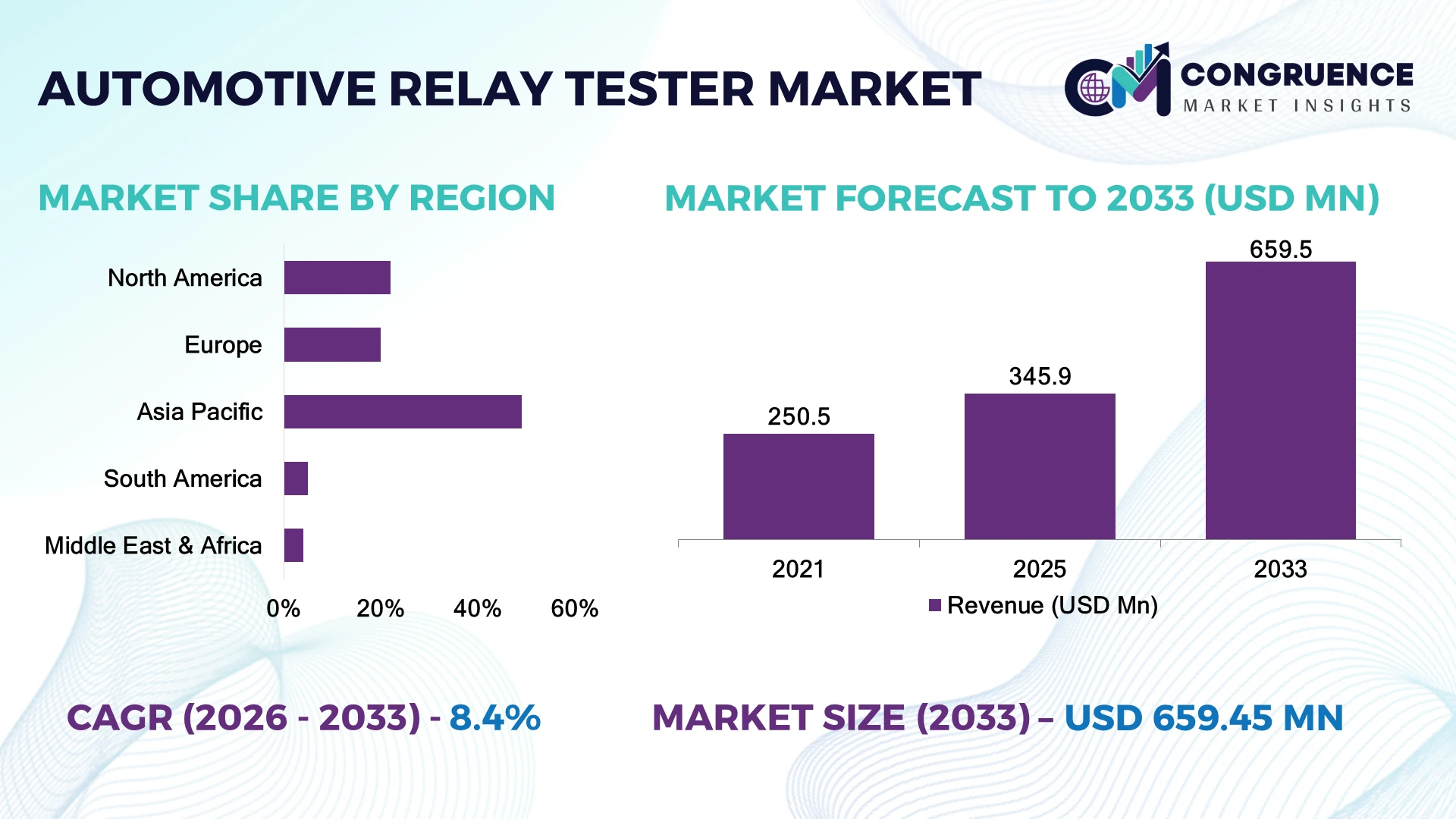
China represents the dominant country market, supported by its approximately 48% share of global automotive-relay production and extensive EV manufacturing capacity. India is emerging faster through EV and component localization, with automotive suppliers increasing capital deployment; one major Indian supplier invested about INR 10 billion over recent years. Compared with India, Japan emphasizes high-precision component validation and automated production. Electrified platforms are increasing relay-testing complexity as high-voltage applications expand rapidly.
The strategic priority is to invest in automated, programmable testers capable of validating conventional and high-voltage relays across increasingly software-defined vehicle architectures.
Market Size & Growth: USD 345.9 Million in 2025 to USD 659.5 Million by 2033 at 8.4% CAGR, driven by vehicle electrification and electronic complexity.
Top Growth Drivers: EV adoption 16.6%, relay-content expansion 10%+, automated testing 30%+.
Short-Term Forecast: By 2028, automated testing can reduce relay validation time by 20–30%.
Emerging Technologies: AI diagnostics, programmable load testing, high-voltage simulation, and automated end-of-line inspection.
Regional Leaders: Asia-Pacific leads, followed by North America and Europe, with EV-focused tester adoption accelerating.
Consumer/End-User Trends: OEM and Tier-1 testing accounts for more than 60% of professional tester demand.
Pilot/Case Example: 2026 remote automotive testing frameworks demonstrated relay-controlled component testing with real-time synchronization.
Competitive Landscape: Leading suppliers include Bosch, Denso, TE Connectivity, Omron, Panasonic and specialized diagnostic-equipment manufacturers.
Regulatory & ESG Impact: Functional and electrical testing supports higher component reliability and reduces premature replacement by approximately 5–10%.
Investment & Funding: India’s automotive-component investment is accelerating, with one supplier committing about INR 10 billion to capacity expansion.
Innovation & Future Outlook: 2026–2028 development will prioritize high-voltage, automated, software-connected testers for EV and SDV production.
The Automotive Relay Tester Market is increasingly concentrated around EV manufacturing, Tier-1 component validation, aftermarket diagnostics, and automated production lines. High-voltage relay requirements are expanding rapidly alongside electrification, while software-defined vehicle architectures are increasing the need for programmable test protocols and traceable results. India’s accelerating EV component localization and China’s manufacturing scale are strengthening demand for faster, digitally connected testing equipment, setting up the market for a shift toward automated validation platforms.
Automotive relay testing is becoming strategically important as vehicle electrical architectures shift from relatively simple switching systems toward high-voltage, software-controlled platforms. EVs use substantially more sophisticated power-management components, increasing the importance of resistance, switching, insulation, load, endurance, and thermal validation. The transition is particularly visible in China and India, where EV manufacturing and component localization are expanding production capacity and increasing pressure for automated quality assurance.
Automated relay testers can reduce repetitive validation time by approximately 20–30% compared with manual bench testing while improving test repeatability and electronic traceability. Conventional workshops remain focused on plug-in diagnostic equipment, whereas OEM and Tier-1 production environments increasingly require programmable multi-channel systems capable of validating different relay specifications. High-voltage testing is becoming particularly important as EV relay applications expand rapidly.
During 2026–2028, manufacturers will increasingly integrate relay testers with automated production lines, MES platforms, barcode identification, data logging, and predictive diagnostics. A Tier-1 supplier can therefore validate relay batches automatically and associate every test result with a production lot, reducing manual documentation and accelerating fault isolation. Companies are responding through tester modularity, software upgrades, OEM partnerships, and expansion into EV component validation. Competitive advantage will depend on high-voltage capability, testing speed, interoperability, traceability, and the ability to support rapidly changing vehicle electrical architectures.
Vehicle electrification is increasing the number and criticality of relay validation points across battery-management, charging, thermal-management, and high-voltage distribution systems. Global EV sales exceeded 17 million units in 2024, while China represented more than 60% of worldwide electric-car sales, creating concentrated demand for automated electrical-component testing. High-voltage relay applications also require insulation, switching-load, endurance, and thermal validation beyond conventional continuity checks. Chinese OEMs and Tier-1 suppliers are therefore expanding automated end-of-line testing, while Indian manufacturers are localizing EV component production. Tester suppliers are responding with programmable loads, multi-channel architectures, and automated data capture. The strategic advantage is shifting toward equipment capable of validating multiple relay specifications without repeated manual reconfiguration.
Advanced automotive relay testers require precision power supplies, programmable loads, insulation measurement, thermal protection, and specialized switching hardware, increasing capital requirements versus conventional diagnostic testers. High-voltage EV applications can require testing at 400–800 V, while automated multi-channel platforms can cost 30–50% more than basic relay-testing equipment. Semiconductor and electronic-component supply disruptions also create procurement exposure for specialized test hardware. Smaller workshops in India and Southeast Asia consequently face longer equipment-payback periods than OEM production facilities. Manufacturers are mitigating the constraint through modular architectures, locally sourced power electronics, standardized interfaces, and leasing arrangements. The non-obvious pressure point is utilization: low-volume users cannot justify advanced testers unless suppliers support multi-purpose configurations covering conventional and high-voltage relay applications.
The strongest opportunity is integrating relay testers directly into EV component production and digital quality systems. Automated end-of-line testing can reduce repetitive validation labor by approximately 20–30%, while barcode-linked test records can improve production traceability by more than 90% compared with paper-based documentation. China offers the largest near-term deployment opportunity because of its EV manufacturing concentration, while India is expanding localized battery, power-electronics, and automotive-component production. Next-generation testers are incorporating programmable high-voltage loads, AI-assisted fault classification, Ethernet connectivity, and MES integration. Suppliers are positioning through OEM partnerships and customized test fixtures. A particularly valuable niche is flexible test cells that validate relays, contactors, fuses, and switching assemblies within one platform, improving equipment utilization and customer return on investment.
The transition toward software-defined vehicles is increasing test-system integration requirements because relay validation increasingly connects with battery-management systems, vehicle controllers, power electronics, and manufacturing execution platforms. EV platforms commonly operate at 400–800 V, while some high-performance architectures reach approximately 800 V, raising insulation, arc-management, and safety requirements. Around 30% of automotive test-system development effort is increasingly directed toward software, connectivity, or data-management functions rather than hardware alone. China can scale advanced production quickly, but suppliers must maintain compatibility across rapidly changing OEM specifications. Companies need investment in configurable test software, cybersecurity, protocol interoperability, automated calibration, and technician training. The strategic challenge is sustaining tester relevance as relay specifications and vehicle electrical architectures change faster than conventional equipment replacement cycles.
High-Voltage Testing Expands: EV architectures operating at 400–800 V are pushing relay testers beyond conventional continuity and resistance checks toward insulation, switching-load, endurance, and thermal validation. High-voltage capability is becoming a purchasing criterion for OEM and Tier-1 production lines, while suppliers are introducing modular test fixtures and programmable power systems to support changing EV platforms.
Automated End-Line Testing Scales: Automotive manufacturers are replacing manual relay inspection with automated multi-channel testing that can reduce repetitive validation time by approximately 20–30%. China’s high-volume EV plants are leading deployment, integrating barcode identification and automatic test-result storage. Equipment providers are responding with MES connectivity and recipe-based testing to reduce operator intervention and improve production traceability.
Software Becomes Test Differentiator: Relay testers are increasingly connected through Ethernet, CAN, and manufacturing data systems, with software and analytics representing an estimated 25–30% of premium system functionality. Automated fault classification and digital test records are reducing diagnostic effort while enabling production engineers to identify recurring relay failures. Suppliers are investing in configurable software rather than hardware-only platforms.
Flexible Test Cells Gain Ground: Manufacturers are increasingly seeking equipment that handles multiple switching components rather than dedicated relay-only machines. Multi-purpose platforms can improve equipment utilization by approximately 15–25% where production mixes change frequently. Indian and Southeast Asian Tier-1 suppliers are favoring modular fixtures and replaceable test modules, allowing one tester architecture to accommodate conventional relays, EV contactors, and related power-distribution components.
Automated automotive relay testers represent the leading type, accounting for approximately 52% of market demand, because OEM and Tier-1 production lines require repeatable electrical, endurance, and high-voltage validation at production speed. Manual relay testers retain relevance in workshops and lower-volume component operations, but their share is gradually declining as automated systems provide higher throughput and digital traceability. Semi-automated platforms account for roughly 28%, serving suppliers that need greater flexibility without the capital intensity of fully automated cells.
High-voltage automated testers are the fastest-growing type, supported by EV contactor and relay applications across 400–800 V architectures. Approximately 30% of new tester specifications increasingly include programmable load, insulation, or endurance functions. Suppliers are responding with modular fixtures, multi-channel architectures, automated calibration, and MES connectivity. The business implication is a shift in investment from basic diagnostic equipment toward configurable production-test platforms capable of supporting both conventional and electrified vehicle programs.
The International Energy Agency reported that global electric-car sales exceeded 17 million in 2024, while China accounted for almost two-thirds of global electric-car sales, reinforcing the production shift toward higher-voltage electrical-component validation.
OEM production-line testing represents the leading application, accounting for approximately 44% of automotive relay tester demand. High-volume assembly requires automated switching, resistance, insulation, load, and endurance checks with electronic traceability, making production environments significantly more equipment-intensive than aftermarket diagnostics. Tier-1 component manufacturing follows at approximately 31% and is the fastest-growing application as suppliers expand EV-specific relay and contactor production. Aftermarket diagnostics and repair workshops remain important but favor compact, lower-cost instruments.
Around 35% of new production-test requirements increasingly incorporate programmable electrical loads or automated data capture, reflecting the transition toward electronically controlled manufacturing. OEMs are integrating testers with MES, barcode systems, and automated handling, while Tier-1 suppliers are adopting modular platforms to accommodate changing customer specifications. Companies are therefore prioritizing scalable test cells rather than dedicated machines. The operational advantage is higher equipment utilization across multiple relay variants, reducing changeover time and strengthening traceability across high-volume production programs.
The International Organization of Motor Vehicle Manufacturers reported that global vehicle production remained concentrated across major manufacturing economies in 2025, reinforcing the importance of scalable end-of-line testing infrastructure for high-volume OEM and component plants.
Automotive OEMs represent the leading end-user group, accounting for approximately 47% of demand because they define vehicle-level electrical specifications and require stringent end-of-line validation. Tier-1 suppliers contribute roughly 38% and represent the fastest-growing buyer group as EV platforms increase relay, contactor, power-distribution, and battery-management requirements. Independent testing laboratories and aftermarket service providers account for the remaining demand, emphasizing flexibility and diagnostic functionality rather than high-throughput production integration.
OEM purchasing typically favors customized automated systems integrated with manufacturing execution and quality platforms, whereas Tier-1 suppliers increasingly prioritize modular testers capable of supporting multiple programs. Approximately 40% of Tier-1 purchasing requirements increasingly emphasize digital traceability and automated reporting. Suppliers are responding through customized fixtures, software libraries, calibration services, and long-term technical partnerships. India is becoming strategically important as global automakers expand local manufacturing and export capacity, while China retains the strongest volume concentration. The competitive priority is therefore shifting toward specification-driven platforms that can scale across vehicle programs without repeated hardware redesign.
The International Energy Agency reported in 2026 that Chinese automakers supplied 60% of global electric-car sales in 2025, while European and North American automakers each accounted for about 15%, highlighting the concentration of EV production influence in China and the resulting importance of localized component-testing capacity.
Asia-Pacific accounted for the largest market share at 49% in 2025 however, Asia-Pacific is expected to register the fastest growth, expanding at a CAGR of 9.4% between 2026 and 2033.

EV Production Drives High-Voltage Test Modernization
North America represents approximately 22% of global automotive relay tester demand, supported by established OEM production, Tier-1 electronics manufacturing, EV programs, and advanced vehicle testing infrastructure. The United States contributes nearly 82% of regional demand, with Michigan, Ohio, Kentucky, and Tennessee remaining important automotive manufacturing hubs. More than 40% of new production-test specifications increasingly require programmable electrical loads, automated data capture, or high-voltage validation. EV and hybrid platforms are increasing requirements for contactor and relay testing across battery and power-distribution systems. U.S. manufacturers are upgrading end-of-line stations with automated fixtures, MES connectivity, and traceability tools. Suppliers are responding through modular high-voltage platforms and application-specific partnerships. The strategic shift is toward flexible testers capable of supporting multiple vehicle architectures without major production-line redesign.
United States Market Outlook: The United States remains North America's principal market because of its concentration of vehicle assembly plants, Tier-1 suppliers, battery factories, and advanced automotive engineering centers. More than 40% of major new electrified-vehicle production programs increasingly incorporate automated electrical-component validation. Michigan and the southern automotive corridor are particularly important deployment centers, supporting demand for programmable relay testers, automated fixtures, and high-voltage safety validation.
Electrification Raises Component Validation Standards
Europe accounts for approximately 20% of global automotive relay tester demand, supported by Germany, France, Italy, Spain, and Central European manufacturing clusters. Germany contributes roughly 35% of regional demand because of its concentration of premium OEMs, powertrain suppliers, electronics manufacturers, and vehicle engineering facilities. Approximately 35% of new automotive test requirements increasingly incorporate automated electrical validation and digital traceability. The shift toward EVs and plug-in hybrids is increasing demand for insulation, endurance, switching-load, and thermal testing rather than basic continuity checks. European manufacturers are emphasizing flexible equipment that supports multiple vehicle programs while maintaining strict quality documentation. Tester suppliers are responding through software-configurable platforms, high-voltage modules, and integration with automated production systems.
Germany Market Outlook: Germany remains Europe's most significant automotive relay tester market because of its dense OEM and Tier-1 manufacturing ecosystem. Bavaria, Baden-Württemberg, and Lower Saxony host major vehicle and component production clusters requiring advanced electrical validation. Approximately one-third of new electrified-vehicle production programs increasingly require automated high-voltage component testing, supporting demand for programmable relay and contactor test systems. German buyers also emphasize traceability, calibration, and integration with production-quality systems.
Manufacturing Scale Accelerates Automated Testing
Asia-Pacific commands approximately 49% of global automotive relay tester demand, making it the largest market by a substantial margin. China represents roughly 62% of regional demand, supported by its EV manufacturing scale, battery ecosystem, electronics supply chain, and extensive Tier-1 supplier base. India, Japan, and South Korea provide additional high-value demand through vehicle production and component localization. More than 45% of new high-volume automotive component lines increasingly incorporate automated electrical testing. China is accelerating high-voltage relay and contactor validation as EV platforms scale, while India is expanding domestic component manufacturing. Suppliers are establishing localized service networks, configurable test platforms, and production-line integration capabilities. The key advantage is equipment scalability: high-volume factories favor multi-channel testers that validate multiple relay variants with minimal changeover.
China Market Outlook: China is the dominant national market because it combines the world's largest EV manufacturing ecosystem with extensive automotive electronics and component production. More than 60% of global electric-car sales are concentrated in China, strengthening demand for high-voltage relay and contactor validation. Guangdong, Shanghai, Jiangsu, and Zhejiang are important manufacturing hubs, where suppliers increasingly integrate automated testing with MES, barcode tracking, and digital quality systems.
Localized Automotive Production Supports Test Equipment Demand
South America contributes approximately 5% of global automotive relay tester demand, with Brazil accounting for more than 60% of regional activity. Automotive production in São Paulo, Minas Gerais, Paraná, and Bahia creates the strongest concentration of component-testing requirements. Around 25% of major automotive component manufacturers increasingly use automated electrical testing, although manual and semi-automated systems remain important among smaller suppliers. Brazil's vehicle electrification initiatives are gradually increasing requirements for higher-voltage relay and contactor validation. Suppliers are responding with modular testers, localized technical support, and flexible financing models that reduce upfront equipment costs. The market remains more price-sensitive than North America or Germany, making multi-purpose test equipment particularly attractive. Providers that combine conventional relay diagnostics with EV-oriented capabilities can improve equipment utilization and broaden customer coverage.
Brazil Market Outlook: Brazil represents the strongest South American opportunity because of its automotive manufacturing base and concentration of component suppliers. São Paulo and Minas Gerais remain important production centers, while investments in vehicle electrification are gradually increasing requirements for electronic and high-voltage component validation. Approximately 25% of larger component manufacturers increasingly employ automated electrical testing, creating demand for scalable testers that can support both conventional automotive relays and emerging EV contactors.
Automotive Localization Creates New Testing Capacity
Middle East & Africa accounts for approximately 4% of global automotive relay tester demand, with South Africa and selected Gulf markets representing the principal deployment centers. South Africa contributes nearly 45% of regional demand through its established vehicle assembly and component-manufacturing ecosystem. Approximately 20% of larger automotive component operations increasingly use automated electrical testing, while new localization initiatives are creating additional opportunities. Morocco and Egypt are becoming important manufacturing locations for automotive components and wiring systems, increasing requirements for production-line validation. Suppliers are entering through distributor networks, local service partnerships, and modular equipment packages. High equipment-import costs and limited specialist support remain constraints, making remote diagnostics and localized maintenance strategically valuable. The strongest opportunity lies in new automotive manufacturing capacity where testers can be specified during factory and production-line design.
South Africa Market Outlook: South Africa remains the region's most established automotive testing market because of its vehicle assembly plants, export-oriented component manufacturing, and established supplier network. Gauteng and the Eastern Cape are important automotive production centers. Approximately 20% of larger component operations increasingly use automated electrical validation, while electrification and localization programs are encouraging suppliers to introduce programmable relay and contactor testing capabilities.
The market pits Doble, OMICRON, Megger, Fluke and Yokogawa against Chroma, Hioki and specialized Asian manufacturers, with global test-and-measurement leaders competing against cost-focused regional suppliers. The top five players hold an estimated 40% combined share, indicating meaningful concentration. Competition centers on accuracy, automation, high-voltage capability and service; premium systems command roughly 20–30% higher pricing, while automated platforms can reduce repetitive test time by 20–30%. Leading suppliers compete through software upgrades, expanded calibration networks, EV partnerships and modular test architectures. Chroma emphasizes automated EV testing, while Megger and Doble strengthen programmable relay-test ecosystems. The competitive shift is moving from standalone instruments toward connected, software-defined validation platforms supporting EV components. Entry barriers include calibration credibility, safety certification, application libraries, OEM relationships and specialized engineering expertise. Price pressure remains strongest in India and China, where localized suppliers challenge imported systems across Asia. Winning requires high-voltage capability, rapid testing, traceable data, flexible integration and dependable regional service.
Doble Engineering Company
OMICRON Electronics
Megger Group
Fluke Corporation
Yokogawa Electric Corporation
Chroma ATE
Kikusui Electronics
Hioki E.E. Corporation
Haefely Test
Ponovo Power
DV Power
SCOPE T&M
ASI Test Lab
Crest Technology
Automotive relay testing is moving from continuity checks toward programmable, multi-parameter systems covering resistance, switching time, load, insulation, endurance and thermal behavior. Automated platforms can cut repetitive validation time by 20–30%, while digital result capture improves traceability and reduces manual documentation. Around 35% of new production-test specifications require automated data acquisition or programmable loads.
High-voltage and hardware-in-the-loop testing are emerging as EV architectures expand from conventional 12/24-V electrical systems toward 400–800-V platforms. Testers combine programmable DC sources, electronic loads, CAN communication, insulation measurement and fault sequencing. Compared with manual bench testing, integrated systems can improve test throughput by roughly 25% and reduce operator intervention by 30%. Chroma, Megger, Doble and specialized suppliers benefit as OEMs demand flexible test environments rather than fixed instruments.
Between 2026 and 2028, software-defined testing will become the decisive technology layer. MES connectivity, barcode identification, automated calibration, remote diagnostics and AI-assisted fault classification will turn relay testers into production assets. Suppliers with open APIs and modular fixtures will gain an advantage because one platform can support conventional relays, EV contactors and evolving specifications. The investment priority is shifting toward scalable high-voltage hardware plus software that preserves test recipes, traceability and interoperability across multiple vehicle programs.
July 2025 Chroma ATE introduced a Power HIL system for EV on-board charger testing, handling CAN startup sequences within 200–600 ms and message forwarding within 10 ms. The development strengthens real-time automotive component validation and expands automated electrical test capabilities. Source: chromaate.com
October 2025 Hioki received a 2025 Good Design Award for CT6833 and CT6834 current probes, delivering ±0.07% DC accuracy and 50% smaller size. The compact instruments improve measurement access in constrained automotive spaces, supporting electrification-focused testing validation workflows globally. Source: hioki.com
December 2025 Doble scheduled advanced relay-testing training using its Protection Suite and F6150 platform, covering pickup, timing, instantaneous and target tests. The four-hour program strengthens automotive technician capability and supports broader automation and modern standardized relay-validation practices across service teams. Source: doble.com
January 2025 Chroma ATE released software for its 33011 Universal Relay Driver Control, supporting Windows 7/10/11. The update strengthens programmable relay-control integration and gives test developers a maintained software interface for automated test applications and production-system connectivity and traceability. Source: chromaate.com
The Automotive Relay Tester Market Report covers automated, semi-automated, and manual relay-testing systems across OEM production lines, Tier-1 component manufacturing, aftermarket diagnostics, R&D laboratories, and independent testing facilities. Analysis spans conventional low-voltage relays, high-voltage relays, EV contactors, switching assemblies, and multifunctional electrical test platforms. The report evaluates testing requirements including resistance, switching time, insulation, load, endurance, thermal behavior, and automated pass/fail validation.
Regional coverage includes North America, Europe, Asia-Pacific, South America, and Middle East & Africa, with detailed assessment of China, the United States, Germany, Japan, India, South Korea, Brazil, and South Africa. Technology analysis covers programmable loads, high-voltage simulation, CAN connectivity, MES integration, automated calibration, digital traceability, and hardware-in-the-loop testing. Approximately 35% of new production-test specifications increasingly emphasize automated data capture, helping decision-makers prioritize equipment investment, supplier partnerships, localization, capacity expansion, and competitive positioning through 2026–2033.
| Report Attribute/Metric | Report Details |
|---|---|
|
Market Revenue in 2025 |
USD 345.9 Million |
|
Market Revenue in 2033 |
USD 659.5 Million |
|
CAGR (2026 - 2033) |
8.4% |
|
Base Year |
2025 |
|
Forecast Period |
2026 - 2033 |
|
Historic Period |
2021 - 2025 |
|
Segments Covered |
By Type
By Application
By End-User
|
|
Key Report Deliverable |
Revenue Forecast, Growth Trends, Market Dynamics, Segmental Overview, Regional and Country-wise Analysis, Competition Landscape |
|
Region Covered |
North America, Europe, Asia-Pacific, South America, Middle East, Africa |
|
Key Players Analyzed |
Doble Engineering Company, OMICRON Electronics, Megger Group, Fluke Corporation, Yokogawa Electric Corporation, Chroma ATE, Kikusui Electronics, Hioki E.E. Corporation, Haefely Test, Ponovo Power, DV Power, SCOPE T&M, ASI Test Lab, Crest Technology |
|
Customization & Pricing |
Available on Request (10% Customization is Free) |




