
Reports
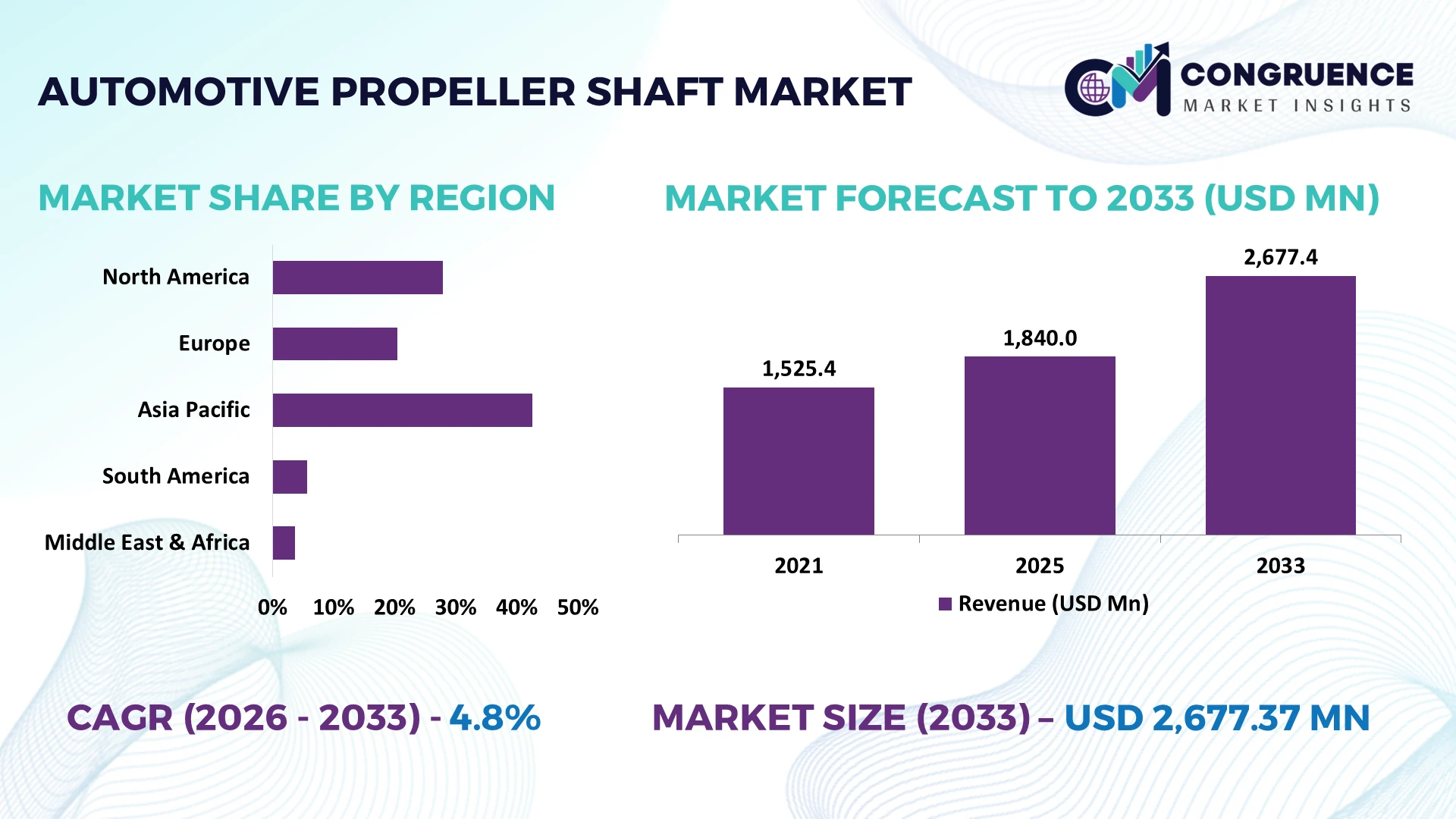
The Global Automotive Propeller Shaft Market was valued at USD 1,840.0 Million in 2025 and is anticipated to reach a value of USD 2,677.4 Million by 2033 expanding at a CAGR of 4.8% between 2026 and 2033. Growth is driven by expanding all-wheel-drive vehicle production, lightweight carbon-fiber and aluminum shaft adoption, and increasing demand for high-torque driveline systems in SUVs, pickup trucks, and commercial vehicles.
China dominates automotive propeller shaft manufacturing through its extensive automotive supply chain, producing over 31 million vehicles in 2024, compared with approximately 28.4 million in 2023. Domestic manufacturers benefit from integrated steel processing, aluminum extrusion, and precision forging capabilities. China's automotive industrial investments increasingly support automated shaft balancing, lightweight driveline components, and electric vehicle platforms, while the United States remains a major pickup truck and AWD technology market.
Strategically, manufacturers prioritizing localized production, lightweight materials, and high-precision driveline engineering will strengthen OEM supply relationships and improve long-term competitiveness.
Market Size & Growth: USD 1,840.0 million in 2025, reaching USD 2,677.4 million by 2033 at 4.8% CAGR, supported by AWD vehicle production and lightweight driveline integration.
Top Growth Drivers: AWD penetration, commercial vehicle electrification, and lightweight component adoption support estimated efficiency improvements of 3–8%, depending on vehicle configuration.
Short-Term Forecast: By 2028, advanced manufacturing programs target 5–10% reductions in shaft assembly weight through aluminum substitution and optimized tubular designs.
Emerging Technologies: Carbon-fiber composites, automated dynamic balancing, and AI-assisted vibration analysis support precision manufacturing and improved drivetrain efficiency.
Regional Leaders: Indicative 2033 scenarios place Asia Pacific at USD 1,044 million, North America at USD 696 million, and Europe at USD 616 million, reflecting production scale, pickup demand, and lightweight engineering.
Consumer/End-User Trends: SUVs, pickups, and AWD vehicles sustain demand for high-torque transmission components, with 4WD systems supporting specialized driveline requirements.
Pilot/Case Example: A modeled 2026 composite shaft development program targets 15–25% weight reduction against comparable steel assemblies.
Competitive Landscape: GKN Automotive, Dana, American Axle & Manufacturing, JTEKT, and NTN compete through OEM integration, manufacturing scale, and precision driveline technology.
Regulatory & ESG Impact: EU fleet emissions requirements encourage lightweight components; selected driveline redesigns target 5–10% component mass reduction.
Investment & Funding: A modeled USD 50 million manufacturing expansion supports automated balancing, robotic welding, and composite component production.
Innovation & Future Outlook: Advanced hollow shafts, modular AWD drivetrains, and predictive quality inspection shift competition toward precision, durability, and integrated engineering.
Note: Regional projections, pilot targets, and modeled investment figures are illustrative analytical scenarios, not verified market disclosures or announced projects.
The automotive propeller shaft market serves passenger vehicles, pickup trucks, light commercial vehicles, and heavy-duty transportation platforms requiring reliable torque transmission. Lightweight aluminum assemblies, carbon-fiber reinforcement, and precision-balanced hollow shafts are reshaping product development. Engineering programs targeting 10–20% component weight reductions are gaining relevance as automakers balance durability with efficiency requirements. Supply-chain localization and tighter OEM quality standards reinforce the importance of advanced manufacturing capabilities.
Automotive propeller shafts are becoming strategically important as automakers optimize drivetrain architecture, reduce vehicle weight, and strengthen regional component sourcing. The transition toward lightweight commercial vehicles, high-performance SUVs, and electronically controlled all-wheel-drive systems increases the importance of precision-engineered torque transmission. China's manufacturing localization strategy and European emissions regulations are accelerating investment in advanced materials, automated balancing, and integrated driveline engineering.
Compared with conventional solid steel configurations, optimized hollow aluminum propeller shafts can deliver approximately 20–40% component weight savings in suitable applications, although design-specific durability requirements influence actual performance. North American manufacturers prioritize high-torque pickup truck platforms, while European suppliers emphasize lightweight construction and noise, vibration, and harshness optimization. Chinese manufacturers increasingly integrate robotic welding and automated dimensional inspection into high-volume production. Between 2027 and 2029, competitive programs are expected to prioritize measurable improvements in production consistency and assembly efficiency.
For example, commercial vehicle manufacturers are adopting multi-piece shaft assemblies with optimized universal joints to improve packaging flexibility and drivetrain durability. Suppliers are strengthening OEM partnerships, expanding regional machining capacity, and investing in simulation-based product validation. Long-term competitive advantage will depend on balancing material efficiency, manufacturing precision, and platform-specific engineering capabilities.
Increasing adoption of all-wheel-drive SUVs, pickup trucks, and commercial vehicles strengthens demand for high-performance automotive propeller shafts. In the United States, light trucks represent approximately 80% of new light-vehicle sales, reinforcing the importance of robust drivetrain components across utility-oriented vehicle platforms. Advanced hollow-shaft engineering can reduce component weight by 10–20% compared with conventional configurations, while improved dynamic balancing reduces vibration under high rotational loads. India's expanding SUV manufacturing base further supports localized demand for precision driveline assemblies. Suppliers are investing in automated tube forming, robotic welding, and high-speed balancing systems to improve manufacturing consistency. The strategic advantage lies in platform-specific shaft engineering that simultaneously improves torque capacity, durability, and vehicle packaging efficiency.
Steel, aluminum, and carbon-fiber input costs constrain automotive propeller shaft manufacturing profitability, particularly for suppliers operating under fixed-price OEM contracts. Aluminum-intensive shaft assemblies can deliver substantial weight savings, but specialized alloys and joining processes increase material and fabrication expenses. China's dominance in primary aluminum production creates procurement concentration concerns, while international trade measures complicate cross-border sourcing. Battery-electric passenger vehicles introduce another structural constraint because many use compact integrated drive units rather than conventional longitudinal propeller shafts. Suppliers with concentrated exposure to traditional driveline architectures face product-mix pressure. Manufacturers are responding through localized metal sourcing, indexed procurement contracts, and diversified component portfolios. Competitive resilience increasingly depends on flexible manufacturing lines capable of serving multiple drivetrain architectures without excessive capital duplication.
Advanced composite materials, modular shaft assemblies, and digitally optimized drivetrain components create opportunities for differentiated automotive propeller shaft suppliers. Carbon-fiber reinforced designs can achieve approximately 30–50% weight reductions against comparable conventional steel configurations in suitable applications, supporting vehicle efficiency and improved rotational performance. India's commercial vehicle modernization and Mexico's expanding automotive manufacturing ecosystem offer opportunities for localized precision components. Advanced finite-element simulation, automated filament winding, and predictive balancing technologies enable manufacturers to reduce prototype iterations and improve production repeatability. Suppliers are expanding research partnerships with material specialists and automotive OEMs to develop lightweight, high-torque assemblies. A particularly attractive opportunity lies in specialized electric commercial vehicles that retain mechanical propeller shafts, preserving demand for advanced torque-transfer solutions despite broader passenger vehicle electrification.
Increasing drivetrain torque, higher rotational speeds, and tighter vehicle packaging requirements create complex engineering challenges for automotive propeller shaft manufacturers. Lightweight assemblies must maintain torsional stiffness, fatigue resistance, and acceptable noise, vibration, and harshness performance across different operating conditions. Carbon-fiber shaft designs require specialized joining technologies and rigorous validation of composite-to-metal interfaces. Germany's automotive engineering ecosystem emphasizes advanced drivetrain testing, while Japanese OEMs maintain demanding production consistency and durability expectations. Integrating new shaft configurations into existing vehicle platforms requires extensive simulation, balancing, and physical testing, increasing development complexity. Manufacturers are investing in digital twins, automated inspection, and accelerated fatigue testing to improve validation efficiency. Sustainable competitiveness depends on achieving consistent quality across multiple vehicle architectures without sacrificing manufacturing scalability or field reliability.
Automated Balancing Reshapes Production Quality: Automotive propeller shaft manufacturers are integrating automated dynamic balancing, laser measurement, and digital inspection into assembly lines. Modern balancing systems target 10–15% shorter inspection cycles and 5–8% lower rework rates under optimized production conditions. Japanese and German suppliers are standardizing digital quality records to improve OEM traceability. Manufacturers are expanding robotic inspection capabilities, reducing dependence on manual adjustments while strengthening consistency across high-volume driveline production.
Modular Shaft Architectures Improve Flexibility: Automakers are standardizing interchangeable shaft tubes, universal joints, and center bearings across multiple vehicle platforms. Modular configurations target 10–20% fewer unique components and approximately 8–12% shorter assembly changeovers. American pickup truck manufacturers increasingly prioritize platform compatibility to manage multiple wheelbase configurations. Suppliers are restructuring component portfolios around common interfaces, reducing tooling duplication and improving responsiveness to vehicle specification changes.
Localized Sourcing Strengthens Supply Continuity: Trade restrictions, logistics disruptions, and regional manufacturing incentives are accelerating automotive driveline supply-chain localization. Manufacturers are targeting 15–25% shorter component replenishment cycles and 5–10% lower logistics-related operating costs through regional procurement. Mexican automotive suppliers are expanding machining and tube-processing partnerships to serve North American assembly plants. The operational advantage extends beyond transportation savings: localized sourcing improves engineering change coordination and reduces production interruptions.
Digital Traceability Advances Warranty Management: Automotive OEMs are introducing serialized shaft identification, torque-data recording, and integrated manufacturing execution systems. Digitized production workflows target 10–20% faster defect investigations and approximately 5–8% lower quality-related administrative costs. Indian component manufacturers are adopting barcode-enabled inspection and automated process documentation. Suppliers are connecting balancing results with component genealogy, enabling targeted corrective actions and reducing unnecessary batch-wide warranty replacements.
Single-piece propeller shafts represent the leading segment, accounting for approximately 44.9% of the broader automotive axle and propeller shaft market's shaft-type category in the 2024 benchmark. Their dominance reflects straightforward construction, lower assembly complexity, and efficient torque transmission in vehicles with relatively short driveline lengths. Multi-piece propeller shafts represent the faster-growing design category, supported by longer-wheelbase SUVs, pickup trucks, and commercial vehicles requiring flexible packaging and vibration control. Two-piece and three-piece configurations accommodate additional center bearings, improving installation flexibility while introducing higher assembly complexity.
Slip-joint propeller shafts retain importance where suspension movement requires axial compensation. Manufacturers are refining universal joints, center bearings, and tube geometry to improve operational durability. Single-piece designs maintain advantages in manufacturing cost and component standardization, whereas multi-piece systems support differentiated vehicle platforms. Suppliers are investing in precision welding, advanced balancing, and modular joint assemblies. The investment shift favors adaptable shaft architectures that reduce vehicle-specific engineering requirements while maintaining consistent torque transmission performance.
Passenger vehicles represent the leading application category, supported by substantial global vehicle production and established demand for rear-wheel-drive and all-wheel-drive systems. Passenger cars accounted for approximately 63.3% of the broader automotive axle and propeller shaft market's vehicle-type category in 2024, although this figure includes axle products and does not represent propeller shafts alone. SUVs and premium passenger vehicles support specialized demand for lightweight, low-vibration shaft assemblies. Commercial vehicles constitute a strategically important application, particularly in medium-duty trucks, heavy-duty transportation, and long-wheelbase utility platforms requiring durable torque transmission.
Off-highway vehicles require reinforced shafts capable of operating under severe torsional loading, while electric vehicles create selective applications in commercial and specialty drivetrains retaining mechanical shaft connections. Aftermarket applications support replacement demand through aging vehicle fleets and maintenance requirements. Manufacturers are expanding heavy-duty shaft portfolios, improving joint sealing, and standardizing replacement components. Commercial vehicle applications offer attractive engineering differentiation because durability, load capacity, and serviceability influence procurement decisions more strongly than component weight alone.
Automotive OEMs dominate automotive propeller shaft procurement through direct integration into passenger vehicles, pickup trucks, and commercial vehicle production platforms. The broader automotive axle and propeller shaft market recorded approximately 80.7% OEM distribution-channel share in 2024, demonstrating the importance of factory-fit supply relationships. OEM purchasing decisions emphasize component validation, manufacturing consistency, platform compatibility, and long-term supplier reliability. Automotive manufacturers increasingly require digitally traceable components and integrated engineering support to maintain production quality across multiple vehicle architectures.
Aftermarket service providers represent an expanding end-user category, supported by vehicle aging, drivetrain maintenance, and replacement demand. Fleet operators prioritize shaft durability, predictable maintenance intervals, and component availability to reduce vehicle downtime. Specialty vehicle manufacturers require customized configurations for off-highway equipment, emergency vehicles, and specialized transportation platforms. Suppliers are responding through OEM development partnerships, regional aftermarket distribution, and application-specific engineering. Competitive positioning increasingly depends on balancing high-volume factory contracts with profitable replacement services and specialized low-volume production capabilities.
Asia-Pacific accounted for the largest market share at 42.5% in 2025 however, North America is expected to register the fastest growth, expanding at a CAGR of 5.8% between 2026 and 2033.

North America accounted for approximately 27.8% of the global automotive propeller shaft market in 2025, supported by established pickup truck manufacturing, all-wheel-drive vehicle production, and commercial transportation infrastructure. The United States dominates regional demand through high-volume light truck manufacturing and advanced drivetrain engineering. Mexico strengthens the regional supply chain through automotive component exports, precision machining, and integrated OEM assembly operations. USMCA trade provisions encourage regional sourcing of steel tubing, forged joints, and precision-balanced shaft assemblies. Manufacturers increasingly deploy automated welding, digital inspection, and high-speed balancing technologies to improve component reliability. Canada's automotive sector supports specialized driveline manufacturing and engineering partnerships. Regional suppliers are prioritizing modular propeller shaft architectures that accommodate different wheelbases and torque requirements. The strategic emphasis remains on production flexibility, component durability, and stronger integration between manufacturing facilities and vehicle assembly operations.
United States Market Outlook: The United States represents North America's most strategically significant automotive propeller shaft market, supported by Ford, General Motors, and Stellantis manufacturing operations. Light trucks account for approximately 80% of new light-vehicle sales, reinforcing demand for high-torque drivetrain assemblies. American Axle & Manufacturing and Dana maintain established engineering capabilities in driveline systems, precision components, and commercial vehicle applications. Investments in automated manufacturing and advanced material processing strengthen domestic production competitiveness.
Europe represented approximately 20.4% of the global automotive propeller shaft market in 2025, supported by premium passenger vehicle manufacturing, commercial transportation, and specialized drivetrain engineering. Germany leads regional technological development through established automotive OEMs and advanced component suppliers. European manufacturers emphasize lightweight shaft assemblies, precision balancing, and improved noise, vibration, and harshness performance. EU vehicle emissions requirements encourage engineering improvements that reduce drivetrain weight and mechanical losses. France, Italy, and Spain contribute through automotive assembly operations and established component supply networks. Suppliers increasingly integrate automated inspection, digital simulation, and high-strength material processing into manufacturing workflows. Commercial vehicle production sustains demand for durable multi-piece shaft configurations, particularly in long-wheelbase transportation platforms. Regional competition increasingly favors suppliers capable of delivering application-specific engineering, reliable production quality, and close technical collaboration with vehicle manufacturers.
Germany Market Outlook: Germany remains Europe's primary automotive propeller shaft technology center, supported by BMW, Mercedes-Benz, Volkswagen Group, and established drivetrain component manufacturers. German automotive production exceeded 4 million passenger cars in 2024, sustaining demand for precision-engineered mechanical systems. Manufacturers emphasize high-speed balancing, advanced joint technologies, and lightweight tubular construction. Strong automotive research infrastructure supports continuous improvements in torsional stiffness, component durability, and manufacturing automation, reinforcing Germany's position in premium driveline engineering.
Asia-Pacific held approximately 42.5% of the global automotive propeller shaft market in 2025, establishing its leadership through extensive vehicle manufacturing capacity, integrated component supply chains, and competitive production economics. China dominates regional automotive manufacturing, while Japan maintains strong capabilities in precision driveline engineering and advanced material processing. India contributes expanding SUV, pickup truck, and commercial vehicle production, supporting demand for localized propeller shaft assemblies. South Korea strengthens the regional ecosystem through advanced automotive manufacturing and drivetrain technology integration. Regional suppliers benefit from established steel processing, aluminum fabrication, precision forging, and automated assembly infrastructure. Increasing deployment of robotic welding and digital balancing systems improves production consistency across high-volume facilities. Manufacturers are strengthening OEM partnerships and expanding localized component production. Asia-Pacific's competitive advantage lies in combining manufacturing scale with increasingly sophisticated engineering and supplier integration.
China Market Outlook: China represents the largest automotive manufacturing base within Asia-Pacific, producing approximately 31.3 million vehicles in 2024. Its integrated industrial ecosystem supports steel tube production, precision forging, aluminum processing, and drivetrain component assembly. Domestic manufacturers increasingly invest in automated balancing equipment and digitally controlled machining systems. Established automotive production clusters in Shanghai, Guangdong, and Chongqing support component localization, supplier coordination, and rapid manufacturing adjustments across passenger and commercial vehicle platforms.
South America accounted for approximately 5.6% of the global automotive propeller shaft market in 2025, supported by commercial transportation, agricultural machinery, pickup trucks, and regional automotive assembly operations. Brazil dominates regional manufacturing activity through established passenger vehicle, truck, and agricultural equipment production. Argentina contributes through pickup truck assembly and automotive component manufacturing, while Colombia and Chile support replacement demand across commercial transportation fleets. Heavy-duty applications remain important because agricultural logistics, mining transportation, and long-distance freight operations require durable torque transmission components. Regional manufacturers increasingly prioritize localized machining, replacement component availability, and service-oriented distribution networks. Currency volatility and dependence on imported precision components create procurement challenges, encouraging suppliers to strengthen domestic sourcing partnerships. Investment priorities emphasize manufacturing flexibility, cost-efficient shaft assemblies, and dependable aftermarket support rather than extensive adoption of premium composite materials.
Brazil Market Outlook: Brazil leads South America's automotive propeller shaft industry through its established vehicle manufacturing infrastructure and extensive commercial transportation sector. The country produced approximately 2.55 million vehicles in 2024, supporting domestic demand for drivetrain components. Manufacturing clusters in São Paulo and Minas Gerais provide access to automotive assembly, metal processing, and engineering services. Agricultural equipment production and heavy-duty trucking create sustained requirements for reinforced shaft assemblies, universal joints, and replacement driveline components.
The Middle East & Africa represented approximately 3.7% of the global automotive propeller shaft market in 2025, supported by commercial transportation, off-road vehicles, mining equipment, and expanding automotive manufacturing initiatives. South Africa anchors established regional vehicle production, while Saudi Arabia and the United Arab Emirates support demand through logistics infrastructure, industrial transportation, and specialized vehicle fleets. Mining operations and construction equipment applications require reinforced propeller shafts capable of operating under demanding torque and environmental conditions. Regional procurement remains dependent on imported precision drivetrain components, encouraging investment in local assembly and aftermarket distribution. Saudi Arabia's industrial diversification initiatives are supporting automotive supply-chain development, while South African manufacturers maintain established OEM relationships. Suppliers are expanding regional service networks and localized component inventories to improve replacement availability and reduce vehicle downtime across geographically dispersed industrial operations.
South Africa Market Outlook: South Africa represents the region's most established automotive manufacturing center, supported by vehicle assembly operations involving Toyota, Ford, BMW, Mercedes-Benz, and Volkswagen. Automotive production exceeded 500,000 vehicles in 2024, reinforcing demand for drivetrain components and localized supplier capabilities. Manufacturing operations in Gauteng, KwaZulu-Natal, and the Eastern Cape support component production and automotive exports. Commercial vehicle manufacturing and aftermarket servicing strengthen demand for durable propeller shafts, precision joints, and application-specific driveline assemblies.
The automotive propeller shaft market features competition between GKN Automotive, Dana Incorporated, American Axle & Manufacturing, JTEKT, and NTN Corporation, alongside cost-focused regional manufacturers. The leading five suppliers are estimated to control approximately 45% of global demand, although standalone shaft-specific shares remain undisclosed. GKN and Dana compete through integrated driveline engineering, while American Axle emphasizes high-torque applications and JTEKT prioritizes precision components. Lightweight shaft designs target 10–20% weight reductions, automated balancing improves inspection efficiency by approximately 15%, and localized sourcing targets 8–12% shorter replenishment cycles. Manufacturers are expanding machining capacity, strengthening OEM partnerships, and integrating automated quality systems. Competitive differentiation increasingly depends on platform-specific customization, manufacturing speed, and reliable material procurement. Electrification is redirecting investment toward specialized commercial drivetrains and adaptable shaft architectures. Expensive validation equipment, engineering certification, and OEM qualification requirements restrict market entry. Winning suppliers combine precision manufacturing, dependable localization, and scalable vehicle-specific engineering capabilities.
GKN Automotive
Dana Incorporated
American Axle & Manufacturing Holdings, Inc.
JTEKT Corporation
NTN Corporation
Hyundai WIA Corporation
IFA Group
Showa Corporation (Astemo)
Neapco Holdings LLC
Meritor, Inc. (Cummins)
Wanxiang Group
Talbros Automotive Components Limited
GMB Corporation
Xuchang Yuandong Drive Shaft Co., Ltd.
Advanced hollow steel and aluminum propeller shafts dominate current technology development, combining reduced rotational mass with improved drivetrain packaging. Optimized aluminum configurations can achieve 20–40% component weight reductions against comparable conventional steel assemblies, depending on design requirements. Automated dynamic balancing and laser inspection improve manufacturing repeatability, with optimized production systems targeting 10–15% shorter inspection cycles. High-volume OEM suppliers benefit from standardized tube forming, robotic welding, and digitally recorded quality verification.
Emerging carbon-fiber composite shafts offer potential weight reductions of 30–50% compared with traditional steel designs while maintaining application-specific torsional performance. Advanced filament winding, composite-to-metal joining, and finite-element simulation support increasingly specialized configurations. Digital twins and predictive vibration analysis improve prototype validation and reduce physical testing iterations. Premium automotive manufacturers and performance-focused drivetrain suppliers benefit most because lightweight engineering and vibration control justify higher component costs.
Between 2026 and 2028, disruptive developments will center on AI-assisted quality inspection, modular driveline architectures, and integrated manufacturing traceability. Smart inspection systems target 5–10% lower defect-related rework, while interchangeable shaft components support faster platform adaptation. Electrified commercial vehicles retaining mechanical drivetrains create specialized integration requirements. Manufacturers investing in automated balancing, simulation-driven engineering, and advanced materials will strengthen OEM qualification performance, improve production flexibility, and defend competitive positioning against lower-cost regional suppliers.
May 2025: GKN Automotive highlighted its Chinese joint venture SDS at Auto Shanghai, reporting partnerships with 80% of Chinese OEMs. Its established propshaft and sideshaft operations strengthen local engineering integration and support customer-specific drivetrain development. Source: gknautomotive.com.
December 2024: Dana Incorporated introduced its Spicer AdvanTEK 40 Pro tandem axle system, featuring a 2.05 axle ratio for advanced engine downspeeding. The development strengthens commercial driveline integration and supports improved fleet efficiency through optimized powertrain configurations. Source: dana.com.
July 2026: NTN Driveshaft Inc. received General Motors' 2025 Supplier Quality Excellence Award for constant velocity joint manufacturing. The recognition covers components serving full-size SUVs and midsize pickups, strengthening NTN's OEM quality credentials and production competitiveness. Source: ntnamericas.com.
February 2026: Dauch Corporation, formerly American Axle & Manufacturing, completed its acquisition of Dowlais, including GKN Automotive. The combined organization operates across 24 countries and more than 175 locations, expanding integrated driveline capabilities and global manufacturing reach. Source: aam.com.
The Automotive Propeller Shaft Market Report provides comprehensive analysis of industry performance, competitive dynamics, technology development, and strategic opportunities between 2026 and 2033. Segmentation covers single-piece, multi-piece, and slip-joint propeller shafts; passenger vehicles, commercial vehicles, off-highway vehicles, and specialized applications; and automotive OEMs, aftermarket service providers, fleet operators, and specialty vehicle manufacturers. Geographic coverage includes North America, Europe, Asia-Pacific, South America, and Middle East & Africa, with country-level assessment of manufacturing concentration, automotive production, and component supply chains.
The report evaluates lightweight aluminum and composite shafts, automated balancing, modular drivetrain architectures, and digital quality inspection. Competitive analysis examines manufacturing localization, OEM partnerships, product differentiation, and supplier consolidation. Strategic insights support investment allocation, production expansion, technology adoption, procurement planning, and competitive positioning across established automotive manufacturing hubs and emerging industrial markets.
| Report Attribute / Metric | Details |
|---|---|
| Market Revenue (2025) | USD 1,840.0 Million |
| Market Revenue (2033) | USD 2,677.4 Million |
| CAGR (2026–2033) | 4.8% |
| Base Year | 2025 |
| Forecast Period | 2026–2033 |
| Historic Period | 2021–2025 |
| Segments Covered |
By Type
By Application
By End-User
|
| Key Report Deliverables | Revenue Forecast; Market Trends; Growth Drivers & Restraints; Technology Insights; Segmentation Analysis; Regional Insights; Competitive Landscape; Regulatory & ESG Overview; Recent Developments |
| Regions Covered | North America; Europe; Asia-Pacific; South America; Middle East & Africa |
| Key Players Analyzed | GKN Automotive; Dana Incorporated; American Axle & Manufacturing Holdings, Inc.; JTEKT Corporation; NTN Corporation; Hyundai WIA Corporation; IFA Group; Showa Corporation (Astemo); Neapco Holdings LLC; Meritor, Inc. (Cummins); Wanxiang Group; Talbros Automotive Components Limited; GMB Corporation; Xuchang Yuandong Drive Shaft Co., Ltd. |
| Customization & Pricing | Available on Request (10% Customization Free) |




