
Reports
The Global Automotive Profile Seal Market was valued at USD 2,727.6 Million in 2025 and is anticipated to reach a value of USD 4,186.0 Million by 2033 expanding at a CAGR of 5.5% between 2026 and 2033. Growth is being driven by increasing vehicle electrification, tighter cabin sealing requirements, lightweight EPDM/TPE profiles, and rising demand for acoustic, thermal, and water-ingress protection.
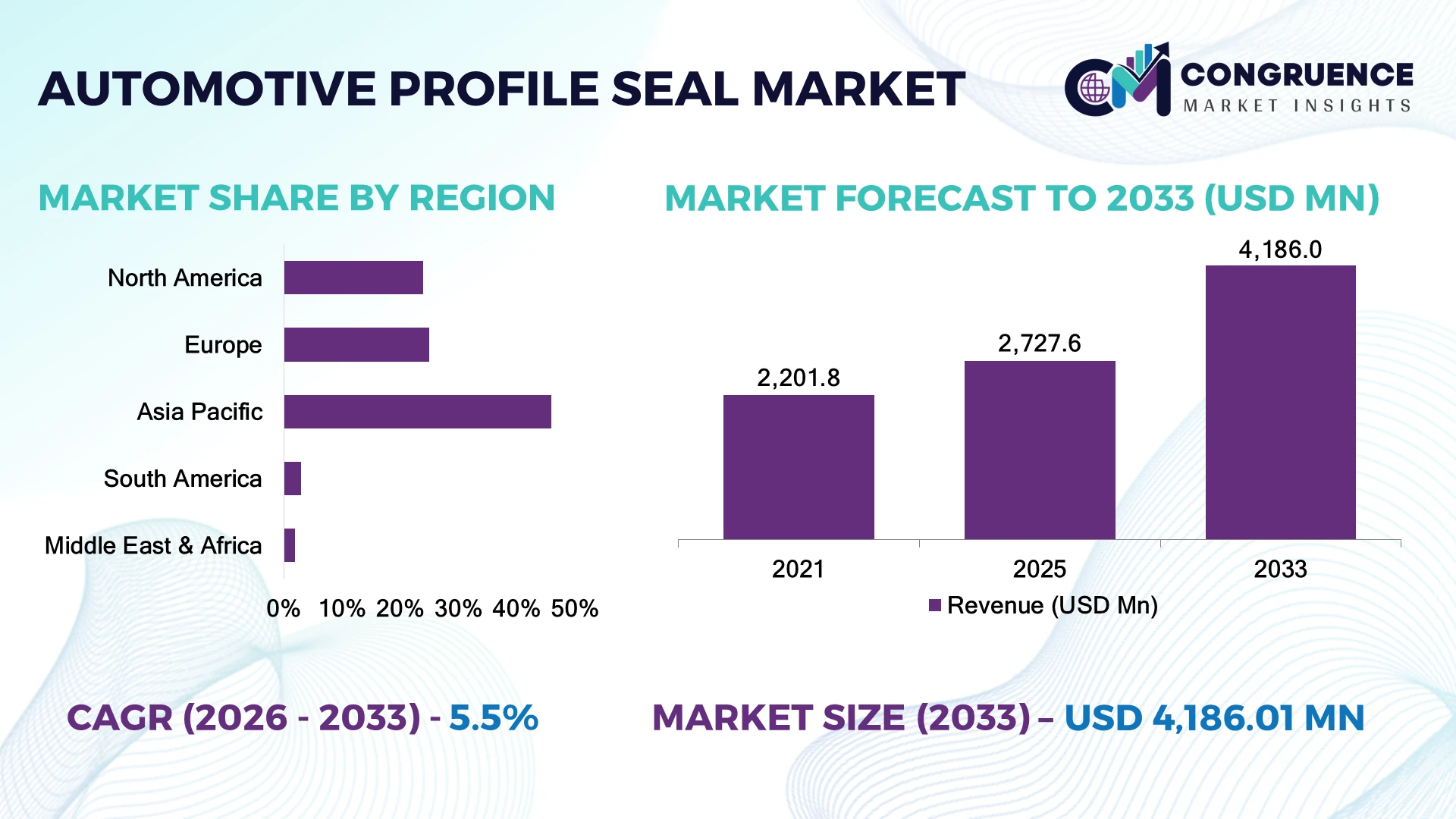
China represents the dominant automotive profile seal manufacturing and consumption base, contributing approximately 30–32% of global demand, supported by its large vehicle-production ecosystem and expanding EV manufacturing capacity. The United States follows at roughly 18–20%, with strong demand from SUVs, pickups, EVs, and premium vehicles. European OEMs are accelerating lightweight sealing and recycled-material adoption as emissions and circularity requirements tighten. By 2026, advanced extrusion and co-extrusion technologies account for approximately 35–40% of new high-performance profile-seal applications.
The strategic priority is shifting toward lightweight, multifunctional seals engineered jointly with vehicle platforms rather than commodity rubber profiles.
Market Size & Growth: USD 2.73 billion in 2025 to USD 4.19 billion by 2033 at a 5.5% CAGR, driven by EV platforms and advanced sealing requirements.
Top Growth Drivers: Vehicle electrification ~30%, lightweighting ~25%, and acoustic sealing requirements ~20% of incremental demand influence.
Short-Term Forecast: By 2028, automated extrusion and inline inspection can improve production efficiency by 8–12% while reducing scrap by 5–8%.
Emerging Technologies: Co-extruded TPE profiles, low-friction coatings, recycled EPDM, and sensor-enabled sealing systems are gaining automotive adoption.
Regional Leaders: Asia-Pacific is projected near USD 1.8 billion, Europe around USD 1.1 billion, and North America approximately USD 0.9 billion by 2033, with EV platforms driving advanced-profile adoption.
Consumer/End-User Trends: Passenger vehicles represent approximately 70–75% of profile-seal demand, with premium and electric vehicles requiring higher acoustic and thermal sealing performance.
Pilot/Case Example: Advanced co-extrusion programs are targeting 10–15% lower profile weight while maintaining dimensional stability and compression performance.
Competitive Landscape: Cooper Standard holds an estimated 15–18% share, competing with Hutchinson, Toyoda Gosei, Henniges Automotive, and SaarGummi.
Regulatory & ESG Impact: Recycled and bio-attributed elastomer adoption can reduce material-related carbon intensity by approximately 10–20% in selected sealing applications.
Investment & Funding: More than USD 1 billion in recent automotive sealing capacity, tooling, EV-platform, and manufacturing investments is strengthening regional production flexibility.
Innovation & Future Outlook: Next-generation profiles will combine lightweight substrates, low-friction surfaces, improved acoustic isolation, and automated inspection, shifting competition toward platform-level engineering.
Automotive profile seals are increasingly concentrated around door, window, liftgate, roof, hood, and glazing applications requiring simultaneous control of water ingress, wind noise, vibration, and thermal transfer. Advanced EPDM and TPE formulations account for an estimated 60–65% of new high-performance profile development. In 2026, EV manufacturers are prioritizing lighter, lower-friction sealing systems to protect driving range while maintaining quiet-cabin performance, making material engineering and precision extrusion central to supplier differentiation.
Automotive profile seals are becoming strategically important because vehicle platforms increasingly demand simultaneous lightweighting, acoustic isolation, thermal management, and weather protection. EV architectures intensify this requirement: quieter powertrains make wind and road noise more noticeable, while battery and electronics systems increase sensitivity to water and dust ingress. Suppliers therefore face greater engineering requirements than conventional commodity sealing programs.
Material and process innovation is creating measurable advantages. TPE and advanced co-extruded profiles can reduce component weight by approximately 10–15% versus selected conventional constructions while enabling tighter dimensional control. Automated extrusion, vision inspection, and digital process monitoring can further reduce manufacturing scrap by 5–8%. China remains the largest production base, while Germany and Japan retain strong positions in precision sealing engineering and premium vehicle applications.
During 2026–2028, suppliers are expected to increase investment in EV-specific profiles, low-friction coatings, recycled-content compounds, and automated quality inspection. Platform-level partnerships between seal manufacturers and OEM engineering teams are becoming more important, particularly during early vehicle development. Suppliers that combine material science, tooling precision, acoustic performance, and scalable regional manufacturing will gain stronger positioning as automotive sealing shifts from component supply toward integrated vehicle-platform engineering.
Vehicle electrification is increasing demand for profile seals that combine acoustic isolation, low friction, water protection, and lightweight construction. EV platforms can require approximately 10–15% lower seal weight while maintaining equivalent compression performance, while enhanced acoustic sealing can address 5–10% higher perceived cabin-noise sensitivity created by quieter powertrains. China’s rapid EV production is accelerating adoption of co-extruded TPE and precision EPDM profiles. OEMs are also moving sealing engineering earlier into vehicle-platform development. Suppliers are responding with dedicated EV profile programs, localized extrusion capacity, and joint engineering with automakers. The non-obvious driver is that quieter EV cabins expose sealing deficiencies more clearly, turning acoustic performance into a stronger supplier-selection criterion.
Automotive profile seals remain exposed to fluctuations in EPDM, TPE, additives, aluminum carriers, and extrusion-tooling costs. Material and energy inputs can collectively represent approximately 50–60% of manufacturing cost, while complex multi-material profiles increase tooling and validation expenses by roughly 10–20% compared with conventional single-material sections. European manufacturers also face higher energy and compliance costs than many Asian production hubs. These pressures constrain pricing flexibility when OEM contracts remain highly cost-focused. Suppliers are responding through dual-source material procurement, regional compounding, standardized tooling platforms, and greater use of recyclable compounds. A key operational pressure is maintaining dimensional stability while reducing material usage; aggressive lightweighting without profile redesign can increase compression-set and sealing-performance risks.
Advanced co-extrusion, low-friction coatings, recycled-content elastomers, and sensor-integrated sealing systems are creating higher-value applications. Co-extruded profiles can reduce component weight by approximately 10–15%, while optimized surface coatings can lower sliding friction by 15–25% in selected door and window applications. Germany and Japan are strong development centers for precision sealing, while Chinese EV manufacturers provide rapid deployment volumes. The emerging opportunity is integrating conductive or sensor-ready elements into seals for door-status monitoring, pressure sensing, and vehicle diagnostics. Suppliers are increasing R&D partnerships with OEM engineering teams and expanding automated extrusion lines. This shifts value creation from supplying standardized rubber sections toward engineered sealing assemblies that support electronics, acoustics, and vehicle-level functional requirements.
Modern automotive profiles increasingly combine EPDM, TPE, thermoplastic carriers, flock coatings, adhesives, and metal reinforcement, creating tighter process-control requirements. Multi-material extrusion can increase process complexity by approximately 15–25%, while dimensional tolerances can tighten by 10–20% for precision glazing and door applications. Production facilities must synchronize extrusion speed, compound temperature, bonding, surface treatment, and inline inspection across multiple process stages. Skilled-tooling and polymer-processing expertise remains critical, particularly in Germany, Japan, and high-volume Chinese manufacturing hubs. Companies are investing in machine vision, automated dimensional measurement, digital process monitoring, and standardized tooling libraries. The strategic challenge is scaling complex profiles without sacrificing consistency; suppliers that cannot industrialize multi-material designs risk losing platform programs despite competitive material pricing.
Co-Extrusion Moves Into Mainstream: Multi-material profile adoption is increasing across EV doors, glazing, and liftgates, with co-extruded designs delivering approximately 10–15% weight reduction and 5–8% fewer assembly interfaces. Suppliers are expanding automated extrusion lines and partnering with OEM engineering teams to industrialize complex profiles without increasing installation time.
Low-Friction Surfaces Gain Priority: Surface coatings and flock treatments are increasingly engineered for smoother window and door operation, with selected formulations reducing sliding friction by 15–25% and improving perceived closing quality. German and Japanese suppliers are refining coating thickness and adhesion controls, while OEMs increasingly specify friction performance during validation.
Recycled Content Enters Profiles: Automakers are increasing recycled EPDM and TPE utilization as material-traceability and circularity requirements strengthen. Selected profile constructions now target 10–20% recycled content without compromising core sealing performance. Suppliers are qualifying recycled feedstocks, reformulating compounds, and strengthening batch traceability to address OEM material-compliance requirements.
Inline Inspection Becomes Standardized: Automated vision systems and laser measurement are expanding across high-volume extrusion plants, reducing dimensional inspection workload by approximately 20–30% and detecting surface defects earlier. The non-obvious shift is that inspection data is increasingly fed back into extrusion-process controls, allowing suppliers to correct dimensional drift before entire production lots require rework.
EPDM remains the leading automotive profile seal material, accounting for approximately 55–60% of global demand because of its weather resistance, ozone stability, temperature tolerance, and established compatibility with door, window, hood, and trunk applications. TPE follows at roughly 20–25% and represents the fastest-growing type as EV manufacturers prioritize lightweight construction, recyclability, lower friction, and design flexibility. PVC and silicone profiles retain specialized positions, together representing approximately 15–20% of demand, with silicone favored where higher temperature stability and premium performance justify its cost.
The shift toward TPE is strongest in new EV platforms, where weight reduction and multi-functional sealing are increasingly specified during vehicle development. TPE can reduce selected profile weight by approximately 10–15% while supporting co-extrusion and recyclable formulations. EPDM remains dominant in mature vehicle programs because of proven durability and manufacturing scale. Suppliers are therefore maintaining EPDM capacity while investing in TPE compounding, co-extrusion, and OEM-specific formulation development.
The IEA reported that nearly 22 million electric cars were produced globally in 2025, with China accounting for nearly 75% of production, reinforcing the shift toward lightweight, high-performance sealing materials in the world's largest EV manufacturing base.
Door and window sealing represents the leading application, accounting for approximately 45–50% of global automotive profile seal demand because these locations require continuous protection against water, dust, wind noise, vibration, and temperature variation. Windshield and glazing applications contribute around 20–25%, while trunk, hood, and liftgate applications collectively account for approximately 20–25%. Door and window profiles remain the mature volume segment, but glazing and liftgate applications are gaining technical importance as vehicle designs become more aerodynamic and electrified.
Liftgate and glazing seals represent the fastest-shifting applications, driven by larger glass areas, frameless designs, powered closures, and stricter acoustic requirements. Advanced profiles can reduce friction by approximately 15–25% in sliding applications while improving closing performance. Suppliers are responding through co-extrusion, flock coatings, low-friction surfaces, and automated dimensional inspection. The business implication is a move toward application-specific engineering rather than standardized profiles, with OEMs increasingly evaluating acoustic, sealing, friction, and assembly performance together.
OICA reported that global vehicle production reached 96.4 million units in 2025, up 3.9%, while Asia-Pacific accounted for more than 61% of global production, sustaining high-volume demand for door, glazing, and body sealing systems.
Automotive OEMs represent the leading end-user group, accounting for approximately 75–80% of automotive profile seal demand because profile seals are designed, validated, and integrated directly into vehicle platforms during body and closure engineering. Tier-1 system suppliers account for roughly 15–20%, while the replacement and aftermarket segment contributes approximately 5–10%. OEM programs demand strict dimensional tolerances, compression performance, acoustic targets, and long-term environmental durability, making qualification barriers substantially higher than in aftermarket applications.
Tier-1 suppliers represent the fastest-shifting buyer group as automakers increasingly outsource complete door, glazing, and closure modules rather than purchasing isolated sealing profiles. Integrated suppliers can coordinate extrusion, carrier integration, coating, tooling, and assembly, reducing interface complexity by approximately 10–15%. China-based EV manufacturers are accelerating platform-specific sourcing, while German and Japanese OEM ecosystems continue emphasizing precision and validation depth. Seal manufacturers are responding with dedicated engineering teams, regional production footprints, long-term platform contracts, and joint development programs. Future demand is therefore shifting toward suppliers capable of delivering engineered assemblies rather than commodity profiles.
The IEA reported that electric cars represented 25% of global new-car sales in 2025, with Chinese manufacturers supplying approximately 60% of electric cars sold worldwide, strengthening the importance of OEM-specific sealing development for rapidly expanding EV platforms.
Asia-Pacific accounted for the largest market share at 46.0% in 2025 however, Asia-Pacific is expected to register the fastest growth, expanding at a CAGR of 6.4% between 2026 and 2033.
EV localization is accelerating advanced sealing adoption across North American vehicle platforms
North America represents approximately 24% of the global automotive profile seal market, supported by high vehicle production, established Tier-1 supplier networks, and strong demand for premium SUVs, pickups, and electric vehicles. The United States accounts for more than 80% of regional automotive production and remains the principal manufacturing base for advanced door, glazing, hood, and liftgate sealing systems. EV programs are increasing demand for lightweight TPE, low-friction coatings, and acoustic profiles, with advanced materials representing approximately 35–40% of new EV-oriented sealing development. Suppliers are also localizing extrusion and tooling capacity near OEM assembly plants to reduce logistics exposure and improve program responsiveness. By 2026, automated extrusion and inline inspection are increasingly deployed in high-volume facilities, supporting tighter tolerances and lower scrap.
United States Market Outlook: The United States is the region's dominant automotive profile seal market, supported by extensive OEM assembly capacity and sophisticated Tier-1 engineering infrastructure. Automotive suppliers increasingly operate dedicated programs for EV doors, glazing, and battery-compartment sealing. Automated extrusion and vision inspection can reduce selected manufacturing scrap by approximately 5–8%, strengthening production economics while supporting stringent OEM dimensional requirements.
Premium vehicle engineering is shifting European seals toward lightweight and low-friction designs
Europe contributes approximately 25% of global automotive profile seal demand, with Germany, France, Spain, Italy, and the Czech Republic representing important vehicle manufacturing centers. Stringent vehicle-efficiency requirements and sustainability targets are encouraging lighter profiles, recycled-content compounds, and low-friction surface treatments. Advanced TPE and co-extruded constructions account for approximately 30–35% of new premium and EV-oriented profile development. European suppliers are also investing in automated inspection and material traceability to meet increasingly demanding OEM specifications. The regional supply chain remains closely integrated with German vehicle platforms, making engineering collaboration and localized production important competitive differentiators.
Germany Market Outlook: Germany remains Europe's key market for automotive profile seals because of its concentration of premium OEMs, Tier-1 suppliers, tooling specialists, and vehicle engineering centers. Suppliers increasingly co-develop sealing systems during early platform engineering, particularly for EV doors, frameless glazing, and liftgates. Precision extrusion and automated dimensional inspection can improve production consistency by approximately 10–15%, supporting premium vehicle quality requirements.
China's EV manufacturing scale is reshaping profile-seal production and material adoption
Asia-Pacific accounts for approximately 46% of the global automotive profile seal market, reflecting its dominant vehicle manufacturing base and extensive supplier ecosystem. China alone represents approximately 30–32% of global automotive profile seal demand, supported by large-scale passenger-vehicle and EV production. Japan, South Korea, and India add significant demand through established OEM and component manufacturing networks. Chinese EV manufacturers are accelerating adoption of lightweight TPE, co-extruded profiles, and low-friction sealing systems, while Japanese suppliers maintain strong positions in precision EPDM and premium sealing engineering. Regional manufacturers are expanding extrusion capacity and localizing compounds and tooling, with automated production improving throughput by approximately 8–12% in selected high-volume facilities.
China Market Outlook: China is the most strategically significant country for automotive profile seals because of its scale in vehicle manufacturing and rapid EV deployment. The country's automotive ecosystem supports localized compounding, extrusion, tooling, and assembly, shortening development cycles for new vehicle programs. EV-focused suppliers increasingly target 10–15% profile-weight reductions while maintaining acoustic and water-sealing performance, creating strong demand for advanced TPE and co-extrusion capabilities.
Brazil's vehicle-production base supports localized sealing supply chains
South America represents approximately 5% of global automotive profile seal demand, with Brazil accounting for roughly 70% of regional vehicle production and component demand. The country's established automotive manufacturing clusters support door, glazing, trunk, hood, and body sealing applications across passenger and commercial vehicles. Local suppliers increasingly combine imported elastomer compounds with domestic extrusion and assembly capabilities, while OEM localization strategies support regional sourcing. EPDM remains dominant because of its established processing infrastructure, although TPE adoption is increasing in newer vehicle programs. Automated extrusion can improve selected production-line efficiency by approximately 8–12%. Suppliers are prioritizing localized tooling, inventory management, and flexible production to reduce exposure to imported material and logistics volatility.
Brazil Market Outlook: Brazil provides the strongest manufacturing base in South America, supported by established OEM plants, component clusters, and domestic vehicle demand. Automotive profile-seal suppliers benefit from localized extrusion and assembly capabilities, although advanced-material adoption remains below North American, European, and Chinese levels. Suppliers investing in TPE processing and automated quality inspection can improve product consistency while positioning for newer vehicle-platform programs.
Automotive localization is creating new demand for regional sealing production
Middle East & Africa contributes approximately 4% of global automotive profile seal demand, with South Africa, Morocco, Saudi Arabia, and the United Arab Emirates representing important manufacturing and automotive investment centers. Morocco has developed a strong vehicle-production ecosystem serving European export markets, while South Africa maintains established passenger and commercial vehicle manufacturing. New automotive localization initiatives are increasing demand for locally supplied extrusion, tooling, and sealing components. Advanced sealing materials remain less prevalent than EPDM-based profiles, but EV and premium-vehicle programs are increasing requirements for low-friction and acoustic performance. Suppliers are responding through regional warehousing, local assembly, and partnerships with automotive component manufacturers. Localization can reduce selected logistics exposure by approximately 10–20%.
Morocco Market Outlook: Morocco is the region's strongest automotive manufacturing hub, supported by large vehicle assembly operations and an export-oriented supplier ecosystem. Its proximity to European production networks makes localized automotive profile-seal manufacturing strategically attractive. Suppliers can leverage established automotive clusters to provide shorter tooling and delivery cycles, while advanced TPE and co-extruded profiles create opportunities as vehicle platforms increasingly adopt higher-performance sealing systems.
Cooper Standard, Hutchinson, Toyoda Gosei, Freudenberg, and Trelleborg compete through distinct combinations of profile engineering, material science, OEM integration, and regional manufacturing. Cooper Standard and Hutchinson compete strongly in integrated sealing systems, while Toyoda Gosei emphasizes weatherstrips and OEM-linked Japanese manufacturing. The top five are estimated to hold approximately 45–50% of global profile-seal activity. Competition centers on material performance, tooling precision, price, and localization: lightweight profiles can reduce component mass by 10–15%, advanced extrusion can improve productivity by 8–12%, and automated inspection can reduce selected scrap by 5–8%. Players are expanding plants near OEM clusters, developing TPE and co-extruded profiles, and forming early-stage engineering partnerships. The competitive shift is toward lightweight, recyclable, EV-specific sealing architectures rather than conventional EPDM profiles alone. Entry barriers include OEM qualification, tooling expertise, durability validation, and global production coverage. Winning requires platform-level engineering, reliable localization, material innovation, and demonstrable weight and assembly savings.
Cooper Standard
Hutchinson
Toyoda Gosei Co., Ltd.
Freudenberg Group
Trelleborg AB
Henniges Automotive
Standard Profil Group
SaarGummi Group
ElringKlinger AG
Dana Incorporated
Parker Hannifin Corporation
SKF
Nishikawa Rubber Co., Ltd.
KCC Co., Ltd.
Advanced co-extrusion, lightweight TPE, EPDM microcellular structures, low-friction coatings, and automated profile inspection are becoming core technologies in new vehicle programs. Co-extrusion can reduce component weight by 10–15%, while inline vision inspection cuts selected defect-related rework by 5–10%. Adoption is strongest among high-volume OEM suppliers serving EV and premium vehicle platforms.
Thermoplastic body seals represent the most disruptive shift. Cooper Standard’s FlexiCore technology demonstrates up to 44% weight reduction versus traditional metal-carrier constructions, while fully recyclable thermoplastic architecture simplifies material recovery. Compared with conventional rubber-metal profiles, this approach can materially reduce part mass and assembly complexity. Suppliers with established TPE compounding and extrusion capabilities gain an advantage as automakers prioritize lightweighting and sustainability.
During 2026–2028, digital extrusion controls, automated dimensional measurement, predictive maintenance, and sensor-ready sealing systems will increasingly connect material processing with vehicle-platform requirements. Automated production can improve selected line efficiency by 8–12%, while digital tooling and simulation shorten development cycles by approximately 10–20%. Cooper Standard, Hutchinson, Toyoda Gosei, and other integrated suppliers benefit from established OEM engineering relationships. The competitive priority is shifting from basic sealing durability toward lightweight architecture, acoustic performance, recyclability, and digitally controlled manufacturing. Suppliers investing now can secure earlier design-in positions and defend margins through higher-value engineered sealing assemblies.
November 2024 Cooper Standard launched FlexiCore, replacing metal carriers with recyclable thermoplastic construction and delivering up to 44% weight reduction. The innovation targets lighter vehicle architectures, improving efficiency and sustainability while strengthening sealing differentiation for EV platforms across global programs. Source: cooperstandard.com
January 2026 Hutchinson’s Monte Alto body-sealing plant in Brazil received four operational awards in Stellantis’ Kaizen SOP 2025 tournament, selected among 48 suppliers. The recognition highlights automation, ergonomics, sustainability, and CO2 reduction, reinforcing manufacturing competitiveness in South American automotive programs. Source: hutchinson.com
December 2025 Toyoda Gosei reported approximately 30% weight reduction for selected weatherstrip designs using material and process innovation. The company is strengthening BEV programs, emerging-market partnerships, recycled materials, and localized product development to improve sealing performance and competitiveness. Source: toyoda-gosei.com
February 2026 Stratview Research identified elastomeric seals as the dominant material category and Asia-Pacific as the leading regional market. The assessment reinforces supplier emphasis on lightweight materials, linear-motion applications, and localized manufacturing across China, Japan, India, and South Korea. Source: stratviewresearch.com
The report evaluates automotive profile seals across elastomeric and thermoplastic types, vehicle categories, motion characteristics, and applications including doors, windows, glazing, trunks, hoods, liftgates, and specialty closures. End-user coverage spans OEMs, Tier-1 suppliers, replacement channels, and specialized vehicle manufacturers. Regional analysis covers North America, Europe, Asia-Pacific, South America, and Middle East & Africa, with country-level assessment of production clusters and supplier localization.
Technology coverage includes EPDM and TPE formulation, co-extrusion, lightweight carriers, low-friction coatings, recycled materials, automated extrusion, digital inspection, and sensor-enabled sealing. The competitive assessment evaluates 14 major participants across engineering capability, OEM relationships, manufacturing footprint, material innovation, and platform-specific development. The report supports investment planning, capacity expansion, OEM targeting, localization strategy, technology selection, partnership development, and competitive positioning through 2026–2033.
| Report Attribute/Metric | Report Details |
|---|---|
|
Market Revenue in 2025 |
USD 2,727.6 Million |
|
Market Revenue in 2033 |
USD 4,186.0 Million |
|
CAGR (2026 - 2033) |
5.5% |
|
Base Year |
2025 |
|
Forecast Period |
2026 - 2033 |
|
Historic Period |
2021 - 2025 |
|
Segments Covered |
By Type
By Application
By End-User
|
|
Key Report Deliverable |
Revenue Forecast, Growth Trends, Market Dynamics, Segmental Overview, Regional and Country-wise Analysis, Competition Landscape |
|
Region Covered |
North America, Europe, Asia-Pacific, South America, Middle East, Africa |
|
Key Players Analyzed |
Cooper Standard, Hutchinson, Toyoda Gosei Co., Ltd., Freudenberg Group, Trelleborg AB, Henniges Automotive, Standard Profil Group, SaarGummi Group, ElringKlinger AG, Dana Incorporated, Parker Hannifin Corporation, SKF, Nishikawa Rubber Co., Ltd., KCC Co., Ltd. |
|
Customization & Pricing |
Available on Request (10% Customization is Free) |




