
Reports
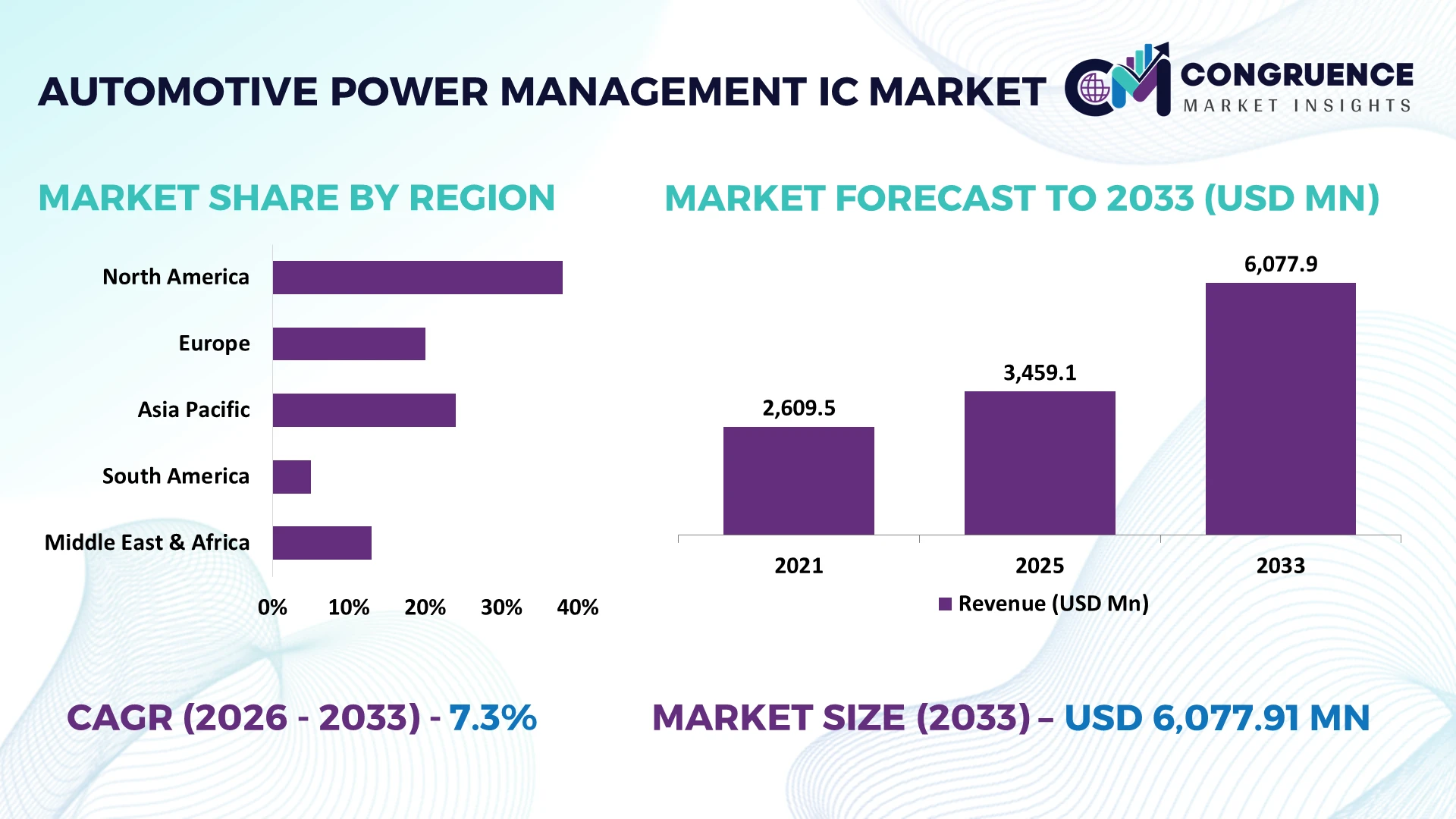
The Global Automotive Power Management IC Market was valued at USD 3459.05 Million in 2025 and is anticipated to reach a value of USD 6077.91 Million by 2033 expanding at a CAGR of 7.3% between 2026 and 2033. Market expansion is driven by electric vehicle electrification, increasing semiconductor content in advanced driver assistance systems, and the adoption of efficient power conversion architectures in automotive electronics.
China represents a major demand center for automotive power management ICs, supported by extensive electric vehicle manufacturing and semiconductor supply chain investments. Electric vehicles accounted for more than 50% of new car sales in China during 2025, strengthening demand for battery management, voltage regulation, and power distribution technologies. Compared with the United States, China benefits from greater electric vehicle production scale and extensive domestic battery manufacturing infrastructure. Government initiatives supporting semiconductor localization are encouraging investment in automotive qualified power management components and domestic electronic supply chains.
Semiconductor manufacturers should prioritize automotive qualified power architectures, partnerships with Chinese electric vehicle manufacturers, and diversified fabrication capacity to strengthen long term competitive positioning.
Market Size & Growth: USD 3459.05 million in 2025, reaching USD 6077.91 million by 2033 at 7.3% CAGR, supported by vehicle electrification.
Top Growth Drivers: Electric vehicle adoption, increasing electronic control integration, and demand for efficient power conversion represent three structural growth drivers.
Short Term Forecast: By 2027, automotive semiconductor suppliers will prioritize higher integration across battery management, voltage regulation, and power distribution architectures.
Emerging Technologies: Three technologies are reshaping automotive power management: gallium nitride semiconductors, silicon carbide devices, and digitally controlled power conversion.
Regional Leaders: Asia Pacific, Europe, and North America represent three important semiconductor demand centers, supported by vehicle electrification and automotive electronics manufacturing.
Consumer and End User Trends: Electric vehicles exceeded 50% of new car sales in China during 2025, supporting increased semiconductor integration.
Pilot and Case Example: In 2024, automotive manufacturers accelerated adoption of 800 volt electrical architectures, enabling higher power charging and improved electrical system efficiency.
Competitive Landscape: Texas Instruments, Infineon Technologies, STMicroelectronics, NXP Semiconductors, and Analog Devices compete through automotive semiconductor portfolios and manufacturing capabilities.
Regulatory and ESG Impact: The European Union's 2035 vehicle emissions framework is influencing automotive electrification investment and semiconductor design priorities.
Investment and Funding: The United States CHIPS and Science Act allocated approximately USD 52.7 billion to semiconductor manufacturing, research, and workforce development.
Innovation and Future Outlook: Advanced automotive platforms increasingly integrate 48 volt electrical systems, intelligent power distribution, and semiconductor architectures supporting centralized vehicle computing.
The Automotive Power Management IC Market encompasses integrated circuits responsible for voltage regulation, battery monitoring, power distribution, and efficient energy conversion across modern vehicles. Increasing electronic complexity is strengthening demand for compact, thermally efficient semiconductor solutions. China's electric vehicle market demonstrates the importance of automotive electrification, with electric models representing more than half of new car sales during 2025. Automotive manufacturers are increasingly adopting centralized electronic architectures and advanced battery management technologies, encouraging semiconductor suppliers to strengthen automotive qualification, manufacturing resilience, and integrated power management capabilities.
Automotive power management ICs are becoming strategically important as vehicle manufacturers transition toward electrified powertrains, centralized computing, and increasingly sophisticated electronic architectures. China's electric vehicles accounted for more than 50% of new car sales in 2025, accelerating requirements for efficient voltage regulation, battery monitoring, and intelligent power distribution. Semiconductor manufacturers are restructuring automotive supply chains through regional fabrication investments, diversified assembly operations, and closer collaboration with vehicle manufacturers to strengthen component availability.
Advanced power management architectures integrate switching regulators, intelligent monitoring, and digital control to improve energy efficiency and thermal performance. High efficiency switching regulators can achieve conversion efficiencies exceeding 95% under specified operating conditions, compared with substantially lower efficiencies in linear regulators operating across large voltage differences. China leads electric vehicle manufacturing scale, while Germany emphasizes advanced automotive engineering and the United States strengthens domestic semiconductor production. These differences influence semiconductor qualification, manufacturing investment, and customer development strategies.
Between 2026 and 2028, automotive manufacturers will increasingly integrate intelligent power distribution and centralized electronic control systems. Practical deployment includes 48 volt electrical architectures that reduce current requirements by 75% compared with equivalent 12 volt systems at identical power levels. Semiconductor suppliers are expanding automotive qualification capabilities, developing integrated power modules, and establishing manufacturing partnerships. Competitive positioning increasingly depends on conversion efficiency, functional safety, and dependable semiconductor supply.
Vehicle electrification is increasing demand for automotive power management ICs across battery monitoring, voltage conversion, electronic control units, and advanced driver assistance systems. Electric vehicles represented more than 50% of new car sales in China during 2025, demonstrating the scale of automotive electrical transformation. Modern switching regulators can achieve conversion efficiencies exceeding 95% under suitable operating conditions, reducing thermal management requirements. Additionally, 48 volt architectures require 75% less current than equivalent 12 volt systems at identical power levels. Chinese automotive manufacturers are integrating sophisticated battery management and centralized electronic architectures, increasing semiconductor requirements. Suppliers are responding through automotive semiconductor development, manufacturing partnerships, and expanded power management product portfolios.
Automotive power management IC manufacturers face structural limitations arising from specialized fabrication requirements, semiconductor packaging dependencies, and concentrated manufacturing infrastructure. Automotive components frequently require operating temperature qualifications extending from minus 40°C to 125°C, increasing production complexity and qualification requirements. Semiconductor fabrication also requires substantial capital investment, while automotive product qualification can extend development schedules. The United States continues strengthening domestic semiconductor manufacturing to reduce dependence on geographically concentrated supply chains. Automotive suppliers must balance production capacity with stringent reliability requirements and fluctuating vehicle manufacturing schedules. Companies are diversifying foundry relationships, establishing long term supply agreements, and expanding regional assembly capabilities. Maintaining qualified alternative production facilities provides an important advantage during semiconductor supply disruptions.
Centralized vehicle computing and intelligent power distribution create opportunities for highly integrated automotive power management ICs. Advanced electronic architectures consolidate distributed control functions while increasing requirements for programmable voltage regulation, fault monitoring, and semiconductor integration. Transitioning from 12 volt to 48 volt electrical systems reduces current requirements by 75% at equivalent power levels, enabling smaller conductors and improved electrical distribution efficiency. Meanwhile, switching regulators achieving efficiencies above 95% support increasingly demanding automotive thermal requirements. Germany's automotive engineering ecosystem provides opportunities for semiconductor suppliers developing integrated power architectures and advanced functional safety capabilities. Manufacturers are investing in intelligent power switches, integrated monitoring technologies, and collaborative development programs with automotive electronics suppliers.
Increasing electronic integration creates significant challenges involving functional safety validation, electromagnetic compatibility, thermal management, and system reliability. Automotive power management ICs must operate across demanding temperature conditions, with certain qualified components supporting temperatures up to 150°C. Modern vehicle electrical architectures integrate numerous electronic control functions, increasing the consequences of power distribution failures. ISO 26262 functional safety requirements introduce extensive verification and documentation obligations for safety relevant semiconductor applications. German automotive manufacturers increasingly emphasize integrated electrical architectures, requiring suppliers to demonstrate consistent performance across interconnected systems. Semiconductor companies must invest in advanced simulation, automated testing, diagnostic integration, and specialized engineering expertise. Establishing reusable safety architectures and standardized validation procedures is essential for managing development complexity and maintaining long term competitiveness.
Expansion of Automotive Semiconductor Localization: Semiconductor manufacturers are restructuring production networks following recent automotive chip shortages and geopolitical trade restrictions. The United States CHIPS Act allocated approximately USD 52.7 billion to semiconductor manufacturing and research initiatives. Companies are expanding domestic fabrication partnerships and qualifying alternative production facilities. Automotive suppliers increasingly prioritize manufacturing continuity, regional capacity, and component traceability, reducing dependence on geographically concentrated semiconductor production.
Increasing Automotive Power Semiconductor Integration: Automotive electronics manufacturers are consolidating voltage regulation, protection, and monitoring functions within integrated semiconductor packages. Advanced switching regulators achieve efficiencies exceeding 95% under specified operating conditions. Integrated power management reduces external component requirements and simplifies printed circuit board layouts. Semiconductor suppliers are expanding integrated product portfolios and developing reference designs that accelerate automotive electronic system development.
Advanced Semiconductor Packaging Gains Importance: Automotive semiconductor manufacturers are adopting improved thermal packaging, compact power modules, and advanced interconnection technologies. Automotive qualified components frequently support operating temperatures reaching 125°C or 150°C, depending on their specifications. Improved thermal management supports reliable operation in demanding automotive environments. Manufacturers are investing in packaging innovation and automated testing to strengthen production consistency and reduce thermal failure risks.
Growing Demand for Automotive Lighting Electronics: Automotive manufacturers are integrating adaptive LED headlights, intelligent interior illumination, and digitally controlled lighting systems. LED technology offers approximately 75% lower electricity consumption than conventional incandescent lighting in comparable applications. Advanced LED drivers enable programmable brightness, fault detection, and individual lighting control. Semiconductor manufacturers are expanding automotive lighting portfolios and collaborating with automotive electronics suppliers to support increasingly sophisticated lighting architectures.
Switching Regulators represent a strategically important segment of the Automotive Power Management IC Market because modern vehicles require efficient voltage conversion across increasingly complex electronic architectures. Advanced switching regulators achieve conversion efficiencies exceeding 95% under suitable operating conditions, reducing thermal losses compared with conventional linear regulation. Their applications extend across automotive electronic control systems, advanced driver assistance platforms, and infotainment electronics. Linear Regulators maintain established demand where low electrical noise, circuit simplicity, and stable voltage regulation are essential. Power Controllers support coordinated energy management and increasingly sophisticated electronic architectures.
Battery ICs are positioned for accelerated adoption as electric vehicle manufacturers expand battery monitoring, cell balancing, and charging control capabilities. China's electric vehicles accounted for more than 50% of new car sales in 2025, reinforcing demand for sophisticated battery electronics. Motor Drivers remain essential for electronically controlled automotive mechanisms, while LED Drivers support adaptive lighting and advanced illumination systems. Semiconductor manufacturers are expanding integrated product portfolios, improving thermal packaging, and strengthening automotive qualification capabilities to address increasingly specialized power management requirements.
Powertrain represents a strategically significant application within the Automotive Power Management IC Market because vehicle propulsion systems require reliable voltage regulation, electronic monitoring, and coordinated power distribution. Electric and hybrid powertrains incorporate increasingly sophisticated semiconductor architectures supporting battery monitoring, energy conversion, and propulsion control. Modern switching regulators can achieve conversion efficiencies exceeding 95% under suitable operating conditions, supporting demanding automotive thermal requirements. Body Electronics represents another established application, incorporating numerous electronically controlled vehicle functions. Infotainment systems require stable voltage regulation and efficient power distribution to support increasingly sophisticated digital interfaces.
EV Charging represents an important expansion area as vehicle manufacturers integrate advanced charging architectures and intelligent battery management systems. ADAS applications require reliable semiconductor power supplies supporting sensors, processing systems, and safety critical electronic functions. Lighting applications are evolving through adaptive LED technology and programmable control systems. Semiconductor manufacturers are developing specialized power management portfolios and collaborating with automotive system suppliers to improve integration, thermal performance, and qualification efficiency across these applications.
Passenger Cars represent a major end user category within the Automotive Power Management IC Market because of their substantial production volumes and extensive electronic system integration. Modern passenger vehicles incorporate semiconductor power management across propulsion systems, infotainment, lighting, and electronically controlled vehicle functions. Electric Vehicles represent an increasingly important demand category because battery management, voltage conversion, and intelligent power distribution require specialized semiconductor solutions. Hybrid Vehicles maintain substantial requirements for coordinated electrical and propulsion system management. Commercial Vehicles increasingly incorporate electronic safety systems, advanced lighting, and efficient electrical architectures.
Automotive OEMs influence semiconductor specifications, vehicle platform integration, and long term component qualification requirements. Tier-1 Suppliers translate these requirements into electronic modules and integrated vehicle systems, making them essential semiconductor procurement partners. China's electric vehicles exceeded 50% of new car sales during 2025, demonstrating the importance of electrified vehicle production. Semiconductor manufacturers are strengthening direct engineering relationships with automotive manufacturers, expanding qualified product portfolios, and developing integrated reference architectures to improve customer integration and manufacturing scalability.
Asia Pacific accounted for the largest estimated market share at 46% in 2025, followed by North America at 24%, Europe at 22%, South America at 5%, and Middle East & Africa at 3%. Asia Pacific is also a major center of automotive electrification and semiconductor manufacturing investment.

Domestic Semiconductor Manufacturing and Automotive Electronics Modernization
North America represents an important automotive power management IC market, supported by semiconductor design expertise, established vehicle manufacturing infrastructure, and increasing investment in domestic chip production. The United States leads regional semiconductor innovation, while Mexico contributes through automotive assembly and electronic component manufacturing. Texas Instruments, Analog Devices, and onsemi maintain substantial automotive semiconductor development capabilities. The United States CHIPS and Science Act established approximately USD 52.7 billion in semiconductor manufacturing, research, and workforce development support. Automotive manufacturers are integrating advanced driver assistance systems, sophisticated electronic control platforms, and efficient power conversion technologies. Semiconductor suppliers are strengthening domestic manufacturing capacity and automotive qualification capabilities to improve supply continuity. Regional production expansion also supports closer collaboration between semiconductor developers, automotive manufacturers, and electronic system integrators.
United States Market Outlook: The United States maintains established semiconductor design and manufacturing capabilities supported by automotive engineering centers and advanced research infrastructure. Texas Instruments has undertaken major domestic semiconductor manufacturing investments, including fabrication development in Texas and Utah. Automotive manufacturers increasingly require integrated power management solutions supporting electronic control systems, battery monitoring, and intelligent vehicle architectures. Domestic semiconductor expansion strengthens opportunities for automotive component qualification and localized procurement.
Automotive Electrification and Advanced Power Semiconductor Engineering
Europe maintains an established automotive semiconductor ecosystem supported by advanced vehicle engineering, specialized semiconductor manufacturing, and stringent automotive qualification requirements. Germany represents a major automotive development center, while France, Italy, and the Netherlands contribute semiconductor design and manufacturing expertise. Infineon Technologies, STMicroelectronics, and NXP Semiconductors maintain extensive automotive semiconductor portfolios supporting vehicle electrification and electronic integration. European manufacturers increasingly prioritize efficient power conversion, functional safety, and advanced semiconductor packaging. The European Chips Act established a policy framework targeting a 20% share of global semiconductor production capacity by 2030. Semiconductor companies are expanding regional fabrication capabilities and strengthening automotive manufacturing partnerships. Increasing integration of sophisticated electronic architectures creates additional requirements for reliable voltage regulation, thermal management, and automotive qualified power management components.
Germany Market Outlook: Germany benefits from established automotive engineering infrastructure and close collaboration between semiconductor manufacturers and vehicle producers. Infineon Technologies maintains substantial power semiconductor development capabilities, supporting advanced automotive electronic systems. German automotive manufacturers increasingly emphasize sophisticated battery management, integrated electronic architectures, and functional safety compliance. Investments in semiconductor manufacturing and advanced automotive engineering strengthen domestic supply chain coordination and specialized component development.
Electric Vehicle Manufacturing Scale and Semiconductor Supply Chain Integration
Asia Pacific maintains a substantial position in automotive power management IC demand through extensive vehicle manufacturing, semiconductor fabrication, and automotive electronics production. China represents a major consumption center, while Japan, South Korea, and Taiwan contribute advanced semiconductor manufacturing and electronic component capabilities. Electric vehicles accounted for more than half of new car sales in China during 2025, strengthening requirements for battery monitoring, voltage regulation, and intelligent power distribution. Japanese semiconductor manufacturers maintain established automotive reliability expertise, while Taiwanese foundries support international semiconductor production. Regional automotive manufacturers increasingly integrate centralized computing architectures and sophisticated electronic control systems. Semiconductor suppliers are expanding automotive qualified product portfolios, strengthening manufacturing partnerships, and developing integrated power management solutions. China's semiconductor localization initiatives are also encouraging domestic automotive component development and supply chain diversification.
China Market Outlook: China maintains extensive electric vehicle manufacturing infrastructure and integrated automotive battery supply chains. Major automotive manufacturers, including BYD, are expanding sophisticated vehicle electronic architectures requiring efficient power conversion and advanced battery management. Domestic semiconductor developers are strengthening automotive qualification capabilities and collaborating with vehicle manufacturers. Government support for semiconductor localization is encouraging additional investment in integrated circuit design, manufacturing infrastructure, and automotive electronic component development.
Automotive Production Modernization and Electronic Component Localization
South America's automotive power management IC market is supported by established vehicle assembly infrastructure and increasing integration of electronic safety and efficiency technologies. Brazil and Argentina represent important automotive manufacturing centers, with Brazil maintaining the region's largest established vehicle production ecosystem. Automotive manufacturers are incorporating advanced electronic control systems, improved lighting technologies, and increasingly sophisticated powertrain electronics. Brazil's automotive industrial policies encourage technological modernization, energy efficiency, and domestic manufacturing development. However, dependence on imported semiconductor components creates exposure to international logistics disruptions and currency fluctuations. Automotive suppliers are strengthening regional distribution networks and coordinating component procurement with international semiconductor manufacturers. Expanding local automotive electronics assembly capabilities provides opportunities to improve component availability and support increasingly sophisticated vehicle production requirements.
Brazil Market Outlook: Brazil maintains established automotive manufacturing clusters in São Paulo, Minas Gerais, and other industrial centers. Its automotive production infrastructure supports passenger vehicles, commercial vehicles, and increasingly sophisticated electronic systems. The country's Mover program encourages automotive technological development, energy efficiency, and industrial modernization. Semiconductor suppliers can strengthen their market presence through partnerships with automotive electronics manufacturers and regional component distributors.
Automotive Industrial Investment and Vehicle Electrification Infrastructure
The Middle East and Africa automotive power management IC market is influenced by automotive industrial diversification, emerging electric vehicle manufacturing, and increasing electronic integration across vehicle platforms. Saudi Arabia is investing in domestic automotive manufacturing, while Morocco and South Africa maintain established automotive production and component assembly capabilities. Saudi Arabia's industrial diversification initiatives are encouraging investment in electric vehicle manufacturing and associated supply chains. Morocco benefits from established automotive export manufacturing infrastructure and proximity to European automotive production networks. Regional semiconductor demand remains closely linked to imported electronic components and international automotive manufacturing partnerships. Automotive suppliers are strengthening regional distribution relationships and developing localized electronic component capabilities. Expanding automotive production infrastructure provides opportunities for semiconductor suppliers supporting advanced powertrain electronics, intelligent lighting, and efficient vehicle power distribution.
Saudi Arabia Market Outlook: Saudi Arabia is developing automotive manufacturing capabilities through industrial diversification initiatives and electric vehicle investment. Ceer represents an important domestic electric vehicle manufacturing initiative, supported by international technology partnerships and planned production infrastructure. Automotive power management semiconductor suppliers have opportunities to establish relationships with emerging vehicle manufacturers and electronic system integrators. Developing qualified component procurement networks will be essential for supporting localized automotive production.
The Automotive Power Management IC Market features competition between established semiconductor manufacturers, integrated device manufacturers, and specialized automotive electronics suppliers. Texas Instruments, Infineon Technologies, STMicroelectronics, NXP Semiconductors, and Analog Devices compete through extensive automotive product portfolios, manufacturing infrastructure, and established vehicle manufacturer relationships. Their combined share of the narrowly defined automotive power management IC segment remains undisclosed, preventing reliable concentration estimates. Competition increasingly emphasizes conversion efficiency, automotive qualification, thermal performance, manufacturing continuity, and integrated semiconductor architectures. Advanced switching regulators achieving efficiencies above 95% provide measurable differentiation, while 48 volt vehicle architectures reduce current requirements by 75% compared with equivalent 12 volt systems. Manufacturers are expanding fabrication capacity, strengthening automotive development partnerships, and investing in advanced packaging. Semiconductor localization initiatives are increasing competition over manufacturing resilience and qualified production capacity. Stringent reliability testing, specialized engineering requirements, and extensive customer qualification procedures restrict market entry. Competitive advantage requires efficient integration and dependable supply.
Texas Instruments
Infineon Technologies
STMicroelectronics
NXP Semiconductors
Analog Devices
onsemi
Renesas Electronics
ROHM Semiconductor
Microchip Technology
Monolithic Power Systems
Diodes Incorporated
Toshiba Electronic Devices & Storage
ABLIC
Torex Semiconductor
Advanced switching regulators, integrated power controllers, and intelligent battery management circuits are transforming automotive electrical architectures. Modern switching regulators achieve efficiencies exceeding 95% under optimized operating conditions, compared with approximately 60% for linear regulators operating under substantial voltage differences. This represents a potential 35 percentage point efficiency improvement, reducing thermal losses and cooling requirements. Automotive manufacturers increasingly integrate multiple voltage rails, diagnostic functions, and protection mechanisms within compact semiconductor packages, simplifying electronic control unit development and improving manufacturing consistency.
Emerging technologies include digitally programmable power management, advanced semiconductor packaging, and integrated battery monitoring. Intelligent power management circuits coordinate voltage sequencing, fault detection, and thermal protection across interconnected automotive systems. Transitioning from conventional 12 volt distribution to 48 volt architectures reduces electrical current requirements by 75% at equivalent power levels. Semiconductor manufacturers are developing integrated solutions that reduce component complexity while supporting increasingly demanding automotive safety and reliability specifications.
Between 2026 and 2028, centralized vehicle computing and intelligent power distribution will influence semiconductor development priorities. Automotive suppliers are investing in programmable regulators, integrated diagnostics, and advanced thermal management. Manufacturers combining efficient conversion with automotive qualification and scalable semiconductor packaging gain competitive advantages. Early investment in integrated architectures strengthens product differentiation, simplifies electronic system development, and improves long term manufacturing flexibility.
February 2025: Infineon Technologies introduced its OPTIREG TLF35585 automotive power management IC, expanding its integrated power supply portfolio. The device supports multiple regulated voltage rails and advanced safety monitoring, simplifying electronic control unit development for demanding automotive safety applications.
August 2025: Diodes Incorporated introduced four automotive compliant asynchronous buck converters designed for 48 volt electrical architectures. Supporting input voltages up to 100 volts and continuous output currents reaching 3.5 amperes, these devices expand power conversion options for automotive manufacturers. m
October 2025: NXP Semiconductors introduced an advanced battery management chipset incorporating electrochemical impedance spectroscopy. Nanosecond level synchronization enables coordinated battery cell measurements, improving battery health diagnostics and supporting more sophisticated safety monitoring and charging management in electric vehicle applications.
September 2024: Renesas Electronics expanded its automotive computing portfolio with the R Car V4M platform, delivering 17 TOPS of artificial intelligence performance. Approximately 50% lower power consumption in comparable camera applications strengthens demand for efficient semiconductor power management.
The Automotive Power Management IC Market Report examines semiconductor technology, automotive electrification, manufacturing developments, and competitive positioning between 2026 and 2033. Product segmentation covers Linear Regulators, Switching Regulators, Battery ICs, Power Controllers, Motor Drivers, and LED Drivers. Application analysis evaluates Powertrain, ADAS, Infotainment, Body Electronics, Lighting, and EV Charging. End user coverage includes Passenger Cars, Commercial Vehicles, Electric Vehicles, Hybrid Vehicles, Automotive OEMs, and Tier 1 Suppliers.
Regional analysis examines North America, Europe, Asia Pacific, South America, and the Middle East and Africa, emphasizing semiconductor manufacturing, automotive production, and technological adoption. Technology coverage includes integrated power architectures, intelligent battery monitoring, advanced packaging, and programmable voltage regulation. The report evaluates manufacturing investments, supply chain diversification, automotive qualification requirements, and competitive strategies to support investment planning and international expansion.
| Report Attribute/Metric | Report Details |
|---|---|
Market Revenue in 2025 | USD 3459.05 Million |
Market Revenue in 2033 | USD 6077.91 Million |
CAGR (2026 - 2033) | 7.3% |
Base Year | 2025 |
Forecast Period | 2026 - 2033 |
Historic Period | 2021 - 2025 |
Segments Covered | By Type
By Application
By End-User
|
Key Report Deliverable | Revenue Forecast, Growth Trends, Market Dynamics, Segmental Overview, Regional and Country-wise Analysis, Competition Landscape |
Region Covered | North America, Europe, Asia-Pacific, South America, Middle East, Africa |
Key Players Analyzed | Texas Instruments, Infineon Technologies, STMicroelectronics, NXP Semiconductors, Analog Devices, onsemi, Renesas Electronics, ROHM Semiconductor, Microchip Technology, Monolithic Power Systems, Diodes Incorporated, Toshiba Electronic Devices & Storage, ABLIC, Torex Semiconductor |
Customization & Pricing | Available on Request (10% Customization is Free) |




