
Reports
The Global Automotive Power Liftgate Market was valued at USD 256.0 Million in 2025 and is anticipated to reach a value of USD 529.1 Million by 2033 expanding at a CAGR of 9.5% between 2026 and 2033. Growth is driven by the integration of hands-free sensors, electric actuators, obstacle detection, and smart access controls across SUV and crossover platforms.
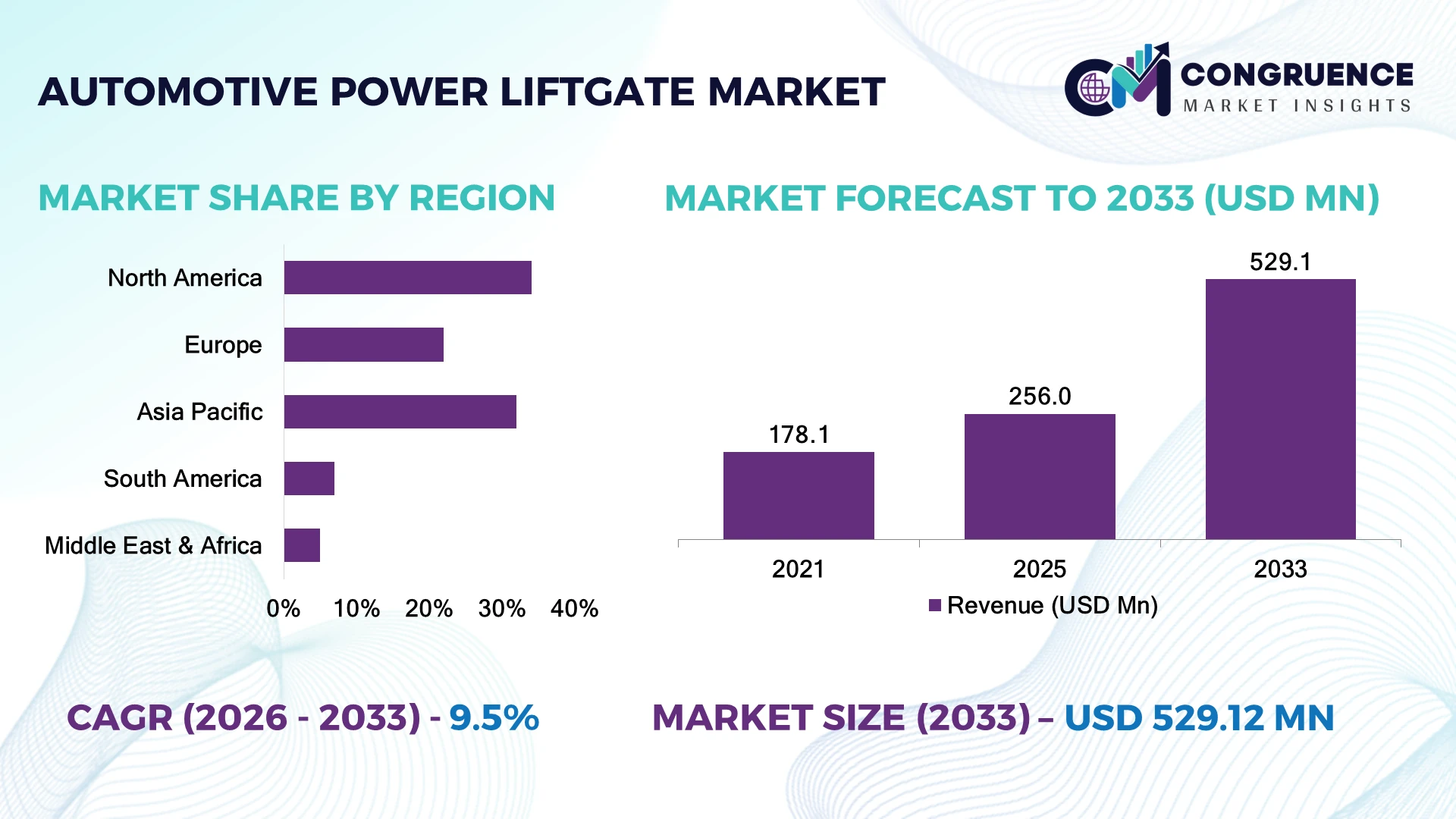
North America holds a dominant position with approximately 36% market share, supported by premium SUV penetration, mature OEM supply chains, and high adoption of automated convenience systems. Asia-Pacific follows at about 34%, with China and India accelerating localized production and EV integration; Asia-Pacific’s power-liftgate installation rate is approximately 48% versus lower penetration across emerging markets. Geopolitical supply-chain restructuring is accelerating regional sourcing.
Strategic priority should center on localized actuator production, sensor integration, and OEM partnerships in high-volume SUV and EV manufacturing hubs.
Market Size & Growth: USD 256.0 million in 2025 rising to USD 529.1 million by 2033 at 9.5% CAGR, driven by sensor-enabled automation and SUV platform upgrades.
Top Growth Drivers: SUV adoption 59%; consumer convenience preference 29%; OEM automation investment 31%.
Short-Term Forecast: By 2028, automated liftgate installations are positioned for measurable expansion, with actuator efficiency targeted to improve by 10–15%.
Emerging Technologies: AI-enabled obstacle detection, gesture recognition, and ultrasonic/infrared sensor fusion are reshaping advanced liftgate architectures.
Regional Leaders: North America is approximately USD 92 million; Asia-Pacific about USD 87 million; Europe about USD 69 million, with EV platforms accelerating smart-liftgate adoption.
Consumer/End-User Trends: Hands-free technology adoption approaches 42%, reflecting stronger preference for contactless vehicle-access features.
Pilot/Case Example: 2023 Tata Harrier facelift introduced a power liftgate, strengthening automated convenience features within India’s expanding SUV segment.
Competitive Landscape: Magna leads at approximately 16.8%, followed by Brose at 12.4% and HI-LEX at 9.7%, alongside Continental and Bosch.
Regulatory & ESG Impact: Lightweight composite adoption is approaching 26% in advanced systems, supporting vehicle mass reduction and efficiency objectives as safety requirements tighten.
Investment & Funding: OEM automation investment has increased approximately 31%, with suppliers prioritizing sensor electronics, electric actuators, and localized manufacturing partnerships.
Innovation & Future Outlook: Next-generation systems combine 48% installation penetration in Asia-Pacific with connected access, predictive obstacle detection, and EV-integrated body electronics.
Automotive power liftgates are gaining traction across SUVs, crossovers, premium vehicles, and EVs as hands-free access, obstacle detection, and electronically controlled actuators become integrated into vehicle architectures. Approximately 42% hands-free adoption indicates a clear shift toward contactless convenience, while supply-chain localization and regional sourcing are reshaping component strategies amid ongoing global automotive trade realignment.
Automotive power liftgates are becoming strategically important because convenience electronics are moving from premium differentiation toward integrated vehicle functionality. Approximately 72% of global supply volume is concentrated among major Tier-1 suppliers, making actuator reliability, electronics integration, and OEM platform access decisive competitive factors. The shift toward EV architectures further strengthens demand for electronically coordinated body systems.
Technology differentiation is increasingly measurable: electric-actuated systems reduce manual intervention and enable automated obstacle detection, while advanced sensor configurations improve access-control responsiveness. Asia-Pacific combines approximately 34% market representation with around 48% installation penetration, while Europe emphasizes sensor fusion and EV integration and North America retains stronger premium-SUV deployment.
Over the next 2–3 years, manufacturers are prioritizing localized actuator production, modular electronics, and sensor partnerships. Fleet and commercial retrofits also provide practical deployment opportunities where automated opening improves loading ergonomics. Companies that combine lightweight structures with connected controls can reduce system complexity while supporting vehicle-efficiency objectives. Strategic advantage will increasingly depend on integrated platforms rather than standalone liftgate hardware.
Sensor-enabled convenience systems are accelerating power-liftgate integration across SUVs and EVs. Hands-free technology adoption approaches 42%, while electric actuator usage has reached approximately 49% and sensor integration about 41% in advanced vehicle applications. The shift from mechanical opening to electronically coordinated access enables obstacle detection, gesture control, and proximity activation. Germany’s premium OEM ecosystem is strengthening sensor-fusion development, while Chinese manufacturers are embedding automated liftgates into rapidly expanding EV platforms. The operational effect is significant: suppliers are moving toward integrated actuator-control modules instead of standalone mechanisms. Companies are responding through electronics investment, OEM co-development, and localized manufacturing. The non-obvious advantage is platform commonality, allowing one electronic architecture to support multiple vehicle derivatives and reduce engineering duplication.
Power-liftgate systems remain structurally more expensive than manual mechanisms, with aftermarket installation costs still around USD 950 in 2025 despite declining substantially from earlier levels. Electronic components, motors, sensors, and control units collectively increase bill-of-material complexity, while approximately 28% of suppliers face heightened pressure from component localization and procurement volatility. China and India are expanding domestic sourcing, but specialized actuator and semiconductor dependencies remain important. Global automotive supply-chain restructuring has therefore increased the importance of dual sourcing and regional contracts. Companies are mitigating exposure through modular designs, multi-supplier procurement, and localized assembly. The key operational constraint is not actuator availability alone; it is synchronization between mechanical, electrical, and vehicle-control interfaces, which raises validation costs across OEM platforms.
Connected liftgates create a higher-value opportunity as manufacturers integrate proximity keys, smartphone controls, gesture recognition, and predictive obstacle detection. Hands-free systems already represent approximately 42% adoption in advanced applications, while EV penetration in Europe has reached about 34%, expanding the addressable base for electronically controlled access systems. India offers an additional opportunity as SUV production and feature adoption move into broader mid-range vehicle segments. Companies are investing in sensor partnerships, modular control units, and lightweight composite structures, with composite usage approaching 26% in advanced liftgate applications. The strategic opportunity extends beyond opening mechanisms: integrating liftgate controls with vehicle access, ADAS, and body electronics creates software-enabled functionality that strengthens OEM differentiation and supports recurring technology upgrades.
Long-term competitiveness depends on integrating liftgates reliably with increasingly software-defined vehicle architectures. Approximately 41% sensor integration and 49% electric-actuator usage demonstrate the growing electronic content, but each additional sensor and control interface increases validation requirements. Cybersecurity and functional-safety requirements also expand as liftgates connect with keyless entry, vehicle networks, and smartphone applications. China’s planned restrictions on concealed door handles from 2027 illustrate how emerging safety concerns can rapidly reshape electronically controlled access technologies. Companies must therefore invest in redundant sensing, secure communication, software validation, and standardized interfaces. The critical challenge is achieving consistent performance across diverse temperatures, loads, vehicle platforms, and software environments while maintaining lightweight construction and dependable serviceability.
Hands-Free Systems Scale Faster: Hands-free liftgates now represent about 46% of installations, while sensor-based activation accounts for roughly 41%. OEMs are shifting from button-operated mechanisms toward gesture and proximity controls, reducing physical interaction and improving access speed. Premium manufacturers are increasingly standardizing these systems across SUV trim levels, while suppliers are scaling compact sensor modules and integrated controllers.
Electric Actuation Gains Ground: Electric power back-door systems command approximately 73% share in advanced liftgate architectures, reflecting the transition away from hydraulic mechanisms. Electric actuation improves packaging flexibility and electronic integration, while automated opening functions account for about 45% of application demand. Manufacturers are redesigning actuator assemblies for quieter operation and lower component complexity as vehicle electronics become increasingly centralized.
EV Platforms Reshape Integration: China produced approximately 16.6 million new-energy vehicles in 2025, representing a 29% increase, accelerating demand for electronically coordinated body systems. Electric vehicles increasingly integrate liftgate controls with keyless entry, vehicle networks, and digital interfaces. Suppliers are responding through platform-specific electronics and localized sourcing, particularly as Chinese manufacturers expand exports and restructure international supply chains.
SUV Feature Content Expands: SUVs account for approximately 61% of power-liftgate applications, with around 68% of SUVs equipped with powered systems. Sensor integration reaches nearly 47% in this vehicle class, creating stronger demand for advanced control modules. India’s ADAS penetration rose from 6.2% to 8.3% in H1 2025, signaling faster electronics adoption across mainstream vehicles and encouraging OEMs to bundle liftgate automation with broader intelligent-vehicle features.
Hands-free power liftgates represent the leading type at approximately 46% share, closely challenging conventional power liftgates at about 54%. Their adoption is strongest in SUVs and premium vehicles because proximity activation, foot-sensing, obstacle detection, and remote operation provide greater functional differentiation than conventional button-operated systems. Hands-free installation reaches approximately 53% across SUVs and 68% among premium vehicles, creating a clear upgrade pathway for OEMs. Conventional systems remain commercially important in cost-sensitive vehicle programs, where simpler electronic architecture and lower bill-of-material requirements support wider deployment.
Hands-free systems are also the faster-shifting type, with gesture-recognition adoption increasing about 24% and EV penetration reaching approximately 37%. Companies are prioritizing sensor fusion, compact control modules, and scalable actuator platforms rather than treating liftgates as isolated hardware. This changes investment priorities toward software-enabled body electronics and OEM co-development.
SUVs dominate application demand with approximately 61% share, supported by larger cargo openings, higher vehicle content, and stronger consumer acceptance of automated convenience features. Around 68% of SUVs incorporate power liftgate systems, compared with approximately 54% of sedan models offering the feature as standard or optional equipment. Electric-actuator usage in SUVs approaches 58%, while sensor integration reaches nearly 47%, demonstrating that SUV platforms are becoming the primary deployment environment for advanced liftgate electronics.
Sedans retain approximately 28% share and remain relevant for premium and executive models, while other applications account for roughly 11%. The fastest operational shift is toward SUV electrification and connected access, where hands-free systems are increasingly combined with digital keys and vehicle-control networks. Companies are therefore prioritizing SUV platform partnerships, modular actuator architectures, and factory integration.
OEMs represent the dominant end-user group at approximately 75% share, reflecting the technical advantages of factory-installed liftgates over retrofit systems. Factory integration allows actuators, latches, sensors, keyless-entry systems, and vehicle-control modules to operate as one architecture, improving validation and installation consistency. Aftermarket demand accounts for approximately 25%, concentrated among owners upgrading older SUVs and utility vehicles where convenience features were not included at purchase.
The aftermarket remains the faster-expanding niche as retrofit compatibility improves and installation kits become more modular. Approximately 38% of consumers show stronger preference for touchless vehicle-access functions, supporting upgrade demand beyond factory-equipped vehicles. OEMs are responding with bundled trim packages and supplier partnerships, while aftermarket providers are developing vehicle-specific kits and simplified installation procedures.
North America accounted for the largest market share at 34% in 2025 however, Asia-Pacific is expected to register the fastest growth, expanding at a CAGR of 11.2% between 2026 and 2033.

North America represents approximately 34% of global Automotive Power Liftgate demand, supported by strong SUV and crossover production, premium vehicle penetration, and established Tier-1 supplier networks. The United States accounts for the majority of regional deployment, with power-operated access systems increasingly incorporated into mid-range as well as luxury vehicle platforms. Approximately 62% of regional liftgate installations are concentrated in SUVs and crossovers, reinforcing demand for higher-load electric actuators and integrated obstacle detection. OEMs are also consolidating liftgate controls with keyless entry and vehicle-body electronics to reduce wiring complexity. Supplier investments increasingly target modular actuator assemblies and localized component sourcing, strengthening production resilience amid North American supply-chain restructuring.
United States Market Outlook: The United States remains the region’s principal manufacturing and consumption hub, supported by a large light-vehicle fleet and extensive SUV production. More than 20% of new light vehicles incorporate advanced hands-free access functionality, encouraging suppliers to expand sensor integration and OEM-specific electronic architectures.
Europe captures approximately 22% of global Automotive Power Liftgate demand, with Germany, France, Italy, and the United Kingdom forming the principal industrial base. Premium manufacturers account for a substantial proportion of regional deployment, while electric vehicles are increasing the integration of electronically controlled body functions. Approximately 37% of European new-vehicle registrations are electrified, creating stronger compatibility requirements for low-noise electric actuators and networked access controls. EU vehicle-safety and sustainability requirements are also encouraging lighter components and improved electronic diagnostics. Manufacturers are responding through lightweight liftgate structures, sensor-fusion development, and closer Tier-1 partnerships. The strategic shift is toward multifunctional modules that combine opening, latching, sensing, and vehicle-network communication rather than separate mechanical assemblies.
Germany Market Outlook: Germany provides the strongest European technology and manufacturing base, supported by premium OEMs and a dense automotive supplier ecosystem. Approximately 30% of new passenger-car registrations are fully electric or plug-in hybrid, increasing demand for electronically coordinated body systems and encouraging suppliers to localize advanced actuator and sensor development.
Asia-Pacific accounts for approximately 32% of global Automotive Power Liftgate demand and represents the fastest-changing manufacturing environment. China dominates regional production, while Japan, South Korea, and India contribute advanced vehicle manufacturing, electronics expertise, and expanding SUV platforms. China produced approximately 16.6 million new-energy vehicles in 2025, creating substantial demand for electronically integrated access systems. Around 48% of advanced SUV platforms in major Asian automotive markets incorporate powered liftgate functionality. Manufacturers are leveraging high-volume electronics production to reduce actuator and controller costs while increasing localization. Chinese EV makers are also accelerating export-oriented platform development, encouraging suppliers to establish regional partnerships and shorten component lead times. This scale advantage is strengthening Asia-Pacific’s position in next-generation liftgate architecture.
China Market Outlook: China is the region’s most significant production and technology hub, combining large-scale EV manufacturing with rapidly expanding intelligent-vehicle integration. New-energy vehicle production reached approximately 16.6 million units in 2025, giving liftgate suppliers an extensive platform base for developing integrated sensors, electronic controllers, and lightweight actuator systems.
South America represents approximately 7% of global Automotive Power Liftgate demand, with Brazil and Argentina accounting for the largest deployment base. Brazil’s SUV and crossover production is particularly important because these platforms carry higher electronic feature content and greater compatibility with powered cargo access. Approximately 31% of new vehicles in major urban markets incorporate advanced convenience electronics, creating a gradual pathway for power-liftgate adoption. Imported components remain significant, exposing suppliers to currency fluctuations and logistics costs. Companies are responding by increasing regional assembly, negotiating longer procurement contracts, and adapting universal actuator platforms to locally produced vehicle models. Brazil’s expanding EV and hybrid manufacturing activity is also encouraging suppliers to establish electronics capabilities closer to vehicle assembly plants.
Brazil Market Outlook: Brazil remains the region’s strongest automotive manufacturing center, supported by a large domestic vehicle base and established OEM assembly operations. Electrified vehicles represented more than 10% of new light-vehicle sales in 2025, strengthening demand for electronically controlled access systems and creating opportunities for suppliers that combine local assembly with imported precision components.
Middle East & Africa accounts for approximately 5% of global Automotive Power Liftgate demand, with the United Arab Emirates, Saudi Arabia, and South Africa representing key commercial and deployment centers. Premium SUVs and luxury vehicles generate a disproportionate share of regional demand, with automated liftgates installed in approximately 43% of targeted premium SUV configurations. Saudi Arabia’s vehicle-manufacturing and mobility investments are expanding the region’s automotive ecosystem, while the UAE remains an important distribution and technology-adoption hub. Companies are prioritizing distributor partnerships, retrofit-compatible systems, and premium OEM relationships. The region’s hot climate and dust exposure also increase demand for durable sensors, sealed actuator assemblies, and low-maintenance electronic components.
Saudi Arabia Market Outlook: Saudi Arabia offers the strongest strategic manufacturing and investment opportunity through its automotive industrial-development programs and expanding vehicle ecosystem. The country’s automotive localization initiatives target increasing domestic manufacturing capacity, creating opportunities for liftgate suppliers to establish assembly partnerships and integrate advanced access technologies into locally produced vehicles.
The Automotive Power Liftgate market pits Magna and Brose against Stabilus, HI-LEX, AISIN, and regional actuator specialists, with system integrators competing against component-focused suppliers. The top five players together hold approximately 55% of the market, leaving regional manufacturers concentrated in cost-sensitive programs. Competition centers on technology, price, supply reliability, and customization. Advanced sensor integration influences nearly 45% of premium deployments, while lightweighting can reduce closure-module mass by 20–30%. Modular architectures also shorten development cycles by roughly 15%. Magna emphasizes vertically integrated mechatronics; Brose combines drives, latches, controls, and sensors; Stabilus leverages actuator expertise; HI-LEX and AISIN compete through precision mechanisms and OEM relationships. Players are expanding localized production, signing platform partnerships, and integrating software with electromechanical hardware. The competitive shift is toward complete closure systems rather than standalone actuators, raising certification, engineering, and OEM-qualification barriers. Winning requires reliable electronics, scalable manufacturing, rapid customization, and OEM integration at scale globally today.
Magna International Inc.
Brose Fahrzeugteile SE & Co. KG
Stabilus SE
HI-LEX Corporation
AISIN Corporation
Continental AG
Robert Bosch GmbH
Valeo SE
ZF Friedrichshafen AG
Grupo Antolin
Johnson Electric Holdings Limited
Flex-N-Gate Corporation
Automotive power liftgates are moving from standalone electric actuators toward integrated mechatronic systems combining spindles, latches, ECUs, sensors, and vehicle-network controls. Hands-free activation is approaching 46% of advanced installations, while obstacle detection reaches roughly 41%. Compared with conventional manual mechanisms, modern electric systems reduce user effort by nearly 100% and enable automated intermediate positioning, creating stronger convenience and safety differentiation.
Sensor fusion is becoming the disruptive layer. Capacitive, ultrasonic, infrared, UWB, and millimeter-wave technologies are increasingly combined for proximity recognition, gesture control, and anti-pinch protection. Brose’s modular architecture operates below 45 dB(A), while integrated control electronics reduce external hardware requirements. AI-assisted obstacle classification can improve response consistency by approximately 10%, benefiting suppliers that control both software and actuator calibration.
Lightweight thermoplastic liftgates and integrated electronics will shape 2026–2028 platform decisions. Thermoplastic structures can deliver 20–30% weight savings versus steel, supporting EV efficiency and packaging flexibility. Magna, Brose, Stabilus, and other Tier-1 suppliers benefit from system integration, while OEMs gain shorter assembly workflows and greater feature scalability. The competitive priority is shifting toward software-ready closure platforms, localized electronics, and modular architectures that support multiple vehicle derivatives without duplicating engineering investment. This shift reduces wiring complexity and accelerates integration across vehicle programs.
November 2024 Brose launched series production of its powered truck-tailgate system, integrating a drive, control unit and two power-cinching latches. The system targets dusty and wet operating environments, strengthening Brose’s North American pickup offering through integrated, robust closure technology. Source: brose.com
April 2025 Stabilus secured a Chinese OEM order exceeding 400,000 electromechanical door-drive systems annually from 2026, transferring POWERISE expertise into broader automated access. The program strengthens Stabilus’s system-level positioning and expands its addressable vehicle-access technology footprint across China. Source: stabilus.com
September 2025 Magna selected XPENG for assembly of two fully electric European-market models at Graz, with serial production beginning in Q3 2025. The partnership demonstrates accelerating localization between Chinese EV makers and established European manufacturing infrastructure, supporting scalable regional vehicle programs. Source: magna.com
December 2025 Grupo Antolin agreed to sell three Indian legal entities for €159 million, transferring more than 1,500 employees while retaining selected Indian activities. The restructuring strengthens financial flexibility and refocuses resources on higher-value automotive interior and liftgate-related capabilities. Source: antolin.com
The Automotive Power Liftgate Market Report covers the evolution of powered rear-access systems across major vehicle platforms, examining type, application, and end-user segmentation. Coverage includes conventional and hands-free liftgate architectures, SUV, sedan, and other vehicle applications, and OEM and aftermarket purchasing channels. The analysis evaluates actuator design, sensor integration, electronic control units, obstacle detection, lightweight materials, and connected access technologies.
Regional coverage spans North America, Europe, Asia-Pacific, South America, and the Middle East & Africa, with country-level emphasis on manufacturing and deployment hubs. The report assesses adoption patterns, supplier positioning, localization, production expansion, technology partnerships, and competitive concentration. With SUV applications representing roughly 61% of demand and hands-free systems approaching 46% of advanced installations, the study identifies investment priorities, expansion opportunities, supply-chain strategies, and technology gaps. It supports 2026–2033 planning by translating deployment shifts into actionable competitive and operational decisions.
| Report Attribute / Metric | Details |
|---|---|
| Market Revenue (2025) | USD 256.0 Million |
| Market Revenue (2033) | USD 529.1 Million |
| CAGR (2026–2033) | 9.5% |
| Base Year | 2025 |
| Forecast Period | 2026–2033 |
| Historic Period | 2021–2025 |
| Segments Covered |
By Type
By Application
By End-User
|
| Key Deliverables | Revenue Forecast; Market Trends; Growth Drivers & Restraints; Technology Insights; Segmentation Analysis; Regional Insights; Competitive Landscape; Regulatory & ESG Overview; Recent Developments |
| Regions Covered | North America; Europe; Asia-Pacific; South America; Middle East & Africa |
| Companies Profiled | Magna International Inc.; Brose Fahrzeugteile SE & Co. KG; Stabilus SE; HI-LEX Corporation; AISIN Corporation; Continental AG; Robert Bosch GmbH; Valeo SE; ZF Friedrichshafen AG; Grupo Antolin; Johnson Electric Holdings Limited; Flex-N-Gate Corporation |
| Customization & Pricing | Available on Request (10% Customization Free) |




